inflation pressure MAZDA MODEL CX-9 2009 (in English) User Guide
[x] Cancel search | Manufacturer: MAZDA, Model Year: 2009, Model line: MODEL CX-9, Model: MAZDA MODEL CX-9 2009Pages: 538, PDF Size: 12.18 MB
Page 426 of 538
Black plate (426,1)
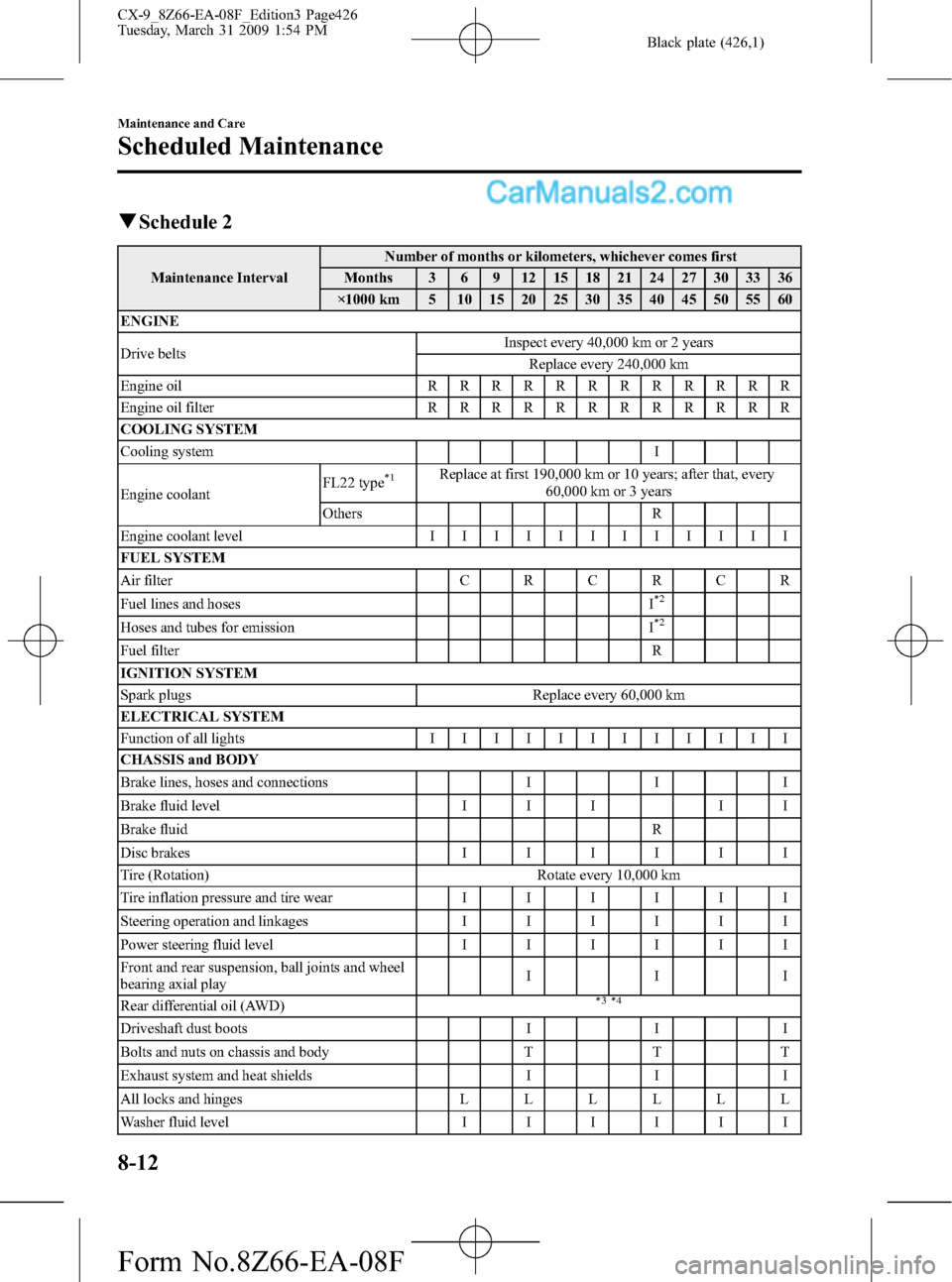
qSchedule 2
Maintenance IntervalNumber of months or kilometers, whichever comes first
Months 3 6 9 12 15 18 21 24 27 30 33 36
×1000 km 5 10 15 20 25 30 35 40 45 50 55 60
ENGINE
Drive beltsInspect every 40,000 km or 2 years
Replace every 240,000 km
Engine oilRRRRRRRRRRRR
Engine oil filterRRRRRRRRRRRR
COOLING SYSTEM
Cooling system I
Engine coolantFL22 type
*1Replace at first 190,000 km or 10 years; after that, every
60,000 km or 3 years
Others R
Engine coolant levelIIIIIIIIIIII
FUEL SYSTEM
Air filterCRCRCR
Fuel lines and hoses I
*2
Hoses and tubes for emission I*2
Fuel filter R
IGNITION SYSTEM
Spark plugs Replace every 60,000 km
ELECTRICAL SYSTEM
Function of all lightsIIIIIIIIIIII
CHASSIS and BODY
Brake lines, hoses and connections I I I
Brake fluid level I I I I I
Brake fluid R
Disc brakesIIIIII
Tire (Rotation) Rotate every 10,000 km
Tire inflation pressure and tire wearIIIIII
Steering operation and linkagesIIIIII
Power steering fluid levelIIIIII
Front and rear suspension, ball joints and wheel
bearing axial playIII
Rear differential oil (AWD)
*3 *4
Driveshaft dust boots I I I
Bolts and nuts on chassis and body T T T
Exhaust system and heat shields I I I
All locks and hingesLLLLLL
Washer fluid levelIIIIII
8-12
Maintenance and Care
Scheduled Maintenance
CX-9_8Z66-EA-08F_Edition3 Page426
Tuesday, March 31 2009 1:54 PM
Form No.8Z66-EA-08F
Page 428 of 538
Black plate (428,1)
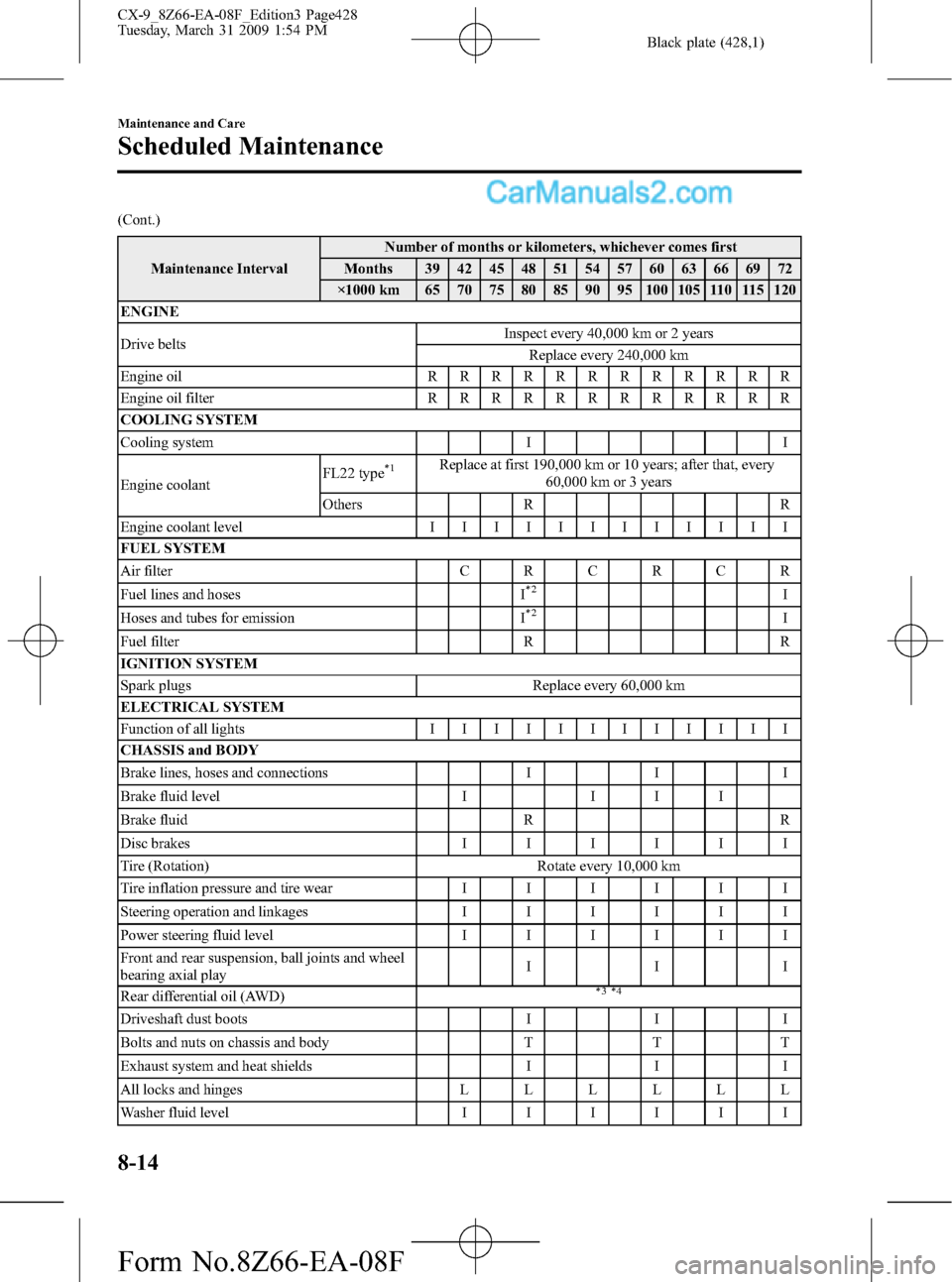
(Cont.)
Maintenance IntervalNumber of months or kilometers, whichever comes first
Months 39 42 45 48 51 54 57 60 63 66 69 72
×1000 km 65 70 75 80 85 90 95 100 105 110 115 120
ENGINE
Drive beltsInspect every 40,000 km or 2 years
Replace every 240,000 km
Engine oilRRRRRRRRRRRR
Engine oil filterRRRRRRRRRRRR
COOLING SYSTEM
Cooling system I I
Engine coolantFL22 type
*1Replace at first 190,000 km or 10 years; after that, every
60,000 km or 3 years
Others R R
Engine coolant levelIIIIIIIIIIII
FUEL SYSTEM
Air filterCRCRCR
Fuel lines and hoses I
*2I
Hoses and tubes for emission I*2I
Fuel filter R R
IGNITION SYSTEM
Spark plugs Replace every 60,000 km
ELECTRICAL SYSTEM
Function of all lightsIIIIIIIIIIII
CHASSIS and BODY
Brake lines, hoses and connections I I I
Brake fluid level I I I I
Brake fluid R R
Disc brakesIIIIII
Tire (Rotation) Rotate every 10,000 km
Tire inflation pressure and tire wearIIIIII
Steering operation and linkagesIIIIII
Power steering fluid levelIIIIII
Front and rear suspension, ball joints and wheel
bearing axial playIII
Rear differential oil (AWD)
*3 *4
Driveshaft dust boots I I I
Bolts and nuts on chassis and body T T T
Exhaust system and heat shields I I I
All locks and hingesLLLLLL
Washer fluid levelIIIIII
8-14
Maintenance and Care
Scheduled Maintenance
CX-9_8Z66-EA-08F_Edition3 Page428
Tuesday, March 31 2009 1:54 PM
Form No.8Z66-EA-08F
Page 430 of 538

Black plate (430,1)
Owner Maintenance Schedule
The owner or a qualified service technician should make these vehicle inspections at the
indicated intervals to ensure safe and dependable operation.
Bring any problem to the attention of an Authorized Mazda Dealer or qualified service
technician as soon as possible.
qWhen Refueling
lBrake fluid level (page 8-23)lEngine coolant level (page 8-21)lEngine oil level (page 8-20)lWasher fluid level (page 8-26)
qAt Least Monthly
Tire inflation pressures (page 8-33)
qAt Least Twice a Year (For Example, Every Spring and Fall)
lAutomatic transaxle fluid level (page 8-24)lPower steering fluid level (page 8-24)
You can do the following scheduled maintenance items if you have some mechanical
ability and a few basic tools and if you closely follow the directions in this manual.
lEngine coolant (page 8-21)lEngine oil (page 8-19)
8-16
Maintenance and Care
Owner Maintenance
CX-9_8Z66-EA-08F_Edition3 Page430
Tuesday, March 31 2009 1:54 PM
Form No.8Z66-EA-08F
Page 447 of 538
Black plate (447,1)
Tires
For reasons of proper performance, safety,
and better fuel economy, always maintain
recommended tire inflation pressures and
stay within the recommended load limits
and weight distribution.
WARNING
Using Different Tire Types:
Driving your vehicle with different
types of tires is dangerous. It could
cause poor handling and poor
braking; leading to loss of control.
Except for the limited use of the
temporary spare tire, use only the
same type tires (radial, bias-belted,
bias-type) on all four wheels.
Using Wrong-Sized Tires:
Using any other tire size than what is
specified for your Mazda (page 10-6)
is dangerous. It could seriously affect
ride, handling, ground clearance, tire
clearance, and speedometer
calibration. This could cause you to
have an accident. Use only tires that
are the correct size specified for your
Mazda.
qTire Inflation Pressure
WARNING
Always inflate the tires to the correct
pressure:
Overinflation or underinflation of
tires is dangerous. Adverse handling
or unexpected tire failure could result
in a serious accident.
Refer to specification charts on page
10-6.The Tire Pressure Monitoring System
í
does not alleviate the need to check the
tire condition every day, including
whether the tires all look inflated properly.
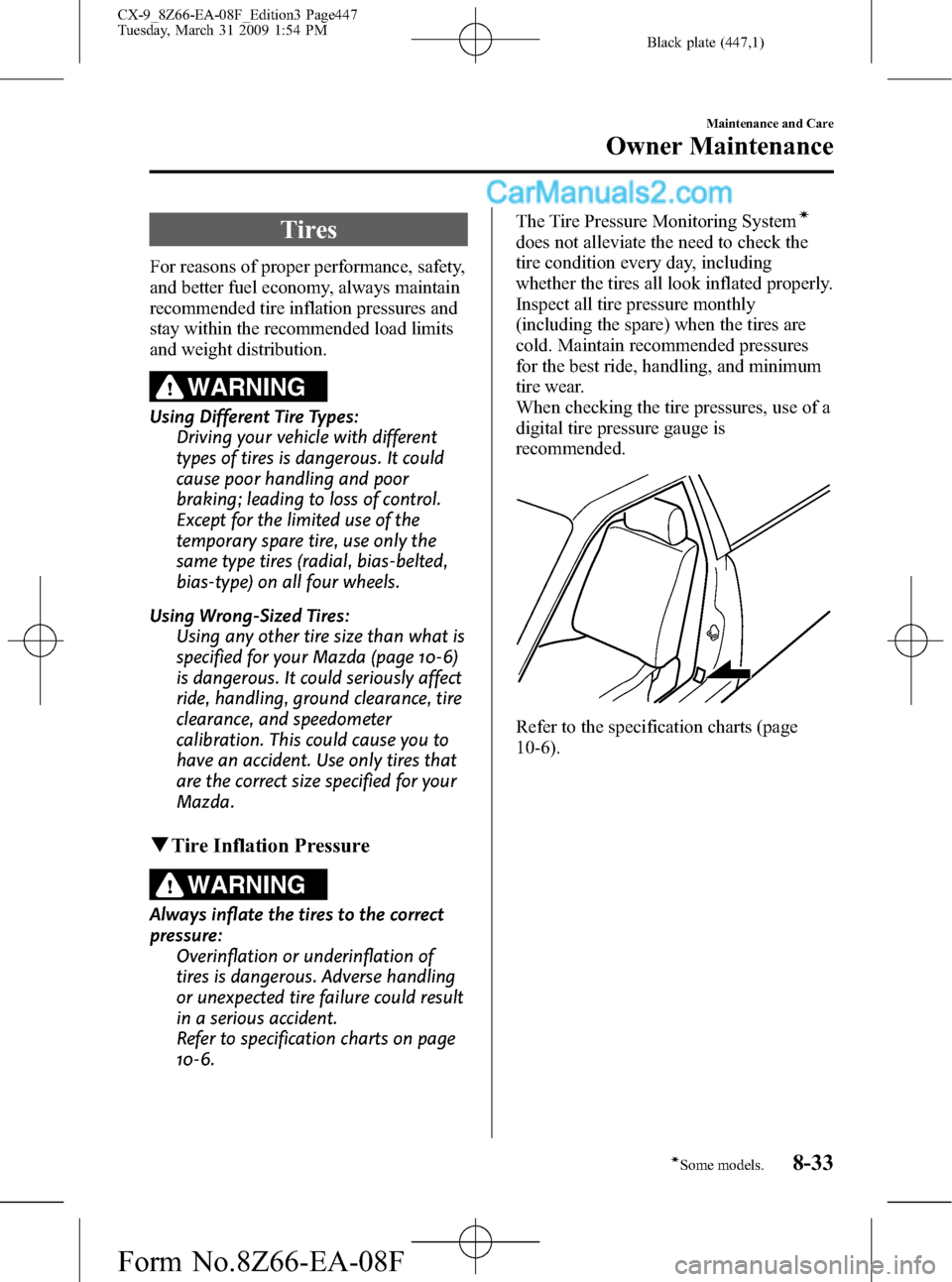
Inspect all tire pressure monthly
(including the spare) when the tires are
cold. Maintain recommended pressures
for the best ride, handling, and minimum
tire wear.
When checking the tire pressures, use of a
digital tire pressure gauge is
recommended.
Refer to the specification charts (page
10-6).
Maintenance and Care
Owner Maintenance
8-33íSome models. CX-9_8Z66-EA-08F_Edition3 Page447
Tuesday, March 31 2009 1:54 PM
Form No.8Z66-EA-08F
Page 448 of 538
Black plate (448,1)
NOTElAlways check tire pressure when tires are
cold.
lWarm tires normally exceed recommended
pressures. Don't release air from warm tires
to adjust the pressure.
lUnderinflation can cause reduced fuel
economy, uneven and accelerated tire wear,
and poor sealing of the tire bead, which
will deform the wheel and cause separation
of tire from rim.
lOverinflation can produce a harsh ride,
uneven and accelerated tire wear, and a
greater possibility of damage from road
hazards.
Keep your tire pressure at the correct
levels. If one frequently needs inflating,
have it inspected.
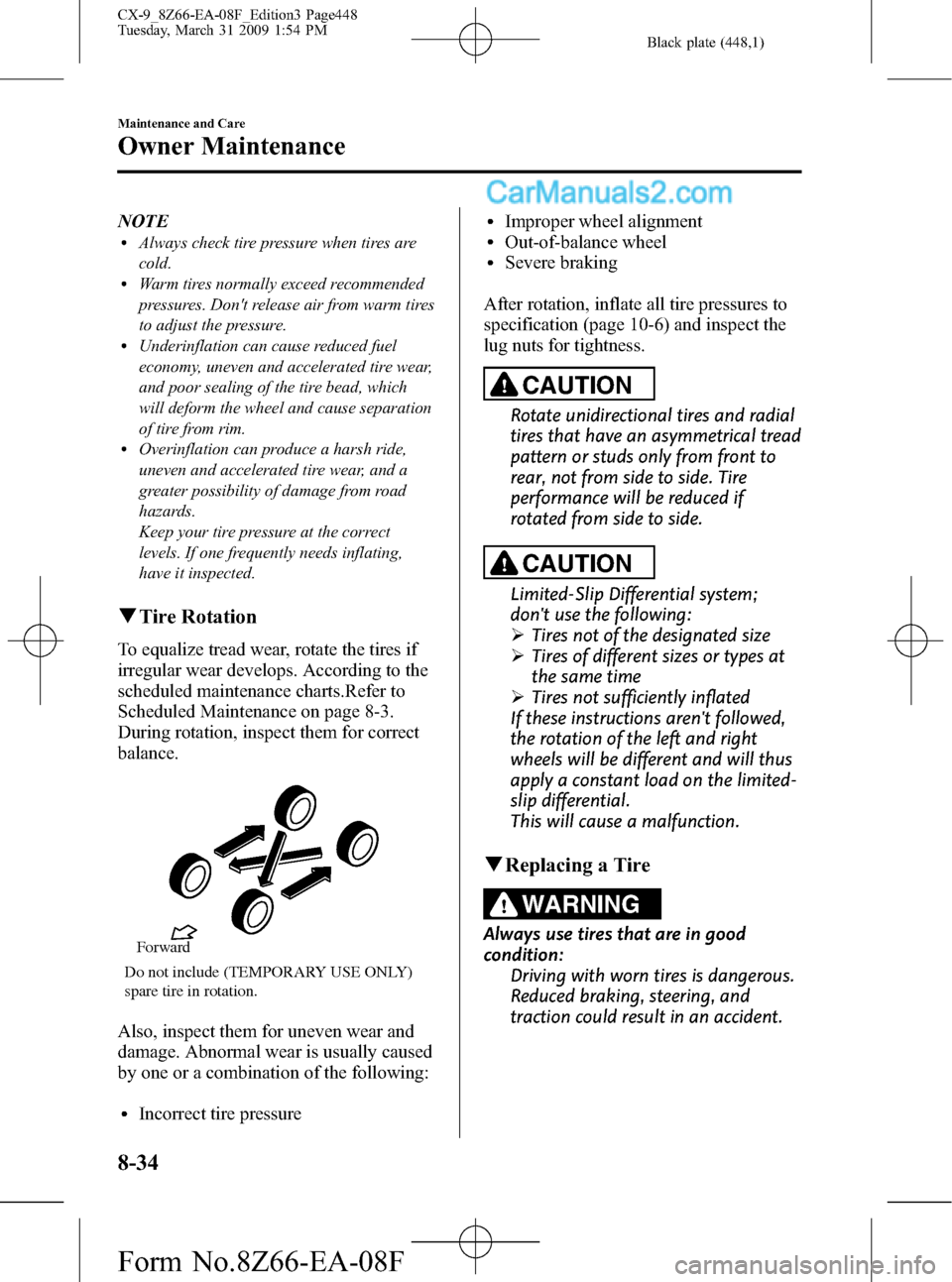
qTire Rotation
To equalize tread wear, rotate the tires if
irregular wear develops. According to the
scheduled maintenance charts.Refer to
Scheduled Maintenance on page 8-3.
During rotation, inspect them for correct
balance.
Do not include (TEMPORARY USE ONLY)
spare tire in rotation.Forward
Also, inspect them for uneven wear and
damage. Abnormal wear is usually caused
by one or a combination of the following:
lIncorrect tire pressure
lImproper wheel alignmentlOut-of-balance wheellSevere braking
After rotation, inflate all tire pressures to
specification (page 10-6) and inspect the
lug nuts for tightness.
CAUTION
Rotate unidirectional tires and radial
tires that have an asymmetrical tread
pattern or studs only from front to
rear, not from side to side. Tire
performance will be reduced if
rotated from side to side.
CAUTION
Limited-Slip Differential system;
don't use the following:
ØTires not of the designated size
ØTires of different sizes or types at
the same time
ØTires not sufficiently inflated
If these instructions aren't followed,
the rotation of the left and right
wheels will be different and will thus
apply a constant load on the limited-
slip differential.
This will cause a malfunction.
qReplacing a Tire
WARNING
Always use tires that are in good
condition:
Driving with worn tires is dangerous.
Reduced braking, steering, and
traction could result in an accident.
8-34
Maintenance and Care
Owner Maintenance
CX-9_8Z66-EA-08F_Edition3 Page448
Tuesday, March 31 2009 1:54 PM
Form No.8Z66-EA-08F
Page 499 of 538

Black plate (499,1)
11. Tread wear, traction and temperature grades
12. Max. permissible inflation pressure
13. SAFETY WARNING
P215/65R15 95H is an example of a tire size and load index rating. Here is an explanation
of the various components of that tire size and load index rating. Note that the tire size and
load index rating may be different from the example.
P
Indicates a tire that may be installed on cars, SUVs, minivans and light trucks as designated
by the Tire and Rim Association (T&RA).
NOTE
If your tire size does not begin with a letter this may mean it is designated by either ETRTO
(European Tire and Rim Technical Organization) or JATMA (Japan Tire Manufacturing Association).
215
“215”is the nominal width of the tire in millimeters. This three-digit number gives the
width in millimeters of the tire from sidewall edge to sidewall edge. In general, the larger
the number, the wider the tire.
65
“65”is the aspect ratio. This two-digit number indicates the tire's ratio of height to width.
R
“R”is the tire construction symbol. R indicates“Radial ply construction”.
15
“15”is the wheel rim diameter in inches.
95
“95”is the Load Index. This two-or three-digit number indicates how much weight each
tire can support.
Customer Information and Reporting Safety Defects
Tire Information (except Canada)
9-27
CX-9_8Z66-EA-08F_Edition3 Page499
Tuesday, March 31 2009 1:55 PM
Form No.8Z66-EA-08F
Page 500 of 538
Black plate (500,1)
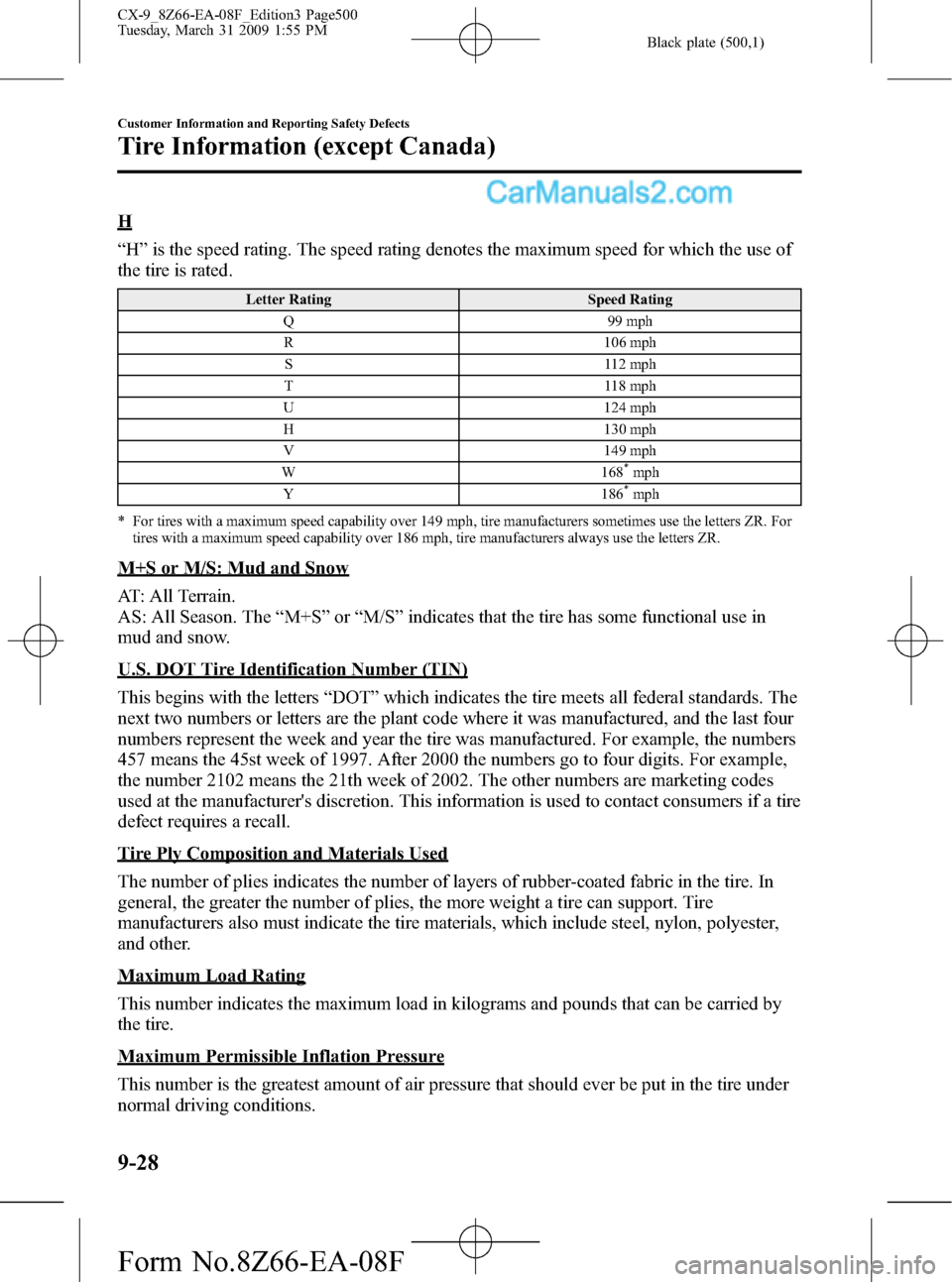
H
“H”is the speed rating. The speed rating denotes the maximum speed for which the use of
the tire is rated.
Letter Rating Speed Rating
Q 99 mph
R 106 mph
S 112 mph
T 118 mph
U 124 mph
H 130 mph
V 149 mph
W 168
*mph
Y 186*mph
* For tires with a maximum speed capability over 149 mph, tire manufacturers sometimes use the letters ZR. For
tires with a maximum speed capability over 186 mph, tire manufacturers always use the letters ZR.
M+S or M/S: Mud and Snow
AT: All Terrain.
AS: All Season. The“M+S”or“M/S”indicates that the tire has some functional use in
mud and snow.
U.S. DOT Tire Identification Number (TIN)
This begins with the letters“DOT”which indicates the tire meets all federal standards. The
next two numbers or letters are the plant code where it was manufactured, and the last four
numbers represent the week and year the tire was manufactured. For example, the numbers
457 means the 45st week of 1997. After 2000 the numbers go to four digits. For example,
the number 2102 means the 21th week of 2002. The other numbers are marketing codes
used at the manufacturer's discretion. This information is used to contact consumers if a tire
defect requires a recall.
Tire Ply Composition and Materials Used
The number of plies indicates the number of layers of rubber-coated fabric in the tire. In
general, the greater the number of plies, the more weight a tire can support. Tire
manufacturers also must indicate the tire materials, which include steel, nylon, polyester,
and other.
Maximum Load Rating
This number indicates the maximum load in kilograms and pounds that can be carried by
the tire.
Maximum Permissible Inflation Pressure
This number is the greatest amount of air pressure that should ever be put in the tire under
normal driving conditions.
9-28
Customer Information and Reporting Safety Defects
Tire Information (except Canada)
CX-9_8Z66-EA-08F_Edition3 Page500
Tuesday, March 31 2009 1:55 PM
Form No.8Z66-EA-08F
Page 501 of 538

Black plate (501,1)
Tread Wear, Traction and Temperature Grades
Tread wear:The tread wear grade is a comparative rating based on the wear rate of the tire
when tested under controlled conditions on a specified government test course. For
example, a tire graded 150 would wear one and one-half (1 1/2) times as well on the
government course as a tire graded 100.
Traction:The traction grades, from highest to lowest are AA, A, B, and C. The grades
represent the tire's ability to stop on wet pavement as measured under controlled conditions
on specified government test surfaces of asphalt and concrete. A tire marked C may have
poor traction performance.
Temperature:The temperature grades are A (the highest), B and C, representing the tire's
resistance to the generation of heat and its ability to dissipate heat when tested under
controlled conditions on a specified indoor laboratory test wheel.
Snow Tires
In some heavy snow areas, local governments may require true snow tires, those with very
deeply cut tread. These tires should only be used in pairs or placed on all four wheels.
Make sure you purchase snow tires that are the same size and construction type as the other
tires on your vehicle.
SAFETY WARNING
The following safety warning appears on the tire's sidewall.
SERIOUS INJURY MAY RESULT FROM:
lEXPLOSION OF TIRE/RIM ASSEMBLY DUE TO IMPROPER MOUNTING-
MATCH TIRE DIAMETER TO RIM DIAMETER; NEVER EXCEED 40 psi (275 kPa)
TO SEAT BEADS-ONLY SPECIALLY TRAINED PERSONS SHOULD MOUNT
TIRES.
lTIRE FAILURE DUE TO UNDER-INFLATION/OVERLOADING/DAMAGE-
FOLLOW OWNER'S MANUAL AND PLACARD IN VEHICLE-FREQUENTLY
CHECK INFLATION PRESSURE AND INSPECT FOR DAMAGE.
Customer Information and Reporting Safety Defects
Tire Information (except Canada)
9-29
CX-9_8Z66-EA-08F_Edition3 Page501
Tuesday, March 31 2009 1:55 PM
Form No.8Z66-EA-08F
Page 504 of 538

Black plate (504,1)
Location of the Tire Label (Placard)
You will find the tire label containing tire inflation pressure by tire size and other important
information on the driver's side B-pillar or on the edge of the driver's door frame.
SAMPLE
qRecommended Tire Inflation Pressure
On the tire label you will find the recommended tire inflation pressure in both kPa and psi
for the tires installed as original equipment on the vehicle. It is very important that the
inflation pressure of the tires on your vehicle is maintained at the recommended pressure.
You should check the tire pressure regularly to insure that the proper inflation pressure is
maintained.
Refer to Tires on page 10-6.
NOTE
Tire pressures listed on the vehicle placard or tire information label indicate the recommended cold
tire inflation pressure, measured when the tires are cold, after the vehicle has been parked for at least
3 hours. As you drive, the temperature in the tire warms up, increasing the tire pressure.
9-32
Customer Information and Reporting Safety Defects
Tire Information (except Canada)
CX-9_8Z66-EA-08F_Edition3 Page504
Tuesday, March 31 2009 1:55 PM
Form No.8Z66-EA-08F
Page 505 of 538

Black plate (505,1)
WARNING
Always check the tire inflation pressures on a regular basis according to the
recommended tire inflation pressure on the tire label and in conjunction with the
information in this owner's manual:
Driving your vehicle with under-inflated tires is dangerous.
Under-inflation is the most common cause of failures in any kind of tire and may
result in severe cracking, tread separation or“blowout”, with unexpected loss of
vehicle control and increased risk of injury. Under-inflation increases sidewall flexing
and rolling resistance, resulting in heat buildup and internal damage to the tire. It
results in unnecessary tire stress, irregular wear, loss of control and accidents. A tire
can lose up to half of its air pressure and not appear to be flat!
It is impossible to determine whether or not tires are properly inflated just by looking
at them.
qChecking Tire Pressure
1. When you check the air pressure, make sure the tires are cold―meaning they are not
hot from driving even a mile.
2. Remove the cap from the valve on one tire.
3. Firmly press a tire gauge onto the valve.
4. Add air to achieve recommended air pressure.
5. If you overfill the tire, release air by pushing on the metal stem in the center of the
valve. Then recheck the pressure with your tire gauge.
6. Replace the valve cap.
7. Repeat with each tire, including the spare.
NOTE
Some spare tires require higher inflation pressure.
8. Visually inspect the tires to make sure there are no nails or other objects embedded that
could poke a hole in the tire and cause an air leak.
9. Check the sidewalls to make sure there are no gouges, cuts, bulges, cracks or other
irregularities.
NOTE
Warm tires normally exceed recommended pressures. Don't release air from warm tires to adjust the
pressure.
Under-inflation can cause serious failures and accidents.
Over-inflation can produce a harsh ride and the greater possibility of damage from road hazards.
Customer Information and Reporting Safety Defects
Tire Information (except Canada)
9-33
CX-9_8Z66-EA-08F_Edition3 Page505
Tuesday, March 31 2009 1:55 PM
Form No.8Z66-EA-08F