brakes MAZDA MODEL CX-9 2011 (in English) Owner's Manual
[x] Cancel search | Manufacturer: MAZDA, Model Year: 2011, Model line: MODEL CX-9, Model: MAZDA MODEL CX-9 2011Pages: 606, PDF Size: 13.55 MB
Page 484 of 606
Black plate (484,1)
qSchedule 1
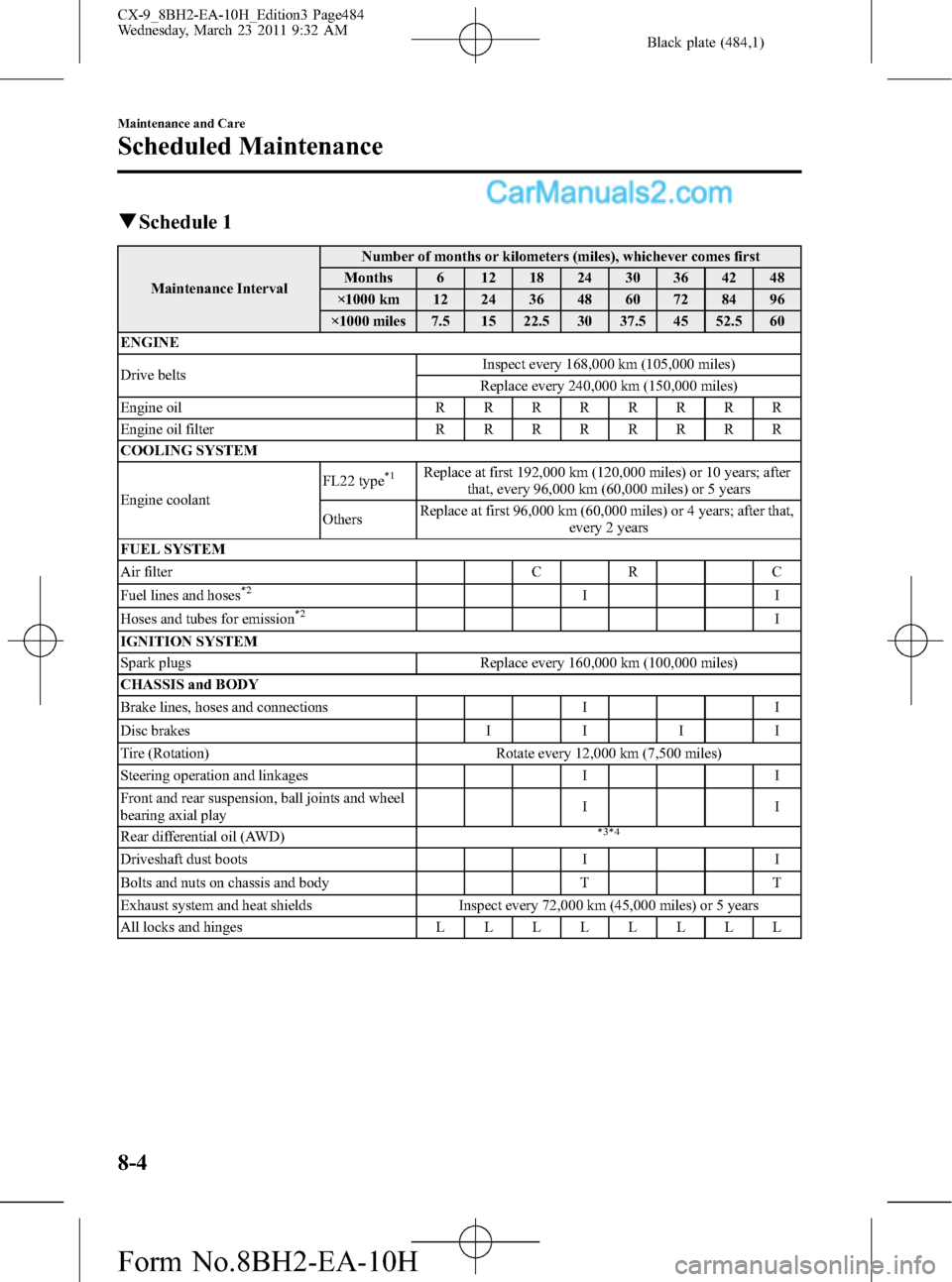
Maintenance IntervalNumber of months or kilometers (miles), whichever comes first
Months 6 12 18 24 30 36 42 48
×1000 km 12 24 36 48 60 72 84 96
×1000 miles 7.5 15 22.5 30 37.5 45 52.5 60
ENGINE
Drive beltsInspect every 168,000 km (105,000 miles)
Replace every 240,000 km (150,000 miles)
Engine oilRRRRRRRR
Engine oil filterRRRRRRRR
COOLING SYSTEM
Engine coolantFL22 type
*1Replace at first 192,000 km (120,000 miles) or 10 years; after
that, every 96,000 km (60,000 miles) or 5 years
OthersReplace at first 96,000 km (60,000 miles) or 4 years; after that,
every 2 years
FUEL SYSTEM
Air filter C R C
Fuel lines and hoses
*2II
Hoses and tubes for emission*2I
IGNITION SYSTEM
Spark plugs Replace every 160,000 km (100,000 miles)
CHASSIS and BODY
Brake lines, hoses and connections I I
Disc brakesIIII
Tire (Rotation) Rotate every 12,000 km (7,500 miles)
Steering operation and linkages I I
Front and rear suspension, ball joints and wheel
bearing axial playII
Rear differential oil (AWD)
*3*4
Driveshaft dust boots I I
Bolts and nuts on chassis and body T T
Exhaust system and heat shields Inspect every 72,000 km (45,000 miles) or 5 years
All locks and hingesLLLLLLLL
8-4
Maintenance and Care
Scheduled Maintenance
CX-9_8BH2-EA-10H_Edition3 Page484
Wednesday, March 23 2011 9:32 AM
Form No.8BH2-EA-10H
Page 487 of 606

Black plate (487,1)
Maintenance IntervalNumber of months or kilometers (miles), whichever comes first
Months 4 8 12 16 20 24 28 32 36 40 44 48
×1000 km 8 16 24 32 40 48 56 64 72 80 88 96
×1000 miles 5 10 15 20 25 30 35 40 45 50 55 60
CHASSIS and BODY
Brake lines, hoses and connections I I
Brake fluid levelIIIIIIIIIIII
Disc brakesIIII
Tire (Rotation) Rotate every 8,000 km (5,000 miles)
Tire inflation pressure and tire wearIIIIIIIIIIII
Steering operation and linkages I I
Power steering fluid levelIIIIIIIIIIII
Front and rear suspension, ball joints and wheel
bearing axial playII
Rear differential oil (AWD)
*4*5
Driveshaft dust boots I I
Bolts and nuts on chassis and body T T
Exhaust system and heat shields Inspect every 72,000 km (45,000 miles) or 5 years
All locks and hingesLLLLLLLLLLLL
Washer fluid levelIIIIIIIIIIII
Maintenance and Care
Scheduled Maintenance
8-7
CX-9_8BH2-EA-10H_Edition3 Page487
Wednesday, March 23 2011 9:32 AM
Form No.8BH2-EA-10H
Page 489 of 606

Black plate (489,1)
Scheduled Maintenance (Mexico)
Follow Schedule 1 if the vehicle is operated mainly where none of the following conditions
apply.
lRepeated short-distance drivinglDriving in dusty conditionslDriving with extended use of brakeslDriving in areas where salt or other corrosive materials are usedlDriving on rough or muddy roadslExtended periods of idling or low-speed operationlDriving for long periods in cold temperatures or extremely humid climateslDriving in extremely hot conditionslDriving in mountainous conditions continually
If any do apply, follow Schedule 2.
NOTE
After the prescribed period, continue to follow the described maintenance at the recommended
intervals.
Maintenance and Care
Scheduled Maintenance
8-9
CX-9_8BH2-EA-10H_Edition3 Page489
Wednesday, March 23 2011 9:32 AM
Form No.8BH2-EA-10H
Page 490 of 606
Black plate (490,1)
qSchedule 1
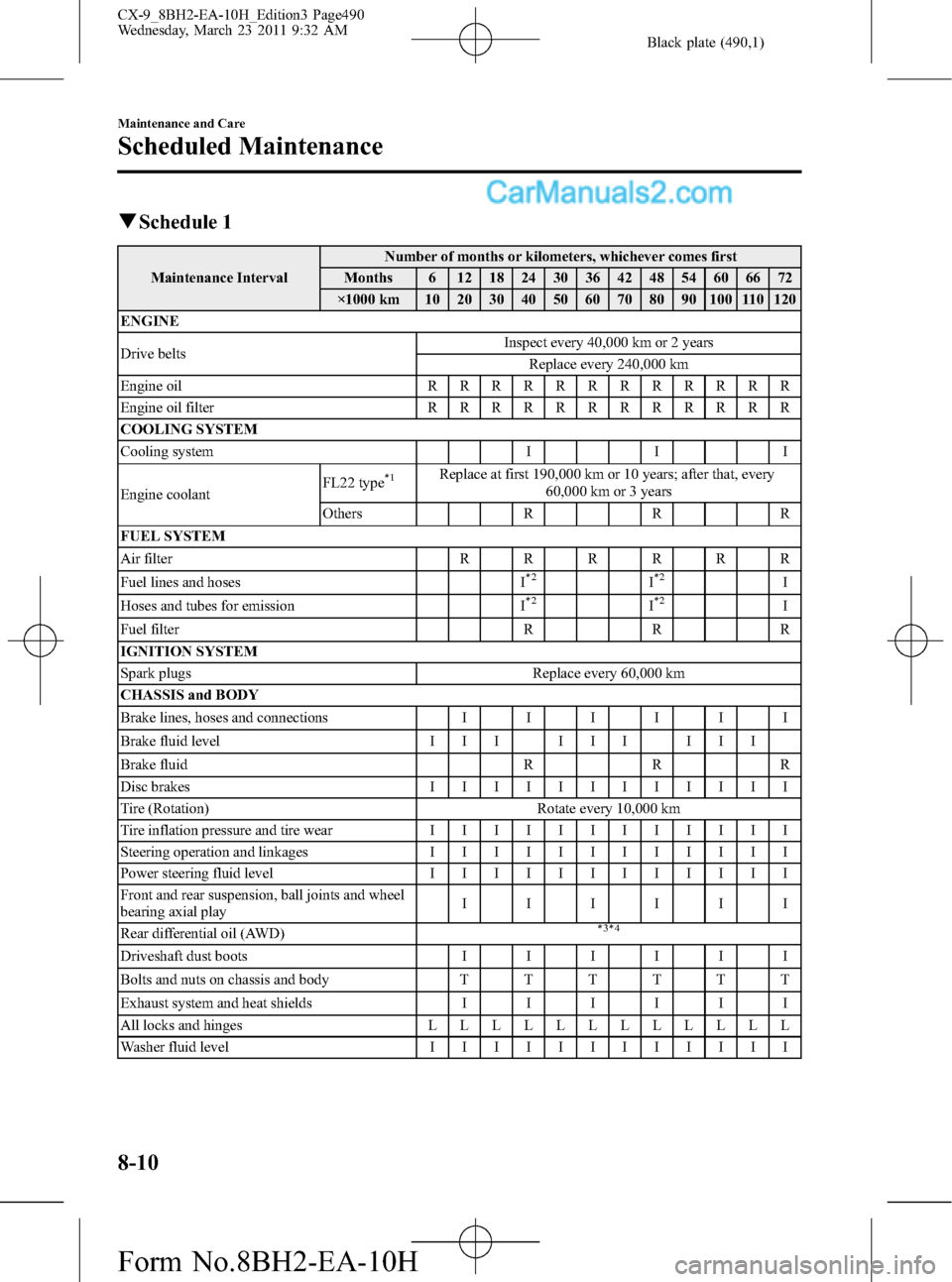
Maintenance IntervalNumber of months or kilometers, whichever comes first
Months 6 12 18 24 30 36 42 48 54 60 66 72
×1000 km 10 20 30 40 50 60 70 80 90 100 110 120
ENGINE
Drive beltsInspect every 40,000 km or 2 years
Replace every 240,000 km
Engine oilRRRRRRRRRRRR
Engine oil filterRRRRRRRRRRRR
COOLING SYSTEM
Cooling system I I I
Engine coolantFL22 type
*1Replace at first 190,000 km or 10 years; after that, every
60,000 km or 3 years
Others R R R
FUEL SYSTEM
Air filterRRRRRR
Fuel lines and hoses I
*2I*2I
Hoses and tubes for emission I*2I*2I
Fuel filter R R R
IGNITION SYSTEM
Spark plugs Replace every 60,000 km
CHASSIS and BODY
Brake lines, hoses and connectionsIIIIII
Brake fluid level I I I I I I I I I
Brake fluid R R R
Disc brakesIIIIIIIIIIII
Tire (Rotation) Rotate every 10,000 km
Tire inflation pressure and tire wearIIIIIIIIIIII
Steering operation and linkagesIIIIIIIIIIII
Power steering fluid levelIIIIIIIIIIII
Front and rear suspension, ball joints and wheel
bearing axial playIIIIII
Rear differential oil (AWD)
*3*4
Driveshaft dust bootsIIIIII
Bolts and nuts on chassis and bodyTTTTTT
Exhaust system and heat shieldsIIIIII
All locks and hingesLLLLLLLLLLLL
Washer fluid levelIIIIIIIIIIII
8-10
Maintenance and Care
Scheduled Maintenance
CX-9_8BH2-EA-10H_Edition3 Page490
Wednesday, March 23 2011 9:32 AM
Form No.8BH2-EA-10H
Page 492 of 606
Black plate (492,1)
qSchedule 2
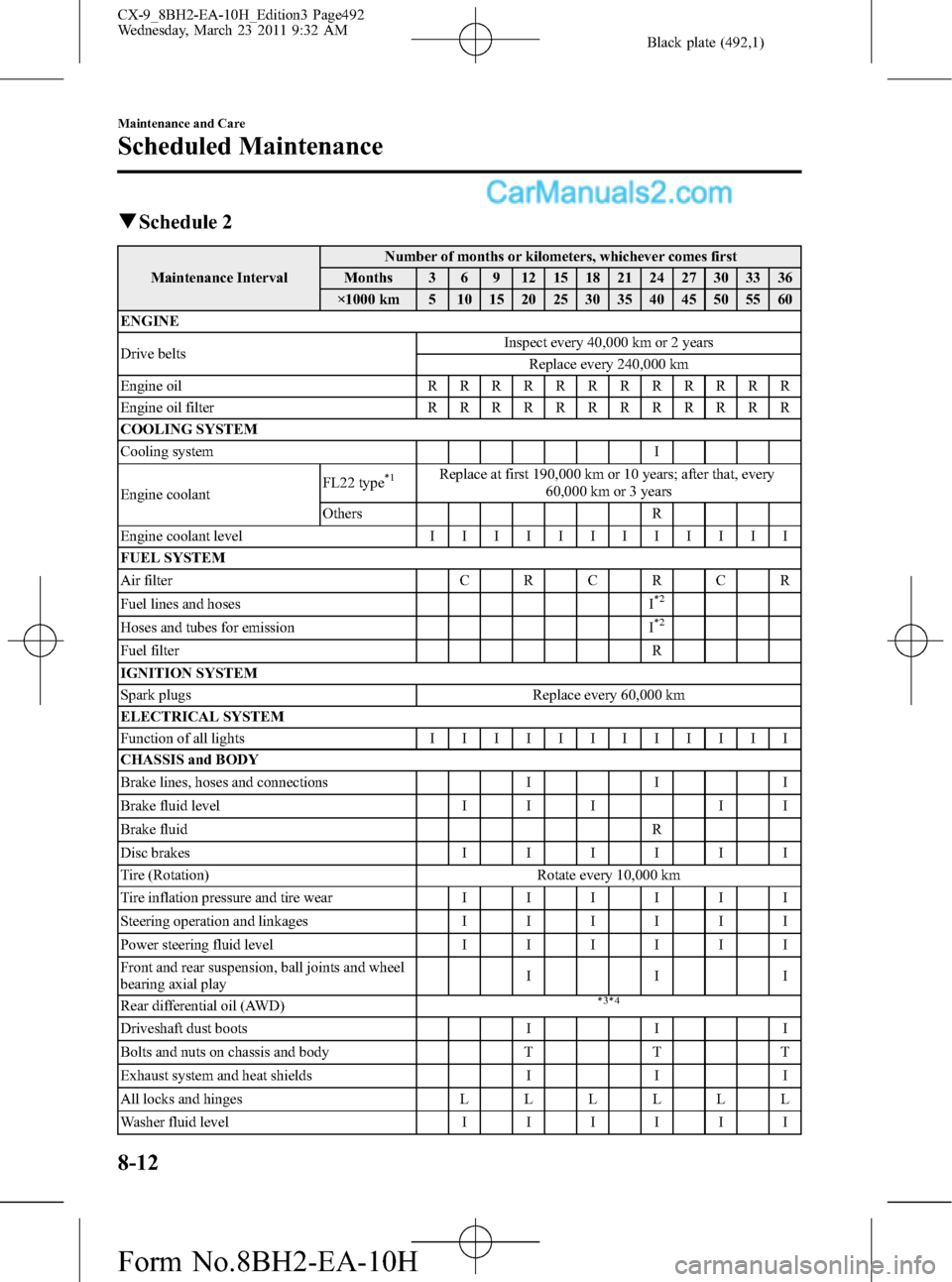
Maintenance IntervalNumber of months or kilometers, whichever comes first
Months 3 6 9 12 15 18 21 24 27 30 33 36
×1000 km 5 10 15 20 25 30 35 40 45 50 55 60
ENGINE
Drive beltsInspect every 40,000 km or 2 years
Replace every 240,000 km
Engine oilRRRRRRRRRRRR
Engine oil filterRRRRRRRRRRRR
COOLING SYSTEM
Cooling system I
Engine coolantFL22 type
*1Replace at first 190,000 km or 10 years; after that, every
60,000 km or 3 years
Others R
Engine coolant levelIIIIIIIIIIII
FUEL SYSTEM
Air filterCRCRCR
Fuel lines and hoses I
*2
Hoses and tubes for emission I*2
Fuel filter R
IGNITION SYSTEM
Spark plugs Replace every 60,000 km
ELECTRICAL SYSTEM
Function of all lightsIIIIIIIIIIII
CHASSIS and BODY
Brake lines, hoses and connections I I I
Brake fluid level I I I I I
Brake fluid R
Disc brakesIIIIII
Tire (Rotation) Rotate every 10,000 km
Tire inflation pressure and tire wearIIIIII
Steering operation and linkagesIIIIII
Power steering fluid levelIIIIII
Front and rear suspension, ball joints and wheel
bearing axial playIII
Rear differential oil (AWD)
*3*4
Driveshaft dust boots I I I
Bolts and nuts on chassis and body T T T
Exhaust system and heat shields I I I
All locks and hingesLLLLLL
Washer fluid levelIIIIII
8-12
Maintenance and Care
Scheduled Maintenance
CX-9_8BH2-EA-10H_Edition3 Page492
Wednesday, March 23 2011 9:32 AM
Form No.8BH2-EA-10H
Page 494 of 606
Black plate (494,1)
(Cont.)
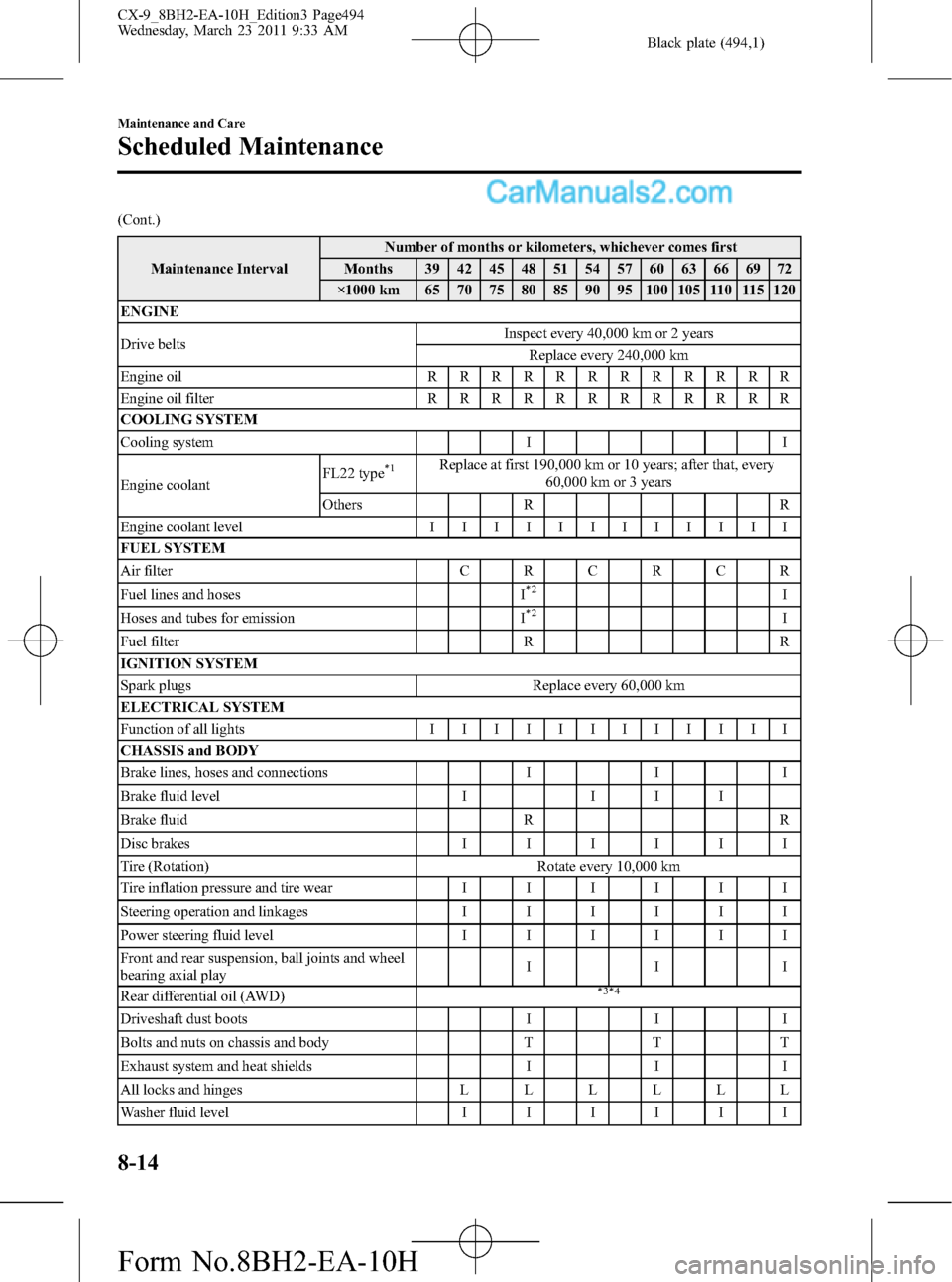
Maintenance IntervalNumber of months or kilometers, whichever comes first
Months 39 42 45 48 51 54 57 60 63 66 69 72
×1000 km 65 70 75 80 85 90 95 100 105 110 115 120
ENGINE
Drive beltsInspect every 40,000 km or 2 years
Replace every 240,000 km
Engine oilRRRRRRRRRRRR
Engine oil filterRRRRRRRRRRRR
COOLING SYSTEM
Cooling system I I
Engine coolantFL22 type
*1Replace at first 190,000 km or 10 years; after that, every
60,000 km or 3 years
Others R R
Engine coolant levelIIIIIIIIIIII
FUEL SYSTEM
Air filterCRCRCR
Fuel lines and hoses I
*2I
Hoses and tubes for emission I*2I
Fuel filter R R
IGNITION SYSTEM
Spark plugs Replace every 60,000 km
ELECTRICAL SYSTEM
Function of all lightsIIIIIIIIIIII
CHASSIS and BODY
Brake lines, hoses and connections I I I
Brake fluid level I I I I
Brake fluid R R
Disc brakesIIIIII
Tire (Rotation) Rotate every 10,000 km
Tire inflation pressure and tire wearIIIIII
Steering operation and linkagesIIIIII
Power steering fluid levelIIIIII
Front and rear suspension, ball joints and wheel
bearing axial playIII
Rear differential oil (AWD)
*3*4
Driveshaft dust boots I I I
Bolts and nuts on chassis and body T T T
Exhaust system and heat shields I I I
All locks and hingesLLLLLL
Washer fluid levelIIIIII
8-14
Maintenance and Care
Scheduled Maintenance
CX-9_8BH2-EA-10H_Edition3 Page494
Wednesday, March 23 2011 9:33 AM
Form No.8BH2-EA-10H
Page 503 of 606

Black plate (503,1)
Brake Fluid
qInspecting Brake Fluid Level
Inspect the fluid level in the reservoir
regularly. It should be kept at MAX.
The level normally drops with
accumulated distance, a condition
associated with wear of brake linings. If it
is excessively low, have the brake system
inspected by an Authorized Mazda
Dealer.
qAdding Brake Fluid
WARNING
Be careful not to spill brake fluid on
yourself or on the engine:
Spilled brake fluid is dangerous. If it
gets in your eyes, they could be
seriously injured. If this happens,
immediately flush your eyes with
water and get medical attention.
Brake fluid spilled on a hot engine
could cause a fire.
If the brake fluid level is low, have the
brakes inspected:
Low brake fluid levels are dangerous.
Low levels could signal brake lining
wear or a brake system leak. Your
brakes could fail and cause an
accident.
If the fluid level is low, add fluid until it
reaches MAX.
Before adding fluid, thoroughly clean the
area around the cap.
CAUTION
ØBrake fluid will damage painted
surfaces. If brake fluid does get on
a painted surface, wash it off with
water immediately.
ØUsing nonspecified brake fluids
(page 10-4) will damage the
system. Mixing different fluids will
also damage it.
If the brake system frequently
requires new fluid, consult an
Authorized Mazda Dealer.
Maintenance and Care
Owner Maintenance
8-23
CX-9_8BH2-EA-10H_Edition3 Page503
Wednesday, March 23 2011 9:33 AM
Form No.8BH2-EA-10H
Page 537 of 606

Black plate (537,1)
CAUTION
ØDo not use steel wool, abrasive
cleaners, or strong detergents
containing highly alkaline or
caustic agents on chrome-plated
or anodized aluminum parts. This
may damage the protective
coating; also, cleaners and
detergents may discolor or
deteriorate the paint.
ØTo prevent damaging the antenna,
remove it before entering a car
wash facility or passing beneath a
low overhead clearance.
Pay special attention to removing salt,
dirt, mud, and other foreign material from
the underside of the fenders, and make
sure the drain holes in the lower edges of
the doors and rocker panels are clean.
Insects, tar, tree sap, bird droppings,
industrial fallout, and similar deposits can
damage the finish if not removed
immediately. When prompt washing with
plain water is ineffective, use a mild soap
made for use on vehicles.
Thoroughly rinse off all soap with
lukewarm or cold water. Do not allow
soap to dry on the finish.
After washing the vehicle, dry it with a
clean chamois to prevent water spots from
forming.
WARNING
Dry off brakes that have become wet
by driving slowly, releasing the
accelerator pedal and lightly applying
the brakes several times until the brake
performance returns to normal:
Driving with wet brakes is
dangerous. Increased stopping
distance or the vehicle pulling to one
side when braking could result in a
serious accident. Light braking will
indicate whether the brakes have
been affected.
When using a high water pressure car
wash
High water temperature and high water
pressure car washers are available
depending on the type of car wash
machine. If the car washer nozzle is put
too close to the vehicle, the force of the
spray could damage or deform the
molding, affect the sealability of parts,
and allow water to penetrate the interior.
Keep a sufficient space (30 cm or more)
between the nozzle and the vehicle. In
addition, do not spend too much time
spraying the same area of the vehicle, and
be very careful when spraying between
gaps in doors and around windows.
Waxing
Your vehicle needs to be waxed when
water no longer beads on the finish.
Always wash and dry the vehicle before
waxing it. In addition to the vehicle body,
wax the metal trim to maintain its luster.
1. Use wax which contains no abrasives.
Waxes containing abrasive will remove
paint and could damage bright metal
parts.
Maintenance and Care
Appearance Care
8-57
CX-9_8BH2-EA-10H_Edition3 Page537
Wednesday, March 23 2011 9:33 AM
Form No.8BH2-EA-10H
Page 539 of 606

Black plate (539,1)
WARNING
Dry wet brakes by driving very slowly
and applying the brakes lightly until
brake performance is normal:
Driving with wet brakes is
dangerous. Increased stopping
distance or the vehicle pulling to one
side when braking could result in a
serious accident. Light braking will
indicate whether the brakes have
been affected.
qAluminum Wheel Maintenance
A protective coating is provided over the
aluminum wheels. Special care is needed
to protect this coating.
CAUTION
Do not use any detergent other than
mild detergent. Before using any
detergent, verify the ingredients.
Otherwise, the product could discolor
or stain the aluminum wheels.NOTE
lDo not use a wire brush or any abrasive
cleaner, polishing compound, or solvent on
aluminum wheels. They may damage the
coating.
lAlways use a sponge or soft cloth to clean
the wheels.
Rinse the wheels thoroughly with lukewarm
or cold water. Also, be sure to clean the
wheels after driving on dusty or salted
roads to help prevent corrosion.
lAvoid washing your vehicle in an automatic
car wash that uses high-speed or hard
brushes.
lIf your aluminum wheels lose luster, wax
the wheels.
(With Tire Pressure Monitoring System)
Check special requirements for Tire Pressure
Monitoring System.
Refer to Tires and Wheels on page 5-32.
qPlastic Part Maintenance
lWhen cleaning the plastic lenses of the
lights, do not use gasoline, kerosene,
rectified spirit, paint, thinner, highly
acidic detergents, or strongly alkaline
detergents. Otherwise, these chemical
agents can discolor or damage the
surfaces resulting in a significant loss
in functionality. If plastic parts become
inadvertently exposed to any of these
chemical agents, flush with water
immediately.
lIf plastic parts such as the bumpers
become inadvertently exposed to
chemical agents or fluids such as
gasoline, oil, engine coolant, or battery
fluid, it could cause discoloration,
staining, or paint peeling. Wipe off any
such chemical agents or fluids using a
soft cloth immediately.
Maintenance and Care
Appearance Care
8-59
CX-9_8BH2-EA-10H_Edition3 Page539
Wednesday, March 23 2011 9:33 AM
Form No.8BH2-EA-10H
Page 574 of 606

Black plate (574,1)
qGlossary of Terms
Tire Placard:A label indicating the OE tire sizes, recommended inflation pressure, and
the maximum weight the vehicle can carry.
Tire Identification Number (TIN):A number on the sidewall of each tire providing
information about the tire brand and manufacturing plant, tire size, and date of
manufacture.
Inflation Pressure:A measure of the amount of air in a tire.
kPa:Kilopascal, the metric unit for air pressure.
psi:Pounds per square inch, the English unit for air pressure.
B-pillar:The structural member at the side of the vehicle behind the front door.
Original Equipment (OE):Describes components originally equipped on the vehicle.
Vehicle Load Limit:The maximum value of the combination weight of occupants and
cargo.
Bead Area of the Tire:Area of the tire next to the rim.
Sidewall Area of the Tire:Area between the bead area and the tread.
Tread Area of the Tire:Area on the perimeter of the tire that contacts the road when it's
mounted on the vehicle.
Seating capacitymeans the total allowable number of vehicle occupants. Seating capacity
is described on the tire label.
Production options weightis the combination weight of installed regular production
options weighing over 2.3 kilograms in excess of the standard items which they replace,
and not previously considered in the curb weight or accessory weight, including heavy
duty brakes, ride levelers, roof rack, heavy duty battery, and special trim.
Rimis the metal support (wheel) for a tire or a tire and tube assembly upon which the tire
beads are seated.
9-32
Customer Information and Reporting Safety Defects
Tire Information (except Canada)
CX-9_8BH2-EA-10H_Edition3 Page574
Wednesday, March 23 2011 9:33 AM
Form No.8BH2-EA-10H