weight MAZDA MODEL CX-9 2019 Owners Manual (in English)
[x] Cancel search | Manufacturer: MAZDA, Model Year: 2019, Model line: MODEL CX-9, Model: MAZDA MODEL CX-9 2019Pages: 692
Page 54 of 692

Child-Restraint System Installation
▼Categories of Child-Restraint Systems
NOTE
When purchasing, ask the manufacturer of the child-restraint system which type of
child-restraint system is appropriate for your child and vehicle.
(Mexico)
Child-restraint systems are classified into the following 5 gro
ups according to the UN-R 44
regulation.
Group Age WeightSize Classification/
Fixture (CRF)
0 Up to about 9 months old Up to 10 kg (up to 22 lb) L1
L2
R1
0
Up to about 2 years old Up to 13 kg (up to 29 lb) R1
R2
R3
1 About 8 months to 4 years old 9 kg ― 18 kg (20 lb ― 40 lb) R2
R3
F2
F2X F3
2 About 3 to 7 years old 15 kg ― 25 kg (33 lb ― 55 lb) ―
3 About 6 to 12 years old 22 kg ― 36 kg (48 lb ― 79 lb) ―
(Except Mexico)
Please comply with the legal regulations concerning the use of child-restraint systems in
your country.
▼ Child-Restraint System Types
In this owner's manual, explanation of
child-restraint system
s is provided for the
following three types of popular
child-restraint system s: infant seat, child
seat, booster seat.
NOTE
Installation position is determined by
the type of child-restraint system.
Always read the manufacturer's
instructions and this owner's manual
carefully.
Essential Safety Equipment
Child Restraint
2-42
CX-9_8HB2-EA-18G_Edition1 2018-5-11 13:09:27
Page 67 of 692

Refer to Head Restraints on page 2-21.
Front Passenger's Seat Child-Restraint
System Installation (With Front
Passenger Occupant Classification
System)
1. Make sure the ignition is switched off.
2. Slide the seat as far back as possible.
3. Remove the head restraint. However,
when installing a backless booster seat,
always install the vehicle head restraint
to the seat where the backless booster
seat is installed.
4. Place the child-restraint system on the seat without putti ng your weight on the
seat and fasten the seat belt. See the
manufacturer's instructions on the
child-restraint system for belt routing
instructions.
5. To get the retractor into the automatic
locking mode, pull the shoulder belt
portion of the seat belt until the entire
length of the belt is out of the retractor.
6. Push the child-restraint system firmlyinto the vehicle seat. Be sure the belt
retracts as snugly as possible. A
clicking noise from the retractor will
be heard during retraction if the system
is in automatic lo cking mode. If the
belt does not lock the seat down tight,
repeat the previous step and also this
one.
NOTE
Inspect this function before each use
of the child-restraint system. You
should not be able to pull the
shoulder belt out of the retractor
while the system is in the automatic
locking mode. When you remove the
child-restraint system, be sure the
belt fully retracts to return the
system to emergency locking mode
before occupants use the seat belts.
Follow the child-restraint system
manufacturer's instructions
carefully.
Depending on the type of
child-restraint system, it may not
employ seat belts which are in
automatic locking mode.
7. Seat your child safely in the
child-restraint system and secure the
child according to the instructions
from the child-restraint system
manufacturer.
Essential Safety Equipment
Child Restraint
2-55
CX-9_8HB2-EA-18G_Edition1 2018-5-11 13:09:27
Page 78 of 692

Never install any front-end equipment to your vehicle:
Installation of front-end equipment, such as frontal protection bar (kangaroo bar, bull bar,
push bar, or other similar devices), snowplow , or winches, is dangerous. The air bag crash
sensor system could be affected. This could cause air bags to inflate unexpectedly, or it could
prevent the air bags from inflating during an accident. Front occupants could be seriously
injured.
Do not modify the suspension:
Modifying the vehicle suspension is dangerous. If the vehicle's height or the suspension is
modified, the vehicle will be unable to accura tely detect a collision or roll-over accident
resulting in incorrect or unexpected air bag depl oyment and the possibility of serious injuries.
To prevent false detection by the air bag sensor system, heed the following:
Do not use tires or wheels other th an those specified for your Mazda:
Use of any tire or wheel other than thos e specified for your Mazda (page 9-8) is
dangerous. Use of such wheels will prevent th e vehicle's accident detections system from
accurately detecting a collision or roll-over accident resulting in incorrect or unexpected air
bag deployment and the possibility of serious injuries.
Do not overload your vehicle:
Overloading your vehicle is dangerous as it could prevent the air bag crash sensor system
from accurately detecting a collision or roll-over accident resulting in incorrect or
unexpected air bag deployment and the possibili ty of serious injuries. The gross axle weight
rating (GAWR) and the gross vehicle weight rati ng (GVWR) for your vehicle are on the Motor
Vehicle Safety Standard Label on the driver's door frame. Do not exceed these ratings.
Do not drive the vehicle
off-road:
Driving your Mazda off-road is dangerous beca use the vehicle has not been designed to do
so. Driving the vehicle off-road could prevent the air bag crash sensor system from
accurately detecting a collision or roll-over accident resulting in incorrect or unexpected air
bag deployment and the possibility of serious injuries.
Do not modify a front door or leave any da mage unrepaired. Always have an Authorized
Mazda Dealer inspect a damaged front door:
Modifying a front door or leaving any damage unrepaired is dangerous. Each front door has a
side crash sensor as a component of the suppleme ntal restraint system. If holes are drilled in a
front door, a door speaker is left removed, or a damaged door is left unrepaired, the sensor
could be adversely affected causing it to not detect the pressure of an impact correctly during
a side collision. If a sensor does not detect a side impact correctly, the side and curtain air
bags and the front seat belt pretensioner may not operate normally which could result in
serious injury to occupants.
Essential Safety Equipment
SRS Air Bags
2-66
CX-9_8HB2-EA-18G_Edition1 2018-5-11 13:09:27
Page 115 of 692

▼Rear Door Child Safety Locks
These locks are intended to help prevent
children from acciden
tally opening the
rear doors. Use them on both rear doors
whenever a child rides in the rear seat of
the vehicle.
If you slide the child safety lock to the
lock position before closing that door, the
door cannot be opened from the inside.
The door can only be opened by pulling
the outside handle.
Lock Unlock
Liftgate
WA R N I N G
Never allow a person to ride in the luggage
compartment:
Allowing a person to ride in the luggage
compartment is dangerous. The person in
the luggage compartment could be
seriously injured or
killed during sudden
braking or a collision.
Do not drive with the liftgate open:
Exhaust gas in the cabin of a vehicle is
dangerous. An open liftgate in a moving
vehicle will cause exhaust gas to be drawn
into the cabin. This gas contains CO
(carbon monoxide), which is colorless,
odorless, and highly poisonous, and it can
cause loss of consciousness and death.
Moreover, an open liftgate could cause
occupants to fall out in an accident.
Do not stack or leave loaded luggage
unsecured in the luggage compartment:
Otherwise, the luggage may move or
collapse, resulting in injury or an accident.
In addition, do not load luggage higher
than the seatbacks. It may affect the side or
rear field of view.
CAUTION
Before opening the liftgate, remove any
snow and ice accumulation on it.
Otherwise, the liftgate could close under
the weight of the snow and ice resulting
in injury.
Before Driving
Doors and Locks
3-19
CX-9_8HB2-EA-18G_Edition1 2018-5-11 13:09:27
Page 118 of 692
Always confirm the safety of the area
around the power liftgate before operating
it electrically.
Not checking the area around the liftgate
for people before operating it using the
power liftgate switch or the button on the
keyless entry system is dangerous. A person
could become caught between the liftgate
and an obstruction while it is opening
electrically or between the liftgate and
vehicle while it is closing electrically,
resulting in an accident and serious injury.
Never allow children to operate the power
liftgate system:
Allowing children to operate the power
liftgate switch and the keyless entry system
is dangerous. Children are not aware of the
dangers of people getting fingers and
hands caught in a moving liftgate. If
someone's neck, head or hands get caught
in a closing door, it could result in death or
serious injury.
CAUTION
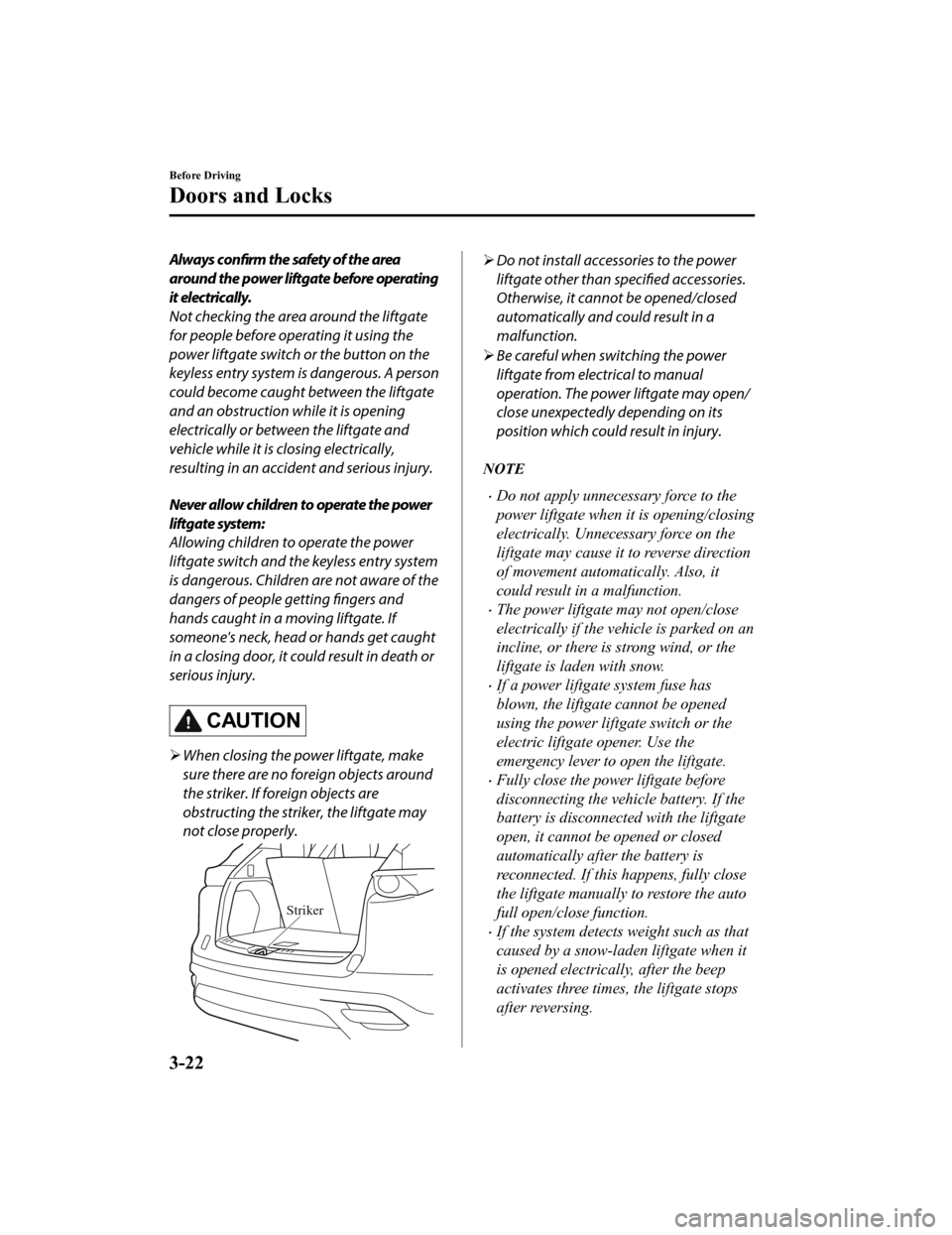
When closing the power liftgate, make
sure there are no foreign objects around
the striker. If foreign objects are
obstructing the striker, the liftgate may
not close properly.
Striker
Do not install accessories to the power
liftgate other than specified accessories.
Otherwise, it cannot be opened/closed
automatically and could result in a
malfunction.
Be careful when switching the power
liftgate from electrical to manual
operation. The power liftgate may open/
close unexpectedly depending on its
position which could result in injury.
NOTE
Do not apply unnecessary force to the
power liftgate when it is opening/closing
electrically. Unnecessary force on the
liftgate may cause it to reverse direction
of movement automatically. Also, it
could result in a malfunction.
The power liftgate may not open/close
electrically if the vehicle is parked on an
incline, or there is strong wind, or the
liftgate is laden with snow.
If a power liftgate system fuse has
blown, the liftgate cannot be opened
using the power liftgate switch or the
electric liftgate opener. Use the
emergency lever to open the liftgate.
Fully close the power liftgate before
disconnecting the vehicle battery. If the
battery is disconnected with the liftgate
open, it cannot be opened or closed
automatically after the battery is
reconnected. If this happens, fully close
the liftgate manually to restore the auto
full open/close function.
If the system detects weight such as that
caused by a snow-laden liftgate when it
is opened electrically, after the beep
activates three times, the liftgate stops
after reversing.
Before Driving
Doors and Locks
3-22
CX-9_8HB2-EA-18G_Edition1 2018-5-11 13:09:27
Page 143 of 692
Break-In Period
No special break-in is necessary, but a few
precautions in the first 1,000 km (600
miles) may add to the performance,
economy, and life of the vehicle.
Do not race the engine.
Do not maintain one constant speed,
either slow or fast, for a long period of
time.
Do not drive constantly at full-throttle or
high engine rpm for extended periods of
time.
Avoid unnecessary hard stops.
Avoid full-throttle starts.
Do not tow a trailer.
Saving Fuel and Protection of the Environment
How you operate your Mazda determines
how far it will travel on a tank of fuel. Use
these suggestions to help save fuel and
reduce CO
2.
Avoid long warm-ups. Once the engine
runs smoothly, begin driving.
Avoid fast starts.
Drive at lower speeds.
Anticipate when to apply the brakes
(avoid sudden braking).
Follow the maintenance schedule (page
6-4) and have an Authorized Mazda
Dealer perform inspections and
servicing.
Use the air conditioner only when
necessary.
Slow down on rough roads.
Keep the tires properly inflated.
Do not carry unnecessary weight.
Do not rest your foot on the brake pedal
while driving.
Keep the wheels in correct alignment.
Keep windows closed at high speeds.
Slow down when driving in crosswinds
and headwinds.
WA R N I N G
Never stop the engine when going down a
hill:
Stopping the engine when going down a
hill is dangerous. This causes the loss of
power steering and power brake control,
and may cause damage to the drivetrain.
Any loss of steering or braking control
could cause an accident.
Before Driving
Driving Tips
3-47
CX-9_8HB2-EA-18G_Edition1 2018-5-11 13:09:27
Page 148 of 692
Driving In Flooded Area
WA R N I N G
Dry off brakes that have become wet by
driving slowly, releasing the accelerator
pedal and lightly applying the brakes
several times until the brake performance
returns to normal:
Driving with wet brakes is dangerous.
Increased stopping distance or the vehicle
pulling to one side when braking could
result in a serious accident. Light braking
will indicate whether the brakes have been
affected.
CAUTION
Do not drive the vehicle on flooded roads
as it could cause short circuiting of
electrical/electronic parts, or engine
damage or stalling from water absorption.
If the vehicle has been immersed in water,
consult an Authorized Mazda Dealer.
Overloading
WA R N I N G
Be careful not to overload your vehicle:
The gross axle weight rating (GAWR) and
the gross vehicle weight rating (GVWR) of
the vehicle are on the Motor Vehicle Safety
Standard Label on the driver's door frame.
Exceeding these ratings can cause an
accident or vehicle damage. You can
estimate the weight of the load by
weighing the items (or people) before
putting them in the vehicle.
Before Driving
Driving Tips
3-52
CX-9_8HB2-EA-18G_Edition1 2018-5-11 13:09:27
Page 151 of 692
Trailer Towing (U.S.A. and Canada)
Your Mazda was designed and built primarily to carry passengers and cargo.
If you tow a trailer, follow thes e instructions because driver and passenger safety depends
on proper equipment and safe d riving habits. Towing a trailer w ill affect handling, braking,
durability, performance, and fuel economy.
Never overload your vehicle or trailer. Consult an Authorized M azda Dealer if you need
further details.
CAUTION
Do not tow a trailer during the first 1,000 km ( 600 miles) of your new Mazda. If you do, you
may damage the engine, transaxle, differential, wheel bearings, and other power-train
components.
NOTE
When towing, use of gasoline with a octane rating of 91 or higher is recommended.
Your vehicle is equipped with a Trailer Stability Control (TSC) mechanism, which
enhances vehicle stability when towing a trailer.
Refer to Trailer Stability Control (TSC) on page 4-98.
▼ Weight Limits
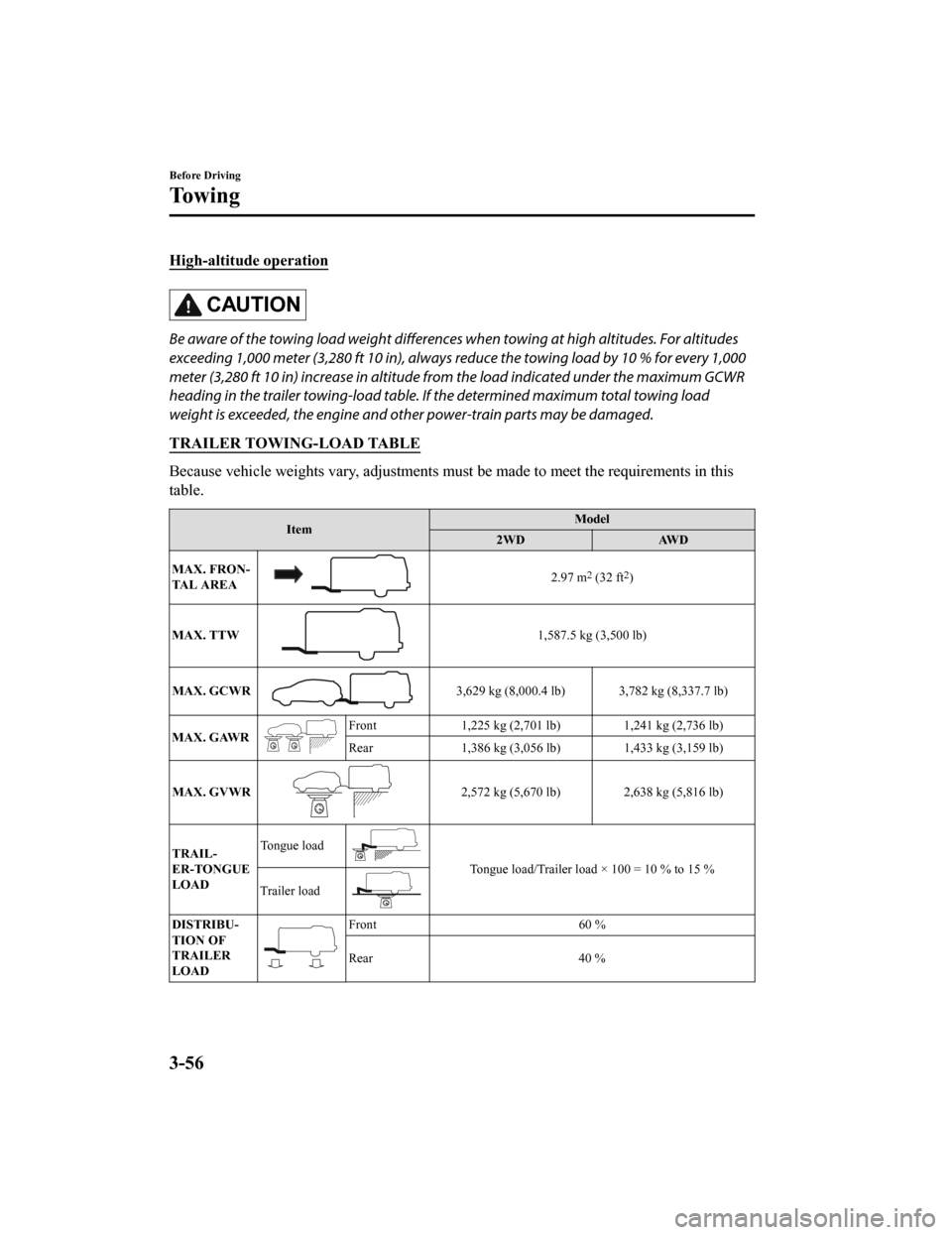
TTW and GCWR
The total trailer weight (TTW), g
ross combination weight rating (GCWR), gross axle
weight rating (GAWR), trailer load, and trailer tongue load mus t be within the
prescribed limits.
The total trailer weight (TTW) is the sum of the weights of the trailer load (trailer
weight plus cargo), trailer hitch, 2 passengers, and vehicle load (baggage, food, camp
gear, etc.). Never allow the tota l trailer weight (TTW) to exceed specifications in the
Trailer Towing-Load Table.
The maximum GCWR is the combinat ion weight of the trailer and load plus the
towing vehicle (including trailer hitch, vehicle passengers, and load). It must not
exceed specifications in the load table.
GAWR and GVWR
Do not exceed front and rear GAWR (gross axle weight rating) an d GVWR (gross vehicle
weight rating). If you do, vehicle handling, braking, and perfo rmance will be affected. These
values are also on the Motor Vehicle Safety Certification Label posted on the driver's door
frame.
Before Driving
To w i n g
3-55
CX-9_8HB2-EA-18G_Edition1 2018-5-11 13:09:27
Page 152 of 692
High-altitude operation
CAUTION
Be aware of the towing load weight differences when towing at high altitudes. For altitudes
exceeding 1,000 meter (3,280 ft 10 in), always reduce the towing load by 10 % for every 1,000
meter (3,280 ft 10 in) increase in altitude from the load indicated under the maximum GCWR
heading in the trailer towing-load table. If the determined maximum total towing load
weight is exceeded, the engine and other power-train parts may be damaged.
TRAILER TOWING-LOAD TABLE
Because vehicle weights vary, adjustments must be made to meet the requirements in this
table.
Item Model
2WD AWD
MAX. FRON‐
TA L A R E A
2.97 m2 (32 ft2)
MAX. TTW
1,587.5 kg (3,500 lb)
MAX. GCWR
3,629 kg (8,000.4 lb) 3,782 kg (8,337.7 lb)
MAX. GAWR
Front 1,225 kg (2,701 lb) 1,241 kg (2,736 lb)
Rear 1,386 kg (3,056 lb) 1,433 kg (3,159 lb)
MAX. GVWR
2,572 kg (5,670 lb) 2,638 kg (5,816 lb)
TRAIL‐
ER-TONGUE
LOAD Tongue load
Tongue load/Trailer load × 100 = 10 % to 15 %
Trailer load
DISTRIBU‐
TION OF
TRAILER
LOADFront 60 %
Rear 40 %
Before Driving
To w i n g
3-56
CX-9_8HB2-EA-18G_Edition1 2018-5-11 13:09:27
Page 153 of 692
WA R N I N G
Always keep tow loads within specified limits as indicated in the Trailer Towing-Load Table:
Attempting to tow loads greater than those specified is dangerous as it may cause serious
handling and performance problems that could result in personal injury or vehicle damage,
or both.
Load your trailer with the weight about 60 % toward the front and 40 % toward the rear:
Loading the trailer with more weight in the rear than in the front is dangerous. Doing so could
cause you to lose control. The trailer tongue load must be 10 % ―15 % of the total trailer load
(sum of the weights of the trailer and cargo).
Always have the total trailer weight and tongue load determined prior to departure:
Attempting to tow loads withou t determining the total trailer weight and tongue load is
dangerous. Trailer sway from crosswinds, roug h roads or other causes could result in loss of
control and a serious accident.
CAUTION
The total trailer weight and tongue load ca n be determined by weighing the trailer on
platform scales at a highway weight station or a trucking company.
▼ Trailer Hitch
Use only a hitch ball recommended by the trailer manufacturer that conforms to the gross
trailer weight requirement.
When not towing a trailer, remove
the trailer hitch (if detachable) to reduce the possibility of
damage as a result of the vehicle being rear-ended.
WA R N I N G
Always make sure the trailer hitch is securely attached before departure:
An unsecured trailer hitch is dangerous as it causes greater trailer sway from crosswinds,
rough roads or other causes, resulting in loss of control and a serious accident.
Examine all trailer-hitch mounting bolts regularly and tighten any that are loose. If the hitch
is removed, seal any open mounting holes to prevent exhaust, dust, water, dirt and other
foreign elements from filtering in, possibly en dangering personal safety and damaging your
vehicle.
Do not install a hitch that stiffens the bumper as it will reduce the bumper's performance.
Before Driving
To w i n g
3-57
CX-9_8HB2-EA-18G_Edition1 2018-5-11 13:09:27