wheel MAZDA MODEL MX-30 EV 2022 Owners Manual
[x] Cancel search | Manufacturer: MAZDA, Model Year: 2022, Model line: MODEL MX-30 EV, Model: MAZDA MODEL MX-30 EV 2022Pages: 547, PDF Size: 79.35 MB
Page 508 of 547

Uniform Tire Quality
Grading System (UTQGS)
▼ Uniform Tire Quality Grading
System (UTQGS)
This information relates to the tire
grading system developed by the U.S.
National Highway
Traffic Safety
Administration for grading tires by
tread wear, traction, and temperature
performance.
▼ Trea d Wea r
The tread wear grade is a comparative
rating based on the wear rate of the
tire when tested under controlled
conditions on a speci
fied government
test course.
For example, a tire graded 150 would
wear one-and-a-half times as well on
the government course as a tire graded
100.
The relative performance of tires
depends upon the actual conditions of
their use, however, and may depart
signi ficantly from the norm because of
variations in driving habits, service
practices and di fferences in road
characteristics and climate.
▼ Traction-AA, A, B, C
The traction grades, from highest to
lowest, are AA, A, B, and C. These
grades represent the tire's ability to
stop on wet pavement as measured
under controlled conditions on
speci
fied government test surfaces of
asphalt and concrete. A tire marked C
may have poor traction performance.
WARNING
The traction grade assigned to this tire
is based on braking (straight ahead)
traction tests and does not include
acceleration cornering (turning),
hydroplaning , or peak traction
characteristics.
▼ Temperature-A, B, C
The temperature grades A (the
highest), B, and C, represent the tire's
resistance to the generation of heat
and its ability to dissipate heat when
tested under controlled conditions on
a specified indoor laboratory test
wheel.
Sustained high temperature can cause
the material of the tire to degenerate
and reduce tire life, and excessive
temperatures can lead to sudden tire
failure.
Grade C corresponds to a level of
performance which all passenger
vehicle tires must meet under the
Federal Motor Vehicle Safety Standard
No. 109. Grades B and A represent
higher levels of performance on the
laboratory test wheel than the
minimum required by law.
Customer Information and Reporting Safety Defects
Uniform Tire Quality Grading System (UTQGS)
8-19
MX
-30_8JD4-EA -21G_Edition2_new 2021-5-18 14:38:07
Page 510 of 547

Tire Labeling
▼Tire Labeling
Federal law requires tire manufacturers
to place standardized information on
the sidewall of all tires. This
information identi
fies and describes
the fundamental characteristics of the
tire and also provides a tire
identi fication number for safety
standard certi fication and in case of a
recall.
▼ Information on Passenger Vehicle
Tires
Please refer to the sample below.
1. SAFETY WARNING
2. Passenger car tire
3. Nominal width of tire in millimeters
4. Ratio of height to width (aspect
rat io)
5. Radial
6. Run- flat tire
7. Rim diameter code
8. TIN : U.S. DOT tire
identification
number
9. Load index & speed symbol
10.Severe snow conditions
11.Tire ply composition and materials used
12.Max. load rating
13.Tread wear, traction and temperature grades
14.Max. permissible in flation pressure
P215/65R15 95H is an example of a
tire size and load index rating. Here is
an explanation of the various
components of that tire size and load
index rating. Note that the tire size and
load index rating may be di fferent from
the example.
P
Indicates a tire that may be installed on
cars, SUVs, minivans and light trucks as
designated by the Tire and Rim
Association (T&RA).
NOTE
If your tire size does not begin with a
letter this may mean it is designated by
either ETRTO (European Tire and Rim
Technical Organization) or JATMA
(Japan Tire Manufacturing
Association).
215
“215” is the nominal width of the tire
in millimeters. This three-digit number
gives the width in millimeters of the
tire from sidewall edge to sidewall
edge. In general, the larger the
number, the wider the tire.
65
“65” is the aspect ratio. This two-digit
number indicates the tire's ratio of
height to width.
R
“R” is the tire construction symbol. R
indicates “Radial ply construction”.
15
“15” is the wheel rim diameter in
inches.
Customer Information and Reporting Safety Defects
Tire Information (U.S.A.)
8-21
MX -30_8JD4-EA -21G_Edition2_new 2021-5-18 14:38:07
Page 512 of 547

The grades represent the tire's ability
to stop on wet pavement as measured
under controlled conditions on
specified government test surfaces of
asphalt and concrete. A tire marked C
may have poor traction performance.
Temperature: The temperature grades
are A (the highest), B and C,
representing the tire's resistance to the
generation of heat and its ability to
dissipate heat when tested under
controlled conditions on a speci fied
indoor laboratory test wheel.
Snow Tires
In some heavy snow areas, local
governments may require true snow
tires, those with very deeply cut tread.
These tires should only be used in pairs
or placed on all four wheels. Make
sure you purchase snow tires that are
the same size and construction type as
the other tires on your vehicle.
SAFETY WARNING
The following safety warning appears
on the tire's sidewall.
SERIOUS INJURY MAY RESULT FROM:
EXPLOSION OF TIRE/RIM ASSEMBLY
DUE TO IMPROPER
MOUNTING -MATCH TIRE
DIAMETER TO RIM DIAMETER;
NEVER EXCEED 40 psi (275 kPa) TO
SEAT BEADS -ONLY SPECIALLY
TRAINED PERSONS SHOULD
MOUNT TIRES.
TIRE FAILURE DUE TO
UNDER -INFLATION/
OVERLOADING/DAMAGE -FOLLOW
OWNER'S MANUAL AND PLACARD
IN VEHICLE -FREQUENTLY CHECK
INFLATION PRESSURE AND INSPECT
FOR DAMAGE.
▼ Information on Temporary Tires
Please refer to the sample below.
1. Temporary tires
2. Nominal width of tire in millimeters
3. Ratio of height to width (aspect
ratio)
4. Diagonal
5. Rim diameter code
6. Load index & speed symbol
T115/70D16 90M is an example of a
tire size and load index rating. Here is
an explanation of the various
components of that tire size and load
index rating. Note that the tire size and
load index rating may be di fferent from
the example.
T
Indicates a tire that may be installed on
cars, SUVs, minivans and light trucks as
designated by the Tire and Rim
Association (T&RA).
115
“115” is the nominal width of the tire
in millimeters. This three-digit number
gives the width in millimeters of the
tire from sidewall edge to sidewall
edge. In general, the larger the
number, the wider the tire.
Customer Information and Reporting Safety Defects
Tire Information (U.S.A.)
8-23
MX -30_8JD4-EA -21G_Edition2_new 2021-5-18 14:38:07
Page 513 of 547

70
“70” is the aspect ratio. This two-digit
number indicates the tire's ratio of
height to width.
D
“D” is the tire construction symbol. D
indicates “diagonal ply construction”.
16
“16” is the wheel rim diameter in
inches.
90
“90” is the Load Index. This two-or
three-digit number indicates how
much weight each tire can support.
M
“M” is the speed rating. The speed
rating denotes the maximum speed for
which the use of the tire is rated.
Letter Rating Speed Rating
M 81 mph
Location of the Tire Label (Placard)
▼Location of the Tire Label (Placard)
Yo u w i l l
find the tire label containing
tire inflation pressure by tire size and
other important information on the
driver's side B -pillar or on the edge of
the rear door on the driver's side.
SAMPLE
▼ Recommended Tire In
flation
Pressure
On the tire label you will find the
recommended tire inflation pressure in
both kPa and psi for the tires installed
as original equipment on the vehicle. It
is very important that the inflation
pressure of the tires on your vehicle is
maintained at the recommended
pressure. You should check the tire
pressure regularly to insure that the
proper in flation pressure is maintained.
Refer to Tires on page 9-5.
NOTE
Tire pressures listed on the vehicle
placard or tire information label
indicate the recommended cold tire
in flation pressure, measured when the
tires are cold, after the vehicle has
been parked for at least 3 hours. As
you drive, the temperature in the tire
warms up, increasing the tire pressure.
Customer Information and Reporting Safety Defects
Tire Information (U.S.A.)
8-24
MX -30_8JD4-EA -21G_Edition2_new 2021-5-18 14:38:07
Page 515 of 547

road when it's mounted on the
vehicle.
Seating capacity means the total
allowable number of vehicle
occupants. Seating capacity is
described on the tire label.
Production options weight is the
combination weight of installed regular
production options weighing over 2.3
kilograms in excess of the standard
items which they replace, and not
previously considered in the curb
weight or accessor y weight, including
heavy duty brakes, ride levelers, roof
rack, heavy duty battery, and special
trim.
Rim is the metal support (wheel) for a
tire or a tire and tube assembly upon
which the tire beads are seated.Tire Maintenance
▼ Tire Maintenance
Improper or inadequate vehicle
maintenance can cause tires to wear
abnormally. Here are some important
maintenance points:
▼Tire
Inflation Pressure
Inspect all tire pressure monthly
(including the spare) when the tires are
cold. Maintain recommended
pressures for the best ride, top
handling , and minimum tire wear. Use
the pressures speci
fied on the vehicle
tire information placard or tire label for
optimum service.
▼ Tire Rotation
To equalize tread wear, rotate the tires
every 16,000 km (10,000 miles) at the
latest or sooner if irregular wear
develops. Mazda recommends to
rotate every 8,000 km (5,000 miles) to
help increase tire life and distribute
wear more evenly.
1. Forward
Do not include (TEMPORARY USE
ONLY) spare tire in rotation.
Inspect the tires for uneven wear and
damage. Abnormal wear is usually
caused by one or a combination of the
following:
Incorrect tire pressure
Customer Information and Reporting Safety Defects
Tire Information (U.S.A.)
8-26
MX
-30_8JD4-EA -21G_Edition2_new 2021-5-18 14:38:07
Page 516 of 547

Improper wheel alignmentOut-of-balance wheelSevere braking
After rotation, in flate all tire pressures
to speci fication on page 9-5 and
inspect the lug nuts for tightness.
CAUTION
Rotate unidirectional tires and radial
tires that have an asymmetrical tread
pattern or studs only from front to rear,
not from side to side. Tire performance
will be weakened if rotated from side
to side.
▼ Replacing a Tire
WARNING
Always use tires that are in good
condition:
Driving with worn tires is dangerous.
Reduced braking, steering, and
traction could result in an accident.
If a tire wears evenly, a wear indicator
will appear as a solid band across the
tread.
Replace the tire when this happens.
1. New tread
2. Worn tread
3. Tread wear indicator
You should replace the tire before the
band crosses the entire tread.
NOTE
Tires degrade over time, even when
they are not being used on the road. It
is recommended that tires generally be
replaced when they are 6 years or
older. Heat caused by hot climates or
frequent high load
ing conditions can
accelerate the aging process. You
should replace the spare tire when you
replace the other road tires due to the
aging of the spare tire. The period in
which the tire was manufactured (both
week and year) is indicated by a 4-digit
number.
Refer to Tire Labeling on page 8-21.
▼ Safety Practices
The way you drive has a great deal to
do with your tire mileage and safety.
So cultivate good driving habits for
your own bene
fit.
Observe posted speed limits and
drive at speeds that are safe for the
existing weather conditions
Avoid fast starts, stops and turnsAvoid potholes and objects on the
road
Do not run over curbs or hit the tire
against the curb when parking
CAUTION
If you feel a sudden vibration or ride
disturbance while driving or you
suspect your tire or vehicle has been
damaged, immediately reduce your
speed. Drive with caution until you can
safely pull
off the road. Stop and
inspect the tire for damage. If the tire
is under-in flated or damaged, de flate
it, remove the tire and rim and replace
it with your spare tire. If you cannot
detect a cause, have the vehicle towed
to the nearest vehicle or tire dealer to
have the vehicle inspected.
Customer Information and Reporting Safety Defects
Tire Information (U.S.A.)
8-27
MX -30_8JD4-EA -21G_Edition2_new 2021-5-18 14:38:07
Page 535 of 547
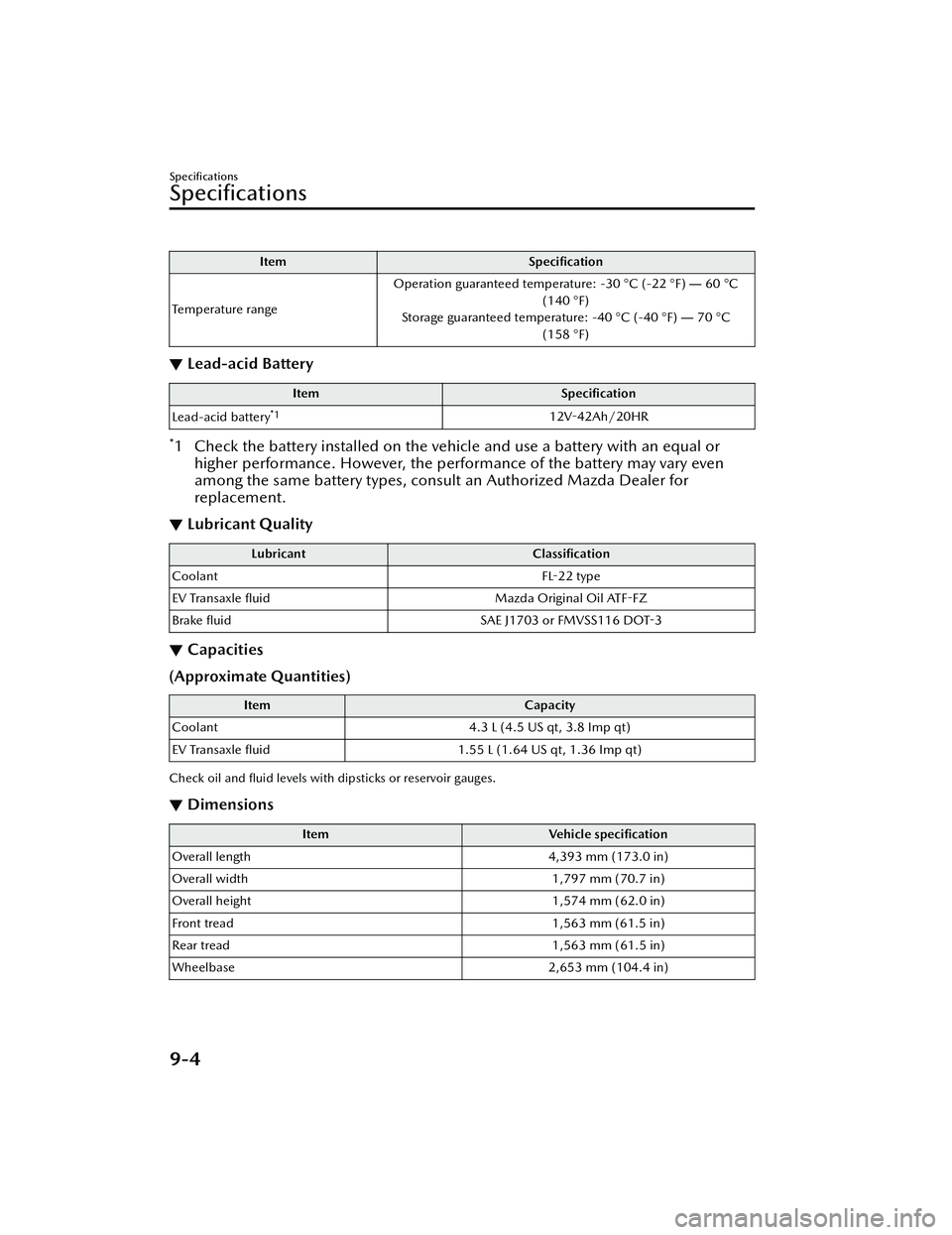
ItemSpecification
Te m p e ra t u r e ra n g e Operation guaranteed temperature: -30 °C (-22 °F)
― 60 °C
(140 °F)
Storage guaranteed temperature: -40 °C (-40 °F) ― 70 °C
(158 °F)
▼ Lead-acid Battery
Item
Specification
Lead-acid battery
*112V -42Ah/20HR
*1 Check the battery installed on the vehicle and use a battery with an equal or
higher performance. However, the performance of the battery may vary even
among the same battery types, consul t an Authorized Mazda Dealer for
replacement.
▼ Lubricant Quality
Lubricant
Classification
Coolant FL-22 type
EV Transaxle fluid Mazda Original Oil ATF-FZ
Brake fluid SAE J1703 or FMVSS116 DOT-3
▼ Capacities
(Approximate Quantities)
Item
Capacity
Coolant 4.3 L (4.5 US qt, 3.8 Imp qt)
EV Transaxle fluid 1.55 L (1.64 US qt, 1.36 Imp qt)
Check oil and fluid levels with dipsticks or reservoir gauges.
▼ Dimensions
Item
Vehicle specification
Overall length 4,393 mm (173.0 in)
Overall width 1,797 mm (70.7 in)
Overall height 1,574 mm (62.0 in)
Front tread 1,563 mm (61.5 in)
Rear tread 1,563 mm (61.5 in)
Wheelbase 2,653 mm (104.4 in)
Specifications
Speci fications
9-4
MX-30_8JD4-EA -21G_Edition2_new 2021-5-18 14:38:07
Page 540 of 547

Index
Climate Control System Operation
AreaAir Intake Selector Icon........... 5-6
AUTO Switch......................... 5-4
Po w e r Sw i tc h ( Sys te m On/
Off )....................................... 5-5
Temperature Control Switch/
Icon....................................... 5-5
Touch Panel Basic Operation... 5-4
Windshield Defroster Switch....5-6
Collision warning...................... 7-40
Coming Home Light.................. 4-37
Cruise Control........................ 4-176 Cruise control switch.......... 4-176
Cruise standby indication (white)/
cruise set indication (green) ..........
......................................... 4-176
Cruising & Tra ffic Support
(CTS)...................................... 4-118 Close proximity warning...... 4-121
Display indication............... 4-119
Setting the system...............4-122
Stop hold control............... 4-126
Cup Holder.............................. 5-42
Customer Assistance (Canada)..... 8-6
Customer Assistance (Puerto
Rico).......................................... 8-8
Customer Assistance (U.S.A.)....... 8-2
D
Daytime Running Lights............. 4-39
Defogger.................................. 4-45 Mirror.................................. 4-46
Rear window........................ 4-45
Depleted Lead-acid Battery Jump-starting....................... 7-12
Dimensions.................................9-4
Display....................................... 4-9
Distance & Speed Alert (DSA).... 4-99
Door Locks............................... 3-33
Door-ajar Warning Beep............ 7-40
Driver Attention Alert (DAA).... 4-100
Driver Monitoring Camera......... 4-81
Driver Monitoring (DM)...........4-102
Driving on Uneven Road............ 3-60
Driving Tips...............................3-56 Break-in period.................... 3-56
Driving on uneven road.........3-60
Floor mat............................. 3-57
Hazardous driving.................3-56
Overloading......................... 3-59
Rocking the vehicle...............3-57
Shift control system...............4-32
Winter driving...................... 3-58
Dynamic Stability Control
(DSC)....................................... 4-66 TCS/DSC indicator light........4-66
E
Electric Parking Brake (EPB)........ 4-52
Electric Parking Brake (EPB) Warning
Beep.........................................7-39
Electric Vehicles.......................... 3-2Electronic Sound.................... 3-9
Steering Wheel Paddle............ 3-7
Emergency Lane Keeping (ELK) ..........
.............................................. 4-129 Blind Spot Assist................. 4-129
Road Keep Assist................ 4-133
Emergency Starting Push-starting........................ 7-17
Emergency Stop Signal System.... 4-61
Emergency Towing Tiedown hooks..................... 7-19
Towing description............... 7-18
Essential Information................... 6-2
Event Data Recorder.................. 8-17
EV System Before Starting the EV System.. 4-5
Emergency EV System Stop...... 4-8
10-3
MX -30_8JD4-EA -21G_Edition2_new 2021-5-18 14:38:07
Page 541 of 547

Index
Starting the EV System............ 4-5
Starting the EV System When the
Key Battery is Dead................ 4-6
When Stopping the EV
System................................... 4-8
Excessive Speed Warning........... 7-40
Exterior Care............................. 6-34 Aluminum wheel
maintenance........................ 6-39
Bright-metal maintenance..... 6-38
Camera and Lens
Maintenance........................ 6-38
Maintaining the finish........... 6-35
Plastic part maintenance....... 6-39
F
Flasher Hazard warning.................... 4-47
Headlights............................4-35
Flat Tire...................................... 7-3
Floor Mat................................. 3-57
Fluids Brake................................... 6-12
Classi fication.......................... 9-4
Washer................................ 6-13
Foot Brake................................ 4-52
Forward Sensing Camera (FSC)... 4-71
Front Camera/Side Cameras/Rear
Camera.................................... 4-81
Front Cross Tra ffic Alert (FCTA) ..........
.............................................. 4-104
Front Cross Tra ffic Alert (FCTA)
Warning Beep........................... 7-40
Front Radar Sensor.................... 4-75
Front Side Radar Sensor............. 4-77
Fully Discharged High Voltage Battery Actions to take if the remaining
high voltage battery power is
completely depleted............. 7-16
Fuses........................................ 6-27
Panel description.................. 6-29
Replacement........................ 6-27
G
Gauges....................................... 4-9
Glove Compartment..................5-45
H
Hazardous Driving.....................3-56
Hazard Warning Flasher............. 4-47
Headlights Coming home light...............4-37
Flashing................................4-37
High-low beam.................... 4-37
Leaving home light............... 4-37
Leveling................................4-38
Head Restraint.......................... 2-18
High Beam Control System
(HBC)....................................... 4-83 High Beam Control System (HBC)
indicator light (green)........... 4-83
High Voltage Battery.................... 9-3
Hill Launch Assist (HLA)............. 4-61
HomeLink Wireless Control
System...................................... 4-47
Hood Release............................. 6-8
Horn........................................ 4-46
I
If a Warning Light Turns On or
Flashes......................................7-21
If the Active Driving Display Does Not
Operate.................................... 7-43
Illuminated Entry System............ 5-38
Immobilizer System................... 3-54
Inspecting Brake Fl uid Level........6-12
Inspecting Coolan t Level............ 6-11
Inspecting Washer Fluid Level..... 6-13
Instrument Cluster.......................4-9 Average Energy E fficiency.......4-16
10-4
MX -30_8JD4-EA -21G_Edition2_new 2021-5-18 14:38:07
Page 545 of 547

Index
Registering Your Vehicle in A Foreign
Country.................................... 8-14
Remaining High Voltage Battery
Power Warning Beep................. 7-38
ReplacementFuse..................................... 6-27
Key battery........................... 6-21
Light bulbs........................... 6-26
Tires.....................................6-24
Wheel.................................. 6-25
Wiper.................................. 6-14
Reverse Position Warning Beep... 7-39
Road Keep Assist.....................4-133
Rocking the Vehicle................... 3-57
S
Safety Defects, Reporting
(Canada).................................. 8-12
Safety Defects, Reporting
(U.S.A.).................................... 8-11
Scheduled Maintenance Canada.................................. 6-5
U.S.A. and Puerto Rico........... 6-4
Seats Driver's seat........................... 2-4
Driving position memory....... 2-10
Front passenger's seat........... 2-12
Front seat............................... 2-4
Head restraint...................... 2-18
Rear seat.............................. 2-15
Seat warmer......................... 2-21
Seat Belt System Automatic locking................ 2-28
Emergency locking................ 2-28
Extender.............................. 2-33
Pregnant women.................. 2-27
Seat belt precautions............ 2-26
Seat Belt Warning Beep............. 7-37
Security System Immobilizer system............... 3-54
Selector lever not in P reminder
warning beep............................ 7-39
Shift Control SystemDriving tips.......................... 4-32
Selector lever operation........ 4-28
Selector lever position
functions.............................. 4-26
Shift-lock system...................4-32
Shift Position Warning Beep....... 7-39
Smart Brake Support (SBS)....... 4-136 Stopping the Smart Brake Support
(SBS) system operation........4-143
Speci fications
Capacities.............................. 9-4
Charge System....................... 9-3
Dimensions............................ 9-4
Electrical system..................... 9-4
High Voltage Battery............... 9-3
Light bulbs............................. 9-5
Lubricant quality..................... 9-4
Tires.......................................9-5
Weights................................. 9-5
SRS Air Bags Driver and front passenger
occupant classification
system................................. 2-64
How the SRS air bags work.... 2-58
Limitations to SRS air bag...... 2-63
Monitoring........................... 2-69
SRS air bag deployment
criteria................................. 2-61
Supplemental restraint system
components......................... 2-57
Supplemental restraint system
(SRS) precautions................. 2-52
Steering Wheel Heated steering wheel.......... 2-23
Horn.................................... 4-46
Storage Compartments.............. 5-45 Center console..................... 5-46
Glove compartment..............5-45
10-8
MX -30_8JD4-EA -21G_Edition2_new 2021-5-18 14:38:07