child restraint MAZDA MODEL MX-30 EV 2022 Owner's Manual
[x] Cancel search | Manufacturer: MAZDA, Model Year: 2022, Model line: MODEL MX-30 EV, Model: MAZDA MODEL MX-30 EV 2022Pages: 547, PDF Size: 79.35 MB
Page 65 of 547

WARNING
Follow the manufacturer's
instructions for the use of the
child-restraint system:
An unsecured child-restraint system is
dangerous. In a sudden stop or a
collision it could move causing serious
injury or death to the child or other
occupants. Make sure the
child-restraint system is properly
secured in place according to the
child-restraint system manufacturer's
instructions.
Never attach two child-restraint
systems to the same LATCH lower
anchor:
Attaching two child-restraint systems
to the same LATCH lower anchor is
dangerous. In a collision, one anchor
may not be strong enough to hold two
child-restraint system attachments, and
it may break, causing serious injury or
death. If you use the seat position for
another child-restraint system when an
outboard LATCH position is occupied,
use the center seat belts instead, and
the tether if tether-equipped.
Make sure the child-restraint system is
properly secured:
An unsecured child-restraint system is
dangerous. In a sudden stop or a
collision it could move causing serious
injury or death to the child or other
occupants. Follow the child-restraint
system manufacturer's instructions on
belt routing to secure the seat just as
you would with a child in it so that
nobody is tempted to put a child in an
improperly secured seat later on.
When not in use, remove it from the
vehicle or fasten it with a seat belt, or
attach it to BOTH LATCH lower
anchors for LATCH child-restraint
systems.
Make sure there are no seat belts or
foreign objects near or around the
LATCH child-restraint system:
Not following the child-restraint system
manufacturer's instructions when
installing the child-restraint system is
dangerous. If seat belts or a foreign
object prevent the child-restraint
system from being securely attached to
the LATCH lower anchors and the
child-restraint system is installed
improperly, the child-restraint system
could move in a sudden stop or
collision causing serious injury or death
to the child or other occupants. When
installing the child-restraint system,
make sure there are no seat belts or
foreign objects near or around the
LATCH lower anchors. Always follow
the child-restraint system
manufacturer's instructions.
Installation on rear outboard seats
1. First, adjust the front seat to allowclearance between the
child-restraint system and the front
seat.
Refer to Adjusting the Driver's Seat
on page 2-4.
Essential Safety Equipment
Child Restraint
2-48
MX -30_8JD4-EA -21G_Edition2_new 2021-5-18 14:38:07
Page 66 of 547

Refer to Adjusting the Front
Passenger's Seat on page 2-12.
2. Make sure the seatback is securely latched by pushing it back until it is
fully locked.
3. Remove the cover of the child-restraint system's LATCH
lower anchors to verify the
locations of the LATCH lower
anchors.
1. Lower anchor
NOTE
The LATCH lower anchors
marking on the cover indicates
the position of the LATCH lower
anchors for the attachment of a
child-restraint system.
Store the removed cover so that it
does not get lost.
4. Remove the head restraint. However, when installing a backless
booster seat, always install the
vehicle head restraint to the seat
where the backless booster seat is
installed.
Refer to Head Restraints on page
2-18.
5. Secure the child-restraint system using BOTH LATCH lower anchors,
following the child-restraint system
manufacturer's instruction. Pull on
the child-restraint to be sure both
anchors are engaged.
6. If your child-restraint system cameequipped with a tether, that means
it is very important to properly
secure the tether for child safety.
Please carefully follow the
child-restraint system
manufacturer's instructions when
installing tethers.
WARNING
Use the tether and tether anchor only
for a child-restraint system:
Using the tether or tether anchor to
secure anything but a child-restraint
system is dangerous. This could
weaken or damage the tether or tether
anchor and result in injury.
Always remove the head restraint and
install child-restraint system (except
when installing a backless booster
seat):
Installing a child-restraint system
without removing the head restraint is
dangerous. The child-restraint system
cannot be installed correctly which
may result in death or injury to the
child in a collision.
1. Tether strap
2. Anchor bracket
3. Forward
Essential Safety Equipment
Child Restraint
2-49
MX -30_8JD4-EA -21G_Edition2_new 2021-5-18 14:38:07
Page 67 of 547

Always attach the tether strap to the
correct tether anchor position:
Attaching the tether strap to the
incorrect tether anchor position is
dangerous. In a collision, the tether
strap could come off and loosen the
child-restraint system. If the
child-restraint system moves it could
result in death or injury to the child.
Always install the head restraint and
adjust it to the appropriate position
after removing the child-restraint
system:
Driving with the head restraint
removed is dangerous as impact to the
occupant's head cannot be prevented
during emergency braking or in a
collision, which could result in a
serious accident, injury or death.
Refer to Head Restraints on page 2-18.
Installation on rear center seat
The LATCH lower anchors at the center
of the rear seat are much further apart
than the sets of LATCH lower anchors
for child-restraint system installation at
other seating positions. Child-restraint
systems with rigid LATCH attachments
cannot be installed on the center
seating position. Some LATCH
equipped child-restraint systems can
be placed in the center position and
will reach the nearest LATCH lower
anchors which are 420 mm (16.5 in)
apart. LATCH compatible
child-restraint systems (with
attachments on belt webbing) can be
used at this seating position only if the
child-restraint system manufacturer's
instructions state that the
child-restraint system can be installed
to LATCH lower anchors that are 420
mm (16.5 in) apart. Do not attach two
child-restraint systems to the same
LATCH lower anchor. If your
child-restraint system has a tether, it
must also be used for your child's
optimum safety.
The procedure is the same as the
installation for the rear outboard seats.
LATCH lower anchor location
WARNING
Always remove the head restraint and
install child-restraint system (except
when installing a backless booster
seat):
Installing a child-restraint system
without removing the head restraint is
dangerous. The child-restraint system
cannot be installed correctly which
may result in death or injury to the
child in a collision.
1. Tether strap
2. Anchor bracket
Essential Safety Equipment
Child Restraint
2-50
MX -30_8JD4-EA -21G_Edition2_new 2021-5-18 14:38:07
Page 68 of 547

3. Forward
Always attach the tether strap to the
correct tether anchor position:
Attaching the tether strap to the
incorrect tether anchor position is
dangerous. In a collision, the tether
strap could come off and loosen the
child-restraint system. If the
child-restraint system moves it could
result in death or injury to the child.
Always install the head restraint and
adjust it to the appropriate position
after removing the child-restraint
system:
Driving with the head restraint
removed is dangerous as impact to the
occupant's head cannot be prevented
during emergency braking or in a
collision, which could result in a
serious accident, injury or death.
Refer to Head Restraints on page 2-18.
Essential Safety Equipment
Child Restraint
2-51
MX -30_8JD4-EA -21G_Edition2_new 2021-5-18 14:38:07
Page 69 of 547
Supplemental Restraint
System (SRS) Precautions
▼ Supplemental Restraint System
(SRS) Precautions
The front and side supplemental
restraint systems (SRS) include
different
types of air bags. Please verify the
di fferent types of air bags which are
equipped on your vehicle by locating
the “SRS AIRBAG” location indicators.
These indicators are visible in the area
where the air bags are installed.
The air bags are installed in the
following locations:
The steering wheel hub (driver air
bag)
The front passenger dashboard (front
passenger air bag)
Under the instrument panel (driver
and front passenger knee air bags)
The outboard sides of the front
seatbacks (side air bags)
The front and rear window pillars,
and the roof edge along both sides
(curtain air bags)
The air bag supplemental restraint
systems are designed to provide
supplemental protection in certain
situations so seat belts are always
important in the following ways:
Without seat belt usage, the air bags
cannot provide adequate protection
during an accident. Seat belt usage is
necessary to:
Keep the occupant from being
thrown into an inflating air bag.
Reduce the possibility of injuries
during an accident that is not
designed for air bag in
flation, such as
rear impact.
Reduce the possibility of injuries in
frontal, near frontal or side collisions
or roll-over accidents that are not
severe enough to activate the air
bags.
Reduce the possibility of being
thrown from your vehicle.
Reduce the possibility of injuries to
lower body and legs during an
accident.
Hold the driver in a position which
allows better control of the vehicle.
Refer to the Front Passenger Occupant
Classi fication System (page 2-64) for
details.
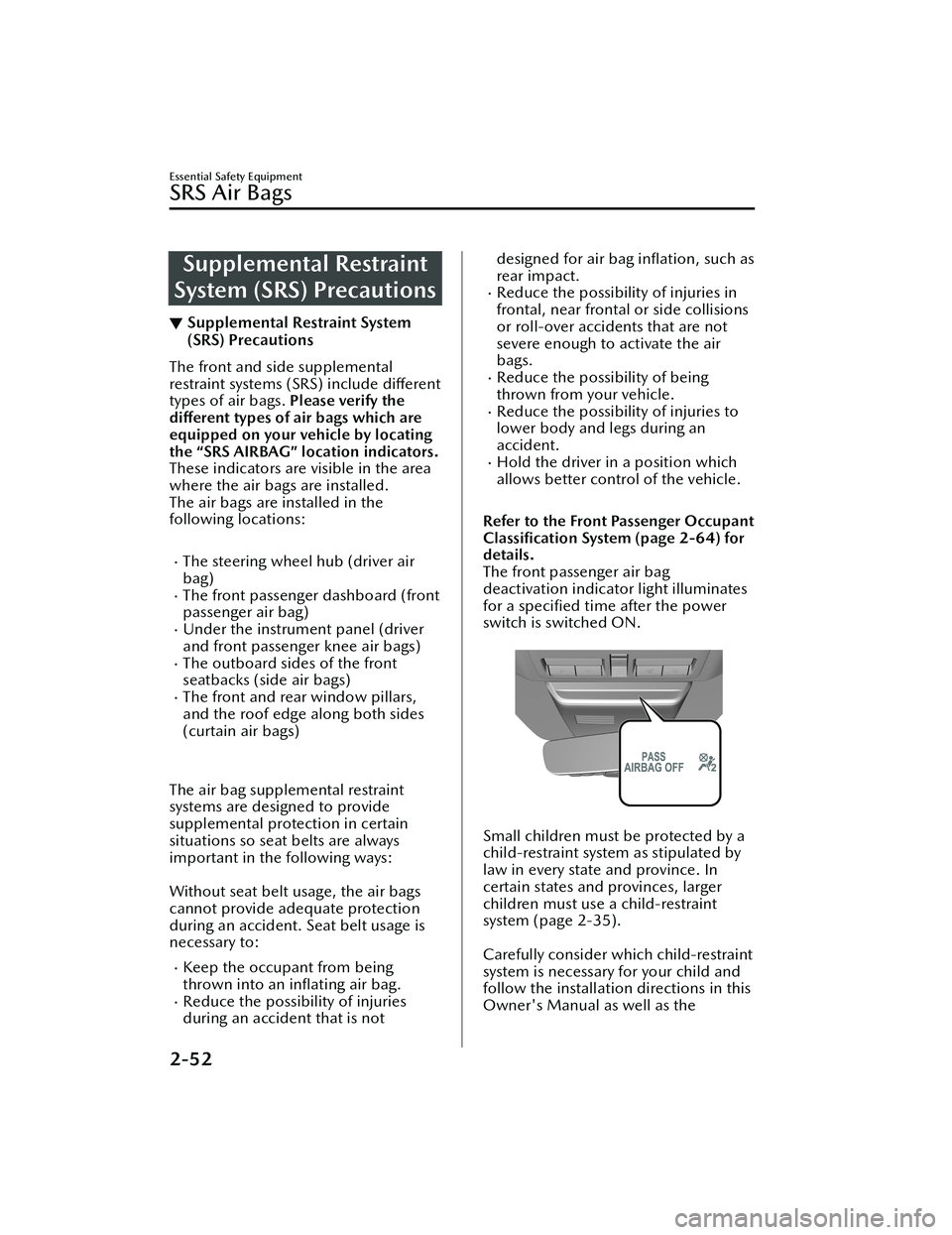
The front passenger air bag
deactivation indicator light illuminates
for a speci fied time after the power
switch is switched ON.
Small children must be protected by a
child-restraint system as stipulated by
law in every state and province. In
certain states and provinces, larger
children must use a child-restraint
system (page 2-35).
Carefully consider which child-restraint
system is necessary for your child and
follow the installation directions in this
Owner's Manual as well as the
Essential Safety Equipment
SRS Air Bags
2-52
MX -30_8JD4-EA -21G_Edition2_new 2021-5-18 14:38:07
Page 70 of 547

child-restraint system manufacturer's
instructions.
WARNING
Seat belts must be worn in air bag
equipped vehicles:
Depending only on the air bags for
protection during an accident is
dangerous. Alone, air bags may not
prevent serious injuries. The
appropriate air bags can be expected
to inflate only in the first accident, such
as frontal, near frontal or side collisions
or roll-over accidents that are at least
moderate. Vehicle occupants should
always wear seat belts.
Children should not ride in the front
passenger seat:
Placing a child, 12 years or under, in
the front seat is dangerous. The child
could be hit by a deploying air bag and
be seriously injured or even killed. A
sleeping child is more likely to lean
against the door and be hit by the side
air bag in moderate collision to the
front-passenger side of the vehicle.
Whenever possible, always secure a
child 12 years and under on the rear
seats with an appropriate
child-restraint system for the child's
age and size.
Never use a rear-facing child-restraint
system in the front seat with an air
bag that could deploy:
Rear-facing child-restraint systems on
the front seat are particularly
dangerous even though you may feel
assured that a front passenger air bag
will not deploy based on the fact that
the front passenger air bag
deactivation indicator light illuminates.
The child-restraint system can be hit by
a deploying air bag and moved
violently backward resulting in serious
injury or death to the child.
Do not sit too close to the driver and
front passenger air bags:
Sitting too close to the driver and front
passenger air bag modules or placing
hands or feet on them is extremely
dangerous. The driver and front
passenger air bags inflate with great
force and speed. Serious injuries could
occur if someone is too close. The
driver should always hold onto only the
rim of the steering wheel. The front
seat passenger should keep both feet
on the floor. Front seat occupants
should adjust their seats as far back as
possible and always sit upright against
the seatbacks with seat belts worn
properly.
Essential Safety Equipment
SRS Air Bags
2-53
MX -30_8JD4-EA -21G_Edition2_new 2021-5-18 14:38:07
Page 73 of 547
Do not place luggage or other objects
under the front seats:
Placing luggage or other objects under
the front seats is dangerous. The
components essential to the
supplemental restraint system could be
damaged, and in the event of a side
collision, the appropriate air bags may
not deploy, which could result in death
or serious injury. To prevent damage to
the components essential to the
supplemental restraint system, do not
place luggage or other objects under
the front seats.
Do not operate a vehicle with
damaged air bag/seat belt
pretensioner system components:
Expended or damaged air bag/seat
belt pretensioner system components
must be replaced after any collision
which caused them to deploy or
damage them. Only a trained
Authorized Mazda Dealer can fully
evaluate these systems to see that they
will work in any subsequent accident.
Driving with an expended or damaged
air bag or pretensioner unit will not
aff ord you the necessary protection in
the event of any subsequent accident
which could result in serious injury or
death.
Do not remove interior air bag parts:
Removing any components such as the
front seats, front dashboard, the
steering wheel or parts on the front
and rear window pillars and along the
roof edge, containing air bag parts or
sensors is dangerous. These parts
contain essential air bag components.
The air bag could accidentally activate
and cause serious injuries. Always have
an Authorized Mazda Dealer remove
these parts.Properly dispose of the air bag
system:
Improper disposal of an air bag or a
vehicle with live air bags in it can be
extremely dangerous. Unless all safety
procedures are followed, injury could
result. Have an Authorized Mazda
Dealer safely dispose of the air bag
system or scrap an air bag equipped
vehicle.
NOTE
If it becomes necessary to have the
components or wiring system for the
supplementary restraint system modi fied to accommodate a person
with certain medical conditions in
accordance with a certi fied
physician, contact an Authorized
Mazda Dealer, refer to “Customer
Assistance (U.S.A.)” (page 8-2).
When an air bag deploys, a loud in flation noise can be heard and
some smoke will be released.
Neither is likely to cause injury,
however, the texture of the air bags
may cause light skin injuries on body
parts not covered with clothing
through friction.
Should you sell your Mazda, we urge
you to tell the new owner of its air
bag systems and that familiarization
with all instructions about them,
from the Owner's Manual, is
important.
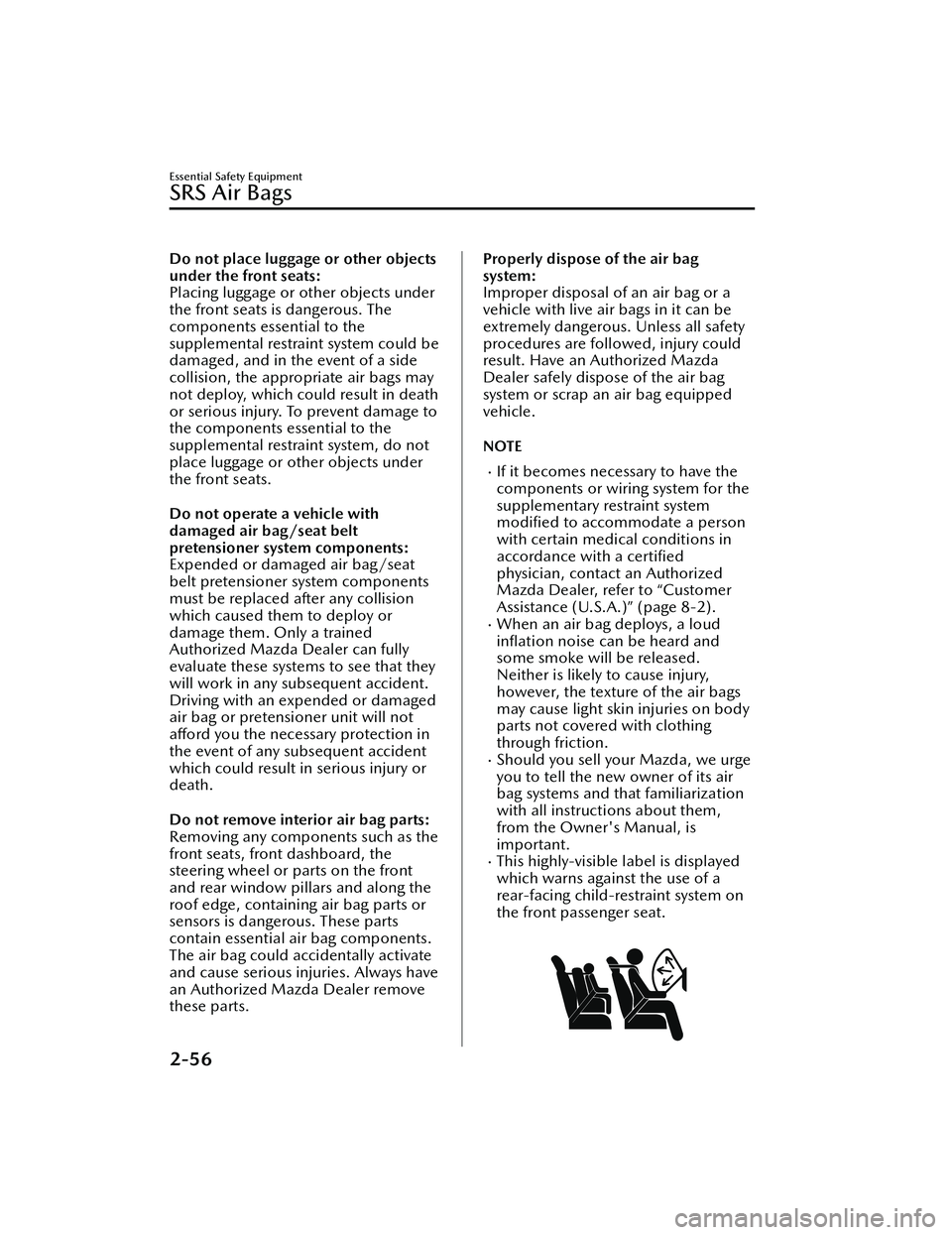
This highly-visible label is displayed
which warns against the use of a
rear-facing child-restraint system on
the front passenger seat.
Essential Safety Equipment
SRS Air Bags
2-56
MX -30_8JD4-EA -21G_Edition2_new 2021-5-18 14:38:07
Page 84 of 547

Luggage or other items placed under
the front passenger seat or between
the front passenger seat and driver
seat that push up the front passenger
seat bottom.
Any accessories which might
decrease the total seated weight on
the front passenger seat are attached
to the front passenger seat.
The front passenger front and side air
bags and knee air bags, and the seat
belt pretensioner system will
deactivate if the front passenger air
bag deactivation indicator light
illuminates.
Do not increase the total seated
weight on the front passenger seat:
When an infant or small child sits on
the front passenger seat, increasing the
total seated weight on the front
passenger seat is dangerous. The front
passenger seat weight sensors will
detect the increased total seated
weight, which could result in the
unexpected deployment of the front
passenger front and side air bags and
knee air bags, and seat belt
pretensioner system in an accident and
may cause serious injury. Increasing the
total seated weight on the front
passenger seat could result in the front
passenger front and side air bags and
knee air bags, and seat belt
pretensioner system deployment in an
accident under the following
conditions, for example:
Luggage or other items are placed on
the seat with the child in the
child-restraint system.
The front passenger seat contacts the
vehicle ceiling.A rear passenger or luggage push or
pull down on the front passenger
seatback.
A rear passenger steps on the front
passenger seat rails with their feet.
Luggage or other items are placed on
the seatback or hung on the head
restraint.
Heavy items are placed in the
seatback map pocket.
The seat is washed.
Liquids are spilled on the seat.
The front passenger seat is moved
backward, pushing into luggage or
other items placed behind it.
The front passenger seatback
contacts the rear seat.
Luggage or other items are placed
between the front passenger seat
and driver seat.
Any accessories which might increase
the total seated weight on the front
passenger seat are attached to the
front passenger seat.
CAUTION
To assure proper deployment of the
front air bag and to prevent damage
to the sensors in the front seat
bottoms:
Do not place sharp objects on the
front seat bottoms or leave heavy
luggage on them.
Do not spill any liquids on the
front seats or under the front seats.
To allow the sensors to function
properly, always perform the
following:
Adjust the front seats as far back as
possible and always sit upright
against the seatbacks with seat
belts worn properly.
Essential Safety Equipment
SRS Air Bags
2-67
MX -30_8JD4-EA -21G_Edition2_new 2021-5-18 14:38:07
Page 85 of 547

If you place your child on the front
passenger seat, secure the
child-restraint system properly and
slide the front passenger seat as far
back as possible (page 2-44).
NOTE
The system requires about 10
seconds to alternate between turning
the front passenger front and side air
bags and knee air bags, and seat belt
pretensioner system on or o ff.
The front passenger air bag
deactivation indicator light may
illuminate repeatedly if luggage or
other items are put on the front
passenger seat, or if the temperature
of the vehicle's interior changes
suddenly.
The front passenger air bag
deactivation indicator light may
illuminate for 10 seconds if the total
seated weight on the front passenger
seat changes.
The air bag/front seat belt
pretensioner system warning light
might illuminate if the front
passenger seat receives a severe
impact.
If the front passenger air bag
deactivation indicator light does not
illuminate after installing a
child-restraint system on the front
passenger seat,
first, re-install your
child-restraint system according to
the procedure in this owner's
manual. Then, if the front passenger
air bag deactivation indicator light
still does not illuminate, install the
child-restraint system on the rear seat
and consult an Authorized Mazda
Dealer as soon as possible.
If the front passenger air bag
deactivation indicator light
illuminates when an adult is seated
in the front passenger seat, have the
passenger re-adjust their posture by
sitting with their feet on the floor,
and then re-fastening the seat belt. If
the front passenger air bag
deactivation indicator light still
illuminates, move the passenger to
the rear seat. If sitting in the rear seat
is not possible, slide the front
passenger seat as far back as
possible. Consult an Authorized
Mazda Dealer as soon as possible.
▼ Driver and Front Passenger Buckle
Switches
The buckle switches on the front seat
belts detect whether or not the front
seat belts are securely fastened and
further control the deployment of the
air bags.
Essential Safety Equipment
SRS Air Bags
2-68
MX
-30_8JD4-EA -21G_Edition2_new 2021-5-18 14:38:07
Page 539 of 547

Index
A
Accessory Socket....................... 5-39
Actions to take if the remaining high
voltage battery power is completely
depleted................................... 7-16
Active Driving Display................4-24
AC Power Outlet....................... 5-40
Adaptive Front Lighting System
(AFS)........................................ 4-82
Add-On Non-Genuine Parts and
Accessories............................... 8-15
Advanced KeyAdvanced keyless entry
system................................. 3-31
Operational range................ 3-32
Advanced Keyless Entry System... 3-31
Air Intake Selector Icon................5-6
Antilock Brake System (ABS).......4-63
Assist Grips............................... 5-44
AUTOHOLD.............................. 4-57
AUTOHOLD Warning Beep........ 7-39
AUTO Switch.............................. 5-4
B
Battery Replacement........................ 6-20
Speci fications......................... 9-4
Blind Spot Assist......................4-129
Blind Spot Monitoring (BSM)..... 4-87
Canceling operation of Blind Spot
Monitoring (BSM).................4-91
Blind Spot Monitoring (BSM) Warning
Beep.........................................7-40
Bottle Holder............................ 5-43
Brakes
Brake assist.......................... 4-56
Brake override system........... 4-56
Electric Parking Brake (EPB)....4-52
Foot brake............................4-52
Pad wear indicator................4-56
Parking brake....................... 4-52
Warning light........................4-55
Brake Override System............... 4-56
Brake Override Warning Beep.....7-39
Brake System Warning Beep....... 7-39
Break-In Period......................... 3-56
C
Capacities...................................9-4
Cell Phones.............................. 8-16
Center Console......................... 5-46
Charge System............................ 9-3
Charging................................... 3-14
Child Restraint Categories of child-restraint
systems................................ 2-39
Child-restraint precautions.... 2-35
Child-restraint system
installation........................... 2-39
Child-restraint system suitability
for various seat positions....... 2-40
Installing child-restraint
systems................................ 2-41
LATCH child-restraint
systems................................ 2-47
Climate Control System Adjusting the Vents.................5-8
Basic Climate Control System
Operation.............................. 5-7
Climate Control System Operation
Area...................................... 5-3
Climate Control Timer.......... 5-12
Convenient Ways to Use the
Climate Control System........ 5-10
For Your Ride Comfort............ 5-2
Remote Climate Control....... 5-13
Selecting the Air flow Mode..... 5-8
Windshield Defrosting and
Defogging.............................. 5-9
10-2
MX -30_8JD4-EA -21G_Edition2_new 2021-5-18 14:38:07