seats MAZDA MODEL MX-30 EV 2022 Owner's Manual
[x] Cancel search | Manufacturer: MAZDA, Model Year: 2022, Model line: MODEL MX-30 EV, Model: MAZDA MODEL MX-30 EV 2022Pages: 547, PDF Size: 79.35 MB
Page 37 of 547
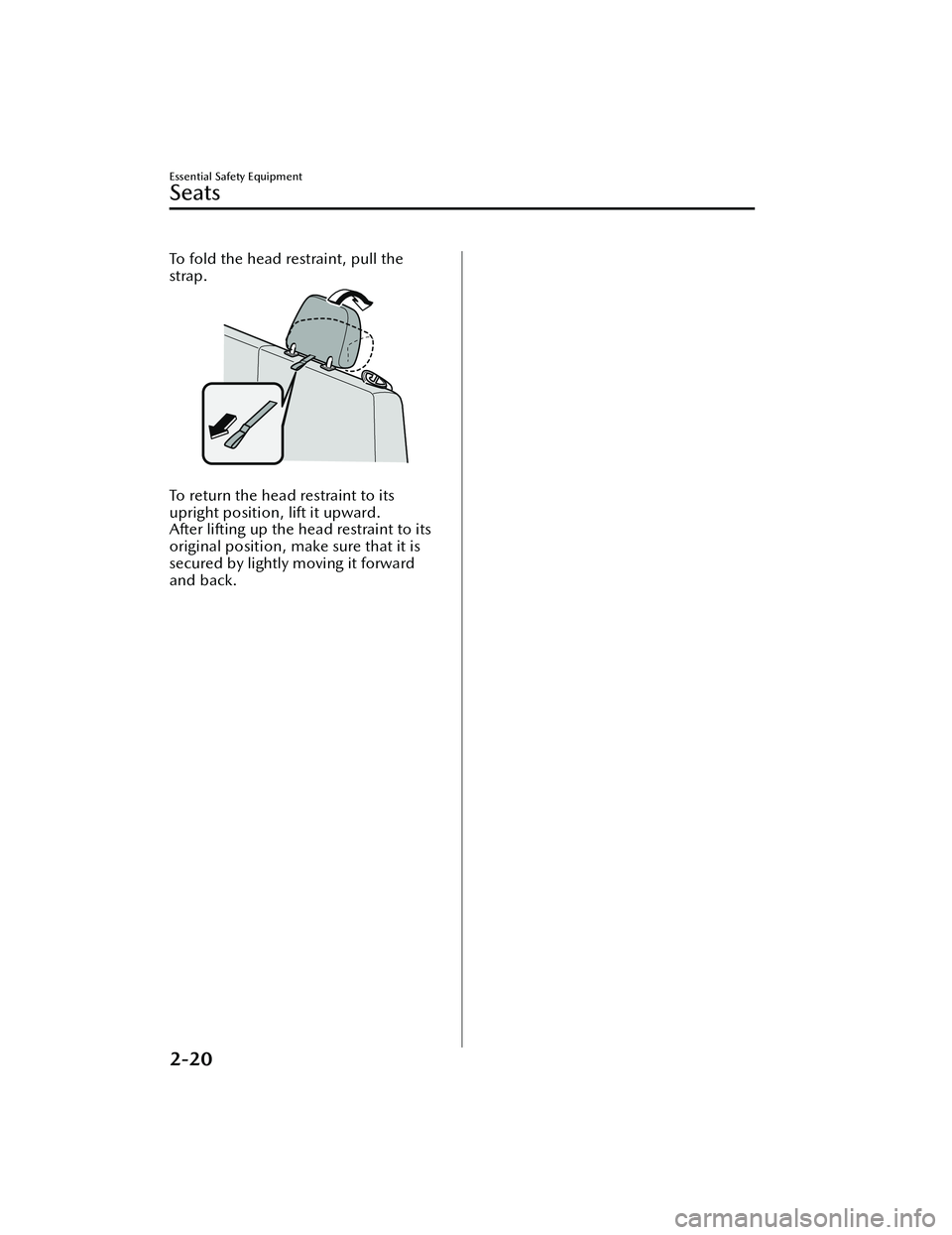
To fold the head restraint, pull the
strap.
To return the head restraint to its
upright position, lift it upward.
After lifting up the head restraint to its
original position, make sure that it is
secured by lightly moving it forward
and back.
Essential Safety Equipment
Seats
2-20
MX-30_8JD4-EA -21G_Edition2_new 2021-5-18 14:38:07
Page 38 of 547
Seat Warmer*
▼Seat Warmer
The front seats can be warmed up
while the EV system is operating.
WARNING
Be careful when using the seat
warmer:
The heat from the seat warmer may be
too hot for the following people and
could cause a low-temperature burn.
Infants, small children, elderly
people, and physically challenged
people
People with delicate skin
People who are excessively fatigued
People who are intoxicated
People who have taken
sleep-inducing medicine such as
sleeping pills or cold medicine
Do not use the seat warmer with
anything having high
moisture-retention ability such as a
blanket or cushion on the seat:
The seat may be heated excessively
and cause a low-temperature burn.
Do not use the seat warmer even
when taking a short nap in the
vehicle:
The seat may be heated excessively
and cause a low-temperature burn.
Do not place heavy objects with sharp
projections on the seat, or insert
needles or pins into it:
This could cause the seat to become
excessively heated and result in injury
from a minor burn.
CAUTION
Do not use organic solvents such as
benzene or gasoline to clean the seat.
It may damage the seat surface and the
heater.
NOTE
The seat warmer cannot be used while
charging the vehicle.
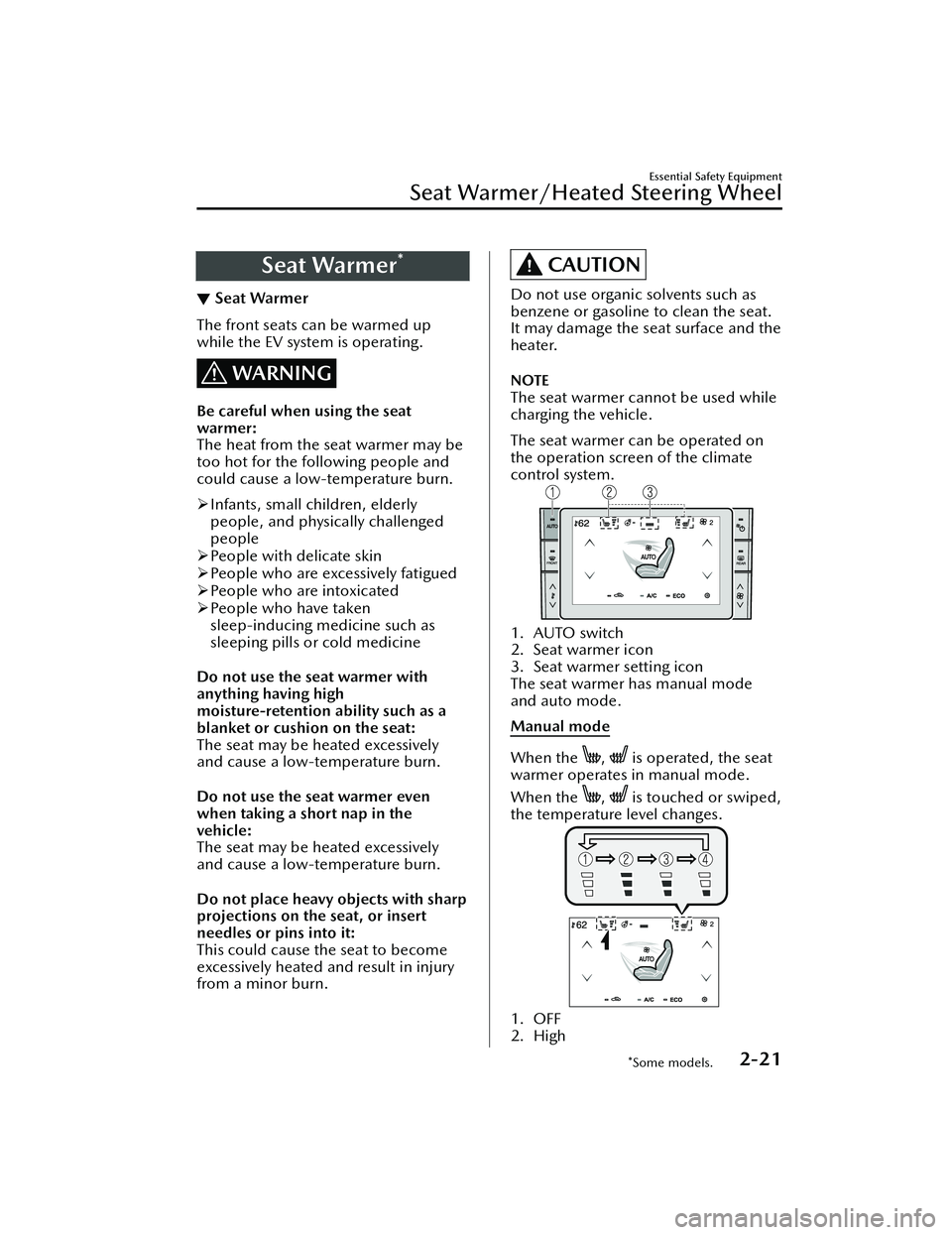
The seat warmer can be operated on
the operation screen of the climate
control system.
1. AUTO switch
2. Seat warmer icon
3. Seat warmer setting icon
The seat warmer has manual mode
and auto mode.
Manual mode
When the , is operated, the seat
warmer operates in manual mode.
When the
, is touched or swiped,
the temperature level changes.
1. OFF
2. High
Essential Safety Equipment
Seat Warmer/Heated Steering Wheel
*Some models.2-21
MX -30_8JD4-EA -21G_Edition2_new 2021-5-18 14:38:07
Page 43 of 547

Seat Belt Precautions
▼Seat Belt Precautions
Seat belts help to decrease the
possibility of severe injury during
accidents and sudden stops. Mazda
recommends that the driver and all
passengers always wear seat belts.
All the seats have lap/shoulder belts.
These belts have retractors with inertia
locks that keep them out of the way
when not in use. The locks allow the
belts to remain comfortable on users,
but they will lock in position during a
collision.
However, the front passenger's seat
and all rear lap/shoulder belt
retractors operate in two modes:
emergency locking mode, and for
child-restraint systems, automatic
locking mode. While we recommend
you put all children in the rear seats, if
you must use the front passenger seat
for a child, slide the front passenger
seat as far back as possible and make
sure any child-restraint system is
secured properly.
WARNING
Always wear your seat belt and make
sure all occupants are properly
restrained:
Not wearing a seat belt is extremely
dangerous. During a collision,
occupants not wearing seat belts could
hit someone or things inside the
vehicle or even be thrown out of the
vehicle. They could be seriously injured
or even killed. In the same collision,
occupants wearing seat belts would be
much safer.
Do not wear twisted seat belts:
Twisted seat belts are dangerous. In a
collision, the full width of the belt is
not available to absorb the impact.
This puts more force on the bones
beneath the belt, which could cause
serious injury or death. So, if your seat
belt is twisted, you must straighten the
seat belt to remove any twists and to
allow the full width of the belt to be
used.
Never use one seat belt on more than
one person at a time:
Using one seat belt for more than one
person at a time is dangerous. A seat
belt used in this way cannot spread the
impact forces properly and the two
passengers could be crushed together
and seriously injured or even killed.
Never use one belt for more than one
person at a time and always operate
the vehicle with each occupant
properly restrained.
Do not operate a vehicle with a
damaged seat belt:
Using a damaged seat belt is
dangerous. An accident could damage
the belt webbing of the seat belt in
use. A damaged seat belt cannot
provide adequate protection in a
collision. Have an Authorized Mazda
Dealer inspect all seat belt systems in
use during an accident before they are
used again.
Essential Safety Equipment
Seat Belt Systems
2-26
MX
-30_8JD4-EA -21G_Edition2_new 2021-5-18 14:38:07
Page 52 of 547

Child-RestraintPrecautions
▼ Child-Restraint Precautions
Mazda strongly urges the use of
child-restraint systems for children
small enough to use them.
You are required by law to use a
child-restraint system for children in
the U.S. and Canada.
Check your local and state or
provincial laws for speci
fic
requirements regarding the safety of
children riding in your vehicle.
Whatever child-restraint system you
consider, please pick the appropriate
one for the age and size of the child,
obey the law and follow the
instructions that come with the
individual child-restraint system.
A child who has outgrown
child-restraint systems should sit in the
rear and use seat belts, both lap and
shoulder. If the shoulder belt crosses
the neck or face, move the child closer
to the center of the vehicle in the
outboard seats, and towards the
buckle on the right if the child is seated
on the center seat.
Statistics con firm that the rear seat is
the best place for all children up to 12
years of age, and more so with a
supplemental restraint system (air
bags).
A rear-facing child-restraint system
should NEVER be used on the front
seat with the air bag system activated.
The front passenger's seat is also the
least preferred seat for other
child-restraint systems.
To reduce the chance of injuries
caused by deployment of the front
passenger air bag , the front passenger
seat weight sensors occupant
classi fication sensor works as a part of
the supplemental restraint system. This
system deactivates the front passenger
front and side air bags and knee air
bags, and also the front passenger seat
belt pretensioner system when the
front passenger air bag deactivation
indicator light illuminates.
When an infant or small child sits on
the front passenger seat, the system
shuts o ff the front passenger front and
side air bags and knee air bags, and
seat belt pretensioner system, so make
sure the front passenger air bag
deactivation indicator light illuminates.
Even if the front passenger air bag is
shut o ff, Mazda strongly recommends
that children be properly restrained
and child-restraint systems of all kinds
are properly secured on the rear seats
which are the best place for children.
For more details, refer to "Front
passenger seat weight sensors" (page
2-64).
Essential Safety Equipment
Child Restraint
2-35
MX -30_8JD4-EA -21G_Edition2_new 2021-5-18 14:38:07
Page 54 of 547

Do not install a front-facing
child-restraint system on the front
passenger seat unless it is
unavoidable:
In a collision, the force of a deploying
air bag could cause serious injury or
death to the child. If installing a
front-facing child-restraint system on
the front passenger seat is
unavoidable, move the front passenger
seat as far back as possible.
Seating a child in a child-restraint
system on the front passenger seat is
dangerous under certain conditions :
Your vehicle is equipped with front
passenger seat weight sensors. Even
with the front passenger seat weight
sensors, if you must use the front
passenger seat to seat a child, using a
child-restraint system on the front
passenger seat under the following
conditions increases the danger of the
front passenger air bag deploying and
could result in serious injury or death
to the child.
The front passenger air bag
deactivation indicator light does not
illuminate when seating a child in the
child-restraint system.
Luggage or other items are placed on
the seat with the child in the
child-restraint system.
A rear passenger or luggage pushing
or pulling down on the front
passenger seatback.
Luggage or other items are placed on
the seatback or hung on the head
restraint.
The seat is washed.
Liquids are spilled on the seat.
The front passenger seat is moved
backward, pushing into luggage or
other items placed behind it.
The front passenger seatback
contacts the rear seat.
Luggage or other items are placed
between the front passenger seat
and driver seat.
An electric device is put on the front
passenger's seat.
An additional electrical device, such
as a seat warmer is installed to the
surface of the front passenger seat.
Any accessories, which might
increase the total seated weight on
the front passenger seat, are
attached to the front passenger seat.
The designated positions with seat
belts on the rear seats are the safest
places for children. Always use seat
belts and child restraints.
Essential Safety Equipment
Child Restraint
2-37
MX -30_8JD4-EA -21G_Edition2_new 2021-5-18 14:38:07
Page 55 of 547
Do not allow a child or anyone to
lean over to or against the side
window of a vehicle with side and
curtain air bags:
It is dangerous to allow anyone to lean
over to or against the side window, the
area of the front passenger seat, the
front and rear window pillars and the
roof edge along both sides from which
the side and curtain air bags deploy,
even if a child-restraint system is used.
The impact of inflation from a side or
curtain air bag could cause serious
injury or death to an out of position
child. Furthermore, leaning over to or
against the door could block the side
and curtain air bags and eliminate the
advantages of supplemental
protection. Because the front seats are
equipped with fron t air bags, the rear
seat is always a better location for
children. Take special care not to allow
a child to lean over to or against the
side window, even if the child is seated
in a child-restraint system.
Never use one seat belt on more than
one person at a time:
Using one seat belt for more than one
person at a time is dangerous. A seat
belt used in this way cannot spread the
impact forces properly and the two
passengers could be crushed together
and seriously injured or even killed.
Never use one belt for more than one
person at a time and always operate
the vehicle with each occupant
properly restrained.
CAUTION
A seat belt or child-restraint system can
become very hot in a closed vehicle
during warm weather. To avoid burning
yourself or a child, check them before
you or your child touches them.
NOTE
Your Mazda is equipped with LATCH
lower anchors for attachment of
specially designed LATCH
child-restraint systems on the rear
seats. When using these anchors to
secure a child-restraint system, refer to
"Using LATCH Lower Anchor" (page
2-47).
Essential Safety Equipment
Child Restraint
2-38
MX -30_8JD4-EA -21G_Edition2_new 2021-5-18 14:38:07
Page 56 of 547

Child-Restraint SystemInstallation
▼Categories of Child-Restraint
Systems
NOTE
When purchasing, ask the
manufacturer of the child-restraint
system which type of child-restraint
system is appropriate for your child
and vehicle.
Please comply with the legal
regulations concerning the use of
child-restraint systems in your country.
▼
Child-Restraint System Types
In this owner's manual, explanation of
child-restraint systems is provided for
the following three types of popular
child-restraint systems: infant seat,
child seat, booster seat.
NOTE
Installation position is determined by
the type of child-restraint system.
Always read the manufacturer's
instructions and this owner's manual
carefully.
Due to variations in the design of
child-restraint systems, vehicle seats
and seat belts, all child-restraint
systems may not
fit all seating
positions. Before purchasing a
child-restraint system, it should be
tested in the speci fic vehicle seating
position (or positions) where it is
intended to be used. If a previously
purchased child-restraint system
does not fit, you may need to
purchase a di fferent one that will.
Infant seat
An infant seat provides restraint by
bracing the infant's head, neck and
back against the seating surface.
Child seat
A child seat restrains a child's body
using the harness.
Booster seat
A booster seat is a child restraint
accessory designed to improve the fit
of the seat belt system around the
child's body.
1. Full booster seat
2. Backless booster seat
When using a backless booster seat,
always install the vehicle head restraint
Essential Safety Equipment
Child Restraint
2-39
MX -30_8JD4-EA -21G_Edition2_new 2021-5-18 14:38:07
Page 58 of 547

Installing Child-RestraintSystems
▼Installing Child-Restraint Systems
Accident statistics reveal that a child is
safer in the rear seat. The front
passenger's seat is clearly the worst
choice for any child under 12, and
with rear-facing child-restraint systems
it is clearly unsafe due to air bags.
NOTE
Even if your vehicle is equipped with
front passenger occupant classi
fication
sensor (page 2-64), which
automatically deactivates the front
passenger air bag , a rear seat is the
safest place for a child of any age or
size.
Some child-restraint systems now
come with tethers and therefore must
be installed on the seats that take
tethers to be e ffective. In your Mazda,
tethered child-restraint systems can
only be accommodated in the three
positions on the rear seat.
Some child-restraint systems also
employ specially designed LATCH
attachments; refer to "Using LATCH
Lower Anchor" (page 2-47).
WARNING
Tethered Child-Restraint Systems
Work Only on Tether-Equipped Rear
Seats:
Installation of a tether equipped
child-restraint system in the front
passenger's seat defeats the safety
design of the system and will result in
an increased chance of serious injury if
the child-restraint system goes forward
without bene fit of being tethered.
Place tether equipped child-restraint
systems where there are tether
anchors.
▼ Anchor Bracket
Anchor brackets for securing
child-restraint systems are equipped in
the vehicle. Locate each anchor
position using the illustration.
To install a child-restraint system,
remove the head restraint. Always
follow the instruction manual
accompanying the child-restraint
system.
Anchor bracket location
Use the indicated anchor bracket
locations when installing a
child-restraint syst
em equipped with a
tether.
1. For right
2. For center
3. For left
Essential Safety Equipment
Child Restraint
2-41
MX -30_8JD4-EA -21G_Edition2_new 2021-5-18 14:38:07
Page 62 of 547
NOTE
To check if your front seats have side
air bags:
Mazda vehicles equipped with side
air bag will have a "SRS AIRBAG" tag
on the outboard shoulder of the
front seats.
To check if your vehicle has curtain
air bags:
Mazda vehicles equipped with
curtain air bag will have an "SRS
AIRBAG" marking on the window
pillars along the roof edge.
WARNING
Always move the front passenger seat
as far back as possible if installing a
front-facing child-restraint system on
it is unavoidable:
As your vehicle has front air bags and
doubly so because your vehicle has
side air bags, a front-facing
child-restraint system should be put on
the front passenger seat only when it is
unavoidable.
Even if the front passenger air bag
deactivation indicator light illuminates,
always move the seat as far back as
possible, because the force of a
deploying air bag could cause serious
injury or death to the child.
Never use a rear-facing child-restraint
system in the front seat with an air
bag that could deploy:
Rear-facing child-restraint systems on
the front seat are particularly
dangerous.
Even in a moderate collision, the
child-restraint system can be hit by a
deploying air bag and moved violently
backward resulting in serious injury or
death to the child. Even though you
may feel assured that the front
passenger air bag will not deploy
based on the fact that the front
passenger air bag deactivation
indicator light illuminates, you should
not use a rear-facing child-restraint
system in the front seat.
Do not allow a child or anyone to
lean over to or against the side
window of a vehicle with side and
curtain air bags:
It is dangerous to allow anyone to lean
over to or against the side window, the
area of the front passenger seat, the
front and rear window pillars and the
roof edge along both sides from which
the side and curtain air bags deploy,
even if a child-restraint system is used.
The impact of inflation from a side or
curtain air bag could cause serious
injury or death to an out of position
child. Furthermore, leaning over to or
against the door could block the side
and curtain air bags and eliminate the
advantages of supplemental
protection. Because the front seats are
equipped with fron t air bags, the rear
seat is always a better location for
children. Take special care not to allow
a child to lean over to or against the
side window, even if the child is seated
in a child-restraint system.
Essential Safety Equipment
Child Restraint
2-45
MX -30_8JD4-EA -21G_Edition2_new 2021-5-18 14:38:07
Page 64 of 547

8. Switch the power switch ON andmake sure the front passenger air
bag deactivation indicator light
illuminates after installing a
child-restraint system on the front
passenger seat.
If the front passenger air bag
deactivation indicator light does
not illuminate, remove the
child-restraint system, switch the
power switch to OFF, and then
re-install the child-restraint system
(page 2-64).
WARNING
Do not seat a child in a child-restraint
system on the front passenger seat if
the front passenger air bag
deactivation indicator light does not
illuminate:
While it is always better to install any
child-restraint system on the rear seat,
it is imperative that a child-restraint
system ONLY be used on the front
passenger seat if the deactivation
indicator light illuminates when the
child is seated in the child-restraint
system (page 2-64). Seating a child in
a child-restraint system installed on the
front passenger seat with the front
passenger air bag deactivation
indicator light not illuminated is
dangerous. If this indicator light does
not illuminate, this means that the
front passenger front and side air bags,
and knee air bags, and seat belt
pretensioners are ready for
deployment. If an accident were to
deploy an air bag , a child in a
child-restraint system sitting in the
front passenger seat could be seriously
injured or killed. If the indicator light
does not illuminate after seating a
child in a child-restraint system on the
front passenger seat, seat a child in a
child-restraint system on the rear seat
and consult an Authorized Mazda
Dealer as soon as possible.
▼ Using LATCH Lower Anchor
Your Mazda is equipped with LATCH
lower anchors for attachment of
specially designed LATCH
child-restraint systems in the rear seats.
Both anchors must be used, otherwise
the seat will bounce around and put
the child in danger. Most LATCH
child-restraint systems must also be
used in conjunction with a tether to be
e
ff ective. If they have a tether you must
use it to better assure your child's
safety.
Essential Safety Equipment
Child Restraint
2-47
MX -30_8JD4-EA -21G_Edition2_new 2021-5-18 14:38:07