brake MAZDA MODEL MX-5 2006 (in English) Service Manual
[x] Cancel search | Manufacturer: MAZDA, Model Year: 2006, Model line: MODEL MX-5, Model: MAZDA MODEL MX-5 2006Pages: 366, PDF Size: 6.35 MB
Page 279 of 366

Black plate (279,1)
Brake/Clutch Fluid
qInspecting Brake/Clutch Fluid Level
The brakes and clutch draw fluid from the
same reservoir.
Inspect the fluid level in the reservoir
regularly. It should be kept at MAX.
The level normally drops with
accumulated distance, a condition
associated with wear of brake and clutch
linings. If it is excessively low, have the
brake/clutch system inspected by an
Authorized Mazda Dealer.
qAdding Brake/Clutch Fluid
WARNING
Spilled Brake Fluid:
Spilled brake fluid is dangerous. If it
gets in your eyes, they could be
seriously injured. If this happens,
immediately flush your eyes with water
and get medical attention. Brake fluid
spilled on a hot engine could cause a
fire. Be careful not to spill brake fluid
on yourself or on the engine.
Low Brake/Clutch Fluid Levels:
Low brake/clutch fluid levels are
dangerous. Low levels could signal
brake lining wear or a brake system
leak. Your brakes could fail and cause
an accident. If you find a low fluid
level, have the brakes and clutch
inspected.
If the fluid level is low, add fluid until it
reaches MAX.
Before adding fluid, thoroughly clean the
area around the cap.
CAUTION
lBrake and clutch fluid will damage
painted surfaces. If brake or clutch
fluid does get on a painted surface,
wipe it off immediately.
lUsing nonspecified brake and clutch
fluids (page 10-4) will damage the
systems. Mixing different fluids will
also damage them.
If the brake/clutch system frequently
requires new fluid, consult an
Authorized Mazda Dealer.
Maintenance and Care
Owner Maintenance
8-21
MX-5_8U35-EA-05F_Edition1 Page279
Monday, April 18 2005 4:20 PM
Form No.8U35-EA-05F
Page 292 of 366

Black plate (292,1)
Light Bulbs
High-mount brake light
License plate lights
Trunk light
Reverse lights
Rear turn signal lights
Brake lights / Taillights
Side-marker lights
Overhead light
Head lights (High beam)
Parking light
Fog lights
Headlights (Low beam)
Front turn signal lights
Side-marker lightsSome models.
8-34
Maintenance and Care
Owner Maintenance
MX-5_8U35-EA-05F_Edition1 Page292
Monday, April 18 2005 4:20 PM
Form No.8U35-EA-05F
Page 297 of 366

Black plate (297,1)
2. Disconnect the bulb from the socket.
3. Install the new bulb in the reverse order
of removal.
Front side-marker lights
1. Slide the unit as shown in the figure to
remove it.
2. Turn the socket and bulb assembly
counterclockwise and remove it.3. Disconnect the bulb from the socket.
4. Install the new bulb in the reverse order
of removal.
Brake lights/Taillights, Rear turn signal
lights, Reverse lights
1. Pull the center section of the plastic
retainers and remove them, then
remove the trunk end trim.
Removal
Installation
Maintenance and Care
Owner Maintenance
8-39
MX-5_8U35-EA-05F_Edition1 Page297
Monday, April 18 2005 4:20 PM
Form No.8U35-EA-05F
Page 298 of 366

Black plate (298,1)
2. On the side the bulb is to be replaced,
pull the center section of the plastic
retainers and remove them, then
remove the trunk side trim.
Removal
Installation
3. Turn the socket and bulb assembly
counterclockwise and remove it.
4. Disconnect the bulb from the socket.
Brake lights/Taillights
Rear turn signal lights
Reverse lights
5. Install the new bulb in the reverse order
of removal.
qReplacing Interior Light Bulbs
Overhead light
1. Wrap a flathead screwdriver with a soft
cloth to prevent damage to the trim and
gently insert it in the overhead light as
shown in the figure, and then remove
the cover.
2. Disconnect the bulb by pulling it out.
3. Install the new bulb in the reverse order
of removal.
8-40
Maintenance and Care
Owner Maintenance
MX-5_8U35-EA-05F_Edition1 Page298
Monday, April 18 2005 4:20 PM
Form No.8U35-EA-05F
Page 302 of 366

Black plate (302,1)
DESCRIPTIONFUSE
RATINGPROTECTED COMPONENT
17 BTN 30 A For protection of various circuits
18 MAIN 120 A For protection of all circuits
19 EGI INJ 10 A Injector
20 EGI COMP1 10 A Engine control system
21 EGI COMP2 10 A Engine control system
22 HEAD LOW L 15 A Headlight low beam (LH)
23 HEAD LOW R 15 A Headlight low beam (RH)
24 HEAD 15 A Headlight high beams
25 P.WIND 20 A Power windows
26 ENGINE 15 A Engine control system
27 WIPER 20 A Windshield wipers and washer
28 DRL 15 A DRL
í, Headlight levellingí
29 HORN 15 A Horn
30 STOP 10 A Brake lights
31 ETV 10 A Electric throttle valve
32 FUEL PUMP 15 A Fuel Pump
33 HAZARD 10 A Turn signals, Hazard warning flashers
34 P.WIND2 20 A―
35 IG KEY1 40 A For protection of various circuits
8-44
Maintenance and Care
íSome models.
Owner Maintenance
MX-5_8U35-EA-05F_Edition1 Page302
Monday, April 18 2005 4:20 PM
Form No.8U35-EA-05F
Page 307 of 366

Black plate (307,1)
Insects, tar, tree sap, bird droppings,
industrial fallout, and similar deposits can
damage the finish if not removed
immediately. When prompt washing with
plain water is ineffective, use a mild soap
made for use on vehicles.
Thoroughly rinse off all soap with
lukewarm or cold water. Don't allow soap
to dry on the finish.
After washing the vehicle, dry it with a
clean chamois to prevent water spots from
forming.
WARNING
Driving with Wet Brakes:
Driving with wet brakes is dangerous.
Increased stopping distance or the
vehicle pulling to one side when
braking could result in a serious
accident. Light braking will indicate
whether the brakes have been affected.
Dry the brakes by driving very slowly
and applying the brakes lightly until
brake performance is normal.
Waxing
Your vehicle needs to be waxed when
water no longer beads on the finish.
Always wash and dry the vehicle before
waxing it. In addition to the vehicle body,
wax the metal trim to maintain its luster.
1. Use wax which contains no abrasives.
Waxes containing abrasive will remove
paint and could damage bright metal
parts.
2. Use a good grade of natural wax for
metallic, mica, and solid colors.3. When waxing, coat evenly with the
sponge supplied or a soft cloth.
4. Wipe off the wax with a soft cloth.
NOTE
A spot remover to remove oil, tar, and
similar materials will usually also take
off the wax. Rewax these areas even if
the rest of the vehicle doesn't need it.
qRepairing Damage to the Finish
Deep scratches or chips on the finish
should be repaired promptly. Exposed
metal quickly rusts and can lead to major
repairs.
CAUTION
If your Mazda is damaged and needs
metal parts repaired or replaced, make
sure the body shop applies anti-
corrosion materials to all parts, both
repaired and new. This will prevent
them from rusting.
qBright-Metal Maintenance
lUse tar remover to remove road tar and
insects. Never do this with a knife or
similar tool.
lTo prevent corrosion on bright-metal
surfaces, apply wax or chrome
preservative and rub it to a high luster.
lDuring cold weather or in coastal areas,
cover bright-metal parts with a coating
of wax or preservative heavier than
usual. It would also help to coat them
with noncorrosive petroleum jelly or
some other protective compound.
Maintenance and Care
Appearance Care
8-49
MX-5_8U35-EA-05F_Edition1 Page307
Monday, April 18 2005 4:20 PM
Form No.8U35-EA-05F
Page 308 of 366

Black plate (308,1)
CAUTION
Don't use steel wool, abrasive cleaners,
or strong detergents containing highly
alkaline or caustic agents on chrome-
plated or anodized aluminum parts.
This may result in damage to the
protective coating and cause
discoloration or paint deterioration.
qUnderbody Maintenance
Road chemicals and salt used for ice and
snow removal and solvents used for dust
control may collect on the underbody. If
not removed, they will speed up rusting
and deterioration of such underbody parts
as fuel lines, frame, floor pan, and exhaust
system, even though these parts may be
coated with anti-corrosive material.
Thoroughly flush the underbody and
wheel housings with lukewarm or cold
water at the end of each winter. Try also
to do this every month.
Pay special attention to these areas
because they easily hide mud and dirt.It
will do more harm than good to wet
down the road grime without removing
it.
The lower edges of doors, rocker panels,
and frame members have drain holes that
should not be clogged. Water trapped
there will cause rusting.
WARNING
Driving with Wet Brakes:
Driving with wet brakes is dangerous.
Increased stopping distance or the
vehicle pulling to one side when
braking could result in a serious
accident. Light braking will indicate
whether the brakes have been affected.
Dry the brakes by driving very slowly
and applying the brakes lightly until
brake performance is normal.
qAluminum Wheel Maintenance
A protective coating is provided over the
aluminum wheels. Special care is needed
to protect this coating.
NOTE
lDon't use a wire brush or any
abrasive cleaner, polishing
compound, or solvent on aluminum
wheels. They may damage the
coating.
lOnly use a mild soap or neutral
detergent and always use a sponge or
soft cloth to clean the wheels.
Rinse thoroughly with lukewarm or
cold water. Also, be sure to clean the
wheels after driving on dusty or
salted roads. This helps prevent
corrosion.
lAvoid washing your vehicle in an
automatic car wash that uses high-
speed or hard brushes.
lIf your aluminum wheels lose luster,
wax the wheels.
8-50
Maintenance and Care
Appearance Care
MX-5_8U35-EA-05F_Edition1 Page308
Monday, April 18 2005 4:20 PM
Form No.8U35-EA-05F
Page 338 of 366

Black plate (338,1)
NOTE
Warm tires normally exceed recommended pressures. Don't release air from warm tires
to adjust the pressure.
Under-inflation can cause serious failures and accidents.
Over-inflation can produce a harsh ride and the greater possibility of damage from road
hazards.
qGlossary of Terms
Tire Placard:A label indicating the OE tire sizes, recommended inflation pressure, and
the maximum weight the vehicle can carry.
Tire Identification Number (TIN):A number on the sidewall of each tire providing
information about the tire brand and manufacturing plant, tire size, and date of
manufacture.
Inflation Pressure:A measure of the amount of air in a tire.
kPa:Kilopascal, the metric unit for air pressure.
psi:Pounds per square inch, the English unit for air pressure.
B-pillar:The structural member at the side of the vehicle behind the front door.
Original Equipment (OE):Describes components originally equipped on the vehicle.
Vehicle Load Limit:The maximum value of the combined weight of occupants and cargo.
Bead Area of the Tire:Area of the tire next to the rim.
Sidewall Area of the Tire:Area between the bead area and the tread.
Tread Area of the Tire:Area on the perimeter of the tire that contacts the road when it's
mounted on the vehicle.
Seating capacitymeans the total allowable number of vehicle occupants. Seating capacity
is described on the tire label.
Production options weightis the combined weight of installed regular production options
weighing over 2.3 kilograms in excess of the standard items which they replace, and not
previously considered in the curb weight or accessory weight, including heavy duty brakes,
ride levelers, roof rack, heavy duty battery, and special trim.
Rimis the metal support (wheel) for a tire or a tire and tube assembly upon which the tire
beads are seated.
9-26
Customer Information and Reporting Safety Defects
Tire Information (U.S.A.)
MX-5_8U35-EA-05F_Edition1 Page338
Monday, April 18 2005 4:20 PM
Form No.8U35-EA-05F
Page 342 of 366

Black plate (342,1)
Vehicle Loading
This section will guide you in the proper loading of your vehicle and/or trailer, to keep
your loaded vehicle weight within its design rating capability, with or without a trailer.
Properly loading your vehicle will provide maximum return of vehicle design performance.
Before loading your vehicle, familiarize yourself with the following terms for determining
your vehicle's weight ratings, with or without a trailer, from the vehicle's Safety
Certification Label and Tire and Load Information Label:
WARNING
Overloaded Vehicle:
Overloading a vehicle is dangerous. The results of overloading can have serious
consequences in terms of passenger safety. Too much weight on a vehicle's suspension
system can cause spring or shock absorber failure, brake failure, handling or steering
problems, irregular tire wear, tire failure or other damage.
Overloading makes a vehicle harder to drive and control. It also increases the distance
required for stopping. In cases of serious overloading, brakes can fail completely,
particularly on steep grades. The load a tire will carry safely is a combination of the
size of the tire, its load range, and corresponding inflation pressure.
Never overload the vehicle and always observe the vehicle's weight ratings from the
vehicle's Safety Certification and Tire and Load Information labels.
Base Curb Weight is the weight of the vehicle including a full tank of fuel and all
standard equipment. It does not include passengers, cargo, or optional equipment.
9-30
Customer Information and Reporting Safety Defects
Tire Information (U.S.A.)
MX-5_8U35-EA-05F_Edition1 Page342
Monday, April 18 2005 4:20 PM
Form No.8U35-EA-05F
Page 347 of 366
Black plate (347,1)
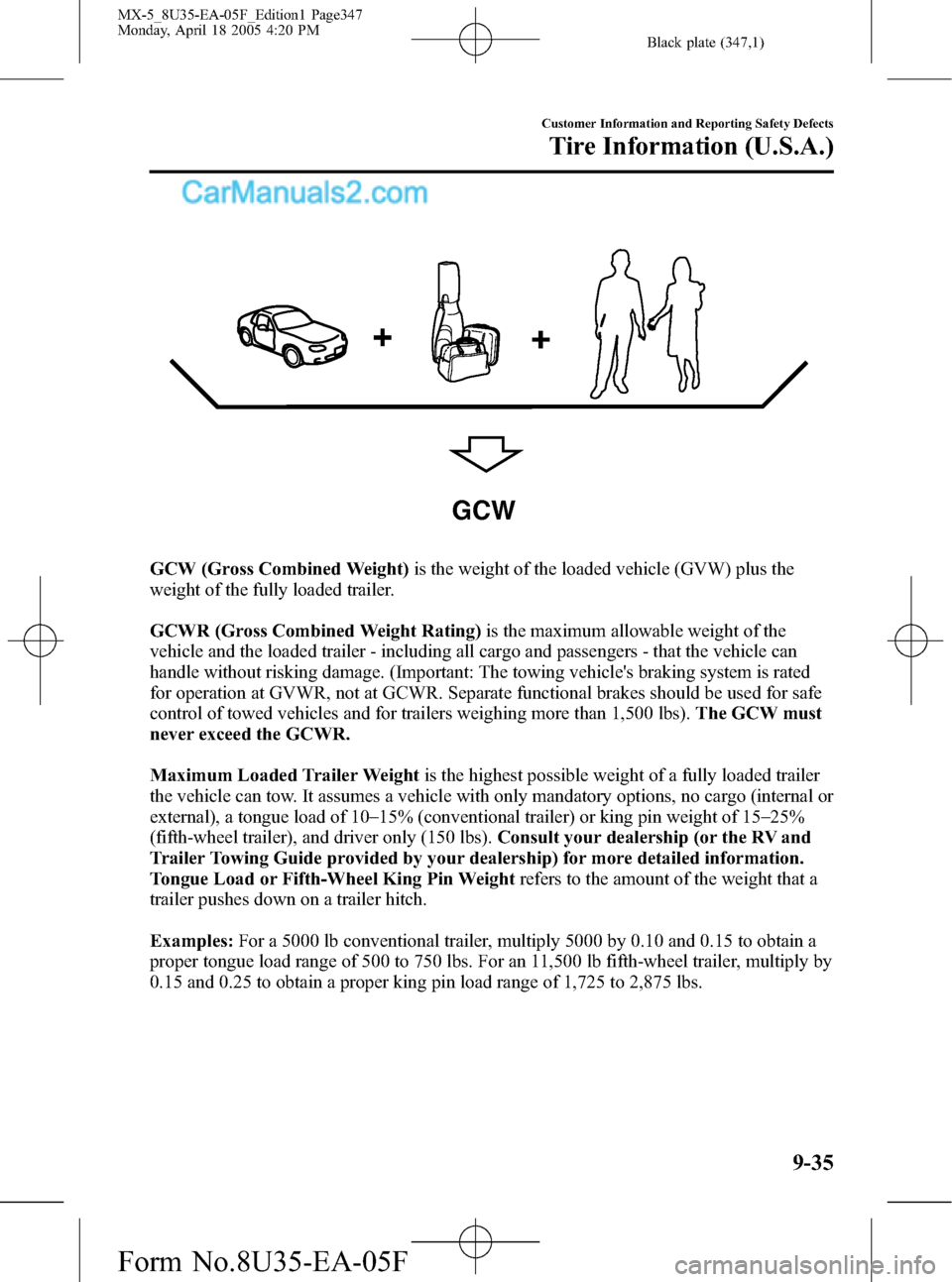
GCW
GCW (Gross Combined Weight)is the weight of the loaded vehicle (GVW) plus the
weight of the fully loaded trailer.
GCWR (Gross Combined Weight Rating)is the maximum allowable weight of the
vehicle and the loaded trailer - including all cargo and passengers - that the vehicle can
handle without risking damage. (Important: The towing vehicle's braking system is rated
for operation at GVWR, not at GCWR. Separate functional brakes should be used for safe
control of towed vehicles and for trailers weighing more than 1,500 lbs).The GCW must
never exceed the GCWR.
Maximum Loaded Trailer Weightis the highest possible weight of a fully loaded trailer
the vehicle can tow. It assumes a vehicle with only mandatory options, no cargo (internal or
external), a tongue load of 10_
15% (conventional trailer) or king pin weight of 15_
25%
(fifth-wheel trailer), and driver only (150 lbs).Consult your dealership (or the RV and
Trailer Towing Guide provided by your dealership) for more detailed information.
Tongue Load or Fifth-Wheel King Pin Weightrefers to the amount of the weight that a
trailer pushes down on a trailer hitch.
Examples:For a 5000 lb conventional trailer, multiply 5000 by 0.10 and 0.15 to obtain a
proper tongue load range of 500 to 750 lbs. For an 11,500 lb fifth-wheel trailer, multiply by
0.15 and 0.25 to obtain a proper king pin load range of 1,725 to 2,875 lbs.
Customer Information and Reporting Safety Defects
Tire Information (U.S.A.)
9-35
MX-5_8U35-EA-05F_Edition1 Page347
Monday, April 18 2005 4:20 PM
Form No.8U35-EA-05F