air condition MAZDA MODEL MX-5 2006 Owners Manual (in English)
[x] Cancel search | Manufacturer: MAZDA, Model Year: 2006, Model line: MODEL MX-5, Model: MAZDA MODEL MX-5 2006Pages: 366, PDF Size: 6.35 MB
Page 3 of 366

Black plate (3,1)
Thank you for choosing a Mazda. We at Mazda design and build vehicles with complete
customer satisfaction in mind.
To help ensure enjoyable and trouble-free operation of your Mazda, read this manual
carefully and follow its recommendations.
An Authorized Mazda Dealer knows your vehicle best. So when maintenance or service is
necessary, that's the place to go.
Our nationwide network of Mazda professionals is dedicated to providing you with the best
possible service.
We assure you that all of us at Mazda have an ongoing interest in your motoring pleasure
and in your full satisfaction with your Mazda product.
Mazda Motor Corporation
HIROSHIMA, JAPAN
Important Notes About This Manual
Keep this manual in the glove box as a handy reference for the safe and enjoyable use of your Mazda. Should you
resell the vehicle, leave this manual with it for the next owner.
All specifications and descriptions are accurate at the time of printing. Because improvement is a constant goal at
Mazda, we reserve the right to make changes in specifications at any time without notice and without obligation.
Event Data Recorder
This vehicle is equipped with an event data recorder. In the event of a crash, this device records data related to
vehicle dynamics and safety systems for a short period of time. These data can help provide a better
understanding of the circumstances in which crashes and injuries occur and lead to the designing of safer
vehicles.
Air Conditioning and the Environment
Your Mazda's genuine air conditioner is filled with HFC134a (R134a), a refrigerant that has been found not to
damage the earth's ozone layer. If the air conditioner does not operate properly, consult an Authorized Mazda
Dealer.
Please be aware that this manual applies to all models, equipment and options. As a result, you may find
some explanations for equipment not installed on your vehicle.
©2005 Mazda Motor Corporation
Printed in Japan May 2005(Print1)
A Word to Mazda Owners
MX-5_8U35-EA-05F_Edition1 Page3
Monday, April 18 2005 4:17 PM
Form No.8U35-EA-05F
Page 5 of 366

Black plate (5,1)
MX-5_8U35-EA-05F_Edition1 Page5
Monday, April 18 2005 4:17 PM
Form No.8U35-EA-05F
Table of Contents
Your Vehicle at a Glance
Interior, exterior views and part identification of your Mazda.1
Essential Safety Equipment
Use of safety equipment, including seats, seat belt system, SRS air bags and
child-restraint systems.2
Knowing Your Mazda
Explanation of basic operations and controls; opening/closing and adjustment
of various parts.3
Before Driving Your Mazda
Important information about driving your Mazda.4
Driving Your Mazda
Explanation of instruments and controls.5
Interior Comfort
Use of various features for drive comfort, including air-conditioning and audio
system.6
In Case of an Emergency
Helpful information on what to do in an emergency.7
Maintenance and Care
How to keep your Mazda in top condition.8
Customer Information and Reporting Safety Defects
Important consumer information including warranties and add-on equipment.9
Specifications
Technical information about your Mazda.10
Index11
Page 30 of 366

Black plate (30,1)
WARNING
Seating Children in a Child-Restraint System on the Passenger Seat:
This vehicle is equipped with both a passenger seat weight sensor and a passenger an
air bag deactivation indicator light (page 2-36). Even with the passenger seat weight
sensors, seating a child in a child-restraint system on the passenger seat under the
following conditions increases the danger of the passenger air bag deploying and
could result in serious injury or death to the child. These are among the reasons why
the passenger air bag should be turned off by using the key.
lThe total seated weight of the child with the child-restraint system on the passenger
seat is approximately 30 kg (66 lb) or more with a child in the child-restraint
system.
lLuggage or other items are placed on the seat with the child in the child-restraint
system.
lThe seat is washed.lLiquids are spilled on the seat.lThe passenger seat is moved backward, and it is pushed into luggage or other items
placed behind it.
lLuggage or other items are placed between the passenger seat and center console.lAny accessories which might increase the total seated weight on the passenger seat
are attached to the passenger seat.
Children and Seating Position with Side Air Bag:
Allowing anyone to lean over or against the door is dangerous. If the vehicle is
equipped with side air bags, the impact of an inflating side air bag could cause serious
injury or death to the person. Children are more likely to sleep in the vehicle; when
they do, they are more at risk in the passenger's seat that has a side air bag because
they may slump over into the path of the seatback-mounted air bag. Furthermore,
leaning over or against the doors could block the side air bag and eliminate the
advantages of supplemental protection. Because the side air bag deploys from the
outboard shoulder of the seat, do not allow the child to lean over or against the side
window, even if the child is seated in a child-restraint system.
One Belt, One Passenger:
Using one seat belt for more than one person at a time is dangerous. A seat belt used
in this way can't spread the impact forces properly and the two passengers could be
crushed together and seriously injured or even killed. Never use one belt for more
than one person at a time and always operate the vehicle with each occupant properly
restrained.
2-18
Essential Safety Equipment
Child Restraint
MX-5_8U35-EA-05F_Edition1 Page30
Monday, April 18 2005 4:17 PM
Form No.8U35-EA-05F
Page 42 of 366
Black plate (42,1)
Passenger Air Bag
Deactivation Switch
WARNING
Unnecessary Deactivation of
Passenger Air Bag:
Unnecessary deactivation of the
passenger air bag is dangerous. If
turned off unnecessarily, the
passenger will not receive the added
protection of the air bag. Serious
injuries or even death could occur.
With the exception of passengers
fitting the categories described below,
do not turn the air bag deactivation
switch to the OFF position.
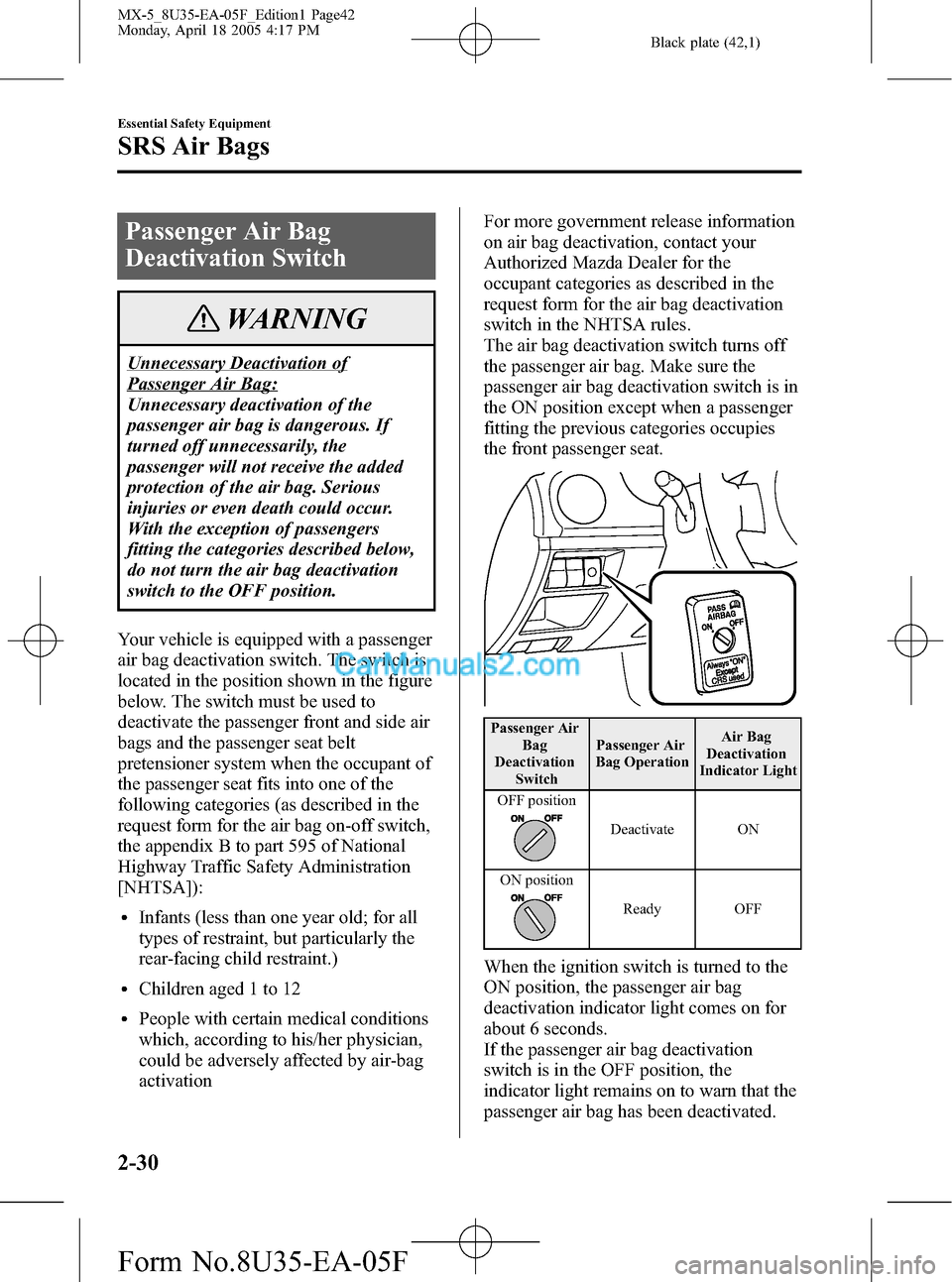
Your vehicle is equipped with a passenger
air bag deactivation switch. The switch is
located in the position shown in the figure
below. The switch must be used to
deactivate the passenger front and side air
bags and the passenger seat belt
pretensioner system when the occupant of
the passenger seat fits into one of the
following categories (as described in the
request form for the air bag on-off switch,
the appendix B to part 595 of National
Highway Traffic Safety Administration
[NHTSA]):
lInfants (less than one year old; for all
types of restraint, but particularly the
rear-facing child restraint.)
lChildren aged 1 to 12
lPeople with certain medical conditions
which, according to his/her physician,
could be adversely affected by air-bag
activationFor more government release information
on air bag deactivation, contact your
Authorized Mazda Dealer for the
occupant categories as described in the
request form for the air bag deactivation
switch in the NHTSA rules.
The air bag deactivation switch turns off
the passenger air bag. Make sure the
passenger air bag deactivation switch is in
the ON position except when a passenger
fitting the previous categories occupies
the front passenger seat.
Passenger Air
Bag
Deactivation
SwitchPassenger Air
Bag OperationAir Bag
Deactivation
Indicator Light
OFF position
Deactivate ON
ON position
Ready OFF
When the ignition switch is turned to the
ON position, the passenger air bag
deactivation indicator light comes on for
about 6 seconds.
If the passenger air bag deactivation
switch is in the OFF position, the
indicator light remains on to warn that the
passenger air bag has been deactivated.
2-30
Essential Safety Equipment
SRS Air Bags
MX-5_8U35-EA-05F_Edition1 Page42
Monday, April 18 2005 4:17 PM
Form No.8U35-EA-05F
Page 43 of 366

Black plate (43,1)
In addition to using the key to deactivate
the passenger air bag, the passenger air
bag is also deactivated and the passenger
air bag deactivation indicator light is
illuminated automatically when the total
seated weight on the passenger seat is less
than 30 kg (66 lb).
NOTE
Have the passenger air bag deactivation
switch inspected by an Authorized
Mazda Dealer if any of these conditions
occur:
lThe indicator light does not
illuminate when the ignition switch
is turned to the ON position.
lThe indicator light does not remain
on when the ignition switch is in the
ON position and the passenger air
bag deactivation switch is in the OFF
position.
lThe indicator remains on when the
ignition switch is in the ON position
and the passenger air bag
deactivation switch is in the ON
position.
qTo Deactivate the Passenger Air Bag
Before driving, always confirm that the
passenger air bag deactivation switch is in
the appropriate position according to your
requirements (page 2-30).
WARNING
Do not leave the Key in the Passenger
Air Bag Deactivation Switch:
Unintentional deactivation of the
passenger air bag is dangerous. In an
accident, the passenger will not be
properly protected. Serious injuries or
even death could occur. To avoid
unintentional deactivation, always use
the same key to operate the passenger
air bag deactivation switch and the
ignition switch, that way you won't
leave the key in the passenger air bag
deactivation switch.
1. Insert the key into the passenger air bag
deactivation switch and turn the key
clockwise until the key points to OFF.
2. Remove the key.
3. Make sure the air bag deactivation
indicator light remains illuminated
when the ignition is in the ON position.
Essential Safety Equipment
SRS Air Bags
2-31
MX-5_8U35-EA-05F_Edition1 Page43
Monday, April 18 2005 4:17 PM
Form No.8U35-EA-05F
Page 50 of 366

Black plate (50,1)
The passenger air bag deactivation indicator light illuminates or is off under the following conditions:
Total seated weight on the
passenger seatPassenger air bag
deactivation indicator lightPassenger front and side
air bagsPassenger seat belt
pretensioner system
Empty (Not occupied)
*OFF OFF OFF
Less than approx. 30 kg
(66 lb)ON OFF OFF
Approx. 42 kg (93 lb) or
moreOFF ON ON
If the passenger air bag has been deactivated using the key, the passenger air bag deactivation indicator light will
remain illuminated as long you leave the passenger air bag turned off, and the chart above no longer applies.
Refer to Passenger air bag deactivation switch on page 2-30.
* If the passenger seat belt is buckled, the passenger air bag deactivation indicator light illuminates, however this
does not indicate a malfunction.
If the passenger air bag deactivation indicator light does not illuminate when the ignition
switch is turned to the ON position and does not illuminate as indicated in the above chart,
do not allow a child to sit in the passenger seat and consult an Authorized Mazda Dealer as
soon as possible. The system may not work properly in an accident. You must deactivate
the passenger air bag using the key (page 2-30) and consult an Authorized Mazda Dealer.
WARNING
Decreasing the Total Seated Weight on the Passenger Seat:
When an adult or large child sits on the passenger seat, decreasing the total seated
weight on the passenger seat from the total seated weight of approximately 42 kg (93
lb) required for air bag deployment is dangerous. The passenger seat weight sensors
will detect the reduced total seated weight condition and the passenger front and side
air bags and seat belt pretensioner system will not deploy during an accident. The
passenger will not have the supplementary protection of the air bag, which could
result in serious injury. Decreasing the total seated weight on the passenger seat from
the total seated weight of approximately 42 kg (93 lb) could result in an air bag not
deploying under the following conditions, for example:
lLuggage or other items placed under the passenger seat or between the passenger
seat and center console that push up the passenger seat bottom.
lThe passenger seat occupant sits in a manner such that the occupant's entire
weight is not placed on the seat sitting too close to the door.
lAny accessories which might decrease the total seated weight on the passenger seat
are attached to the passenger seat.
The passenger front and side air bags and seat belt pretensioner systems will
deactivate if the total seated weight on the passenger seat is close to 30 kg (66 lb) and
they will reactivate before the weight exceeds 42 kg (93 lb).
2-38
Essential Safety Equipment
SRS Air Bags
MX-5_8U35-EA-05F_Edition1 Page50
Monday, April 18 2005 4:17 PM
Form No.8U35-EA-05F
Page 51 of 366

Black plate (51,1)
WARNING
Increasing the Total Seated Weight on the Passenger Seat:
When an infant or small child sits on the passenger seat, increasing the total seated
weight on the passenger seat from the total seated weight of approximately 30 kg (66
lb) is dangerous. The passenger seat weight sensors will detect the increased total
seated weight, which could result in the unexpected deployment of the passenger front
and side air bags and seat belt pretensioner system in an accident and serious injury.
Increasing the total seated weight on the passenger seat beyond the total seated weight
of approximately 30 kg (66 lb) could result in the passenger front and side air bags
and seat belt pretensioner system deployment in an accident under the following
conditions, for example:
lThe total seated weight of the child with the child-restraint system on the passenger
seat is approximately 30 kg (66 lb) or more.
lLuggage or other items are placed on the seat with the child in the child-restraint
system.
lThe seat is washed.lLiquids are spilled on the seat.lThe passenger seat is moved backward, and it is pushed into luggage or other items
placed behind it.
lLuggage or other items are placed between the passenger seat and center console.lAny accessories which might increase the total seated weight on the passenger seat
are attached to the passenger seat.
The passenger front and side air bags and seat belt pretensioner systems will
deactivate if the total seated weight on the passenger seat is close to 30 kg (66 lb) and
they will reactivate before the weight exceeds 42 kg (93 lb).
CAUTION
lTo assure proper deployment of the front air bag and to prevent damage to the sensors
in the seat bottoms:
lDo not place sharp objects on the seat bottoms or leave heavy luggage on them.lDo not spill any liquids on the seats or under the seats.
lTo allow the sensors to function properly, always perform the following:
lAdjust the seats as far back as possible and always sit upright against the seatbacks
with seat belts worn properly.
lIf you place your child on the passenger seat, secure the child-restraint system
properly and slide the passenger seat as far back as possible.
Essential Safety Equipment
SRS Air Bags
2-39
MX-5_8U35-EA-05F_Edition1 Page51
Monday, April 18 2005 4:17 PM
Form No.8U35-EA-05F
Page 57 of 366

Black plate (57,1)
lPassenger air bag deactivation
indicator light does not illuminate
when the ignition switch is turned to
the ON position or does not illuminate
as indicated in the chart or when you
manually deactivate the passenger air
bag with the key.
For more details about passenger air
bag deactivation, refer to:
lPassenger seat weight sensors (page
2-36)
lPassenger air bag deactivation
switch (page 2-30)
WARNING
Damaged Air Bag/Seat Belt
Pretensioner System Components:
Expended or damaged air bag or seat
belt pretensioner units must be
replaced after any collision which
caused them to deploy or damage
them. Only a trained Authorized
Mazda Dealer can fully evaluate these
systems to see that they will work in
the next accident. Driving with an
expended or damaged air bag or
pretensioner units will provide you
reduced protection in the next accident
and you could be injured or killed.
Removing Interior Parts:
Removing any components such as the
seats(if side air bags are equipped),
dashboard, the steering wheel or parts
containing air bag parts or sensors is
dangerous. These parts contain
essential air bag components. The air
bag could accidentally activate and
cause serious injuries. Always have an
Authorized Mazda Dealer remove
these parts.
WARNING
Air Bag Disposal:
Improper disposal of an air bag or a
vehicle with live air bags in it can be
extremely dangerous. Unless all safety
procedures are followed, injury can
result. Ask an Authorized Mazda
Dealer how to safely dispose of an air
bag or how to scrap an air bag
equipped vehicle.
NOTE
If it becomes necessary to have the
components or wiring system for the
supplementary restraint system
modified to accommodate a person with
certain medical conditions in
accordance with a certified physician,
contact an Authorized Mazda Dealer,
refer to“Customer Assistance (U.S.A.)”
(page 9-2).
Essential Safety Equipment
SRS Air Bags
2-45
MX-5_8U35-EA-05F_Edition1 Page57
Monday, April 18 2005 4:17 PM
Form No.8U35-EA-05F
Page 121 of 366

Black plate (121,1)
Break-In Period
No special break-in is necessary, but a few
precautions in the first 1,000 km (600
miles) may add to the performance,
economy, and life of your Mazda.
lDon't race the engine.
lDon't maintain one constant speed,
either slow or fast, for a long period of
time.
lDon't drive constantly at full-throttle or
high engine rpm for extended periods
of time.
lAvoid unnecessary hard stops.
lAvoid full-throttle starts.
Money-Saving Suggestions
How you operate your Mazda determines
how far it will travel on a tank of fuel. Use
these suggestions to help save money on
fuel and repairs.
lAvoid long warm-ups. Once the engine
runs smoothly, begin driving.
lAvoid fast starts.
lKeep the engine tuned. Follow the
maintenance schedule (page 8-3) and
have an Authorized Mazda Dealer
perform inspections and servicing.
lUse the air conditioner only when
necessary.
lSlow down on rough roads.
lKeep the tires properly inflated.
lDon't carry unnecessary weight.
lDon't rest your foot on the brake pedal
while driving.
lKeep the wheels in correct alignment.
lKeep windows closed at high speeds.
lSlow down when driving in crosswinds
and headwinds.
WARNING
Coasting:
Stopping the engine when going down
a hill is dangerous. This causes the
loss of power steering and power
brake control, and may cause damage
to the drivetrain. Any loss of steering
or braking control could cause an
accident. Never stop the engine when
going down a hill.
Before Driving Your Mazda
Driving Tips
4-7
MX-5_8U35-EA-05F_Edition1 Page121
Monday, April 18 2005 4:17 PM
Form No.8U35-EA-05F
Page 152 of 366

Black plate (152,1)
Dynamic Stability Control
(DSC)
í
The Dynamic Stability Control (DSC)
automatically controls braking and engine
torque in conjunction with systems such
as ABS and TCS to help control side slip
when driving on slippery surfaces, or
during sudden or evasive maneuvering,
enhancing vehicle safety.
Refer to ABS (page 5-7) and TCS (page
5-23).
WARNING
DSC and Unsafe Driving:
The dynamic stability control (DSC)
cannot compensate for unsafe and
reckless driving, excessive speed,
tailgating (following another vehicle
too closely), and hydroplaning
(reduced tire friction and road contact
because of water on the road surface).
You can still have an accident. So
don't rely on the dynamic stability
control as a substitute for safe driving.
CAUTION
lThe DSC may not operate correctly
unless the following are observed:
lUse tires of the correct size
specified for your Mazda on all
four wheels.
lUse tires of the same
manufacturer, brand and tread
pattern on all four wheels.
lDo not mix worn tires.
lThe DSC may not operate correctly
when using tire chains or the
temporary spare tire.
lIf repair or replacement of the
steering or other surrounding
equipment is necessary, have it done
at an Authorized Mazda Dealer. If
the center position of the steering
deviates, the DSC may not operate
correctly because there is a sensor in
the steering which detects driving
conditions.
qTCS/DSC Indicator Light
This indicator light stays on for a few
seconds when the ignition switch is turned
to the ON position. If the TCS or DSC is
operating, the indicator light flashes.
If the light stays on, the TCS or DSC may
have a malfunction and they may not
operate correctly. Take your vehicle to an
Authorized Mazda Dealer.
5-24
Driving Your Mazda
íSome models.
Starting and Driving
MX-5_8U35-EA-05F_Edition1 Page152
Monday, April 18 2005 4:18 PM
Form No.8U35-EA-05F