Placard MAZDA MODEL MX-5 MIATA 2006 Owners Manual
[x] Cancel search | Manufacturer: MAZDA, Model Year: 2006, Model line: MODEL MX-5 MIATA, Model: MAZDA MODEL MX-5 MIATA 2006Pages: 378, PDF Size: 4.01 MB
Page 163 of 378
Black plate (163,1)
Tire Pressure Monitoring
System
í
The tire pressure monitoring system
(TPMS) monitors the pressure for each
tire.
If tire pressure is too low in one or more
tires, the system will inform the driver via
the warning light in the instrument panel
and by the warning beep sound.
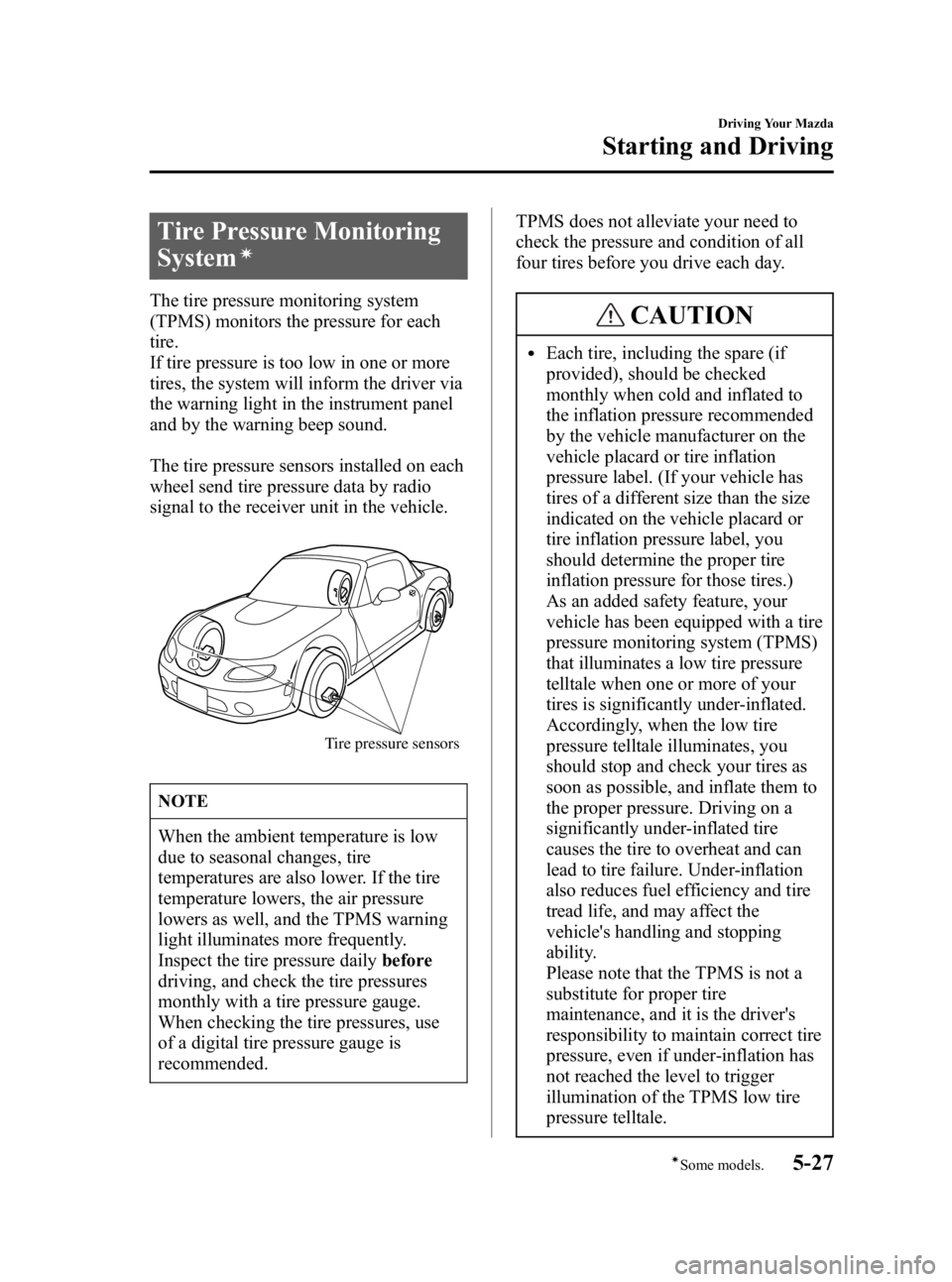
The tire pressure sensors installed on each
wheel send tire pressure data by radio
signal to the receiver unit in the vehicle.
Tire pressure sensors
NOTE
When the ambient temperature is low
due to seasonal changes, tire
temperatures are also lower. If the tire
temperature lowers, the air pressure
lowers as well, and the TPMS warning
light illuminates more frequently.
Inspect the tire pressure dailybefore
driving, and check the tire pressures
monthly with a tire pressure gauge.
When checking the tire pressures, use
of a digital tire pressure gauge is
recommended. TPMS does not alleviate your need to
check the pressure and condition of all
four tires before you drive each day.
CAUTION
lEach tire, including the spare (if
provided), should be checked
monthly when cold and inflated to
the inflation pressure recommended
by the vehicle manufacturer on the
vehicle placard or tire inflation
pressure label. (If your vehicle has
tires of a different size than the size
indicated on the vehicle placard or
tire inflation pressure label, you
should determine the proper tire
inflation pressure for those tires.)
As an added safety feature, your
vehicle has been equipped with a tire
pressure monitoring system (TPMS)
that illuminates a low tire pressure
telltale when one or more of your
tires is significantly under-inflated.
Accordingly, when the low tire
pressure telltale illuminates, you
should stop and check your tires as
soon as possible, and inflate them to
the proper pressure. Driving on a
significantly under-inflated tire
causes the tire to overheat and can
lead to tire failure. Under-inflation
also reduces fuel efficiency and tire
tread life, and may affect the
vehicle's handling and stopping
ability.
Please note that the TPMS is not a
substitute for proper tire
maintenance, and it is the driver's
responsibility to maintain correct tire
pressure, even if under-inflation has
not reached the level to trigger
illumination of the TPMS low tire
pressure telltale.
Driving Your Mazda
Starting and Driving
5-27íSome models.
MX-5_8U35-EA-05F_Edition4 Page163
Thursday, October 6 2005 11:3 AM
Form No.8U35-EA-05F
Page 325 of 378

Black plate (325,1)
9
Customer Information and Reporting
Safety Defects
Important consumer information including warranties and add-on equipment.
Customer Assistance ............................... 9-2 Customer Assistance (U.S.A.) ............ 9-2
Customer Assistance (Canada) ........... 9-4
Customer Assistance (Puerto Rico) .... 9-7
Mazda Importer/Distributors ................. 9-8 Importer/Distributor ............................ 9-8
Distributor in Each Area ..................... 9-8
Warranty .................................................. 9-9 Warranties for Your Mazda ................. 9-9
Outside the United States and
Canada .............................................. 9-10
Outside the United States .................. 9-11
Outside Canada ................................. 9-12
Registering Your Vehicle in A Foreign
Country (Except United States and
Canada) ............................................. 9-13
Add-On Non-Genuine Parts and
Accessories ....................................... 9-14
Cell Phones ............................................. 9-15 Cell Phones Warning ......................... 9-15
Uniform Tire Quality Grading System
(UTQGS) ................................................ 9-16 Uniform Tire Quality Grading System
(UTQGS) .......................................... 9-16
Tire Information (U.S.A.) ..................... 9-18 Tire Labeling ..................................... 9-18
Location of the Tire Label
(Placard) ............................................ 9-24
Tire Maintenance .............................. 9-27
Vehicle Loading ................................ 9-30
Steps for Determining the Correct Load
Limit: ................................................ 9-37 Reporting Safety Defects ....................... 9-38
Reporting Safety Defects (U.S.A.) .... 9-38
Reporting Safety Defects (Canada) ... 9-39
Service Publications .............................. 9-40 Service Publications .......................... 9-40
9-1
MX-5_8U35-EA-05F_Edition4 Page325
Thursday, October 6 2005 11:6 AM
Form No.8U35-EA-05F
Page 345 of 378
Black plate (345,1)
Tread Wear, Traction and Temperature Grades
Tread wear:The tread wear grade is a comparative rating based on the wear rate of the tire
when tested under controlled conditions on a specified government test course. For
example, a tire graded 150 would wear one and one-half (1 1/2) times as well on the
government course as a tire graded 100.
Traction: The traction grades, from highest to lowest are AA, A, B, and C. The grades
represent the tire's ability to stop on wet pavement as measured under controlled conditions
on specified government test surfaces of asphalt and concrete. A tire marked C may have
poor traction performance.
Temperature: The temperature grades are A (the highest), B and C, representing the tire's
resistance to the generation of heat and its ability to dissipate heat when tested under
controlled conditions on a specified indoor laboratory test wheel.
Snow Tires
In some heavy snow areas, local governments may require true snow tires, those with very
deeply cut tread. These tires should only be used in pairs or placed on all four wheels.
Make sure you purchase snow tires that are the same size and construction type as the other
tires on your vehicle.
SAFETY WARNING
The following safety warning appears on the tire's sidewall.
SERIOUS INJURY MAY RESULT FROM:
lEXPLOSION OF TIRE/RIM ASSEMBLY DUE TO IMPROPER MOUNTING-
MATCH TIRE DIAMETER TO RIM DIAMETER; NEVER EXCEED 40 psi (275 kPa)
TO SEAT BEADS-ONLY SPECIALLY TRAINED PERSONS SHOULD MOUNT
TIRES.
lTIRE FAILURE DUE TO UNDER-INFLATION/OVERLOADING/DAMAGE-
FOLLOW OWNER'S MANUAL AND PLACARD IN VEHICLE-FREQUENTLY
CHECK INFLATION PRESSURE AND INSPECT FOR DAMAGE.
Customer Information and Reporting Safety Defects
Tire Information (U.S.A.)
9-21
MX-5_8U35-EA-05F_Edition4 Page345
Thursday, October 6 2005 11:6 AM
Form No.8U35-EA-05F
Page 348 of 378

Black plate (348,1)
Location of the Tire Label (Placard)
You will find the tire label containing tire inflation pressure by tire size and other important
information on the driver's side B-pillar or on the edge of the driver's door frame.
SAMPLE
qRecommended Tire Inflation Pressure
On the tire label you will find the recommended tire inflation pressure in both kPa and psi
for the tires installed as original equipment on the vehicle. It is very important that the
inflation pressure of the tires on your vehicle is maintained at the recommended pressure.
You should check the tire pressure regularly to insure that the proper inflation pressure is
maintained.
Refer to Tires on page 10-6.
NOTE
Tire pressures listed on the vehicle placard or tire information label indicate the
recommended cold tire inflation pressure, measured when the tires are cold, after the
vehicle has been parked for at least 3 hours. As you drive, the temperature in the tire
warms up, increasing the tire pressure.
9-24
Customer Information and Reporting Safety Defects
Tire Information (U.S.A.)
MX-5_8U35-EA-05F_Edition4 Page348
Thursday, October 6 2005 11:6 AM
Form No.8U35-EA-05F
Page 350 of 378
Black plate (350,1)
NOTE
Warm tires normally exceed recommended pressures. Don't release air from warm tires
to adjust the pressure.
Under-inflation can cause serious failures and accidents.
Over-inflation can produce a harsh ride and the greater possibility of damage from road
hazards.
qGlossary of Terms
Tire Placard: A label indicating the OE tire sizes, recommended inflation pressure, and
the maximum weight the vehicle can carry.
Tire Identification Number (TIN): A number on the sidewall of each tire providing
information about the tire brand and manufacturing plant, tire size, and date of
manufacture.
Inflation Pressure: A measure of the amount of air in a tire.
kPa: Kilopascal, the metric unit for air pressure.
psi: Pounds per square inch, the English unit for air pressure.
B-pillar: The structural member at the side of the vehicle behind the front door.
Original Equipment (OE): Describes components originally equipped on the vehicle.
Vehicle Load Limit: The maximum value of the combined weight of occupants and cargo.
Bead Area of the Tire: Area of the tire next to the rim.
Sidewall Area of the Tire: Area between the bead area and the tread.
Tread Area of the Tire: Area on the perimeter of the tire that contacts the road when it's
mounted on the vehicle.
Seating capacity means the total allowable number of vehicle occupants. Seating capacity
is described on the tire label.
Production options weight is the combined weight of installed regular production options
weighing over 2.3 kilograms in excess of the standard items which they replace, and not
previously considered in the curb weight or accessory weight, including heavy duty brakes,
ride levelers, roof rack, heavy duty battery, and special trim.
Rim is the metal support (wheel) for a tire or a tire and tube assembly upon which the tire
beads are seated.
9-26
Customer Information and Reporting Safety Defects
Tire Information (U.S.A.)
MX-5_8U35-EA-05F_Edition4 Page350
Thursday, October 6 2005 11:6 AM
Form No.8U35-EA-05F
Page 351 of 378

Black plate (351,1)
Tire Maintenance
Improper or inadequate vehicle maintenance can cause tires to wear abnormally. Here are
some important maintenance points:
qTire Inflation Pressure
Inspect all tire pressure monthly (including the spare) when the tires are cold. Maintain
recommended pressures for the best ride, top handling, and minimum tire wear. Use the
pressures specified on the vehicle tire information placard or tire label for optimum service.
qTire Rotation
To equalize tread wear, rotate the tires every 12,000 km (7,500 miles) or sooner if irregular
wear develops. During rotation, inspect them for correct balance.
Forward
Inspect the tires for uneven wear and damage. Abnormal wear is usually caused by one or a
combination of the following:
lIncorrect tire pressure
lImproper wheel alignment
lOut-of-balance wheel
lSevere braking
After rotation, inflate all tire pressures to specification (page 10-6) and inspect the lug nuts
for tightness.
Customer Information and Reporting Safety Defects
Tire Information (U.S.A.)
9-27
MX-5_8U35-EA-05F_Edition4 Page351
Thursday, October 6 2005 11:6 AM
Form No.8U35-EA-05F
Page 361 of 378
Black plate (361,1)
Steps for Determining the Correct Load Limit:
Steps for Determining Correct Load Limit:
(1) Locate the statement“The combined weight of occupants and cargo should never
exceed XXX kg or XXX lbs” on your vehicle's placard.
(2) Determine the combined weight of the driver and passengers that will be riding in your vehicle.
(3) Subtract the combined weight of the driver and passengers from XXX kg or XXX lbs.
(4) The resulting figure equals the available amount of cargo and luggage load capacity. For example, if the “XXX ”amount equals 1400 lbs. and there will be five 150 lb
passengers in your vehicle, the amount of available cargo and luggage load capacity is
650 lbs. (1400 _
750 (5 × 150) = 650 lbs.)
(5) Determine the combined weight of luggage and cargo being loaded on the vehicle. That weight may not safely exceed the available cargo and luggage load capacity
calculated in Step 4.
(6) If your vehicle will be towing a trailer, the load from your trailer will be transferred to your vehicle. Consult this manual to determine how this reduces the available cargo
and luggage load capacity of your vehicle.
Customer Information and Reporting Safety Defects
Tire Information (U.S.A.)
9-37
MX-5_8U35-EA-05F_Edition4 Page361
Thursday, October 6 2005 11:6 AM
Form No.8U35-EA-05F