four MAZDA MODEL MX-5 MIATA 2008 Owners Manual
[x] Cancel search | Manufacturer: MAZDA, Model Year: 2008, Model line: MODEL MX-5 MIATA, Model: MAZDA MODEL MX-5 MIATA 2008Pages: 400, PDF Size: 4.99 MB
Page 144 of 400

Black plate (144,1)
Rocking the Vehicle
WARNING
Do not spin the wheels at more than 56
km/h (35 mph), and do not allow
anyone to stand behind a wheel when
pushing the vehicle:When the vehicle is stuck, spinning
the wheels at high speed is
dangerous. The spinning tire could
overheat and explode. This could
cause serious injuries.
CAUTION
Too much rocking may cause engine
overheating, transmission failure,
and tire damage.
If you must rock the vehicle to free it from
snow, sand or mud, depress the
accelerator slightly and slowly move the
shift lever from 1 (D) to R.
Winter Driving
lCarry emergency gear, including tire
chains, window scraper, flares, a small
shovel, jumper cables, and a small bag
of sand or salt.
Ask an Authorized Mazda Dealer to
perform the following precautions:
lHave the proper ratio of antifreeze in
the radiator.
Refer to Engine Coolant on page 8-23.
lInspect the battery and its cables. Cold
reduces battery capacity.
lInspect the ignition system for damage
and loose connections.
lUse washer fluid made with
antifreeze ―but don't use engine
coolant antifreeze for washer fluid
(page 8-26).
lDon't use the parking brake in freezing
weather as the parking brake may
freeze. Instead, shift to P with an
automatic transmission and to 1 or R
with a manual transmission. Block the
rear wheels.
q Snow Tires
Use snow tires on all four wheels
Don't go faster than 120 km/h (75 mph)
while driving with snow tires. Inflate
snow tires 30 kPa (0.3 kgf/cm
2, 4.3 psi)
more than recommended on the tire
pressure label (driver's door frame), but
never more than the maximum cold-tire
pressure shown on the tires.
Your vehicle is originally equipped with
summer tires designed for optimum
traction on wet and dry roads. If your
vehicle is to be used on snow and ice
covered roads, Mazda recommends that
you replace the tires originally equipped
on your vehicle with snow tires during the
winter months.
4-8
Before Driving Your Mazda
Driving Tips
MX-5_8X49-EA-07F_Edition5 Page144
Thursday, February 21 2008 12:51 AM
Form No.8X49-EA-07F
Page 145 of 400

Black plate (145,1)
WARNING
Use only the same size and type tires
(snow, radial, or non-radial) on all four
wheels:Using tires different in size or type is
dangerous. Your vehicle's handling
could be greatly affected and result
in an accident.
CAUTION
Check local regulations before using
studded tires.
NOTE
If your vehicle is equipped with the tire
pressure monitoring system, the system may
not function correctly when using tires with
steel wire reinforcement in the sidewalls (page
5-31).
q Tire Chains
Check local regulations before using tire
chains.
CAUTION
Ø Chains may affect handling.
Ø Do not go faster than 50 km/h (30
mph) or the chain manufacturer's
recommended limit, whichever is
lower.
Ø Drive carefully and avoid bumps,
holes, and sharp turns.
Ø Avoid locked-wheel braking.
Ø Do not use chains on roads that
are free of snow or ice. The tires
and chains could be damaged.
Ø Chains may scratch or chip
aluminum wheels. NOTE
If your vehicle is equipped with the tire
pressure monitoring system, the system may
not function correctly when using tire chains.
Install the chains on the rear tires.
Do not use chains on the front tires.
Please consult an Authorized Mazda
Dealer.
Installing the chains
1. Secure the chains on the rear tires as
tightly as possible. Always follow the
chain manufacturer's instructions.
2. Retighten the chains after driving 1/2 ―1 km (1/4 ―1/2 mile).
Before Driving Your Mazda
Driving Tips
4-9
MX-5_8X49-EA-07F_Edition5 Page145
Thursday, February 21 2008 12:51 AM
Form No.8X49-EA-07F
Page 172 of 400
Black plate (172,1)
Dynamic Stability Control
(DSC)
í
The Dynamic Stability Control (DSC)
automatically controls braking and engine
torque in conjunction with systems such
as ABS and TCS to help control side slip
when driving on slippery surfaces, or
during sudden or evasive maneuvering,
enhancing vehicle safety.
Refer to ABS (page 5-8) and TCS (page
5-23).
WARNING
Do not rely on the dynamic stability
control as a substitute for safe driving:The dynamic stability control (DSC)
cannot compensate for unsafe and
reckless driving, excessive speed,
tailgating (following another vehicle
too closely), and hydroplaning
(reduced tire friction and road
contact because of water on the road
surface). You can still have an
accident.
CAUTION
ØThe DSC may not operate correctly
unless the following are observed:
ØUse tires of the correct size
specified for your Mazda on all
four wheels.
ØUse tires of the same
manufacturer, brand and tread
pattern on all four wheels.
ØDo not mix worn tires.
Ø The DSC may not operate correctly
when tire chains are used or a
temporary spare tire is installed
because the tire diameter changes.
Ø If repair or replacement of the
steering or other surrounding
equipment is necessary, have it
done at an Authorized Mazda
Dealer. If the center position of the
steering deviates, the DSC may not
operate correctly because there is
a sensor in the steering which
detects driving conditions.
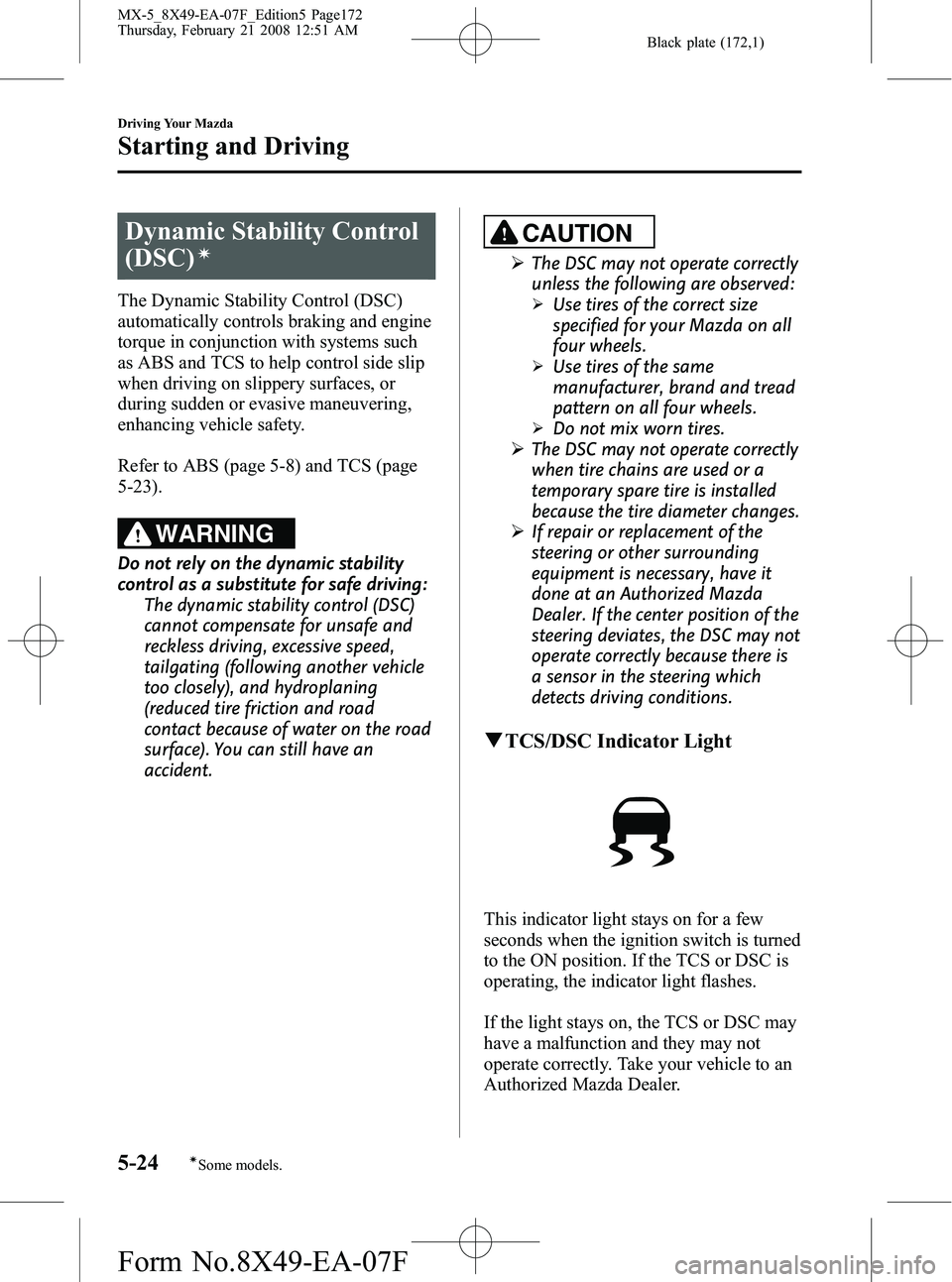
qTCS/DSC Indicator Light
This indicator light stays on for a few
seconds when the ignition switch is turned
to the ON position. If the TCS or DSC is
operating, the indicator light flashes.
If the light stays on, the TCS or DSC may
have a malfunction and they may not
operate correctly. Take your vehicle to an
Authorized Mazda Dealer.
5-24
Driving Your Mazda
íSome models.
Starting and Driving
MX-5_8X49-EA-07F_Edition5 Page172
Thursday, February 21 2008 12:51 AM
Form No.8X49-EA-07F
Page 175 of 400

Black plate (175,1)
Tire Pressure Monitoring Systemí
The tire pressure monitoring system (TPMS) monitors the pressure for each tire.
If tire pressure is too low in one or more tires, the system will inform the driver via the
warning light in the instrument panel and by the warning beep sound.
The tire pressure sensors installed on each wheel send tire pressure data by radio signal to
the receiver unit in the vehicle.
Tire pressure sensors
NOTE
When the ambient temperature is low due to seasonal changes, tire temperatures are also lower.
When the tire temperature decreases, the air pressure decreases as well. The TPMS warning light
may illuminate more frequently. Visually inspect the tires daily before driving, and check tire
pressures monthly with a tire pressure gauge. When checking tire pressures, use of a digital tire
pressure gauge is recommended.
TPMS does not alleviate your need to check the pressure and condition of all four tires
regularly.
Driving Your Mazda
Starting and Driving
5-27íSome models.
MX-5_8X49-EA-07F_Edition5 Page175
Thursday, February 21 2008 12:51 AM
Form No.8X49-EA-07F
Page 178 of 400

Black plate (178,1)
Adjust the tire pressure to the correct tire
pressure. Refer to the specification charts
(page 10-6).
CAUTION
When replacing/repairing the tires or
wheels or both, have the work done
by an Authorized Mazda Dealer, or
the tire pressure sensors may be
damaged.NOTE
lPerform tire pressure adjustment when the
tires are cold. Tire pressure will vary
according to the tire temperature, therefore
let the vehicle stand for 1 hour or only drive
it 1.6 km (1 mile) or less before adjusting
the tire pressures. When pressure is
adjusted on hot tires to the cold inflation
pressure, the TPMS warning light/beep may
turn on after the tires cool and pressure
drops below specification.
Also, an illuminated TPMS warning light,
resulting from the tire air pressure dropping
due to cold ambient temperature, may go
out if the ambient temperature rises. In this
case, it will also be necessary to adjust the
tire air pressures. If the TPMS warning
light illuminates due to a drop in tire air
pressure, make sure to check and adjust the
tire air pressures.
lAfter adjusting the tire air pressures, it may
require some time for the TPMS warning
light to go out. If the TPMS warning light
remains illuminated, drive the vehicle at a
speed of at least 25 km/h (16 mph) for 10
minutes, and then verify that it goes out.
lTires can loose a little air quite naturally
over time and the TPMS cannot tell if the
tires are getting too soft over time or you
have a flat. However, when you find one
low tire in a set of four - that is an
indication of trouble; you should have
someone drive the vehicle slowly forward
so you can inspect any low tire for cuts and
any metal sticking through tread or
sidewall. Put a few drops of water in the
valve stem to see if it bubbles indicating a
bad valve. Leaks need to be addressed by
more than simply refilling the trouble tire as
leaks are dangerous - take it to an
Authorized Mazda Dealer which has all the
equipment to fix tires, TPMS systems and
order the best replacement tire for your
vehicle.
5-30
Driving Your Mazda
Starting and Driving
MX-5_8X49-EA-07F_Edition5 Page178
Thursday, February 21 2008 12:51 AM
Form No.8X49-EA-07F
Page 195 of 400

Black plate (195,1)
Adjust the tire pressure to the correct tire
pressure. Refer to the specification charts
(page 10-6).
CAUTION
When replacing/repairing the tires or
wheels or both, have the work done
by an Authorized Mazda Dealer, or
the tire pressure sensors may be
damaged.NOTE
lPerform tire pressure adjustment when the
tires are cold. Tire pressure will vary
according to the tire temperature, therefore
let the vehicle stand for 1 hour or only drive
it 1.6 km (1 mile) or less before adjusting
the tire pressures. When pressure is
adjusted on hot tires to the cold inflation
pressure, the TPMS warning light/beep may
turn on after the tires cool and pressure
drops below specification.
Also, an illuminated TPMS warning light,
resulting from the tire air pressure dropping
due to cold ambient temperature, may go
out if the ambient temperature rises. In this
case, it will also be necessary to adjust the
tire air pressures. If the TPMS warning
light illuminates due to a drop in tire air
pressure, make sure to check and adjust the
tire air pressures.
lAfter adjusting the tire air pressures, it may
require some time for the TPMS warning
light to go out. If the TPMS warning light
remains illuminated, drive the vehicle at a
speed of at least 25 km/h (16 mph) for 10
minutes, and then verify that it goes out.
lTires can loose a little air quite naturally
over time and the TPMS cannot tell if the
tires are getting too soft over time or you
have a flat. However, when you find one
low tire in a set of four - that is an
indication of trouble; you should have
someone drive the vehicle slowly forward
so you can inspect any low tire for cuts and
any metal sticking through tread or
sidewall. Put a few drops of water in the
valve stem to see if it bubbles indicating a
bad valve. Leaks need to be addressed by
more than simply refilling the trouble tire as
leaks are dangerous - take it to an
Authorized Mazda Dealer which has all the
equipment to fix tires, TPMS systems and
order the best replacement tire for your
vehicle.
Driving Your Mazda
Warning/Indicator Lights and Beep Sounds
5-47
MX-5_8X49-EA-07F_Edition5 Page195
Thursday, February 21 2008 12:51 AM
Form No.8X49-EA-07F
Page 365 of 400

Black plate (365,1)
H
“H ”is the speed rating. The speed rating denotes the maximum speed for which the use of
the tire is rated.
Letter Rating Speed Rating
Q 99 mph
R 106 mph
S 112 mph
T 118 mph
U 124 mph
H 130 mph
V 149 mph
W 168
*mph
Y 186*mph
* For tires with a maximum speed capability over 149 mph, tire manufacturers sometimes use the letters ZR. For tires with a maximum speed capability over 186 mph, tire manufacturers always use the letters ZR.
M+S or M/S: Mud and Snow
AT: All Terrain.
AS: All Season. The “M+S ”or “M/S ”indicates that the tire has some functional use in
mud and snow.
U.S. DOT Tire Identification Number (TIN)
This begins with the letters “DOT ”which indicates the tire meets all federal standards. The
next two numbers or letters are the plant code where it was manufactured, and the last four
numbers represent the week and year the tire was manufactured. For example, the numbers
457 means the 45st week of 1997. After 2000 the numbers go to four digits. For example,
the number 2102 means the 21th week of 2002. The other numbers are marketing codes
used at the manufacturer's discretion. This information is used to contact consumers if a tire
defect requires a recall.
Tire Ply Composition and Materials Used
The number of plies indicates the number of layers of rubber-coated fabric in the tire. In
general, the greater the number of plies, the more weight a tire can support. Tire
manufacturers also must indicate the tire materials, which include steel, nylon, polyester,
and other.
Maximum Load Rating
This number indicates the maximum load in kilograms and pounds that can be carried by
the tire.
Maximum Permissible Inflation Pressure
This number is the greatest amount of air pressure that should ever be put in the tire under
normal driving conditions.
Customer Information and Reporting Safety Defects
Tire Information (U.S.A.)
9-25
MX-5_8X49-EA-07F_Edition5 Page365
Thursday, February 21 2008 12:52 AM
Form No.8X49-EA-07F
Page 366 of 400

Black plate (366,1)
Tread Wear, Traction and Temperature Grades
Tread wear:The tread wear grade is a comparative rating based on the wear rate of the tire
when tested under controlled conditions on a specified government test course. For
example, a tire graded 150 would wear one and one-half (1 1/2) times as well on the
government course as a tire graded 100.
Traction: The traction grades, from highest to lowest are AA, A, B, and C. The grades
represent the tire's ability to stop on wet pavement as measured under controlled conditions
on specified government test surfaces of asphalt and concrete. A tire marked C may have
poor traction performance.
Temperature: The temperature grades are A (the highest), B and C, representing the tire's
resistance to the generation of heat and its ability to dissipate heat when tested under
controlled conditions on a specified indoor laboratory test wheel.
Snow Tires
In some heavy snow areas, local governments may require true snow tires, those with very
deeply cut tread. These tires should only be used in pairs or placed on all four wheels.
Make sure you purchase snow tires that are the same size and construction type as the other
tires on your vehicle.
SAFETY WARNING
The following safety warning appears on the tire's sidewall.
SERIOUS INJURY MAY RESULT FROM:
lEXPLOSION OF TIRE/RIM ASSEMBLY DUE TO IMPROPER MOUNTING-
MATCH TIRE DIAMETER TO RIM DIAMETER; NEVER EXCEED 40 psi (275 kPa)
TO SEAT BEADS-ONLY SPECIALLY TRAINED PERSONS SHOULD MOUNT
TIRES.
lTIRE FAILURE DUE TO UNDER-INFLATION/OVERLOADING/DAMAGE-
FOLLOW OWNER'S MANUAL AND PLACARD IN VEHICLE-FREQUENTLY
CHECK INFLATION PRESSURE AND INSPECT FOR DAMAGE.
9-26
Customer Information and Reporting Safety Defects
Tire Information (U.S.A.)
MX-5_8X49-EA-07F_Edition5 Page366
Thursday, February 21 2008 12:52 AM
Form No.8X49-EA-07F