parking brake MAZDA MODEL MX-5 MIATA 2011 User Guide
[x] Cancel search | Manufacturer: MAZDA, Model Year: 2011, Model line: MODEL MX-5 MIATA, Model: MAZDA MODEL MX-5 MIATA 2011Pages: 454, PDF Size: 5.69 MB
Page 149 of 454
Black plate (149,1)
Winter Driving
lCarry emergency gear, including tire
chains, window scraper, flares, a small
shovel, jumper cables, and a small bag
of sand or salt.
Ask an Authorized Mazda Dealer to
perform the following precautions:
lHave the proper ratio of antifreeze in
the radiator.
Refer to Engine Coolant on page 8-20.
lInspect the battery and its cables. Cold
reduces battery capacity.
lInspect the ignition system for damage
and loose connections.
lUse washer fluid made with
antifreeze ―but do not use engine
coolant antifreeze for washer fluid
(page 8-23).
lDo not use the parking brake in
freezing weather as it may freeze.
Instead, shift to P with an automatic
transmission and to 1 or R with a
manual transmission. Block the rear
wheels.
lDo not apply excessive force to a
window scraper when removing ice or
frozen snow on the mirror glass and
windshield.
lNever use warm or hot water for
removing snow or ice from windows
and mirrors as it could result in the
glass cracking.
lBraking performance can be adversely
affected if snow or ice adheres to the
brake equipment. If this situation
occurs, drive the vehicle slowly,
releasing the accelerator pedal and
lightly applying the brakes several
times until the brake performance
returns to normal.
q Snow Tires
Use snow tires on all four wheels
Do not go faster than 120 km/h (75 mph)
while driving with snow tires. Inflate
snow tires 30 kPa (0.3 kgf/cm
2, 4.3 psi)
more than recommended on the tire
pressure label (driver's door frame), but
never more than the maximum cold-tire
pressure shown on the tires.
Your vehicle is originally equipped with
summer tires designed for optimum
traction on wet and dry roads. If your
vehicle is to be used on snow and ice
covered roads, Mazda recommends that
you replace the tires originally equipped
on your vehicle with snow tires during the
winter months.
WARNING
Use only the same size and type tires
(snow, radial, or non-radial) on all four
wheels: Using tires different in size or type is
dangerous. Your vehicle's handling
could be greatly affected and result
in an accident.
CAUTION
Check local regulations before using
studded tires.
NOTE
If your vehicle is equipped with the tire
pressure monitoring system, the system may
not function correctly when using tires with
steel wire reinforcement in the sidewalls (page
5-34).
Before Driving Your Mazda
Driving Tips
4-9
MX-5_8BR3-EA-10F_Edition3 Page149
Wednesday, March 2 2011 5:26 PM
Form No.8BR3-EA-10F
Page 157 of 454

Black plate (157,1)
Automatic Transmission VehicleWARNING
Remove the key only when the vehicle
is parked (with steering lock
mechanism):Removing the key from the ignition
switch while the vehicle is moving is
dangerous. Removing the key allows
the steering wheel to lock. You will
lose steering control and a serious
accident could occur. (For vehicles
equipped with the advanced key, the
steering wheel locks when the starter
knob is turned to the OFF/LOCK
position.)
Before leaving the driver's seat, always
switch the ignition to OFF/LOCK, set the
parking brake and make sure the shift
lever is in P (automatic transmission) or
in 1st gear or R (manual transmission): It is important to switch the ignition
to OFF/LOCK even if you are not
removing the key from the ignition or
leaving the vehicle. Leaving the key
in other positions will disable some of
the vehicle security systems and run
the battery down.
Leaving the driver's seat without
switching the ignition to OFF/LOCK,
setting the parking brake and
shifting the shift lever to P
(automatic transmission) or to 1st
gear or R (manual transmission) is
dangerous. Unexpected vehicle
movement could occur. This could
cause an accident.
NOTE
If turning the key is difficult, move the steering
wheel left and right.
Leaving the key or start knob in any position
but the OFF/LOCK position also disables
some of the security features and may run the
battery down.
Driving Your Mazda
Starting and Driving
5-3
MX-5_8BR3-EA-10F_Edition3 Page157
Wednesday, March 2 2011 5:26 PM
Form No.8BR3-EA-10F
Page 158 of 454

Black plate (158,1)
ACC (Accessory)
In this position, some electrical
accessories will operate.
ON
This is the normal running position after
the engine is started. Some indicator
lights/warning lights should be inspected
before the engine is started (page 5-42).
NOTE
When the ignition is switched ON, the sound of
the fuel pump motor operating near the fuel
tank can be heard. This does not indicate an
abnormality.
START
The engine is started in this position. It
will crank until you release the key. It
then returns to the ON position.
qIgnition Key Reminder
If the ignition is switched off or the
ignition is switched to ACC with the key
inserted, a continuous beep sound will be
heard when the driver's door is opened.
Starting the Engine
NOTE
Engine-starting is controlled by the spark
ignition system.
This system meets all Canadian Interference-
Causing Equipment Standard requirements
regulating the impulse electrical field strength
of radio noise.
1. Occupants should fasten their seat
belts.
2. Make sure the parking brake is on.
3. Depress the brake pedal.
4. (Manual transmission)
Depress the clutch pedal all the way
and shift into neutral.
Keep the clutch pedal depressed while
cranking the engine.
(Automatic transmission)
Put the vehicle in park (P). If you must
restart the engine while the vehicle is
moving, shift into neutral (N).
NOTE
(Manual transmission)
The starter will not operate unless the clutch is
depressed sufficiently.
(Automatic transmission)
The starter will not operate if the shift lever is
not in P or N.
5. Switch the ignition to START and hold
(up to 10 seconds at a time) until the
engine starts.
CAUTION
Do not try the starter for more than
10 seconds at a time. If the engine
stalls or fails to start, wait 10 seconds
before trying again. Otherwise, you
may damage the starter and drain
the battery.
5-4
Driving Your Mazda
Starting and Driving
MX-5_8BR3-EA-10F_Edition3 Page158
Wednesday, March 2 2011 5:26 PM
Form No.8BR3-EA-10F
Page 161 of 454

Black plate (161,1)
CAUTION
ØDo not drive with your foot held
on the clutch pedal or brake pedal,
or hold the clutch pedal depressed
halfway unnecessarily. Doing so
could result in the following:
ØThe clutch and brake parts will
wear out more quickly.
ØThe brakes can overheat and
adversely affect brake
performance.
Ø Always depress the brake pedal
with the right foot. Applying the
brakes with the unaccustomed left
foot could slow your reaction time
to an emergency situation
resulting in insufficient braking
operation.
ØWear shoes appropriate for driving
in order to avoid your shoe
contacting the brake pedal when
depressing the accelerator pedal.
qParking Brake
WARNING
Before leaving the driver's seat, always
switch the ignition to OFF/LOCK, set the
parking brake and make sure the shift
lever is in P with an automatic
transmission or in 1 or R with a manual
transmission:
It is important to switch the ignition
to OFF/LOCK even if you are not
removing the key from the ignition or
leaving the vehicle. Leaving the key
in other positions will disable some of
the vehicle security systems and run
the battery down.
Leaving the driver's seat without
switching the ignition to OFF/LOCK,
setting the parking brake and
shifting the shift lever to P with an
automatic transmission, or to 1 or R
with a manual transmission is
dangerous. Unexpected vehicle
movement could occur. This could
cause an accident.
CAUTION
Driving with the parking brake on
will cause excessive wear of the brake
linings or pads.
NOTE
For parking in snow, refer to Winter Driving
(page 4-9) regarding parking brake use.
Driving Your Mazda
Starting and Driving
5-7
MX-5_8BR3-EA-10F_Edition3 Page161
Wednesday, March 2 2011 5:26 PM
Form No.8BR3-EA-10F
Page 162 of 454
Black plate (162,1)
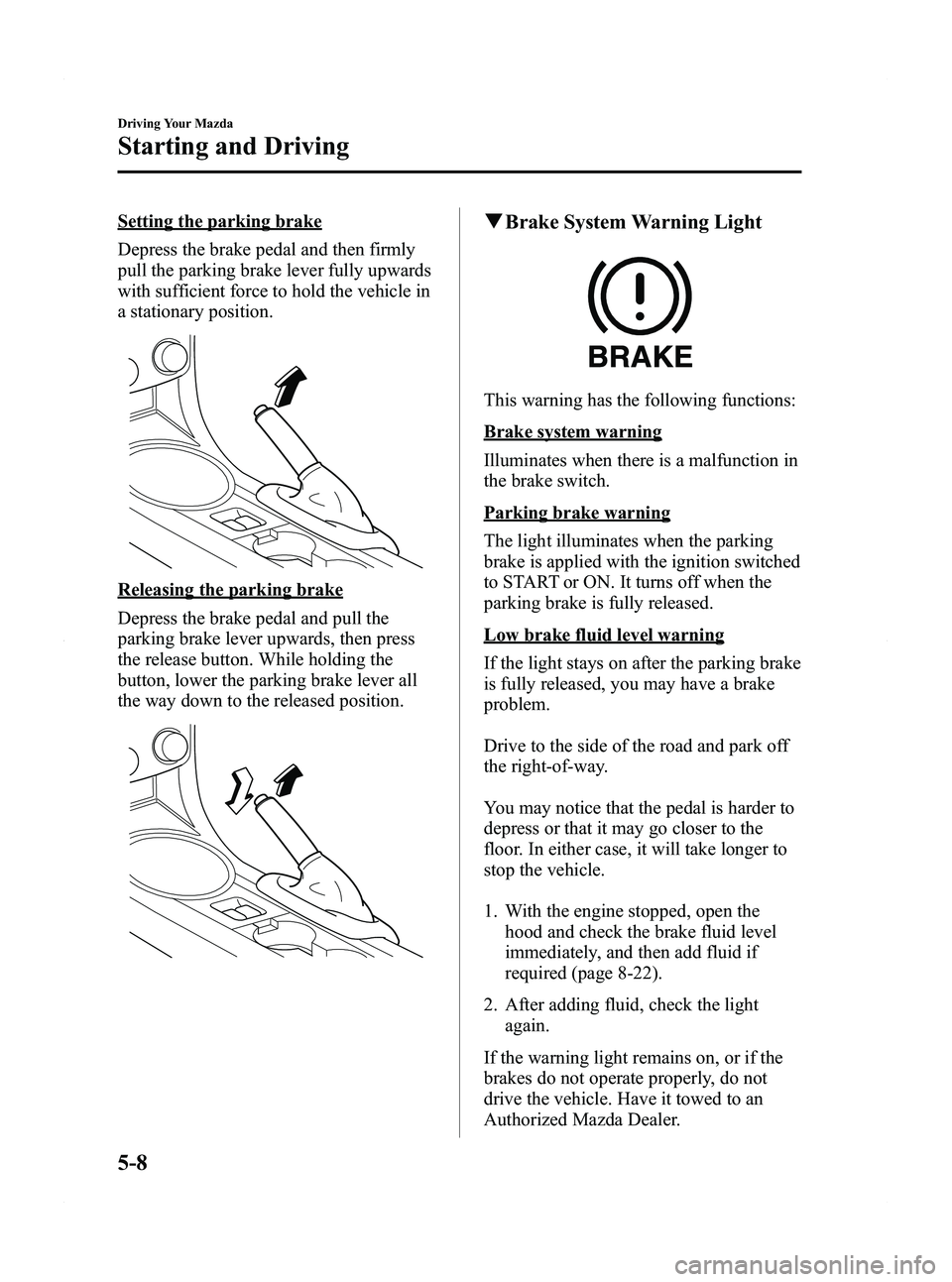
Setting the parking brake
Depress the brake pedal and then firmly
pull the parking brake lever fully upwards
with sufficient force to hold the vehicle in
a stationary position.
Releasing the parking brake
Depress the brake pedal and pull the
parking brake lever upwards, then press
the release button. While holding the
button, lower the parking brake lever all
the way down to the released position.
qBrake System Warning Light
This warning has the following functions:
Brake system warning
Illuminates when there is a malfunction in
the brake switch.
Parking brake warning
The light illuminates when the parking
brake is applied with the ignition switched
to START or ON. It turns off when the
parking brake is fully released.
Low brake fluid level warning
If the light stays on after the parking brake
is fully released, you may have a brake
problem.
Drive to the side of the road and park off
the right-of-way.
You may notice that the pedal is harder to
depress or that it may go closer to the
floor. In either case, it will take longer to
stop the vehicle.
1. With the engine stopped, open the
hood and check the brake fluid level
immediately, and then add fluid if
required (page 8-22).
2. After adding fluid, check the light again.
If the warning light remains on, or if the
brakes do not operate properly, do not
drive the vehicle. Have it towed to an
Authorized Mazda Dealer.
5-8
Driving Your Mazda
Starting and Driving
MX-5_8BR3-EA-10F_Edition3 Page162
Wednesday, March 2 2011 5:26 PM
Form No.8BR3-EA-10F
Page 163 of 454
Black plate (163,1)
Even if the light turns off have your brake
system inspected as soon as possible by
an Authorized Mazda Dealer.
NOTE
Having to add brake fluid is sometimes an
indicator of leakage. Consult an Authorized
Mazda Dealer as soon as possible even if the
brake light is no longer illuminated.
WARNING
Do not drive with the brake system
warning light illuminated. Contact an
Authorized Mazda Dealer to have the
brakes inspected as soon as possible:Driving with the brake system
warning light illuminated is
dangerous. It indicates that your
brakes may not work at all or that
they could completely fail at any
time. If this light remains
illuminated, after checking that the
parking brake is fully released, have
the brakes inspected immediately.
qAnti-Lock Brake System (ABS)
The ABS control unit continuously
monitors the speed of each wheel. If one
is about to lock up, the ABS responds by
automatically releasing and reapplying
that wheel's brake.
The driver will feel a slight vibration in
the brake pedal and may hear a chattering
noise from the brake system. This is
normal when the ABS operates. Continue
to depress the brake pedal without
pumping the brakes.
WARNING
Do not rely on ABS as a substitute for
safe driving:
The ABS cannot compensate for
unsafe and reckless driving, excessive
speed, tailgating (following another
vehicle too closely), driving on ice and
snow, and hydroplaning (reduced tire
friction and road contact because of
water on the road surface). You can
still have an accident.
NOTE
lBraking distances may be longer on loose
surfaces (snow or gravel, for example)
which usually have a hard foundation. A
vehicle with a normal braking system may
require less distance to stop under these
conditions because the tires will build up a
wedge of surface layer when the wheels
skid.
lThe sound of the ABS operating may be
heard when starting the engine or
immediately after starting the vehicle.
However, it does not indicate a malfunction.
q ABS Warning Light
The warning light stays on for a few
seconds when the ignition is switched
ON.
Driving Your Mazda
Starting and Driving
5-9
MX-5_8BR3-EA-10F_Edition3 Page163
Wednesday, March 2 2011 5:26 PM
Form No.8BR3-EA-10F
Page 166 of 454

Black plate (166,1)
(6-speed transmission)
Vehicles with 6-speed transmission are
equipped with a device to prevent shifting
to R (reverse) by mistake. Push the shift
lever downward and shift to R.
WARNING
Do not use sudden engine braking on
slippery road surfaces or at high
speeds:Shifting down while driving on wet,
snowy, or frozen roads, or while
driving at high speeds causes sudden
engine braking, which is dangerous.
The sudden change in tire speed
could cause the tires to skid. This
could lead to loss of vehicle control
and an accident.
Be sure to leave the shift lever in 1 or R
position and set the parking brake
when leaving the vehicle unattended: Otherwise the vehicle could move
and cause an accident.
CAUTION
ØKeep your foot off the clutch pedal
except when shifting gears. Also,
do not use the clutch to hold the
vehicle on an upgrade. Riding the
clutch will cause needless clutch
wear and damage.
Ø Do not apply any excessive lateral
force to the gear lever when
changing from 5th to 4th gear.
This could lead to the accidental
selection of 2nd gear, which can
result in damage to the
transmission.
Ø Make sure the vehicle comes to a
complete stop before shifting to R.
Shifting to R while the vehicle is
still moving may damage the
transmission.
NOTE
If shifting to R is difficult, shift back into
neutral, release the clutch pedal, and try
again.
q Recommendations for Shifting
Upshifting
For normal acceleration, we recommend
these shift points.
Gear 5-speed
transmission 6-speed
transmission
1 to 2 24 km/h (15 mph) 23 km/h (14 mph)
2 to 3 42 km/h (26 mph) 37 km/h (23 mph)
3 to 4 55 km/h (34 mph) 50 km/h (31 mph)
4 to 5 66 km/h (41 mph) 56 km/h (35 mph)
5to6 ―66 km/h (41 mph)
5-12
Driving Your Mazda
Starting and Driving
MX-5_8BR3-EA-10F_Edition3 Page166
Wednesday, March 2 2011 5:26 PM
Form No.8BR3-EA-10F
Page 169 of 454

Black plate (169,1)
qTransmission Ranges
The shift lever must be in P or N to
operate the starter.
P (Park)
P locks the transmission and prevents the
rear wheels from rotating.
WARNING
Always set the shift lever to P and set
the parking brake:
Only setting the shift lever to the P
position without using the parking
brake to hold the vehicle is
dangerous. If P fails to hold, the
vehicle could move and cause an
accident.
CAUTION
ØShifting into P, N or R while the
vehicle is moving can damage
your transmission.
Ø Shifting into a driving gear or
reverse when the engine is running
faster than idle can damage the
transmission.
R (Reverse)
In position R, the vehicle moves only
backward. You must be at a complete stop
before shifting to or from R, except under
rare circumstances as explained in
Rocking the Vehicle (page 4-8).
N (Neutral)
In N, the wheels and transmission are not
locked. The vehicle will roll freely even
on the slightest incline unless the parking
brake or brakes are on.
WARNING
If the engine is running faster than idle,
do not shift from N or P into a driving
gear:
It's dangerous to shift from N or P
into a driving gear when the engine
is running faster than idle. If this is
done, the vehicle could move
suddenly, causing an accident or
serious injury.
Do not shift into N when driving the
vehicle: Shifting into N while driving is
dangerous. Engine braking cannot be
applied when decelerating which
could lead to an accident or serious
injury.
CAUTION
Do not shift into N when driving the
vehicle. Doing so can cause
transmission damage.
NOTE
Apply the parking brake or depress the brake
pedal before moving the shift lever from N to
prevent the vehicle from moving unexpectedly.
D (Drive)
D is the normal driving position. From a
stop, the transmission will automatically
shift through a 6-gear sequence.
Temporary use of the direct mode is
possible.
Refer to Direct Mode on page 5-20.
M (Manual)
M is the manual shift mode position.
Gears can be shifted up or down by
operating the shift lever or steering shift
switches.
Refer to Manual Shift Mode (page 5-16).
Driving Your Mazda
Starting and Driving
5-15
MX-5_8BR3-EA-10F_Edition3 Page169
Wednesday, March 2 2011 5:26 PM
Form No.8BR3-EA-10F
Page 195 of 454
Black plate (195,1)
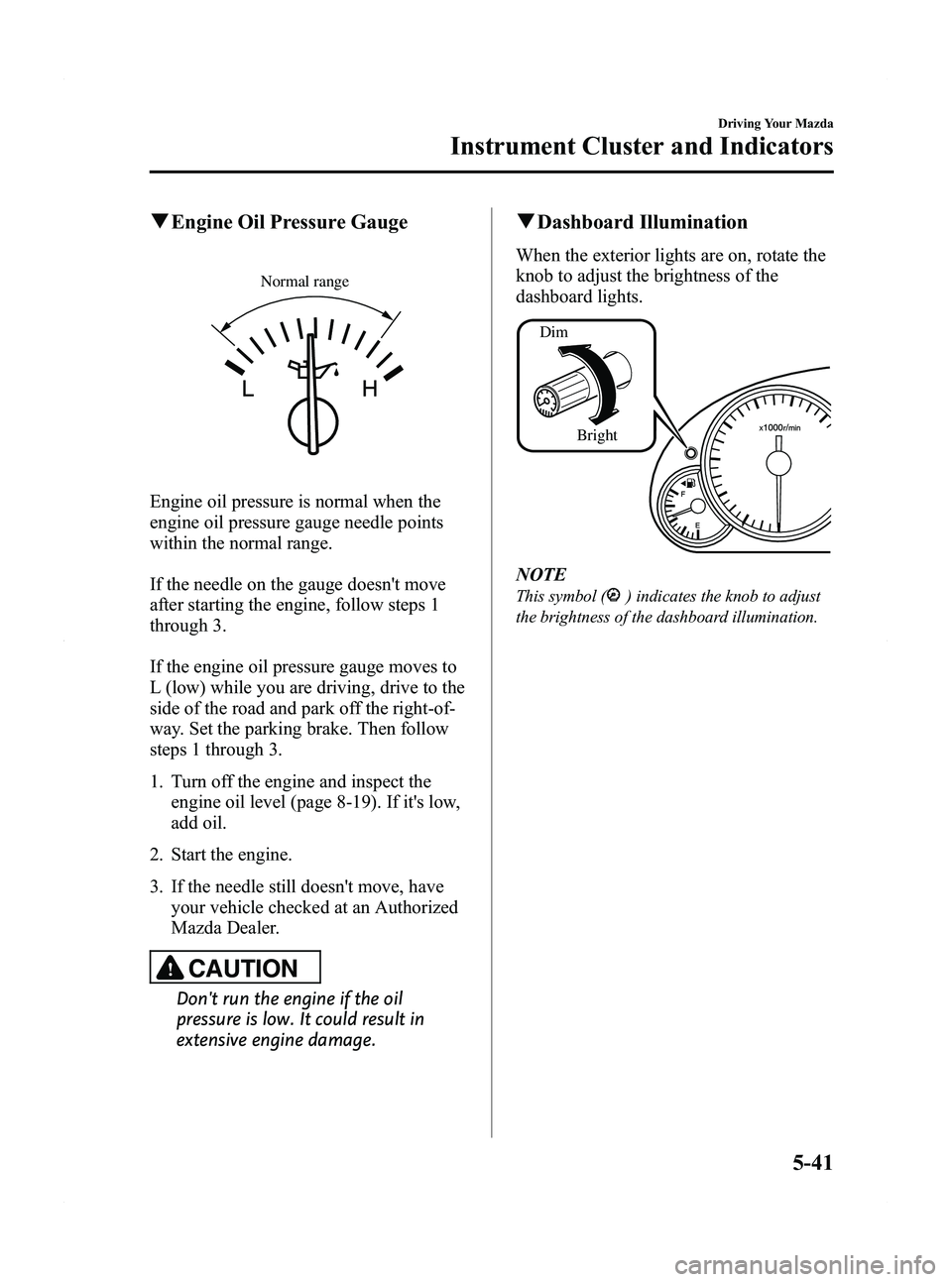
qEngine Oil Pressure Gauge
Normal range
Engine oil pressure is normal when the
engine oil pressure gauge needle points
within the normal range.
If the needle on the gauge doesn't move
after starting the engine, follow steps 1
through 3.
If the engine oil pressure gauge moves to
L (low) while you are driving, drive to the
side of the road and park off the right-of-
way. Set the parking brake. Then follow
steps 1 through 3.
1. Turn off the engine and inspect the
engine oil level (page 8-19). If it's low,
add oil.
2. Start the engine.
3. If the needle still doesn't move, have your vehicle checked at an Authorized
Mazda Dealer.
CAUTION
Don't run the engine if the oil
pressure is low. It could result in
extensive engine damage.
qDashboard Illumination
When the exterior lights are on, rotate the
knob to adjust the brightness of the
dashboard lights.
Dim
Bright
NOTE
This symbol () indicates the knob to adjust
the brightness of the dashboard illumination.
Driving Your Mazda
Instrument Cluster and Indicators
5-41
MX-5_8BR3-EA-10F_Edition3 Page195
Wednesday, March 2 2011 5:26 PM
Form No.8BR3-EA-10F
Page 198 of 454
Black plate (198,1)
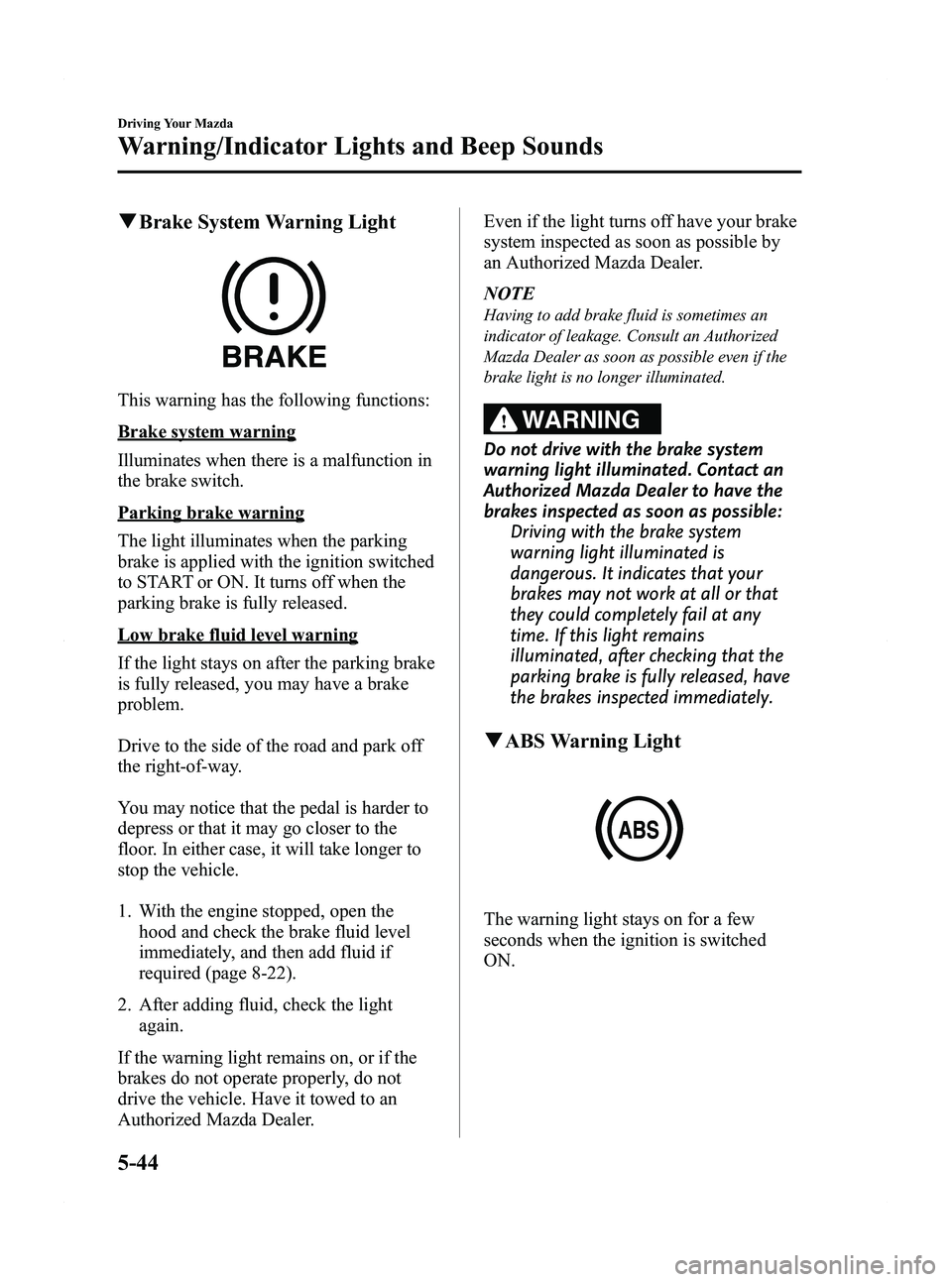
qBrake System Warning Light
This warning has the following functions:
Brake system warning
Illuminates when there is a malfunction in
the brake switch.
Parking brake warning
The light illuminates when the parking
brake is applied with the ignition switched
to START or ON. It turns off when the
parking brake is fully released.
Low brake fluid level warning
If the light stays on after the parking brake
is fully released, you may have a brake
problem.
Drive to the side of the road and park off
the right-of-way.
You may notice that the pedal is harder to
depress or that it may go closer to the
floor. In either case, it will take longer to
stop the vehicle.
1. With the engine stopped, open the
hood and check the brake fluid level
immediately, and then add fluid if
required (page 8-22).
2. After adding fluid, check the light again.
If the warning light remains on, or if the
brakes do not operate properly, do not
drive the vehicle. Have it towed to an
Authorized Mazda Dealer. Even if the light turns off have your brake
system inspected as soon as possible by
an Authorized Mazda Dealer.
NOTE
Having to add brake fluid is sometimes an
indicator of leakage. Consult an Authorized
Mazda Dealer as soon as possible even if the
brake light is no longer illuminated.
WARNING
Do not drive with the brake system
warning light illuminated. Contact an
Authorized Mazda Dealer to have the
brakes inspected as soon as possible:
Driving with the brake system
warning light illuminated is
dangerous. It indicates that your
brakes may not work at all or that
they could completely fail at any
time. If this light remains
illuminated, after checking that the
parking brake is fully released, have
the brakes inspected immediately.
qABS Warning Light
The warning light stays on for a few
seconds when the ignition is switched
ON.
5-44
Driving Your Mazda
Warning/Indicator Lights and Beep Sounds
MX-5_8BR3-EA-10F_Edition3 Page198
Wednesday, March 2 2011 5:26 PM
Form No.8BR3-EA-10F