high MAZDA MODEL MX-5 MIATA PRHT 2013 Repair Manual
[x] Cancel search | Manufacturer: MAZDA, Model Year: 2013, Model line: MODEL MX-5 MIATA PRHT, Model: MAZDA MODEL MX-5 MIATA PRHT 2013Pages: 452, PDF Size: 5.57 MB
Page 385 of 452

Black plate (385,1)
qAluminum Wheel Maintenance
A protective coating is provided over the
aluminum wheels. Special care is needed
to protect this coating.
CAUTION
Do not use any detergent other than
mild detergent. Before using any
detergent, verify the ingredients.
Otherwise, the product could discolor
or stain the aluminum wheels.
NOTE
lDo not use a wire brush or any abrasive
cleaner, polishing compound, or solvent on
aluminum wheels. They may damage the
coating.
lAlways use a sponge or soft cloth to clean
the wheels.
Rinse the wheels thoroughly with lukewarm
or cold water. Also, be sure to clean the
wheels after driving on dusty or salted
roads to help prevent corrosion.
lAvoid washing your vehicle in an automatic
car wash that uses high-speed or hard
brushes.
lIf your aluminum wheels lose luster, wax
the wheels.
(With Tire Pressure Monitoring System)
Check special requirements for Tire Pressure
Monitoring System.
Refer to Tires and Wheels on page 5-34.
q Convertible Top Maintenanceí
The convertible top is made of a special
high-grade material, but if it's not taken
good care of, hardening, staining, and loss
of luster will result. Maintain it under
these guidelines.
Washing
Do not wait until the convertible top gets
really dirty before cleaning it. Dirt that's
there too long will cause deterioration.
1. Before washing, remove dust and
coarse particulate with a soft brush.
2. Gently clean the convertible top with a synthetic neutral detergent, lots of
water, and a soft brush.
3. Rinse it thoroughly with clean water to remove all the soap.
4. Wipe it as dry as you can before the water dries on it.
5. Then allow it to dry completely before lowering it.
Maintenance and Care
Appearance Care
8-57íSome models.
MX-5_8CM3-EA-12F_Edition2 Page385
Friday, August 31 2012 1:46 PM
Form No.8CM3-EA-12F
Page 386 of 452

Black plate (386,1)
CAUTION
ØAutomatic and high-pressure car
washes are harmful to a
convertible top. Avoid them.
Ø Do not spray water directly on the
area where the window glass and
the convertible top meet. This
would probably cause water to
enter the cabin.
Ø Do not spray water with a hose or
a car washing device directly on
the seam area of the body and the
convertible top as it could result in
water penetrating the trunk.
Appearance (Polyvinyl only)
Dress the convertible top once a month
after washing and drying it well. For best
results, use a water-based leather
treatment or vinyl top dressing. This will
help maintain good appearance and
material condition of the convertible top.
CAUTION
ØSome leather treatment products
can ruin the convertible top's
gloss. Be careful of the one you
choose.
Ø Test on an inconspicuous, small
corner of the convertible top if you
are not sure.
Ø Do not get any car wax on the
convertible top.
If you do, remove it with a good
leather cleaner.
Ø Too much treatment on the
convertible top can be as
damaging as too little. Follow the
manufacturer's directions.
Do not overdo it!
Ø Let the convertible top dry
completely before lowering after
applying treatment or dressing.
qHardtop Maintenanceí
Washing
To help protect the hardtop's finish, use a
soft cloth or sponge to wash it.
Insects, tar, tree sap, bird droppings,
industrial fallout, and similar deposits can
damage the finish if they are not removed
immediately. When prompt washing with
plain water is ineffective use a mild soap
made for use on vehicles.
CAUTION
Ø Don't use an automatic car wash.
Ø Don't use strong soap, chemical
detergents, or hot water, and don't
wash the hardtop in direct
sunlight or when the surface is
warm.
8-58
Maintenance and Care
íSome models.
Appearance Care
MX-5_8CM3-EA-12F_Edition2 Page386
Friday, August 31 2012 1:46 PM
Form No.8CM3-EA-12F
Page 387 of 452
Black plate (387,1)
Thoroughly rinse with lukewarm or cold
water. Don't allow soap to dry on the
finish.
Waxing
Wax the hardtop when water no longer
beads on the paint. Always wash and dry
it before waxing.
CAUTION
ØWiping off dust or dirt with a dry
cloth will scratch the finish.
Ø Don't use abrasive wax. This may
damage the protective coating and
discolor or deteriorate the paint.
NOTE
A spot remover to remove oil, tar, and similar
materials will usually also take off the wax.
Rewax these areas.
q Plastic Part Maintenance
lWhen cleaning the plastic lenses of the
lights, do not use gasoline, kerosene,
rectified spirit, paint, thinner, highly
acidic detergents, or strongly alkaline
detergents. Otherwise, these chemical
agents can discolor or damage the
surfaces resulting in a significant loss
in functionality. If plastic parts become
inadvertently exposed to any of these
chemical agents, flush with water
immediately.
lIf plastic parts such as the bumpers
become inadvertently exposed to
chemical agents or fluids such as
gasoline, oil, engine coolant, or battery
fluid, it could cause discoloration,
staining, or paint peeling. Wipe off any
such chemical agents or fluids using a
soft cloth immediately.
lHigh water temperature and high water
pressure car washers are available
depending on the type of high pressure
car washer device. If the car washer
nozzle is put too close to the vehicle or
aimed at one area for an extended
period of time, it could deform plastic
parts or damage the paint.
lDo not use wax containing compounds
(polish). Otherwise, it could result in
paint damage.
lIn addition, do not use an electrical or
air tool to apply wax. Otherwise, the
frictional heat generated could result in
deformation of plastic parts or paint
damage.
Maintenance and Care
Appearance Care
8-59
MX-5_8CM3-EA-12F_Edition2 Page387
Friday, August 31 2012 1:46 PM
Form No.8CM3-EA-12F
Page 412 of 452

Black plate (412,1)
Uniform Tire Quality Grading System (UTQGS)
This information relates to the tire grading system developed by the U.S. National
Highway Traffic Safety Administration for grading tires by tread wear, traction, and
temperature performance.
qTread Wear
The tread wear grade is a comparative rating based on the wear rate of the tire when tested
under controlled conditions on a specified government test course.
For example, a tire graded 150 would wear one-and-a-half times as well on the government
course as a tire graded 100.
The relative performance of tires depends upon the actual conditions of their use, however,
and may depart significantly from the norm because of variations in driving habits, service
practices and differences in road characteristics and climate.
qTraction-AA, A, B, C
The traction grades, from highest to lowest, are AA, A, B, and C. These grades represent
the tire's ability to stop on wet pavement as measured under controlled conditions on
specified government test surfaces of asphalt and concrete. A tire marked C may have poor
traction performance.
WARNING
The traction grade assigned to this tire is based on braking (straight ahead) traction
tests and does not include acceleration cornering (turning), hydroplaning, or peak
traction characteristics.
qTemperature-A, B, C
The temperature grades A (the highest), B, and C, represent the tire's resistance to the
generation of heat and its ability to dissipate heat when tested under controlled conditions
on a specified indoor laboratory test wheel.
Sustained high temperature can cause the material of the tire to degenerate and reduce tire
life, and excessive temperatures can lead to sudden tire failure.
Grade C corresponds to a level of performance which all passenger vehicle tires must meet
under the Federal Motor Vehicle Safety Standard No. 109. Grades B and A represent
higher levels of performance on the laboratory test wheel than the minimum required by
law.
9-22
Customer Information and Reporting Safety Defects
Uniform Tire Quality Grading System (UTQGS)
MX-5_8CM3-EA-12F_Edition2 Page412
Friday, August 31 2012 1:46 PM
Form No.8CM3-EA-12F
Page 417 of 452

Black plate (417,1)
Tread Wear, Traction and Temperature Grades
Tread wear:The tread wear grade is a comparative rating based on the wear rate of the tire
when tested under controlled conditions on a specified government test course. For
example, a tire graded 150 would wear one and one-half (1 1/2) times as well on the
government course as a tire graded 100.
Traction: The traction grades, from highest to lowest are AA, A, B, and C. The grades
represent the tire's ability to stop on wet pavement as measured under controlled conditions
on specified government test surfaces of asphalt and concrete. A tire marked C may have
poor traction performance.
Temperature: The temperature grades are A (the highest), B and C, representing the tire's
resistance to the generation of heat and its ability to dissipate heat when tested under
controlled conditions on a specified indoor laboratory test wheel.
Snow Tires
In some heavy snow areas, local governments may require true snow tires, those with very
deeply cut tread. These tires should only be used in pairs or placed on all four wheels.
Make sure you purchase snow tires that are the same size and construction type as the other
tires on your vehicle.
SAFETY WARNING
The following safety warning appears on the tire's sidewall.
SERIOUS INJURY MAY RESULT FROM:
lEXPLOSION OF TIRE/RIM ASSEMBLY DUE TO IMPROPER MOUNTING-
MATCH TIRE DIAMETER TO RIM DIAMETER; NEVER EXCEED 40 psi (275 kPa)
TO SEAT BEADS-ONLY SPECIALLY TRAINED PERSONS SHOULD MOUNT
TIRES.
lTIRE FAILURE DUE TO UNDER-INFLATION/OVERLOADING/DAMAGE-
FOLLOW OWNER'S MANUAL AND PLACARD IN VEHICLE-FREQUENTLY
CHECK INFLATION PRESSURE AND INSPECT FOR DAMAGE.
Customer Information and Reporting Safety Defects
Tire Information (U.S.A.)
9-27
MX-5_8CM3-EA-12F_Edition2 Page417
Friday, August 31 2012 1:46 PM
Form No.8CM3-EA-12F
Page 421 of 452

Black plate (421,1)
WARNING
Always check the tire inflation pressures on a regular basis according to the
recommended tire inflation pressure on the tire label and in conjunction with the
information in this owner's manual:Driving your vehicle with under-inflated tires is dangerous.
Under-inflation is the most common cause of failures in any kind of tire and may
result in severe cracking, tread separation or “blowout ”, with unexpected loss of
vehicle control and increased risk of injury. Under-inflation increases sidewall flexing
and rolling resistance, resulting in heat buildup and internal damage to the tire. It
results in unnecessary tire stress, irregular wear, loss of control and accidents. A tire
can lose up to half of its air pressure and not appear to be flat!
It is impossible to determine whether or not tires are properly inflated just by looking
at them.
q Checking Tire Pressure
1. When you check the air pressure, make sure the tires are cold ―meaning they are not
hot from driving even a mile.
2. Remove the cap from the valve on one tire.
3. Firmly press a tire gauge onto the valve.
4. Add air to achieve recommended air pressure.
5. If you overfill the tire, release air by pushing on the metal stem in the center of the valve. Then recheck the pressure with your tire gauge.
6. Replace the valve cap.
7. Repeat with each tire, including the spare.
NOTE
Some spare tires require higher inflation pressure.
8. Visually inspect the tires to make sure there are no nails or other objects embedded that could poke a hole in the tire and cause an air leak.
9. Check the sidewalls to make sure there are no gouges, cuts, bulges, cracks or other irregularities.
NOTE
Warm tires normally exceed recommended pressures. Don't release air from warm tires to adjust the
pressure.
Under-inflation can cause serious failures and accidents.
Over-inflation can produce a harsh ride and the greater possibility of damage from road hazards.
Customer Information and Reporting Safety Defects
Tire Information (U.S.A.)
9-31
MX-5_8CM3-EA-12F_Edition2 Page421
Friday, August 31 2012 1:46 PM
Form No.8CM3-EA-12F
Page 424 of 452
Black plate (424,1)
CAUTION
Rotate unidirectional tires and radial tires that have an asymmetrical tread pattern
or studs only from front to rear, not from side to side. Tire performance will be
weakened if rotated from side to side.
(With limited-slip differential)
Don't use the following:
ØTires not of the designated size
Ø Tires of different sizes or types at the same time
Ø Tires not sufficiently inflated
If these instructions aren't followed, the rotation of the left and right wheels will be
different and will thus apply a constant load on the limited-slip differential.
This will cause a malfunction.
q Replacing a Tire
WARNING
Always use tires that are in good condition:
Driving with worn tires is dangerous. Reduced braking, steering, and traction could
result in an accident.
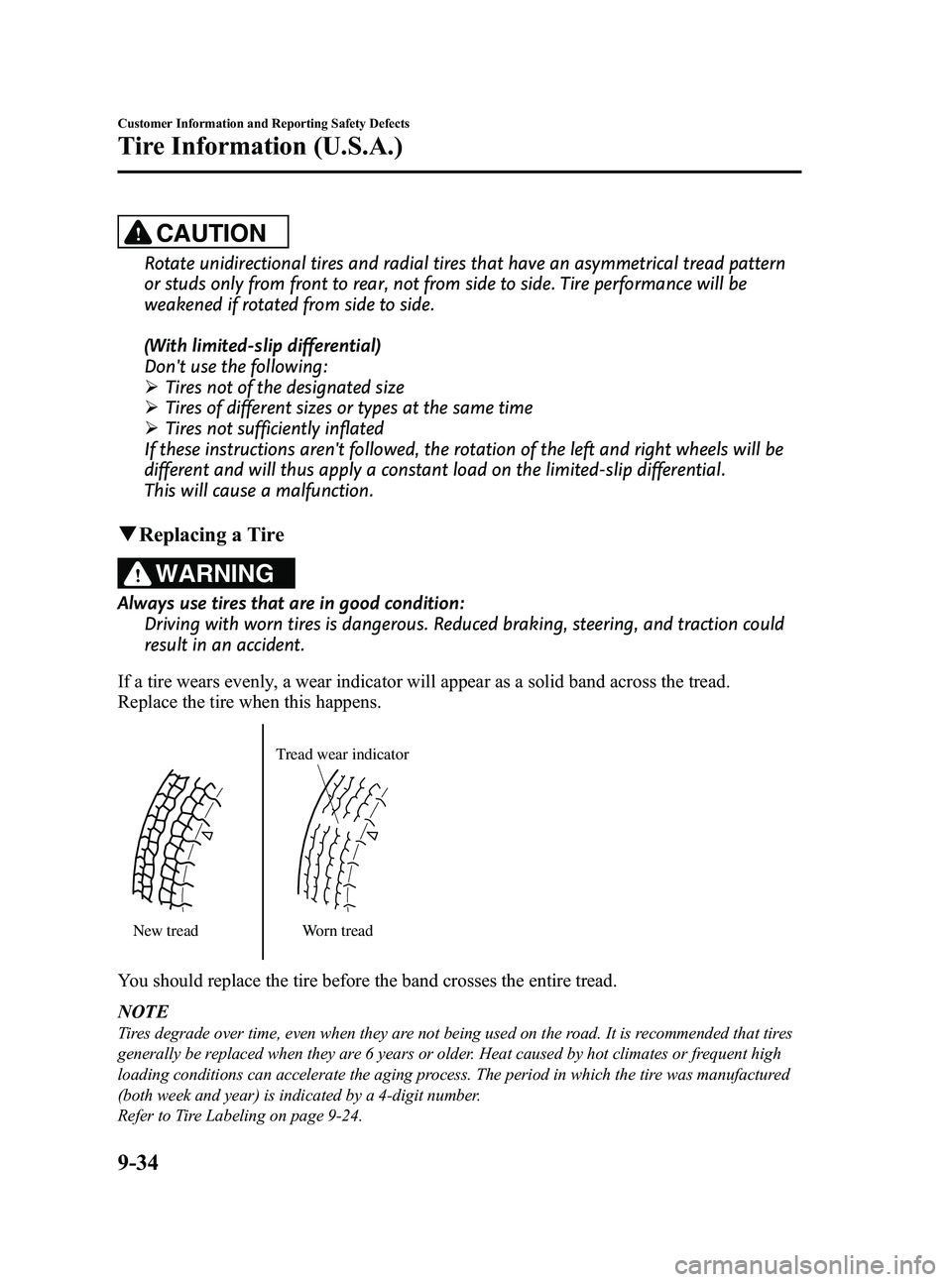
If a tire wears evenly, a wear indicator will appear as a solid band across the tread.
Replace the tire when this happens.
New tread Tread wear indicator
Worn tread
You should replace the tire before the band crosses the entire tread.
NOTE
Tires degrade over time, even when they are not being used on the road. It is recommended that tires
generally be replaced when they are 6 years or older. Heat caused by hot climates or frequent high
loading conditions can accelerate the aging process. The period in which the tire was manufactured
(both week and year) is indicated by a 4-digit number.
Refer to Tire Labeling on page 9-24.
9-34
Customer Information and Reporting Safety Defects
Tire Information (U.S.A.)
MX-5_8CM3-EA-12F_Edition2 Page424
Friday, August 31 2012 1:46 PM
Form No.8CM3-EA-12F
Page 431 of 452

Black plate (431,1)
GCW
GCW (Gross Combination Weight)is the weight of the loaded vehicle (GVW).
GCWR (Gross Combination Weight Rating) is the maximum allowable weight of the
vehicle - including all cargo and passengers - that the vehicle can handle without risking
damage. The GCW must never exceed the GCWR.
WARNING
Exceeding GVWR or GAWR Specifications:
Exceeding the GVWR or the GAWR specified on the certification label is dangerous.
Exceeding any vehicle rating limitation could result in a serious accident, injury, or
damage to the vehicle.
Do not use replacement tires with lower load carrying capacities than the originals
because they may lower the vehicle's GVWR and GAWR limitations. Replacement
tires with a higher limit than the originals do not increase the GVWR and GAWR
limitations.
Never exceed the GVWR or the GAWR specified on the certification label.
Customer Information and Reporting Safety Defects
Tire Information (U.S.A.)
9-41
MX-5_8CM3-EA-12F_Edition2 Page431
Friday, August 31 2012 1:46 PM
Form No.8CM3-EA-12F
Page 433 of 452
Black plate (433,1)
Reporting Safety Defects (U.S.A.)
If you believe that your vehicle has a defect which could cause a crash or could
cause injury or death, you should immediately inform the National Highway
Traffic Safety Administration (NHTSA) in addition to notifying Mazda Motor
Corporation (Your Mazda Importer/Distributor).
If NHTSA receives similar complaints, it may open an investigation, and if it
finds that a safety defect exists in a group of vehicles, it may order a recall and
remedy campaign. However, NHTSA cannot become involved in individual
problems between you, your dealer, or Mazda Motor Corporation (Your Mazda
Importer/Distributor).
To contact NHTSA, you may call the Vehicle Safety Hotline toll-free at 1-888-
327-4236 (TTY:1-800-424-9153) ; go to http://www.safercar.gov; or write to:
Administrator, NHTSA, 1200 New Jersey Avenue, SE., Washington, DC,
20590. You can also obtain other information about motor vehicle safety from
http://www.safercar.gov.
NOTE
If you live in the U.S.A., all correspondence to Mazda Motor Corporation should be forwarded to:
Mazda North American Operations
7755 Irvine Center Drive
Irvine, California 92618-2922
or
P.O. Box 19734
Irvine, CA 92623-9734
Customer Assistance Center or toll free at 1 (800) 222-5500
If you live outside of the U.S.A., please contact the nearest Mazda Distributor shown (page 9-13) in
this booklet.
Customer Information and Reporting Safety Defects
Reporting Safety Defects
9-43
MX-5_8CM3-EA-12F_Edition2 Page433
Friday, August 31 2012 1:46 PM
Form No.8CM3-EA-12F
Page 435 of 452
Black plate (435,1)
Service Publications
Factory-authorized Mazda service publications are available for owners who wish to do
some of their own maintenance and repair.
When requesting any of our publications through an Authorized Mazda Dealer, refer to the
chart below.
If they do not have what you need in stock, they can order it for you.
PUBLICATION ORDER NUMBERPUBLICATION DESCRIPTION
9999-95-042B-13 2013 WORKSHOP MANUAL (English)
9999-MX-042B-13 2013 WORKSHOP MANUAL (Spanish)
9999-95-026G-13 2013 WIRING DIAGRAM (English)
9999-MX-026G-13 2013 WIRING DIAGRAM (Spanish)
9999-95-031C-13 2013 OWNER'S MANUAL (English)
9999-EC-031C-13 2013 OWNER'S MANUAL (English and French)
9999-PR-031C-13 2013 OWNER'S MANUAL (Spanish)
9999-95-MODL-13 2013 SERVICE HIGHLIGHTS
qWORKSHOP MANUAL:
Covers recommended maintenance and repair procedures of the drive train, body and
chassis.
qWIRING DIAGRAM:
Provides electrical schematics as well as component location for the entire electrical
system.
qOWNER'S MANUAL:
This booklet contains information regarding the proper care and operation of your vehicle.
This is not a technician's manual.
qSERVICE HIGHLIGHTS:
Provides description and operation of the many systems of your Mazda.
Customer Information and Reporting Safety Defects
Service Publications
9-45
MX-5_8CM3-EA-12F_Edition2 Page435
Friday, August 31 2012 1:46 PM
Form No.8CM3-EA-12F