Glass MAZDA MODEL MX-5 MIATA RF 2019 Owners Manual
[x] Cancel search | Manufacturer: MAZDA, Model Year: 2019, Model line: MODEL MX-5 MIATA RF, Model: MAZDA MODEL MX-5 MIATA RF 2019Pages: 553, PDF Size: 59 MB
Page 75 of 553
Door Locks
WA R N I N G
Always take all children and pets with you
or leave a responsible person with them:
Leaving a child or a pet unattended in a
parked vehicle is dangerous. In hot
weather, temperatures inside a vehicle can
become high enough to cause brain
damage or even death.
Do not leave the key in your vehicle with
children and keep them in a place where
your children will not find or play with
them:
Leaving children in a vehicle with the key is
dangerous. This could result in someone
being badly injured or even killed.
Keep both doors locked when driving:
Unlocked doors in a moving vehicle are
dangerous. Passengers can fall out if a
door is accidentally opened and can more
easily be thrown out in an accident.
Always close both the windows and
convertible top, lock the doors and the
fuel-filler lid and take the key with you
when leaving your vehicle unattended:
Leaving your vehicle unlocked is dangerous
as children could lock themselves in a hot
vehicle, which could result in death. Also, a
vehicle left unlocked becomes an easy
target for thieves and intruders.
After closing the doors and the fuel-filler lid,
always verify that they are securely closed:
Doors and the fuel-filler lid not securely
closed are dangerous, if the vehicle is
driven with a door and the fuel-filler lid not
securely closed, the d oor and the fuel-filler
lid could open unexpectedly resulting in an
accident.
Always confirm the safety around the
vehicle before opening a door and the
fuel-filler lid:
Suddenly opening a door and the fuel-filler
lid is dangerous. A passing vehicle or a
pedestrian could be hit and cause an
accident.
CAUTION
Always
confirm the conditions around
the vehicle before opening/closing the
doors and the fuel -filler lid and use
caution during strong winds or when
parked on an incline. Not being aware of
the conditions around the vehicle is
dangerous because fingers could get
caught in the door and the fuel-filler lid
or a passing pedestrian could be hit,
resulting in an unexpected accident or
injury.
If the power window does not go up or
down automatically because the battery
is dead, slowly open/close the power
window while pressing the glass inward.
Otherwise, the power window may
contact the convertible top/roof and the
door cannot be opened/closed resulting
in damage to the window.
Before Driving
Doors and Locks
3-11
MX-5_8GV5-EA-18E_Edition3 2018-7-17 15:48:16
Page 94 of 553

NOTE
Do not use glass cleaner or suspend
objects on or around the light sensor.
Otherwise, light sensor sensitivity will
be affected and may not operate
normally.
Light sensor
For information regarding the 3 buttons
(
,,) on the auto-dimming
mirror.
Refer to HomeLink Wireless Control
System on page 4-56.
The auto-dimming function is canceled
when the ignition is switched ON and
the shift/selector lever is in reverse (R).
Before Driving
Mirrors
3-30
MX-5_8GV5-EA-18E_Edition3 2018-7-17 15:48:16
Page 101 of 553
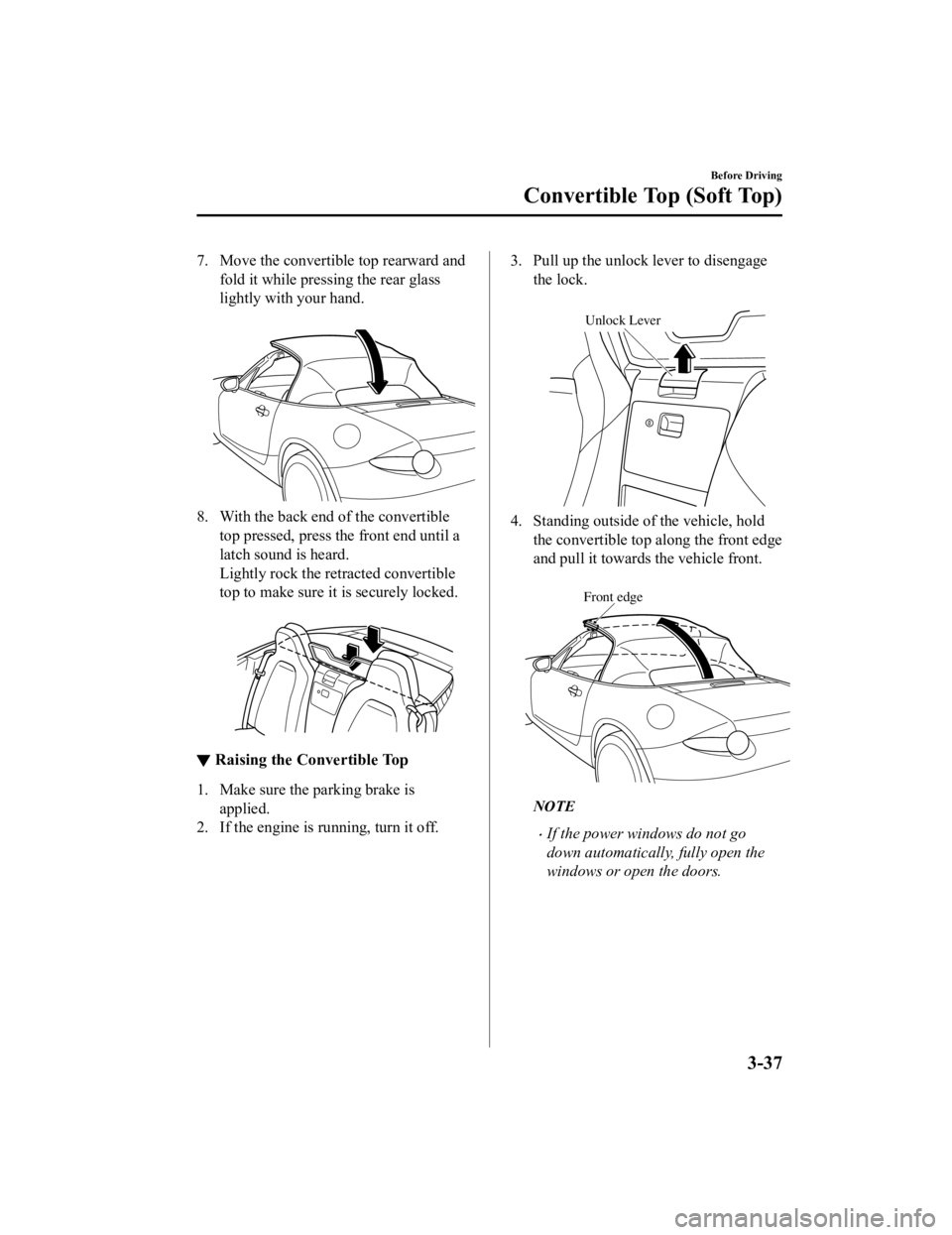
7. Move the convertible top rearward andfold it while pres sing the rear glass
lightly with your hand.
8. With the back end of the convertible top pressed, press the front end until a
latch sound is heard.
Lightly rock the retracted convertible
top to make sure it is securely locked.
▼ Raising the Convertible Top
1. Make sure the parking brake is
applied.
2. If the engine is running, turn it off.
3. Pull up the unlock lever to disengage the lock.
Unlock Lever
4. Standing outside of the vehicle, holdthe convertible top along the front edge
and pull it towards the vehicle front.
Front edge
NOTE
If the power windows do not go
down automatically, fully open the
windows or open the doors.
Before Driving
Convertible Top (Soft Top)
3-37
MX-5_8GV5-EA-18E_Edition3 2018-7-17 15:48:16
Page 103 of 553
Convertible Top (Hardtop)
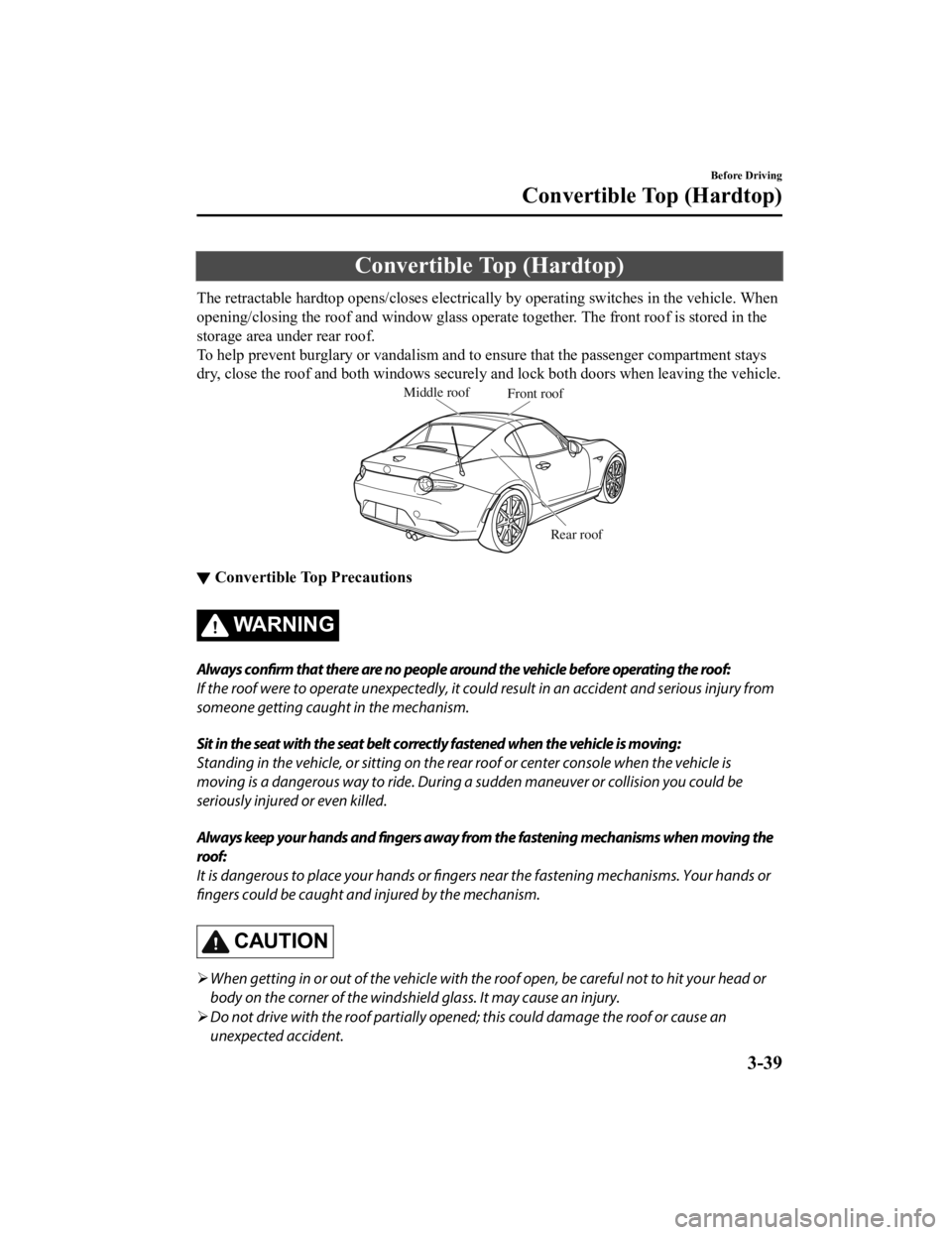
The retractable hardtop opens/closes electrically by operating switches in the vehicle. When
opening/closing the roof and window glass operate together. The front roof is stored in the
storage area under rear roof.
To help prevent burglary or vandalism and to ensure that the pa ssenger compartment stays
dry, close the roof and both windows securely and lock both doo rs when leaving the vehicle.
Front roof
Rear roofMiddle roof
▼Convertible Top Precautions
WA R N I N G
Always
confirm that there are no people around the vehicle before operating the roof:
If the roof were to operate unexpectedly, it coul d result in an accident and serious injury from
someone getting caught in the mechanism.
Sit in the seat with the seat belt correctly fastened when the vehicle is moving:
Standing in the vehicle, or sitting on the rear roof or center console when the vehicle is
moving is a dangerous way to ride. During a sudden maneuver or collision you could be
seriously injured or even killed.
Always keep your hands and fingers away from the fastening mechanisms when moving the
roof:
It is dangerous to place your hands or fingers near the fastening mechanisms. Your hands or
fingers could be caught and injured by the mechanism.
CAUTION
When getting in or out of the vehicle with the roof open, be careful not to hit your head or
body on the corner of the windshield glass. It may cause an injury.
Do not drive with the roof partially opened; this could damage the roof or cause an
unexpected accident.
Before Driving
Convertible Top (Hardtop)
3-39
MX-5_8GV5-EA-18E_Edition3 2018-7-17 15:48:16
Page 104 of 553
Children should not be allowed to play with the retractable hardtop switch.
Do not place objects or cargo around the rear roof, rear glass, or the front roof storage area.
Even small objects may interfere and cause damage.
Remove leaves that accumulate on and around the roof. If the leaves are not removed, they
may block the water drainage outlets.
Before opening the roof, make sure the rear window defogger switch (Defroster) is turned
off. Otherwise the heat generated from the defogger could damage the roof and the
internal material.
When opening/closing the roof, verify that ther e is no obstruction above the roof (about 1.6
m (5 ft 2 in) from the ground) so as not to damage the roof or the obstruction.
When opening/closing the roof, do not apply any load to the front roof or the rear roof. The
opening/closing mechanism of the roof may be damaged.
Do not spray water directly near the seam of the window and roof when washing
off dirt on
the roof with water. Otherwise, water may enter the cabin.
Refer to Convertible Top (Retractable Hardtop) Maintenance on page 6-61.
Open/close the roof with the vehicle parked on a hard, level ground in a safe place where
the vehicle does not obstruct traffic. If the r oof is opened/closed on a slope or bump, the
opening/closing mechanism of the roof may be damaged.
Do not drive through an automatic car wash as it may damage the roof.
Do not open or close the roof forcefully when the ambient temperature is low and the roof
or the surrounding area is frozen as it could damage the roof.
Opening the roof while it is wet can also cause water to drip into the passenger
compartment.
Do not open or close the roof in a strong wind as it could damage the roof.
▼ Operation Indication
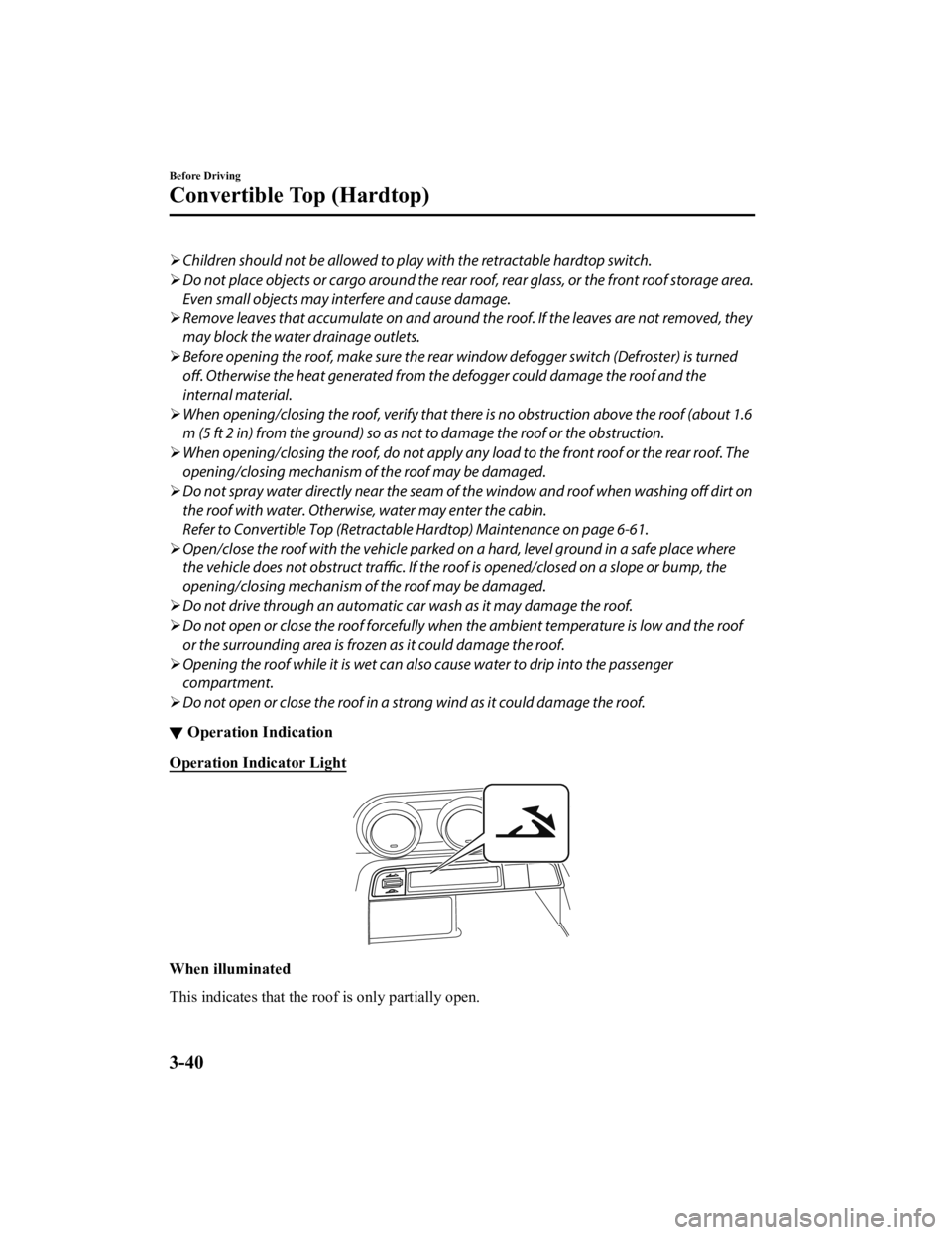
Operation Indicator Light
When illuminated
This indicates that the roof is only partially open.
Before Driving
Convertible Top (Hardtop)
3-40
MX-5_8GV5-EA-18E_Edition3
2018-7-17 15:48:16
Page 114 of 553
Rocking the Vehicle
WA R N I N G
Do not spin the wheels at more than 56
km/h (35 mph), and do not allow anyone
to stand behind a wheel when pushing the
vehicle:
When the vehicle is stuck, spinning the
wheels at high speed is dangerous. The
spinning tire could overheat and explode.
This could cause serious injuries.
CAUTION
Too much rocking may cause engine
overheating, transmission failure, and tire
damage.
If you must rock the vehicle to free it from
snow, sand or mud, depress the accelerator
slightly and slowly move the shift lever/
selector lever from 1 (D) to R position.
Winter Driving
Carry emergency gear, including tire
chains, window scraper, flares, a small
shovel, jumper cables, and a small bag of
sand or salt.
Ask an Authorized Mazda Dealer to check
the following:
Have the proper ratio of antifreeze in the
radiator.
Refer to Engine Coolant on page 6-24.
Inspect the battery and its cables. Cold
reduces battery capacity.
Use an engine oil appropriate for the
lowest ambient temperatures that the
vehicle will be driven in (page 6-22).
Inspect the ignition system for damage
and loose connections.
Use washer fluid made with
antifreeze―but do not use engine
coolant antifreeze for washer fluid (page
6-26).
NOTE
Do not use the parking brake in freezing
weather as it may freeze. Instead, shift
to P with an automatic transmission and
to 1 or R with a manual transmission.
Block the rear wheels.
Remove snow before driving. Snow left
on the windshield is dangerous as it
could obstruct vision.
Do not open or close the soft top when
the temperature is 5 °C (41 °F) or less.
The material of the soft top could be
damaged by freezing.
Do not apply excessive force to a
window scraper when removing ice or
frozen snow on the mirror glass and
windshield.
Before Driving
Driving Tips
3-50
MX-5_8GV5-EA-18E_Edition3 2018-7-17 15:48:16
Page 115 of 553

Never use warm or hot water for
removing snow or ice from windows and
mirrors as it could result in the glass
cracking.
Drive slowly. Braking performance can
be adversely affected if snow or ice
adheres to the brake components. If this
situation occurs, drive the vehicle
slowly, releasing the accelerator pedal
and lightly applying the brakes several
times until the brake performance
returns to normal.
▼Snow Tires
Use snow tires on
all four wheels
Do not go faster than 120 km/h (75 mph)
while driving with sno w tires. Inflate snow
tires 30 kPa (0.3 kgf/cm
2, 4.3 psi) more
than recommended on the tire pressure
label (driver's door frame), but never more
than the maximum c old-tire pressure
shown on the tires.
The vehicle is originally equipped with
summer tires designed for optimum
traction on wet and dry roads. If your
vehicle is to be used on snow and ice
covered roads, Mazda recommends that
you replace the tires originally equipped
on your vehicle with snow tires during the
winter months.
WA R N I N G
Use only the same size and type tires (snow,
radial, or non-radial) on all four wheels:
Using tires different in size or type is
dangerous. Your vehi cle's handling could
be greatly affected and result in an
accident.
CAUTION
Check local regulations before using
studded tires.
NOTE
The tire pressure monitoring system may
not function correctly when using tires
with steel wire reinforcement in the
sidewalls (page 4-115).
▼ Tire Chains
Check local regulati
ons before using tire
chains.
CAUTION
Chains may
affect handling.
Do not go faster than 50 km/h (30 mph)
or the chain manufacturer's
recommended limit, whichever is lower.
Drive carefully and avoid bumps, holes,
and sharp turns.
Avoid locked-wheel braking.
Do not use chains on roads that are free
of snow or ice. The tires and chains could
be damaged.
Chains may scratch or chip aluminum
wheels.
NOTE
The tire pressure monitoring system may
not function correctly when using tire
chains.
Install the chains on the rear tires only.
Do not use chains on the front tires.
Please consult an Authorized Mazda
Dealer.
Before Driving
Driving Tips
3-51
MX-5_8GV5-EA-18E_Edition3 2018-7-17 15:48:16
Page 208 of 553

If the road width is extremely narrow, vehicles two lanes over may be detected. The
detection area of the radar sensors (rear) is set according to the road width of
expressways.
The BSM warning lights may turn on in reaction to stationary objects on the road or the
roadside such as guardrails, tunnels, sidewalls, and parked vehicles.
Objects such as guardrails and concrete walls
running alongside the vehicle.Places where the width between guardrails or
walls on each side of the vehicle narrows.
The walls at the entrance and exits of tunnels,
turnouts.
A BSM warning light may flash or the warnin
g beep may be activated several times when
making a turn at a city intersection.
Turn off the BSM while pulling a trailer or while an accessory such as a bicycle carrier is
installed to the rear of the vehicle. Otherwis e, the radar’s radio waves will be blocked
causing the system to not operate normally.
In the following cases, it may be difficult to view the illumination/flashing of the BSM
warning lights equipped on the door mirrors.
Snow or ice is adhering to the door mirrors.
The door glass is fogged or covered in snow, frost or dirt.
The system switches to the Rear Cross Traffic Alert (RCTA) function when the shift lever
(manual transmission) or the selector lever ( automatic transmission) is shifted to the
reverse (R) position.
Refer to Rear Cross Traffic Alert (RCTA) on page 4-97.
▼ Blind Spot Monitoring (BSM) Warni
ng Lights/Blind Spot Monitoring (BSM)
Warning Beep
The BSM or Rear Cross Traffic Al ert (RCTA) system notifies the driver of the presence of
vehicles in adjacent lanes to the rear of your vehicle using th e BSM warning lights and the
warning beep while the s ystems are operational.
When Driving
i-ACTIVSENSE
4-88
MX-5_8GV5-EA-18E_Edition3 2018-7-17 15:48:16
Page 219 of 553

The battery voltage has decreased.
Under the following conditions, the radar sensors (rear) cannot detect target objects or it
may be difficult to detect them.
The vehicle speed when reversing is about 10 km/h (6 mph) or faster.
The radar sensor (rear) detection area is obstructed by a nearby wall or parked vehicle.
(Reverse the vehicle to a position where the radar sensor detection area is no longer
obstructed.)
Your vehicle
A vehicle is approaching directly from the rear of your vehicle.
Your vehicle
The vehicle is parked on a slant.
Your vehicle
Directly after the Blind Spot Monitoring (BSM) system becomes operable using the
personalization feature.
Radio wave interference from a radar sensor equipped on a nearby parked vehicle.
In the following cases, it may be difficult to view the illumination/flashing of the Blind
Spot Monitoring (BSM) warning indicator lights equipped on the door mirrors.
Snow or ice adheres to the door mirrors.
The door glass is fogged or covered in snow, frost or dirt.
Turn off the RCTA system while pulling a trailer or while an accessory such as a bicycle
carrier is installed to the rear of the vehic le. Otherwise, the radio waves emitted by the
radar will be blocked causing the system to not operate normally.
When Driving
i-ACTIVSENSE
4-99
MX-5_8GV5-EA-18E_Edition3 2018-7-17 15:48:16
Page 224 of 553

Heed the following cautions to assure the correct operation of the Forward Sensing Camera
(FSC).
Be careful not to scratch the Forward Sensing Camera (FSC) lens or allow it to get dirty.
Do not remove the Forward Sensing Camera (FSC) cover.
Do not place objects on the dashboard which reflect light.
Always keep the windshield glass around the camera clean by removing dirt or fogging.
Use the windshield defroster to remove fogging on the windshield.
Consult an Authorized Mazda Dealer regardi ng cleaning the interior side of the
windshield around the Forw ard Sensing Camera (FSC).
Consult an Authorized Mazda Dealer before performing repairs around the Forward
Sensing Camera (FSC).
The Forward Sensing Camera (FSC) is installe d to the windshield. Consult an Authorized
Mazda Dealer for windshield repair and replacement.
When cleaning the wind shield, do not allow glass cleaners or similar cleaning fluids to
get on the Forward Sensing Camera (FSC) le ns. In addition, do not touch the Forward
Sensing Camera (FSC) lens.
When performing repairs around the rearv iew mirror, consult an Authorized Mazda
Dealer.
Consult an Authorized Mazda Dealer regarding cleaning of the camera lens.
Do not hit or apply strong force to the Forward Sensing Camera (FSC) or the area around
it. If the Forward Sensing Camera (FSC) is severely hit or if there are cracks or damage
caused by flying gravel or debris in the area around it, stop using the following systems
and consult an Authorized Mazda Dealer.
High Beam Control System (HBC)
Lane Departure Warning System (LDWS)
Traffic Sign Recognition System (TSR)
Smart City Brake Support (SCBS)
The direction in which the Forward Sensing Camera (FSC) is pointed has been finely
adjusted. Do not change the installation posi tion of the Forward Sensing Camera (FSC) or
remove it. Otherwise, it could result in damage or malfunction.
Always use tires for all wheels that are of the specified size, and the same manufacturer,
brand, and tread pattern. In addition, do no t use tires with significantly different wear
patterns on the same vehicle as the system may not operate normally.
The Forward Sensing Camera (FSC) includes a function for detecting a soiled windshield
and informing the driver, however, depending on the conditions, it may not detect plastic
shopping bags, ice or snow on the windshield. In such cases, the system cannot accurately
determine a vehicle ahead and may not be able to operate normally. Always drive carefully
and pay attention to the road ahead.
When Driving
i-ACTIVSENSE
4-104
MX-5_8GV5-EA-18E_Edition3 2018-7-17 15:48:16