change wheel MAZDA MODEL RX 8 2011 Owners Manual (in English)
[x] Cancel search | Manufacturer: MAZDA, Model Year: 2011, Model line: MODEL RX 8, Model: MAZDA MODEL RX 8 2011Pages: 442, PDF Size: 7.12 MB
Page 124 of 442

Black plate (124,1)
Steering Wheel
WARNING
Never adjust the steering wheel while
the vehicle is moving:
Adjusting the steering wheel while
the vehicle is moving is dangerous.
Moving it can very easily cause the
driver to abruptly turn to the left or
right. This can lead to loss of control
or an accident.
qTilt Steering Wheel
To change the angle of the steering wheel,
stop the vehicle, pull the tilt wheel release
lever under the steering column down,
adjust the wheel, then push the release
lever up to lock the column.
Tilt wheel release
lever
After adjusting, push the wheel up and
down to be certain it's locked before
driving.
Mirrors
qOutside Mirrors
Check the mirror angles before driving.
Mirror type
Flat type (driver's side)
Flat surface mirror.
Convex type (front passenger side)
The mirror has single curvature on its
surface.
WARNING
Be sure to look over your shoulder
before changing lanes:
Changing lanes without taking into
account the actual distance of the
vehicle in the convex mirror is
dangerous. You could have a serious
accident. What you see in the convex
mirror is closer than it appears.
Power mirror
The ignition must be switched to ACC or
ON.
To adjust:
1. Press the left or right side of the
selector switch to choose the left or
right side mirror.
3-54
Knowing Your Mazda
Steering Wheel and Mirrors
RX-8_8BQ7-EA-10H_Edition1 Page124
Wednesday, July 14 2010 11:50 AM
Form No.8BQ7-EA-10H
Page 135 of 442

Black plate (135,1)
WARNING
Never stop the engine when going
down a hill:
Stopping the engine when going
down a hill is dangerous. This causes
the loss of power steering and power
brake control, and may cause
damage to the drivetrain. Any loss of
steering or braking control could
cause an accident.
Hazardous Driving
WARNING
Be extremely careful if it is necessary to
downshift on slippery surfaces:
Downshifting into lower gear while
driving on slippery surfaces is
dangerous. The sudden change in tire
speed could cause the tires to skid.
This could lead to loss of vehicle
control and an accident.
Do not rely on ABS as a substitute for
safe driving:
The ABS cannot compensate for
unsafe and reckless driving, excessive
speed, tailgating (following another
vehicle too closely), driving on ice and
snow, and hydroplaning (reduced tire
friction and road contact because of
water on the road surface). You can
still have an accident.
When driving on ice or in water, snow,
mud, sand, or similar hazards:
lBe cautious and allow extra distance
for braking.
lAvoid sudden braking and sudden
maneuvering.
lDo not pump the brakes. Continue to
press down on the brake pedal.
Refer to Anti-Lock Brake System
(ABS) on page 5-9.
lIf you get stuck, select a lower gear and
accelerate slowly. Do not spin the rear
wheels.
lFor more traction in starting on
slippery surfaces such as ice or packed
snow, use sand, rock salt, chains,
carpeting, or other nonslip material
under the rear wheels.
NOTE
Use snow chains only on the rear wheels.
Before Driving Your Mazda
Driving Tips
4-7
RX-8_8BQ7-EA-10H_Edition1 Page135
Wednesday, July 14 2010 11:50 AM
Form No.8BQ7-EA-10H
Page 138 of 442
Black plate (138,1)
NOTE
If your vehicle is equipped with the tire
pressure monitoring system, the system may
not function correctly when using tires with
steel wire reinforcement in the sidewalls (page
5-34).
qTire Chains
Check local regulations before using tire
chains.
CAUTION
ØChains may affect handling.
ØDo not go faster than 50 km/h (30
mph) or the chain manufacturer's
recommended limit, whichever is
lower.
ØDrive carefully and avoid bumps,
holes, and sharp turns.
ØAvoid locked-wheel braking.
ØDo not use chains on a temporary
spare tire; it may result in damage
to the vehicle and to the tire. Your
vehicle is not equipped with a
factory installed temporary spare
tire.
ØDo not use chains on roads that
are free of snow or ice. The tires
and chains could be damaged.
ØChains may scratch or chip
aluminum wheels.NOTE
lIf your vehicle is equipped with the tire
pressure monitoring system, the system may
not function correctly when using tire
chains.
lTire chains cannot be installed on vehicle
equipped with 19-inch tires. Before
attempting to install tire chains, the tires on
the front and rear must first be changed
from the 19-inch size to 18-inch tires.
Please consult an Authorized Mazda
Dealer.
Install the chains on the rear tires.
Do not use chains on the front tires.
Use only TÜV standard chains, and make
sure they fit.
Installing the chains
1. Secure the chains on the rear tires as
tightly as possible. Always follow the
chain manufacturer's instructions.
2. Retighten the chains after driving 1/2
―1 km (1/4―1/2 mile).
4-10
Before Driving Your Mazda
Driving Tips
RX-8_8BQ7-EA-10H_Edition1 Page138
Wednesday, July 14 2010 11:50 AM
Form No.8BQ7-EA-10H
Page 158 of 442

Black plate (158,1)
qActive Adaptive Shift (AAS)
Active Adaptive Shift (AAS)
automatically controls the transmission
shift points to best suit the road conditions
and driver input. This optimizes engine
performance and improves driving
comfort. When cornering the vehicle,
AAS mode will hold the transmission in
the gear the vehicle was in before entering
the curve, allowing the vehicle to be
accelerated from the same gear after
exiting the curve.
If the driver accelerates rapidly, or
accelerates and decelerates rapidly by
operating the accelerator and brake pedal
for a certain period of time while the
selector lever is in the D position, AAS
mode could activate. When this occurs,
AAS mode will maintain the transmission
in the optimum gear and the driver may
sense that the transmission is not shifting,
however this does not indicate an
abnormality.
qShift-Lock System
The shift-lock system prevents shifting
out of P unless the brake pedal is
depressed.
To shift from P:
1. Depress and hold the brake pedal.
2. Start the engine.
3. Move the shift lever.NOTE
lWhen the ignition switch is in the LOCK
position, the shift lever cannot be shifted
from P.
lTo be sure the vehicle is in park,the
ignition key cannot be removed unless the
shift lever is in P.
l(With Advanced Key)
The ignition cannot be switched from ACC
to OFF when the shift lever is not in P.
qManual Shift Mode
This mode gives you the feel of driving a
manual transmission vehicle by operating
the shift lever and allows you to control
engine rpm and torque to the rear wheels
much like a manual transmission when
more control is desired.
To change to manual shift mode, shift the
lever from D to M.
NOTE
Changing to manual shift mode while driving
will not damage the transmission.
To return to automatic shift mode, shift
the lever from M to D.
5-16
Driving Your Mazda
Starting and Driving
RX-8_8BQ7-EA-10H_Edition1 Page158
Wednesday, July 14 2010 11:50 AM
Form No.8BQ7-EA-10H
Page 160 of 442
Black plate (160,1)
WARNING
Keep your hands on the steering wheel
rim when using fingers or thumbs on
the steering shift switches:
Putting your hands inside the rim of
the steering wheel when using the
steering shift switches is dangerous.
If the driver's air bag were to deploy
in a collision, your hands could be
impacted causing injury.
NOTE
lWhen driving slowly, the gears may not
shift up.
lIn manual shift mode, gears do not shift up
automatically. Do not run the engine with
the tachometer needle in the RED ZONE. If
the tachometer needle enters the RED
ZONE, you may feel engine-braking
because the fuel delivery will be stopped to
protect the engine. However, this does not
indicate an abnormality.
lWhen depressing the accelerator fully, the
transmission will shift to a lower gear,
depending on vehicle speed.
Manually Shifting down
(M6→M5→M4→M3→M2→
M1)
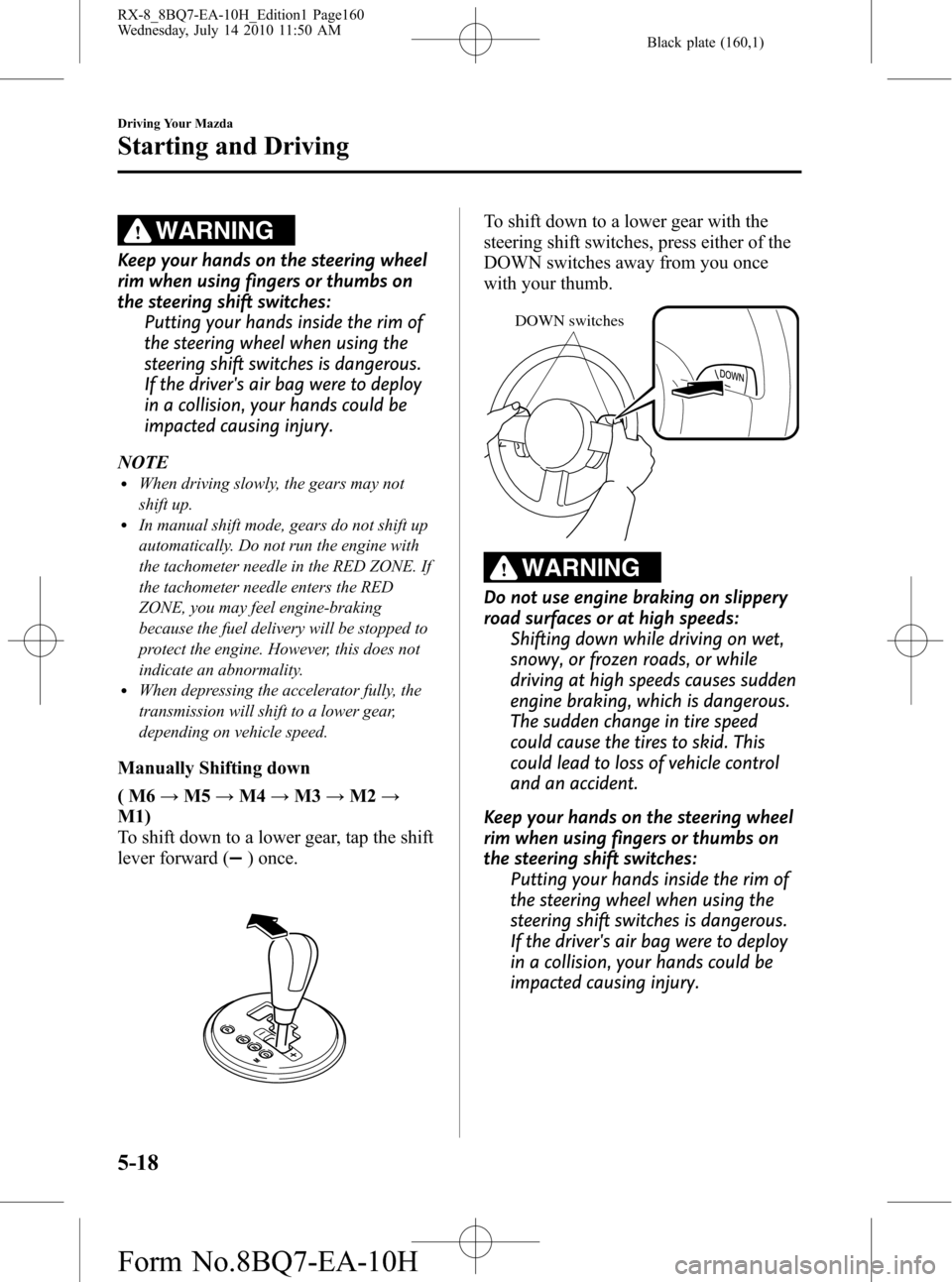
To shift down to a lower gear, tap the shift
lever forward (
) once.
To shift down to a lower gear with the
steering shift switches, press either of the
DOWN switches away from you once
with your thumb.
DOWN switches
WARNING
Do not use engine braking on slippery
road surfaces or at high speeds:
Shifting down while driving on wet,
snowy, or frozen roads, or while
driving at high speeds causes sudden
engine braking, which is dangerous.
The sudden change in tire speed
could cause the tires to skid. This
could lead to loss of vehicle control
and an accident.
Keep your hands on the steering wheel
rim when using fingers or thumbs on
the steering shift switches:
Putting your hands inside the rim of
the steering wheel when using the
steering shift switches is dangerous.
If the driver's air bag were to deploy
in a collision, your hands could be
impacted causing injury.
5-18
Driving Your Mazda
Starting and Driving
RX-8_8BQ7-EA-10H_Edition1 Page160
Wednesday, July 14 2010 11:50 AM
Form No.8BQ7-EA-10H
Page 170 of 442
Black plate (170,1)
CAUTION
ØThe DSC may not operate correctly
unless the following are observed:
ØUse tires of the correct size
specified for your Mazda on all
four wheels.
ØUse tires of the same
manufacturer, brand and tread
pattern on all four wheels.
ØDo not mix worn tires.
ØThe DSC may not operate correctly
when tire chains are used or a
temporary spare tire is installed
because the tire diameter changes.
ØIf repair or replacement of the
steering or other surrounding
equipment is necessary, have it
done at an Authorized Mazda
Dealer. If the center position of the
steering deviates, the DSC may not
operate correctly because there is
a sensor in the steering which
detects driving conditions.
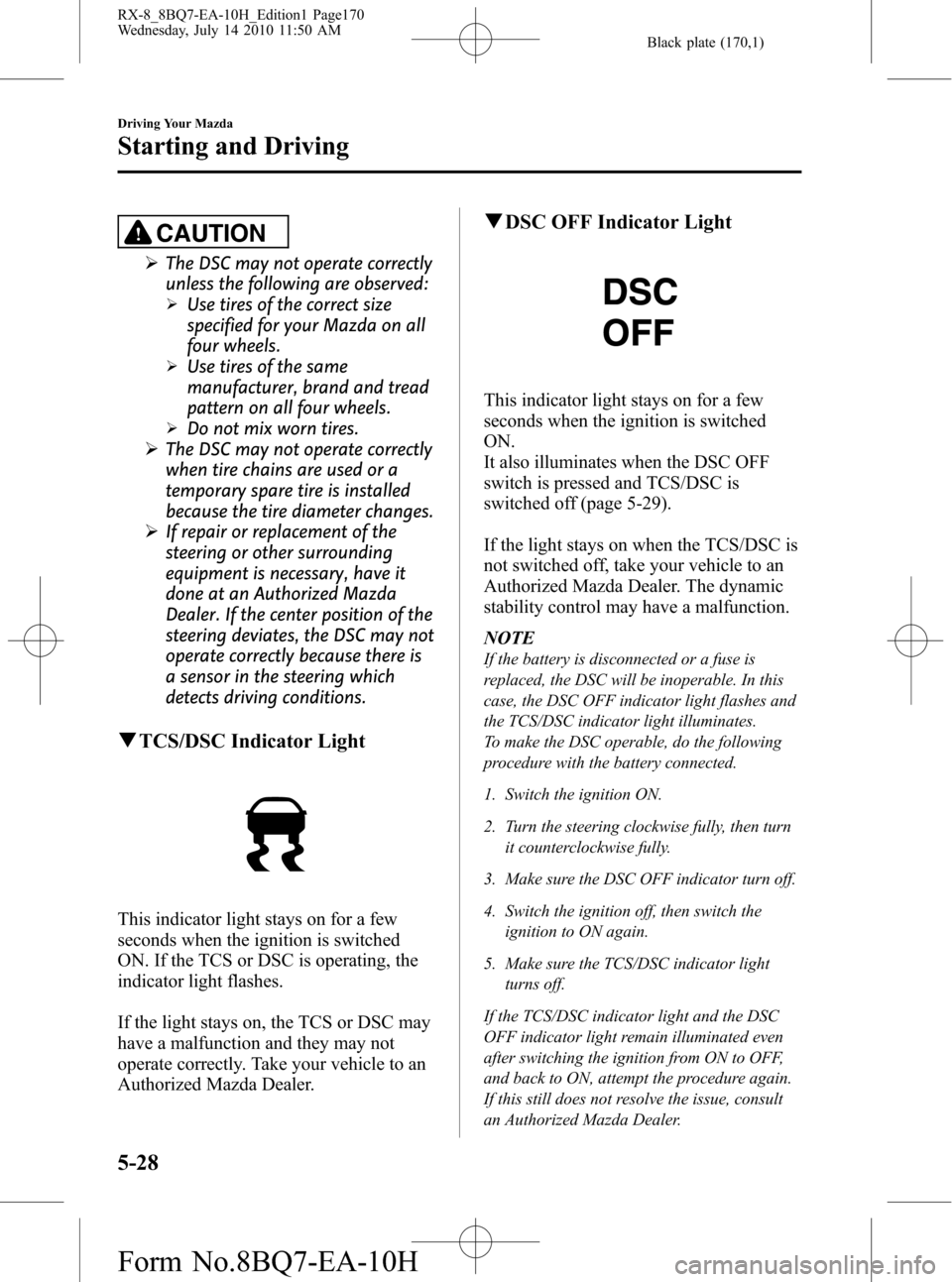
qTCS/DSC Indicator Light
This indicator light stays on for a few
seconds when the ignition is switched
ON. If the TCS or DSC is operating, the
indicator light flashes.
If the light stays on, the TCS or DSC may
have a malfunction and they may not
operate correctly. Take your vehicle to an
Authorized Mazda Dealer.
qDSC OFF Indicator Light
This indicator light stays on for a few
seconds when the ignition is switched
ON.
It also illuminates when the DSC OFF
switch is pressed and TCS/DSC is
switched off (page 5-29).
If the light stays on when the TCS/DSC is
not switched off, take your vehicle to an
Authorized Mazda Dealer. The dynamic
stability control may have a malfunction.
NOTE
If the battery is disconnected or a fuse is
replaced, the DSC will be inoperable. In this
case, the DSC OFF indicator light flashes and
the TCS/DSC indicator light illuminates.
To make the DSC operable, do the following
procedure with the battery connected.
1. Switch the ignition ON.
2. Turn the steering clockwise fully, then turn
it counterclockwise fully.
3. Make sure the DSC OFF indicator turn off.
4. Switch the ignition off, then switch the
ignition to ON again.
5. Make sure the TCS/DSC indicator light
turns off.
If the TCS/DSC indicator light and the DSC
OFF indicator light remain illuminated even
after switching the ignition from ON to OFF,
and back to ON, attempt the procedure again.
If this still does not resolve the issue, consult
an Authorized Mazda Dealer.
5-28
Driving Your Mazda
Starting and Driving
RX-8_8BQ7-EA-10H_Edition1 Page170
Wednesday, July 14 2010 11:50 AM
Form No.8BQ7-EA-10H
Page 172 of 442

Black plate (172,1)
Tire Pressure Monitoring Systemí
The tire pressure monitoring system (TPMS) monitors the pressure for each tire.
If tire pressure is too low in one or more tires, the system will inform the driver via the
warning light in the instrument panel and by the warning beep sound.
The tire pressure sensors installed on each wheel send tire pressure data by radio signal to
the receiver unit in the vehicle.
Tire pressure sensors
NOTE
When the ambient temperature is low due to seasonal changes, tire temperatures are also lower.
When the tire temperature decreases, the air pressure decreases as well. The TPMS warning light
may illuminate more frequently. Visually inspect the tires daily before driving, and check tire
pressures monthly with a tire pressure gauge. When checking tire pressures, use of a digital tire
pressure gauge is recommended.
TPMS does not alleviate your need to check the pressure and condition of all four tires
regularly.
5-30
Driving Your Mazda
íSome models.
Starting and Driving
RX-8_8BQ7-EA-10H_Edition1 Page172
Wednesday, July 14 2010 11:50 AM
Form No.8BQ7-EA-10H
Page 176 of 442
Black plate (176,1)
If the warning light illuminates again even
after the tire pressures are adjusted, there
may be a tire puncture.
Vehicles with Instant Mobility System
(IMS) emergency flat tire repair kit
If an emergency tire repair is needed,
repair the punctured tire with the
emergency flat tire repair kit (page 7-5).
CAUTION
Do not use non-genuine tire sealant.
It may damage the tire pressure
sensor.
Vehicles with optional temporary spare
tire
If you have bought the optional temporary
spare tire, replace the punctured tire with
the temporary spare tire. Refer to the
manufacturer's instructions.
NOTE
A tire pressure sensor is not installed to the
temporary spare tire. The warning light will
flash continuously while the temporary spare
tire is being used.
Warning light flashes
When the warning light flashes, there may
be a system malfunction. Consult an
Authorized Mazda Dealer.
qSystem Error Activation
When the warning light flashes, there may
be a system malfunction. Consult an
Authorized Mazda Dealer.
A system error activation may occur in
the following cases:
lWhen there is equipment or a device
near the vehicle using the same radio
frequency as that of the tire pressure
sensors.
lWhen a metallic device such as a non-
genuine navigation system is equipped
near the center of the dashboard, which
may block radio signals from the tire
pressure sensor to the receiver unit.
lWhen using the following devices in
the vehicle that may cause radio
interference with the receiver unit.
lA digital device such as a personal
computer.
lA current converter device such as a
DC-AC converter.
lWhen excess snow or ice adheres to
the vehicle, especially around the
wheels.
lWhen the tire pressure sensor batteries
are exhausted.
lWhen using a wheel with no tire
pressure sensor installed.
lWhen using tires with steel wire
reinforcement in the side walls.
lWhen using tire chains.
qTires and Wheels
CAUTION
When inspecting or adjusting the tire
air pressures, do not apply excessive
force to the stem part of the wheel
unit. The stem part could be
damaged.
Changing tires and wheels
The following procedure allows the
TPMS to recognize a tire pressure sensor's
unique ID signal code whenever tires or
wheels are changed, such as changing to
and from winter tires.
5-34
Driving Your Mazda
Starting and Driving
RX-8_8BQ7-EA-10H_Edition1 Page176
Wednesday, July 14 2010 11:50 AM
Form No.8BQ7-EA-10H
Page 177 of 442

Black plate (177,1)
NOTE
Each tire pressure sensor has a unique ID
signal code. The signal code must be
registered with the TPMS before it can work.
The easiest way to do it is to have an
Authorized Mazda Dealer change your tire and
complete ID signal code registration.
When having tires changed at an
Authorized Mazda Dealer
When an Authorized Mazda Dealer
changes your vehicle's tires, they will
complete the tire pressure sensor ID signal
code registration.
When changing tires yourself
If you or someone else changes tires, you
or someone else can also undertake the
steps for the TPMS to complete the ID
signal code registration.
1. After tires have been changed, switch
the ignition ON, then back to ACC or
OFF.
2. Wait for about 15 minutes.
3. After about 15 minutes, drive the
vehicle at a speed of at least 25 km/h
(16 mph) for 10 minutes and the tire
pressure sensor ID signal code will be
registered automatically.
NOTE
If the vehicle is driven within about 15 minutes
of changing tires, the tire pressure monitoring
system warning light will flash because the
sensor ID signal code would not have been
registered. If this happens, park the vehicle for
about 15 minutes, after which the sensor ID
signal code will register upon driving the
vehicle for 10 minutes.
Replacing tires and wheels
CAUTION
ØWhen replacing/repairing the tires
or wheels or both, have the work
done by an Authorized Mazda
Dealer, or the tire pressure sensors
may be damaged.
ØThe wheels equipped on your
Mazda are specially designed for
installation of the tire pressure
sensors. Do not use non-genuine
wheels, otherwise it may not be
possible to install the tire pressure
sensors.
Be sure to have the tire pressure sensors
installed whenever tires or wheels are
replaced.
When having a tire or wheel or both
replaced, the following types of tire
pressure sensor installations are possible.
lThe tire pressure sensor is removed
from the old wheel and installed to the
new one.
lThe same tire pressure sensor is used
with the same wheel. Only the tire is
replaced.
lA new tire pressure sensor is installed
to a new wheel.
NOTE
lThe tire pressure sensor ID signal code
must be registered when a new tire pressure
sensor is purchased. For purchase of a tire
pressure sensor and registration of the tire
pressure sensor ID signal code, consult an
Authorized Mazda Dealer.
lWhen reinstalling a previously removed tire
pressure sensor to a wheel, replace the
grommet (seal between valve body/sensor
and wheel) for the tire pressure sensor.
Driving Your Mazda
Starting and Driving
5-35
RX-8_8BQ7-EA-10H_Edition1 Page177
Wednesday, July 14 2010 11:50 AM
Form No.8BQ7-EA-10H
Page 181 of 442
Black plate (181,1)
CAUTION
Do not run the engine with the
tachometer needle in the RED ZONE.
This may cause severe engine
damage.
NOTE
lThe beep sounds to indicate engine overrev
when the tachometer needle enters the
striped zone.
lThe display of the variable red zone in the
tachometer changes according to the
temperature of the engine coolant. To
protect the engine, when the engine coolant
temperature is low, the engine does not run
at high speeds. The fuel supply will be cut
at an rpm lower than the red zone.
qEngine Coolant Temperature Gauge
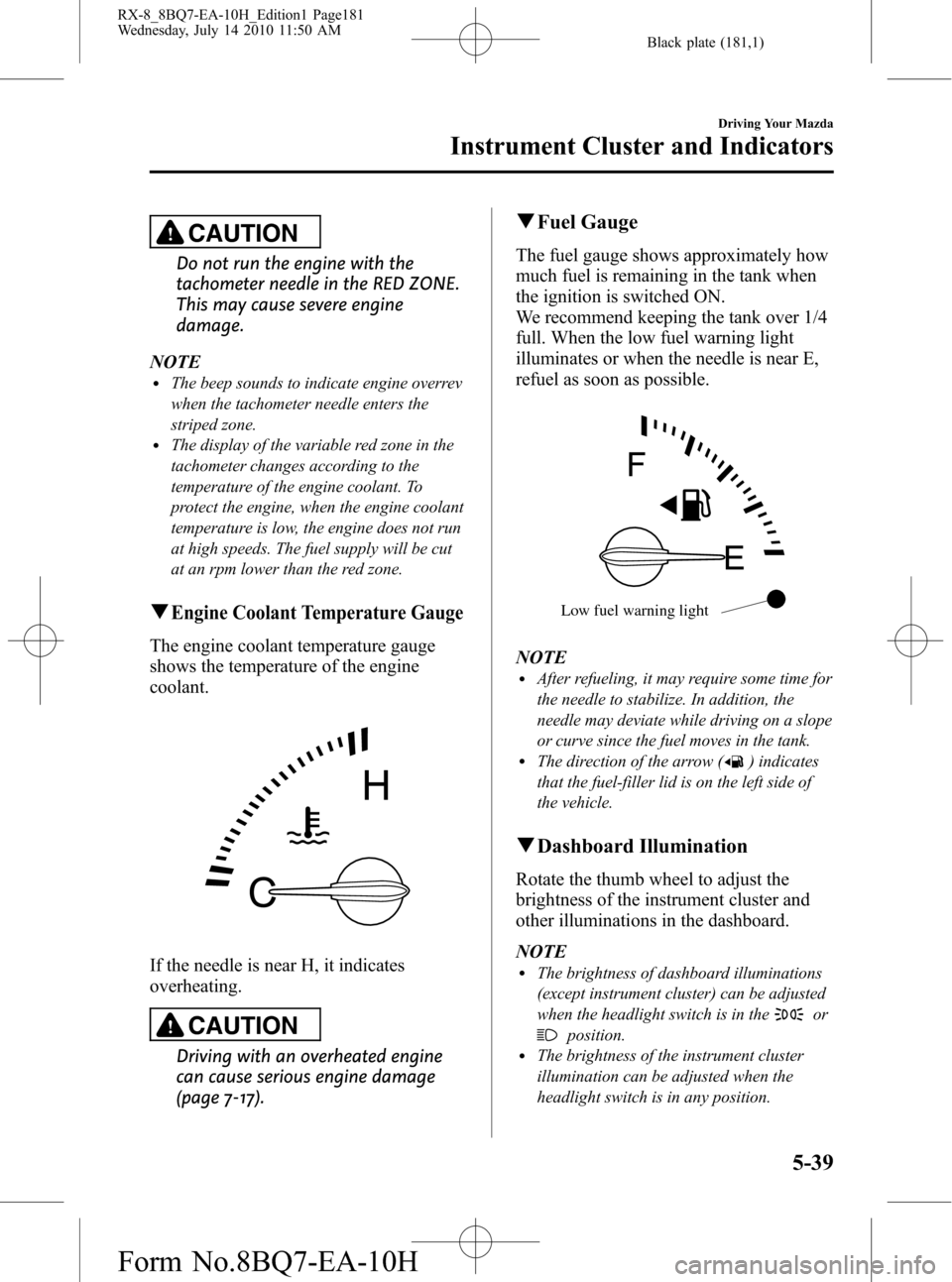
The engine coolant temperature gauge
shows the temperature of the engine
coolant.
If the needle is near H, it indicates
overheating.
CAUTION
Driving with an overheated engine
can cause serious engine damage
(page 7-17).
qFuel Gauge
The fuel gauge shows approximately how
much fuel is remaining in the tank when
the ignition is switched ON.
We recommend keeping the tank over 1/4
full. When the low fuel warning light
illuminates or when the needle is near E,
refuel as soon as possible.
Low fuel warning light
NOTElAfter refueling, it may require some time for
the needle to stabilize. In addition, the
needle may deviate while driving on a slope
or curve since the fuel moves in the tank.
lThe direction of the arrow () indicates
that the fuel-filler lid is on the left side of
the vehicle.
qDashboard Illumination
Rotate the thumb wheel to adjust the
brightness of the instrument cluster and
other illuminations in the dashboard.
NOTE
lThe brightness of dashboard illuminations
(except instrument cluster) can be adjusted
when the headlight switch is in the
or
position.lThe brightness of the instrument cluster
illumination can be adjusted when the
headlight switch is in any position.
Driving Your Mazda
Instrument Cluster and Indicators
5-39
RX-8_8BQ7-EA-10H_Edition1 Page181
Wednesday, July 14 2010 11:50 AM
Form No.8BQ7-EA-10H