overheating MAZDA MODEL TRIBUTE 2003 Owners Manual (in English)
[x] Cancel search | Manufacturer: MAZDA, Model Year: 2003, Model line: MODEL TRIBUTE, Model: MAZDA MODEL TRIBUTE 2003Pages: 248, PDF Size: 2.5 MB
Page 2 of 248
Driving 120
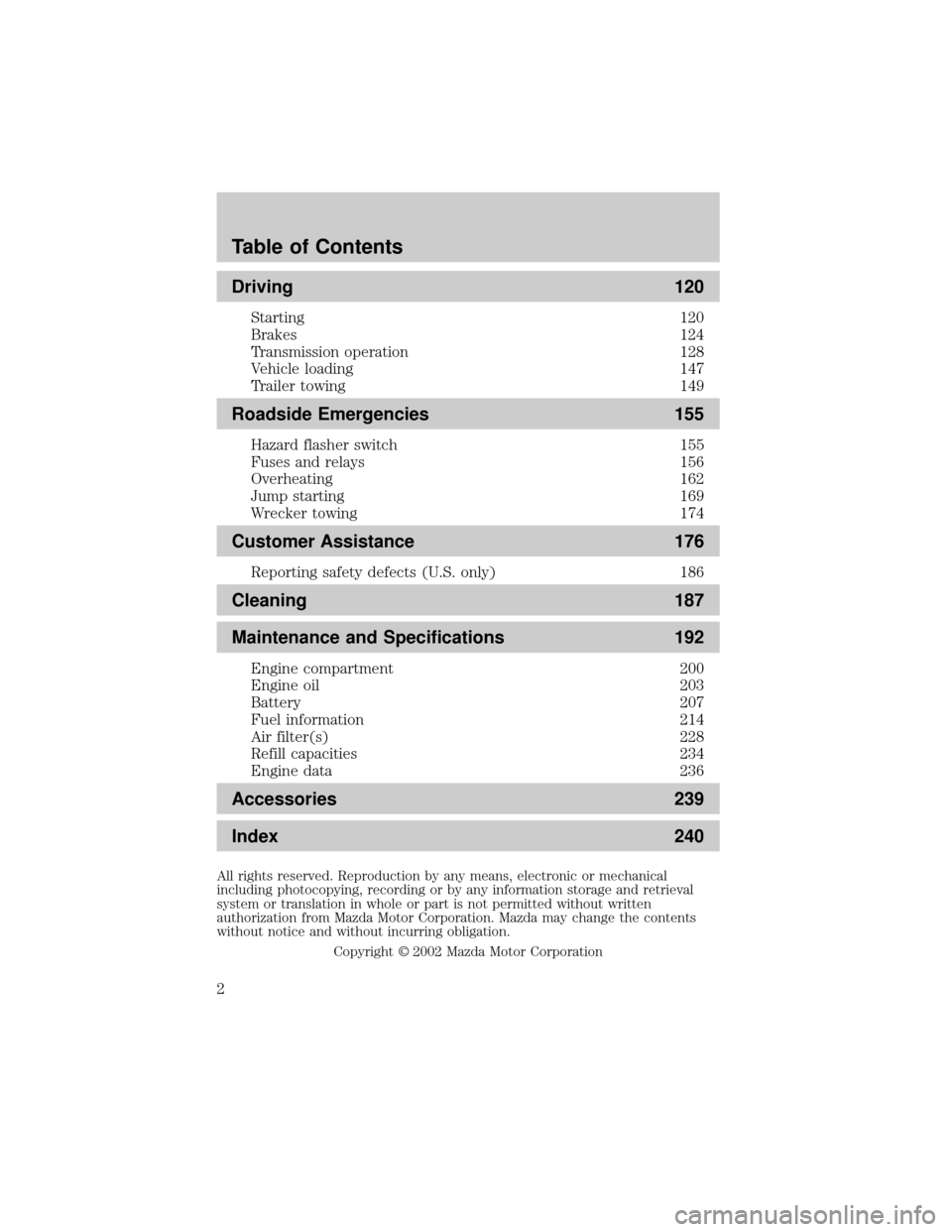
Starting 120
Brakes 124
Transmission operation 128
Vehicle loading 147
Trailer towing 149
Roadside Emergencies 155
Hazard flasher switch 155
Fuses and relays 156
Overheating 162
Jump starting 169
Wrecker towing 174
Customer Assistance 176
Reporting safety defects (U.S. only) 186
Cleaning 187
Maintenance and Specifications 192
Engine compartment 200
Engine oil 203
Battery 207
Fuel information 214
Air filter(s) 228
Refill capacities 234
Engine data 236
Accessories 239
Index 240
All rights reserved. Reproduction by any means, electronic or mechanical
including photocopying, recording or by any information storage and retrieval
system or translation in whole or part is not permitted without written
authorization from Mazda Motor Corporation. Mazda may change the contents
without notice and without incurring obligation.
Copyright 2002 Mazda Motor Corporation
Table of Contents
2
Page 15 of 248
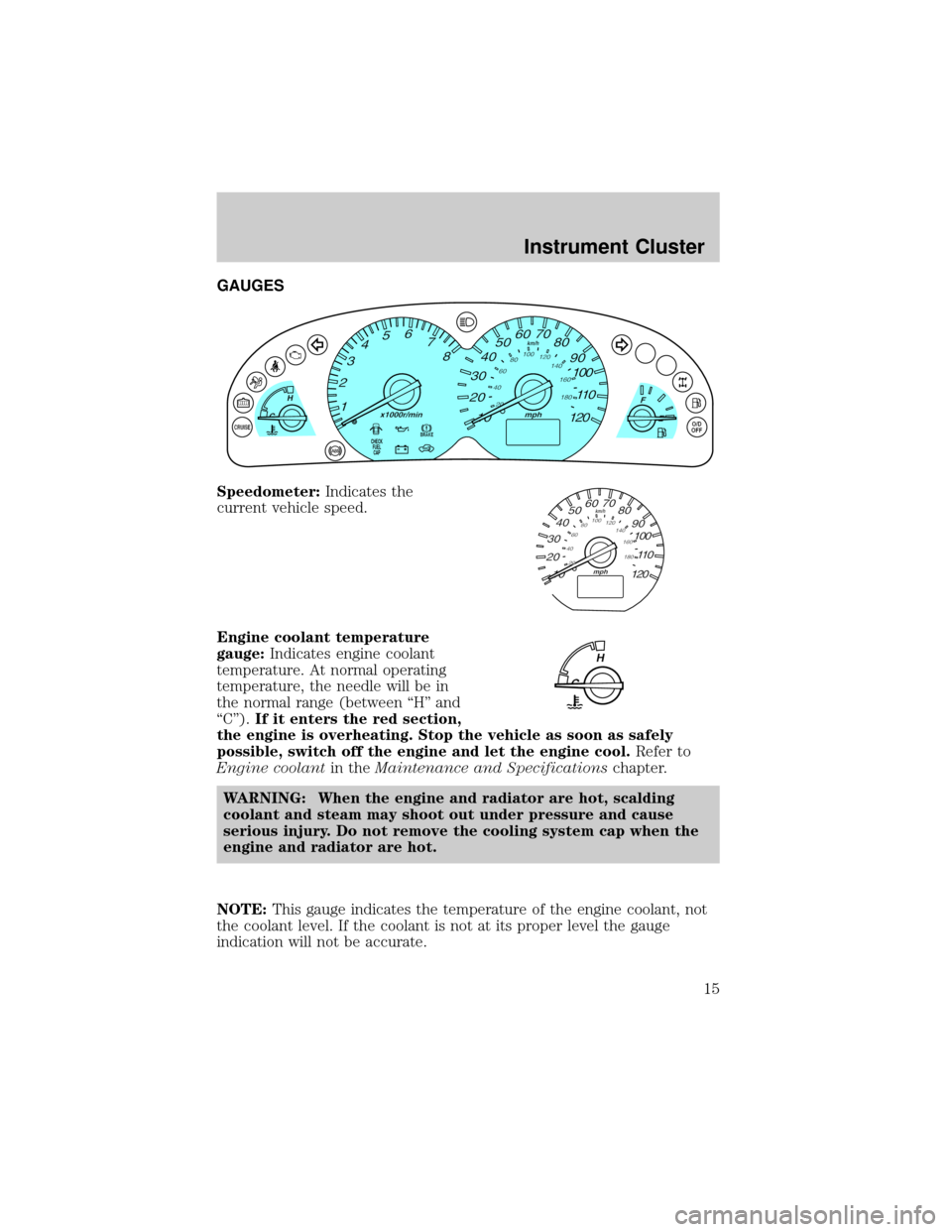
GAUGES
Speedometer:Indicates the
current vehicle speed.
Engine coolant temperature
gauge:Indicates engine coolant
temperature. At normal operating
temperature, the needle will be in
the normal range (between ªHº and
ªCº).If it enters the red section,
the engine is overheating. Stop the vehicle as soon as safely
possible, switch off the engine and let the engine cool.Refer to
Engine coolantin theMaintenance and Specificationschapter.
WARNING: When the engine and radiator are hot, scalding
coolant and steam may shoot out under pressure and cause
serious injury. Do not remove the cooling system cap when the
engine and radiator are hot.
NOTE:This gauge indicates the temperature of the engine coolant, not
the coolant level. If the coolant is not at its proper level the gauge
indication will not be accurate.
CHECK
FUEL
CAP
Instrument Cluster
15
Page 144 of 248
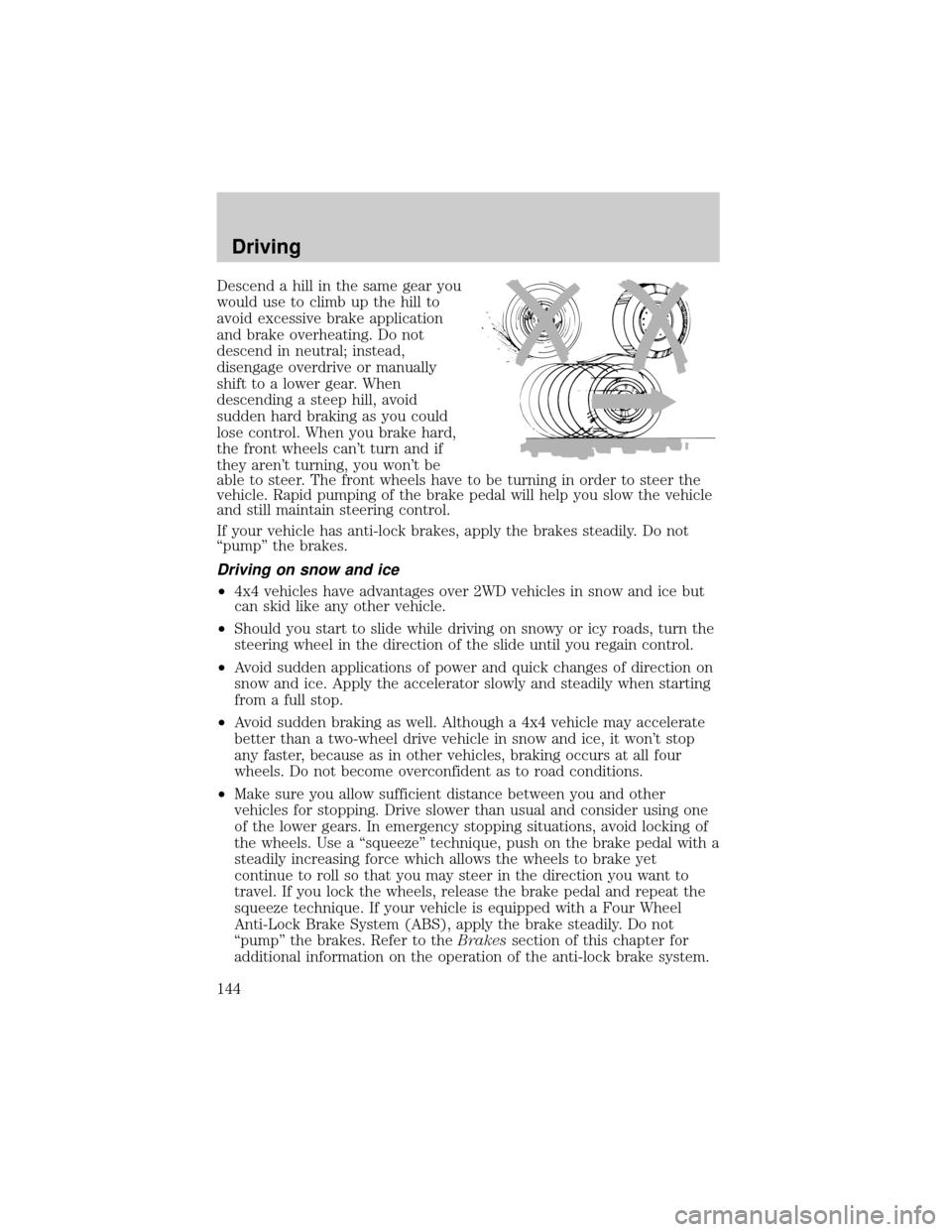
Descend a hill in the same gear you
would use to climb up the hill to
avoid excessive brake application
and brake overheating. Do not
descend in neutral; instead,
disengage overdrive or manually
shift to a lower gear. When
descending a steep hill, avoid
sudden hard braking as you could
lose control. When you brake hard,
the front wheels can't turn and if
they aren't turning, you won't be
able to steer. The front wheels have to be turning in order to steer the
vehicle. Rapid pumping of the brake pedal will help you slow the vehicle
and still maintain steering control.
If your vehicle has anti-lock brakes, apply the brakes steadily. Do not
ªpumpº the brakes.
Driving on snow and ice
²4x4 vehicles have advantages over 2WD vehicles in snow and ice but
can skid like any other vehicle.
²Should you start to slide while driving on snowy or icy roads, turn the
steering wheel in the direction of the slide until you regain control.
²Avoid sudden applications of power and quick changes of direction on
snow and ice. Apply the accelerator slowly and steadily when starting
from a full stop.
²Avoid sudden braking as well. Although a 4x4 vehicle may accelerate
better than a two-wheel drive vehicle in snow and ice, it won't stop
any faster, because as in other vehicles, braking occurs at all four
wheels. Do not become overconfident as to road conditions.
²Make sure you allow sufficient distance between you and other
vehicles for stopping. Drive slower than usual and consider using one
of the lower gears. In emergency stopping situations, avoid locking of
the wheels. Use a ªsqueezeº technique, push on the brake pedal with a
steadily increasing force which allows the wheels to brake yet
continue to roll so that you may steer in the direction you want to
travel. If you lock the wheels, release the brake pedal and repeat the
squeeze technique. If your vehicle is equipped with a Four Wheel
Anti-Lock Brake System (ABS), apply the brake steadily. Do not
ªpumpº the brakes. Refer to theBrakessection of this chapter for
additional information on the operation of the anti-lock brake system.
Driving
144
Page 162 of 248
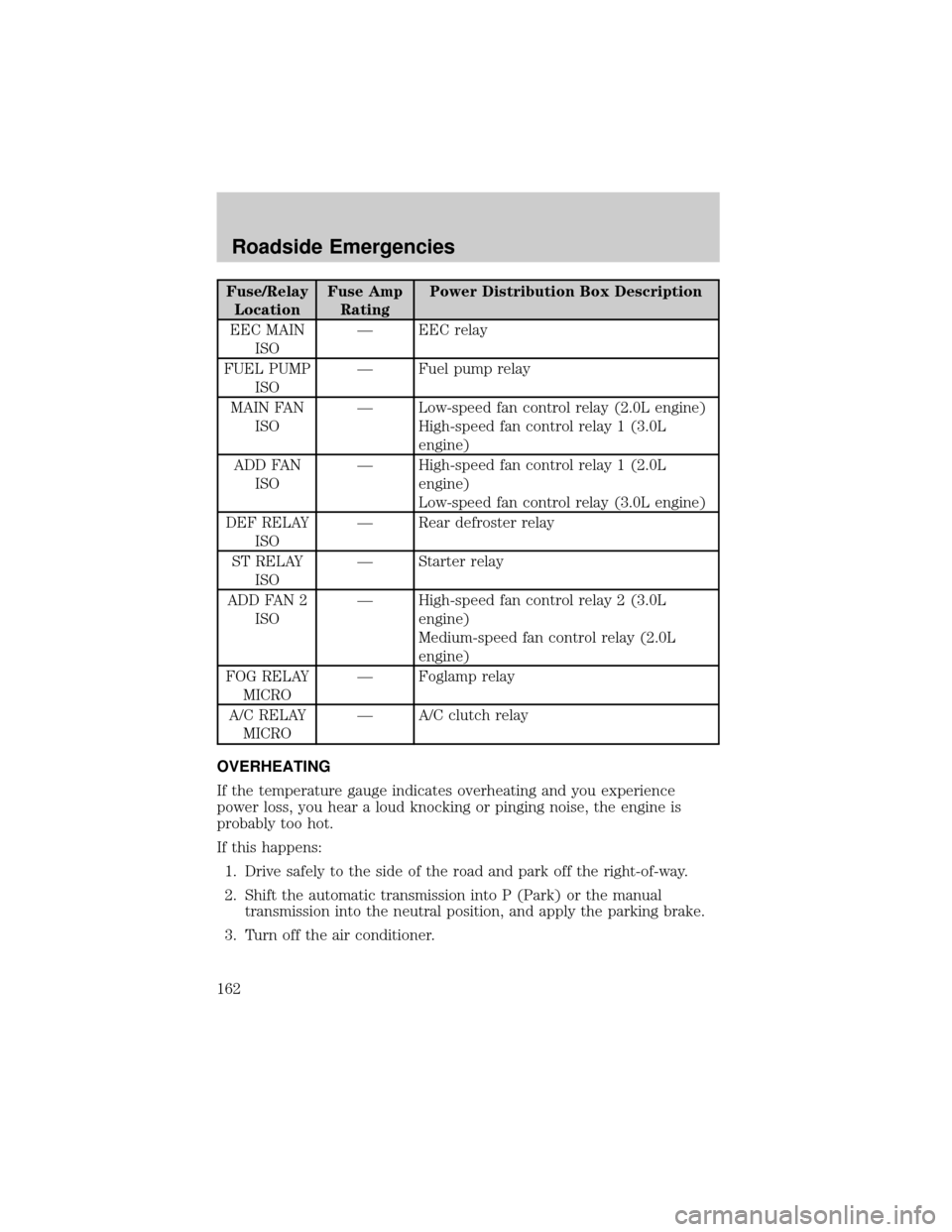
Fuse/Relay
LocationFuse Amp
RatingPower Distribution Box Description
EEC MAIN
ISOÐ EEC relay
FUEL PUMP
ISOÐ Fuel pump relay
MAIN FAN
ISOÐ Low-speed fan control relay (2.0L engine)
High-speed fan control relay 1 (3.0L
engine)
ADD FAN
ISOÐ High-speed fan control relay 1 (2.0L
engine)
Low-speed fan control relay (3.0L engine)
DEF RELAY
ISOÐ Rear defroster relay
ST RELAY
ISOÐ Starter relay
ADD FAN 2
ISOÐ High-speed fan control relay 2 (3.0L
engine)
Medium-speed fan control relay (2.0L
engine)
FOG RELAY
MICROÐ Foglamp relay
A/C RELAY
MICROÐ A/C clutch relay
OVERHEATING
If the temperature gauge indicates overheating and you experience
power loss, you hear a loud knocking or pinging noise, the engine is
probably too hot.
If this happens:
1. Drive safely to the side of the road and park off the right-of-way.
2. Shift the automatic transmission into P (Park) or the manual
transmission into the neutral position, and apply the parking brake.
3. Turn off the air conditioner.
Roadside Emergencies
162
Page 211 of 248

The cooling system in your vehicle is filled with either green-colored or
yellow-colored Mazda Premium Engine Coolant meeting Mazda
Specifications. To determine your vehicle's coolant type (color), check
your coolant reservoir.
To maintain the integrity of the coolant and the cooling system
and maintain the warranty on the cooling system:
²Add Mazda Premium Engine Coolant or the type of coolant
originally equipped in your vehicle.If you are unsure which type
of coolant your vehicle requires, check your coolant reservoir or
contact your local dealer.
²Do not add/mix an orange-colored, extended life coolant such
as Mazda Speciality Orange Engine Coolant, meeting Mazda
specifications with the factory-filled coolant.Mixing Mazda
Speciality Orange Engine Coolant or any orange-colored extended life
product with your factory filled coolant can result in degraded
corrosion protection.
²A large amount of water without engine coolant may be added, in case
of emergency, to reach a vehicle service location. In this instance, the
cooling system must be drained and refilled with a 50/50 mixture of
engine coolant and distilled water as soon as possible. Water alone
(without engine coolant) can cause engine damage from corrosion,
overheating or freezing.
²Do not use alcohol, methanol or brine or any engine coolants
mixed with alcohol or methanol antifreeze (coolant).Alcohol
and other liquids can cause engine damage from overheating or
freezing.
²Do not add extra inhibitors or additives to the coolant.These
can be harmful and compromise the corrosion protection of the engine
coolant.
²Do not mix with recycled coolant unless from a
Mazda-approved recycling process (seeUse of Recycled Engine
Coolantsection.
For vehicles with overflow coolant systems with a non-pressurized cap
on the coolant recovery system, add coolant to the coolant recovery
reservoir when the engine is cool. Add the proper mixture of coolant and
water to the ªcold fullº level. For all other vehicles, which have a coolant
degas system with a pressurized cap, or if it is necessary to remove the
coolant pressure relief cap on the radiator of a vehicle with an overflow
system, follow these steps to add engine coolant.
Maintenance and Specifications
211
Page 212 of 248

WARNING: To reduce the risk of personal injury, make sure the
engine is cool before unscrewing the coolant pressure relief
cap. The cooling system is under pressure; steam and hot liquid
can come out forcefully when the cap is loosened slightly.
1. Before you begin, turn the engine off and let it cool.
2. When the engine is cool, wrap a thick cloth around the coolant
pressure relief cap on the coolant reservoir (an opaque plastic
bottle). Slowly turn cap counterclockwise (left) until pressure begins
to release.
3. Step back while the pressure releases.
4. When you are sure that all the pressure has been released, use the
cloth to turn it counterclockwise and remove the cap.
5. Fill the coolant reservoir slowly with the proper coolant mixture (see
above), to within the ªcold fill rangeº or the ªcold fullº level on the
reservoir. If you removed the radiator cap in an overflow system, fill
the radiator until the coolant is visible and radiator is almost full.
6. Replace the cap. Turn until tightly installed. (Cap must be tightly
installed to prevent coolant loss.)
After any coolant has been added, run the engine for a few minutes to
mix the coolant. Check the coolant concentration. Make sure the engine
is off and cool before removing the coolant pressure relief cap (see
preceding steps on cap removal). Check the concentration per the
Checking Engine Coolantsection. If the concentration is not 50/50
(protection to ±34ÉF/±36ÉC), drain some coolant and adjust the
concentraction. It may take several drains and additions to obtain a 50/50
coolant concentration.
Whenever coolant has been added, the coolant level in the coolant
reservoir should be checked the next few times you drive the vehicle. If
necessary, add enough 50/50 concentration of engine coolant and
distilled water to bring the liquid level to the proper level.
If you have to add more than 1.0 liter (1.0 quart) of engine coolant per
month, have your dealer check the engine cooling system. Your cooling
system may have a leak. Operating an engine with a low level of coolant
can result in engine overheating and possible engine damage).
Maintenance and Specifications
212
Page 227 of 248
![MAZDA MODEL TRIBUTE 2003 Owners Manual (in English) The transmission fluid should be in
the crosshatch zone if at normal
operating temperature (66ÉC-77ÉC
[150ÉF-170ÉF]).
High fluid level
Fluid levels above the
crosshatch zone may result in
transaxl](/img/28/15635/w960_15635-226.png "MAZDA MODEL TRIBUTE 2003 Owners Manual (in English) The transmission fluid should be in
the crosshatch zone if at normal
operating temperature (66ÉC-77ÉC
[150ÉF-170ÉF]).
High fluid level
Fluid levels above the
crosshatch zone may result in
transaxl")
The transmission fluid should be in
the crosshatch zone if at normal
operating temperature (66ÉC-77ÉC
[150ÉF-170ÉF]).
High fluid level
Fluid levels above the
crosshatch zone may result in
transaxle failure. An overfill
condition of transmission fluid
may cause shift and/or
engagement concerns and/or
possible damage.
High fluid levels can be caused by an overheating condition.
Adjusting automatic transmission fluid levels
Before adding any fluid, make sure the correct type is used. The type of
fluid used is normally indicated on the dipstick and also in the
Lubricant specificationssection in this chapter.
Use of a non-approved automatic transmission fluid may cause
internal transaxle component damage.
If necessary, add fluid in 250 mL (1/2 pint) increments through the filler
tube until the level is correct.
If an overfill occurs, excess fluid
should be removed by a qualified
technician.
An overfill condition of
transmission fluid may cause
shift and/or engagement concerns and/or possible damage.
Do not use supplemental transmission fluid additives, treatments or
cleaning agents. The use of these materials may affect transmission
operation and result in damage to internal transmission components.
Maintenance and Specifications
227
Page 243 of 248

K
Keys
positions of the ignition .........120
L
Lamps
bulb replacement
specifications chart ..................51
cargo lamps ...............................49
daytime running light ...............48
fog lamps ...................................48
headlamps .................................48
headlamps, flash to pass ..........49
instrument panel, dimming .....49
interior lamps .....................50±51
replacing bulbs ...................51±55
Lane change indicator
(see Turn signal) ........................50
Liftgate ........................................67
Lights, warning and indicator ....10
anti-lock brakes (ABS) ..........126
Load limits .................................147
GAWR ......................................147
GVWR ......................................147
trailer towing ..........................147
Loading instructions .................149
Locks
childproof ..................................70
doors ..........................................69
Lubricant specifications ...........236
Lumbar support, seats .........80±81
M
Manual transaxle .......................134
fluid, checking and adding ....228
reverse .....................................136Manual transmission
fluid capacities ........................234
Mirrors ...................................59, 61
fold away ...................................62
heated ........................................62
side view mirrors (power) .......61
Moon roof ....................................66
Motorcraft parts ........................219
O
Octane rating ............................217
Oil (see Engine oil) ..................203
Overdrive ...................................130
Overheating ...............................162
P
Parking .......................................136
Parking brake ............................126
Power distribution box
(see Fuses) ...............................159
Power door locks ........................69
Power point ...........................59±60
Power Seats .................................81
Power steering ..........................127
fluid, checking and adding ....224
fluid, refill capacity ................234
fluid, specifications .................236
Power Windows ...........................60
Preparing to drive your
vehicle ........................................128
R
Radio ......................................17, 27
Radio reception .....................42±43
Index
243