transmission fluid MAZDA MODEL TRIBUTE 2003 Owners Manual (in English)
[x] Cancel search | Manufacturer: MAZDA, Model Year: 2003, Model line: MODEL TRIBUTE, Model: MAZDA MODEL TRIBUTE 2003Pages: 248, PDF Size: 2.5 MB
Page 127 of 248
The BRAKE warning lamp in the
instrument cluster illuminates and
remains illuminated (when the
ignition is turned ON) until the
parking brake is released.
WARNING: Always set the parking brake fully and make sure
that the gearshift is securely latched in P (Park) (automatic
transmission) or in 1 (First Gear) (manual transmission).
NOTE:The parking brake is not recommended to stop a moving vehicle.
However, if the normal brakes fail, the parking brake can be used to stop
your vehicle in an emergency. Since the parking brake applies only the
rear brakes, the vehicle's stopping distance will increase greatly and the
handling of your vehicle will be adversely affected.
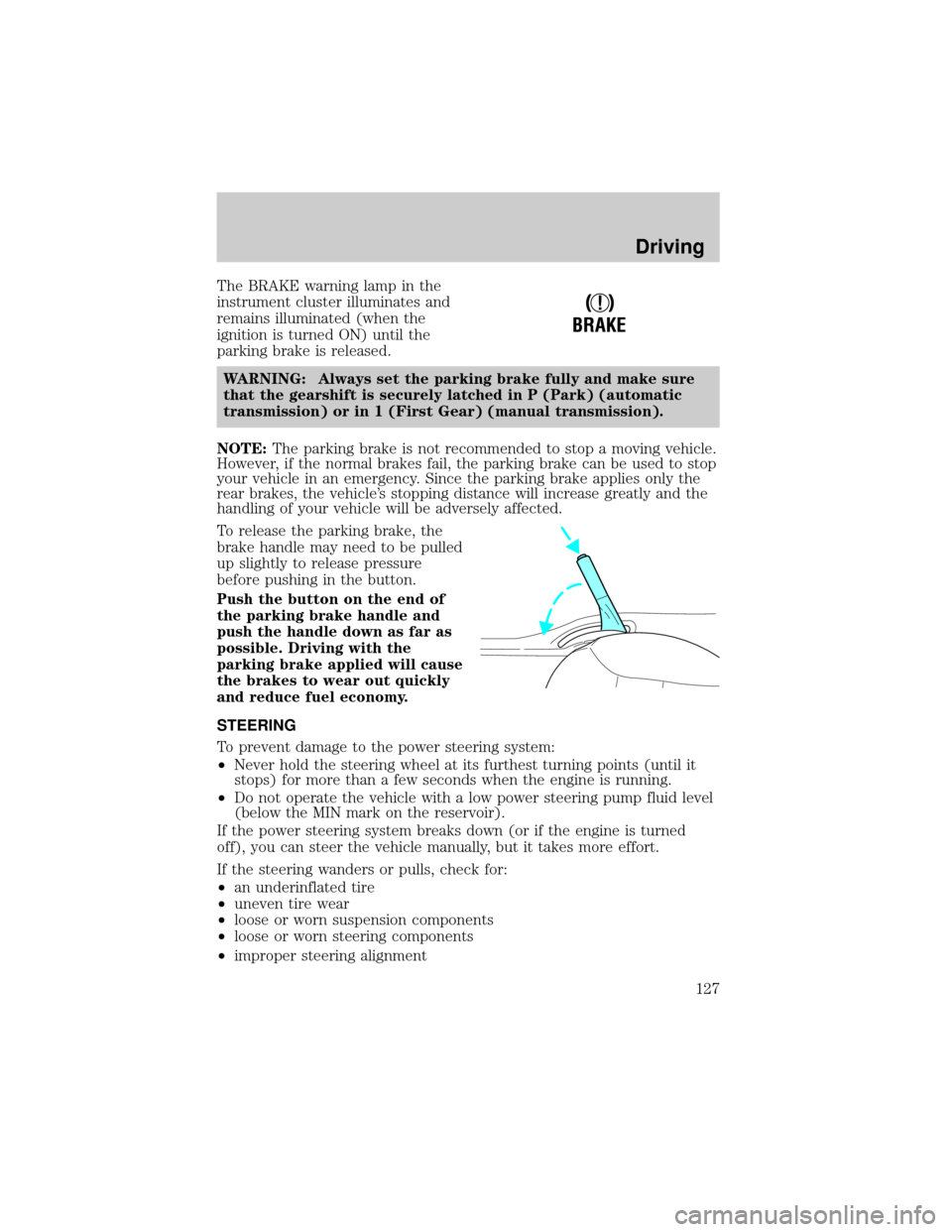
To release the parking brake, the
brake handle may need to be pulled
up slightly to release pressure
before pushing in the button.
Push the button on the end of
the parking brake handle and
push the handle down as far as
possible. Driving with the
parking brake applied will cause
the brakes to wear out quickly
and reduce fuel economy.
STEERING
To prevent damage to the power steering system:
²Never hold the steering wheel at its furthest turning points (until it
stops) for more than a few seconds when the engine is running.
²Do not operate the vehicle with a low power steering pump fluid level
(below the MIN mark on the reservoir).
If the power steering system breaks down (or if the engine is turned
off), you can steer the vehicle manually, but it takes more effort.
If the steering wanders or pulls, check for:
²an underinflated tire
²uneven tire wear
²loose or worn suspension components
²loose or worn steering components
²improper steering alignment
!
BRAKE
Driving
127
Page 147 of 248
DRIVING THROUGH WATER
Do not drive quickly through standing water, especially if the
depth is unknown. Traction or brake capability may be limited
and if the ignition system gets wet, your engine may stall. Water
may also enter your engine's air intake and severely damage your
engine.
If driving through deep or standing water is unavoidable, proceed very
slowly. Never drive through water that is higher than the bottom of the
hubs (for trucks) or the bottom of the wheel rims (for cars).
Once through the water, always try the brakes. Wet brakes do not stop
the vehicle as effectively as dry brakes. Drying can be improved by
moving your vehicle slowly while applying light pressure on the brake
pedal.
Driving through deep water where the transmission vent tube is
submerged may allow water into the transmission and cause
internal transmission damage. Have the fluid checked and, if
water is found, replace the fluid.
VEHICLE LOADING
Before loading a vehicle, familiarize yourself with the following terms:
²Base Curb Weight:Weight of the vehicle including any standard
equipment, fluids, lubricants, etc. It does not include occupants or
aftermarket equipment.
²Payload:Combined maximum allowable weight of cargo, occupants
and optional equipment. The payload equals the gross vehicle weight
rating minus base curb weight.
²GVW (Gross Vehicle Weight):Base curb weight plus payload
weight. The GVW is not a limit or a specification.
²GVWR (Gross Vehicle Weight Rating):Maximum permissible total
weight of the base vehicle, occupants, optional equipment and cargo.
The GVWR is specific to each vehicle and is listed on the Safety
Certification Label on the driver's door pillar.
²GAWR (Gross Axle Weight Rating):Carrying capacity for each axle
system. The GAWR is specific to each vehicle and is listed on the
Safety Certification Label on the driver's door pillar.
²GCW (Gross Combined Weight):The combined weight of the
towing vehicle (including occupants and cargo) and the loaded trailer.
²GCWR (Gross Combined Weight Rating):Maximum permissible
combined weight of towing vehicle (including occupants and cargo)
and the loaded trailer.
Driving
147
Page 197 of 248
SERVICE RECOMMENDATIONS
To help you service your vehicle:
²We highlight do-it-yourself items in the engine compartment for easy
location.
²We provide a Scheduled Maintenance section which makes tracking
routine service easy.
If your vehicle requires professional service, your dealership can provide
necessary parts and service. Check your ªWarranty Informationº to find
out which parts and services are covered.
Use only recommended fuels, lubricants, fluids and service parts
conforming to specifications. Genuine Mazda parts are designed and built
to provide the best performance in your vehicle.
PRECAUTIONS WHEN SERVICING YOUR VEHICLE
WARNING: A hot engine is dangerous. If the engine has been
running, parts of the engine compartment can become very hot.
You could be burned. Don't inspect the coolant system or add
coolant when the engine is hot.
²Do not work on a hot engine.
²Make sure that nothing gets caught in moving parts.
²Do not work on a vehicle with the engine running in an enclosed
space, unless you are sure you have enough ventilation.
²Keep all open flames and other lit material away from the battery and
all fuel related parts.
Working with the engine off
²Automatic transmission:
1. Set the parking brake and shift to P (Park).
2. Turn off the engine and remove the key.
3. Block the wheels.
²Manual transmission:
1. Set the parking brake, depress the clutch and place the gearshift in 1
(First).
2. Turn off the engine and remove the key.
3. Block the wheels.
Maintenance and Specifications
197
Page 201 of 248
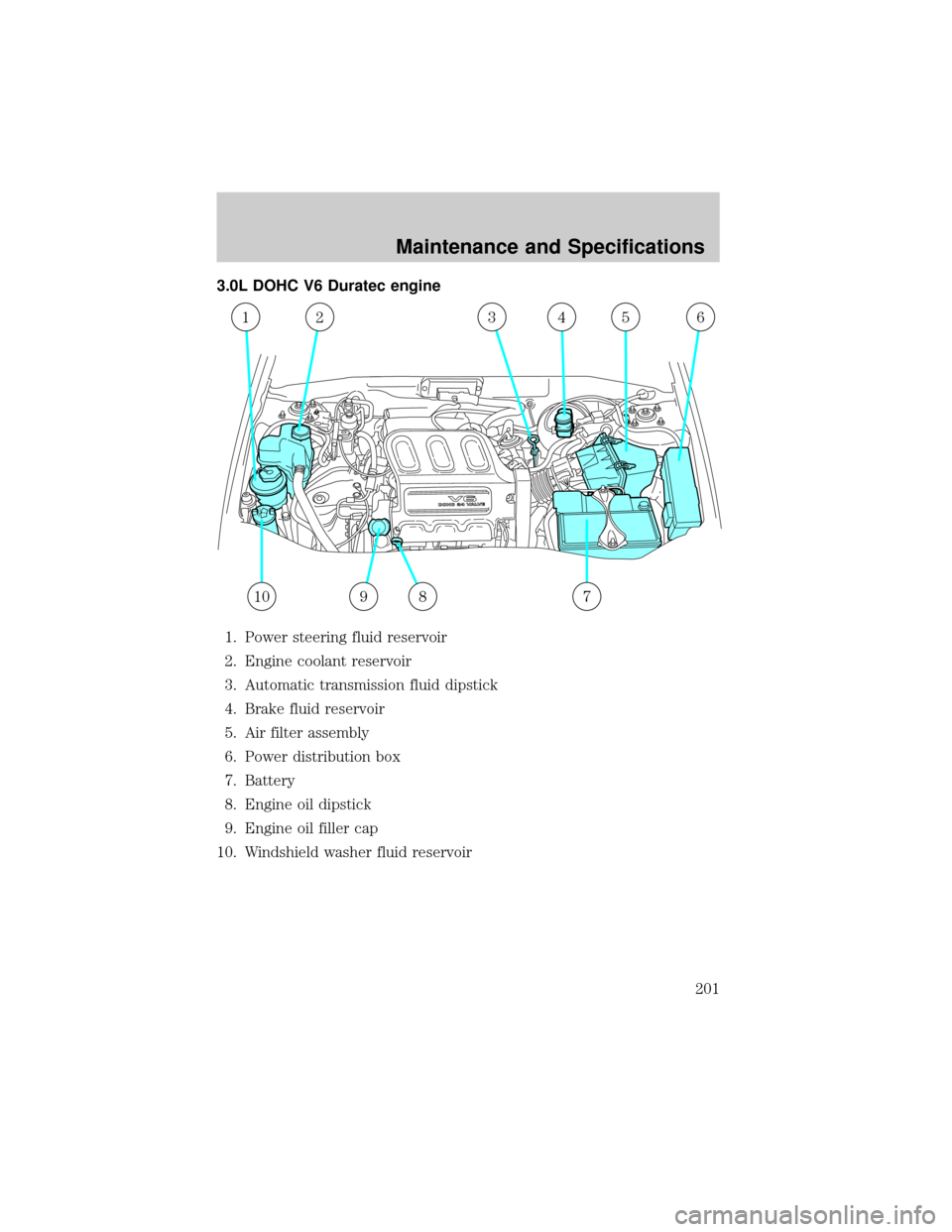
3.0L DOHC V6 Duratec engine
1. Power steering fluid reservoir
2. Engine coolant reservoir
3. Automatic transmission fluid dipstick
4. Brake fluid reservoir
5. Air filter assembly
6. Power distribution box
7. Battery
8. Engine oil dipstick
9. Engine oil filler cap
10. Windshield washer fluid reservoir
10987
123456
Maintenance and Specifications
201
Page 226 of 248

TRANSMISSION FLUID
Checking automatic transmission fluid
Refer to your scheduled maintenance section for scheduled intervals for
fluid checks and changes. Your transaxle does not consume fluid.
However, the fluid level should be checked if the transaxle is not working
properly, i.e., if the transaxle slips or shifts slowly or if you notice some
sign of fluid leakage.
Automatic transmission fluid expands when warmed. To obtain an
accurate fluid check, drive the vehicle until it is warmed up
(approximately 30 km [20 miles]). If your vehicle has been
operated for an extended period at high speeds, in city traffic
during hot weather or pulling a trailer, the vehicle should be
turned off for about 30 minutes to allow fluid to cool before
checking.
1. Drive the vehicle 30 km (20 miles) or until it reaches normal
operating temperature.
2. Park the vehicle on a level surface and engage the parking brake.
3. With the parking brake engaged and your foot on the brake pedal,
start the engine and move the gearshift lever through all of the gear
ranges. Allow sufficient time for each gear to engage.
4. Latch the gearshift lever in P (Park) and leave the engine running.
5. Remove the dipstick, wiping it clean with a clean, dry lint free rag. If
necessary, refer toIdentifying components in the engine
compartmentin this chapter for the location of the dipstick.
6. Install the dipstick making sure it is fully seated in the filler tube.
7. Remove the dipstick and inspect the fluid level. The fluid should be
in the crosshatch zone for normal operating temperature.
Low fluid level
Do not drive the vehicle if the fluid
level is at the bottom of the dipstick
and the outside temperatures are
above 10ÉC (50ÉF).
Correct fluid level
The transmission fluid should be checked at normal operating
temperatures 66ÉC-77ÉC (150ÉF-170ÉF) on a level surface. The normal
operating temperature can be reached after approximately 30 km (20
miles) of driving.
Maintenance and Specifications
226
Page 227 of 248
![MAZDA MODEL TRIBUTE 2003 Owners Manual (in English) The transmission fluid should be in
the crosshatch zone if at normal
operating temperature (66ÉC-77ÉC
[150ÉF-170ÉF]).
High fluid level
Fluid levels above the
crosshatch zone may result in
transaxl](/img/28/15635/w960_15635-226.png "MAZDA MODEL TRIBUTE 2003 Owners Manual (in English) The transmission fluid should be in
the crosshatch zone if at normal
operating temperature (66ÉC-77ÉC
[150ÉF-170ÉF]).
High fluid level
Fluid levels above the
crosshatch zone may result in
transaxl")
The transmission fluid should be in
the crosshatch zone if at normal
operating temperature (66ÉC-77ÉC
[150ÉF-170ÉF]).
High fluid level
Fluid levels above the
crosshatch zone may result in
transaxle failure. An overfill
condition of transmission fluid
may cause shift and/or
engagement concerns and/or
possible damage.
High fluid levels can be caused by an overheating condition.
Adjusting automatic transmission fluid levels
Before adding any fluid, make sure the correct type is used. The type of
fluid used is normally indicated on the dipstick and also in the
Lubricant specificationssection in this chapter.
Use of a non-approved automatic transmission fluid may cause
internal transaxle component damage.
If necessary, add fluid in 250 mL (1/2 pint) increments through the filler
tube until the level is correct.
If an overfill occurs, excess fluid
should be removed by a qualified
technician.
An overfill condition of
transmission fluid may cause
shift and/or engagement concerns and/or possible damage.
Do not use supplemental transmission fluid additives, treatments or
cleaning agents. The use of these materials may affect transmission
operation and result in damage to internal transmission components.
Maintenance and Specifications
227
Page 228 of 248
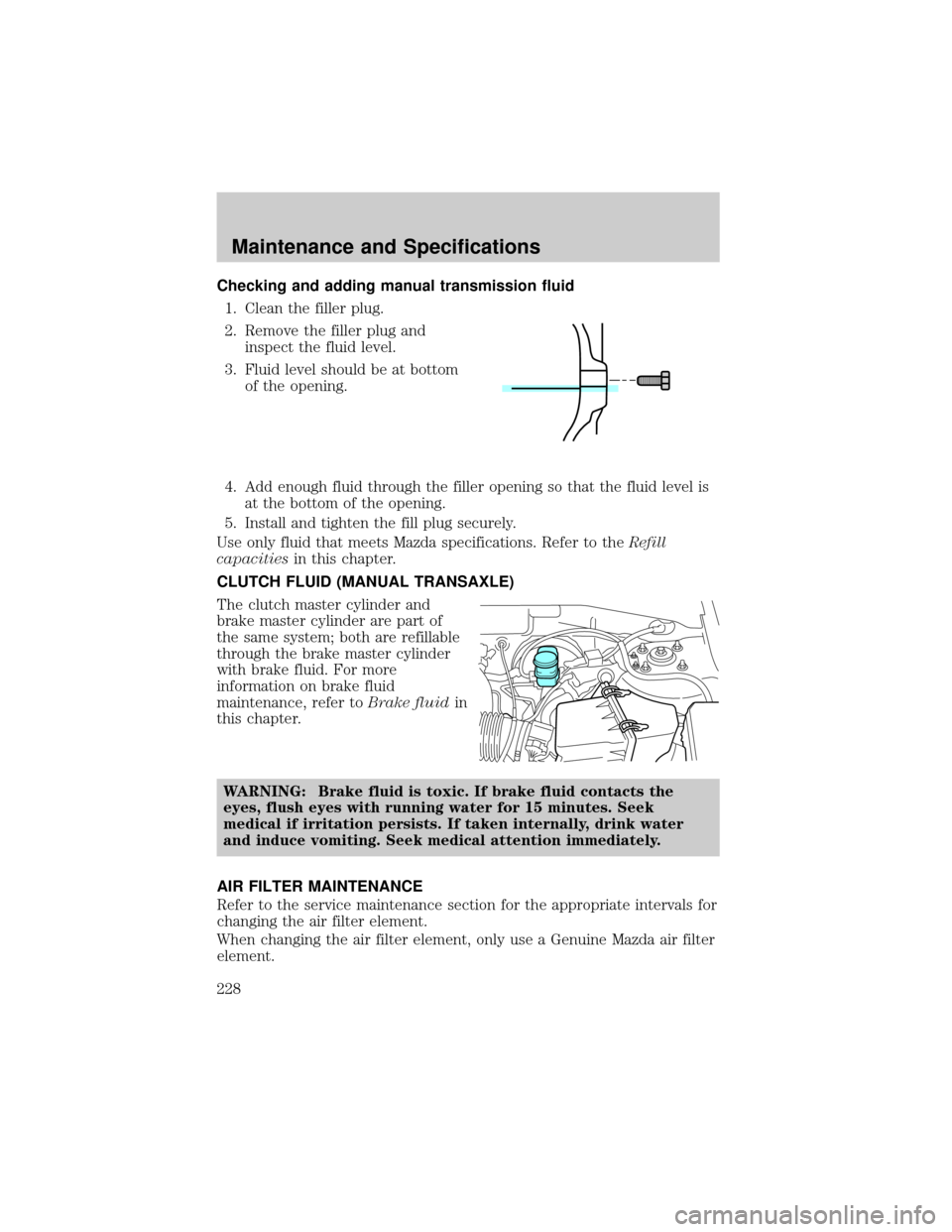
Checking and adding manual transmission fluid
1. Clean the filler plug.
2. Remove the filler plug and
inspect the fluid level.
3. Fluid level should be at bottom
of the opening.
4. Add enough fluid through the filler opening so that the fluid level is
at the bottom of the opening.
5. Install and tighten the fill plug securely.
Use only fluid that meets Mazda specifications. Refer to theRefill
capacitiesin this chapter.
CLUTCH FLUID (MANUAL TRANSAXLE)
The clutch master cylinder and
brake master cylinder are part of
the same system; both are refillable
through the brake master cylinder
with brake fluid. For more
information on brake fluid
maintenance, refer toBrake fluidin
this chapter.
WARNING: Brake fluid is toxic. If brake fluid contacts the
eyes, flush eyes with running water for 15 minutes. Seek
medical if irritation persists. If taken internally, drink water
and induce vomiting. Seek medical attention immediately.
AIR FILTER MAINTENANCE
Refer to the service maintenance section for the appropriate intervals for
changing the air filter element.
When changing the air filter element, only use a Genuine Mazda air filter
element.
Maintenance and Specifications
228
Page 234 of 248

Drive cautiously. If you hear the chains rub or bang against the
vehicle, stop and retighten them. If this does not work, remove
the cables to prevent vehicle damage.
²Avoid overloading your vehicle.
²Remove the tire chains when they are no longer needed.
²Do not use chains on dry roads.
²The suspension insulation and bumpers will help prevent vehicle
damage. Do not remove these components from the vehicle when
using snow tires and traction devices.
²Do not exceed 48 km/h (30 mph) with tire chains on your vehicle.
REFILL CAPACITIES
Fluid Classification Application Capacity
Brake fluid High
Performance
DOT 3 Motor
Vehicle Brake
FluidAll Fill to line on
reservoir
Engine oil
(including filter
change)SAE 5W-20 2.0L I4 Zetec
engine4.25L (4.5
quarts)
3.0L V6 Duratec
engine5.2L (5.5
quarts)
Fuel tank N/A 2.0L I4 Zetec
engine61L (16 gallons)
3.0L V6 Duratec
engine61L (16 gallons)
Power steering
fluidMERCONtAll Fill to line on
reservoir
Transmission
fluid
1API service
GL-4, SAE
75W-90Manual transaxle
(2WD)2.7L (2.85
quarts)2
Manual transaxle
(4X4)2.2L (2.32
quarts)2
MERCONtATF 3.0L engine with
Automatic
transaxle and oil
cooler12.7L (13.4
quarts)3
Maintenance and Specifications
234
Page 235 of 248

Fluid Classification Application Capacity
Transfer Case SAE 75W-140
Synthetic
Lubricant4X4 (Automatic) 0.35L (12
ounces)
API service
GL-5, SAE
80W-904X4 (Manual) 0.35L (12
ounces)
Engine coolant
4Mazda
green-colored or
yellow-colored
Premium Engine
Coolant2.0L I4 Zetec
engine with
manual
transaxle5.0L (5.3
quarts)
3.0L V6 Duratec
engine with
automatic
transaxle10.0L (10.6
quarts)
Rear axle
lubricantAPI service
GL-5, SAE
80W-90
Premium Rear
Axle Lubricant4X4 1.4L (2.96 pints)
5
Windshield
washer fluidn/a All 2.6L (2.7
quarts)
1Ensure the correct automatic transmission fluid is used. Transmission
fluid requirements are indicated on the dipstick or on the dipstick
handle. MERCONtand MERCONtV are not interchangeable. DO NOT
mix MERCONtand MERCONtV. Refer to your scheduled maintenance
section to determine the correct service interval.
2Service refill capacity is determined by filling the transmission to the
bottom of the filler hole with the vehicle on a level surface.
3Indicates only approximate dry-fill capacity. Some applications may vary
based on cooler size and if equipped with an in-tank cooler. The amount
of transmission fluid and fluid level should be set by the indication on
the dipstick's normal operating range.
4Add the coolant type originally equipped in your vehicle. DO NOT USE
Extended Life Engine Coolant (orange in color). Refer toAdding engine
coolantin this chapter.
5Fill to 6 mm to 14 mm (1/4 inch to 9/16 inch) below bottom of fill hole.
Maintenance and Specifications
235
Page 240 of 248

A
ABS (see Brakes) .....................125
Accessory delay ..........................61
Air bag supplemental
restraint system ..................99, 104
and child safety seats ............101
description ........................99, 104
disposal ............................103, 107
driver air bag ..................101, 106
indicator light .................103, 107
operation .........................101, 106
passenger air bag ...........101, 106
side air bag ..............................104
Air cleaner filter ...............228±229
Air conditioning
manual heating and air
conditioning system .................44
All Wheel Drive (AWD),
driving off road .........................137
Ambulance packages ....................5
Antifreeze
(see Engine coolant) ................209
Anti-lock brake system
(see Brakes) ......................125±126
Anti-theft system ........................78
arming the system ....................78
disarming a triggered system ..78
Audio system (see Radio) ...17, 27
Automatic transaxle
driving with .............................131
fluid, adding ............................226
fluid, checking ........................226
Automatic transmission ............128
fluid, refill capacities ..............234
Auxiliary power point .................59Axle
refill capacities ........................234
B
Battery .......................................207
acid, treating emergencies .....207
jumping a disabled battery ....169
maintenance-free ....................207
servicing ..................................207
Brakes ........................................124
anti-lock ...........................125±126
anti-lock brake system (ABS)
warning light ...........................126
fluid, checking and adding ....225
fluid, refill capacities ..............234
fluid, specifications .................236
lubricant specifications ..........236
parking ....................................126
shift interlock ..........................128
Break-in period .............................4
Bulbs ............................................51
C
Calculating load ........................149
Capacities for refilling fluids ....234
Cargo area shade ........................66
CD-single .....................................17
Cell phone warning ...................239
Certification Label ....................238
Child safety restraints ..............108
child safety belts ....................108
Child safety seats ......................112
attaching with tether straps ..116
in front seat ............................113
in rear seat ..............................113
Index
240