ignition MAZDA MODEL TRIBUTE 2005 (in English) Service Manual
[x] Cancel search | Manufacturer: MAZDA, Model Year: 2005, Model line: MODEL TRIBUTE, Model: MAZDA MODEL TRIBUTE 2005Pages: 272, PDF Size: 2.78 MB
Page 182 of 272
•4WD vehicles should be driven with traction devices as referred to in
Using snow tires and traction devicesin theTires, Wheels and
Loadingchapter.
Maintenance and Modifications
The suspension and steering systems on your vehicle have been designed
and tested to provide predictable performance whether loaded or empty
and durable load carrying capability. For this reason, Mazda Motor
Corporation strongly recommends that you do not make modifications
such as adding or removing parts (such as lift kits or stabilizer bars) or
by using replacement parts not equivalent to the original factory
equipment.
Any modifications to a vehicle that raise the center of gravity can make
it more likely the vehicle will roll over as a result of a loss of control.
Mazda Motor Corporation recommends that caution be used with any
vehicle equipped with a high load or device (such as ladder racks or
pickup box cover).
Failure to maintain your vehicle properly may void the warranty, increase
your repair cost, reduce vehicle performance and operational capabilities
and adversely affect driver and passenger safety. Frequent inspection of
vehicle chassis components is recommended if the vehicle is subjected to
heavy off-road usage.
DRIVING THROUGH WATER
Do not drive quickly through standing water, especially if the
depth is unknown. Traction or brake capability may be limited
and if the ignition system gets wet, your engine may stall. Water
may also enter your engine’s air intake and severely damage your
engine.
If driving through deep or standing water is unavoidable, proceed very
slowly. Never drive through water that is higher than the bottom of the
hubs (for trucks) or the bottom of the wheel rims (for cars).
Once through the water, always try the brakes. Wet brakes do not stop
the vehicle as effectively as dry brakes. Drying can be improved by
moving your vehicle slowly while applying light pressure on the brake
pedal.
Driving through deep water where the transmission vent tube is
submerged may allow water into the transmission and cause
internal transmission damage. Have the fluid checked and, if
water is found, replace the fluid.
REVIEW COPY
2005 Mazda Tribute(j14), Owners Guide (post-2002-fmt)(own2002),
Market:USA_English(fus)
Driving
182
Page 183 of 272
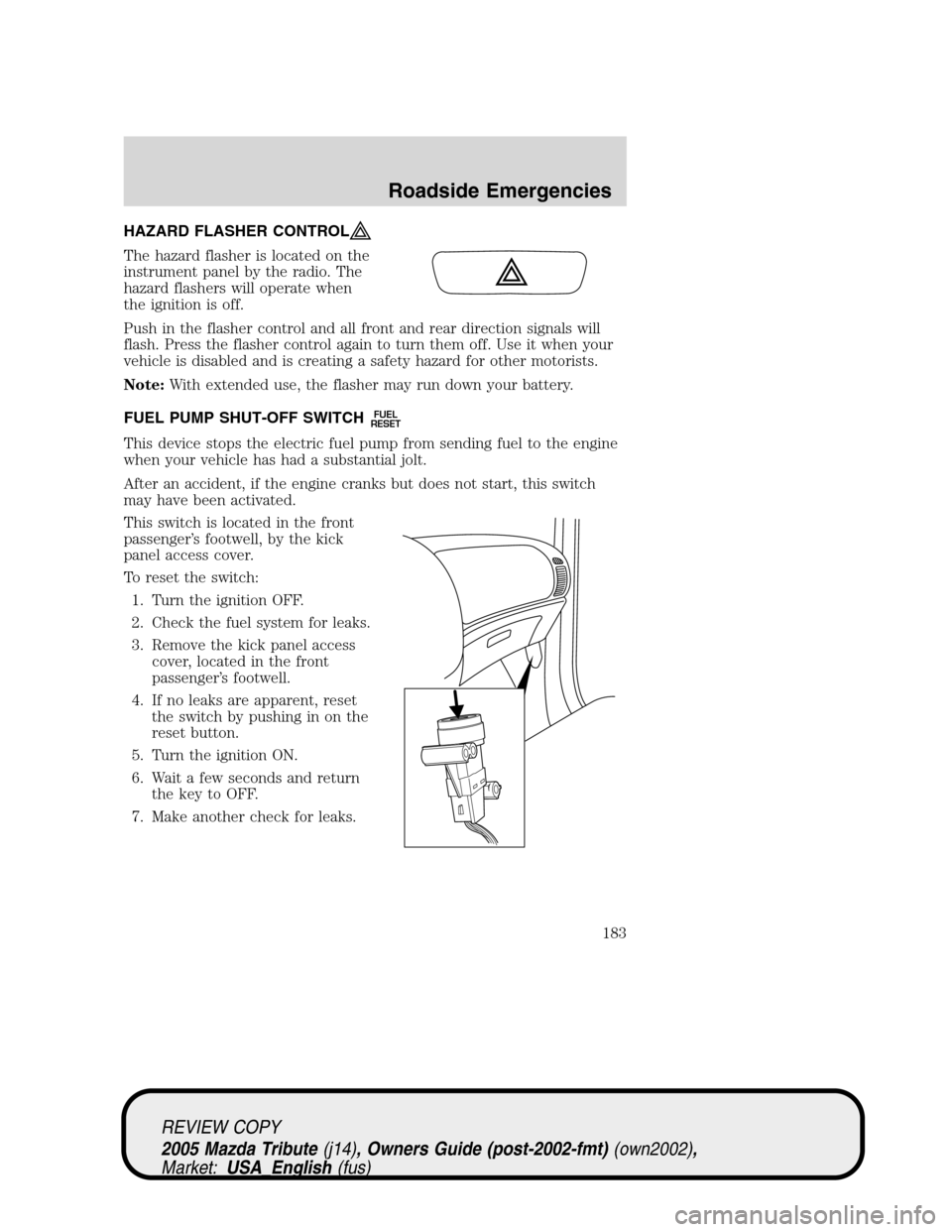
HAZARD FLASHER CONTROL
The hazard flasher is located on the
instrument panel by the radio. The
hazard flashers will operate when
the ignition is off.
Push in the flasher control and all front and rear direction signals will
flash. Press the flasher control again to turn them off. Use it when your
vehicle is disabled and is creating a safety hazard for other motorists.
Note:With extended use, the flasher may run down your battery.
FUEL PUMP SHUT-OFF SWITCH
FUEL
RESET
This device stops the electric fuel pump from sending fuel to the engine
when your vehicle has had a substantial jolt.
After an accident, if the engine cranks but does not start, this switch
may have been activated.
This switch is located in the front
passenger’s footwell, by the kick
panel access cover.
To reset the switch:
1. Turn the ignition OFF.
2. Check the fuel system for leaks.
3. Remove the kick panel access
cover, located in the front
passenger’s footwell.
4. If no leaks are apparent, reset
the switch by pushing in on the
reset button.
5. Turn the ignition ON.
6. Wait a few seconds and return
the key to OFF.
7. Make another check for leaks.
REVIEW COPY
2005 Mazda Tribute(j14), Owners Guide (post-2002-fmt)(own2002),
Market:USA_English(fus)
Roadside Emergencies
Roadside Emergencies
183
Page 186 of 272
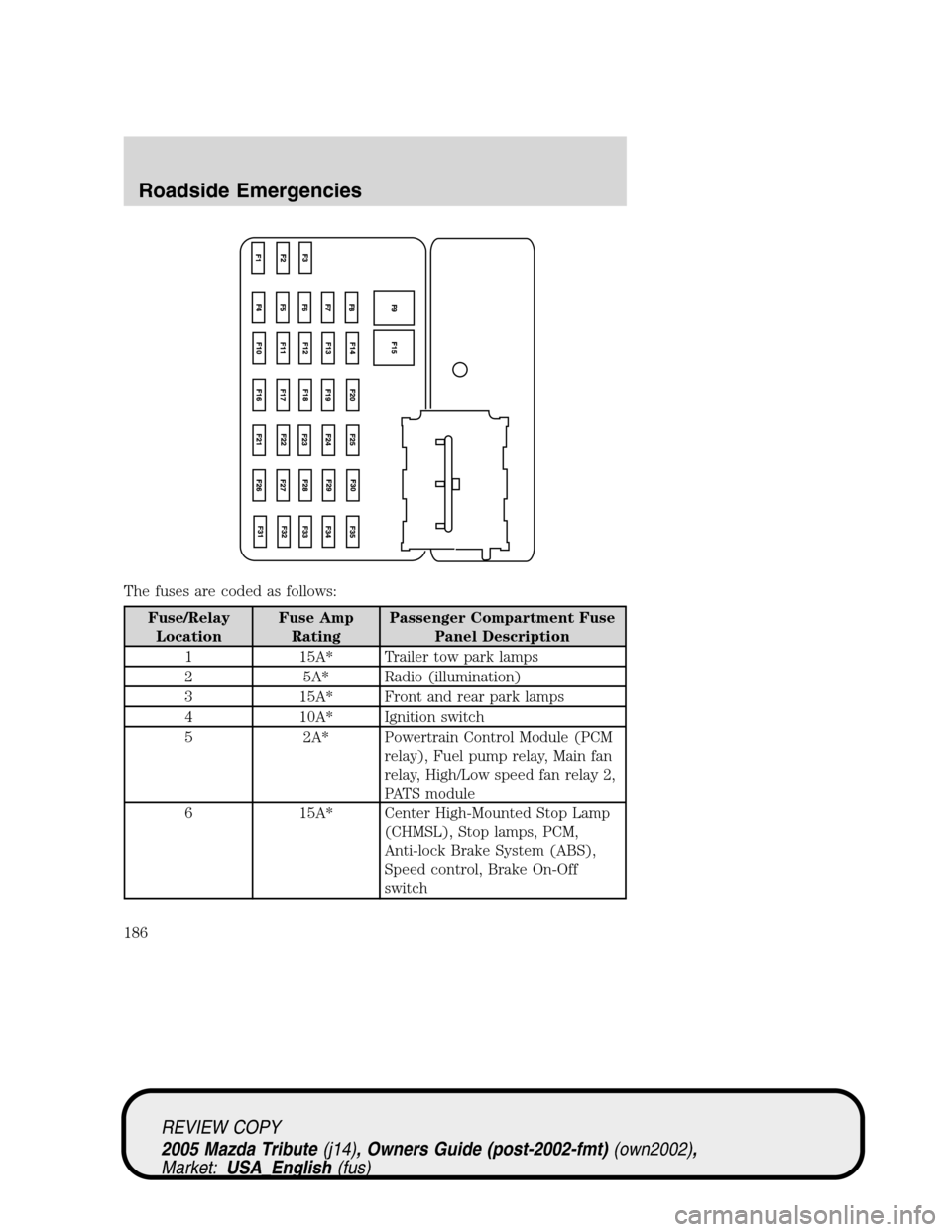
The fuses are coded as follows:
Fuse/Relay
LocationFuse Amp
RatingPassenger Compartment Fuse
Panel Description
1 15A* Trailer tow park lamps
2 5A* Radio (illumination)
3 15A* Front and rear park lamps
4 10A* Ignition switch
5 2A* Powertrain Control Module (PCM
relay), Fuel pump relay, Main fan
relay, High/Low speed fan relay 2,
PATS module
6 15A* Center High-Mounted Stop Lamp
(CHMSL), Stop lamps, PCM,
Anti-lock Brake System (ABS),
Speed control, Brake On-Off
switch
REVIEW COPY
2005 Mazda Tribute(j14), Owners Guide (post-2002-fmt)(own2002),
Market:USA_English(fus)
Roadside Emergencies
186
Page 189 of 272
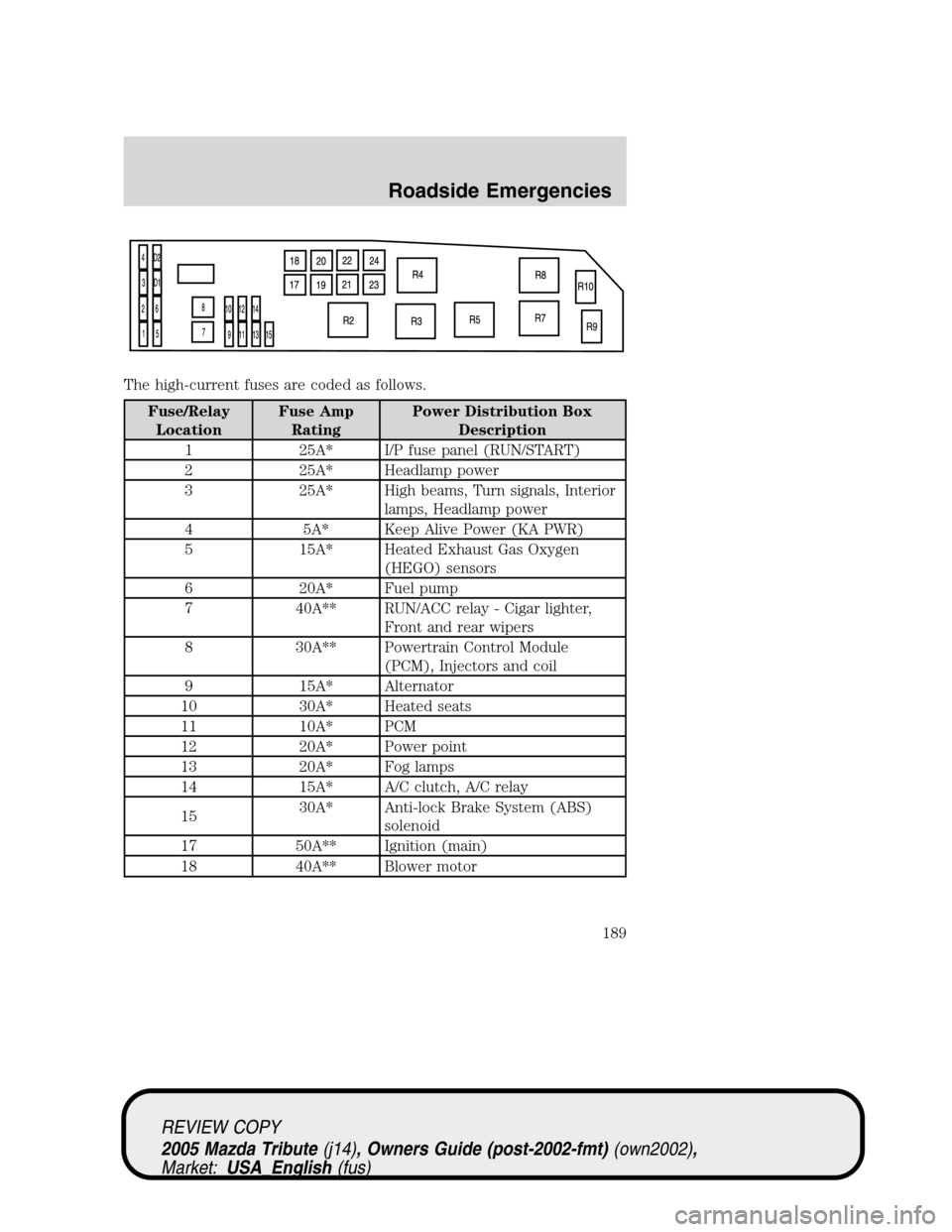
The high-current fuses are coded as follows.
Fuse/Relay
LocationFuse Amp
RatingPower Distribution Box
Description
1 25A* I/P fuse panel (RUN/START)
2 25A* Headlamp power
3 25A* High beams, Turn signals, Interior
lamps, Headlamp power
4 5A* Keep Alive Power (KA PWR)
5 15A* Heated Exhaust Gas Oxygen
(HEGO) sensors
6 20A* Fuel pump
7 40A** RUN/ACC relay - Cigar lighter,
Front and rear wipers
8 30A** Powertrain Control Module
(PCM), Injectors and coil
9 15A* Alternator
10 30A* Heated seats
11 10A* PCM
12 20A* Power point
13 20A* Fog lamps
14 15A* A/C clutch, A/C relay
1530A* Anti-lock Brake System (ABS)
solenoid
17 50A** Ignition (main)
18 40A** Blower motor
REVIEW COPY
2005 Mazda Tribute(j14), Owners Guide (post-2002-fmt)(own2002),
Market:USA_English(fus)
Roadside Emergencies
189
Page 191 of 272
WARNING: Steam from an overheated engine is dangerous. The
escaping steam could seriously burn you. Open the hood ONLY
after steam is no longer escaping from the engine.4. Check whether coolant or steam is escaping from under the hood or from the engine compartment.
• If steam is coming from the engine compartment: do not go near
the front of the vehicle. Stop the engine, then turn the ignition switch
to the ON position without starting the engine. The radiator cooling
fans will start to cool the engine.
• If neither coolant nor steam is escaping: open the hood and idle
the engine until it cools. If this does not lower the temperature, stop
the engine and let it cool.
5. Check the coolant level. If it is low, look for leaks in the radiator hoses and connections, heater hoses and connections, radiator and
water pump.
If you find a leak or other damage, or if coolant is still leaking, stop the
engine and call an Authorized Mazda dealer.
See Adding coolant in theMaintenance and specifications section. If
you find no problems, the engine is cool and no leaks are obvious,
carefully add coolant as required.
WARNING: When the engine and radiator are hot, scalding
coolant and steam may shoot out under pressure and cause
serious injury. Do not remove the cooling system cap when the
engine and radiator are hot.
Note: If the engine continues to overheat or frequently overheats, have
the cooling system inspected. The engine could be seriously damaged
unless repairs are made.
JUMP STARTING YOUR VEHICLE
WARNING: The gases around the battery can explode if
exposed to flames, sparks, or lit cigarettes. An explosion could
result in injury or vehicle damage.
Do not push start your vehicle. You could damage the catalytic
converter.
REVIEW COPY
2005 Mazda Tribute (j14), Owners Guide (post-2002-fmt) (own2002),
Market: USA_English (fus)
Roadside Emergencies
191
Page 217 of 272
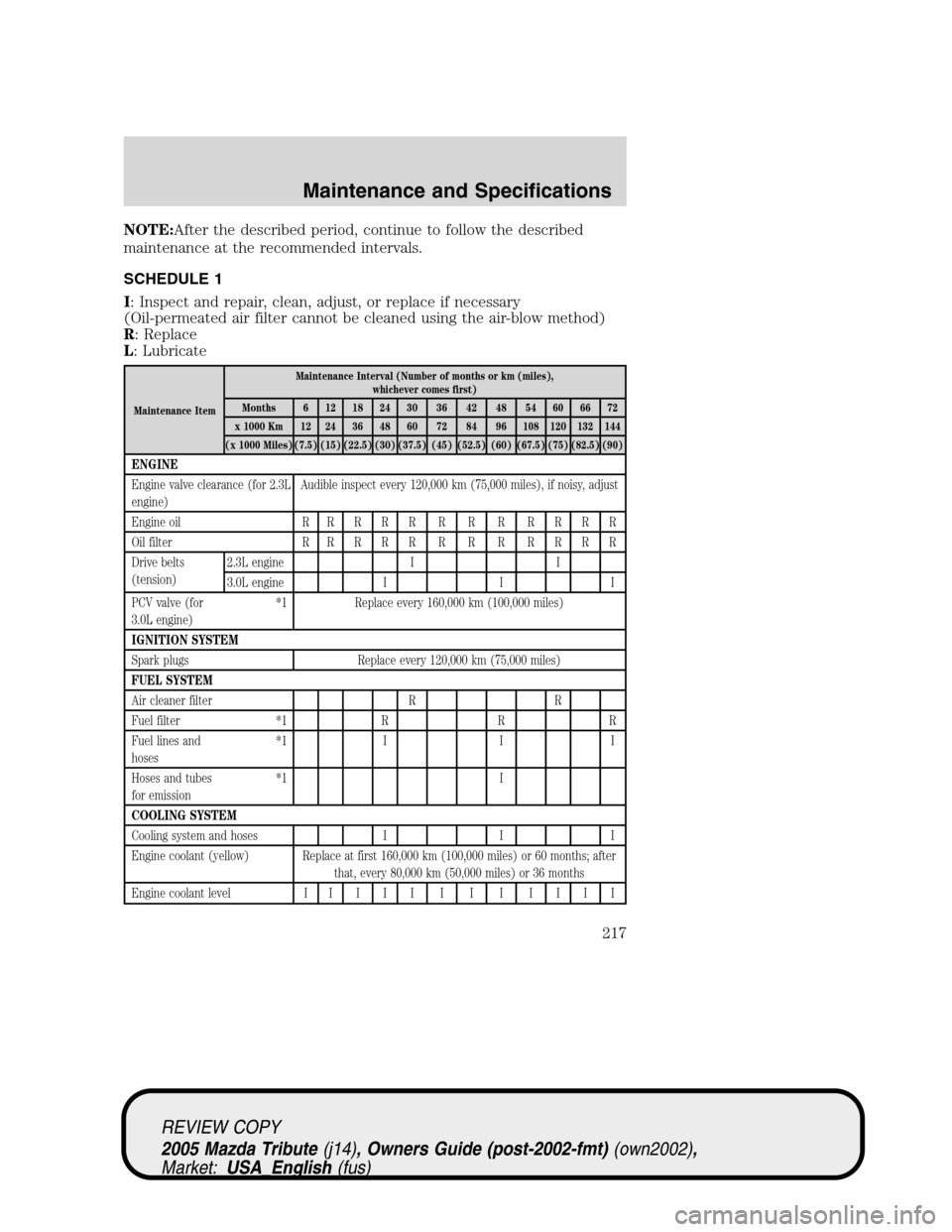
NOTE:After the described period, continue to follow the described
maintenance at the recommended intervals.
SCHEDULE 1
I: Inspect and repair, clean, adjust, or replace if necessary
(Oil-permeated air filter cannot be cleaned using the air-blow method)
R: Replace
L: Lubricate
Maintenance ItemMaintenance Interval (Number of months or km (miles),
whichever comes first)
Months 6 12 18 24 30 36 42 48 54 60 66 72
x 1000 Km 12 24 36 48 60 72 84 96 108 120 132 144
(x 1000 Miles) (7.5) (15) (22.5) (30) (37.5) (45) (52.5) (60) (67.5) (75) (82.5) (90)
ENGINE
Engine valve clearance (for 2.3L
engine)Audible inspect every 120,000 km (75,000 miles), if noisy, adjust
Engine oil RRRRRRRRRRRR
Oil filter RRRRRRRRRRRR
Drive belts
(tension)2.3L engine I I
3.0L engine I I I
PCV valve (for
3.0L engine)*1 Replace every 160,000 km (100,000 miles)
IGNITION SYSTEM
Spark plugs Replace every 120,000 km (75,000 miles)
FUEL SYSTEM
Air cleaner filter R R
Fuel filter *1 R R R
Fuel lines and
hoses*1 I I I
Hoses and tubes
for emission*1 I
COOLING SYSTEM
Cooling system and hoses I I I
Engine coolant (yellow) Replace at first 160,000 km (100,000 miles) or 60 months; after
that, every 80,000 km (50,000 miles) or 36 months
Engine coolant level IIIIIIIIIIII
REVIEW COPY
2005 Mazda Tribute(j14), Owners Guide (post-2002-fmt)(own2002),
Market:USA_English(fus)
Maintenance and Specifications
217
Page 219 of 272
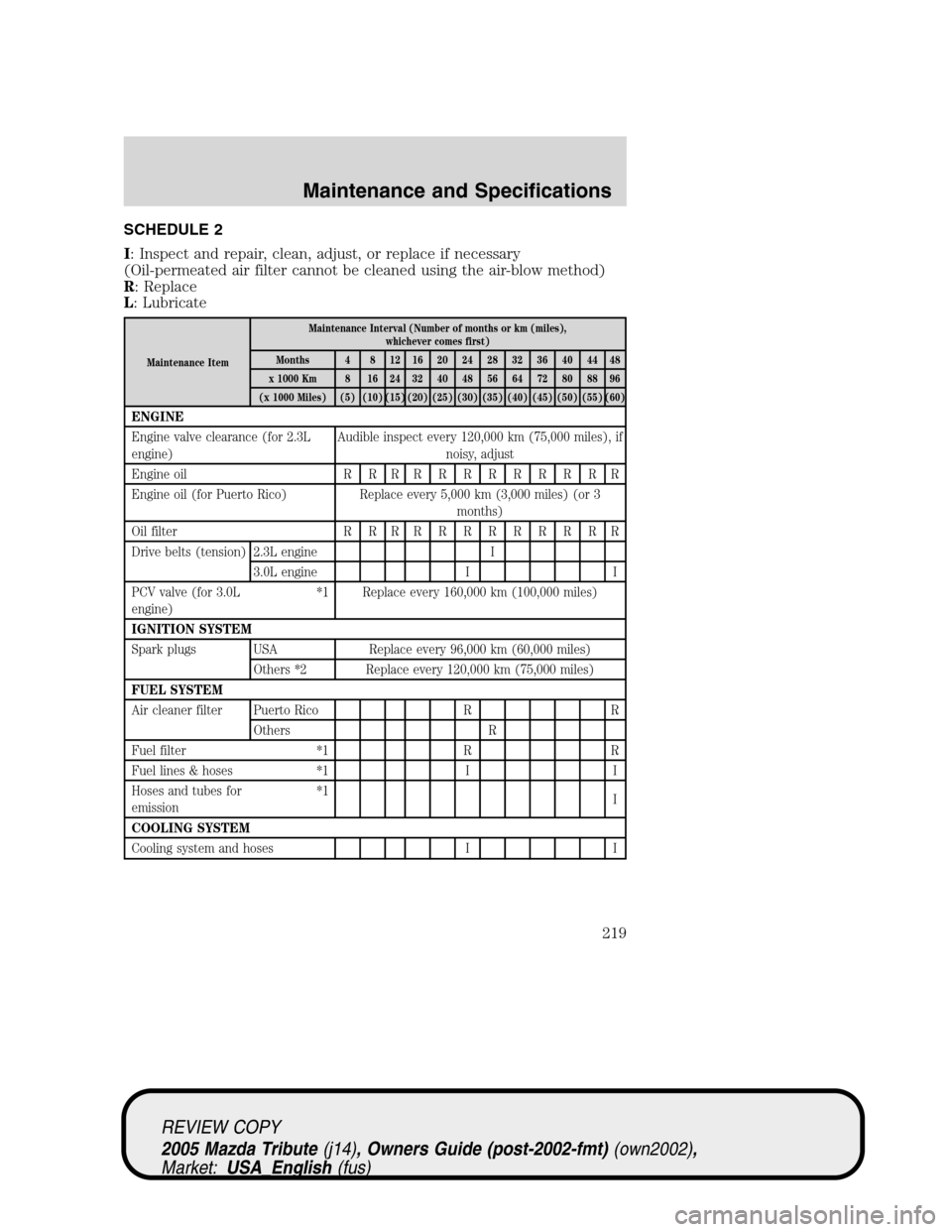
SCHEDULE 2
I: Inspect and repair, clean, adjust, or replace if necessary
(Oil-permeated air filter cannot be cleaned using the air-blow method)
R: Replace
L: Lubricate
Maintenance ItemMaintenance Interval (Number of months or km (miles),
whichever comes first)
Months 4 8 12 16 20 24 28 32 36 40 44 48
x 1000 Km 8 16 24 32 40 48 56 64 72 80 88 96
(x 1000 Miles) (5) (10) (15) (20) (25) (30) (35) (40) (45) (50) (55) (60)
ENGINE
Engine valve clearance (for 2.3L
engine)Audible inspect every 120,000 km (75,000 miles), if
noisy, adjust
Engine oil R R RRRRRRRRRR
Engine oil (for Puerto Rico) Replace every 5,000 km (3,000 miles) (or 3
months)
Oil filter R R RRRRRRRRRR
Drive belts (tension) 2.3L engine I
3.0L engine I I
PCV valve (for 3.0L
engine)*1 Replace every 160,000 km (100,000 miles)
IGNITION SYSTEM
Spark plugs USA Replace every 96,000 km (60,000 miles)
Others *2 Replace every 120,000 km (75,000 miles)
FUEL SYSTEM
Air cleaner filter Puerto Rico R R
Others R
Fuel filter *1 R R
Fuel lines & hoses *1 I I
Hoses and tubes for
emission*1
I
COOLING SYSTEM
Cooling system and hoses I I
REVIEW COPY
2005 Mazda Tribute(j14), Owners Guide (post-2002-fmt)(own2002),
Market:USA_English(fus)
Maintenance and Specifications
219
Page 242 of 272

Cleaner air
Mazda endorses the use of reformulated“cleaner-burning”gasolines to
improve air quality.
Running out of fuel
Avoid running out of fuel because this situation may have an adverse
affect on powertrain components.
If you have run out of fuel:
•You may need to cycle the ignition from OFF to ON several times after
refueling, to allow the fuel system to pump the fuel from the tank to
the engine.
•The
indicator may come on. For more information on the“Check
Engine”indicator, refer to theInstrument Clusterchapter.
Fuel Filler Cap
Your fuel tank filler cap has an indexed design with a 1/4 turn on/off
feature.
When fueling your vehicle:
1. Turn the engine off.
2. Pull the fuel filler door release handle to open the fuel filler door.
3. Carefully turn the filler cap counterclockwise 1/8 of a turn until it
stops.
4. Pull to remove the cap from the fuel filler pipe.
5. To install the cap, align the tabs on the cap with the notches on the
filler pipe.
6. Turn the filler cap clockwise until at least one click is heard.
After refueling, if the“CHECK FUEL CAP”indicator comes on and stays
on when you start the engine, the fuel filler cap may not be properly
installed. Turn off the engine, remove the fuel filler cap, align the cap
properly and reinstall it securely. The indicator should turn off after
three driving cycles with the fuel filler cap properly installed. A driving
cycle consists of a cold engine start-up followed by mixed city/highway
driving.
If you must replace the fuel filler cap, replace it with a fuel filler
cap that is designed for your vehicle. The customer warranty may
be void for any damage to the fuel tank or fuel system if the
correct genuine Mazda fuel filler cap is not used.
REVIEW COPY
2005 Mazda Tribute(j14), Owners Guide (post-2002-fmt)(own2002),
Market:USA_English(fus)
Maintenance and Specifications
242
Page 244 of 272
vehicle after the fuel gauge indicates empty, you might not be
able to refuel the full amount of the advertised capacity of the
fuel tank due to the empty reserve still present in the tank.
For consistent results when filling the fuel tank:
•Turn the engine/ignition switch to the off position prior to refueling,
an error in the reading will result if the engine is left running.
•Use the same filling rate setting (low—medium—high) each time
the tank is filled.
•Allow no more than 2 automatic click-offs when filling.
•Always use fuel with the recommended octane rating.
•Use a known quality gasoline, preferably a national brand.
•Use the same side of the same pump and have the vehicle facing the
same direction each time you fill up.
•Have the vehicle loading and distribution the same every time.
Your results will be most accurate if your filling method is consistent.
Calculating fuel economy
1. Fill the fuel tank completely and record the initial odometer reading
(in miles or kilometers).
2. Each time you fill the tank, record the amount of fuel added (in
gallons or liters).
3. After at least three to five tank fill-ups, fill the fuel tank and record
the current odometer reading.
4. Subtract your initial odometer reading from the current odometer
reading.
5. Follow one of the simple calculations in order to determine fuel
economy:
Calculation 1:Divide total miles traveled by total gallons used.
Calculation 2:Multiply liters used by 100, then divide by total
kilometers traveled.
Keep a record for at least one month and record the type of driving (city
or highway). This will provide an accurate estimate of the vehicle’s fuel
economy under current driving conditions. Additionally, keeping records
during summer and winter will show how temperature impacts fuel
economy. In general, lower temperatures give lower fuel economy.
Driving style—good driving and fuel economy habits
Give consideration to the lists that follow and you may be able to change
a number of variables and improve your fuel economy.
REVIEW COPY
2005 Mazda Tribute(j14), Owners Guide (post-2002-fmt)(own2002),
Market:USA_English(fus)
Maintenance and Specifications
244
Page 246 of 272
•Adding certain accessories to your vehicle (for example bug
deflectors, rollbars/light bars, running boards, ski/luggage racks) may
reduce fuel economy.
•Using fuel blended with alcohol may lower fuel economy.
•Fuel economy may decrease with lower temperatures during the first
8–10 miles (12–16 km) of driving.
•Driving on flat terrain offers improved fuel economy as compared to
driving on hilly terrain.
•Transmissions give their best fuel economy when operated in the top
cruise gear and with steady pressure on the gas pedal.
•Close windows for high speed driving.
EPA window sticker
Every new vehicle should have the EPA window sticker. Contact your
dealer if the window sticker is not supplied with your vehicle. The EPA
window sticker should be your guide for the fuel economy comparisons
with other vehicles.
It is important to note the box in the lower left corner of the window
sticker. These numbers represent the Range of MPG (L/100 km)
expected on the vehicle under optimum conditions. Your fuel economy
may vary depending upon the method of operation and conditions.
EMISSION CONTROL SYSTEM
Your vehicle is equipped with various emission control components and a
catalytic converter which will enable your vehicle to comply with
applicable exhaust emission standards. To make sure that the catalytic
converter and other emission control components continue to work
properly:
•Use only the specified fuel listed.
•Avoid running out of fuel.
•Do not turn off the ignition while your vehicle is moving, especially at
high speeds.
•Have the items listed in yourService Maintenance Section
performed according to the specified schedule.
The scheduled maintenance items listed in the scheduled maintenance
section are essential to the life and performance of your vehicle and to
its emissions system.
If other than Mazda authorized parts are used for maintenance
replacements or for service of components affecting emission control,
such non-Mazda parts should be equivalent to genuine Mazda parts in
performance and durability.
REVIEW COPY
2005 Mazda Tribute(j14), Owners Guide (post-2002-fmt)(own2002),
Market:USA_English(fus)
Maintenance and Specifications
246