maintenance MAZDA MODEL TRIBUTE 4WD 2001 User Guide
[x] Cancel search | Manufacturer: MAZDA, Model Year: 2001, Model line: MODEL TRIBUTE 4WD, Model: MAZDA MODEL TRIBUTE 4WD 2001Pages: 232, PDF Size: 1.74 MB
Page 107 of 232
BRAKES
Your service brakes are self-adjusting. Refer to the service maintenance
section for scheduled maintenance.
Occasional brake noise is normal and often does not indicate a
performance concern with the vehicle's brake system. In normal
operation, automotive brake systems may emit occasional or intermittent
squeal or groan noises when the brakes are applied. Such noises are
usually heard during the first few brake applications in the morning;
however, they may be heard at any time while braking and can be
aggravated by environmental conditions such as cold, heat, moisture,
road dust, salt or mud. If a ªmetal-to-metal,º ªcontinuous grindingº or
ªcontinuous squealº sound is present while braking, the brake linings
may be worn-out and should be inspected by an authorized Mazda
dealership.
Four-wheel anti-lock brake system (ABS) (if equipped)
If the vehicle is equipped with an anti-lock braking system (ABS), a
noise from the hydraulic pump motor and pulsation in the pedal may be
observed during ABS braking events. Pedal pulsation coupled with noise
while braking under panic conditions or on loose gravel, bumps, wet or
snowy roads is normal and indicates proper functioning of the vehicle's
anti-lock brake system.
NOTE:The ABS performs a self-check after you start the engine and
begin to drive away.
A brief mechanical noise may be heard during this test. This is normal. If
a malfunction is found, the ABS warning light will come on. If the vehicle
has continuous vibration or shudder in the steering wheel while braking,
the vehicle should be inspected by an authorized Mazda dealership.
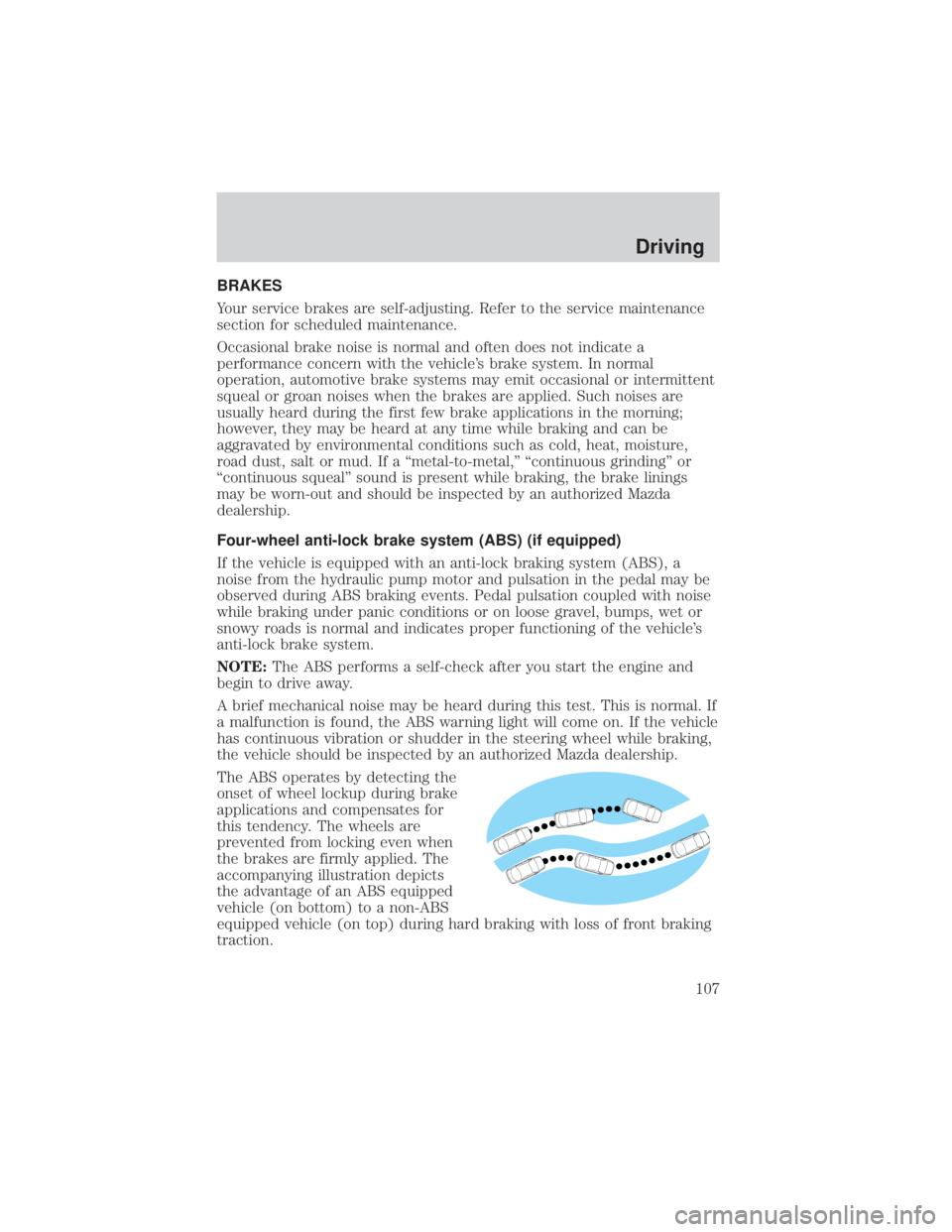
The ABS operates by detecting the
onset of wheel lockup during brake
applications and compensates for
this tendency. The wheels are
prevented from locking even when
the brakes are firmly applied. The
accompanying illustration depicts
the advantage of an ABS equipped
vehicle (on bottom) to a non-ABS
equipped vehicle (on top) during hard braking with loss of front braking
traction.
Driving
107
Page 127 of 232
If driving through deep or standing water is unavoidable, proceed very
slowly. Never drive through water that is higher than the bottom of the
hubs (for trucks) or the bottom of the wheel rims (for cars).
Once through the water, always try the brakes. Wet brakes do not stop
the vehicle as effectively as dry brakes. Drying can be improved by
moving your vehicle slowly while applying light pressure on the brake
pedal.
Driving through deep water where the transmission vent tube is
submerged may allow water into the transmission and cause
internal transmission damage.
TRAILER TOWING
Trailer towing with your vehicle may require the use of a trailer tow
option package.
Trailer towing puts additional loads on your vehicle's engine, transaxle,
axle, brakes, tires, and suspension. For your safety and to maximize
vehicle performance, be sure to use the proper equipment while towing.
Follow these guidelines to ensure safe towing procedure:
²Stay within your vehicle's load limits.
² Thoroughly prepare your vehicle for towing. Refer to Preparing to
tow in this chapter.
² Use extra caution when driving while trailer towing. Refer to Driving
while you tow in this chapter.
² Service your vehicle more frequently if you tow a trailer. Refer to the
ªScheduled Maintenanceº section of this manual.
² Do not tow a trailer until your vehicle has been driven at least 800 km
(500 miles).
² Refer to the instructions included with towing accessories for the
proper installation and adjustment specifications.
Do not exceed the maximum loads listed on the Certification label. For
load specification terms found on the label, refer to Vehicle loadingin
this chapter. Remember to figure in the tongue load of your loaded
vehicle when figuring the total weight.
Driving
127
Page 129 of 232
Trailer brakes
Electric brakes and manual, automatic or surge-type trailer brakes are
safe if installed properly and adjusted to the manufacturer's
specifications. The trailer brakes must meet local and Federal
regulations.WARNING: Do not connect a trailer's hydraulic brake system
directly to your vehicle's brake system. Your vehicle may not
have enough braking power and your chances of having a
collision greatly increase.
The braking system of the tow vehicle is rated for operation at the
GVWR not GCWR.
Trailer lamps
Trailer lamps are required on most towed vehicles. Make sure your
trailer lamps conform to local and Federal regulations. See your
authorized Mazda dealer for proper instructions and equipment for
hooking up trailer lamps.
Driving while you tow
When towing a trailer:
² Ensure that you turn off your speed control. The speed control may
shut off automatically when you are towing on long, steep grades.
² Consult your local motor vehicle speed regulations for towing a trailer.
² Use a lower gear when towing up or down steep hills. This will
eliminate excessive downshifting and upshifting for optimum fuel
economy and transmission cooling.
² Anticipate stops and brake gradually.
Exceeding the GCWR rating may cause internal transmission
damage and void your warranty coverage.
Servicing after towing
If you tow a trailer for long distances, your vehicle will require more
frequent service intervals. Refer to the ªScheduled Maintenanceº section
for more information.
Driving
129
Page 139 of 232
Fuse/RelayLocation Fuse Amp
Rating Passenger Compartment Fuse Panel
Description
24 15A Left/Right Stoplamps, Hight Mounted Stoplamp, Left/Right Trailer Stoplamp, ABS
Unit, ASC Unit (Brake Pedal Position
Switch), PCM, Shift Solenoid
25 30A Power Window Motor - Right Front, Left Front, Right Rear, Left Rear
26 30A Power Door Lock Motor - Right Front, Left Front, Right Rear, Left Rear, GEM (Door
Lock Relay Coil), Power Seat
27 10A Audio, Cluster, Interior Lamp, Map Lamp Cargo Lamp
ACC Ð Accessory Relay
Power distribution box
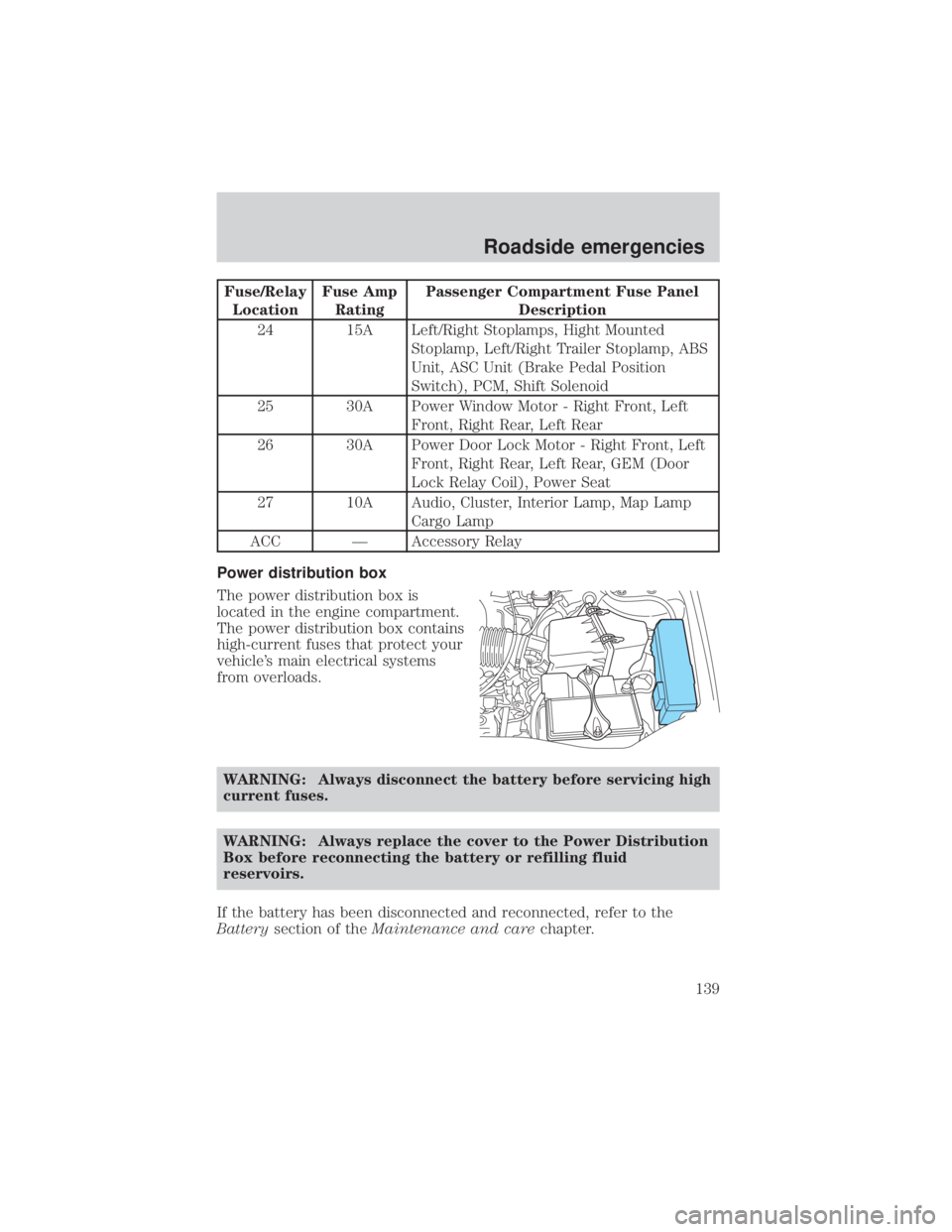
The power distribution box is
located in the engine compartment.
The power distribution box contains
high-current fuses that protect your
vehicle's main electrical systems
from overloads.
WARNING: Always disconnect the battery before servicing high
current fuses.
WARNING: Always replace the cover to the Power Distribution
Box before reconnecting the battery or refilling fluid
reservoirs.
If the battery has been disconnected and reconnected, refer to the
Battery section of the Maintenance and care chapter.
Roadside emergencies
139
Page 155 of 232
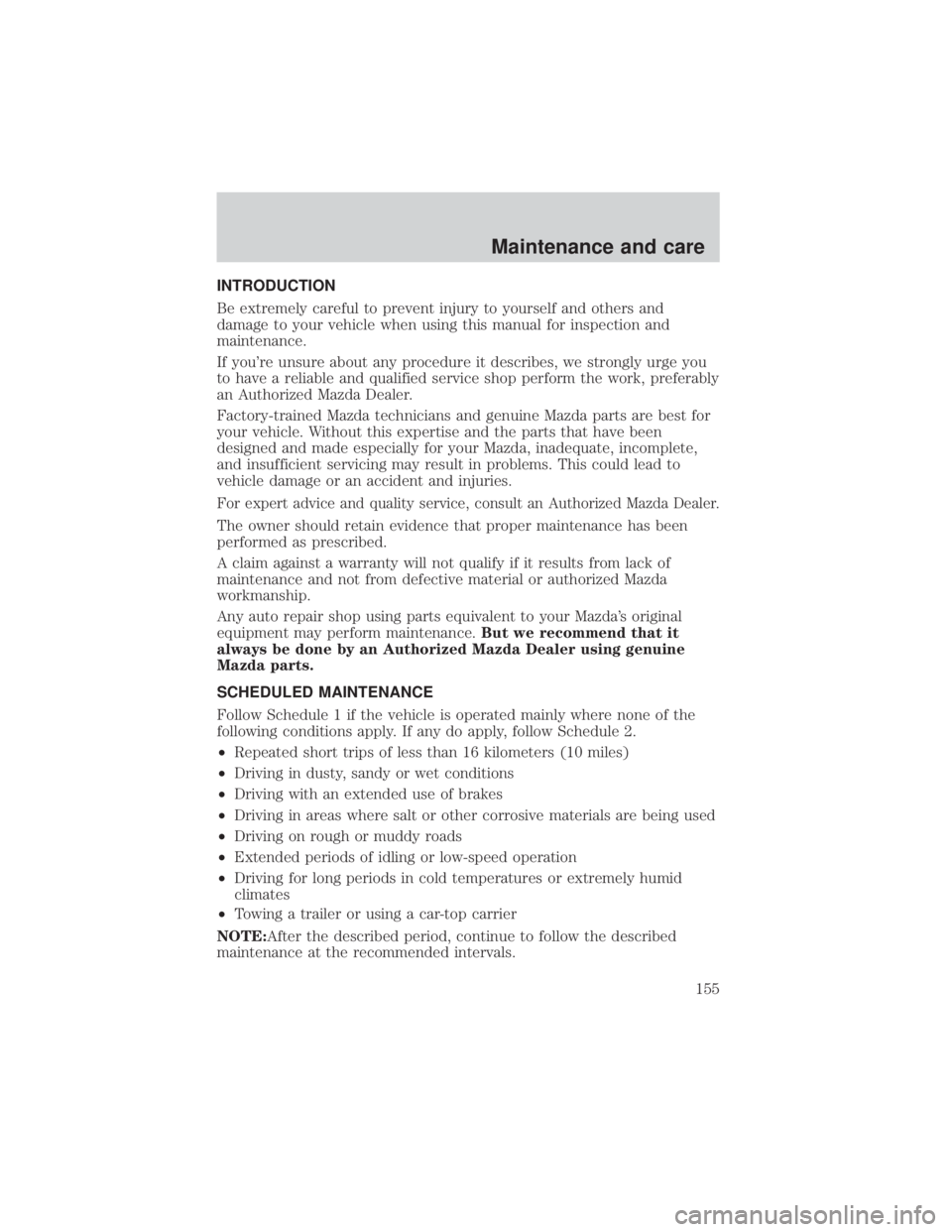
INTRODUCTION
Be extremely careful to prevent injury to yourself and others and
damage to your vehicle when using this manual for inspection and
maintenance.
If you're unsure about any procedure it describes, we strongly urge you
to have a reliable and qualified service shop perform the work, preferably
an Authorized Mazda Dealer.
Factory-trained Mazda technicians and genuine Mazda parts are best for
your vehicle. Without this expertise and the parts that have been
designed and made especially for your Mazda, inadequate, incomplete,
and insufficient servicing may result in problems. This could lead to
vehicle damage or an accident and injuries.
For expert advice and quality service, consult an Authorized Mazda Dealer.
The owner should retain evidence that proper maintenance has been
performed as prescribed.
A claim against a warranty will not qualify if it results from lack of
maintenance and not from defective material or authorized Mazda
workmanship.
Any auto repair shop using parts equivalent to your Mazda's original
equipment may perform maintenance.But we recommend that it
always be done by an Authorized Mazda Dealer using genuine
Mazda parts.
SCHEDULED MAINTENANCE
Follow Schedule 1 if the vehicle is operated mainly where none of the
following conditions apply. If any do apply, follow Schedule 2.
² Repeated short trips of less than 16 kilometers (10 miles)
² Driving in dusty, sandy or wet conditions
² Driving with an extended use of brakes
² Driving in areas where salt or other corrosive materials are being used
² Driving on rough or muddy roads
² Extended periods of idling or low-speed operation
² Driving for long periods in cold temperatures or extremely humid
climates
² Towing a trailer or using a car-top carrier
NOTE:After the described period, continue to follow the described
maintenance at the recommended intervals.
Maintenance and care
155
Page 156 of 232
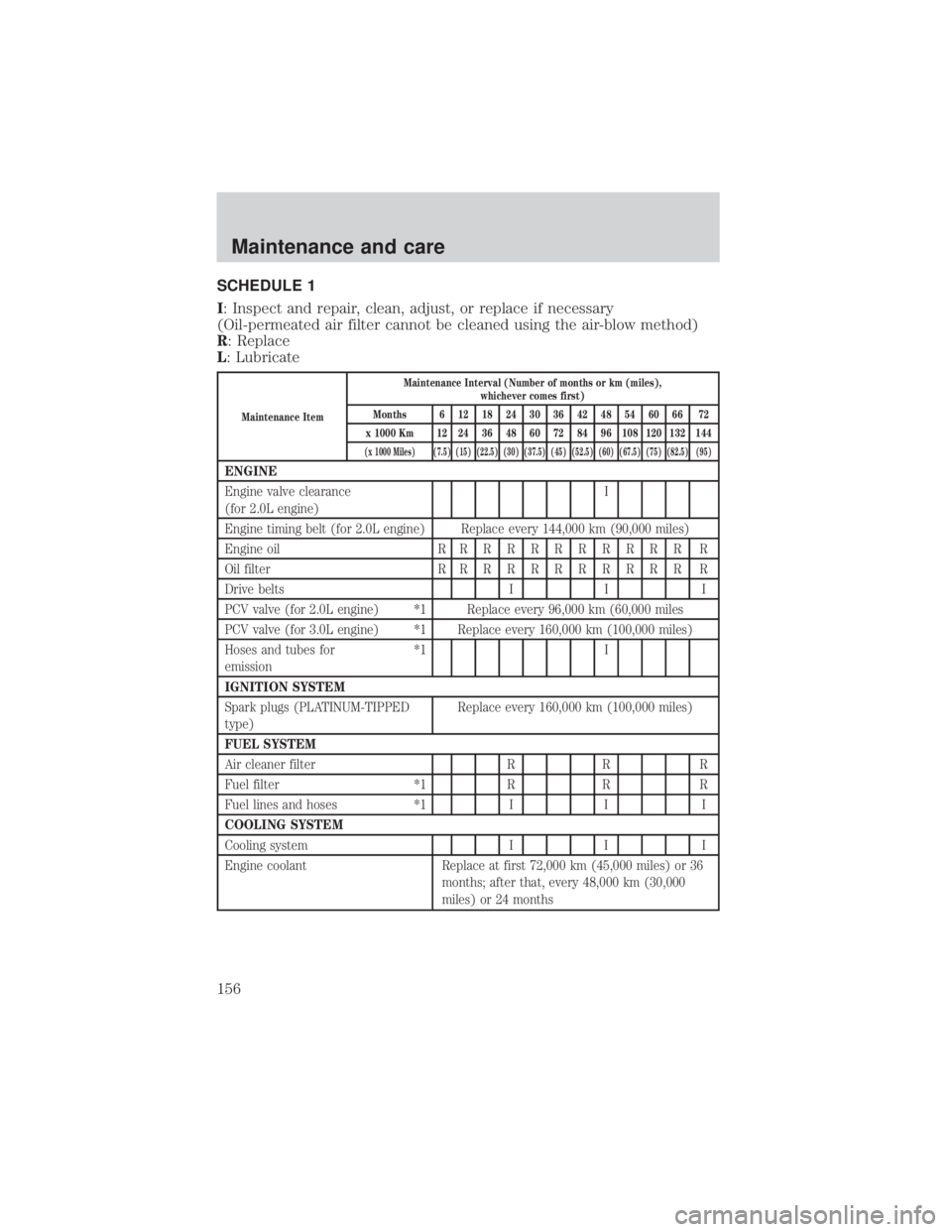
SCHEDULE 1
I: Inspect and repair, clean, adjust, or replace if necessary
(Oil-permeated air filter cannot be cleaned using the air-blow method)
R: Replace
L: Lubricate
Maintenance ItemMaintenance Interval (Number of months or km (miles),
whichever comes first)
Months 6 12 18 24 30 36 42 48 54 60 66 72
x 1000 Km 12 24 36 48 60 72 84 96 108 120 132 144
(x 1000 Miles) (7.5) (15) (22.5) (30) (37.5) (45) (52.5) (60) (67.5) (75) (82.5) (95)
ENGINE
Engine valve clearance
(for 2.0L engine) I
Engine timing belt (for 2.0L engine) Replace every 144,000 km (90,000 miles)
Engine oil R RRRRRRRRRR R
Oil filter R RRRRRRRRRR R
Drive belts I I I
PCV valve (for 2.0L engine) *1 Replace every 96,000 km (60,000 miles
PCV valve (for 3.0L engine) *1 Replace every 160,000 km (100,000 miles)
Hoses and tubes for
emission *1 I
IGNITION SYSTEM
Spark plugs (PLATINUM-TIPPED
type) Replace every 160,000 km (100,000 miles)
FUEL SYSTEM
Air cleaner filter R R R
Fuel filter *1 R R R
Fuel lines and hoses *1 I I I
COOLING SYSTEM
Cooling system I I I
Engine coolant Replace at first 72,000 km (45,000 miles) or 36 months; after that, every 48,000 km (30,000
miles) or 24 months
Maintenance and care
156
Page 157 of 232
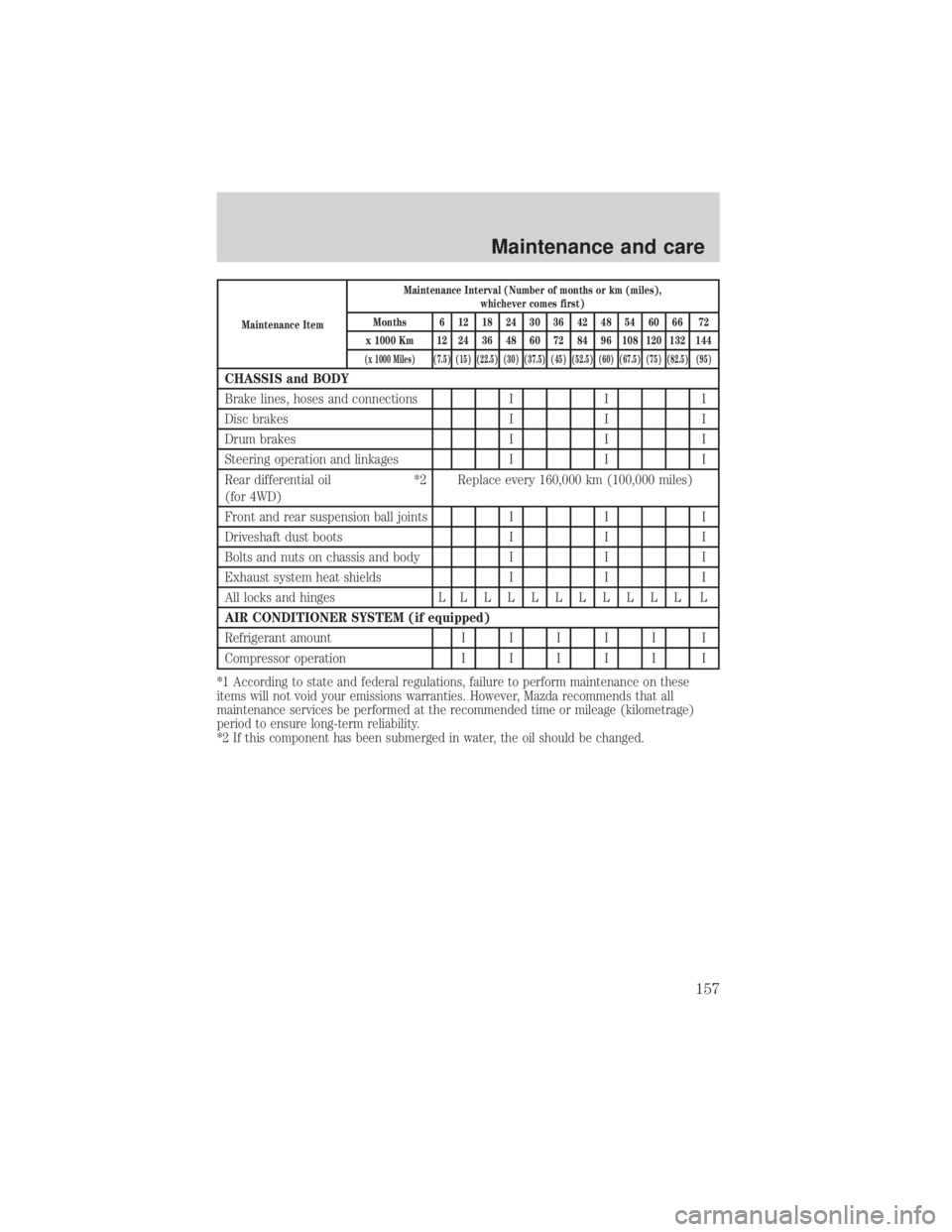
Maintenance ItemMaintenance Interval (Number of months or km (miles),
whichever comes first)
Months 6 12 18 24 30 36 42 48 54 60 66 72
x 1000 Km 12 24 36 48 60 72 84 96 108 120 132 144
(x 1000 Miles) (7.5) (15) (22.5) (30) (37.5) (45) (52.5) (60) (67.5) (75) (82.5) (95)
CHASSIS and BODY
Brake lines, hoses and connections II I
Disc brakes II I
Drum brakes II I
Steering operation and linkages II I
Rear differential oil
(for 4WD) *2 Replace every 160,000 km (100,000 miles)
Front and rear suspension ball joints II I
Driveshaft dust boots II I
Bolts and nuts on chassis and body II I
Exhaust system heat shields II I
All locks and hinges LLLLLLLLLLL L
AIR CONDITIONER SYSTEM (if equipped)
Refrigerant amount IIIII I
Compressor operation IIIII I
*1 According to state and federal regulations, failure to perform maintenance on these
items will not void your emissions warranties. However, Mazda recommends that all
maintenance services be performed at the recommended time or mileage (kilometrage)
period to ensure long-term reliability.
*2 If this component has been submerged in water, the oil should be changed.
Maintenance and care
157
Page 158 of 232
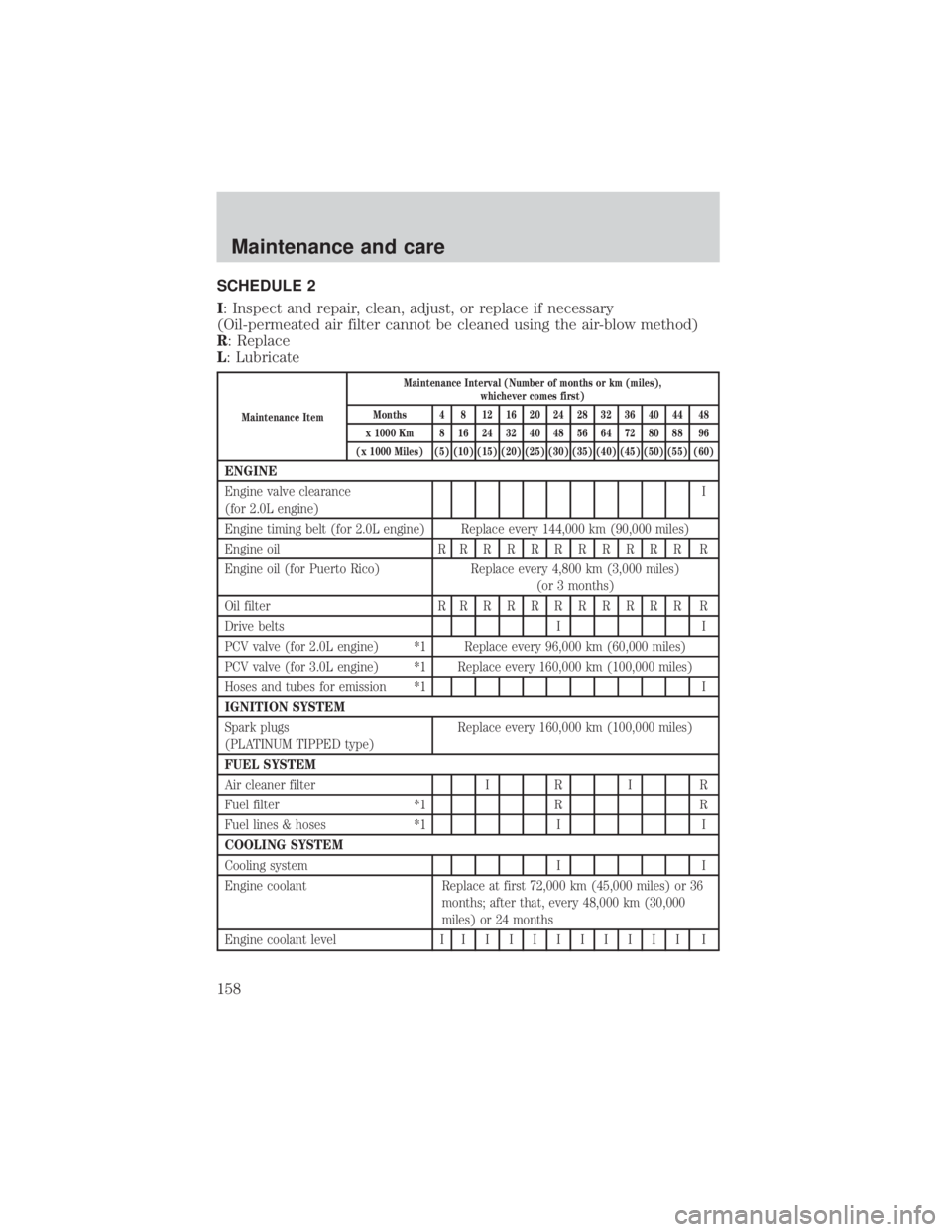
SCHEDULE 2
I: Inspect and repair, clean, adjust, or replace if necessary
(Oil-permeated air filter cannot be cleaned using the air-blow method)
R: Replace
L: Lubricate
Maintenance ItemMaintenance Interval (Number of months or km (miles),
whichever comes first)
Months 4 8 12 16 20 24 28 32 36 40 44 48
x 1000 Km 8 16 24 32 40 48 56 64 72 80 88 96
(x 1000 Miles) (5) (10) (15) (20) (25) (30) (35) (40) (45) (50) (55) (60)
ENGINE
Engine valve clearance
(for 2.0L engine) I
Engine timing belt (for 2.0L engine) Replace every 144,000 km (90,000 miles)
Engine oil R RRRRRRRRRR R
Engine oil (for Puerto Rico) Replace every 4,800 km (3,000 miles) (or 3 months)
Oil filter R RRRRRRRRRR R
Drive belts I I
PCV valve (for 2.0L engine) *1 Replace every 96,000 km (60,000 miles)
PCV valve (for 3.0L engine) *1 Replace every 160,000 km (100,000 miles)
Hoses and tubes for emission *1 I
IGNITION SYSTEM
Spark plugs
(PLATINUM TIPPED type) Replace every 160,000 km (100,000 miles)
FUEL SYSTEM
Air cleaner filter I R I R
Fuel filter *1 R R
Fuel lines & hoses *1 I I
COOLING SYSTEM
Cooling system I I
Engine coolant Replace at first 72,000 km (45,000 miles) or 36 months; after that, every 48,000 km (30,000
miles) or 24 months
Engine coolant level I IIIIIIIIII I
Maintenance and care
158
Page 159 of 232
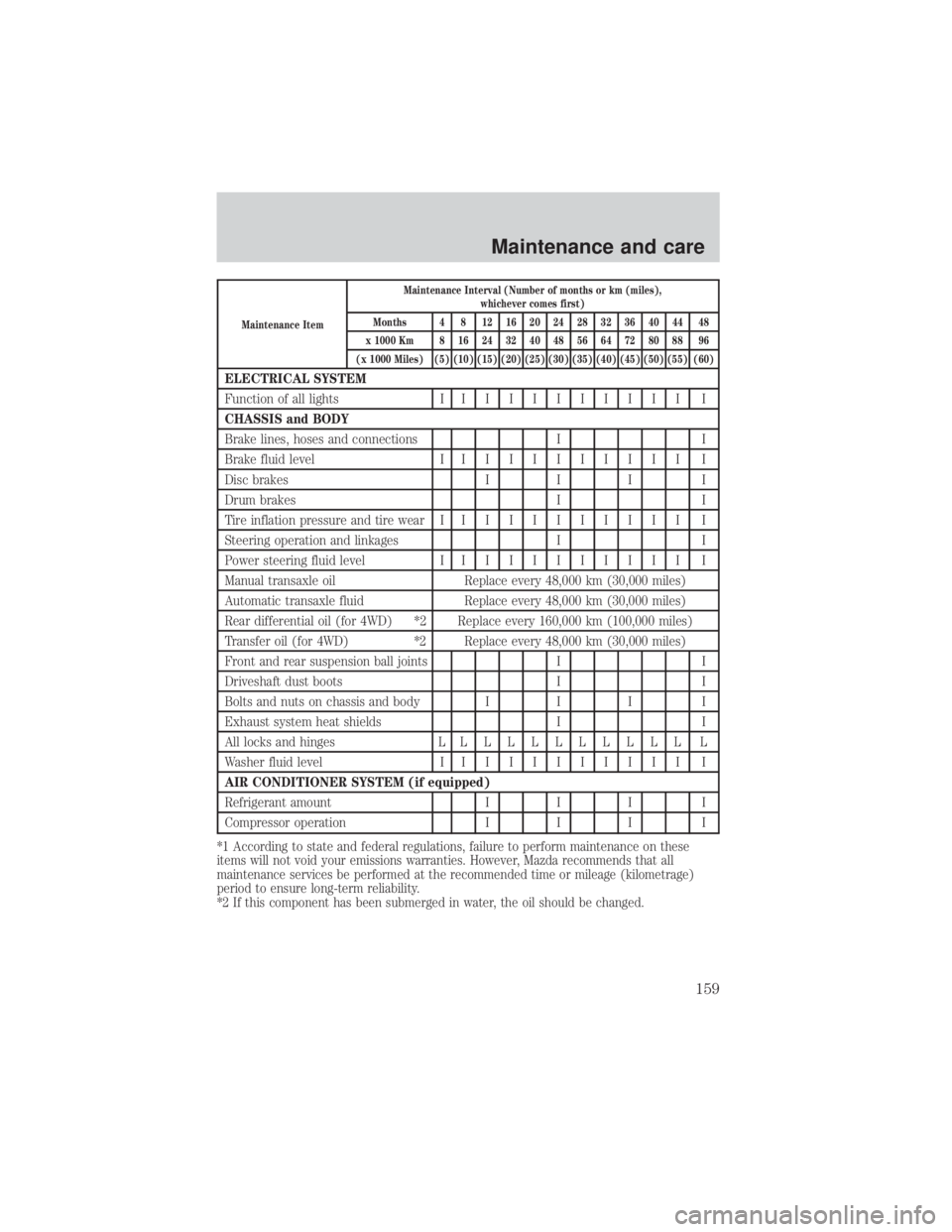
Maintenance ItemMaintenance Interval (Number of months or km (miles),
whichever comes first)
Months 4 8 12 16 20 24 28 32 36 40 44 48
x 1000 Km 8 16 24 32 40 48 56 64 72 80 88 96
(x 1000 Miles) (5) (10) (15) (20) (25) (30) (35) (40) (45) (50) (55) (60)
ELECTRICAL SYSTEM
Function of all lights IIIIIIIIIII I
CHASSIS and BODY
Brake lines, hoses and connections I I
Brake fluid level I IIIIIIIIII I
Disc brakes I I I I
Drum brakes I I
Tire inflation pressure and tire wear I IIIIIIIIII I
Steering operation and linkages I I
Power steering fluid level I IIIIIIIIII I
Manual transaxle oil Replace every 48,000 km (30,000 miles)
Automatic transaxle fluid Replace every 48,000 km (30,000 miles)
Rear differential oil (for 4WD) *2 Replace every 160,000 km (100,000 miles)
Transfer oil (for 4WD) *2 Replace every 48,000 km (30,000 miles)
Front and rear suspension ball joints I I
Driveshaft dust boots I I
Bolts and nuts on chassis and body I I I I
Exhaust system heat shields I I
All locks and hinges L LLLLLLLLLL L
Washer fluid level I IIIIIIIIII I
AIR CONDITIONER SYSTEM (if equipped)
Refrigerant amount I I I I
Compressor operation I I I I
*1 According to state and federal regulations, failure to perform maintenance on these
items will not void your emissions warranties. However, Mazda recommends that all
maintenance services be performed at the recommended time or mileage (kilometrage)
period to ensure long-term reliability.
*2 If this component has been submerged in water, the oil should be changed.
Maintenance and care
159
Page 160 of 232
SERVICE RECOMMENDATIONS
To help you service your vehicle:
²We highlight do-it-yourself items in the engine compartment for easy
location.
² We provide a Scheduled Maintenance section which makes tracking
routine service easy.
If your vehicle requires professional service, your dealership can provide
necessary parts and service. Check your ªWarranty Informationº to find
out which parts and services are covered.
Use only recommended fuels, lubricants, fluids and service parts
conforming to specifications. Genuine Mazda parts are designed and built
to provide the best performance in your vehicle.
PRECAUTIONS WHEN SERVICING YOUR VEHICLE
Be especially careful when inspecting or servicing your vehicle. To avoid
damage and/or personal injury:
² Do not work on a hot engine.
² When the engine is running, make sure that loose clothing, jewelry or
long hair does not get caught up in moving parts.
² Do not work on a vehicle with the engine running in an enclosed
space, unless you are sure you have enough ventilation.
² Keep all lit cigarettes, open flames and other lit material away from
the battery and all fuel related parts.
If you disconnect the battery, the engine must ªrelearnº its idle
conditions before your vehicle will drive properly, as explained in Battery
in this chapter.
Maintenance and care
160