tow MAZDA MODEL TRIBUTE 4WD 2001 Owner's Manual
[x] Cancel search | Manufacturer: MAZDA, Model Year: 2001, Model line: MODEL TRIBUTE 4WD, Model: MAZDA MODEL TRIBUTE 4WD 2001Pages: 232, PDF Size: 1.74 MB
Page 133 of 232
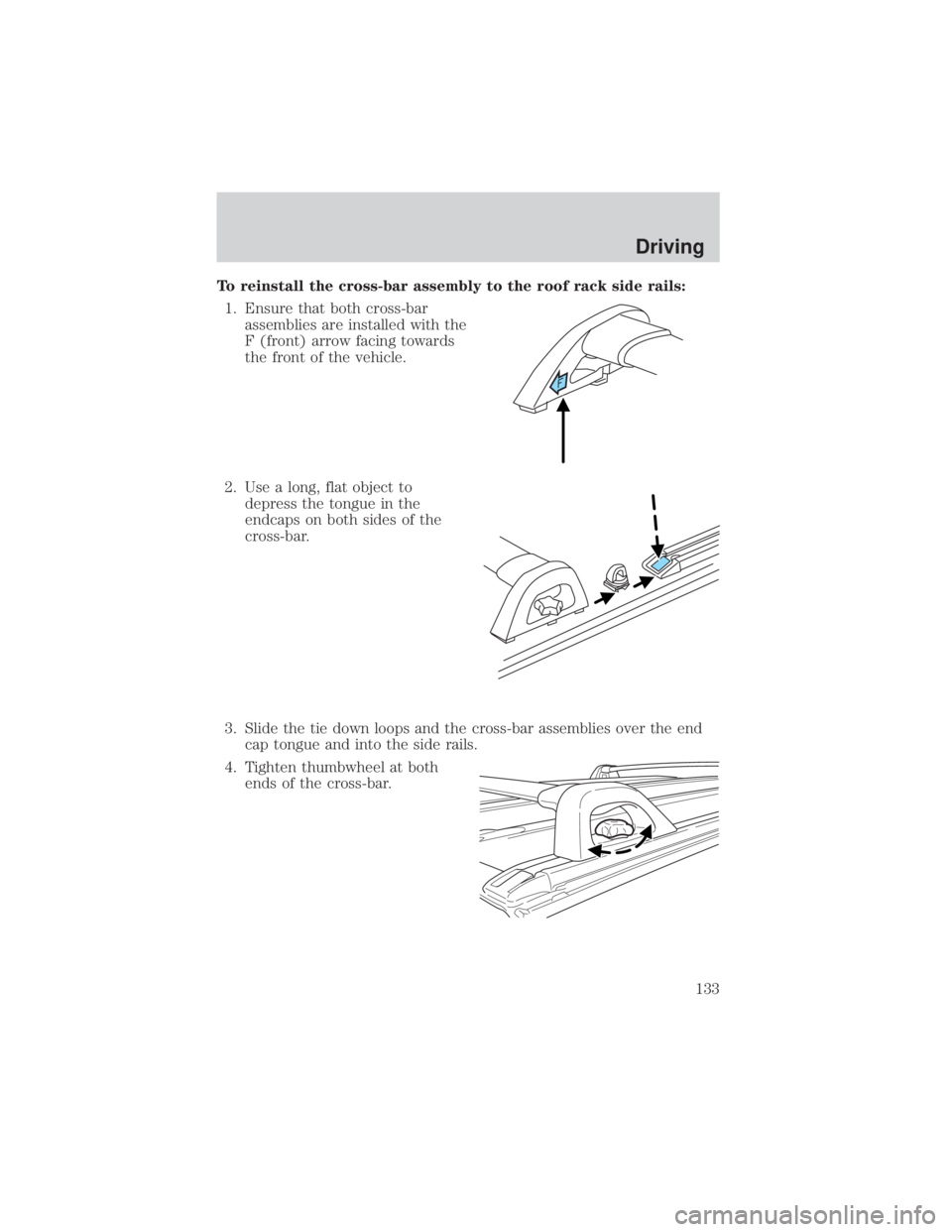
To reinstall the cross-bar assembly to the roof rack side rails:1. Ensure that both cross-bar assemblies are installed with the
F (front) arrow facing towards
the front of the vehicle.
2. Use a long, flat object to depress the tongue in the
endcaps on both sides of the
cross-bar.
3. Slide the tie down loops and the cross-bar assemblies over the end cap tongue and into the side rails.
4. Tighten thumbwheel at both ends of the cross-bar.
Driving
133
Page 143 of 232
It is not recommended that the vehicle be operated in 4WD modes with
a temporary spare. If 4WD operation is necessary, do not operate above
speeds of 16 km/h (10 mph) or for distances above 80 km (50 miles).WARNING: If you use the temporary spare tire continuously or
do not follow these precautions, the tire could fail, causing you
to lose control of the vehicle, possibly injuring yourself or
others.
When driving with the temporary spare tire do not:
² exceed 80 km/h (50 mph) under any circumstances
² load the vehicle beyond maximum vehicle load rating listed on the
Safety Compliance Label
² tow a trailer
² use tire chains
² drive through an automatic car wash, because of the vehicle's reduced
ground clearance
² try to repair the temporary spare tire or remove it from its wheel rim
² use the wheel for any other type of vehicle
Tire change procedure WARNING: When one of the front wheels is off the ground, the
transmission alone will not prevent the vehicle from moving or
slipping off the jack, even if the vehicle is in P (Park)
(automatic transaxle) or R (Reverse) (manual transaxle).
WARNING: To prevent the vehicle from moving when you
change a tire, be sure the parking brake is set, then block (in
both directions) the wheel that is diagonally opposite (other
side and end of the vehicle) to the tire being changed.
WARNING: If the vehicle slips off the jack, you or someone
else could be seriously injured.
Roadside emergencies
143
Page 147 of 232
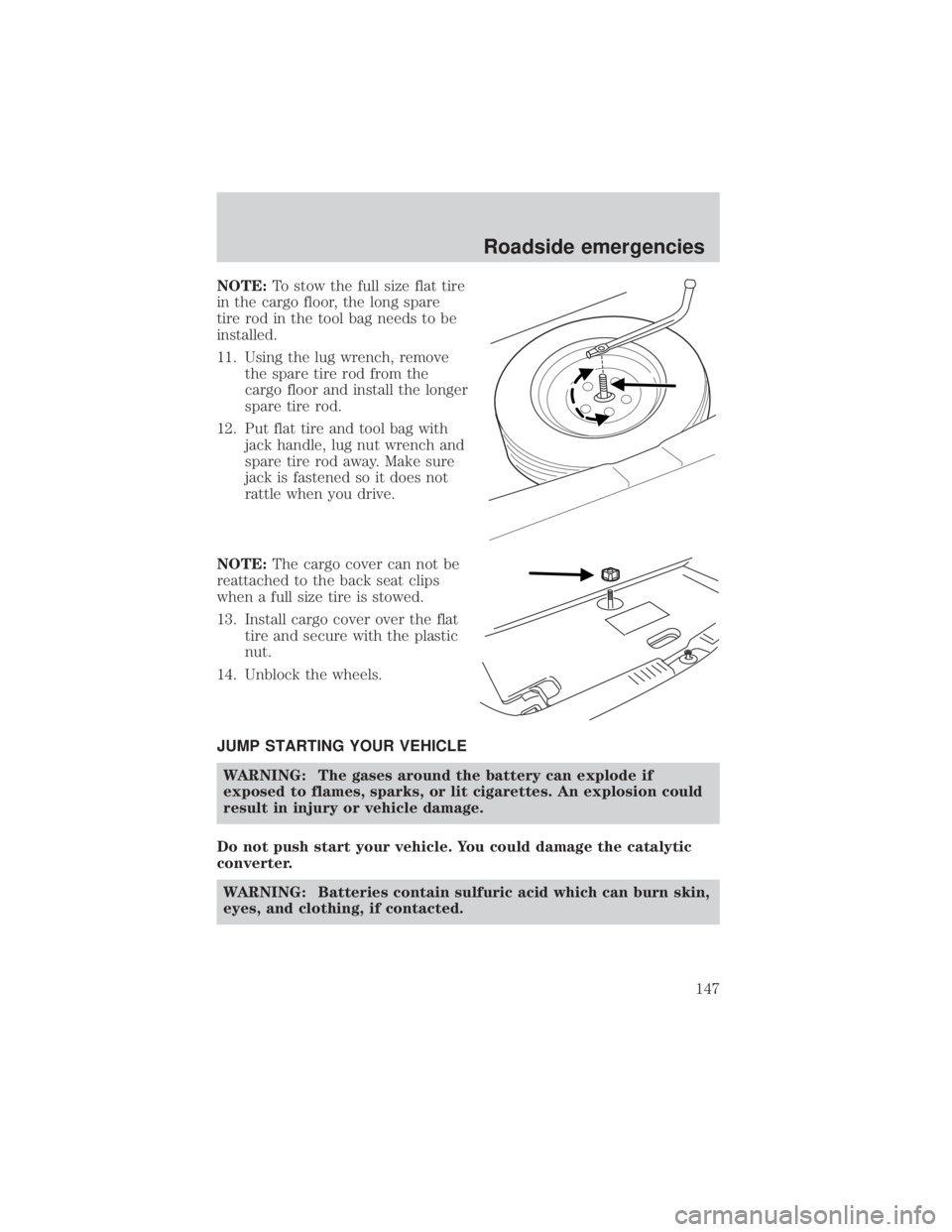
NOTE:To stow the full size flat tire
in the cargo floor, the long spare
tire rod in the tool bag needs to be
installed.
11. Using the lug wrench, remove the spare tire rod from the
cargo floor and install the longer
spare tire rod.
12. Put flat tire and tool bag with jack handle, lug nut wrench and
spare tire rod away. Make sure
jack is fastened so it does not
rattle when you drive.
NOTE: The cargo cover can not be
reattached to the back seat clips
when a full size tire is stowed.
13. Install cargo cover over the flat tire and secure with the plastic
nut.
14. Unblock the wheels.
JUMP STARTING YOUR VEHICLE
WARNING: The gases around the battery can explode if
exposed to flames, sparks, or lit cigarettes. An explosion could
result in injury or vehicle damage.
Do not push start your vehicle. You could damage the catalytic
converter. WARNING: Batteries contain sulfuric acid which can burn skin,
eyes, and clothing, if contacted.
Roadside emergencies
147
Page 153 of 232
WRECKER TOWING
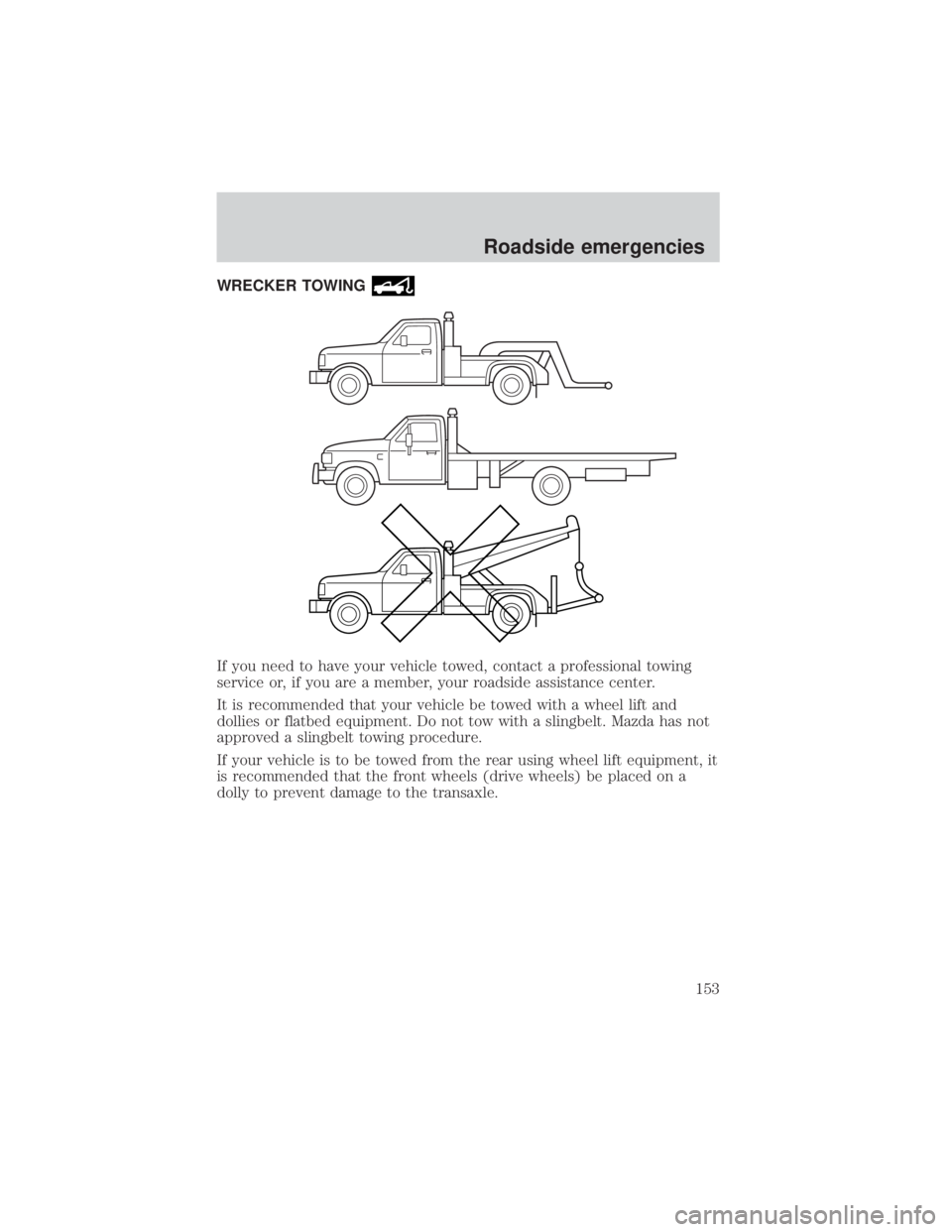
If you need to have your vehicle towed, contact a professional towing
service or, if you are a member, your roadside assistance center.
It is recommended that your vehicle be towed with a wheel lift and
dollies or flatbed equipment. Do not tow with a slingbelt. Mazda has not
approved a slingbelt towing procedure.
If your vehicle is to be towed from the rear using wheel lift equipment, it
is recommended that the front wheels (drive wheels) be placed on a
dolly to prevent damage to the transaxle.
Roadside emergencies
153
Page 154 of 232
On 4x4 vehicles, it is recommended that your vehicle be towed with a
wheel lift and dollies or flatbed equipment with all the wheels off the
ground.
If the vehicle is towed by other means or incorrectly, vehicle
damage may occur.
In case of a roadside emergency with a disabled vehicle (without access
to wheel dollies, car hauling trailer or flatbed transport vehicle) your
vehicle (regardless of powertrain configuration) can be flat towed (all
wheels on the ground) under the following conditions:
²Place the transmission in N (Neutral).
² Maximum speed is 56 km/h (35 mph).
² Maximum distance is 80 km (50 miles).
Mazda provides a towing manual for all authorized tow truck operators.
Have your tow truck operator refer to this manual for proper hook-up
and towing procedures for your vehicle.
Roadside emergencies
154
Page 155 of 232
INTRODUCTION
Be extremely careful to prevent injury to yourself and others and
damage to your vehicle when using this manual for inspection and
maintenance.
If you're unsure about any procedure it describes, we strongly urge you
to have a reliable and qualified service shop perform the work, preferably
an Authorized Mazda Dealer.
Factory-trained Mazda technicians and genuine Mazda parts are best for
your vehicle. Without this expertise and the parts that have been
designed and made especially for your Mazda, inadequate, incomplete,
and insufficient servicing may result in problems. This could lead to
vehicle damage or an accident and injuries.
For expert advice and quality service, consult an Authorized Mazda Dealer.
The owner should retain evidence that proper maintenance has been
performed as prescribed.
A claim against a warranty will not qualify if it results from lack of
maintenance and not from defective material or authorized Mazda
workmanship.
Any auto repair shop using parts equivalent to your Mazda's original
equipment may perform maintenance.But we recommend that it
always be done by an Authorized Mazda Dealer using genuine
Mazda parts.
SCHEDULED MAINTENANCE
Follow Schedule 1 if the vehicle is operated mainly where none of the
following conditions apply. If any do apply, follow Schedule 2.
² Repeated short trips of less than 16 kilometers (10 miles)
² Driving in dusty, sandy or wet conditions
² Driving with an extended use of brakes
² Driving in areas where salt or other corrosive materials are being used
² Driving on rough or muddy roads
² Extended periods of idling or low-speed operation
² Driving for long periods in cold temperatures or extremely humid
climates
² Towing a trailer or using a car-top carrier
NOTE:After the described period, continue to follow the described
maintenance at the recommended intervals.
Maintenance and care
155
Page 184 of 232
Changing the wiper blades
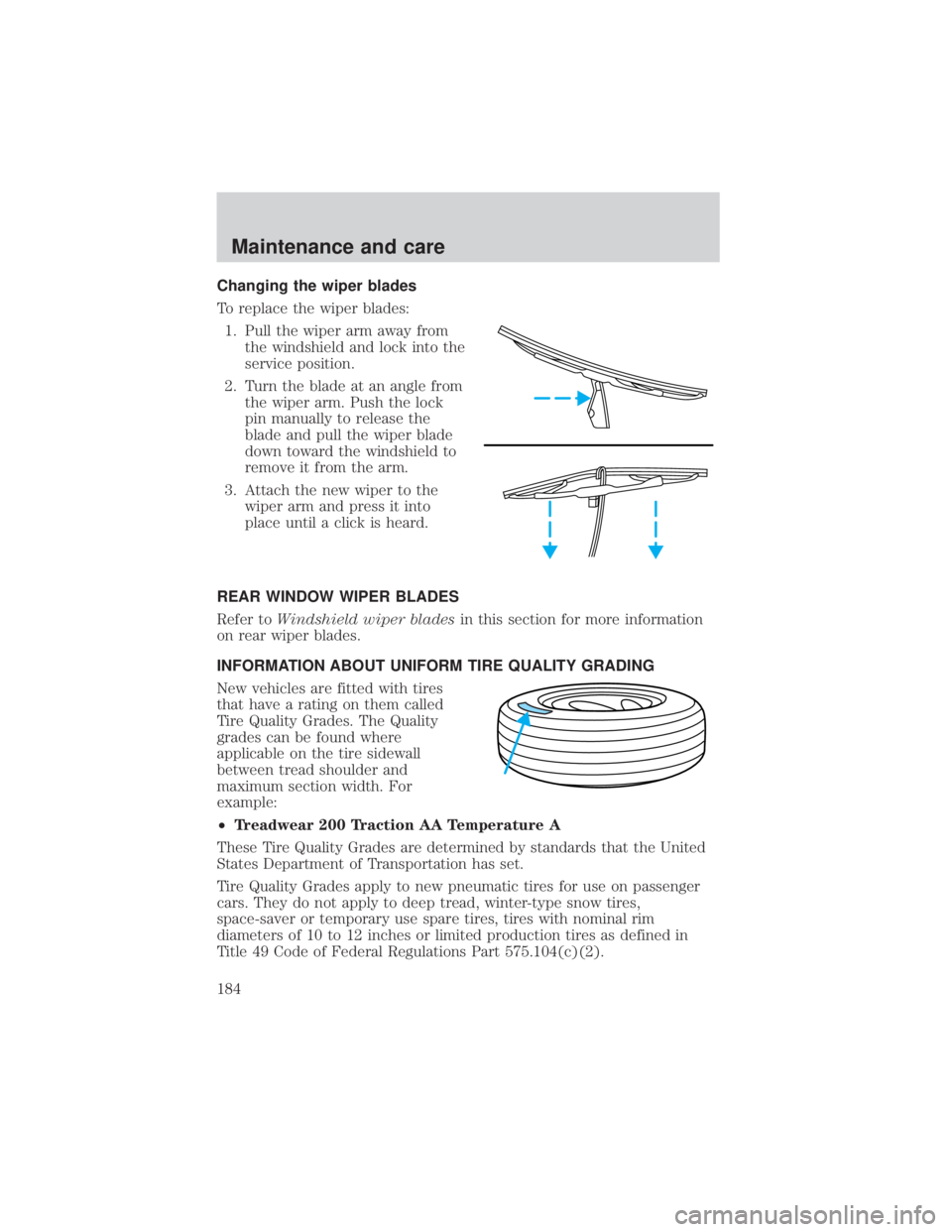
To replace the wiper blades:1. Pull the wiper arm away from the windshield and lock into the
service position.
2. Turn the blade at an angle from the wiper arm. Push the lock
pin manually to release the
blade and pull the wiper blade
down toward the windshield to
remove it from the arm.
3. Attach the new wiper to the wiper arm and press it into
place until a click is heard.
REAR WINDOW WIPER BLADES
Refer to Windshield wiper blades in this section for more information
on rear wiper blades.
INFORMATION ABOUT UNIFORM TIRE QUALITY GRADING
New vehicles are fitted with tires
that have a rating on them called
Tire Quality Grades. The Quality
grades can be found where
applicable on the tire sidewall
between tread shoulder and
maximum section width. For
example:
² Treadwear 200 Traction AA Temperature A
These Tire Quality Grades are determined by standards that the United
States Department of Transportation has set.
Tire Quality Grades apply to new pneumatic tires for use on passenger
cars. They do not apply to deep tread, winter-type snow tires,
space-saver or temporary use spare tires, tires with nominal rim
diameters of 10 to 12 inches or limited production tires as defined in
Title 49 Code of Federal Regulations Part 575.104(c)(2).
Maintenance and care
184
Page 197 of 232
²Combine errands and minimize stop-and-go driving.
Maintenance
²Keep tires properly inflated and use only recommended size.
² Operating a vehicle with the wheels out of alignment will reduce fuel
economy.
² Perform all regularly scheduled maintenance items. Follow the
recommended maintenance schedule and owner maintenance checks
found in your vehicle service maintenance section.
Conditions
²Heavily loading a vehicle or towing a trailer may reduce fuel economy
at any speed.
² Carrying unnecessary weight may reduce fuel economy (approximately
0.4 km/L [1 mpg] is lost for every 180 kg [400 lb] of weight carried).
² Adding certain accessories to your vehicle (for example bug
deflectors, rollbars/light bars, running boards, ski/luggage racks) may
reduce fuel economy.
² Using fuel blended with alcohol may lower fuel economy.
² Fuel economy may decrease with lower temperatures during the first
12±16 km (8±10 miles) of driving.
² Driving on flat terrain offers improved fuel economy as compared to
driving on hilly terrain.
² Transmissions give their best fuel economy when operated in the top
cruise gear and with steady pressure on the gas pedal.
² Close windows for high speed driving.
EPA window sticker
Every new vehicle should have the EPA window sticker. Contact your
dealer if the window sticker is not supplied with your vehicle. The EPA
window sticker should be your guide for the fuel economy comparisons
with other vehicles.
It is important to note the box in the lower left corner of the window
sticker. These numbers represent the Range of L/100 km (MPG)
expected on the vehicle under optimum conditions. Your fuel economy
may vary depending upon the method of operation and conditions.
Maintenance and care
197
Page 206 of 232
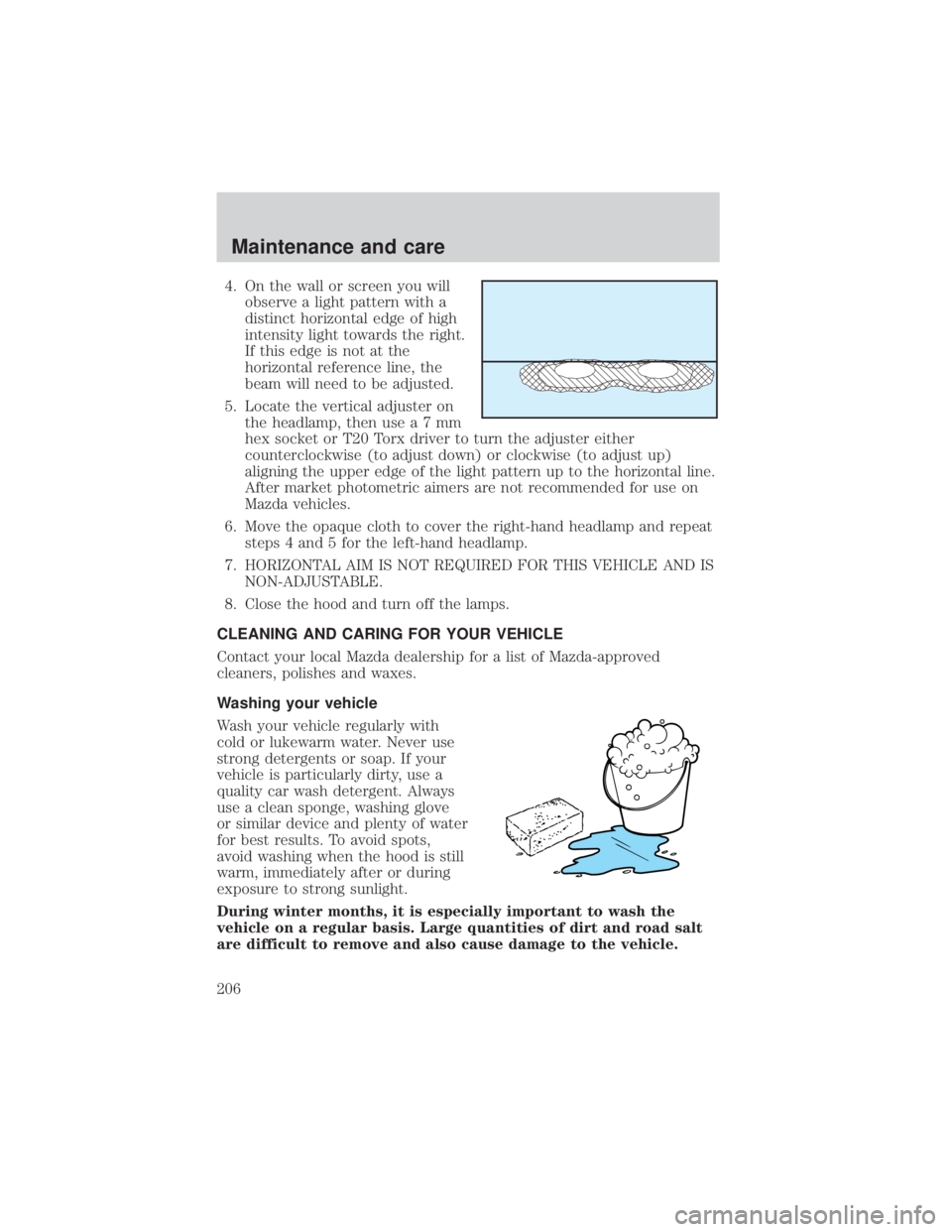
4. On the wall or screen you willobserve a light pattern with a
distinct horizontal edge of high
intensity light towards the right.
If this edge is not at the
horizontal reference line, the
beam will need to be adjusted.
5. Locate the vertical adjuster on the headlamp, then us ea7mm
hex socket or T20 Torx driver to turn the adjuster either
counterclockwise (to adjust down) or clockwise (to adjust up)
aligning the upper edge of the light pattern up to the horizontal line.
After market photometric aimers are not recommended for use on
Mazda vehicles.
6. Move the opaque cloth to cover the right-hand headlamp and repeat steps 4 and 5 for the left-hand headlamp.
7. HORIZONTAL AIM IS NOT REQUIRED FOR THIS VEHICLE AND IS NON-ADJUSTABLE.
8. Close the hood and turn off the lamps.
CLEANING AND CARING FOR YOUR VEHICLE
Contact your local Mazda dealership for a list of Mazda-approved
cleaners, polishes and waxes.
Washing your vehicle
Wash your vehicle regularly with
cold or lukewarm water. Never use
strong detergents or soap. If your
vehicle is particularly dirty, use a
quality car wash detergent. Always
use a clean sponge, washing glove
or similar device and plenty of water
for best results. To avoid spots,
avoid washing when the hood is still
warm, immediately after or during
exposure to strong sunlight.
During winter months, it is especially important to wash the
vehicle on a regular basis. Large quantities of dirt and road salt
are difficult to remove and also cause damage to the vehicle.
Maintenance and care
206
Page 209 of 232

²Cover the highlighted areas to prevent water damage when
cleaning the engine.
² Never wash or rinse the engine while it is running; water in the
running engine may cause internal damage.
Cleaning the wheels
Wash with the same detergent as the body of your vehicle. Do not use
acid-based or alcohol-based wheel cleaners, steel wool, fuel or strong
detergents. Never use abrasives that will damage the finish of special
wheel surfaces. Use a tar remover to remove grease and tar.
The brushes used in some automatic car washes may damage the
finish on your wheels. Before going to a car wash, find out if the
brushes are abrasive.
Cleaning non-painted plastic exterior parts
Use vinyl cleaner for routine cleaning. Clean with a tar remover if
necessary. Do not clean plastic parts with thinners, solvents or
petroleum-based cleaners.
Cleaning the exterior lamps
Wash with the same detergent as the exterior of your vehicle. If
necessary, use a tar remover.
To avoid scratching the lamps, do not use a dry paper towel, chemical
solvents or abrasive cleaners.
Cleaning the wiper blades, windshield and rear window
If the wiper blades do not wipe properly, clean the wiper blade rubber
element with undiluted windshield washer solution or a mild detergent.
To avoid damaging the blades, do not use fuel, kerosene, paint thinner or
other solvents.
If the wiper still does not wipe properly, this could be caused by
substances on the windshield or rear window such as tree sap and some
hot wax treatments used by commercial car washes. Clean the outside of
the windshield or rear window with a non-abrasive cleaner. Do notuse
abrasive cleansers on glass as they may cause scratches. The windshield
or rear window is clean if beads do not form when you rinse it with
water. The windshield, rear window and wiper blades should be cleaned
on a regular basis, and blades or rubber elements replaced when worn.
Maintenance and care
209