maintenance MAZDA MODEL TRIBUTE HEV 2008 User Guide
[x] Cancel search | Manufacturer: MAZDA, Model Year: 2008, Model line: MODEL TRIBUTE HEV, Model: MAZDA MODEL TRIBUTE HEV 2008Pages: 312, PDF Size: 3.68 MB
Page 108 of 312

technology, parents areSTRONGLYencouraged to always properly
restrain children in the rear seat. The sensor also turns off the passenger
front airbag and seat-mounted side airbag (if equipped) when the
passenger seat is empty to prevent unnecessary replacement of airbag(s)
after a collision.
When the front passenger seat is occupied and the sensing system has
turned off the passenger’s frontal airbag, the “pass airbag off” indicator
will light and stay lit to remind you that the front passenger frontal
airbag is off. See Front passenger sensing system in the airbags section
of this chapter.
Front seat belt usage sensors
The front seat belt usage sensors detect whether or not the driver and
front outboard passenger seat belts are fastened. This information allows
your Safety System to tailor the airbag deployment and seat belt
pretensioner activation depending upon seat belt usage. Refer to Seat
belt section in this chapter.
Front seat belt pretensioners
The seat belt pretensioners at the front outboard seating positions are
designed to tighten the seat belts firmly against the occupant’s body
during frontal collisions, and in side collisions and rollovers when the
vehicle is equipped with the Safety Canopy™ system. This helps increase
the effectiveness of the seat belts. In frontal collisions, the seat belt
pretensioners can be activated alone or, if the collision is of sufficient
severity, together with the front airbags.
Front seat belt energy management retractors
The front outboard seat belt energy management retractors, once
initiated, allow webbing to be pulled out of the retractor in a gradual and
controlled manner in response to the occupant’s forward momentum.
This helps reduce the risk of force-related injuries to the occupant’s
chest by limiting the load on the occupant. Refer to Energy
management feature section in this chapter.
Determining if the Personal Safety System is operational
The Safety System uses a warning light in the instrument cluster or a
back-up tone to indicate the condition of the system. Refer to the
Warning lights and chimes section in theInstrument Cluster chapter.
Routine maintenance of the Safety System is not required.
The Restraints control module (RCM) monitors its own internal circuits
and the circuits for the airbag supplemental restraints, crash sensor(s),
2008 Tribute Hybrid (thv)
Owners Guide (post-2002-fmt)
USA (fus)
Seating and Safety Restraints
108
Page 114 of 312

WARNING: The driver and front passenger seat belt system
(including retractors, buckles and height adjusters) must be
replaced if the vehicle is involved in a collision that results in
deployment of front airbags, seat-mounted side airbags and
Safety Canopy™, and seat belt pretensioners.
WARNING: Failure to replace the seat belt assembly under the
above conditions could result in severe personal injuries in the
event of a collision.
Seat belt extension assembly
If the seat belt is too short when fully extended, a 9 inch (23 cm) or
12 inch (31 cm) seat belt extension assembly can be added (part
numbers 611C22–A and 611C22–B respectively). Seat belt extension
assemblies can be obtained from your authorized Mazda dealership.
Use only extensions manufactured by the same supplier as the seat belt.
Manufacturer identification is located at the end of the webbing on the
label. Also, use the seat belt extension only if the seat belt is too short
for you when fully extended.
When you are not using the extensions store them in another location so
that no one will accidentally use them.
NOTE: Do not use extensions to change the fit of the shoulder belt
across the torso.
Seat belt maintenance
Inspect the seat belt systems periodically to make sure they work
properly and are not damaged. Inspect the seat belts to make sure there
are no nicks, tears or cuts. Replace if necessary. All seat belt assemblies,
including retractors, buckles, front seat belt buckle assemblies, buckle
support assemblies (slide bar-if equipped), shoulder belt height adjusters
(if equipped), shoulder belt guide on seatback (if equipped), child safety
seat LATCH and tether anchors, and attaching hardware, should be
inspected after a collision. Mazda Motor Corporation recommends that all
seat belt assemblies in use in vehicles involved in a collision be replaced.
However, if the collision was minor and an authorized dealer finds that
the belts do not show damage and continue to operate properly, they do
not need to be replaced. Seat belt assemblies not in use during a
collision should also be inspected and replaced if either damage or
improper operation is noted.
2008 Tribute Hybrid (thv)
Owners Guide (post-2002-fmt)
USA (fus)
Seating and Safety Restraints
114
Page 128 of 312
In case there is a problem with the
front passenger sensing system, the
airbag readiness lamp in the
instrument cluster will stay lit.
If the airbag readiness lamp is lit, do the following:
The driver and/or adult passengers should check for any objects that
may be lodged underneath the front passenger seat or cargo interfering
with the seat.
If objects are lodged and/or cargo is interfering with the seat; please take
the following steps to remove the obstruction:
•Pull the vehicle over.
• Turn the vehicle off.
• Driver and/or adult passengers should check for any objects lodged
underneath the front passenger seat or cargo interfering with the seat.
• Remove the obstruction(s) (if found).
• Restart the vehicle.
• Wait at least 2 minutes and verify that the airbag readiness lamp is no
longer illuminated
• If the airbag readiness lamp remains illuminated, this may or may/not
be a problem due to the front passenger sensing system.
DO NOT attempt to repair or service the system; take your vehicle
immediately to an authorized Mazda dealer. Ask the front seat occupant
to sit in a rear seat until the air bag system if checked by the authorized
Mazda Dealer.
If it is necessary to modify an advanced front airbag system to
accommodate a person with disabilities, contact the Mazda Customer
Relationship Center at the phone number shown in the Customer
Assistance chapter of this Owner’s Manual.
WARNING: Any alteration/modification to the front passenger
seat may affect the performance of the front passenger sensing
system.
Determining if the system is operational
The SRS uses a readiness light in the instrument cluster or a tone to
indicate the status of the system. Refer to Airbag readinesssection in
the Instrument Cluster chapter. Routine maintenance of the airbag is
not required.
2008 Tribute Hybrid (thv)
Owners Guide (post-2002-fmt)
USA (fus)
Seating and Safety Restraints
128
Page 131 of 312
to inflate in side-impact collisions, not roll-over, rear-impact, frontal or
near-frontal collisions, unless the collision causes sufficient lateral
deceleration.WARNING: Several airbag system components get hot after
inflation. Do not touch them after inflation.
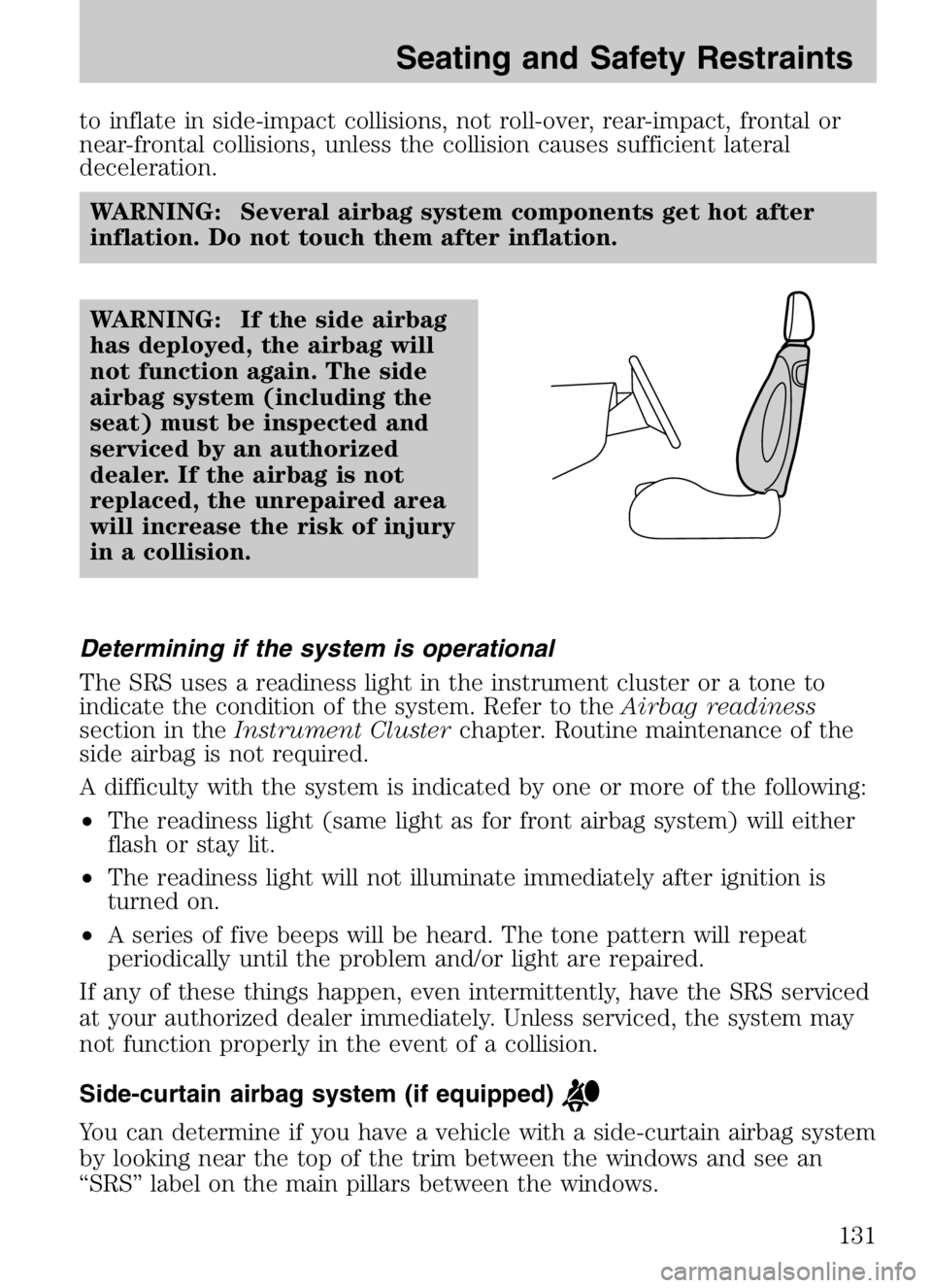
WARNING: If the side airbag
has deployed, the airbag will
not function again. The side
airbag system (including the
seat) must be inspected and
serviced by an authorized
dealer. If the airbag is not
replaced, the unrepaired area
will increase the risk of injury
in a collision.
Determining if the system is operational
The SRS uses a readiness light in the instrument cluster or a tone to
indicate the condition of the system. Refer to the Airbag readiness
section in the Instrument Cluster chapter. Routine maintenance of the
side airbag is not required.
A difficulty with the system is indicated by one or more of the following:
• The readiness light (same light as for front airbag system) will either
flash or stay lit.
• The readiness light will not illuminate immediately after ignition is
turned on.
• A series of five beeps will be heard. The tone pattern will repeat
periodically until the problem and/or light are repaired.
If any of these things happen, even intermittently, have the SRS serviced
at your authorized dealer immediately. Unless serviced, the system may
not function properly in the event of a collision.
Side-curtain airbag system (if equipped)
You can determine if you have a vehicle with a side-curtain airbag system
by looking near the top of the trim between the windows and see an
“SRS” label on the main pillars between the windows.
2008 Tribute Hybrid (thv)
Owners Guide (post-2002-fmt)
USA (fus)
Seating and Safety Restraints
131
Page 134 of 312
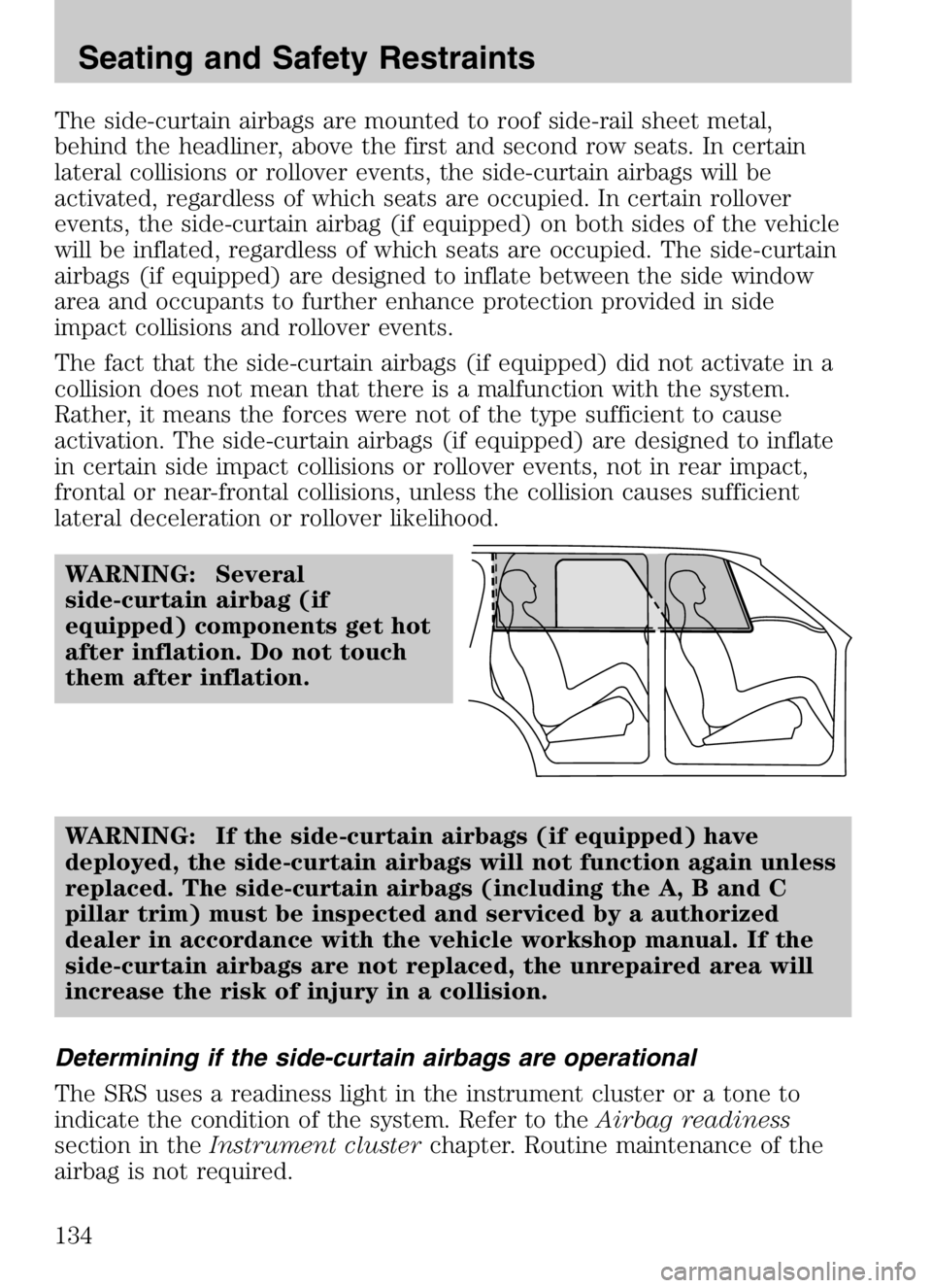
The side-curtain airbags are mounted to roof side-rail sheet metal,
behind the headliner, above the first and second row seats. In certain
lateral collisions or rollover events, the side-curtain airbags will be
activated, regardless of which seats are occupied. In certain rollover
events, the side-curtain airbag (if equipped) on both sides of the vehicle
will be inflated, regardless of which seats are occupied. The side-curtain
airbags (if equipped) are designed to inflate between the side window
area and occupants to further enhance protection provided in side
impact collisions and rollover events.
The fact that the side-curtain airbags (if equipped) did not activate in a
collision does not mean that there is a malfunction with the system.
Rather, it means the forces were not of the type sufficient to cause
activation. The side-curtain airbags (if equipped) are designed to inflate
in certain side impact collisions or rollover events, not in rear impact,
frontal or near-frontal collisions, unless the collision causes sufficient
lateral deceleration or rollover likelihood.WARNING: Several
side-curtain airbag (if
equipped) components get hot
after inflation. Do not touch
them after inflation.
WARNING: If the side-curtain airbags (if equipped) have
deployed, the side-curtain airbags will not function again unless
replaced. The side-curtain airbags (including the A, B and C
pillar trim) must be inspected and serviced by a authorized
dealer in accordance with the vehicle workshop manual. If the
side-curtain airbags are not replaced, the unrepaired area will
increase the risk of injury in a collision.
Determining if the side-curtain airbags are operational
The SRS uses a readiness light in the instrument cluster or a tone to
indicate the condition of the system. Refer to the Airbag readiness
section in the Instrument cluster chapter. Routine maintenance of the
airbag is not required.
2008 Tribute Hybrid (thv)
Owners Guide (post-2002-fmt)
USA (fus)
Seating and Safety Restraints
134
Page 154 of 312
TIRE CARE
Inspecting your tires
Periodically inspect the tire treads for uneven or excessive wear and
remove objects such as stones, nails or glass that may be wedged in the
tread grooves. Check for holes or cuts that may permit air leakage from
the tire and make necessary repairs. Also inspect the tire sidewalls for
cracking, cuts, bruises and other signs of damage or excessive wear. If
internal damage to the tire is suspected, have the tire demounted and
inspected in case it needs to be repaired or replaced. For your safety,
tires that are damaged or show signs of excessive wear should not be
used because they are more likely to blow out or fail.
Improper or inadequate vehicle maintenance can cause tires to wear
abnormally. Inspect all your tires, including the spare, frequently, and
replace them if one or more of the following conditions exist:
Tire wear
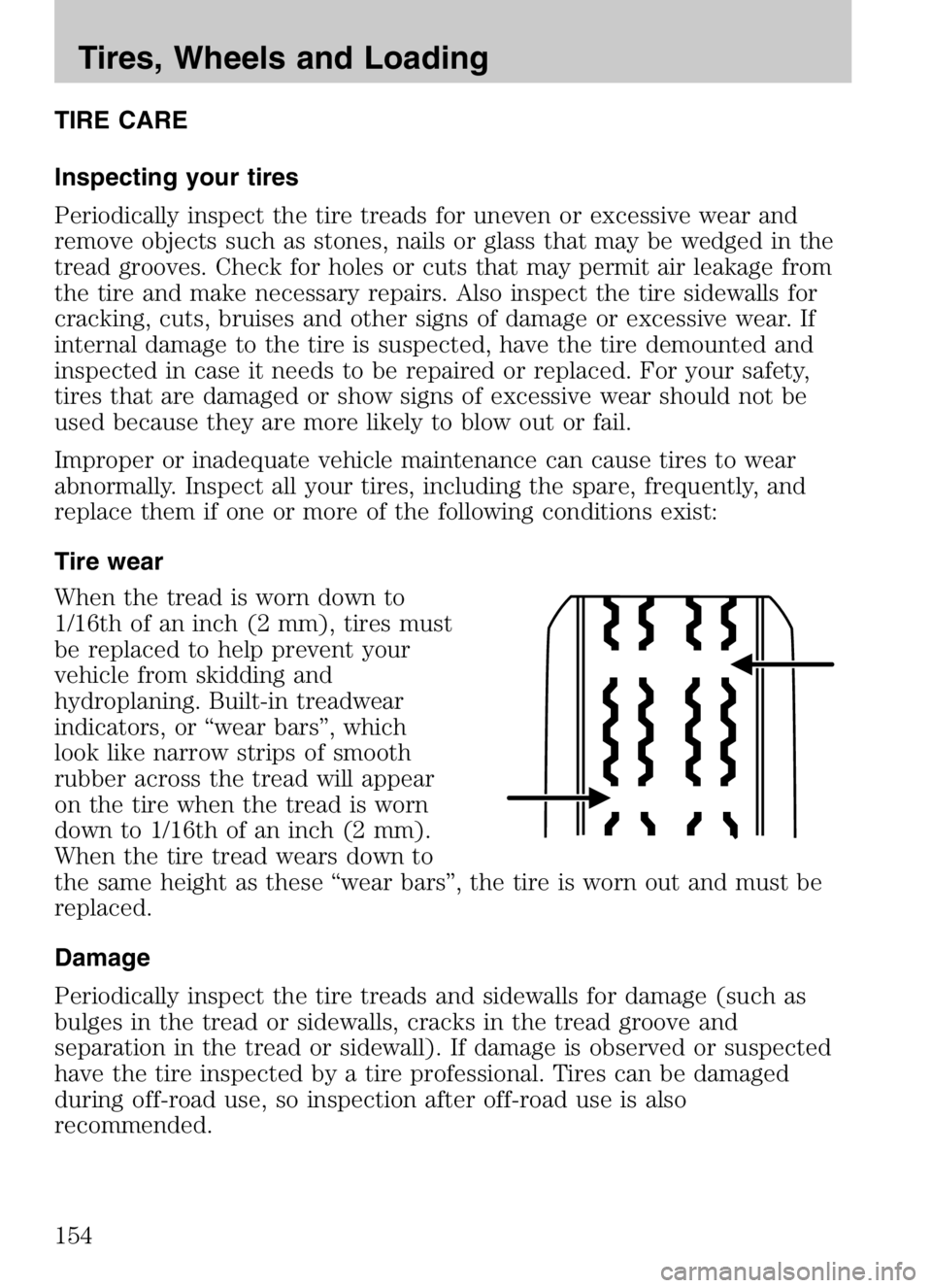
When the tread is worn down to
1/16th of an inch (2 mm), tires must
be replaced to help prevent your
vehicle from skidding and
hydroplaning. Built-in treadwear
indicators, or “wear bars”, which
look like narrow strips of smooth
rubber across the tread will appear
on the tire when the tread is worn
down to 1/16th of an inch (2 mm).
When the tire tread wears down to
the same height as these “wear bars”, the tire is worn out and must be
replaced.
Damage
Periodically inspect the tire treads and sidewalls for damage (such as
bulges in the tread or sidewalls, cracks in the tread groove and
separation in the tread or sidewall). If damage is observed or suspected
have the tire inspected by a tire professional. Tires can be damaged
during off-road use, so inspection after off-road use is also
recommended.
2008 Tribute Hybrid(thv)
Owners Guide (post-2002-fmt)
USA (fus)
Tires, Wheels and Loading
154
Page 158 of 312

Tire and wheel alignment
A bad jolt from hitting a curb or pothole can cause the front end of your
vehicle to become misaligned or cause damage to your tires. If your
vehicle seems to pull to one side when you’re driving, the wheels may be
out of alignment. Have an authorized dealer check the wheel alignment
periodically.
Wheel misalignment in the front or the rear can cause uneven and rapid
treadwear of your tires and should be corrected by an authorized dealer.
Front wheel drive (FWD) vehicles and those with an independent rear
suspension (if equipped) may require alignment of all four wheels.
The tires should also be balanced periodically. An unbalanced tire and
wheel assembly may result in irregular tire wear.
Tire rotation
Rotating your tires at the recommended interval (as indicated in the
Scheduled maintenancesection of theMaintenance and
Specifications chapter) will help your tires wear more evenly, providing
better tire performance and longer tire life.
• Front Wheel Drive (FWD)
vehicles (front tires at top of
diagram)
2008 Tribute Hybrid (thv)
Owners Guide (post-2002-fmt)
USA (fus)
Tires, Wheels and Loading
158
Page 165 of 312

TIRE PRESSURE MONITORING SYSTEM (TPMS)
Each tire, including the spare (if
provided), should be checked
monthly when cold and inflated to
the inflation pressure recommended
by the vehicle manufacturer on the
vehicle placard or tire inflation pressure label. (If your vehicle has tires
of a different size than the size indicated on the vehicle placard or tire
inflation pressure label, you should determine the proper tire inflation
pressure for those tires.)
As an added safety feature, your vehicle has been equipped with a tire
pressure monitoring system (TPMS) that illuminates a low tire pressure
telltale when one or more of your tires is significantly under-inflated.
Accordingly, when the low tire pressure telltale illuminates, you should
stop and check your tires as soon as possible, and inflate them to the
proper pressure. Driving on a significantly under-inflated tire causes the
tire to overheat and can lead to tire failure. Under-inflation also reduces
fuel efficiency and tire tread life, and may affect the vehicle’s handling
and stopping ability.
Please note that the TPMS is not a substitute for proper tire
maintenance, and it is the driver’s responsibility to maintain correct tire
pressure, even if under-inflation has not reached the level to trigger
illumination of the TPMS low tire pressure telltale.
Your vehicle has also been equipped with a TPMS malfunction indicator
to indicate when the system is not operating properly. The TPMS
malfunction indicator is combined with the low tire pressure telltale.
When the system detects a malfunction, the telltale will flash for
approximately one minute and then remain continuously illuminated.
This sequence will continue upon subsequent vehicle start-ups as long as
the malfunction exists.
When the malfunction indicator is illuminated, the system may not be
able to detect or signal low tire pressure as intended. TPMS malfunctions
may occur for a variety of reasons, including the installation of
replacement or alternate tires or wheels on the vehicle that prevent the
TPMS from functioning properly. Always check the TPMS malfunction
telltale after replacing one or more tires or wheels on your vehicle to
ensure that the replacement or alternate tires and wheels allow the
TPMS to continue to function properly.
The Tire Pressure Monitoring System complies with part 15 of the FCC
rules and with RSS-210 of Industry Canada. Operation is subject to the
2008 Tribute Hybrid(thv)
Owners Guide (post-2002-fmt)
USA (fus)
Tires, Wheels and Loading
165
Page 177 of 312

Trailer towing puts additional loads on your vehicle’s engine, transaxle,
axle, brakes, tires, and suspension. For your safety and to maximize
vehicle performance, be sure to use the proper equipment while towing.
Follow these guidelines to ensure safe towing procedure:
•Stay within your vehicle’s load limits.
• Thoroughly prepare your vehicle for towing. Refer to Preparing to
tow in this chapter.
• Use extra caution when driving while trailer towing. Refer to Driving
while you tow in this chapter.
• Service your vehicle more frequently if you tow a trailer. Refer to the
severe duty schedule in the service maintenance section.
• Do not tow a trailer until your vehicle has been driven at least
500 miles (800 km).
• Refer to the instructions included with towing accessories for the
proper installation and adjustment specifications.
Do not exceed the maximum loads listed on the Certification label. For
load specification terms found on the label, refer to Vehicle loadingin
this chapter. Remember to figure in the tongue load of your loaded
trailer when figuring the total weight.
FWD
GCWR (Gross Combined Weight Rating)/Trailer Weights Engine Maximum GCWR - lb. (kg) Trailer Weight
Range - lb. (kg) Maximum
frontal area of
trailer - ft
2(m2)
2.3L 4820 (2186) 1000 (454) 24 (2.2)
Notes:For high altitude operation, reduce GCW by 2% per 1000 ft.
(300 meters) elevation. For definitions of terms and instructions on
calculating your vehicle’s load, refer to Vehicle loadingin this chapter.
Maximum trailer weights shown. The combined weight of the completed
towing vehicle and the loaded trailer must not exceed the GCWR.
Your Hybrid vehicle is capable of pulling the maximum trailer weight(s)
as specified above. Certain states require electric trailer brakes for
trailers over a specified weight. Your Hybrid vehicle electrical system is
not equipped to accommodate electric trailer brakes.
2008 Tribute Hybrid (thv)
Owners Guide (post-2002-fmt)
USA (fus)
Tires, Wheels and Loading
177
Page 180 of 312

•Do not exceed the GCWR rating or transmission damage may occur.
Servicing after towing
If you tow a trailer for long distances, your vehicle will require more
frequent service intervals. Refer to your scheduled maintenance
information for more information.
Trailer towing tips
• Practice turning, stopping and backing up before starting on a trip to
get the feel of the vehicle trailer combination. When turning, make
wider turns so the trailer wheels will clear curbs and other obstacles.
• Allow more distance for stopping with a trailer attached.
• If you are driving down a long or steep hill, shift to a lower gear. Do
not apply the brakes continuously, as they may overheat and become
less effective.
• The trailer tongue weight should be 10–15% of the loaded trailer
weight.
• If you will be towing a trailer frequently in hot weather, hilly
conditions, at GCWR, or any combination of these factors, consider
refilling your rear axle with synthetic gear lube if not already so
equipped. Refer to the Maintenance and Specifications chapter for
the lubricant specification. Remember that regardless of the rear axle
lube used, do not tow a trailer for the first 500 miles (800 km) of a
new vehicle, and that the first 500 miles (800 km) of towing be done
at no faster than 70 mph (112 km/h) with no full throttle starts.
• After you have traveled 50 miles (80 km), thoroughly check your
hitch, electrical connections and trailer wheel lug nuts.
• Vehicles with trailers should not be parked on a grade. If you must
park on a grade, place wheel chocks under the trailer’s wheels.
Launching or retrieving a boat
Disconnect the wiring to the trailer before backing the trailer
into the water. Reconnect the wiring to the trailer after the
trailer is removed from the water.
When backing down a ramp during boat launching or retrieval:
• do not allow the static water level to rise above the bottom edge of
the rear bumper.
• do not allow waves to break higher than 6 inches (15 cm) above the
bottom edge of the rear bumper.
2008 Tribute Hybrid (thv)
Owners Guide (post-2002-fmt)
USA (fus)
Tires, Wheels and Loading
180