brake MAZDA MODEL TRIBUTE HEV 2008 Owner's Manual
[x] Cancel search | Manufacturer: MAZDA, Model Year: 2008, Model line: MODEL TRIBUTE HEV, Model: MAZDA MODEL TRIBUTE HEV 2008Pages: 312, PDF Size: 3.68 MB
Page 177 of 312

Trailer towing puts additional loads on your vehicle’s engine, transaxle,
axle, brakes, tires, and suspension. For your safety and to maximize
vehicle performance, be sure to use the proper equipment while towing.
Follow these guidelines to ensure safe towing procedure:
•Stay within your vehicle’s load limits.
• Thoroughly prepare your vehicle for towing. Refer to Preparing to
tow in this chapter.
• Use extra caution when driving while trailer towing. Refer to Driving
while you tow in this chapter.
• Service your vehicle more frequently if you tow a trailer. Refer to the
severe duty schedule in the service maintenance section.
• Do not tow a trailer until your vehicle has been driven at least
500 miles (800 km).
• Refer to the instructions included with towing accessories for the
proper installation and adjustment specifications.
Do not exceed the maximum loads listed on the Certification label. For
load specification terms found on the label, refer to Vehicle loadingin
this chapter. Remember to figure in the tongue load of your loaded
trailer when figuring the total weight.
FWD
GCWR (Gross Combined Weight Rating)/Trailer Weights Engine Maximum GCWR - lb. (kg) Trailer Weight
Range - lb. (kg) Maximum
frontal area of
trailer - ft
2(m2)
2.3L 4820 (2186) 1000 (454) 24 (2.2)
Notes:For high altitude operation, reduce GCW by 2% per 1000 ft.
(300 meters) elevation. For definitions of terms and instructions on
calculating your vehicle’s load, refer to Vehicle loadingin this chapter.
Maximum trailer weights shown. The combined weight of the completed
towing vehicle and the loaded trailer must not exceed the GCWR.
Your Hybrid vehicle is capable of pulling the maximum trailer weight(s)
as specified above. Certain states require electric trailer brakes for
trailers over a specified weight. Your Hybrid vehicle electrical system is
not equipped to accommodate electric trailer brakes.
2008 Tribute Hybrid (thv)
Owners Guide (post-2002-fmt)
USA (fus)
Tires, Wheels and Loading
177
Page 178 of 312

4WD
GCWR (Gross Combined Weight Rating)/Trailer Weights Engine Maximum GCWR - lb. (kg) Trailer Weight
Range - lb. (kg) Maximum
frontal area of
trailer - ft
2(m2)
2.3L 4980 (2259) 1000 (454) 24 (2.2)
Notes:For high altitude operation, reduce GCW by 2% per 1000 ft.
(300 meters) elevation. For definitions of terms and instructions on
calculating your vehicle’s load, refer to Vehicle loadingin this chapter.
Maximum trailer weights shown. The combined weight of the completed
towing vehicle and the loaded trailer must not exceed the GCWR.
Your Hybrid vehicle is capable of pulling the maximum trailer weight(s)
as specified above. Certain states require electric trailer brakes for
trailers over a specified weight. Your Hybrid vehicle electrical system is
not equipped to accommodate electric trailer brakes.
WARNING: Do not exceed the GVWR or the GAWR specified on
the certification label.
WARNING: Towing trailers beyond the maximum recommended
gross trailer weight exceeds the limit of the vehicle and could
result in engine damage, transmission damage, structural
damage, loss of vehicle control, vehicle rollover and personal
injury.
Preparing to tow
Use the proper equipment for towing a trailer and make sure it is
properly attached to your vehicle. See your authorized dealer or a
reliable trailer dealer if you require assistance.
Hitches
Do not use hitches that clamp onto the vehicle bumper. Use a load
carrying hitch. You must distribute the load in your trailer so that
10–15% of the total weight of the trailer is on the tongue.
Safety chains
Always connect the trailer’s safety chains to hook retainers on the
vehicle. To connect the trailer’s safety chains, cross the chains under the
trailer tongue and allow slack for turning corners.
2008 Tribute Hybrid (thv)
Owners Guide (post-2002-fmt)
USA (fus)
Tires, Wheels and Loading
178
Page 179 of 312
If you use a rental trailer, follow the instructions that the rental agency
gives to you.
Do not attach safety chains to the bumper.
Trailer brakes
Electric, manual, automatic or surge-type brakes, if compatible with the
vehicle, are safe if installed properly and adjusted to the manufacturer’s
specifications. The trailer brakes must meet local and Federal
regulations.WARNING: Do not connect a trailer’s hydraulic brake system
directly to your vehicle’s brake system. Your vehicle may not
have enough braking power and your chances of having a
collision greatly increase.
The braking system of the tow vehicle is rated for operation at the
GVWR not GCWR.
Trailer lamps
Trailer lamps are required on most towed vehicles. Make sure all running
lights, brake lights, turn signals and hazard lights are working. Do not
connect trailer lamps directly to your vehicle’s tail lamps. This can cause
damage to your vehicle’s electrical system. See your authorized dealer or
trailer rental agency for proper instructions and equipment for hooking
up trailer lamps.
Driving while you tow
When towing a trailer:
• Keep your speed no faster than 70 mph (112 km/h) during the first
500 miles (800 km) of towing a trailer, and don’t make full throttle
starts.
• Turn off the speed control. The speed control may shut off
automatically when you are towing on long, steep grades.
• Consult your local motor vehicle speed regulations for towing a trailer.
• Anticipate stops and brake gradually.
2008 Tribute Hybrid (thv)
Owners Guide (post-2002-fmt)
USA (fus)
Tires, Wheels and Loading
179
Page 180 of 312

•Do not exceed the GCWR rating or transmission damage may occur.
Servicing after towing
If you tow a trailer for long distances, your vehicle will require more
frequent service intervals. Refer to your scheduled maintenance
information for more information.
Trailer towing tips
• Practice turning, stopping and backing up before starting on a trip to
get the feel of the vehicle trailer combination. When turning, make
wider turns so the trailer wheels will clear curbs and other obstacles.
• Allow more distance for stopping with a trailer attached.
• If you are driving down a long or steep hill, shift to a lower gear. Do
not apply the brakes continuously, as they may overheat and become
less effective.
• The trailer tongue weight should be 10–15% of the loaded trailer
weight.
• If you will be towing a trailer frequently in hot weather, hilly
conditions, at GCWR, or any combination of these factors, consider
refilling your rear axle with synthetic gear lube if not already so
equipped. Refer to the Maintenance and Specifications chapter for
the lubricant specification. Remember that regardless of the rear axle
lube used, do not tow a trailer for the first 500 miles (800 km) of a
new vehicle, and that the first 500 miles (800 km) of towing be done
at no faster than 70 mph (112 km/h) with no full throttle starts.
• After you have traveled 50 miles (80 km), thoroughly check your
hitch, electrical connections and trailer wheel lug nuts.
• Vehicles with trailers should not be parked on a grade. If you must
park on a grade, place wheel chocks under the trailer’s wheels.
Launching or retrieving a boat
Disconnect the wiring to the trailer before backing the trailer
into the water. Reconnect the wiring to the trailer after the
trailer is removed from the water.
When backing down a ramp during boat launching or retrieval:
• do not allow the static water level to rise above the bottom edge of
the rear bumper.
• do not allow waves to break higher than 6 inches (15 cm) above the
bottom edge of the rear bumper.
2008 Tribute Hybrid (thv)
Owners Guide (post-2002-fmt)
USA (fus)
Tires, Wheels and Loading
180
Page 183 of 312
Important safety precautions
A computer system controls the engine’s idle revolutions per minute
(RPM). When the engine starts, the idle RPM runs higher than normal in
order to warm the engine. If the engine idle speed does not slow down
automatically, have the vehicle checked.
Before starting the vehicle:1. Make sure all vehicle occupants have buckled their seat belts. For more information on seat belts and their proper usage, refer to the
Seating and Safety Restraints chapter.
2. Make sure vehicle accessories are off.
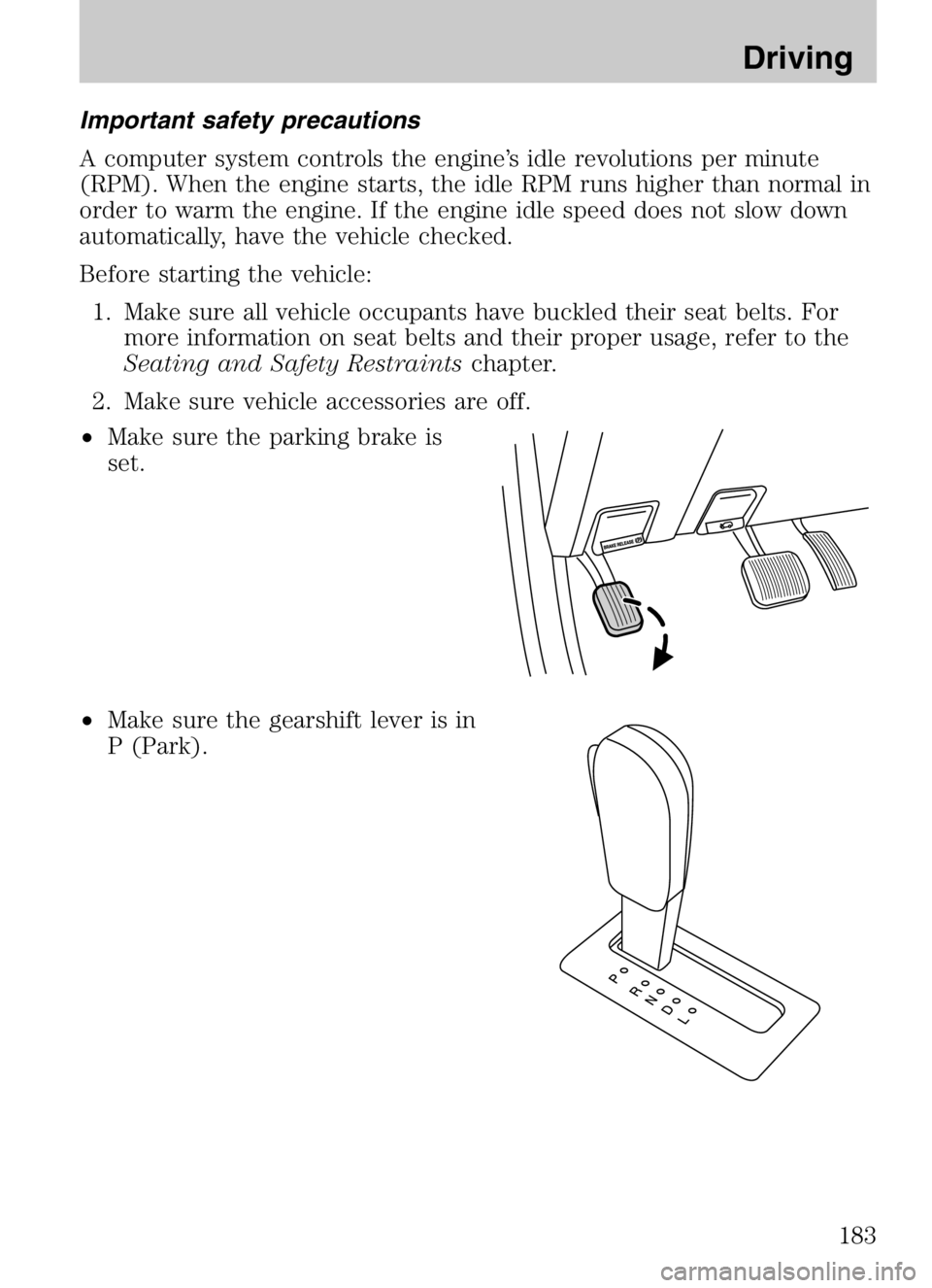
• Make sure the parking brake is
set.
• Make sure the gearshift lever is in
P (Park).
2008 Tribute Hybrid (thv)
Owners Guide (post-2002-fmt)
USA (fus)
Driving
183
Page 187 of 312

Make sure system is unplugged and properly stowed before driving the
vehicle. While not in use, make sure the protective cover seals the
prongs of the engine block heater cord plug.
BRAKES
Occasional brake noise is normal. If a metal-to-metal, continuous grinding
or continuous squeal sound is present, the brake linings may be worn-out
and should be inspected by an authorized dealer. If the vehicle has
continuous vibration or shudder in the steering wheel while braking, the
vehicle should be inspected by an authorized dealer.
Refer toBrake system warning
light in the Instrument Cluster
chapter for information on the brake
system warning light.
Under normal operating conditions, brake dust may accumulate on the
wheels. Some brake dust is inevitable as brakes wear and does not
contribute to brake noise. The use of modern friction materials with
emphasis on improved performance and environmental considerations
can lead to more dust than in the past. Brake dust can be cleaned by
weekly washing with soapy water and a soft sponge. Heavier deposits can
be removed with Mazda Wheel and Tire Cleaner (ZC-37–A).
Four-wheel anti-lock brake system (ABS)
Your vehicle is equipped with an Anti-lock Braking System (ABS). This
system helps you maintain steering control during emergency stops by
keeping the brakes from locking. The hydraulic brake system used for
regenerative braking is different from other vehicles. The noise from the
ABS pump motor and the brake pedal pulsation are much less than on
vehicles with conventional ABS. Noise and pedal pulsation during ABS
may not be noticed.
The sliding car symbol in the
instrument cluster will be
illuminated during ABS braking.
The hydraulic brake system used for regenerative braking will charge its
hydraulic system at the beginning of a trip and discharge the system at
the end of each trip. You may notice a pumping sound when you enter
the vehicle or a venting sound a few minutes after parking the vehicle.
P!
BRAKE
2008 Tribute Hybrid (thv)
Owners Guide (post-2002-fmt)
USA (fus)
Driving
187
Page 188 of 312

Using ABS
When hard braking is required, apply continuous force on the brake
pedal; do not pump the brake pedal since this will reduce the
effectiveness of the ABS and will increase your vehicle’s stopping
distance. The ABS will be activated immediately, allowing you to retain
steering control during hard braking and on slippery surfaces. However,
the ABS does not decrease stopping distance.
ABS warning lamp
The ABS lamp in the instrument
cluster momentarily illuminates
when the ignition is turned on. If
the light does not illuminate during
start up, remains on or flashes, the
ABS may be disabled and may need to be serviced.
Even when the ABS is disabled,
normal braking is still effective. (If
your BRAKE warning lamp
illuminates with the parking brake
released, have your brake system
serviced immediately by an authorized dealer.)
Regenerative Braking System (RBS)
Your vehicle uses a feature known as regenerative braking. This is used
to simulate the engine braking of an internal combustion engine and
assist the standard brake system while recovering some of the energy of
motion back into the battery to improve fuel economy. The standard
brake system is designed to fully stop the car if regenerative braking is
not available. During regenerative braking, the motor is spun as a
generator to create electrical current. This recharges the high voltage
battery and slows the vehicle. In effect, once the accelerator pedal is
released, the motor changes from an energy user to an energy producer.
When the accelerator pedal is released or the brake pedal is applied, the
brake controller automatically detects the amount of deceleration
requested and optimizes how much of the deceleration will be produced
by regenerative braking. The remaining portion is generated by standard
friction braking. When the battery is almost fully charged, the amount of
regenerative braking is limited to avoid overcharging, and the requested
deceleration is produced by standard friction braking alone.
Regenerative braking does not take the place of the standard friction
brakes; it only assists them. Regenerative braking has also been designed
ABS
P!
BRAKE
2008 Tribute Hybrid(thv)
Owners Guide (post-2002-fmt)
USA (fus)
Driving
188
Page 189 of 312
to interact with the anti-lock brake system (ABS). Regenerative braking
is disabled when the ABS is activated or the battery is fully charged.
Parking brake
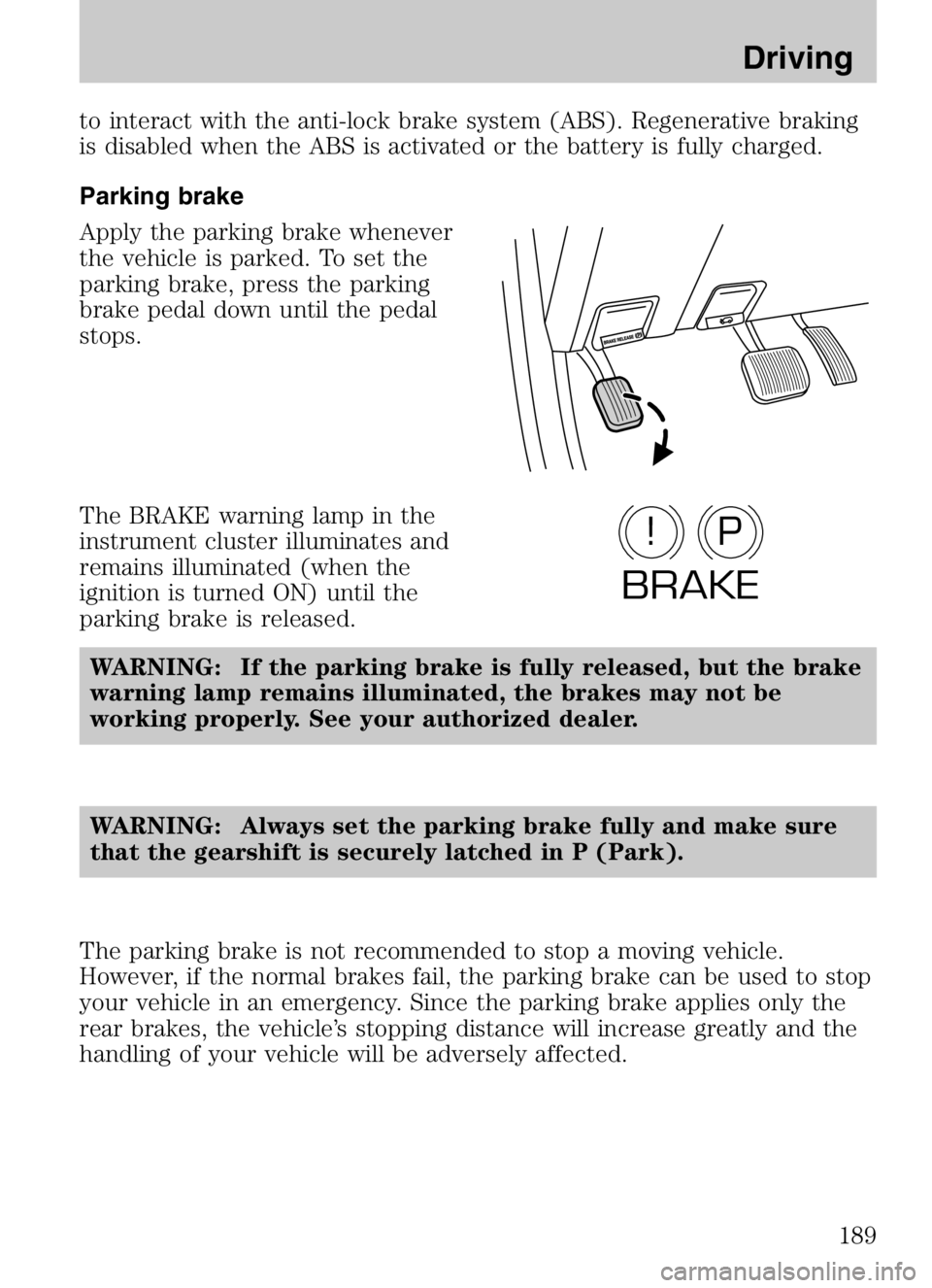
Apply the parking brake whenever
the vehicle is parked. To set the
parking brake, press the parking
brake pedal down until the pedal
stops.
The BRAKE warning lamp in the
instrument cluster illuminates and
remains illuminated (when the
ignition is turned ON) until the
parking brake is released.WARNING: If the parking brake is fully released, but the brake
warning lamp remains illuminated, the brakes may not be
working properly. See your authorized dealer.
WARNING: Always set the parking brake fully and make sure
that the gearshift is securely latched in P (Park).
The parking brake is not recommended to stop a moving vehicle.
However, if the normal brakes fail, the parking brake can be used to stop
your vehicle in an emergency. Since the parking brake applies only the
rear brakes, the vehicle’s stopping distance will increase greatly and the
handling of your vehicle will be adversely affected.
P!
BRAKE
2008 Tribute Hybrid (thv)
Owners Guide (post-2002-fmt)
USA (fus)
Driving
189
Page 190 of 312
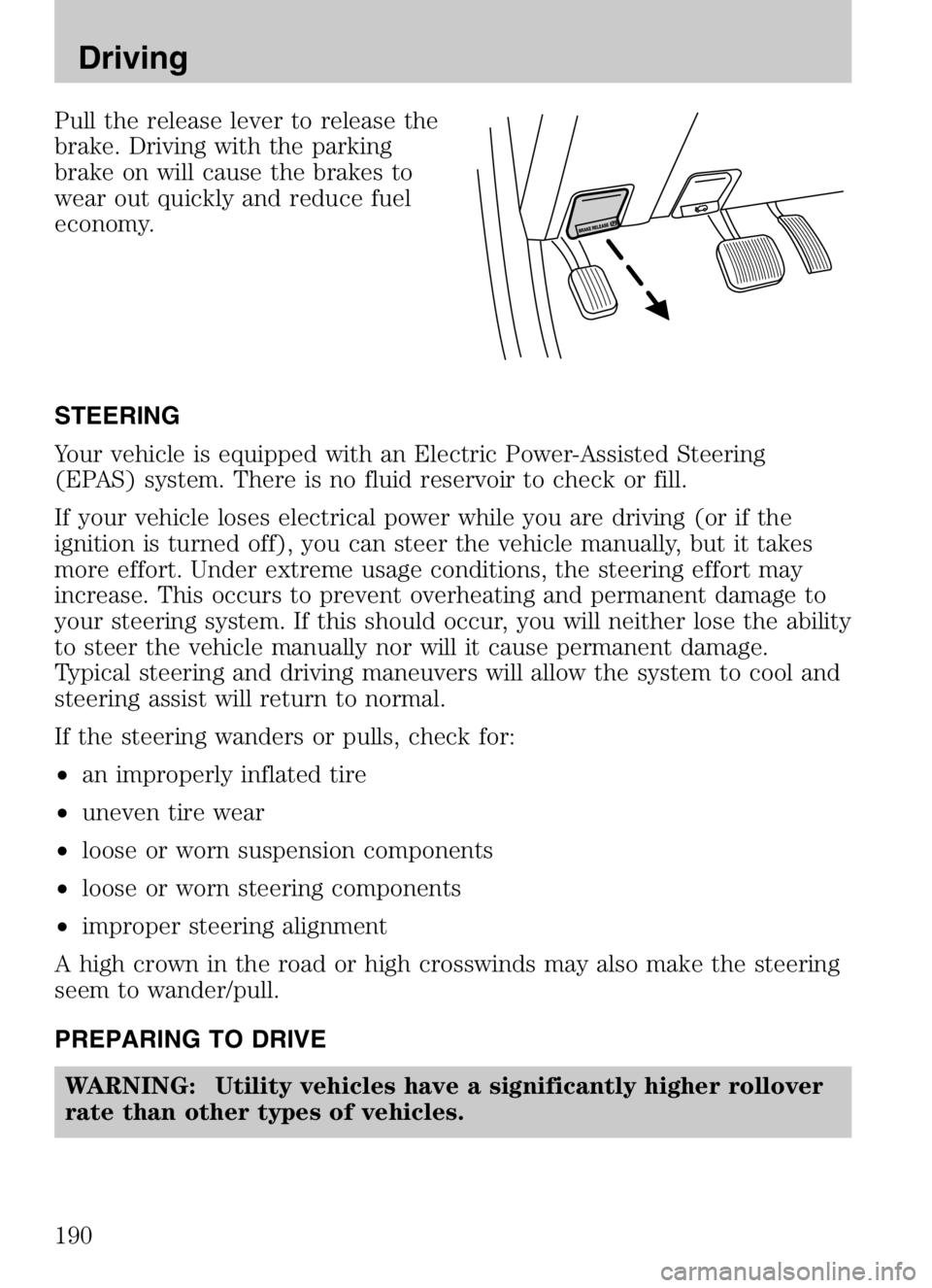
Pull the release lever to release the
brake. Driving with the parking
brake on will cause the brakes to
wear out quickly and reduce fuel
economy.
STEERING
Your vehicle is equipped with an Electric Power-Assisted Steering
(EPAS) system. There is no fluid reservoir to check or fill.
If your vehicle loses electrical power while you are driving (or if the
ignition is turned off), you can steer the vehicle manually, but it takes
more effort. Under extreme usage conditions, the steering effort may
increase. This occurs to prevent overheating and permanent damage to
your steering system. If this should occur, you will neither lose the ability
to steer the vehicle manually nor will it cause permanent damage.
Typical steering and driving maneuvers will allow the system to cool and
steering assist will return to normal.
If the steering wanders or pulls, check for:
•an improperly inflated tire
• uneven tire wear
• loose or worn suspension components
• loose or worn steering components
• improper steering alignment
A high crown in the road or high crosswinds may also make the steering
seem to wander/pull.
PREPARING TO DRIVE
WARNING: Utility vehicles have a significantly higher rollover
rate than other types of vehicles.
2008 Tribute Hybrid (thv)
Owners Guide (post-2002-fmt)
USA (fus)
Driving
190
Page 191 of 312

WARNING: In a rollover crash, an unbelted person is
significantly more likely to die than a person wearing a seat
belt.
Utility vehicles and trucks have larger tires and increased ground
clearance, giving the vehicle a higher center of gravity than a passenger
car. WARNING: Vehicles with a higher center of gravity such as
utility vehicles and trucks handle differently than vehicles with
a lower center of gravity. Utility vehicles and trucks are not
designed for cornering at speeds as high as passenger cars any
more than low-slung sports cars are designed to perform
satisfactorily under off-road conditions. Avoid sharp turns,
excessive speed or abrupt maneuvers in these vehicles. Failure
to drive cautiously could result in an increased risk of loss of
vehicle control, vehicle rollover, personal injury and death.
WARNING: Loaded vehicles, with a higher center of gravity,
may handle differently than unloaded vehicles. Do not overload
your vehicle and use extra precautions, such as driving at
slower speeds, avoiding abrupt steering changes and allowing
for increased stopping distance, when driving a heavily loaded
vehicle. Over loading or loading the vehicle improperly can
deteriorate handling capability and contribute to loss of vehicle
control and vehicle rollover.
AUTOMATIC TRANSMISSION OPERATION
Brake-shift interlock
This vehicle is equipped with a brake-shift interlock feature that prevents
the gearshift lever from being moved from P (Park) when the ignition is
in the RUN position unless brake pedal is depressed.
If you cannot move the gearshift lever out of P (Park) with ignition in
the RUN position and the brake pedal depressed, it is possible that a
fuse has blown or the vehicle’s brake lamps are not operating properly.
Refer to Fuses and relays in theRoadside Emergencies chapter.
If the fuse is not blown, perform the following procedure: 1. Apply the parking brake.
2008 Tribute Hybrid (thv)
Owners Guide (post-2002-fmt)
USA (fus)
Driving
191