weight MAZDA MX5 MIATA 2016 User Guide
[x] Cancel search | Manufacturer: MAZDA, Model Year: 2016, Model line: MX5 MIATA, Model: MAZDA MX5 MIATA 2016Pages: 526, PDF Size: 10.44 MB
Page 454 of 526

7–46
If Trouble Arises
Warning/Indicator Lights and Warning Sounds
Seat Belt Warning Beep
Except Mexico
If the driver's seat belt is not fastened
when the ignition is switched ON, a beep
sound will be heard for about 6 seconds.
If the driver or the passenger's seat belt is
not fastened and the vehicle is driven at a
speed faster than about 20 km/h (12 mph),
a beep sound will be heard again for a
specified period of time.
Until a seat belt is fastened or a given
period of time has elapsed, the beep sound
will not stop even if the vehicle speed falls
below 20 km/h (12 mph).
NOTE
To allow the passenger occupant
classification sensor to function
properly, do not place and sit on
an additional seat cushion on the
passenger's seat. The sensor may not
function properly because the additional
seat cushion could cause sensor
interference.
If a small child is seated on the
passenger's seat, the warning beep may
not operate.
Mexico
If the vehicle speed exceeds about 20 km/h
(12 mph) with the driver or passenger's
seat belt unfastened, a warning beep
sounds continuously. If the seat belt
remains unfastened, the beep sound stops
once and then continues for about 90
seconds. The beep stops after the driver or
passenger's seat belt is fastened.
Until a seat belt is fastened or a given
period of time has elapsed, the beep sound
will not stop even if the vehicle speed falls
below 20 km/h (12 mph).
NOTE
Placing heavy items on the passenger's
seat may cause the passenger's seat belt
warning function to operate depending
on the weight of the item.
To allow the passenger seat weight
sensor to function properly, do not place
and sit on an additional seat cushion
on the passenger's seat. The sensor
may not function properly because the
additional seat cushion could cause
sensor interference.
If a small child is seated on the
passenger's seat, the warning beep may
not operate.
Ignition Not Switched Off (STOP)
Warning Beep
If the driver's door is opened with the
ignition switched to ACC, a beep will
be heard continuously in the cabin to
notify the driver that the ignition has not
been switched OFF (STOP). Under this
condition, the keyless entry system will
not operate, the vehicle cannot be locked,
and the battery voltage will be depleted.
MX-5_8EU4-EA-15D_Edition3.indb 462015/10/21 16:56:03
Page 483 of 526
8–25
Customer Information and Reporting Safety Defects
Tire Information (U.S.A.)
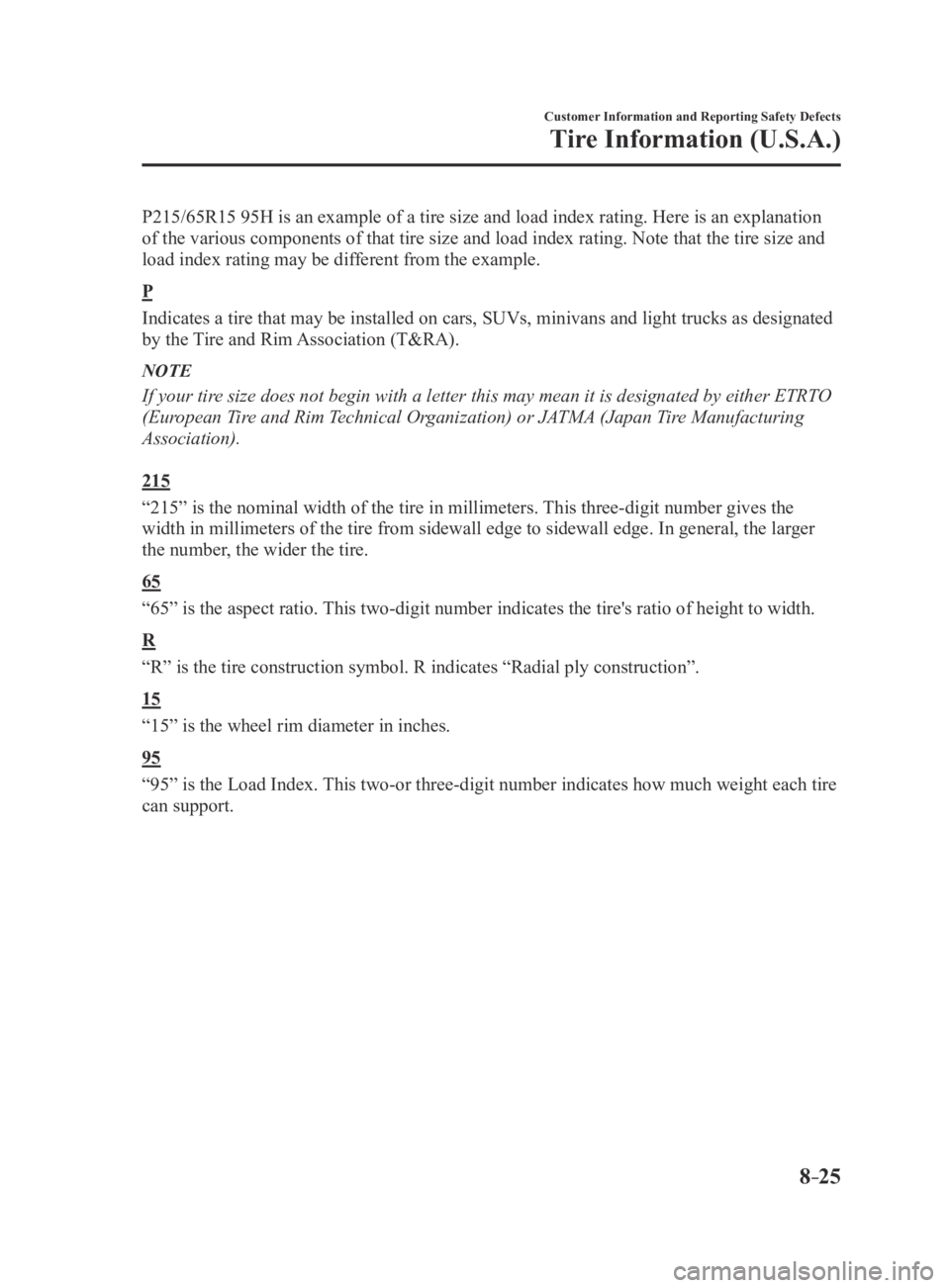
P215/65R15 95H is an example of a tire size and load index rating. Here is an explanation
of the various components of that tire size and load index rating. Note \
that the tire size and
load index rating may be different from the example.
P
Indicates a tire that may be installed on cars, SUVs, minivans and light\
trucks as designated
by the Tire and Rim Association (T&RA).
NOTE
If your tire size does not begin with a letter this may mean it is designated by ei\
ther ETRTO
(European Tire and Rim Technical Organization) or JATMA (Japan Tire Manufacturing
Association).
215
“215” is the nominal width of the tire in millimeters. This three-digit number gives the
width in millimeters of the tire from sidewall edge to sidewall edge. In\
general, the larger
the number, the wider the tire.
65
“65” is the aspect ratio. This two-digit number indicates the tire's ratio of height to width.
R
“R” is the tire construction symbol. R indicates “Radial ply construction”.
15
“15” is the wheel rim diameter in inches.
95
“95” is the Load Index. This two-or three-digit number indicates how much weight each tire
can support.
MX-5_8EU4-EA-15D_Edition3.indb 252015/10/21 16:56:09
Page 484 of 526
8–26
Customer Information and Reporting Safety Defects
Tire Information (U.S.A.)
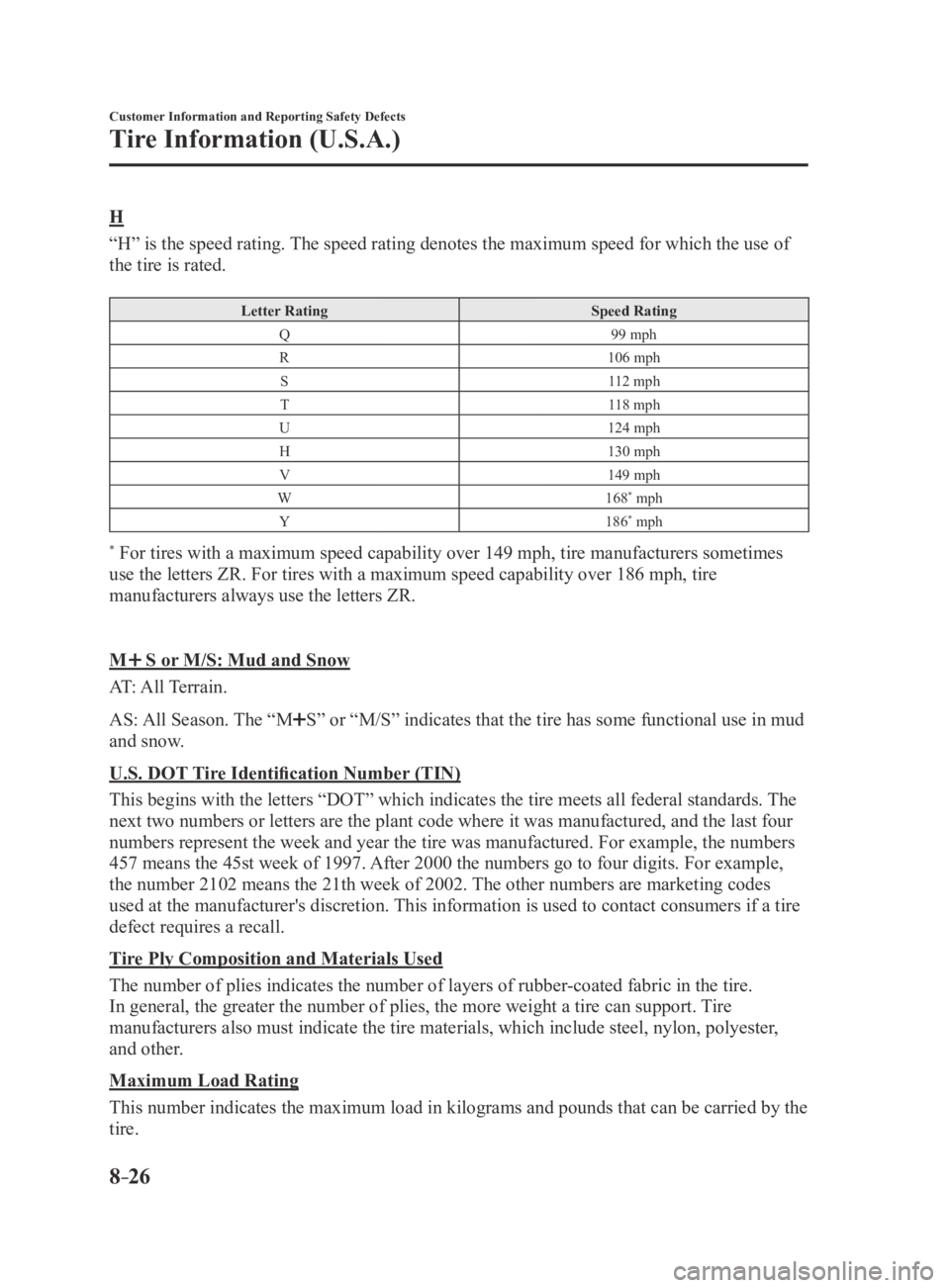
H
“H” is the speed rating. The speed rating denotes the maximum speed for which the use of
the tire is rated.
Letter RatingSpeed Rating
Q 99 mph
R 106 mph
S 112 mph
T 118 mph
U 124 mph
H 130 mph
V 149 mph
W 168
* mph
Y 186* mph
* For tires with a maximum speed capability over 149 mph, tire manufactur\
ers sometimes
use the letters ZR. For tires with a maximum speed capability over 186 mph, tire
manufacturers always use the letters ZR.
M S or M/S: Mud and Snow
AT: All Terrain.
AS: All Season. The “M
S” or “M/S” indicates that the tire has some functional use in \
mud
and snow.
U.S. DOT Tire Identification Number (TIN)
This begins with the letters “DOT” which indicates the tire meets \
all federal standards. The
next two numbers or letters are the plant code where it was manufactured\
, and the last four
numbers represent the week and year the tire was manufactured. For examp\
le, the numbers
457 means the 45st week of 1997. After 2000 the numbers go to four digits. For example,
the number 2102 means the 21th week of 2002. The other numbers are marketing codes
used at the manufacturer's discretion. This information is used to contact consumers if a tire
defect requires a recall.
Tire Ply Composition and Materials Used
The number of plies indicates the number of layers of rubber-coated fabric in the tire.
In general, the greater the number of plies, the more weight a tire can \
support. Tire
manufacturers also must indicate the tire materials, which include steel\
, nylon, polyester,
and other.
Maximum Load Rating
This number indicates the maximum load in kilograms and pounds that can \
be carried by the
tire.
MX-5_8EU4-EA-15D_Edition3.indb 262015/10/21 16:56:10
Page 487 of 526
8–29
Customer Information and Reporting Safety Defects
Tire Information (U.S.A.)
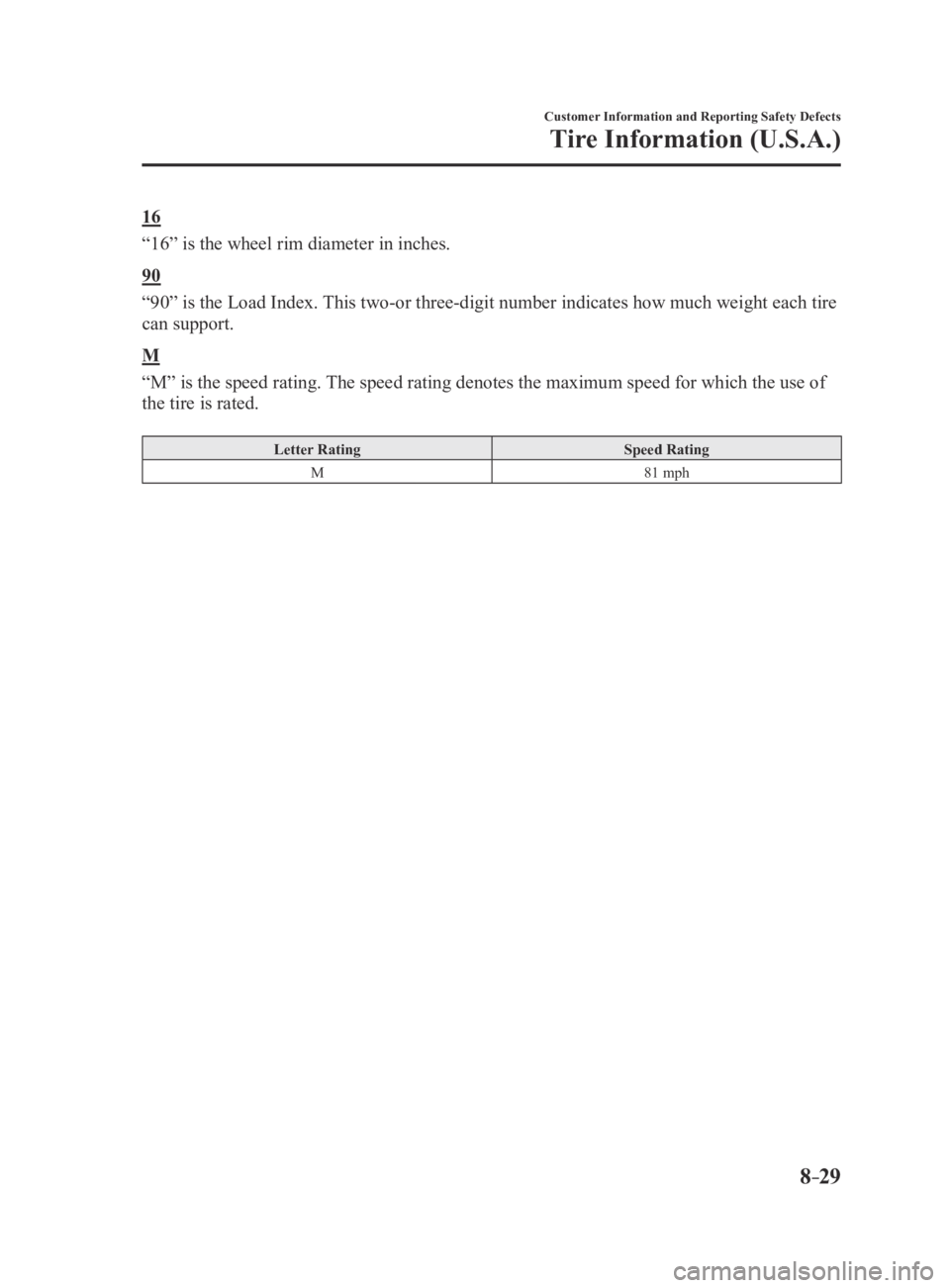
16
“16” is the wheel rim diameter in inches.
90
“90” is the Load Index. This two-or three-digit number indicates how much weight each tire
can support.
M
“M” is the speed rating. The speed rating denotes the maximum speed for which the use of
the tire is rated.
Letter RatingSpeed Rating
M 81 mph
MX-5_8EU4-EA-15D_Edition3.indb 292015/10/21 16:56:10
Page 490 of 526
8–32
Customer Information and Reporting Safety Defects
Tire Information (U.S.A.)
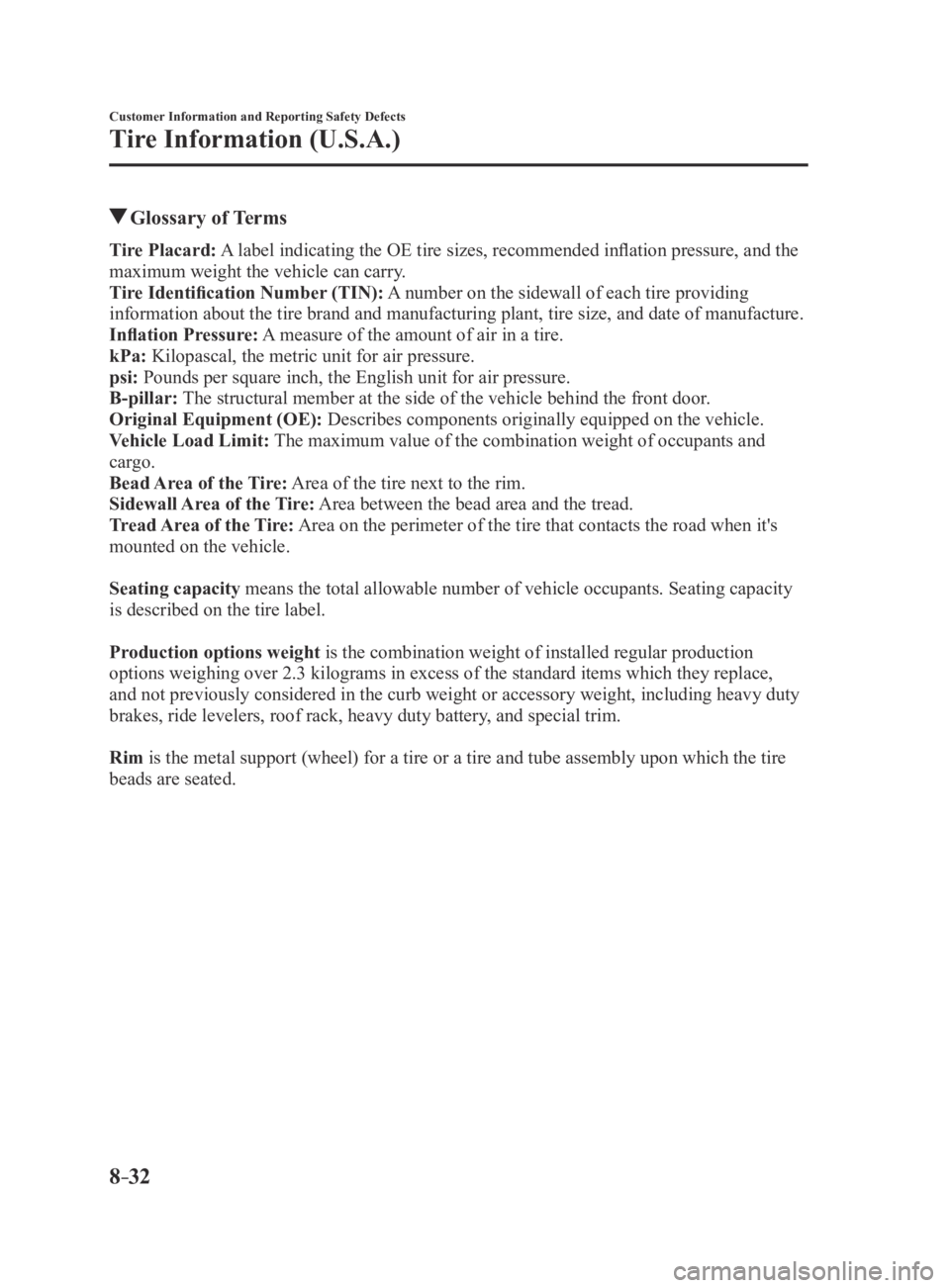
Glossary of Terms
Tire Placard: A label indicating the OE tire sizes, recommended inflation pressure, and the
maximum weight the vehicle can carry.
Tire Identification Number (TIN): A number on the sidewall of each tire providing
information about the tire brand and manufacturing plant, tire size, and\
date of manufacture.
Inflation Pressure: A measure of the amount of air in a tire.
kPa: Kilopascal, the metric unit for air pressure.
psi: Pounds per square inch, the English unit for air pressure.
B-pillar: The structural member at the side of the vehicle behind the front door.
Original Equipment (OE): Describes components originally equipped on the vehicle.
Vehicle Load Limit: The maximum value of the combination weight of occupants and
cargo.
Bead Area of the Tire: Area of the tire next to the rim.
Sidewall Area of the Tire: Area between the bead area and the tread.
Tread Area of the Tire: Area on the perimeter of the tire that contacts the road when it's
mounted on the vehicle.
Seating capacity means the total allowable number of vehicle occupants. Seating capacity\
is described on the tire label.
Production options weight is the combination weight of installed regular production
options weighing over 2.3 kilograms in excess of the standard items whic\
h they replace,
and not previously considered in the curb weight or accessory weight, in\
cluding heavy duty
brakes, ride levelers, roof rack, heavy duty battery, and special trim.
Rim is the metal support (wheel) for a tire or a tire and tube assembly u\
pon which the tire
beads are seated.
MX-5_8EU4-EA-15D_Edition3.indb 322015/10/21 16:56:11
Page 494 of 526
8–36
Customer Information and Reporting Safety Defects
Tire Information (U.S.A.)
Vehicle Loading
WARNING
Do not tow a trailer with this vehicle:
Towing a trailer with this vehicle is dangerous because it has not been designed to tow a
trailer and doing so will affect the drive system which could result in vehicle damage.
This section will guide you in the proper loading of your vehicle, to ke\
ep your loaded
vehicle weight within its design rating capability. Properly loading your vehicle will provide
maximum return of vehicle design performance. Before loading your vehicle, familiarize
yourself with the following terms for determining your vehicle's weight \
ratings, from the
vehicle's Safety Certification Label and Tire and Load Information Label:
WARNING
Overloaded Vehicle:
Overloading a vehicle is dangerous. The results of overloading can have serious
consequences in terms of passenger safety. Too much weight on a vehicle's suspension
system can cause spring or shock absorber failure, brake failure, handling or steering
problems, irregular tire wear, tire failure or other damage.
Overloading makes a vehicle harder to drive and control. It also increases the distance
required for stopping. In cases of serious overloading, brakes can fail completely,
particularly on steep grades. The load a tire will carry safely is a combination of the size of
the tire, its load range, and corresponding inflation pressure.
Never overload the vehicle and always observe the vehicle's weight ratings from the
vehicle's Safety Certification and Tire and Load Information labels.
MX-5_8EU4-EA-15D_Edition3.indb 362015/10/21 16:56:12
Page 495 of 526

Base Curb Weight is the weight of the vehicle including a full tank of fuel and all\
standard equipment. It does no")
8–37
Customer Information and Reporting Safety Defects
Tire Information (U.S.A.)
Base Curb Weight is the weight of the vehicle including a full tank of fuel and all\
standard equipment. It does not include passengers, cargo, or optional equipment.
Vehicle Curb Weight is the weight of your new vehicle when you picked it up from your
dealer plus any aftermarket equipment.
PAYLOAD
Payload is the combination weight of cargo and passengers that the vehicle is designed
to carry. The maximum payload for your vehicle can be found on the Tire and Load
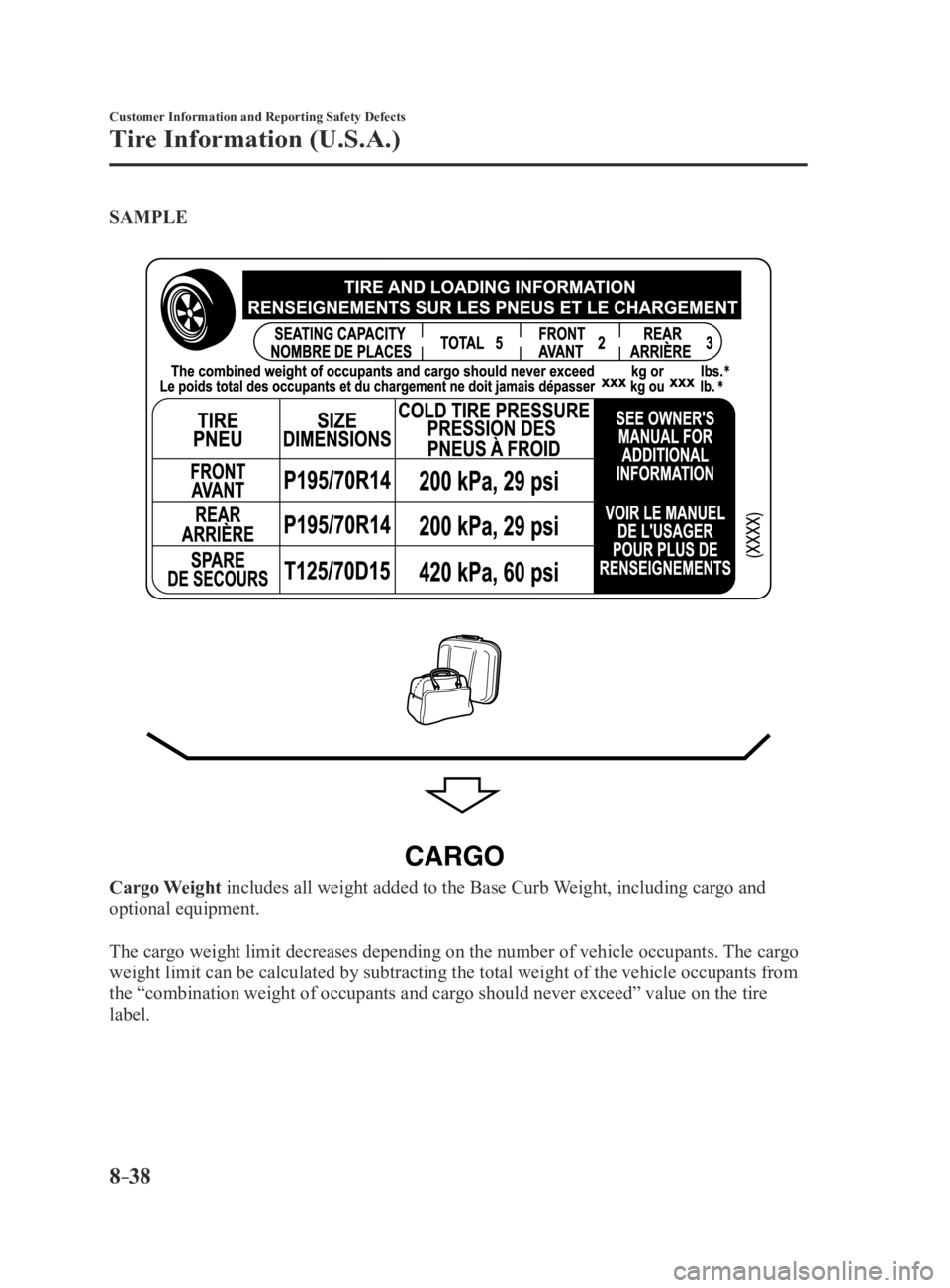
Information label on the driver's door frame or door pillar. Look for “THE COMBINATION
WEIGHT OF OCCUPANTS AND CARGO SHOULD NEVER EXCEED XXX kg or
XXX lbs” for your maximum payload. The payload listed on the tire label is the maximum
payload for the vehicle as built by the assembly plant. If any aftermark\
et or dealer installed
equipment has been installed on the vehicle, the weight of the equipment\
must be subtracted
from the payload listed on the tire label in order to be accurate.
MX-5_8EU4-EA-15D_Edition3.indb 372015/10/21 16:56:13
Page 496 of 526
8–38
Customer Information and Reporting Safety Defects
Tire Information (U.S.A.)
SAMPLE
CARGO
Cargo Weight includes all weight added to the Base Curb Weight, including cargo and
optional equipment.
The cargo weight limit decreases depending on the number of vehicle occupants. \
The cargo
weight limit can be calculated by subtracting the total weight of the ve\
hicle occupants from
the “combination weight of occupants and cargo should never exceed” value on the tire
label.
MX-5_8EU4-EA-15D_Edition3.indb 382015/10/21 16:56:13
Page 497 of 526
8–39
Customer Information and Reporting Safety Defects
Tire Information (U.S.A.)
Examples: Based on a single occupant weight of 68 kg (150 lbs), and a value of 385 kg (849
lbs) for the “combination weight of occupants and cargo should never exceed”:
The cargo weight limit with one occupant is 385 kg (849 lbs) - 68 kg (150 lb\
s) = 317 kg
(699 lbs)
The cargo weight limit with two occupants is 385 kg (849 lbs) - (68 × 2)\
kg ( (150 × 2) lbs)
= 249 kg (549 lbs)
If the weight of the occupant increases, the cargo weight limit decreases by that much.
GAW (Gross Axle Weight) is the total weight placed on each axle (front and rear) -
including vehicle curb weight and all payload.
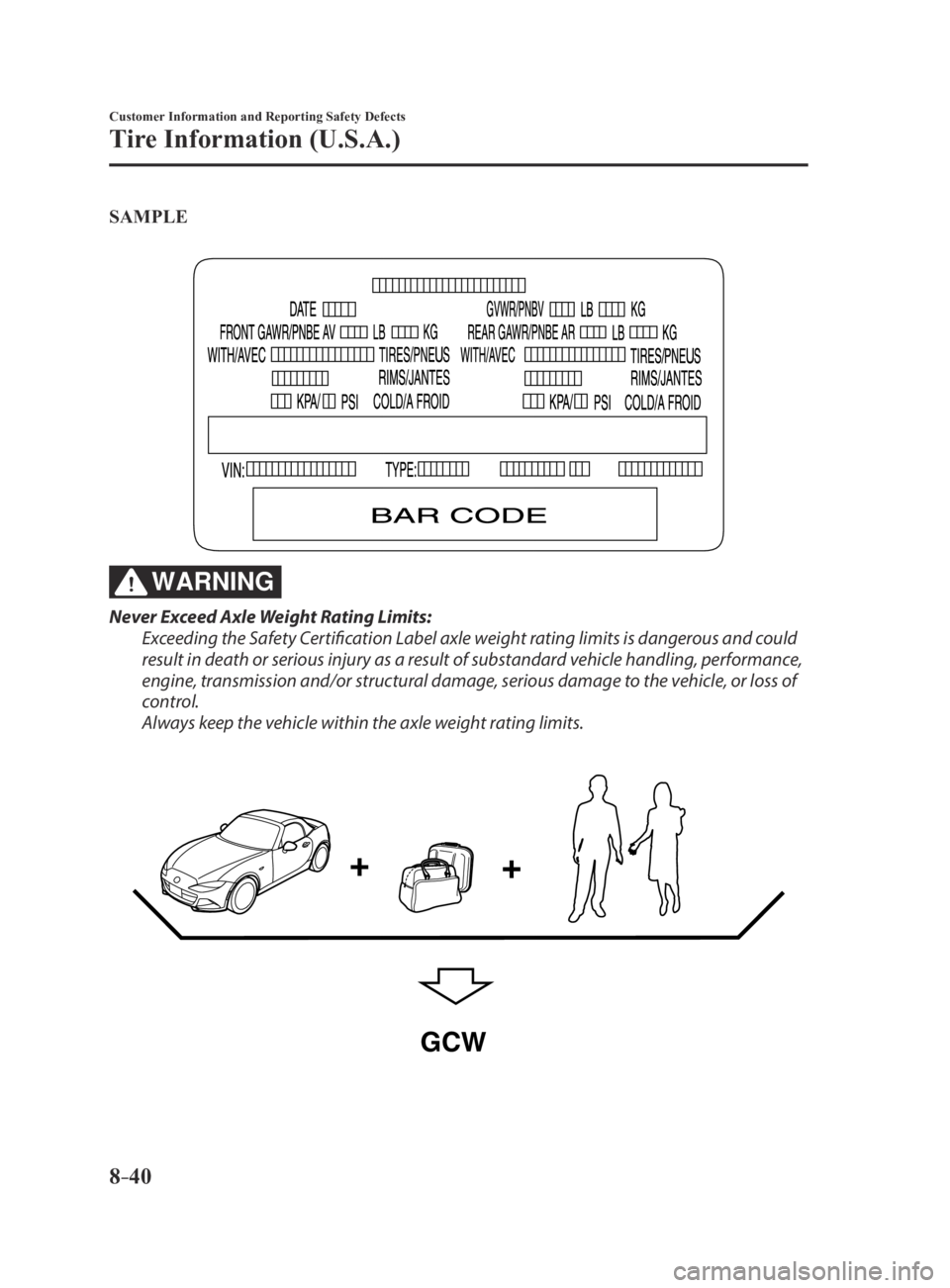
GAWR (Gross Axle Weight Rating) is the maximum allowable weight that can be carried
by a single axle (front or rear). These numbers are shown on the Safety Compliance
Certification Label located on the driver's door frame or door pillar. The total load on
each axle must never exceed its GAWR.
GVW
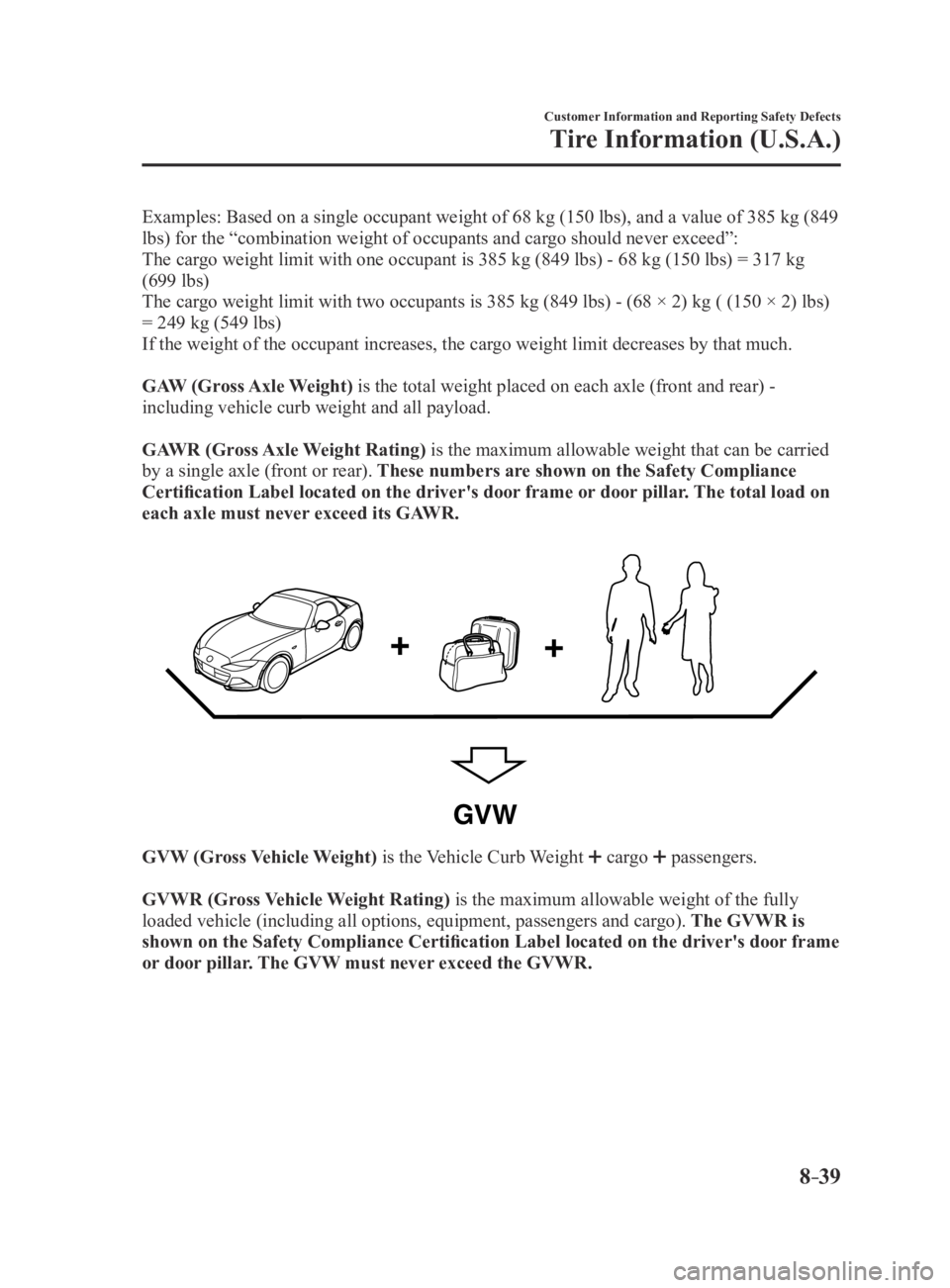
GVW (Gross Vehicle Weight) is the Vehicle Curb Weight cargo passengers.
GVWR (Gross Vehicle Weight Rating) is the maximum allowable weight of the fully
loaded vehicle (including all options, equipment, passengers and cargo). The GVWR is
shown on the Safety Compliance Certification Label located on the driver's door frame
or door pillar. The GVW must never exceed the GVWR.
MX-5_8EU4-EA-15D_Edition3.indb 392015/10/21 16:56:14
Page 498 of 526
8–40
Customer Information and Reporting Safety Defects
Tire Information (U.S.A.)
SAMPLE
WARNING
Never Exceed Axle Weight Rating Limits:
Exceeding the Safety Certification Label axle weight rating limits is dangerous and could
result in death or serious injury as a result of substandard vehicle handling, performance,
engine, transmission and/or structural damage, serious damage to the vehicle, or loss of
control.
Always keep the vehicle within the axle weight rating limits.
GCW
MX-5_8EU4-EA-15D_Edition3.indb 402015/10/21 16:56:14