air condition MAZDA MX5 MIATA 2017 Owner's Guide
[x] Cancel search | Manufacturer: MAZDA, Model Year: 2017, Model line: MX5 MIATA, Model: MAZDA MX5 MIATA 2017Pages: 568, PDF Size: 16.58 MB
Page 372 of 568

6 –10 Maintenance and Care
Scheduled Maintenance Maintenance Interval Number of months or kilometers (miles), whichever comes first.
Months 6 12 18 24 30 36 42 48 54 60 66 72
×1000 km 8 16 24 32 40 48 56 64 72 80 88 96
×1000 miles 5 10 15 20 25 30 35 40 45 50 55 60
All locks and hinges L L L L L L L L L L L L
Washer fluid level I I I I I I I I I I I I
Emergency flat tire repair kit (if installed) *7
Inspect annually.
Chart symbols:
I: Inspect: Inspect and clean, repair, adjust, fill up, or replace if necessary.
R: Replace
L: Lubricate
T: Tighten
Remarks:
*1 Engine oil flexible maintenance is available for U.S.A. and Puer to Rico residents whose vehicle is operated
mainly where none of the following conditions apply.
Extended periods of idling or low-speed operation such as polic e car, taxi or driving school car
Driving in dusty conditions
If any do apply, follow fixed maintenance.
The engine oil and filter must be changed at least once a year o r within 16,000 km (10,000 miles) since last
engine oil and filter change. Reset the engine oil data whenever replacing the engine oil regardless of the
message/wrench indicator light display.
*2 Use of FL-22 is recommended when replacing engine coolant. Usin g engine coolant other than FL-22 may
cause serious damage to the engine and cooling system.
*3 If the vehicle is operated in very dusty or sandy areas, clean and if necessary, replace the air filter more often
than the recommended intervals.
*4 According to state/provincial and federal regulations, failure to perform maintenance on these items will not
void your emissions warranties. However, Mazda recommends that all maintenance services be performed at the
recommended time or mileage/kilometer period to ensure long-term reliability.
*5 The Tire Pressure Monitoring System (TPMS) initialization must be performed so that the system operates
normally (if equipped).
*6 If this component has been submerged in water, the oil should be replaced.
*7 Check the tire repair fluid expiration date every year when perf orming the periodic maintenance. Replace the
tire repair fluid bottle with new one before the expiration date .
MX-5_8FR4-EA-16J_Edition1.indb 10 2016/08/11 20:29:38
Page 393 of 568

6 –31 Maintenance and Care
Owner Maintenance
Brake/Clutch Fluid Inspecting Brake/Clutch Fluid
Level
WARNING If the brake/clutch fluid level is low, have
the brakes inspected:
A low brake/clutch fluid level is
dangerous.
A low level could indicate brake lining
wear or a brake system leak which
could cause the brakes to fail and lead
to an accident.
The brakes and clutch draw fluid from the
same reservoir.
Inspect the fluid level in the reservoir
regularly. It should be kept between the
MAX and MIN lines.
The level normally drops with
accumulated distance, a condition
associated with wear of brake and clutch
linings. If it is excessively low, have
the brake/clutch system inspected by an
Authorized Mazda Dealer. Washer Fluid Inspecting Washer Fluid Level
WARNING Use only windshield washer fluid or
plain water in the reservoir:
Using radiator antifreeze as washer
fluid is dangerous. If sprayed on the
windshield, it will dirty the windshield,
affect your visibility, and could result in
an accident.
Using Washer Fluid Without Anti-freeze
Protection in Cold Weather:
Operating your vehicle in temperatures
below 4 degrees C (40 degrees F)
using washer fluid without anti-freeze
protection is dangerous as it could
cause impaired windshield vision and
result in an accident. In cold weather,
always use washer fluid with anti-
freeze protection.
NOTE
State or local regulations may restrict the
use of volatile organic compounds (VOCs),
which are commonly used as anti-freeze
agents in washer fluid. A washer fluid with
limited VOC content should be used only
if it provides adequate freeze resistance
for all regions and climates in which the
vehicle will be operated.
MX-5_8FR4-EA-16J_Edition1.indb 31 2016/08/11 20:29:44
Page 403 of 568

6 –41 Maintenance and Care
Owner Maintenance
TiresFor reasons of proper performance, safety,
and better fuel economy, always maintain
recommended tire inflation pressures and
stay within the recommended load limits
and weight distribution.
WARNING Using Different Tire Types:
Driving your vehicle with different
types of tires is dangerous. It could
cause poor handling and poor braking;
leading to loss of control.
Except for the limited use of the
temporary spare tire, use only the
same type tires (radial, bias-belted,
bias-type) on all four wheels.
Using Wrong-Sized Tires:
Using any other tire size than what is
specified for the vehicle (page 9-8 )
is dangerous. It could seriously affect
ride, handling, ground clearance,
tire clearance, and speedometer
calibration. This could cause you to
have an accident. Use only tires that
are the correct size specified for the
vehicle. Tire Inflation Pressure
WARNING Always inflate the tires to the correct
pressure:
Overinflation or underinflation of tires
is dangerous. Adverse handling or
unexpected tire failure could result in a
serious accident.
Refer to Tires on page 9-8 .
Use only a Mazda-genuine tire valve
cap:
Use of a non-genuine part is
dangerous as the correct tire air
pressure cannot be maintained if the
tire valve becomes damaged. If the
vehicle is driven under this condition,
the tire air pressure will decrease which
could result in a serious accident. Do
not use any part for the tire valve cap
that is not a Mazda-genuine part.
Inspect all tire pressures monthly when
the tires are cold. Maintain recommended
pressures for the best ride, handling, and
minimum tire wear.
Refer to the specification charts (page
9-8 ).
(With tire pressure monitoring system)
After adjusting the tire pressure,
initialization of the tire pressure
monitoring system is necessary to make
the system operate normally.
Refer to Tire Pressure Monitoring System
Initialization on page 4-108 .
NOTE
Always check tire pressure when tires
are cold.
Warm tires normally exceed
recommended pressures. Do not release
air from warm tires to adjust the
pressure.
MX-5_8FR4-EA-16J_Edition1.indb 41 2016/08/11 20:29:46
Page 419 of 568

6 –57 Maintenance and Care
Owner Maintenance
*Some models.DESCRIPTION FUSE
RATING PROTECTED COMPONENT
18 A/C MAG 7.5 A Air conditioner
19 AT PUMP
H/L HI 20 A Transmission control system *
20 AT 15 A Transmission control system *
21 D LOCK 25 A Power door locks
22 H/L RH 20 A Headlight (RH)
23
ENG
B2 7.5 A Engine control system
24 TAIL 20 A Taillights, License plate lights, Parking lights
25 DRL 15 A —
26 ROOM 25 A Overhead light
27 FOG 15 A —
28 H/CLEAN 20 A —
29 STOP 10 A Brake lights
30 HORN 15 A Horn
31 H/L LH 20 A Headlight (LH)
32 ABS/DSC S 30 A ABS, Dynamic stability control system
33 HAZARD 15 A Hazard warning flashers, Turn signal lights
34 FUEL PUMP 15 A Fuel system
35
ENG B3 5 A —
36 WIPER 20 A Windshield wipers
37
CABIN
B 50 A For protection of various circuits
38 — — —
39 — — —
40 ABS/DSC M 50 A ABS, Dynamic stability control system
41 EVVT
A/R PUMP 20 A Engine control system
42 EVPS 30 A Brake control system
43 FAN1 30 A Cooling fan
44 FAN2 40 A —
45 ENG.MAIN 40 A Engine control system
46 EPS 60 A Power steering system
47 DEFOG 30 A Rear window defogger
48 IG2 30 A For protection of various circuits
49 INJECTOR 30 A Engine control system
50 HEATER 40 A Air conditioner
51 — — —
52 — — —
MX-5_8FR4-EA-16J_Edition1.indb 57 2016/08/11 20:29:50
Page 441 of 568
7 –7 If Trouble Arises
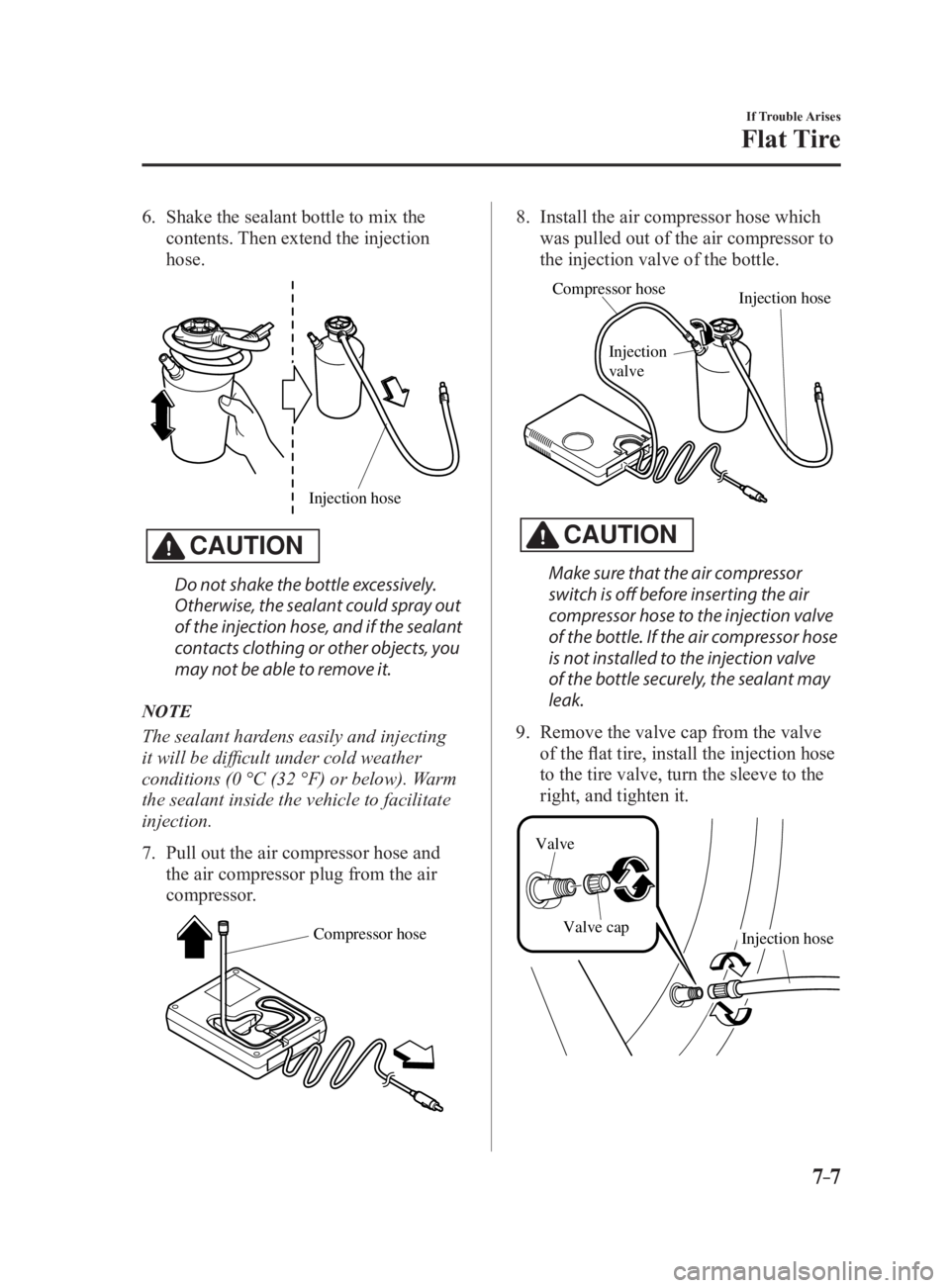
Flat Tire6. Shake the sealant bottle to mix the
contents. Then extend the injection
hose.
Injection hose
CAUTION Do not shake the bottle excessively.
Otherwise, the sealant could spray out
of the injection hose, and if the sealant
contacts clothing or other objects, you
may not be able to remove it.
NOTE
The sealant hardens easily and injecting
it will be difficult under cold weather
conditions (0 °C (32 °F) or below). Warm
the sealant inside the vehicle to facilitate
injection.
7. Pull out the air compressor hose and
the air compressor plug from the air
compressor. Compressor hose 8. Install the air compressor hose which
was pulled out of the air compressor to
the injection valve of the bottle. Compressor hose
Injection hose
Injection
valve
CAUTION Make sure that the air compressor
switch is off before inserting the air
compressor hose to the injection valve
of the bottle. If the air compressor hose
is not installed to the injection valve
of the bottle securely, the sealant may
leak.
9. Remove the valve cap from the valve
of the flat tire, install the injection hose
to the tire valve, turn the sleeve to the
right, and tighten it.
Valve capValve
Injection hose
MX-5_8FR4-EA-16J_Edition1.indb 7 2016/08/11 20:29:56
Page 445 of 568

7 –11 If Trouble Arises
Flat TireNOTE
If an emergency flat tire repair has been
performed using the emergency flat tire
repair kit, Mazda recommends that the
tire be replaced with a new one as soon
as possible. If the tire is to be repaired
or reused, consult an Authorized Mazda
Dealer.
The wheel can be reused if the sealant
adhering to it is removed. However,
replace the valve with a new one.
Mexico
1. Move the vehicle off the right-of-way
to a safe place on a level and hard
surface where the vehicle does not
obstruct traffic.
2. Shift the shift lever to the 1 or Reverse
(R) position for a manual transmission,
and shift the selector lever to the P
position for an automatic transmission.
3. Apply the parking brake with the brake
pedal depressed and turn off the engine.
4. If necessary, flash the hazard warning
lights and set up the roadside
emergency triangle.
5. Unload passengers and cargo and
remove the emergency flat tire repair
kit. 6. Shake the tire sealant well.
CAUTION If the bottle is shaken after the
injection hose is screwed on, tire
sealant could spray out from the
injection hose. Tire sealant contacting
clothing or other objects may be
impossible to remove. Shake the bottle
before screwing on the injection hose.
NOTE
The sealant hardens easily and injecting
it will be difficult under cold weather
conditions (0 °C (32 °F) or below). Warm
the sealant inside the vehicle to facilitate
injection.
7. Remove the cap from the bottle. Screw
on the injection hose with the bottle's
inner cap left on to break the inner cap. Cap
Injection hose
Tire sealant
MX-5_8FR4-EA-16J_Edition1.indb 11 2016/08/11 20:29:57
Page 461 of 568

7 –27 If Trouble Arises
Overheating
OverheatingIf the high engine coolant temperature
warning light turns on, the vehicle loses
power, or you hear a loud knocking or
pinging noise, the engine is probably too
hot.
WARNING Pull over to a safe location, then
switch the ignition off and make sure
the fan is not running before attempting
to work near the cooling fan:
Working near the cooling fan when it
is running is dangerous. The fan could
continue running indefinitely even if
the engine has stopped and the engine
compartment temperature is high. You
could be hit by the fan and seriously
injured.
Do not remove either cooling
system cap when the engine and
radiator are hot:
When the engine and radiator are hot,
scalding coolant and steam may shoot
out under pressure and cause serious
injury.
Open the hood ONLY after steam is no
longer escaping from the engine:
Steam from an overheated engine is
dangerous. The escaping steam could
seriously burn you. If the high engine coolant temperature
warning light turns on:
1. Drive safely to the side of the road and
park off the right-of-way.
2. Put a vehicle with an automatic
transmission in park (P), a manual
transmission in neutral.
3. Apply the parking brake.
4. Turn off the air conditioner.
5. Check whether coolant or steam is
escaping from the engine compartment.
If steam is coming from the engine
compartment:
Do not go near the front of the vehicle.
Stop the engine.
Wait until the steam dissipates, then
open the hood and start the engine.
If neither coolant nor steam is
escaping:
Open the hood and idle the engine until
it cools.
CAUTION If the cooling fan does not operate
while the engine is running, the engine
temperature will increase. Stop the
engine and call an Authorized Mazda
Dealer.
6. Make sure the cooling fan is operating,
then turn off the engine after the
temperature has decreased.
7. When cool, check the coolant level.
If it is low, look for coolant leaks from
the radiator and hoses.
MX-5_8FR4-EA-16J_Edition1.indb 27 2016/08/11 20:30:01
Page 471 of 568

7 –37 If Trouble Arises
Warning/Indicator Lights and Warning Sounds
*Some models.Signal Warning
Automatic
Transmission
Indication/Warning
Light *
The indication/light illuminates when the transmission has a problem.
CAUTION If the automatic transmission warning indication/light illuminates, the transmission
has an electrical problem. Continuing to drive your Mazda in this condition could cause
damage to your transmission. Consult an Authorized Mazda Dealer as soon as possible.
(Illuminate)
TCS/DSC Indicator
Light If the light stays on, the TCS, DSC or the brake assist system may have a malfunction and
they may not operate correctly. Take your vehicle to an Authorized Mazda Dealer.
Air Bag/Seat Belt
Pretensioner System
Warning Light A system malfunction is indicated if the warning light constantly flashes, constantly
illuminates or does not illuminate at all when the ignition is switched ON. If any of these
occur, consult an Authorized Mazda Dealer as soon as possible. The system may not operate
in an accident.
WARNING Never tamper with the air bag/pretensioner systems and always have an Authorized
Mazda Dealer perform all servicing and repairs:
Self-servicing or tampering with the systems is dangerous. An air bag/pretensioner
could accidentally activate or become disabled causing serious injury or death.
(Flashing)
Tire Pressure
Monitoring System
Warning Light *
If the tire pressure monitoring system has a malfunction, the tire pressure warning light
flashes. Have your vehicle checked by an Authorized Mazda Dealer as soon as possible.
WARNING If the tire pressure monitoring system warning light illuminates or flashes, or the tire
pressure warning beep sound is heard, decrease vehicle speed immediately and avoid
sudden maneuvering and braking:
If the tire pressure monitoring system warning light illuminates or flashes, or the tire
pressure warning beep sound is heard, it is dangerous to drive the vehicle at high
speeds, or perform sudden maneuvering or braking. Vehicle drivability could worsen
and result in an accident.
To determine if you have a slow leak or a flat, pull over to a safe position where you can
check the visual condition of the tire and determine if you have enough air to proceed
to a place where air may be added and the system monitored again by an Authorized
Mazda Dealer or a tire repair station.
Do not ignore the TPMS Warning Light:
Ignoring the TPMS warning light is dangerous, even if you know why it is illuminated.
Have the problem taken care of as soon as possible before it develops into a more
serious situation that could lead to tire failure and a dangerous accident.
MX-5_8FR4-EA-16J_Edition1.indb 37 2016/08/11 20:30:03
Page 477 of 568

7 –43 If Trouble Arises
Warning/Indicator Lights and Warning Sounds
*Some models.Signal Warning Action to be taken
(Illuminate)
Tire Pressure Monitoring
System Warning Light *
When the warning light illuminates, and
the warning beep sound is heard (about 3
seconds), tire pressure is too low in one or
more tires.
WARNING If the tire pressure monitoring system
warning light illuminates or flashes,
or the tire pressure warning beep
sound is heard, decrease vehicle
speed immediately and avoid sudden
maneuvering and braking:
If the tire pressure monitoring system
warning light illuminates or flashes,
or the tire pressure warning beep
sound is heard, it is dangerous to
drive the vehicle at high speeds, or
perform sudden maneuvering or
braking. Vehicle drivability could
worsen and result in an accident.
To determine if you have a slow leak
or a flat, pull over to a safe position
where you can check the visual
condition of the tire and determine
if you have enough air to proceed to
a place where air may be added and
the system monitored again by an
Authorized Mazda Dealer or a tire
repair station.
Do not ignore the TPMS Warning Light:
Ignoring the TPMS warning light is
dangerous, even if you know why
it is illuminated. Have the problem
taken care of as soon as possible
before it develops into a more serious
situation that could lead to tire
failure and a dangerous accident. Inspect the tires and adjust to the specified
inflation pressure (page 6-41 ).
NOTE
Perform tire pressure adjustment when
the tires are cold. Tire pressure will
vary according to the tire temperature,
therefore let the vehicle stand for 1
hour or only drive it 1.6 km (1 mile) or
less before adjusting the tire pressures.
When pressure is adjusted on hot tires
to the cold inflation pressure, the TPMS
warning light/beep may turn on after
the tires cool and pressure drops below
specification.
Also, an illuminated TPMS warning
light, resulting from the tire air
pressure dropping due to cold ambient
temperature will remain illuminated
even if the ambient temperature rises.
In this case, it will also be necessary to
adjust the tire air pressures. If the TPMS
warning light illuminates due to a drop
in tire air pressure, make sure to check
and adjust the tire air pressures.
Tires lose air naturally over time and
the TPMS cannot tell if the tires are
getting too soft over time or you have
a flat. However, when you find one low
tire in a set of four-that is an indication
of trouble; you should have someone
drive the vehicle slowly forward so you
can inspect any low tire for cuts and any
metal objects sticking through tread or
sidewall. Put a few drops of water in the
valve stem to see if it bubbles indicating
a bad valve. Leaks need to be addressed
by more than simply reinflating the tire
as leaks are dangerous — take it to an
Authorized Mazda Dealer.
MX-5_8FR4-EA-16J_Edition1.indb 43 2016/08/11 20:30:05
Page 502 of 568
8 –2 Customer Information and Reporting Safety Defects
Customer Assistance
Customer Assistance (U.S.A.)Your complete and permanent satisfaction is our business. We are here to serve you. All
Authorized Mazda Dealers have the knowledge and the tools to keep your Mazda vehicle in
top condition.
If you have any questions or recommendations for improvement re garding the service of
your Mazda vehicle or servicing by Mazda Dealer personnel, we recommend that you take
the following steps:
NOTE
If it becomes necessary to have the components or wiring system for the supplementary
restraint system modified to accommodate a person with certain medical conditions in
accordance with a certified physician, contact an Authorized Mazda Dealer. For more
information, go to NHTSA website www.safercar.gov (VEHICLE SHOPPERS > Air Bags >
Air Bag FAQs > Air Bag Deactivation).
STEP 1: Contact Your Mazda DealerDiscuss the matter with an Authorized Mazda Dealer. This is the quickest and best way to
address the issue.
If your concern has not been resolved by the CUSTOMER RELATIONS, SALES,
SERVICE, or PARTS MANAGER, then please contact the GENERAL MANAGER of
the dealership or the OWNER.
If it becomes necessary to have the components or wiring system for the supplementary
restraint system modified to accommodate a person with certain m edical conditions in
accordance with a certified physician, go to STEP 2.
STEP 2: Contact Mazda North American OperationsIf for any reason you feel the need for further assistance after contacting your dealership
management or it becomes necessary to have the components or wiring system for the
supplementary restraint system modified to accommodate a person with certain medical
conditions in accordance with a certified physician, you can rea ch Mazda North American
Operations by one of the following ways.
Log on: at www.MazdaUSA.com
Answers to many questions, including how to locate or contact a local Mazda dealership in
the U.S., can be found here.
E-mail: click on “Contact Us” located on the “Inside Mazda” tab , or at the bottom of the
page at www.MazdaUSA.com
By phone at: 1 (800) 222-5500
MX-5_8FR4-EA-16J_Edition1.indb 2 2016/08/11 20:30:11