light MERCEDES-BENZ A CLASS 2012 Owners Manual
[x] Cancel search | Manufacturer: MERCEDES-BENZ, Model Year: 2012, Model line: A CLASS, Model: MERCEDES-BENZ A CLASS 2012Pages: 356, PDF Size: 4.96 MB
Page 298 of 356
X
Wipe the wooden trim and trim elements
with a damp, lint-free cloth, e.g. a microfi-
bre cloth.
X Heavy soiling: use car care and cleaning
products recommended and approved by
Mercedes-Benz.
Cleaning the seat covers General notes
!
Do
not use microfibre cloths to clean gen-
uine leather, artificial leather or
Alcantara® covers. If used often, these can
damage the cover.
i Note that regular care is essential to
make sure that the appearance and com-
fort of the covers are retained over time.
Genuine leather seat covers
Leather is a natural product.
It exhibits natural surface characteristics, for
example:
R Differences in the texture
R Signs of stretching and marking
R Slight nuances of colour
These are characteristics of leather and not
material defects.
! To retain the natural appearance of the
leather, observe the following cleaning
instructions:
R Clean genuine leather covers carefully
with a damp cloth and then wipe the cov-
ers down with a dry cloth.
R Make sure that the leather does not
become soaked. It may otherwise
become rough and cracked.
R Only use leather care agents that have
been tested and approved by Mercedes-
Benz. You can obtain these from a quali-
fied specialist workshop. Seat covers of other materials
!
Observe the following when cleaning:
R Clean
artificial leather covers with a cloth
moistened with a solution containing
1% detergent (e.g. washing-up liquid).
R Clean cloth covers with a microfibre
cloth moistened with a solution contain-
ing 1% detergent (e.g. washing-up liquid).
Rub carefully, and always wipe entire
seat sections to avoid leaving visible
lines. Leave the seat to dry afterwards.
Cleaning results depend on the type of
dirt and how long it has been there.
R Clean Alcantara® covers with a damp
cloth. Make sure that you wipe entire
seat sections to avoid leaving visible
lines.
Cleaning the seat belts G
WARNING
Seat belts may be severely weakened if
bleached or coloured. This may lead to the
seat
belts, for example, tearing or failing in an
accident. There is an increased risk of injury,
possibly even fatal.
Never bleach or colour seat belts.
! Do not clean the seat belts using chemical
cleaning agents. Do not dry the seat belts
at temperatures above 80 † or in direct
sunlight.
X Use clean, lukewarm water and soap solu-
tion.
Cleaning the roof lining and carpets X
Roof lining: if it is very dirty, use a soft
brush or a cleaning agent recommended
and approved by Mercedes-Benz.
X Carpets: use the carpet and textile clean-
ing
agents recommended and approved by
Mercedes-Benz. 296
Care
Maintenance and care
Page 304 of 356
Using the TIREFIT kit
TIREFIT is a tyre sealant.
You can use TIREFIT to seal punctures of up
to 4 mm, particularly those in the tyre tread.
You
can use TIREFIT at outside temperatures
down to Ò20 †. TIREFIT sticker, 2-part
X
Do not remove any foreign objects which
have penetrated the tyre, e.g. screws or
nails.
X Remove the tyre sealant bottle, the accom-
panying TIREFIT sticker and the tyre infla-
tion compressor from the stowage well
underneath
the luggage compartment floor
(Y page 299).
X Affix part : of the TIREFIT sticker within
the driver's field of vision.
X Affix part ;
of the TIREFIT sticker near the
valve on the wheel with the defective tyre. X
Remove filler hose B
and plug = from the
bottom section of the tyre inflation com-
pressor housing.
X Slide the yellow filler hose connector into
the
mounting on yellow cap A of tyre seal-
ant bottle : until the plug engages.
X With the sealing rings in front, slide yellow
cap A of tyre sealant bottle : into the
mounting of tyre inflation compressor ;
until the cap and both hooks engage. X
Remove the cap from valve C
on the faulty
tyre.
X Screw filler hose D onto valve.
X Insert plug = into the socket of the ciga-
rette lighter (Y page 278) or into a 12 V
power
socket in your vehicle (Y page 278).
X Turn the key to position 1 in the ignition
lock (Y page 143).
X Press on/off switch ?
on the tyre inflation
compressor to ON.
The tyre inflation compressor is switched
on. The tyre is inflated.
i First,
tyre sealant is pumped into the tyre.
The pressure can briefly rise to approx-
imately 500 kPa (5 bar/73 psi).
Do not switch off the tyre inflation com-
pressor during this phase.
X Let the tyre inflation compressor run for a
maximum of ten minutes. The tyre should
then have attained a pressure of at least
200 kPa (2.0 bar/29 psi).
! Do not operate the tyre inflation com-
pressor for longer than ten minutes at a 302
Flat tyre
Breakdown assistance
Page 309 of 356
G
WARNING
A discharged battery can freeze at tempera-
tures below freezing point. When jump-start-
ing
the vehicle or charging the battery, gases
can escape from the battery. There is a risk of
an explosion.
Allow the frozen battery to thaw out before
charging it or jump-starting.
! Only use battery chargers with a maxi-
mum charging voltage of 14.8 V.
! Only charge the battery using the jump-
start connection point.
The jump-starting connection point is in the
engine compartment (Y page 308).
X Open the bonnet (Y page 285).
X Connect the battery charger to the positive
terminal
and earth point in the same order
as when connecting the donor battery in
the jump-starting procedure
(Y page 308).
If the indicator/warning lamps do not light up
at low temperatures, it is very likely that the
discharged battery has frozen. In this case
you may neither jump-start the vehicle nor
charge the battery. The service life of a bat-
tery
that has been thawed could be reduced.
The starting characteristics may be impaired,
especially at low temperatures. Have the
thawed battery checked at a qualified spe-
cialist workshop.
Only charge the installed battery with a bat-
tery charger which has been tested and
approved by Mercedes-Benz. A battery
charger unit specially adapted for Mercedes-
Benz vehicles and tested and approved by
Mercedes-Benz is available as an accessory.
It permits the charging of the battery in its
installed position. Contact a Mercedes-Benz
Service Centre for information and availabil-
ity. Read the battery charger's operating
instructions before charging the battery. Battery (vehicle)
307
Breakdown assistance Z
Page 310 of 356
Jump-starting
For the jump-starting procedure, use only the jump-starting connection point, consisting of a
positive terminal and an earth point, in the engine compartment. G
WARNING
Battery acid is caustic. There is a risk of injury.
Avoid contact with the skin, eyes or clothing. Do not inhale any battery gases. Do not lean over
the battery. Keep children away from batteries. Wash battery acid immediately with water and
seek medical attention. G
WARNING
During charging and jump-starting, explosive gases can escape from the battery. There is a risk
of an explosion.
Particularly avoid fire, naked flames, creating sparks and smoking. Ensure there is sufficient
ventilation while charging and jump-starting. Do not lean over a battery. G
WARNING
During the charging process, a battery produces hydrogen gas. If a short circuit occurs or sparks
are created, the hydrogen gas can ignite. There is a risk of an explosion.
R Make sure that the positive terminal of a connected battery does not come into contact with
vehicle parts.
R Never place metal objects or tools on a battery.
R It
is important that you observe the described order of the battery terminals when connecting
and disconnecting a battery.
R When jump-starting, make sure that the battery poles with identical polarity are connected.
R It is particularly important to observe the described order when connecting and disconnecting
the jump leads.
R Never connect or disconnect the battery terminals while the engine is running. G
WARNING
A discharged battery can freeze at temperatures below freezing point. When jump-starting the
vehicle
or charging the battery, gases can escape from the battery. There is a risk of an explosion.
Allow the frozen battery to thaw out before charging it or jump-starting. G
WARNING
Non-combusted fuel can collect in the exhaust system and ignite. There is a risk of fire. Avoid
repeated and lengthy starting attempts.
! Vehicles
with a petrol engine: avoid repeated and lengthy starting attempts. Otherwise,
the non-combusted fuel may damage the catalytic converter.
If the indicator/warning lamps do not light up at low temperatures, it is very likely that the
discharged battery has frozen. In this case you may neither jump-start the vehicle nor charge
the battery. The service life of a battery that has been thawed could be reduced. The starting 308
Jump-starting
Breakdown assistance
Page 324 of 356
G
WARNING
If you fit unsuitable accessories onto tyre
valves, the tyre valves may be overloaded and
malfunction, which can cause tyre pressure
loss. Due to their design, retrofitted tyre pres-
sure monitors keep the tyre valve open. This
can also result in tyre pressure loss. There is
a risk of accident.
Only screw standard valve caps or valve caps
specifically provided by Mercedes-Benz for
your vehicle onto the tyre valve. G
WARNING
If the tyre pressure drops repeatedly, the
wheel, valve or tyre may be damaged. Tyre
pressure that is too low may result in a tyre
blow-out. There is a risk of accident.
R Check the tyre for foreign objects.
R Check
whether the wheel is losing air or the
valve is leaking.
If you are unable to rectify the damage, con-
tact a qualified specialist workshop. H
Environmental note
Check the tyre pressure regularly, at least
every 14 days
.
You will find a table of tyre pressures for var-
ious operating conditions on the inside of
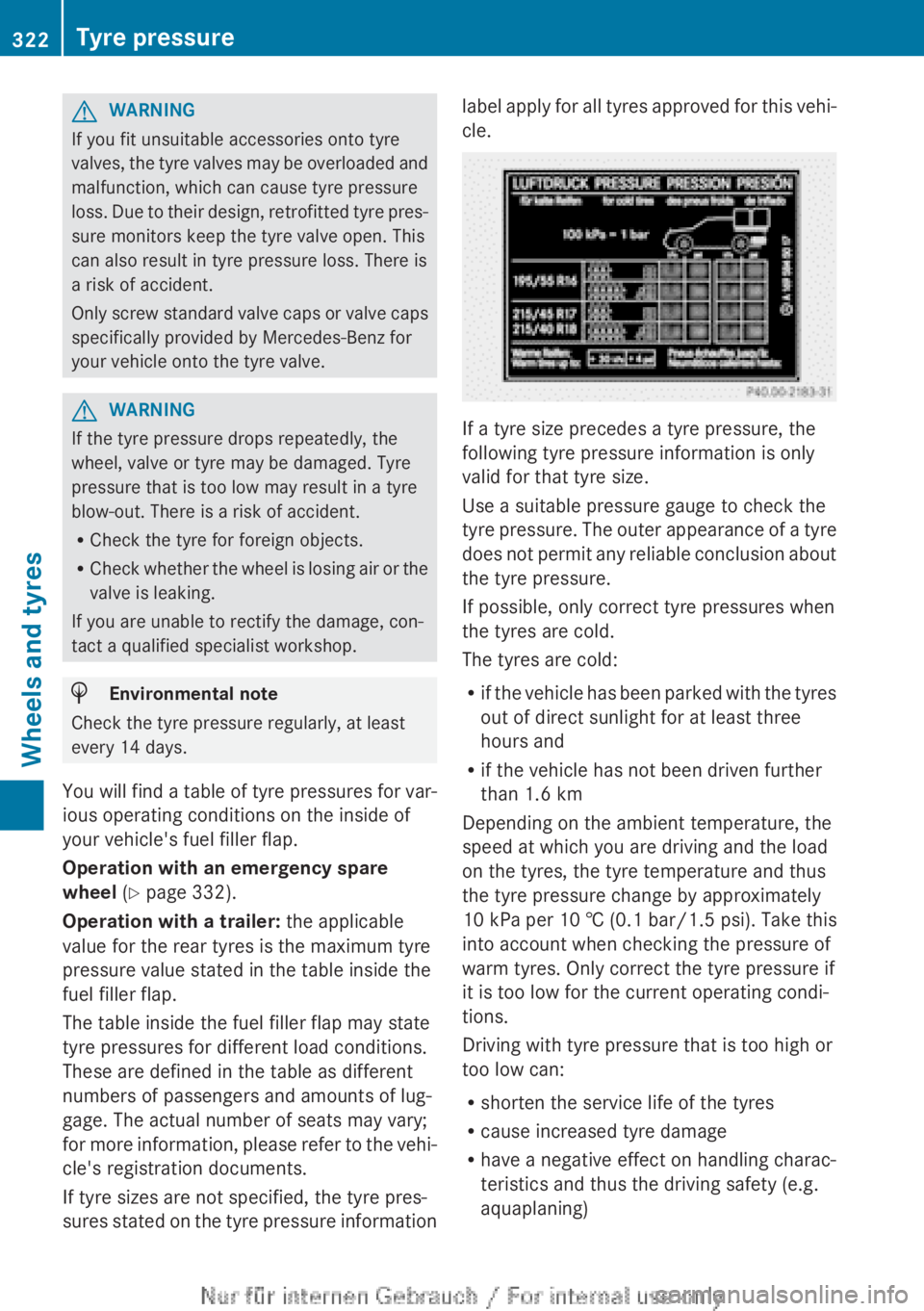
your vehicle's fuel filler flap.
Operation with an emergency spare
wheel (Y page 332).
Operation with a trailer: the applicable
value for the rear tyres is the maximum tyre
pressure value stated in the table inside the
fuel filler flap.
The table inside the fuel filler flap may state
tyre pressures for different load conditions.
These are defined in the table as different
numbers of passengers and amounts of lug-
gage. The actual number of seats may vary;
for more information, please refer to the vehi-
cle's registration documents.
If tyre sizes are not specified, the tyre pres-
sures stated on the tyre pressure information label apply for all tyres approved for this vehi-
cle.
If a tyre size precedes a tyre pressure, the
following tyre pressure information is only
valid for that tyre size.
Use a suitable pressure gauge to check the
tyre
pressure. The outer appearance of a tyre
does not permit any reliable conclusion about
the tyre pressure.
If possible, only correct tyre pressures when
the tyres are cold.
The tyres are cold:
R if the vehicle has been parked with the tyres
out of direct sunlight for at least three
hours and
R if the vehicle has not been driven further
than 1.6 km
Depending on the ambient temperature, the
speed at which you are driving and the load
on the tyres, the tyre temperature and thus
the tyre pressure change by approximately
10 kPa per 10 † (0.1 bar/1.5 psi). Take this
into account when checking the pressure of
warm tyres. Only correct the tyre pressure if
it is too low for the current operating condi-
tions.
Driving with tyre pressure that is too high or
too low can:
R shorten the service life of the tyres
R cause increased tyre damage
R have a negative effect on handling charac-
teristics and thus the driving safety (e.g.
aquaplaning)322
Tyre pressure
Wheels and tyres
Page 328 of 356
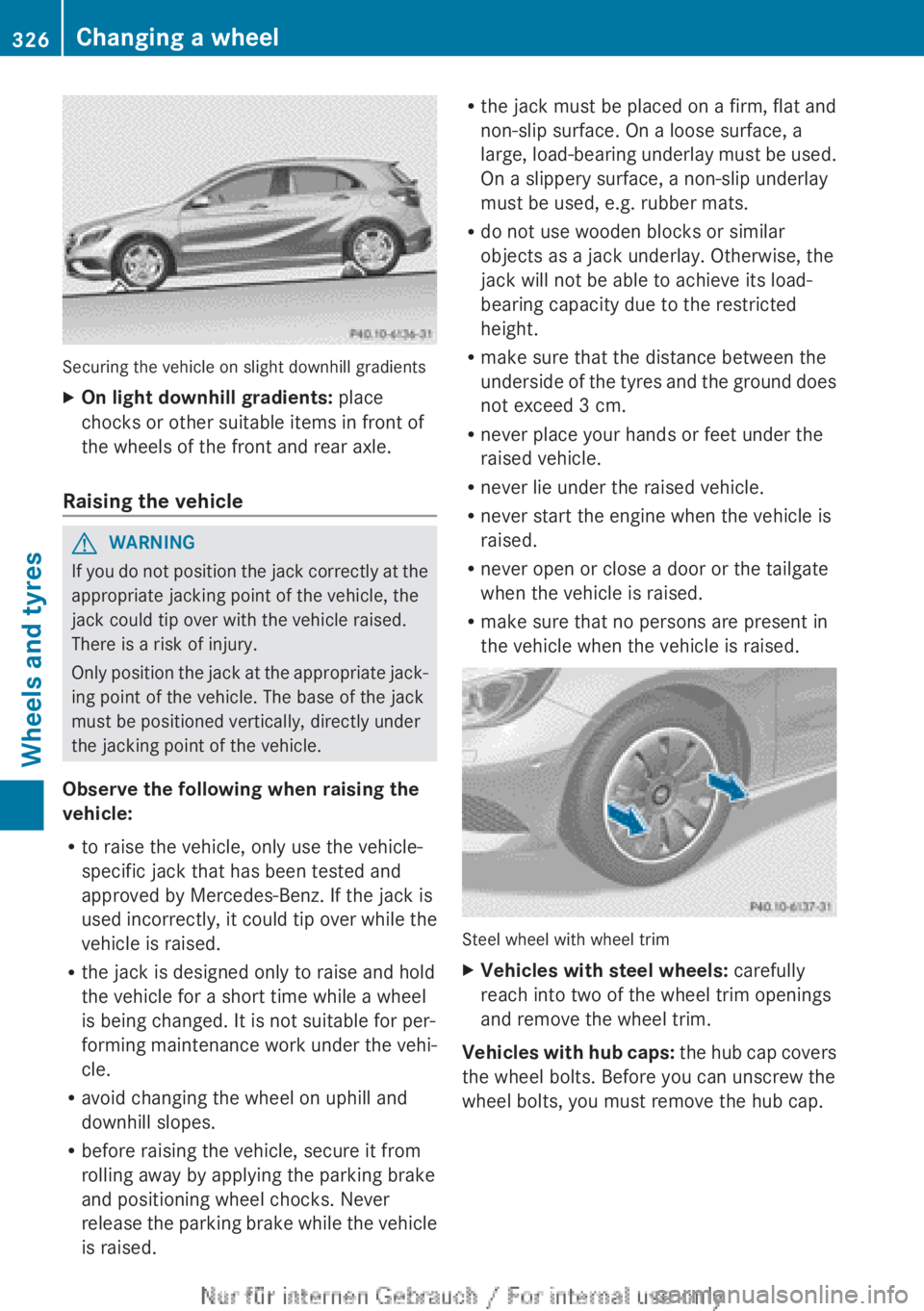
Securing the vehicle on slight downhill gradients
X
On light downhill gradients: place
chocks or other suitable items in front of
the wheels of the front and rear axle.
Raising the vehicle G
WARNING
If you do not position the jack correctly at the
appropriate jacking point of the vehicle, the
jack could tip over with the vehicle raised.
There is a risk of injury.
Only
position the jack at the appropriate jack-
ing point of the vehicle. The base of the jack
must be positioned vertically, directly under
the jacking point of the vehicle.
Observe the following when raising the
vehicle:
R to raise the vehicle, only use the vehicle-
specific jack that has been tested and
approved by Mercedes-Benz. If the jack is
used incorrectly, it could tip over while the
vehicle is raised.
R the jack is designed only to raise and hold
the vehicle for a short time while a wheel
is being changed. It is not suitable for per-
forming maintenance work under the vehi-
cle.
R avoid changing the wheel on uphill and
downhill slopes.
R before raising the vehicle, secure it from
rolling away by applying the parking brake
and positioning wheel chocks. Never
release the parking brake while the vehicle
is raised. R
the jack must be placed on a firm, flat and
non-slip surface. On a loose surface, a
large,
load-bearing underlay must be used.
On a slippery surface, a non-slip underlay
must be used, e.g. rubber mats.
R do not use wooden blocks or similar
objects as a jack underlay. Otherwise, the
jack will not be able to achieve its load-
bearing capacity due to the restricted
height.
R make sure that the distance between the
underside of the tyres and the ground does
not exceed 3 cm.
R never place your hands or feet under the
raised vehicle.
R never lie under the raised vehicle.
R never start the engine when the vehicle is
raised.
R never open or close a door or the tailgate
when the vehicle is raised.
R make sure that no persons are present in
the vehicle when the vehicle is raised. Steel wheel with wheel trim
X
Vehicles with steel wheels: carefully
reach into two of the wheel trim openings
and remove the wheel trim.
Vehicles with hub caps:
the hub cap covers
the wheel bolts. Before you can unscrew the
wheel bolts, you must remove the hub cap. 326
Changing a wheel
Wheels and tyres
Page 333 of 356
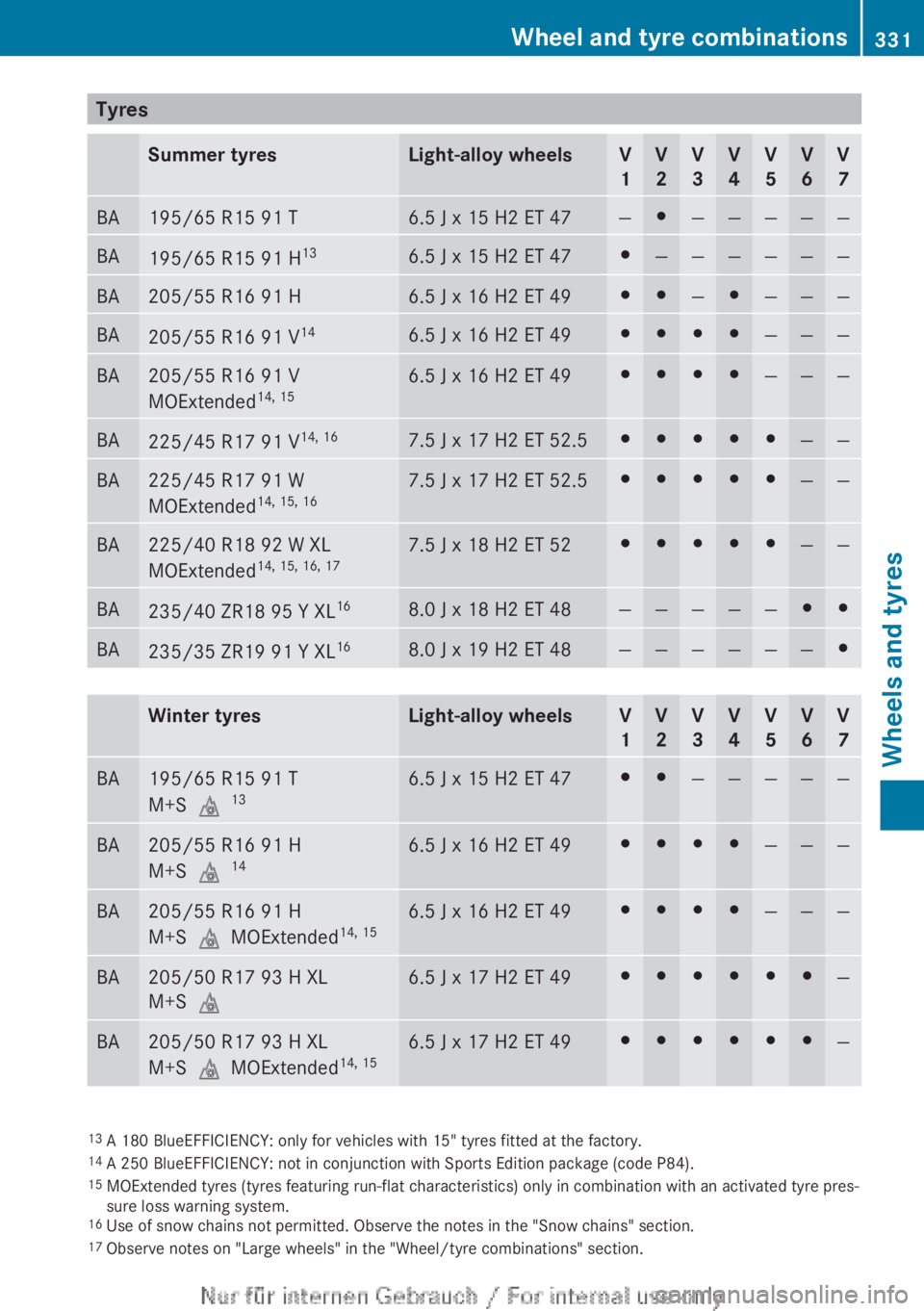
Tyres
Summer tyres Light-alloy wheels V
1 V
2 V
3 V
4 V
5 V
6 V
7 BA 195/65 R15 91 T 6.5 J x 15 H2 ET 47 — #
— — — — —
BA
195/65 R15 91 H
13 6.5 J x 15 H2 ET 47 #
— — — — — —
BA 205/55 R16 91 H 6.5 J x 16 H2 ET 49 # #
— #
— — —
BA
205/55 R16 91 V
14 6.5 J x 16 H2 ET 49 # # # #
— — —
BA 205/55 R16 91 V
MOExtended
14, 15 6.5 J x 16 H2 ET 49 # # # #
— — —
BA
225/45 R17 91 V
14, 16 7.5 J x 17 H2 ET 52.5 # # # # #
— —
BA 225/45 R17 91 W
MOExtended
14, 15, 16 7.5 J x 17 H2 ET 52.5 # # # # #
— —
BA 225/40 R18 92 W XL
MOExtended
14, 15, 16, 17 7.5 J x 18 H2 ET 52 # # # # #
— —
BA
235/40 ZR18 95 Y XL
16 8.0 J x 18 H2 ET 48 — — — — — # #
BA
235/35 ZR19 91 Y XL
16 8.0 J x 19 H2 ET 48 — — — — — — #
Winter tyres Light-alloy wheels V
1 V
2 V
3 V
4 V
5 V
6 V
7 BA 195/65 R15 91 T
M+S
i 13 6.5 J x 15 H2 ET 47 # #
— — — — —
BA 205/55 R16 91 H
M+S
i 14 6.5 J x 16 H2 ET 49 # # # #
— — —
BA 205/55 R16 91 H
M+S
iMOExtended 14, 15 6.5 J x 16 H2 ET 49 # # # #
— — —
BA 205/50 R17 93 H XL
M+S
i 6.5 J x 17 H2 ET 49 # # # # # #
—
BA 205/50 R17 93 H XL
M+S
iMOExtended 14, 15 6.5 J x 17 H2 ET 49 # # # # # #
—
13
A 180 BlueEFFICIENCY: only for vehicles with 15" tyres fitted at the factory.
14 A 250 BlueEFFICIENCY: not in conjunction with Sports Edition package (code P84).
15 MOExtended tyres (tyres featuring run-flat characteristics) only in combination with an activated tyre pres-
sure loss warning system.
16 Use of snow chains not permitted. Observe the notes in the "Snow chains" section.
17 Observe notes on "Large wheels" in the "Wheel/tyre combinations" section. Wheel and tyre combinations
331Wheels and tyres Z
Page 334 of 356
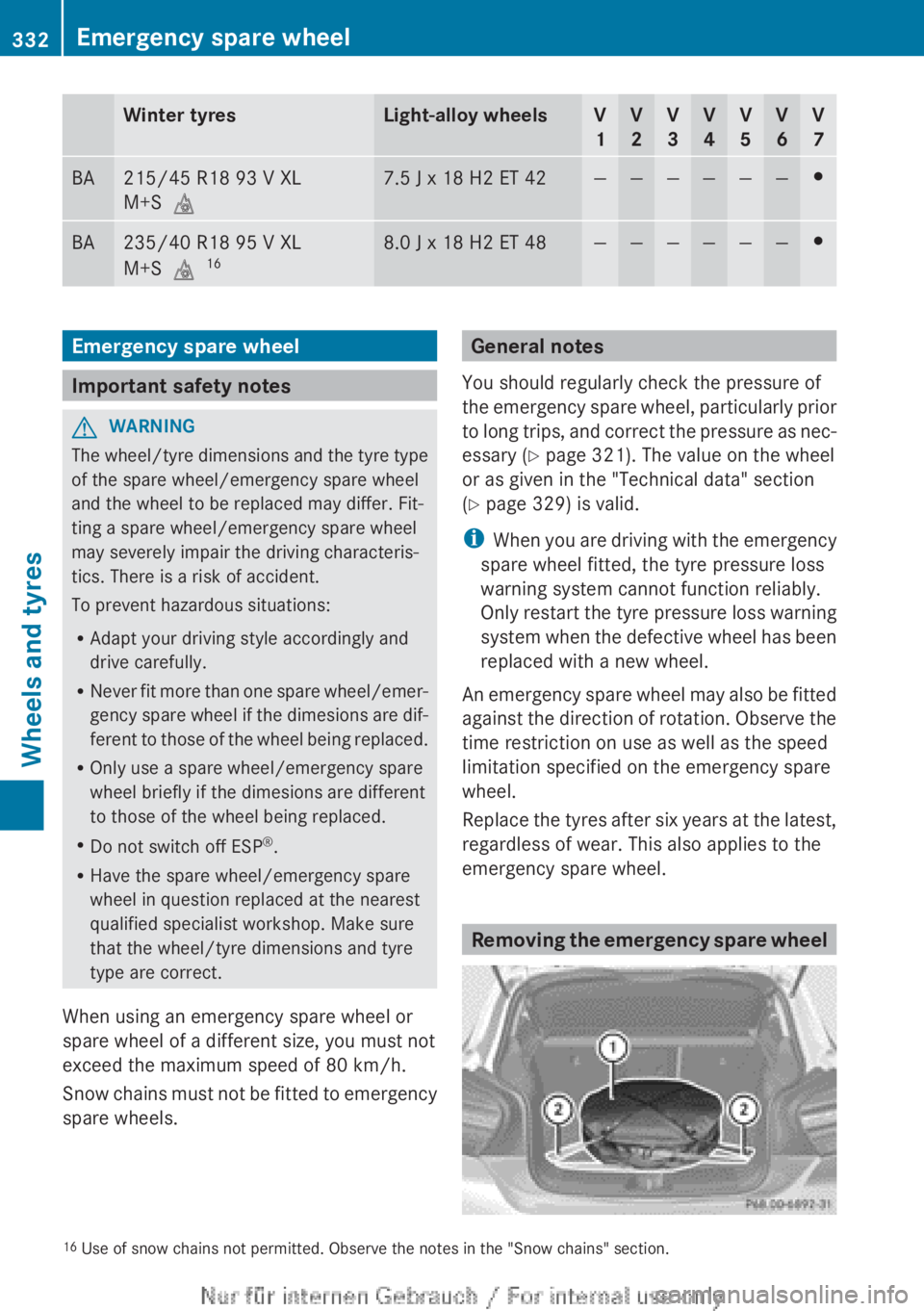
Winter tyres Light-alloy wheels V
1 V
2 V
3 V
4 V
5 V
6 V
7 BA 215/45 R18 93 V XL
M+S
i 7.5 J x 18 H2 ET 42 — — — — — — #
BA 235/40 R18 95 V XL
M+S
i 16 8.0 J x 18 H2 ET 48 — — — — — — #
Emergency spare wheel
Important safety notes
G
WARNING
The wheel/tyre dimensions and the tyre type
of the spare wheel/emergency spare wheel
and the wheel to be replaced may differ. Fit-
ting a spare wheel/emergency spare wheel
may severely impair the driving characteris-
tics. There is a risk of accident.
To prevent hazardous situations:
R Adapt your driving style accordingly and
drive carefully.
R Never
fit more than one spare wheel/emer-
gency spare wheel if the dimesions are dif-
ferent to those of the wheel being replaced.
R Only use a spare wheel/emergency spare
wheel briefly if the dimesions are different
to those of the wheel being replaced.
R Do not switch off ESP ®
.
R Have the spare wheel/emergency spare
wheel in question replaced at the nearest
qualified specialist workshop. Make sure
that the wheel/tyre dimensions and tyre
type are correct.
When using an emergency spare wheel or
spare wheel of a different size, you must not
exceed the maximum speed of 80 km/h.
Snow chains must not be fitted to emergency
spare wheels. General notes
You should regularly check the pressure of
the
emergency spare wheel, particularly prior
to long trips, and correct the pressure as nec-
essary ( Y page 321). The value on the wheel
or as given in the "Technical data" section
(Y page 329) is valid.
i When you are driving with the emergency
spare wheel fitted, the tyre pressure loss
warning system cannot function reliably.
Only restart the tyre pressure loss warning
system when the defective wheel has been
replaced with a new wheel.
An emergency spare wheel may also be fitted
against the direction of rotation. Observe the
time restriction on use as well as the speed
limitation specified on the emergency spare
wheel.
Replace the tyres after six years at the latest,
regardless of wear. This also applies to the
emergency spare wheel. Removing the emergency spare wheel
16
Use of snow chains not permitted. Observe the notes in the "Snow chains" section.332
Emergency spare wheel
Wheels and tyres