dimensions MERCEDES-BENZ A CLASS 2012 Owners Manual
[x] Cancel search | Manufacturer: MERCEDES-BENZ, Model Year: 2012, Model line: A CLASS, Model: MERCEDES-BENZ A CLASS 2012Pages: 356, PDF Size: 4.96 MB
Page 19 of 356
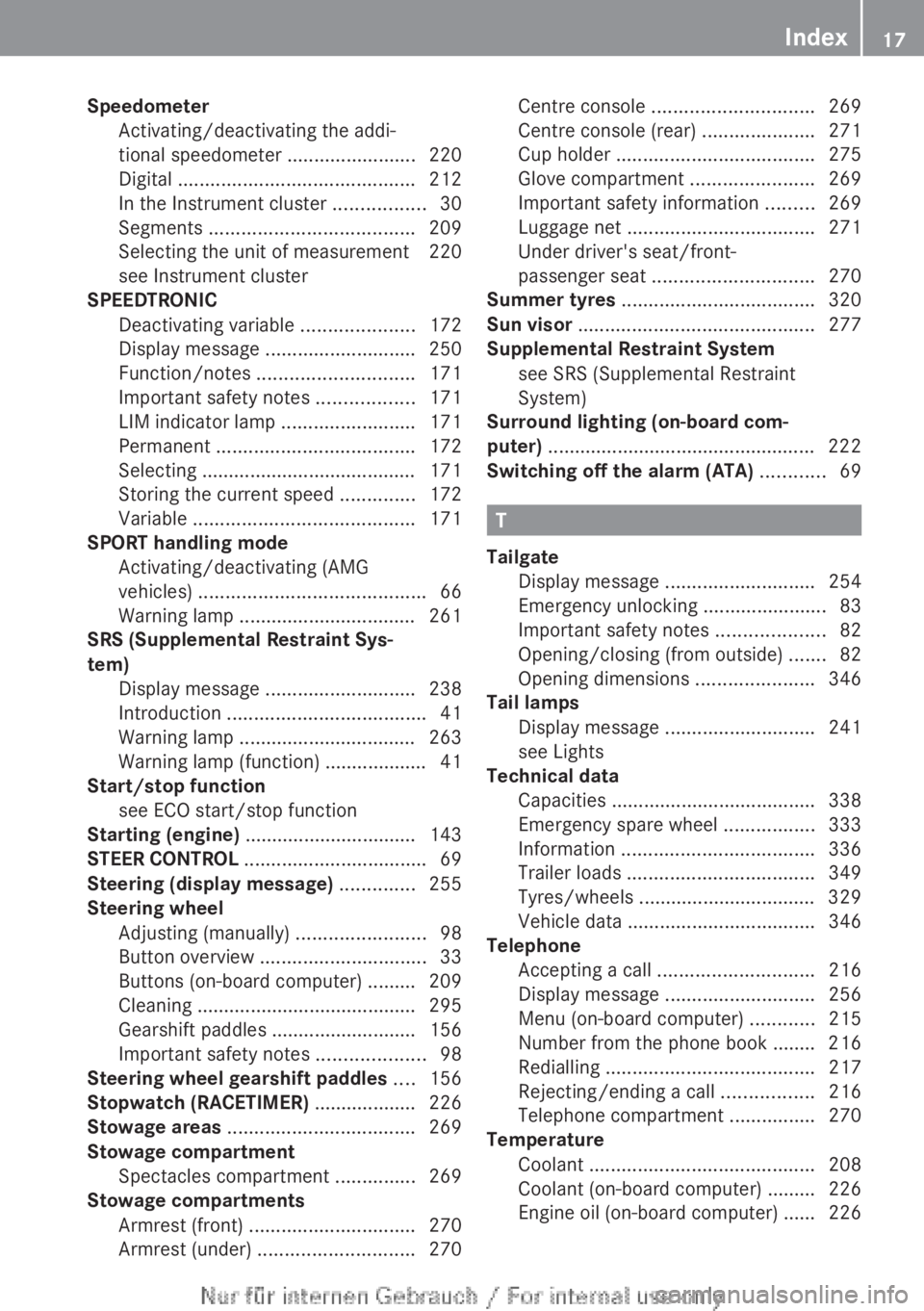
Speedometer
Activating/deactivating the addi-
tional speedometer ........................220
Digital ............................................ 212
In the Instrument cluster
.................30
Segments ...................................... 209
Selecting the unit of measurement 220
see Instrument cluster
SPEEDTRONIC
Deactivating variable .....................172
Display message ............................ 250
Function/notes ............................. 171
Important safety notes .................. 171
LIM indicator lamp .........................171
Permanent ..................................... 172
Selecting ........................................ 171
Storing the current speed .............. 172
Variable ......................................... 171
SPORT handling mode
Activating/deactivating (AMG
vehicles) .......................................... 66
Warning lamp ................................. 261
SRS (Supplemental Restraint Sys-
tem)
Display message ............................ 238
Introduction ..................................... 41
Warning lamp ................................. 263
Warning lamp (function) ................... 41
Start/stop function
see ECO start/stop function
Starting (engine) ................................ 143
STEER CONTROL .................................. 69
Steering (display message) ..............255
Steering wheel Adjusting (manually) ........................98
Button overview ............................... 33
Buttons (on-board computer) ......... 209
Cleaning ......................................... 295
Gearshift paddles ........................... 156
Important safety notes .................... 98
Steering wheel gearshift paddles ....156
Stopwatch (RACETIMER) ................... 226
Stowage areas ................................... 269
Stowage compartment Spectacles compartment ...............269
Stowage compartments
Armrest (front) ............................... 270
Armrest (under) ............................. 270Centre console ..............................
269
Centre console (rear) ..................... 271
Cup holder
..................................... 275
Glove compartment ....................... 269
Important safety information ......... 269
Luggage net ................................... 271
Under driver's seat/front-
passenger seat .............................. 270
Summer tyres .................................... 320
Sun visor ............................................ 277
Supplemental Restraint System see SRS (Supplemental Restraint
System)
Surround lighting (on-board com-
puter) .................................................. 222
Switching off the alarm (ATA) ............69 T
Tailgate Display message
............................ 254
Emergency unlocking .......................83
Important safety notes .................... 82
Opening/closing (from outside) ....... 82
Opening dimensions ...................... 346
Tail lamps
Display message ............................ 241
see Lights
Technical data
Capacities ...................................... 338
Emergency spare wheel ................. 333
Information .................................... 336
Trailer loads ................................... 349
Tyres/wheels ................................. 329
Vehicle data ................................... 346
Telephone
Accepting a call ............................. 216
Display message ............................ 256
Menu (on-board computer) ............ 215
Number from the phone book ........ 216
Redialling ....................................... 217
Rejecting/ending a call ................. 216
Telephone compartment ................ 270
Temperature
Coolant .......................................... 208
Coolant (on-board computer) ......... 226
Engine oil (on-board computer) ...... 226 Index
17
Page 20 of 356
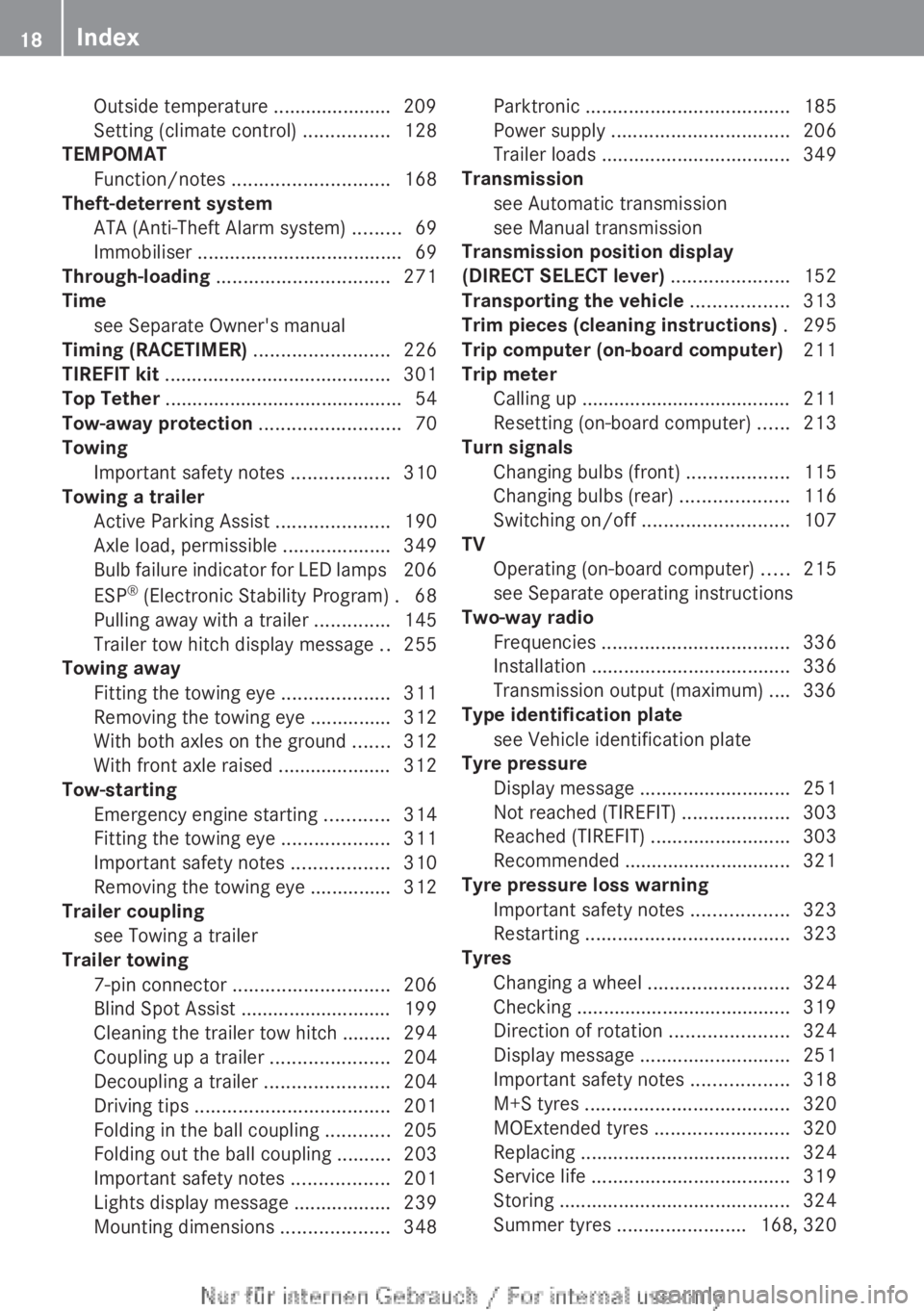
Outside temperature ...................... 209
Setting (climate control)
................128
TEMPOMAT
Function/notes ............................. 168
Theft-deterrent system
ATA (Anti-Theft Alarm system) .........69
Immobiliser ...................................... 69
Through-loading ................................ 271
Time see Separate Owner's manual
Timing (RACETIMER) .........................226
TIREFIT kit .......................................... 301
Top Tether ............................................ 54
Tow-away protection .......................... 70
Towing Important safety notes .................. 310
Towing a trailer
Active Parking Assist .....................190
Axle load, permissible .................... 349
Bulb failure indicator for LED lamps 206
ESP ®
(Electronic Stability Program) . 68
Pulling away with a trailer ..............145
Trailer tow hitch display message .. 255
Towing away
Fitting the towing eye ....................311
Removing the towing eye ...............312
With both axles on the ground ....... 312
With front axle raised ..................... 312
Tow-starting
Emergency engine starting ............ 314
Fitting the towing eye ....................311
Important safety notes .................. 310
Removing the towing eye ...............312
Trailer coupling
see Towing a trailer
Trailer towing
7-pin connector ............................. 206
Blind Spot Assist ............................ 199
Cleaning the trailer tow hitch ......... 294
Coupling up a trailer ......................204
Decoupling a trailer ....................... 204
Driving tips .................................... 201
Folding in the ball coupling ............205
Folding out the ball coupling ..........203
Important safety notes .................. 201
Lights display message .................. 239
Mounting dimensions .................... 348Parktronic ......................................
185
Power supply ................................. 206
Trailer loads ................................... 349
Transmission
see Automatic transmission
see Manual transmission
Transmission position display
(DIRECT SELECT lever) ......................152
Transporting the vehicle .................. 313
Trim pieces (cleaning instructions) . 295
Trip computer (on-board computer) 211
Trip meter Calling up ....................................... 211
Resetting (on-board computer) ...... 213
Turn signals
Changing bulbs (front) ................... 115
Changing bulbs (rear) .................... 116
Switching on/off ........................... 107
TV
Operating (on-board computer) ..... 215
see Separate operating instructions
Two-way radio
Frequencies ................................... 336
Installation ..................................... 336
Transmission output (maximum) .... 336
Type identification plate
see Vehicle identification plate
Tyre pressure
Display message ............................ 251
Not reached (TIREFIT) .................... 303
Reached (TIREFIT) .......................... 303
Recommended ............................... 321
Tyre pressure loss warning
Important safety notes .................. 323
Restarting ...................................... 323
Tyres
Changing a wheel .......................... 324
Checking ........................................ 319
Direction of rotation ......................324
Display message ............................ 251
Important safety notes .................. 318
M+S tyres ...................................... 320
MOExtended tyres .........................320
Replacing ....................................... 324
Service life ..................................... 319
Storing ........................................... 324
Summer tyres ........................ 168, 32018
Index
Page 21 of 356
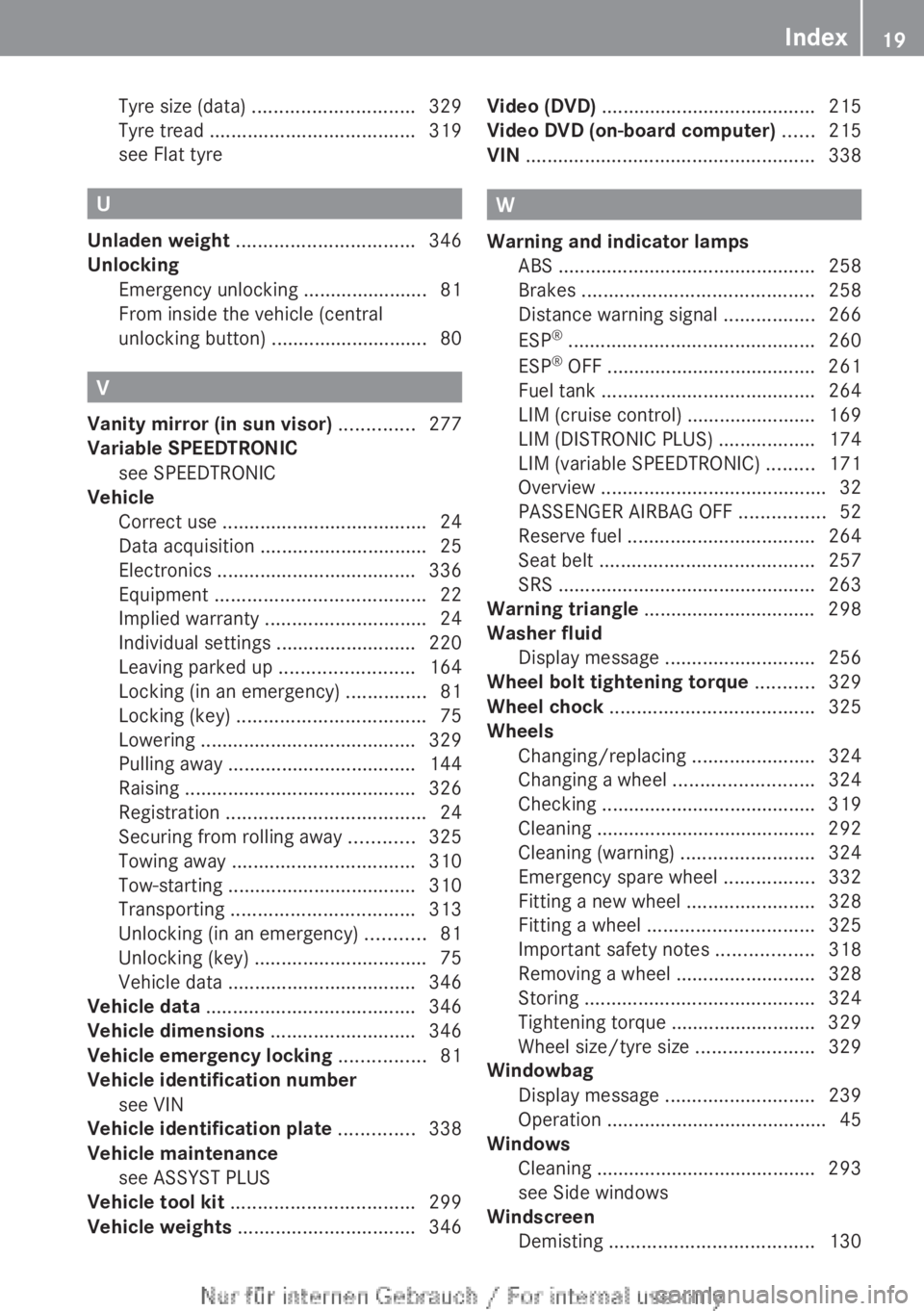
Tyre size (data)
.............................. 329
Tyre tread ...................................... 319
see Flat tyre
U
Unladen weight ................................. 346
Unlocking Emergency unlocking .......................81
From inside the vehicle (central
unlocking button) ............................. 80V
Vanity mirror (in sun visor) .............. 277
Variable SPEEDTRONIC see SPEEDTRONIC
Vehicle
Correct use ...................................... 24
Data acquisition ............................... 25
Electronics ..................................... 336
Equipment ....................................... 22
Implied warranty .............................. 24
Individual settings ..........................220
Leaving parked up ......................... 164
Locking (in an emergency) ............... 81
Locking (key) ................................... 75
Lowering ........................................ 329
Pulling away ................................... 144
Raising ........................................... 326
Registration ..................................... 24
Securing from rolling away ............325
Towing away .................................. 310
Tow-starting ................................... 310
Transporting .................................. 313
Unlocking (in an emergency) ........... 81
Unlocking (key) ................................ 75
Vehicle data ................................... 346
Vehicle data ....................................... 346
Vehicle dimensions ...........................346
Vehicle emergency locking ................81
Vehicle identification number see VIN
Vehicle identification plate ..............338
Vehicle maintenance see ASSYST PLUS
Vehicle tool kit .................................. 299
Vehicle weights ................................. 346Video (DVD)
........................................
215
Video DVD (on-board computer) ......215
VIN ...................................................... 338 W
Warning and indicator lamps ABS
................................................ 258
Brakes ........................................... 258
Distance warning signal ................. 266
ESP ®
.............................................. 260
ESP ®
OFF ....................................... 261
Fuel tank ........................................ 264
LIM (cruise control) ........................ 169
LIM (DISTRONIC PLUS) .................. 174
LIM (variable SPEEDTRONIC) ......... 171
Overview .......................................... 32
PASSENGER AIRBAG OFF ................ 52
Reserve fuel ................................... 264
Seat belt ........................................ 257
SRS ................................................ 263
Warning triangle ................................ 298
Washer fluid
Display message ............................ 256
Wheel bolt tightening torque ...........329
Wheel chock ...................................... 325
Wheels Changing/replacing .......................324
Changing a wheel .......................... 324
Checking ........................................ 319
Cleaning ......................................... 292
Cleaning (warning) .........................324
Emergency spare wheel ................. 332
Fitting a new wheel ........................328
Fitting a wheel ............................... 325
Important safety notes .................. 318
Removing a wheel ..........................328
Storing ........................................... 324
Tightening torque ........................... 329
Wheel size/tyre size ......................329
Windowbag
Display message ............................ 239
Operation ......................................... 45
Windows
Cleaning ......................................... 293
see Side windows
Windscreen
Demisting ...................................... 130 Index
19
Page 84 of 356
are still visible. Press down the locking
knobs manually, if necessary
(Y page 80).
X Close the driver's door.
X Take the emergency key element out of the
key ( Y page 75).
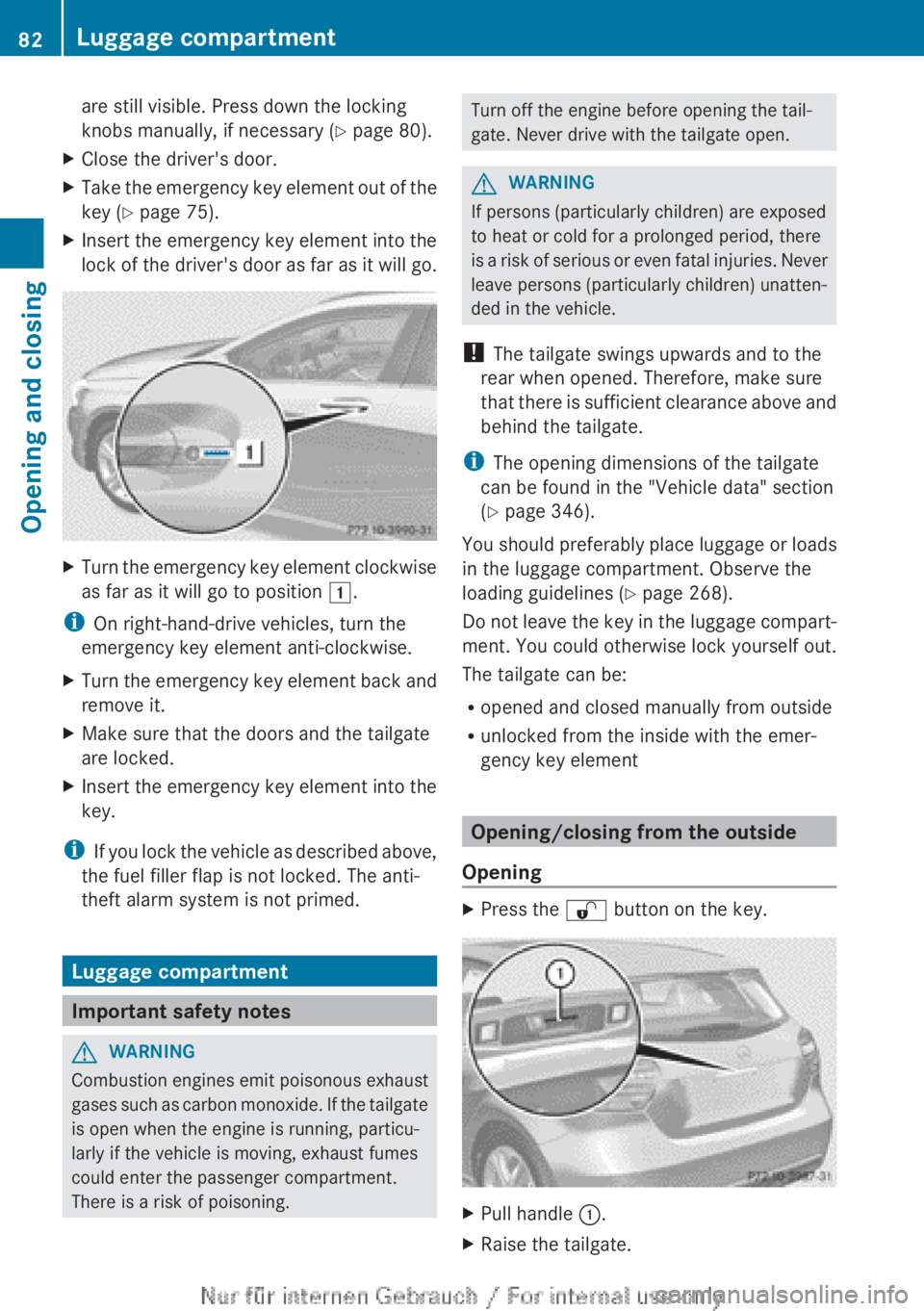
X Insert the emergency key element into the
lock
of the driver's door as far as it will go. X
Turn the emergency key element clockwise
as far as it will go to position 1.
i On right-hand-drive vehicles, turn the
emergency key element anti-clockwise.
X Turn the emergency key element back and
remove it.
X Make sure that the doors and the tailgate
are locked.
X Insert the emergency key element into the
key.
i If
you lock the vehicle as described above,
the fuel filler flap is not locked. The anti-
theft alarm system is not primed. Luggage compartment
Important safety notes
G
WARNING
Combustion engines emit poisonous exhaust
gases
such as carbon monoxide. If the tailgate
is open when the engine is running, particu-
larly if the vehicle is moving, exhaust fumes
could enter the passenger compartment.
There is a risk of poisoning. Turn off the engine before opening the tail-
gate. Never drive with the tailgate open.
G
WARNING
If persons (particularly children) are exposed
to heat or cold for a prolonged period, there
is
a risk of serious or even fatal injuries. Never
leave persons (particularly children) unatten-
ded in the vehicle.
! The tailgate swings upwards and to the
rear when opened. Therefore, make sure
that there is sufficient clearance above and
behind the tailgate.
i The opening dimensions of the tailgate
can be found in the "Vehicle data" section
(Y page 346).
You should preferably place luggage or loads
in the luggage compartment. Observe the
loading guidelines ( Y page 268).
Do not leave the key in the luggage compart-
ment. You could otherwise lock yourself out.
The tailgate can be:
R opened and closed manually from outside
R unlocked from the inside with the emer-
gency key element Opening/closing from the outside
Opening X
Press the % button on the key. X
Pull handle :.
X Raise the tailgate.82
Luggage compartment
Opening and closing
Page 85 of 356
Closing
X
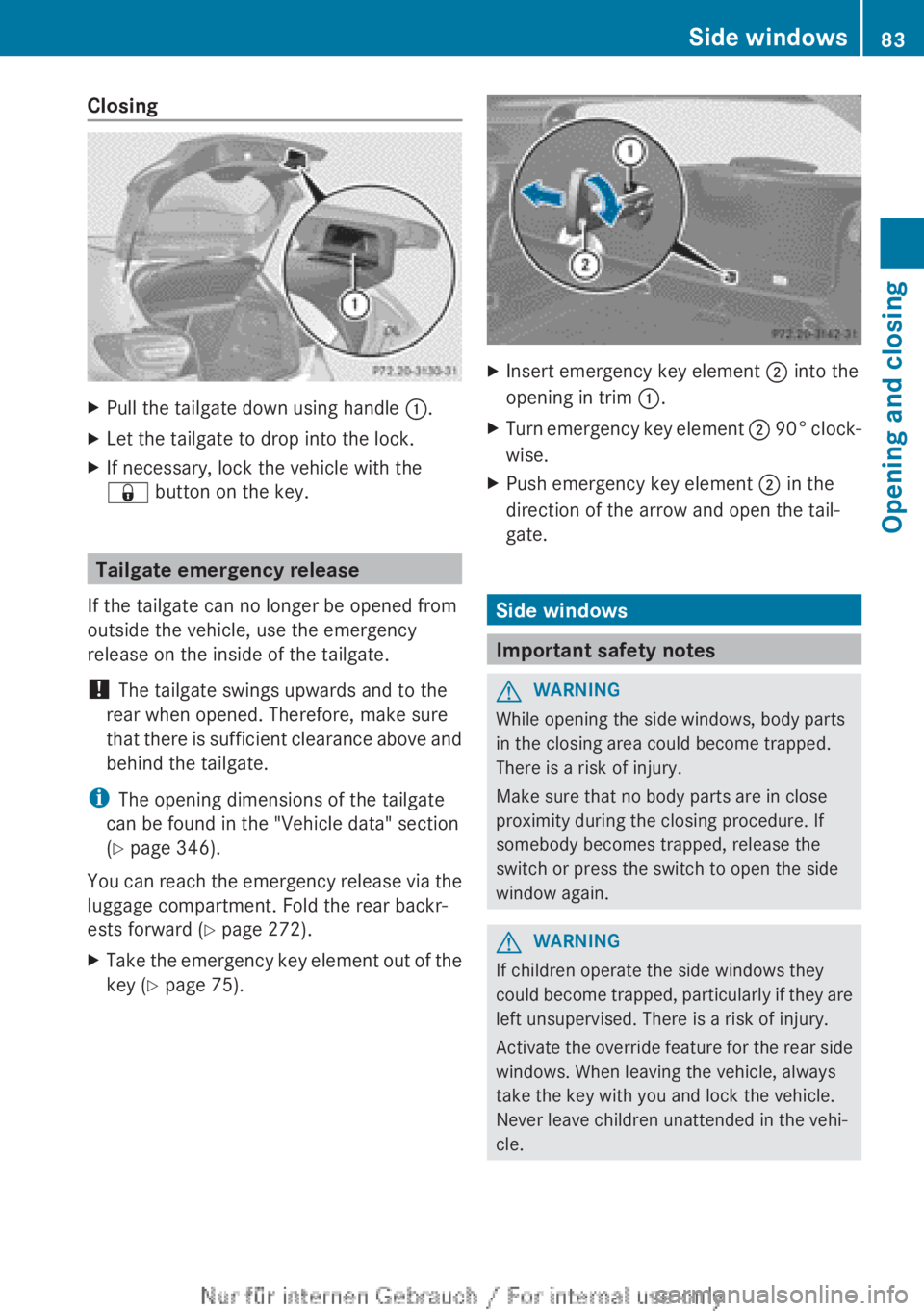
Pull the tailgate down using handle :.
X Let the tailgate to drop into the lock.
X If necessary, lock the vehicle with the
& button on the key. Tailgate emergency release
If the tailgate can no longer be opened from
outside the vehicle, use the emergency
release on the inside of the tailgate.
! The tailgate swings upwards and to the
rear when opened. Therefore, make sure
that
there is sufficient clearance above and
behind the tailgate.
i The opening dimensions of the tailgate
can be found in the "Vehicle data" section
(Y page 346).
You can reach the emergency release via the
luggage compartment. Fold the rear backr-
ests forward ( Y page 272).
X Take the emergency key element out of the
key ( Y page 75). X
Insert emergency key element ; into the
opening in trim :.
X Turn emergency key element ;
90° clock-
wise.
X Push emergency key element ; in the
direction of the arrow and open the tail-
gate. Side windows
Important safety notes
G
WARNING
While opening the side windows, body parts
in the closing area could become trapped.
There is a risk of injury.
Make sure that no body parts are in close
proximity during the closing procedure. If
somebody becomes trapped, release the
switch or press the switch to open the side
window again. G
WARNING
If children operate the side windows they
could
become trapped, particularly if they are
left unsupervised. There is a risk of injury.
Activate the override feature for the rear side
windows. When leaving the vehicle, always
take the key with you and lock the vehicle.
Never leave children unattended in the vehi-
cle. Side windows
83
Opening and closing Z
Page 204 of 356
trailer combination could also become unsta-
ble.
To avoid hazardous situations:
R
make
sure to check the noseweight before
each journey.
R use a drawbar noseweight as close as pos-
sible to the maximum noseweight.
R do not exceed the maximum permissible
noseweight.
R do not use a noseweight lower than the
minimum permissible trailer drawbar nose-
weight.
When reversing the vehicle towards the
trailer, make sure there is nobody between
the trailer and the vehicle.
Couple and uncouple the trailer carefully. If
you do not couple the trailer to the towing
vehicle correctly, the trailer could become
detached.
Make sure that the following values are not
exceeded:
R the permissible trailer drawbar noseweight
R the permissible trailer load
R the permissible rear axle load of the towing
vehicle
R the maximum permissible gross vehicle
weight of both the towing vehicle and the
trailer
The applicable permissible values, which
must not be exceeded, can be found:
R in your vehicle documents
R on the identification plates of the trailer tow
hitch and the trailer
R on the vehicle identification plate
If the values differ, the lowest value applies.
You will find the values approved by the man-
ufacturer on the vehicle identification plates
and those for the towing vehicle under "Tech-
nical data" ( Y page 349).
When towing a trailer, your vehicle's handling
characteristics will be different in comparison
to when driving without a trailer. The vehicle/trailer combination:
R
is heavier
R is restricted in its acceleration and gradi-
ent-climbing capability
R has an increased braking distance
R is affected more by strong crosswinds
R demands more sensitive steering
R has a larger turning circle
This can impair the vehicle's handling char-
acteristics.
Adapt your style of driving accord-
ingly. Maintain a safe distance. Drive care-
fully.
When towing a trailer, always adjust your
speed to the current road and weather con-
ditions. Do not exceed the maximum permis-
sible speed for your vehicle/trailer combina-
tion.
General notes X
When towing a trailer, set the tyre pressure
on the rear axle of the towing vehicle for a
maximum
load; see the tyre pressure table
in the fuel filler flap ( Y page 321).
Please note that when towing a trailer, PARK-
TRONIC ( Y page 182) and Blind Spot Assist
(Y
page 197) availability is limited or not avail-
able at all.
i The height of the ball coupling changes
with the load of the vehicle. If necessary,
use a trailer with a height-adjustable draw-
bar.
You will find fitting dimensions and loads
under "Technical data" ( Y page 348).
Driving tips i
Observe the notes on ESP ®
trailer stabi-
lisation ( Y page 68).
The
maximum permissible speed for vehicle/
trailer combinations depends on the type of
trailer. Before beginning the journey, check
the trailer's documents to see what the max-
imum permitted speed is. Observe the legally 202
Towing a trailer
Driving and parking
Page 320 of 356
Useful information
i This Owner's Manual describes all mod-
els,
series and optional equipment for your
vehicle that were available at the time of
going to press. National variations are pos-
sible. Note that your vehicle may not be
equipped with all of the functions descri-
bed. This is also the case for systems and
functions relevant to safety.
i Read the information on qualified special-
ist workshops: (Y page 24). Important safety notes
G
WARNING
If wheels and tyres of the wrong size are used,
the wheel brakes or suspension components
may be damaged. There is a risk of an acci-
dent.
Always replace wheels and tyres with those
that fulfil the specifications of the original
part.
When replacing wheels, make sure to fit the
correct:
R designation
R type
When replacing tyres, make sure to fit the
correct:
R designation
R manufacturer
R type G
WARNING
A flat tyre severely impairs the driving, steer-
ing
and braking characteristics of the vehicle.
There is a risk of accident.
Tyres without run-flat characteristics:
R do not drive with a flat tyre.
R immediately replace the flat tyre with your
emergency spare wheel or spare wheel, or
consult a qualified specialist workshop. Tyres with run-flat characteristics:
R
pay attention to the information and warn-
ing notices on MOExtended tyres (tyres
with run-flat characteristics).
Accessories that are not approved for your
vehicle by Mercedes-Benz or that are not
being
used correctly can impair the operating
safety.
Before purchasing and using non-approved
accessories, visit a qualified specialist work-
shop and enquire about:
R suitability
R legal stipulations
R factory recommendations
Information on dimensions and types of
wheels and tyres for your vehicle can be
found ( Y page 329).
Information on air pressure for the tyres on
your vehicle can be found:
R on the tyre pressure label on the fuel filler
flap
R under "Tyre pressure"
Modification work on the brake system and
wheels is not permitted. The use of wheel
spacers or brake dust shields is not permit-
ted. This invalidates the general operating
permit for the vehicle.
i Further information on wheels and tyres
can be obtained at any qualified specialist
workshop. Operation
Information on driving
R Check
the tyre pressures when the vehicle
is heavily laden and, if necessary, adjust.
R While driving, pay attention to vibrations,
noises and unusual handling characteris-
tics, e.g. pulling to one side. This may indi-
cate that the wheels or tyres are damaged.
If you suspect that a tyre is defective,
reduce your speed immediately. Stop the
vehicle as soon as possible to check the318
Operation
Wheels and tyres
Page 326 of 356
After a teach-in period, the tyre pressure
loss warning system will monitor the set
tyre pressures of all four tyres.
or
If you wish to cancel the restart:
X Press the % button.
or
X If the Tyre press. now OK? message
appears, use the 9 or : button to
select Cancel.
X Press the a button.
The tyre pressure values stored at the last
restart will continue to be monitored. Changing a wheel
Flat tyre
You can find information on what to do in the
event of flat tyre in the "Flat tyre" section
(Y page 300). You will also find information
on driving with MOExtended tyres in the event
of a flat tyre.
Vehicles with an emergency spare
wheel: in the event of a flat tyre, the emer-
gency spare wheel is fitted according to the
description under "Fitting a wheel"
(Y page 325). Interchanging the wheels
G
WARNING
Interchanging the front and rear wheels may
severely impair the driving characteristics if
the
wheels or tyres have different dimensions.
The wheel brakes or suspension components
may also be damaged. There is a risk of acci-
dent.
Interchange front and rear wheels only if the
wheels and tyres are of the same dimensions.
Interchanging the front and rear wheels of
differing dimensions can render the general
operating permit invalid. Always pay attention to the instructions and
safety notes when changing a wheel
(Y page 324).
The
wear patterns on the front and rear tyres
differ, depending on the operating conditions.
Interchange the wheels before a clear wear
pattern has formed on the tyres. Front tyres
typically wear more on the shoulders and the
rear tyres in the centre.
On vehicles that have the same size front and
rear wheels, you can interchange the wheels
every 5,000km to 10,000 km depending on
the degree of tyre wear. Maintain the direc-
tion of tyre rotation.
Clean the contact surfaces of the wheel and
the brake disc thoroughly every time a wheel
is interchanged. Check the tyre pressure and,
if necessary, restart the tyre pressure loss
warning system. Direction of rotation
Tyres with a specified direction of rotation
have
additional benefits, e.g. if there is a risk
of aquaplaning. You will only gain these ben-
efits if the correct direction of rotation is
observed.
An arrow on the sidewall of the tyre indicates
its correct direction of rotation. Storing wheels
Store
wheels that are not being used in a cool,
dry and preferably dark place. Protect the
tyres against oil, grease, petrol and diesel. Cleaning the wheels
G
WARNING
The water jet of circular-jet nozzles (dirt grind-
ers) can cause damage not visible from the
outside
to tyres or chassis components. Com-
ponents damaged in this way can unexpect-
edly fail. There is a risk of an accident. 324
Changing a wheel
Wheels and tyres
Page 334 of 356
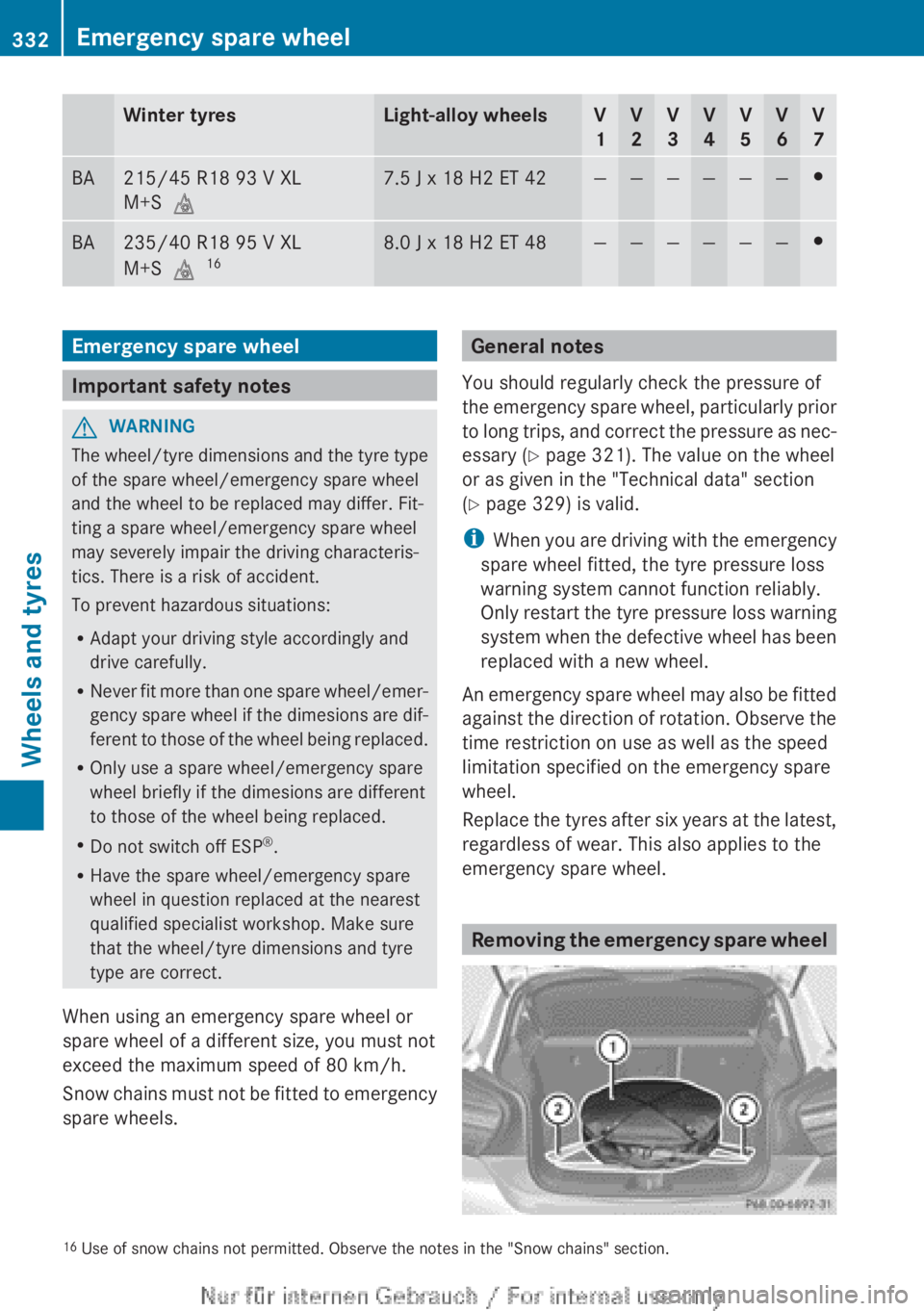
Winter tyres Light-alloy wheels V
1 V
2 V
3 V
4 V
5 V
6 V
7 BA 215/45 R18 93 V XL
M+S
i 7.5 J x 18 H2 ET 42 — — — — — — #
BA 235/40 R18 95 V XL
M+S
i 16 8.0 J x 18 H2 ET 48 — — — — — — #
Emergency spare wheel
Important safety notes
G
WARNING
The wheel/tyre dimensions and the tyre type
of the spare wheel/emergency spare wheel
and the wheel to be replaced may differ. Fit-
ting a spare wheel/emergency spare wheel
may severely impair the driving characteris-
tics. There is a risk of accident.
To prevent hazardous situations:
R Adapt your driving style accordingly and
drive carefully.
R Never
fit more than one spare wheel/emer-
gency spare wheel if the dimesions are dif-
ferent to those of the wheel being replaced.
R Only use a spare wheel/emergency spare
wheel briefly if the dimesions are different
to those of the wheel being replaced.
R Do not switch off ESP ®
.
R Have the spare wheel/emergency spare
wheel in question replaced at the nearest
qualified specialist workshop. Make sure
that the wheel/tyre dimensions and tyre
type are correct.
When using an emergency spare wheel or
spare wheel of a different size, you must not
exceed the maximum speed of 80 km/h.
Snow chains must not be fitted to emergency
spare wheels. General notes
You should regularly check the pressure of
the
emergency spare wheel, particularly prior
to long trips, and correct the pressure as nec-
essary ( Y page 321). The value on the wheel
or as given in the "Technical data" section
(Y page 329) is valid.
i When you are driving with the emergency
spare wheel fitted, the tyre pressure loss
warning system cannot function reliably.
Only restart the tyre pressure loss warning
system when the defective wheel has been
replaced with a new wheel.
An emergency spare wheel may also be fitted
against the direction of rotation. Observe the
time restriction on use as well as the speed
limitation specified on the emergency spare
wheel.
Replace the tyres after six years at the latest,
regardless of wear. This also applies to the
emergency spare wheel. Removing the emergency spare wheel
16
Use of snow chains not permitted. Observe the notes in the "Snow chains" section.332
Emergency spare wheel
Wheels and tyres
Page 348 of 356
At temperatures above freezing:
X
Fill the washer fluid reservoir with a mixture
of water and washer fluid, e.g. MB Sum-
merFit.
Mix 1 part MB SummerFit to 100 parts water.
At temperatures below freezing:
X Fill the washer fluid reservoir with a mixture
of water and washer fluid, e.g. MB Winter-
Fit.
Adapt the mixing ratio to the outside temper-
ature.
R Down
to Ò10 †: mix 1 part MB WinterFit to
2 parts water.
R Down to Ò20 †: mix 1 part MB WinterFit to
1 part water.
R Down to Ò29 †: mix 2 parts MB WinterFit
to 1 part water.
i Add washer fluid concentrate, e.g. MB
SummerFit or MB WinterFit, to the washer
fluid all year round. Vehicle data
General notes
Please note that for the specified vehicle
data:
R the heights specified may vary as a result
of:
-tyres
- load
- condition of the suspension
- optional equipment
R items of optional equipment increase the
unladen weight and reduce the maximum
payload.
The unladen weight is specified in
accordance with EC directives and
includes:
- driver (68 kg)
- luggage (7 kg)
- all fluids (fuel tank 90% full) R
vehicle-specific weight information can be
found on the vehicle identification plate
(Y page 338).
R only
for certain countries: you can find vehi-
cle-specific vehicle data in the COC docu-
ments (CERTIFICATE OF CONFORMITY)
These documents are delivered with your
vehicle.
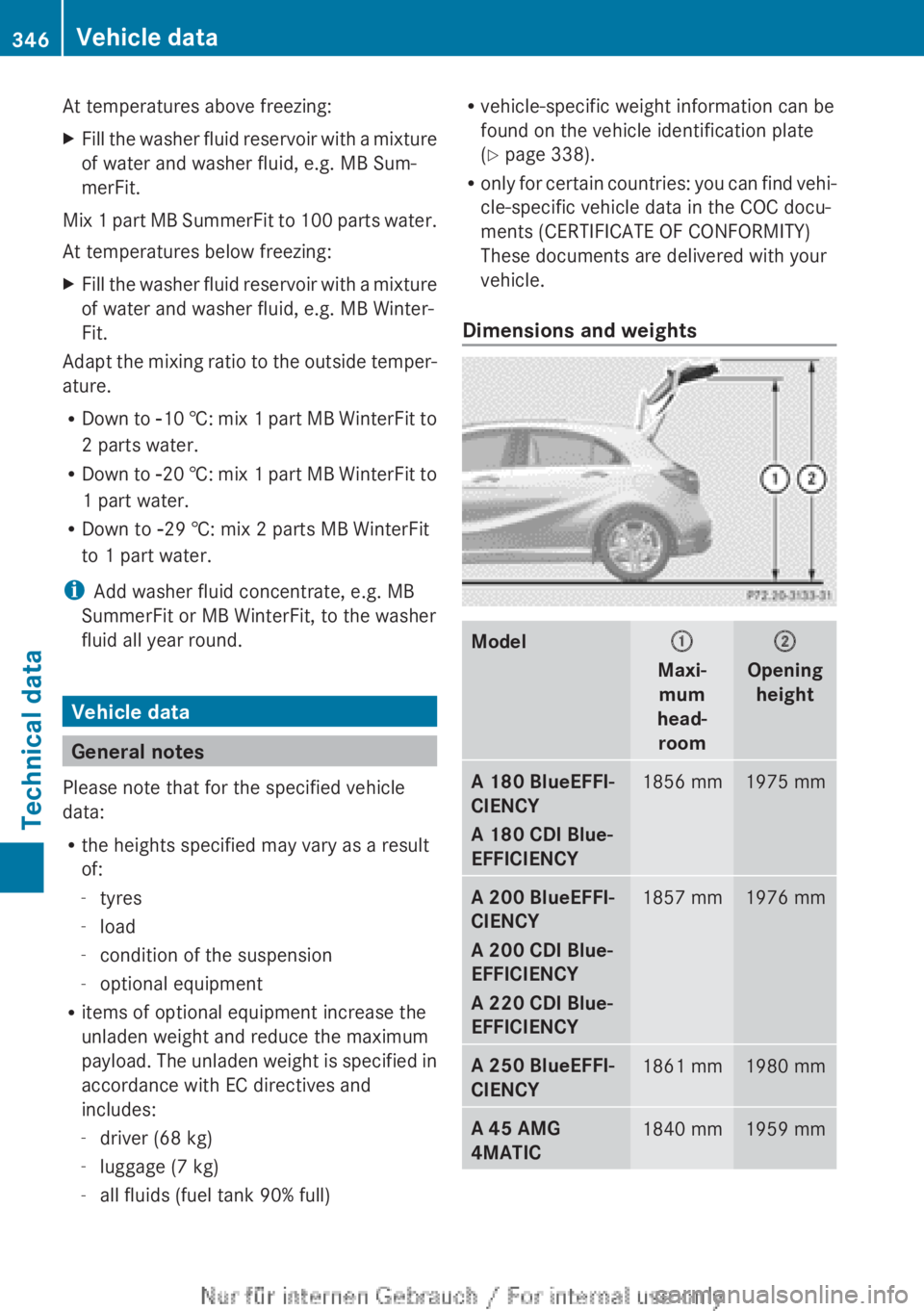
Dimensions and weights Model :
Maxi- mum
head- room ;
Opening height A 180 BlueEFFI-
CIENCY
A 180 CDI Blue-
EFFICIENCY
1856 mm 1975 mm
A 200 BlueEFFI-
CIENCY
A 200 CDI Blue-
EFFICIENCY
A 220 CDI Blue-
EFFICIENCY
1857 mm 1976 mm
A 250 BlueEFFI-
CIENCY
1861 mm 1980 mm
A 45 AMG
4MATIC
1840 mm 1959 mm346
Vehicle data
Technical data