height MERCEDES-BENZ A-CLASS HATCHBACK 2008 User Guide
[x] Cancel search | Manufacturer: MERCEDES-BENZ, Model Year: 2008, Model line: A-CLASS HATCHBACK, Model: MERCEDES-BENZ A-CLASS HATCHBACK 2008Pages: 305, PDF Size: 5.43 MB
Page 158 of 305
Loading and stowing
155
X
To fit: insert the luggage compartment
floor into the guide rail at an angle of
approximately 45°.
X Fold the luggage compartment floor down.
Opening/closing the luggage compart-
ment floor (vehicles with variable lug-
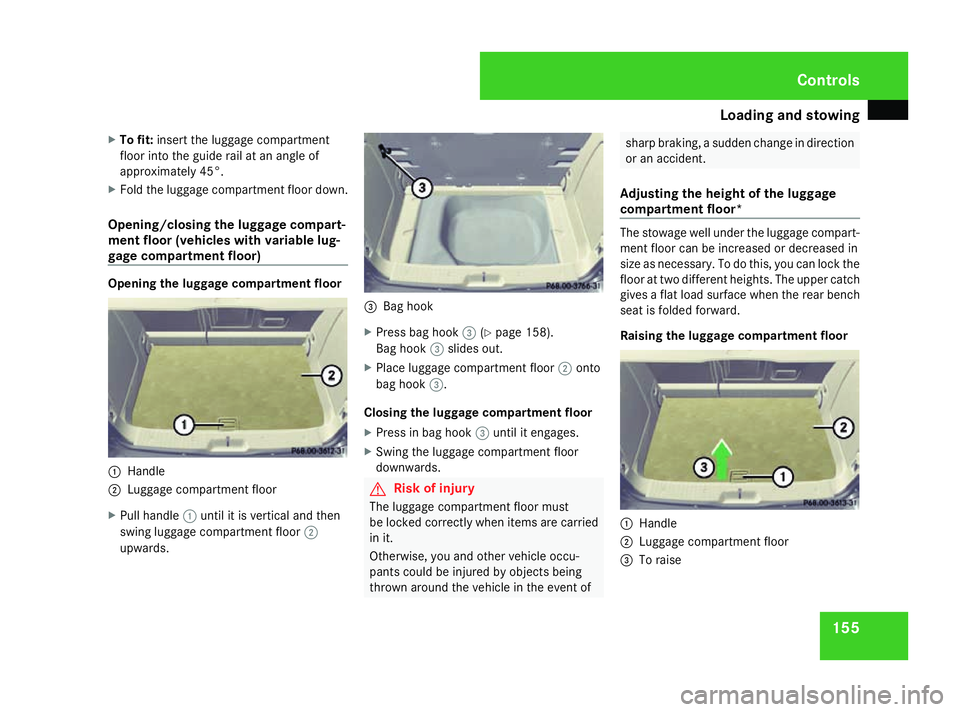
gage compartment floor) Opening the luggage compartment floor
1
Handle
2 Luggage compartment floor
X Pull handle 1until it is vertical and then
swing luggage compartment floor 2
upwards. 3
Bag hook
X Press bag hook 3(Ypage 158).
Bag hook 3slides out.
X Place luggage compartment floor 2onto
bag hook 3.
Closing the luggage compartment floor
X Press in bag hook 3until it engages.
X Swing the luggage compartment floor
downwards. G
Risk of injury
The luggage compartment floor must
be locked correctly when items are carried
in it.
Otherwise, you and other vehicle occu-
pants could be injured by objects being
thrown around the vehicle in the event of sharp braking, a sudden change in direction
or an accident.
Adjusting the height of the luggage
compartment floor* The stowage well under the luggage compart-
ment floor can be increased or decreased in
size as necessary. To do this, you can lock the
floor at two different heights. The upper catch
gives a flat load surface when the rear bench
seat is folded forward.
Raising the luggage compartment floor
1
Handle
2 Luggage compartment floor
3 To raise Controls
169_AKB; 2; 4, en-GB
wdomann,
Version: 2.10.6 2008-07-16T08:52:06+02:00 - Seite 155 ZDateiname: 6515_0315_02_buchblock.pdf; preflight
Page 175 of 305
Engine compartment
172
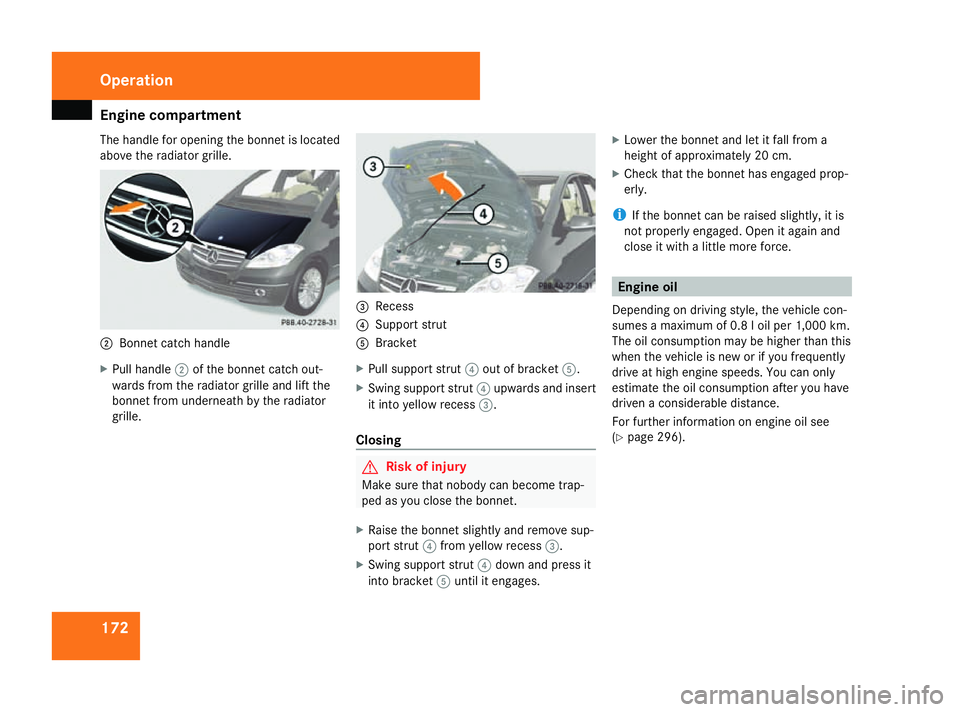
The handle for opening the bonnet is located
above the radiator grille. 2
Bonnet catch handle
X Pull handle 2of the bonnet catch out-
wards from the radiator grille and lift the
bonnet from underneath by the radiator
grille. 3
Recess
4 Support strut
5 Bracket
X Pull support strut 4out of bracket 5.
X Swing support strut 4upwards and insert
it into yellow recess 3.
Closing G
Risk of injury
Make sure that nobody can become trap-
ped as you close the bonnet.
X Raise the bonnet slightly and remove sup-
port strut 4from yellow recess 3.
X Swing support strut 4down and press it
into bracket 5until it engages. X
Lower the bonnet and let it fall from a
height of approximately 20 cm.
X Check that the bonnet has engaged prop-
erly.
i If the bonnet can be raised slightly, it is
not properly engaged. Open it again and
close it with a little more force. Engine oil
Depending on driving style, the vehicle con-
sumes a maximum of 0.8 l oil per 1,000 km.
The oil consumption may be higher than this
when the vehicle is new or if you frequently
drive at high engine speeds. You can only
estimate the oil consumption after you have
driven a considerable distance.
For further information on engine oil see
(Y page 296). Operation
169_AKB; 2; 4, en-GB
wdomann,
Version: 2.10.6 2008-07-16T08:52:06+02:00 - Seite 172Dateiname: 6515_0315_02_buchblock.pdf; preflight
Page 192 of 305
Trailer towing*
189
not use a noseweight of less than 50 kg,
otherwise the trailer may come loose.
Bear in mind that the payload and the rear
axle load are reduced by the actual nose-
weight.
i The height of the ball coupling changes
with the load of the vehicle. If necessary,
use a trailer with a height-adjustable draw-
bar.
Coupling up a trailer G
Risk of injury
Do not connect a trailer with an engaged
overrun brake. Otherwise, your hand could
become trapped between the bumper and
drawbar.
! Do not disconnect a trailer with an
engaged overrun brake. Otherwise your
vehicle could be damaged by the spring
action of the overrun brake.
X Position the trailer level behind the vehicle.
X Couple up the trailer.
X Establish the electrical connection
between the vehicle and the trailer. Driving tips In Germany, the maximum permitted speed
for vehicle/trailer combinations is 80 km/h.
G
Risk of accident
A maximum speed of 80 km/h should not
be exceeded, even in countries where
higher speeds are permitted for vehicle/
trailer combinations. This lowers the risk of
an accident.
When towing a trailer, your vehicle's handling
characteristics will be different in comparison
to when driving without a trailer.
The vehicle/trailer combination:
R is heavier
R is restricted in its acceleration and gradi-
ent-climbing capability
R has an increased braking distance
R is affected more by strong crosswinds
R demands more sensitive steering
R consumes more fuel
On long and steep downhill gradients, you
must select a lower gear in good time, or in
vehicles with AUTOTRONIC*, select shift
range 1,2or 3. i
This also applies if you have activated
cruise control* or Speedtronic*.
This will use the braking effect of the engine,
so less braking will be required to maintain
the speed. This relieves the load on the brake
system and prevents the brakes from over-
heating and wearing too quickly. If you need
additional braking, depress the brake pedal
repeatedly rather than continuously. G
Risk of accident
Never depress the brake pedal continu-
ously while the vehicle is in motion, e.g.
never cause the brakes to rub by applying
constant slight pedal pressure. This causes
the brake system to overheat, increases
the braking distance and can lead to the
brakes failing completely.
Driving tips
R Maintain a greater distance from the vehi-
cle in front than when driving without a
trailer.
R Avoid braking abruptly. If possible, brake
gently at first to allow the trailer to run on.
Then increase the braking force rapidly.
R The values given for gradient-climbing
capabilities from a standstill refer to sea
level. When driving in mountainous areas, Operation
* optional
169_AKB; 2; 4, en-GB
wdomann,
Version: 2.10.6 2008-07-16T08:52:06+02:00 - Seite 189 ZDateiname: 6515_0315_02_buchblock.pdf; preflight
Page 263 of 305

Flat tyre
2601
Wheel wrench
X Using wheel wrench 1, loosen the bolts on
the wheel you wish to change by about one
full turn. Do not unscrew the bolts com-
pletely.
Raising the vehicle G
Risk of injury
The jack is designed only to raise the vehi-
cle for a short time while a wheel is being
changed.
The vehicle must be placed on stands if you
intend to work under it.
Make sure that the jack is placed on a firm,
non-slip, level surface. Do not use wooden
blocks or similar objects as a jack underlay. Otherwise, the jack will not be able to ach-
ieve its load-bearing capacity due to the
restricted height.
Do not start the engine at any time while
the wheel is being changed.
Do not lie under the vehicle when it is being
supported by the jack. If you do not raise
the vehicle as described, it could slip off the
jack (e.g. if the engine is started or a door
or the tailgate is opened or closed) and you
could be seriously injured. G
Risk of accident
If you fail to position the jack correctly, the
vehicle may:
R slip off the jack
R injure you or others
R be damaged
Thus, it is important to make sure that the
jack is positioned correctly in the respec-
tive jacking points. Before positioning the
jack, remove any dirt that may have collec-
ted in the jacking points.
The jacking points for the jack are located
behind the wheel housings of the front wheels
and in front of the wheel housings of the rear
wheels. 1
Jacking point
2 Jack
3 Ratchet ring spanner with socket wrench
X Position jack 2at jacking point 1. Practical advice
169_AKB; 2; 4, en-GB
wdomann,
Version: 2.10.6
2008-07-16T08:52:06+02:00 - Seite 260 Dateiname: 6515_0315_02_buchblock.pdf; preflight
Page 289 of 305
Vehicle weights
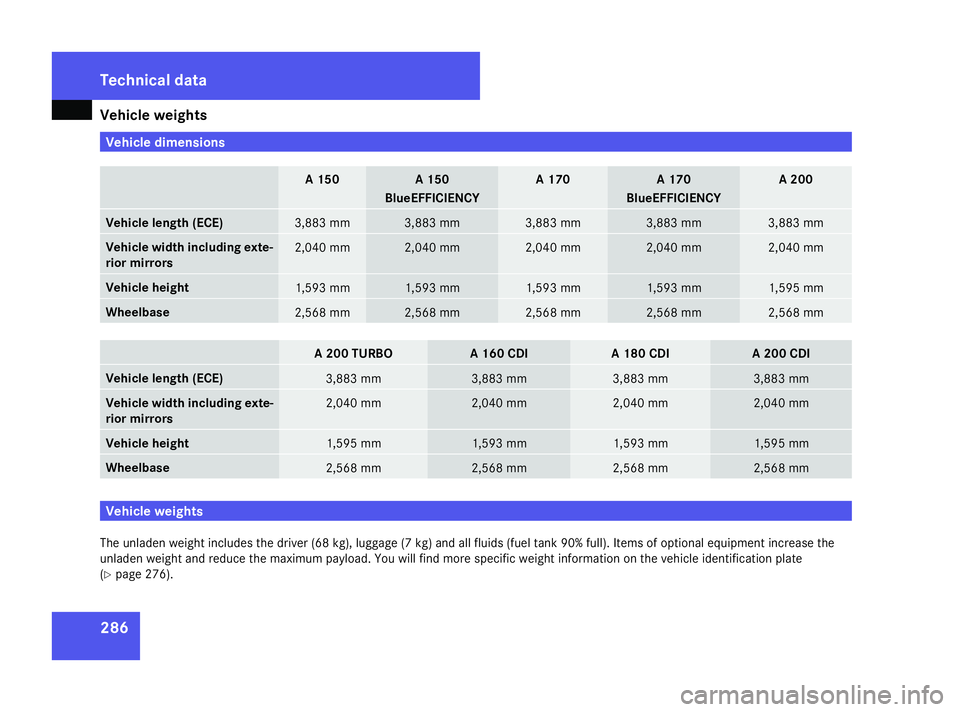
286 Vehicle dimensions
A 150 A 150
BlueEFFICIENCY A 170 A 170
BlueEFFICIENCY A 200
Vehicle length (ECE)
3,883 mm 3,883 mm 3,883 mm 3,883 mm 3,883 mm
Vehicle width including exte-
ri or mirrors 2,040 mm 2,040 mm 2,040 mm 2,040 mm 2,040 mm
Vehicle height
1,593 mm 1,593 mm 1,593 mm 1,593 mm 1,595 mm
Wheelbase
2,568 mm 2,568 mm 2,568 mm 2,568 mm 2,568 mm
A 200 TURBO A 160 CDI A 180 CDI A 200 CDI
Vehicle length (ECE)
3,883 mm 3,883 mm 3,883 mm 3,883 mm
Vehicle width including exte-
rior mirrors
2,040 mm 2,040 mm 2,040 mm 2,040 mm
Vehicle height
1,595 mm 1,593 mm 1,593 mm 1,595 mm
Wheelbase
2,568 mm 2,568 mm 2,568 mm 2,568 mm
Vehicle weights
The unladen weight includes the driver (68 kg), luggage (7 kg) and all fluids (fuel tank 90% full). Items of optional equipment increase the
unladen weight and reduce the maximum payload. You will find more specific weight information on the vehicle identification plate
(Y page 276). Technical data
169_AKB; 2; 4, en-GB
wdomann
,V ersion: 2.10.6
2008-07-16T08:52:06+02:00 - Seite 286 Dateiname: 6515_0315_02_buchblock.pdf; preflight