tow MERCEDES-BENZ A-CLASS HATCHBACK 2008 Manual PDF
[x] Cancel search | Manufacturer: MERCEDES-BENZ, Model Year: 2008, Model line: A-CLASS HATCHBACK, Model: MERCEDES-BENZ A-CLASS HATCHBACK 2008Pages: 305, PDF Size: 5.43 MB
Page 260 of 305
Flat tyre
257
X
Pull connector 4and air pump hose 5
from the housing.
X Screw air pump hose 5onto flange 6of
TIREFIT filler bottle 1.
X Place TIREFIT sealant filler bottle 1head
downwards into recess 2of the electric
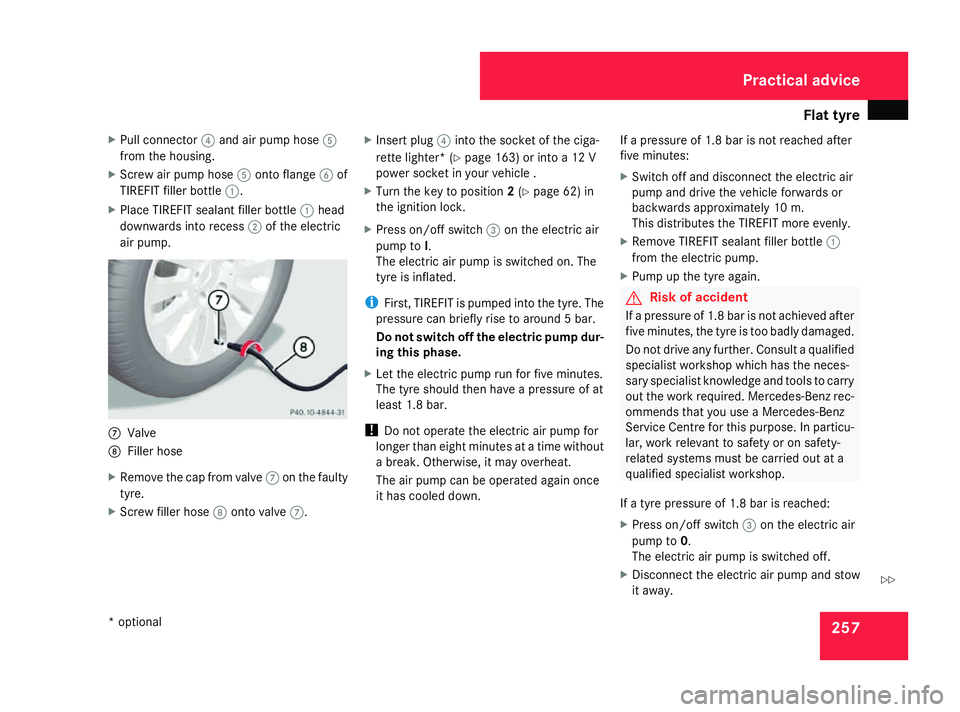
air pump. 7
Valve
8 Filler hose
X Remove the cap from valve 7on the faulty
tyre.
X Screw filler hose 8onto valve 7. X
Insert plug 4into the socket of the ciga-
rette lighter* (Y page 163) or into a 12 V
power socket in your vehicle .
X Turn the key to position 2(Y page 62) in
the ignition lock.
X Press on/off switch 3on the electric air
pump to I.
The electric air pump is switched on. The
tyre is inflated.
i First, TIREFIT is pumped into the tyre. The
pressure can briefly rise to around 5 bar.
Do not switch off the electric pump dur-
ing this phase.
X Let the electric pump run for five minutes.
The tyre should then have a pressure of at
least 1.8 bar.
! Do not operate the electric air pump for
longer than eight minutes at a time without
a break. Otherwise, it may overheat.
The air pump can be operated again once
it has cooled down. If a pressure of 1.8 bar is not reached after
five minutes:
X Switch off and disconnect the electric air
pump and drive the vehicle forwards or
backwards approximately 10 m.
This distributes the TIREFIT more evenly.
X Remove TIREFIT sealant filler bottle 1
from the electric pump.
X Pump up the tyre again. G
Risk of accident
If a pressure of 1.8 bar is not achieved after
five minutes, the tyre is too badly damaged.
Do not drive any further. Consult a qualified
specialist workshop which has the neces-
sary specialist knowledge and tools to carry
out the work required. Mercedes-Benz rec-
ommends that you use a Mercedes-Benz
Service Centre for this purpose. In particu-
lar, work relevant to safety or on safety-
related systems must be carried out at a
qualified specialist workshop.
If a tyre pressure of 1.8 bar is reached:
X Press on/off switch 3on the electric air
pump to 0.
The electric air pump is switched off.
X Disconnect the electric air pump and stow
it away. Practical advice
* optional
169_AKB; 2; 4, en-GB
wdomann
, Version: 2.10.6 2008-07-16T08:52:06+02:00 - Seite 257 ZDateiname: 6515_0315_02_buchblock.pdf; preflight
Page 261 of 305
Flat tyre
258
X
Fold up the warning triangle and stow it
away.
X Pull away immediately.
This distributes the TIREFIT more evenly
around the tyre.
X Stop after driving for approximately ten
minutes and check the tyre pressure with
the electric air pump. G
Risk of accident
If the tyre pressure is now lower than
1.3 bar, the tyre is too badly damaged. Do
not drive any further. Consult a qualified
specialist workshop which has the neces-
sary specialist knowledge and tools to carry
out the work required. Mercedes-Benz rec-
ommends that you use a Mercedes-Benz
Service Centre for this purpose. In particu-
lar, work relevant to safety or on safety-
related systems must be carried out at a
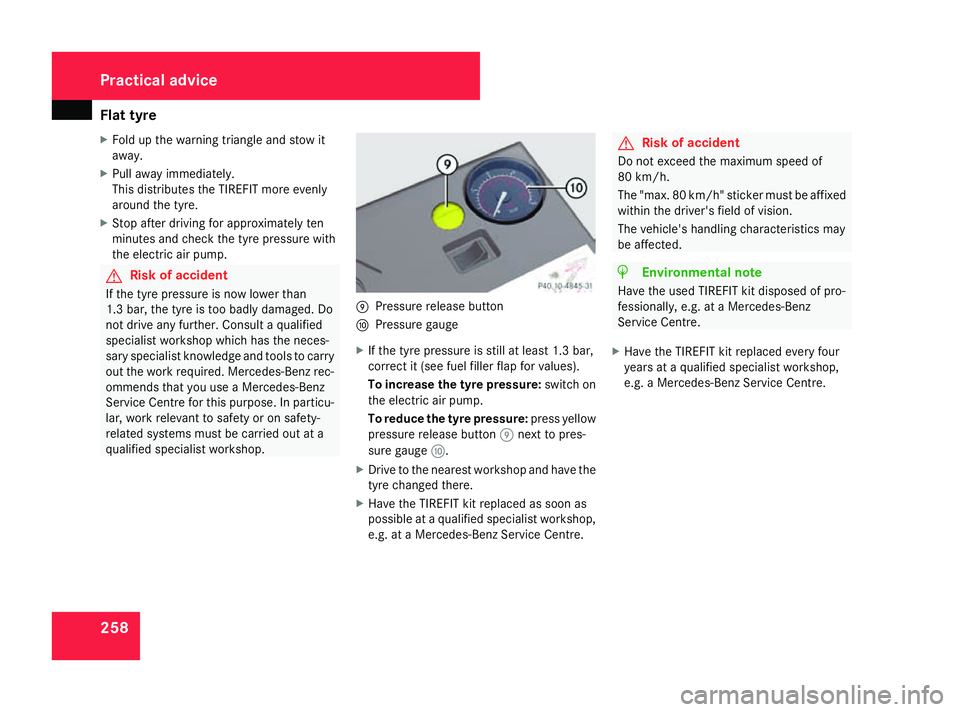
qualified specialist workshop. 9
Pressure release button
a Pressure gauge
X If the tyre pressure is still at least 1.3 bar,
correct it (see fuel filler flap for values).
To increase the tyre pressure: switch on
the electric air pump.
To reduce the tyre pressure: press yellow
pressure release button 9next to pres-
sure gauge a.
X Drive to the nearest workshop and have the
tyre changed there.
X Have the TIREFIT kit replaced as soon as
possible at a qualified specialist workshop,
e.g. at a Mercedes-Benz Service Centre. G
Risk of accident
Do not exceed the maximum speed of
80 km/h.
The "max. 80 km/h "sticker must be affixed
within the driver's field of vision.
The vehicle's handling characteristics may
be affected. H
Environmental note
Have the used TIREFIT kit disposed of pro-
fessionally, e.g. at a Mercedes-Benz
Service Centre.
X Have the TIREFIT kit replaced every four
years at a qualified specialist workshop,
e.g. a Mercedes-Benz Service Centre. Practical advice
169_AKB; 2; 4, en-GB
wdomann,
Version: 2.10.6
2008-07-16T08:52:06+02:00 - Seite 258 Dateiname: 6515_0315_02_buchblock.pdf; preflight
Page 262 of 305
Flat tyre
259Changing a wheel/fitting the spare
wheel*
G
Risk of accident
The wheel dimensions and tyre size of the
"Minispare" emergency spare wheel* may
differ from those of the standard wheels.
Your vehicle's handling characteristics will
change when a "Minispare" emergency
spare wheel* is fitted. Adapt your style of
driving accordingly.
The "Minispare" emergency spare wheel*
may only be used for a short time. Do not
exceed the maximum speed of 80 km/h
and do not deactivate ESP ®
.
Never drive the vehicle with more than one
"Minispare" emergency spare wheel* fit-
ted. G
Risk of accident
Have the "Minispare" emergency spare
wheel* or the spare wheel* replaced with
a new wheel as soon as possible at a quali-
fied specialist workshop which has the nec-
essary specialist knowledge and tools to
carry out the work required. Mercedes-
Benz recommends that you use a
Mercedes-Benz Service Centre for this pur- pose. In particular, work relevant to safety
or on safety-related systems must be car-
ried out at a qualified specialist workshop.
Preparing the vehicle X
Prepare the vehicle as described
(Y page 253).
X If a trailer is coupled, uncouple it.
X Place the wheels in the straight-ahead posi-
tion.
X Take the "Minispare" emergency spare
wheel* or the spare wheel* out of the stow-
age well under the luggage compartment
floor.
X Take the following out of the left-hand
stowage compartment in the luggage com-
partment
R
the vehicle tool kit
R the wheel chock
R the jack
X Secure the vehicle to prevent it from rolling
away.
On level ground: place chocks or similar
items under the front and rear of the wheel
that is diagonally opposite the wheel you
wish to change. X
On downhill gradients: place chocks or
similar behind both wheels of the other
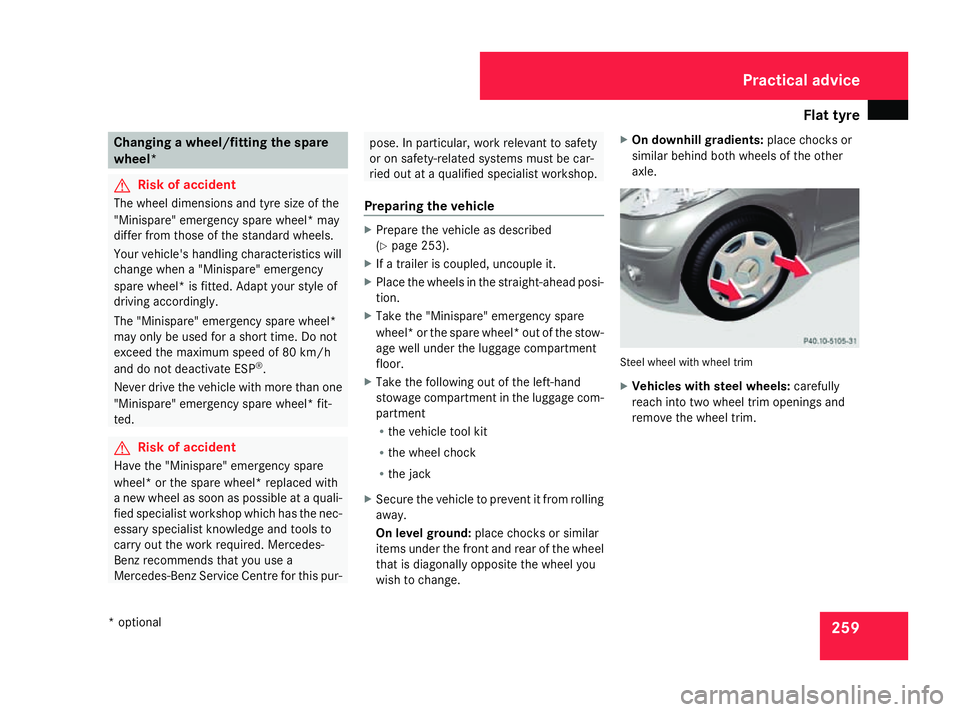
axle. Steel wheel with wheel trim
X
Vehicles with steel wheels: carefully
reach into two wheel trim openings and
remove the wheel trim. Practical advice
* optional
169_AKB; 2; 4, en-GB
wdomann, Version: 2.10.6 2008-07-16T08:52:06+02:00 - Seite 259 ZDateiname: 6515_0315_02_buchblock.pdf; preflight
Page 265 of 305
Flat tyre
262
Lowe
ring the vehicle X
Place the ratchet ring spanner onto the
hexagon nut of the jack so that the lettering
AB is visible.
X Lower the vehicle by turning the ratchet
ring spanner until the vehicle is once again
standing firmly on the ground.
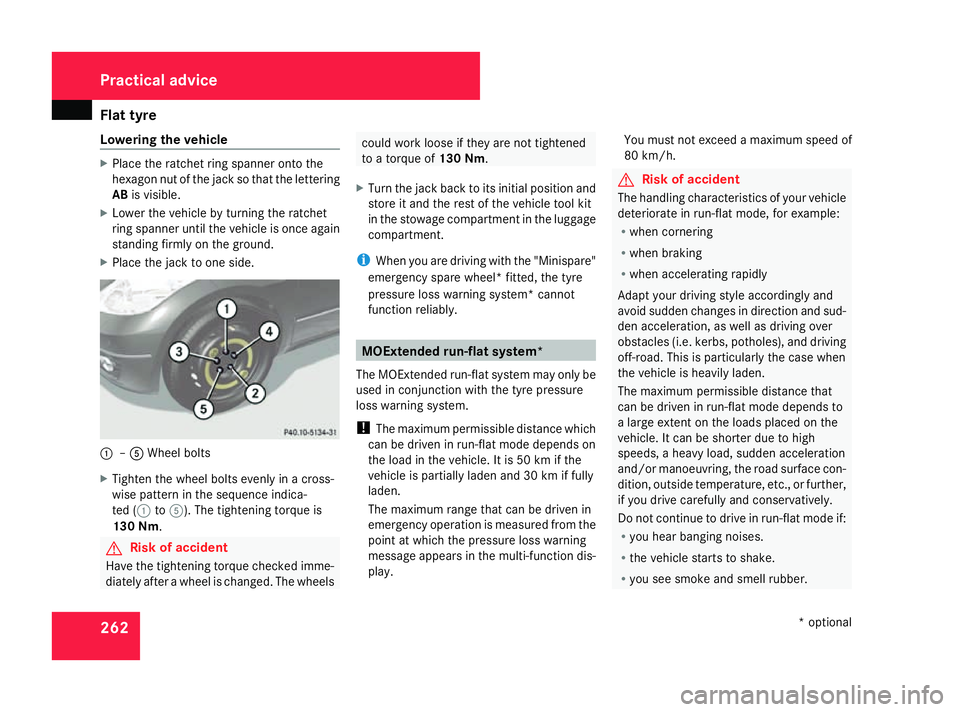
X Place the jack to one side. 1
–5 Wheel bolts
X Tighten the wheel bolts evenly in a cross-
wise pattern in the sequence indica-
ted (1 to5). The tightening torque is
130 Nm . G
Risk of accident
Have the tightening torque checked imme-
diately after a wheel is changed. The wheels could work loose if they are not tightened
to a torque of 130 Nm.
X Turn the jack back to its initial position and
store it and the rest of the vehicle tool kit
in the stowage compartment in the luggage
compartment.
i When you are driving with the "Minispare"
emergency spare wheel* fitted, the tyre
pressure loss warning system* cannot
function reliably. MOExtended run-flat system*
The MOExtended run-flat system may only be
used in conjunction with the tyre pressure
loss warning system.
! The maximum permissible distance which
can be driven in run-flat mode depends on
the load in the vehicle. It is 50 km if the
vehicle is partially laden and 30 km if fully
laden.
The maximum range that can be driven in
emergency operation is measured from the
point at which the pressure loss warning
message appears in the multi-function dis-
play. You must not exceed a maximum speed of
80 km/h. G
Risk of accident
The handling characteristics of your vehicle
deteriorate in run-flat mode, for example:
R when cornering
R when braking
R when accelerating rapidly
Adapt your driving style accordingly and
avoid sudden changes in direction and sud-
den acceleration, as well as driving over
obstacles (i.e. kerbs, potholes), and driving
off-road. This is particularly the case when
the vehicle is heavily laden.
The maximum permissible distance that
can be driven in run-flat mode depends to
a large extent on the loads placed on the
vehicle. It can be shorter due to high
speeds, a heavy load, sudden acceleration
and/or manoeuvring, the road surface con-
dition, outside temperature, etc., or further,
if you drive carefully and conservatively.
Do not continue to drive in run-flat mode if:
R you hear banging noises.
R the vehicle starts to shake.
R you see smoke and smell rubber. Practical advice
* optional
169_AKB; 2; 4, en-GB
wdomann
,V ersion: 2.10.6
2008-07-16T08:52:06+02:00 - Seite 262 Dateiname: 6515_0315_02_buchblock.pdf; preflight
Page 271 of 305
Towing and tow-starting
268 Towing and tow-starting
Points to remember
G
Risk of accident
If you have the vehicle towed, you must use
a rigid towing bar if:
R the engine is not running.
R there is a brake system malfunction.
R there is a malfunction in the voltage sup-
ply or the vehicle's electrical system.
The electric power steering and the brake
force booster do not work when the engine
is not running. Greater braking force will
then be required and brake pedal travel will
be longer. If necessary, depress the brake
pedal with full force.
Do not tow the vehicle if the key cannot be
turned in the ignition lock. If this is the case,
the steering is locked and the vehicle can-
not be steered.
If you tow or tow-start another vehicle, its
weight must not exceed the maximum per-
missible gross vehicle weight of your vehi-
cle.
It is better to have the vehicle transported
than to have it towed. When towing, observe the legal requirements
in all countries concerned.
!
When towing, pull away slowly and with-
out jerking. If the tractive power is too high,
the vehicles could be damaged.
! Do not use the towing eye for recovery,
as this could damage the vehicle. If in
doubt, recover the vehicle with a crane.
! You may tow the vehicle for a maximum
of 50 km. A towing speed of 50 km/h must
not be exceeded.
With towing distances over 50 km, the
entire vehicle needs to be lifted up and
transported.
! Only secure the tow cable or towing bar
to the towing eyes. You may otherwise
damage the vehicle.
R Vehicles with AUTOTRONIC* must not be
tow-started.
R If the engine does not start, try jump-start-
ing it (Y page 266).
R If it is not possible to jump-start the vehicle,
have it towed to the nearest qualified spe-
cialist workshop, e.g. a Mercedes-Benz
Service Centre. R
The selector lever must be in position N
when towing a vehicle with AUTO-
TRONIC*.
R If you are towing the vehicle over a consid-
erable distance, this must only be done
with the front axle raised.
R The ignition must be switched off if you are
towing the vehicle with the front/rear axle
raised. Intervention by ESP ®
could other-
wise damage the brake system.
R Before towing the vehicle, make sure that
the battery is connected and charged. Oth-
erwise:
-you cannot switch on the ignition
- you cannot move the selector lever
to N(on vehicles with AUTOTRONIC*)
- you have no support when braking
i Switch off the automatic locking feature
before the vehicle is towed (Y page 111).
You could otherwise be locked out when
pushing or towing the vehicle. Practical advice
* optional
169_AKB; 2; 4, en-GB
wdomann,
Version: 2.10.6
2008-07-16T08:52:06+02:00 - Seite 268 Dateiname: 6515_0315_02_buchblock.pdf; preflight
Page 272 of 305
Towing and tow-starting
269Fitting the towing eye
Vehicles with a trailer tow hitch: if you
intend to use the vehicle for towing, fit the ball
coupling (Y page 186) and connect the tow-
bar to this.
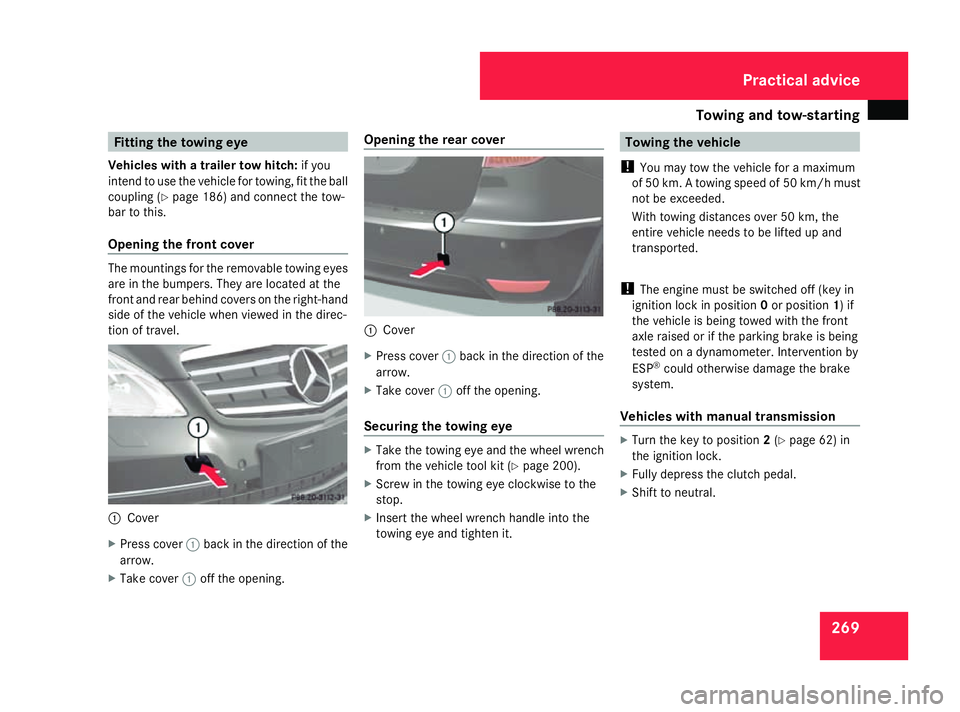
Opening the front cover The mountings for the removable towing eyes
are in the bumpers. They are located at the
front and rear behind covers on the right-hand
side of the vehicle when viewed in the direc-
tion of travel.
1
Cover
X Press cover 1back in the direction of the
arrow.
X Take cover 1off the opening. Opening the rear cover
1
Cover
X Press cover 1back in the direction of the
arrow.
X Take cover 1off the opening.
Securing the towing eye X
Take the towing eye and the wheel wrench
from the vehicle tool kit ( Ypage 200).
X Screw in the towing eye clockwise to the
stop.
X Insert the wheel wrench handle into the
towing eye and tighten it. Towing the vehicle
! You may tow the vehicle for a maximum
of 50 km. A towing speed of 50 km/h must
not be exceeded.
With towing distances over 50 km, the
entire vehicle needs to be lifted up and
transported.
! The engine must be switched off (key in
ignition lock in position 0or position 1) if
the vehicle is being towed with the front
axle raised or if the parking brake is being
tested on a dynamometer. Intervention by
ESP ®
could otherwise damage the brake
system.
Vehicles with manual transmission X
Turn the key to position 2(Y page 62) in
the ignition lock.
X Fully depress the clutch pedal.
X Shift to neutral. Practical advice
169_AKB; 2; 4, en-GB
wdomann,
Version: 2.10.6 2008-07-16T08:52:06+02:00 - Seite 269 ZDateiname: 6515_0315_02_buchblock.pdf; preflight
Page 273 of 305
Towing and tow-starting
270
Vehicles with AUTOTRONIC* X
Turn the key to position 2in the ignition
lock.
X Move the selector lever to N.Tow-starting (emergency engine
starting)
Please note:
R Vehicles with AUTOTRONIC* must not be
tow-started.
R The battery must be connected.
R The engine and catalytic converter must be
cold.
R Avoid repeated and lengthy starting
attempts.
Vehicles with manual transmission X
Turn the key to position 2(Y page 62) in
the ignition lock.
X Fully depress the clutch pedal.
X Shift to neutral. X
Tow the vehicle or let it roll.
X Shift to a suitable gear and bring the clutch
pedal up slowly. Do not depress the accel-
erator pedal.
The engine is started. Removing the towing eye
X Take the wheel wrench from the vehicle
tool kit ( Ypage 200).
X Insert the wheel wrench handle into the
towing eye and turn it anti-clockwise.
X Unscrew the towing eye.
X Replace the cover and press it until it
engages.
X Return the towing eye and the wheel
wrench to the vehicle tool kit. Transporting the vehicle
The towing eyes or trailer coupling *can be
used to pull the vehicle onto a trailer or trans-
porter if you wish to transport it.
! Only lash the vehicle down by the wheels
or wheel rims, not by parts of the vehicle
such as axle or steering components. The
vehicle could otherwise be damaged.
Vehicles with manual transmission X
Shift to neutral.
Vehicles with AUTOTRONIC* X
Turn the key to position 2(Y page 62) in
the ignition lock.
X Move the selector lever to N.Practical advice
* optional
169_AKB; 2; 4, en-GB
wdomann,
Version: 2.10.6
2008-07-16T08:52:06+02:00 - Seite 270 Dateiname: 6515_0315_02_buchblock.pdf; preflight
Page 279 of 305

Vehicle identification plates
276phones/wireless devices in the vehicle.
This also ensures that interference
between these devices and the vehicle's
electronics is kept to a minimum. If instal-
led, the exterior aerial conducts the elec-
tromagnetic fields transmitted by a mobile
phone to the exterior of the vehicle. Frequency range Maximum trans-
mission output
(watts)
Short wave
(< 50 MHz) 100
4 m waveband 20
2 m waveband 50
70 cm waveband 35
25 cm waveband 10
!
If electrical or electronic equipment
which does not comply with the above
installation conditions is operated inside
the vehicle, the vehicle's operating permit
may be invalidated (EU Directive
95/54/EC - Automotive EMC directive) Vehicle identification plates
Vehicle identification plate with vehi-
cle identification number (VIN) and
paint code number
The vehicle identification plate is located at
the bottom of the door frame on the front-
passenger side. 1
Vehicle identification plate
X Open the driver's door.
You will see vehicle identification plate
1. Vehicle identification plate (example)
1
Vehicle identification plate
2 Vehicle manufacturer
3 EU type approval number
4 Vehicle identification number (VIN)
5 Maximum permissible gross vehicle
weight
6 Maximum permissible towing weight
7 Maximum permissible front axle load
8 Maximum permissible rear axle load
9 Paint code number Technical data
169_AKB; 2; 4, en-GB
wdomann,
Version: 2.10.6 2008-07-16T08:52:06+02:00 - Seite 276Dateiname: 6515_0315_02_buchblock.pdf; preflight
Page 293 of 305
Trailer coupling*
290 Trailer coupling*
Mounting dimensions
G
Risk of accident
Only have a trailer tow hitch retrofitted at a
qualified specialist workshop which has the
necessary specialist knowledge and tools
to carry out the work required. Mercedes-
Benz recommends that you use a
Mercedes-Benz Service Centre for this pur-
pose. In particular, work relevant to safety
or on safety-related systems must be car-
ried out at a qualified specialist workshop.
! If you have a trailer tow hitch retrofitted,
changes to the cooling system may be nec-
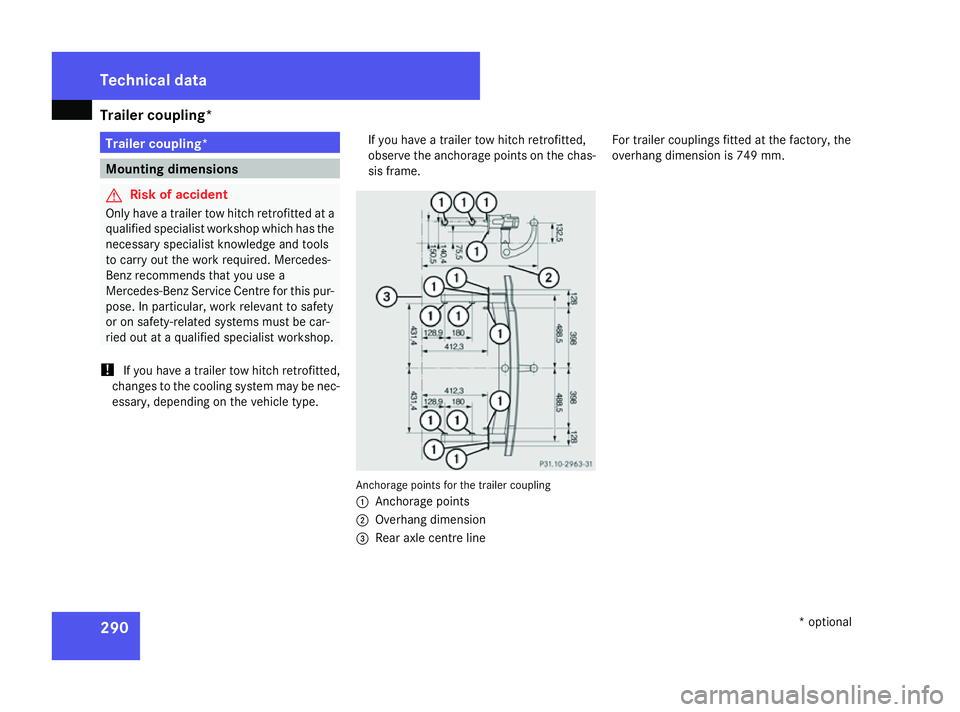
essary, depending on the vehicle type. If you have a trailer tow hitch retrofitted,
observe the anchorage points on the chas-
sis frame.
Anchorage points for the trailer coupling
1
Anchorage points
2 Overhang dimension
3 Rear axle centre line For trailer couplings fitted at the factory, the
overhang dimension is 749 mm.Te
chnical da ta
* optional
169_AKB; 2; 4, en-GB
wdomann,
Version: 2.10.6 2008-07-16T08:52:06+02:00 - Seite 290Dateiname: 6515_0315_02_buchblock.pdf; preflight
Page 296 of 305
Service products and capacities
293
adding the wrong fuel is not covered by the
warranty.
More information about refuelling and fuels
can be found on (Y page 168). Introduction to fuel consumption
The vehicle will use more fuel than usual in
the following situations:
R at very low temperatures
R in urban traffic
R on short trips
R when towing a trailer
R in mountainous terrain The consumption figures have been deter-
mined according to EU Directive
RL 80
/1268 /EEC.
i Only for certain countries: the respective
current consumption and emission values
of your vehicle can be found in the COC
papers (EC-CERTIFICATE OF CONFORM-
ITY). These documents are supplied when
the vehicle is delivered.
! Do not use any special additives, as they
can cause malfunctions and engine dam-
age. Damage resulting from the use of such
additives is not covered by the Mercedes-
Benz warranty. H
Environmental note
CO 2(carbon dioxide) is the gas which sci-
entists believe to be principally responsible
for global warming (the greenhouse effect).
Your vehicle's CO 2emissions are directly
related to fuel consumption and therefore
depend on:
R efficient use of the fuel by the engine
R driving style
R other non-technical factors, such as envi-
ronmental influences or road conditions
You can minimise your vehicle's CO 2emis-
sions by driving carefully and having it serv-
iced regularly. Technical data
169_AKB; 2; 4, en-GB
wdomann,
Version: 2.10.6 2008-07-16T08:52:06+02:00 - Seite 293 ZDateiname: 6515_0315_02_buchblock.pdf; preflight