wheel MERCEDES-BENZ A-CLASS HATCHBACK 2008 Manual PDF
[x] Cancel search | Manufacturer: MERCEDES-BENZ, Model Year: 2008, Model line: A-CLASS HATCHBACK, Model: MERCEDES-BENZ A-CLASS HATCHBACK 2008Pages: 305, PDF Size: 5.43 MB
Page 214 of 305
Display
messages 211Display messages Possible cause/consequence Possible solution
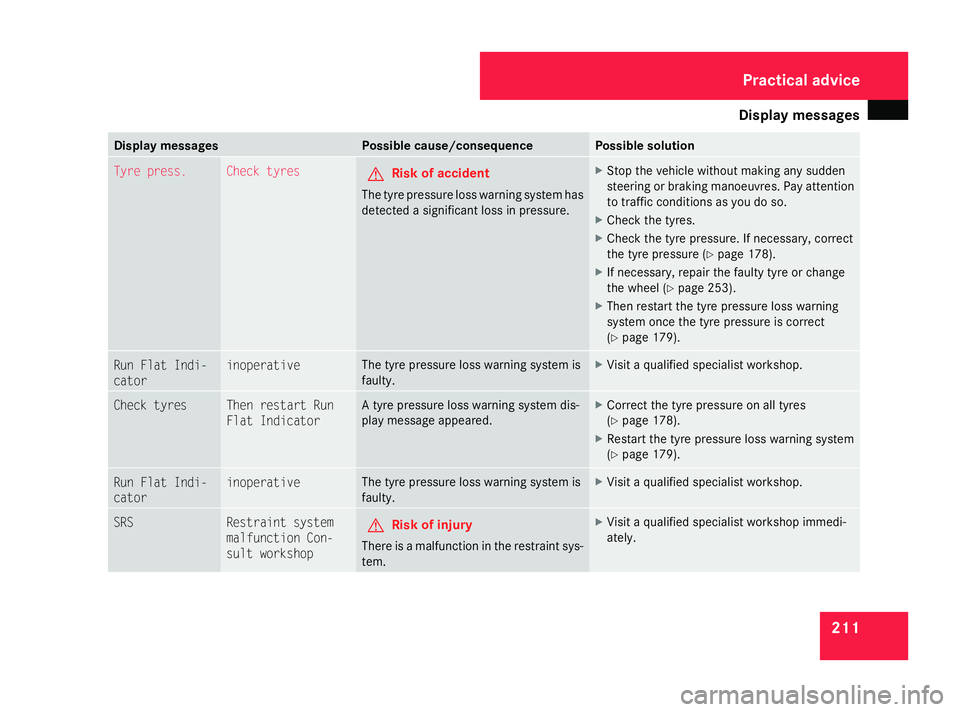
Tyre press. Check tyres
G
Risk of accident
The tyre pressure loss warning system has
detected a significant loss in pressure. X
Stop the vehicle witho ut making any sudden
steering or braking manoeuvres. Pay attention
to traffic conditions as you do so.
X Check the tyres.
X Check the tyre pressure. If necessary, correct
the tyre pressure (Y page 178).
X If necessary, repair the faulty tyre or change
the wheel ( Ypage 253).
X Then restart the tyre pressure loss warning
system once the tyre pressure is correct
(Y page 179). Run Flat Indi-
cator inoperative The tyre pressure loss warning system is
faulty. X
Visit a qualified specialist workshop. Check tyres Then restart Run
Flat Indicator A tyre pressure loss warning system dis-
play message appeared. X
Correct the tyre pressure on all tyres
(Y page 178).
X Restart the tyre pressure loss warning system
(Y page 179). Run Flat Indi-
cator inoperative The tyre pressure loss warning system is
faulty. X
Visit a qualified specialist workshop. SRS Restraint system
malfunction Con-
sult workshop G
Risk of injury
There is a malfunction in the restraint sys-
tem. X
Visit a qualified specialist workshop immedi-
ately. Practical advice
169_AKB; 2; 4, en-GB
wdomann
,V ersion: 2.10.6
2008-07-16T08:52:06+02:00 - Seite 211 ZDateiname: 6515_0315_02_buchblock.pdf; preflight
Page 227 of 305
Troubleshooting
224 Warning and indicator lamps in the instrument cluster
Problem Possible cause/consequence Suggested solutions
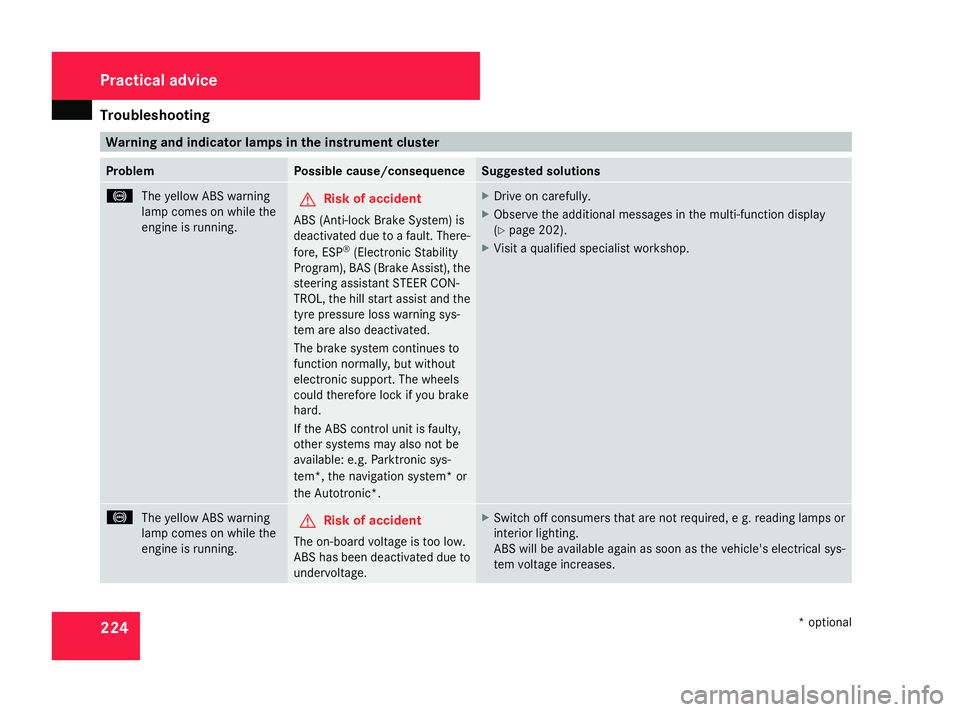
-
Theyellow ABS warning
lamp comes on while the
engine is running. G
Risk of accident
ABS (Anti-lock Brake System) is
deactivated due to a fault. There-
fore, ESP ®
(Electronic Stability
Program), BAS (Brake Assist), the
steering assistant STEER CON-
TROL, the hill start assist and the
tyre pressure loss warning sys-
tem are also deactivated.
The brake system continues to
function normally, but without
electronic support. The wheels
could therefore lock if you brake
hard.
If the ABS control unit is faulty,
other systems may also not be
available: e.g. Parktronic sys-
tem*, the navigation system* or
the Autotronic*. X
Drive on carefully.
X Observe the additional messages in the multi-function display
(Y page 202).
X Visit a qualified specialist workshop. -
The yellow ABS warning
lamp comes on while the
engine is running. G
Risk of accident
The on-board voltage is too low.
ABS has been deactivated due to
undervoltage. X
Switch off consumers that are not required, e g. reading lamps or
interior lighting.
ABS will be available again as soon as the vehicle's electrical sys-
tem voltage increases. Practical advice
* optional
169_AKB; 2; 4, en-GB
wdomann
,V ersion: 2.10.6
2008-07-16T08:52:06+02:00 - Seite 224 Dateiname: 6515_0315_02_buchblock.pdf; preflight
Page 228 of 305
Troubleshooting
225Problem Possible cause/consequence Suggested solutions
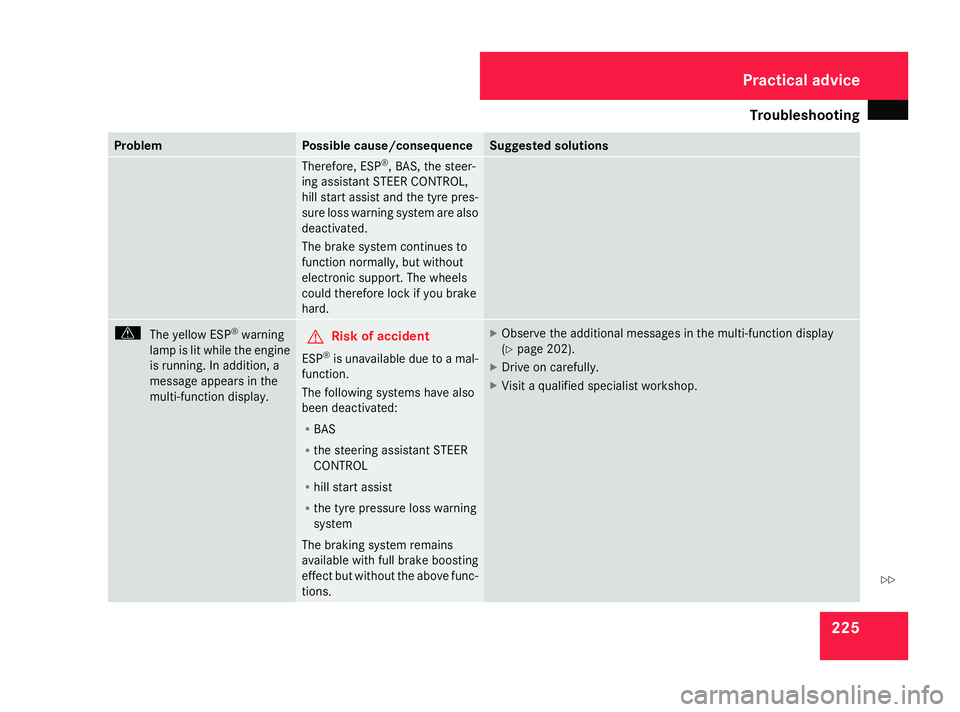
Therefore, ESP
®
, BAS, the steer-
ing assistant STEER CONTROL,
hill start assist and the tyre pres-
sure loss warning system are also
deactivated.
The brake system continues to
function normall y, but without
electronic support. The wheels
could therefore lock if you brake
hard. v
The yellow ESP ®
warning
lamp is lit while the engine
is running. In addition, a
message appears in the
multi-function display. G
Risk of accident
ESP ®
is unavailable due to a mal-
function.
The following systems have also
been deactivated:
R BAS
R the steering assistant STEER
CONTROL
R hill start assist
R the tyre pressure loss warning
system
The braking system remains
available with full brake boosting
effect but without the above func-
tions. X
Observe the additional messages in the multi-function display
(Y page 202).
X Drive on carefully.
X Visit a qualified specialist workshop. Practical advice
169_AKB; 2; 4, en-GB
wdomann
,V ersion: 2.10.6
2008-07-16T08:52:06+02:00 - Seite 225 ZDateiname: 6515_0315_02_buchblock.pdf; preflight
Page 229 of 305
Troubleshooting
226 Problem Possible cause/consequence Suggested solutions
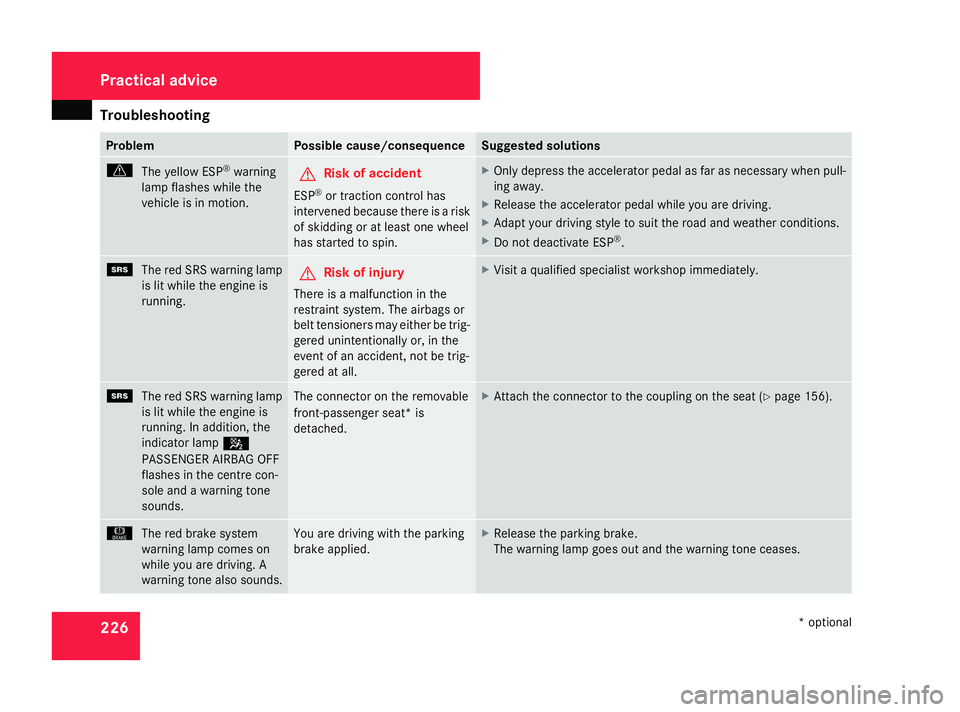
v
Theyellow ESP ®
warning
lamp flashes while the
vehicle is in motion. G
Risk of accident
ESP ®
or traction control has
intervened because there is a risk
of skidding or at least one wheel
has started to spin. X
Only depress the accelerator pedal as far as necessary when pull-
ing away.
X Release the accelerator pedal while you are driving.
X Adapt your driving style to suit the road and weather conditions.
X Do not deactivate ESP ®
. 1
The red SRS warning lamp
is lit while the engine is
running. G
Risk of injury
There is a malfunction in the
restraint system. The airbags or
belt tensioners may either be trig-
gered unintentionally or, in the
event of an accident, not be trig-
gered at all. X
Visit a qualified specialist workshop immediately. 1
The red SRS warning lamp
is lit while the engine is
running. In addition, the
indicator lamp 5
PASSENGER AIRBAG OFF
flashes in the centre con-
sole and a warning tone
sounds. The connector on the removable
front-passenger seat* is
detached. X
Attach the connector to the coupling on the seat (Y page 156).H
The red brake system
warning lamp comes on
while you are driving. A
warning tone also sounds. You are driving with the parking
brake applied. X
Release the parking brake.
The warning lamp goes out and the warning tone ceases. Practical advice
* optional
169_AKB; 2; 4, en-GB
wdomann
,V ersion: 2.10.6
2008-07-16T08:52:06+02:00 - Seite 226 Dateiname: 6515_0315_02_buchblock.pdf; preflight
Page 242 of 305
Troubleshooting
239Key
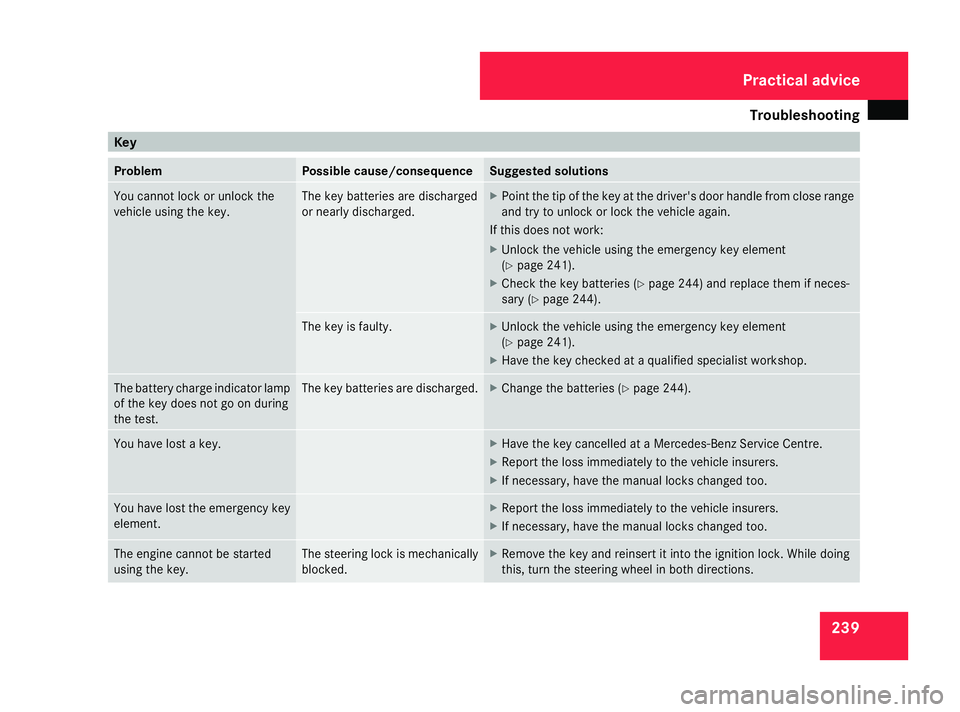
Problem Possible cause/consequence Suggested solutions
You cannot lock or unlock the
vehicle using the key. The key batteries are discharged
or nearl
y discharged. X
Point the tip of the key at the driver's door handle from close range
and try to unlock or lock the vehicle again.
If this does not work:
X Unlock the vehicle using the emergency key element
(Y page 241).
X Check the key batteries (Y page 244) and replace them if neces-
sary ( Ypage 244). The key is faulty. X
Unlock the vehicle using the emergency key element
(Y page 241).
X Have the key checked at a qualified specialist workshop. The battery charge indicator lamp
of the key does not go on during
the test. The key batteries are discharged. X
Change the batteries ( Ypage 244). You have lost a key. X
Have the key cancelled at a Mercedes-Benz Service Centre.
X Report the loss immediately to the vehicle insurers.
X If necessary, have the manual locks changed too. You have lost the emergency key
element. X
Report the loss immediately to the vehicle insurers.
X If necessary, have the manual locks changed too. The engine cannot be started
using the key. The steering lock is mechanically
blocked. X
Remove the key and reinsert it into the ignition lock. While doing
this, turn the steering wheel in both directions. Practical advice
169_AKB; 2; 4, en-GB
wdomann
,V ersion: 2.10.6
2008-07-16T08:52:06+02:00 - Seite 239 ZDateiname: 6515_0315_02_buchblock.pdf; preflight
Page 250 of 305

Changing the bulbs
247
i
Due to the location of the bulbs in the
front headlamps, it is best to have these
changed at a qualified specialist workshop,
e.g. a Mercedes-Benz Service Centre.
i Have the headlamp setting checked reg-
ularly at a qualified specialist workshop,
e.g. a Mercedes-Benz Service Centre. Changing the front bulbs
Opening/closing the cover in the front
wheel arch X
To open: turn the front wheels inwards.
X Unscrew retaining screw 1.
X Fold the cover down. X
To close: fold the cover upwards.
X Screw in retaining screw 1.
Removing/fitting the washer fluid res-
ervoir You must remove the washer fluid reservoir
from the engine compartment before you can
replace the bulbs in the front left-hand head-
lamp. X
To remove: turn retaining screw 1anti-
clockwise.
X Remove washer fluid reservoir 2from
bracket 3.
X Put washer fluid reservoir 2to one side
and leave the lines and hoses connected.
Make sure that no washer fluid escapes. X
To fit: guide the lower retaining lug into the
rubber grommet on the longitudinal mem-
ber and fit washer fluid reservoir 2into
bracket 3.
X Turn retaining screw 1clockwise.
Replacing the bulbs in the dipped-beam
headlamp (halogen headlamps) X
Switch off the lights.
X Open the cover in the front wheel arch
(Y page 247).
X Open the bonnet.
X Left-hand headlamps: remove the washer
fluid reservoir (Y page 247).
X Press retaining lug :down and remove
housing cover 2.
X Pull connector =from bulb holder 4. Practical advice
169_AKB; 2; 4, en-GB
wdomann
,V ersion: 2.10.6
2008-07-16T08:52:06+02:00 - Seite 247 ZDateiname: 6515_0315_02_buchblock.pdf; preflight
Page 251 of 305

Changing the bulbs
248
X
Turn bulb holder 4anti-clockwise and pull
it out.
X Remove the bulb from bulb holder 4.
X Insert the new bulb into bulb holder 4.
X Insert bulb holder 4and turn it clockwise.
X Attach connector =to bulb holder 4.
X Align the bottom of housing cover 2and
fold it upwards until it engages.
Main-beam headlamps (halogen head-
lamps)/cornering light*(bi-xenon head-
lamps*) X
Switch off the lights.
X Open the cover in the front wheel arch
(Y page 247).
X Open the bonnet. X
Remove the washer fluid reservoir
(Y page 247).
X Press retaining lug 1down and remove
housing cover ;.
X Main-beam headlamps: pull connector =
from the bulb.
X Turn housing cover ?anti-clockwise.
X Remove the bulb.
X Insert the new bulb so that it is flush.
X Turn housing cover ?clockwise.
X Main-beam headlamps: attach connec-
tor =to the bulb.
X Align the bottom of housing cover ;and
fold it upwards until it engages.
Replacing the bulb in the side lamp/
parking lamp (halogen headlamps) X
Switch off the lights.
X Open the cover in the front wheel arch
(Y page 247).
X Open the bonnet.
X Remove the washer fluid reservoir
(Y page 247).
X Press retaining lug :down and remove
housing cover ;.
X Pull out bulb holder =.
X Turn the bulb anti-clockwise, applying
slight pressure, and remove it from bulb
holder =.
X Insert the new bulb into bulb holder =and
turn it clockwise.
X Insert bulb holder =.
X Align the bottom of housing cover ;and
fold it upwards until it engages. Practical advice
* optional
169_AKB; 2; 4, en-GB
wdomann
,V ersion: 2.10.6
2008-07-16T08:52:06+02:00 - Seite 248 Dateiname: 6515_0315_02_buchblock.pdf; preflight
Page 252 of 305

Changing the bulbs
249
Replacing the turn signal lamps
X
Switch off the lights.
X Open the cover in the front wheel arch
(Y page 247).
X Open the bonnet.
X Left-hand headlamp: remove the washer
fluid reservoir (Y page 247).
X Turn bulb holder :anti-clockwise and pull
it out.
X Turn the bulb anti-clockwise, applying
slight pressure, and remove it from bulb
holder :. X
Insert the new bulb into bulb holder :and
turn clockwise while applying slight pres-
sure.
X Insert bulb holder :and turn it clockwise. Changing the rear bulbs
Opening and closing the side trim pan-
els You must open the side trim panel in the lug-
gage compartment before you can change
the bulbs in the tail lamps.
Left-hand side trim panel Right-hand side trim panel
Opening
X
Turn release catch 190° in the direction
of the arrow and remove side trim panel
2.
X Left side: remove the compressor.
X Right side: remove the stowage compart-
ment.
Closing
X Left side: insert the compressor.
X Right side: insert the stowage compart-
ment.
X Insert side trim panel 2and turn catch
1 90° in the opposite direction to the
arrow. Practical advice
169_AKB; 2; 4, en-GB
wdomann
,V ersion: 2.10.6
2008-07-16T08:52:06+02:00 - Seite 249 ZDateiname: 6515_0315_02_buchblock.pdf; preflight
Page 256 of 305
Flat tyre
253Flat tyre
Flat tyre equipment variants
Your vehicle may be equipped with:
R a TIREFIT kit (Y page 200)
R a "Minispare" emergency spare
wheel* (Y page 201)
R a spare wheel* (Y page 201)
R the MOExtended run-flat sys-
tem* (Y page 262) Preparing the vehicle
i Vehicle preparation is not necessary on
vehicles with MOE tyres*.
X Stop your vehicle as far away from traffic
as possible on solid, non-slippery, level
ground.
X Switch on the hazard warning lamps.
X Apply the handbrake.
Vehicles with manual transmission X
Shift to either first or reverse gear. Vehicles with AUTOTRONIC* X
Move the selector lever to P.
For all vehicles X
All occupants must get out of the vehicle.
Make sure that they are not endangered as
they do so.
X Make sure that no one is near the danger
area whilst a wheel is being changed. Any-
one who is not directly assisting in the
wheel change should, for example, stand
behind the barrier.
X Switch off the engine.
X Remove the key from the ignition lock.
X Get out of the vehicle.
X Close the driver’s door.
X Place the warning triangle (Y page 200) at
a suitable distance. Observe legal require-
ments. Using the TIREFIT kit
You can use the TIREFIT kit to seal small
punctures, particularly those in the tyre tread.
You can use TIREFIT in outdoor temperatures
down to -20 °C. G
Risk of accident
In the following situations, your safety is at
particular risk and tyre sealant is unable to
provide breakdown assistance:
R if there are cuts or punctures in the tyre
greater than 4 mm
R if the wheel rim is damaged
R if you have driven at very low tyre pres-
sures or on a flat tyre
Do not drive any further. Consult a qualified
specialist workshop which has the neces-
sary specialist knowledge and tools to carry
out the work required.
Mercedes-Benz recommends that you use
a Mercedes-Benz Service Centre for this
purpose. In particular, work relevant to
safety or on safety-related systems must be
carried out at a qualified specialist work-
shop. Practical advice
* optional
169_AKB; 2; 4, en-GB
wdomann,
Version: 2.10.6 2008-07-16T08:52:06+02:00 - Seite 253 ZDateiname: 6515_0315_02_buchblock.pdf; preflight
Page 257 of 305
Flat tyre
254
X
Do not remove any foreign objects which
have penetrated the tyre, e.g. screws or
nails.
X Remove TIREFIT, the accompanying "max.
80 km/h" sticker and the electric air pump
from the stowage compartment
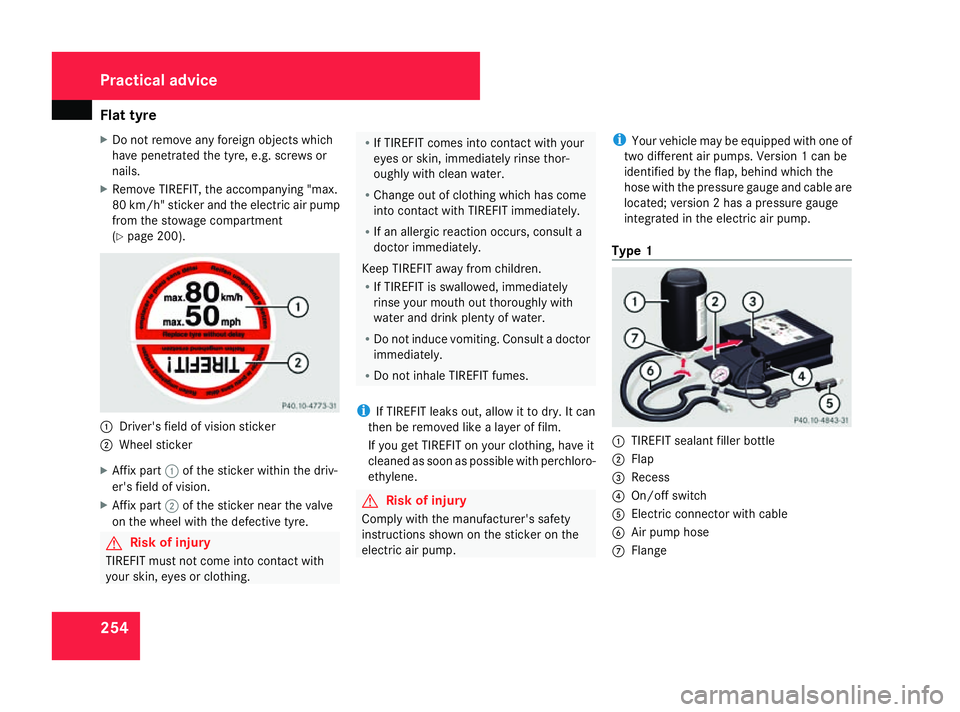
(Y page 200). 1
Driver's field of vision sticker
2 Wheel sticker
X Affix part 1of the sticker within the driv-
er's field of vision.
X Affix part 2of the sticker near the valve
on the wheel with the defective tyre. G
Risk of injury
TIREFIT must not come into contact with
your skin, eyes or clothing. R
If TIREFIT comes into contact with your
eyes or skin, immediately rinse thor-
oughly with clean water.
R Change out of clothing which has come
into contact with TIREFIT immediately.
R If an allergic reaction occurs, consult a
doctor immediately.
Keep TIREFIT away from children.
R If TIREFIT is swallowed, immediately
rinse your mouth out thoroughly with
water and drink plenty of water.
R Do not induce vomiting. Consult a doctor
immediately.
R Do not inhale TIREFIT fumes.
i If TIREFIT leaks out, allow it to dry. It can
then be removed like a layer of film.
If you get TIREFIT on your clothing, have it
cleaned as soon as possible with perchloro-
ethylene. G
Risk of injury
Comply with the manufacturer's safety
instructions shown on the sticker on the
electric air pump. i
Your vehicle may be equipped with one of
two different air pumps. Version 1 can be
identified by the flap, behind which the
hose with the pressure gauge and cable are
located; version 2 has a pressure gauge
integrated in the electric air pump.
Type 1 1
TIREFIT sealant filler bottle
2 Flap
3 Recess
4 On/off switch
5 Electric connector with cable
6 Air pump hose
7 Flange Practical advice
169_AKB; 2; 4, en-GB
wdomann
, Version: 2.10.6 2008-07-16T08:52:06+02:00 - Seite 254Dateiname: 6515_0315_02_buchblock.pdf; preflight