door lock MERCEDES-BENZ A-CLASS HATCHBACK 2008 Owners Manual
[x] Cancel search | Manufacturer: MERCEDES-BENZ, Model Year: 2008, Model line: A-CLASS HATCHBACK, Model: MERCEDES-BENZ A-CLASS HATCHBACK 2008Pages: 305, PDF Size: 5.43 MB
Page 8 of 305
5
Changing a wheel
see Flat tyre
Child-proof locks
Rear doors ........................................ 54
Children
Fastening seat belts.......................... 51
In the vehicle. ................................... 42
Restraint systems. ............................ 43
Child seat
Automatic recognition ......................45
Automatic recognition (malfunc-
tion). ............................................... 223
Integrated ......................................... 50
ISOFIX............................................... 48
Recommendations. ...........................47
Suitable positions. ............................ 46
Cigarette lighter................................. 163
Cockpit Overview. .......................................... 22
COMAND............................................. 101
On-board computer. .......................101
see separate operating instructions
Constant headlamp mode
Setting (on-board computer).......... .109
Consumption statistics (on-board
computer)........................................... 112
Convenience closing............................ 86
Convenience opening........................... 86
Coolant................................................ 175
Checking the level. .........................175Display message
............213, 214, 215
Mixture ratio ................................... 297
Temperature gauge ...........................97
Cornering light
Display message ............................. 216
Cruise control..................................... 115
Cup holder.......................................... 144 D
Dashboard see Instrument cluster
Date
Setting (on-board computer).......... .109
Daytime driving lights
see Constant headlamp mode
Delayed switch-off
Exterior lighting (on-board com-
puter). ............................................. 110
Interior lighting (on-board com-
puter). ............................................. 110
Diesel
Low outside temperatures. .............170
Diesel engine
Winter driving. ................................ 170
Digital speedometer.......................... 103
Dipped-beam headlamps Display message ............................. 216
Symmetrical. .................................. 185Display message
................................ 202
Service interval display. ..................191
Display messages
Symbol messages. ..........................212
Text messages. ............................... 203
Distance recorder
see Total distance recorder
see Trip meter
Distance Recorder
see Trip meter
Door
Automatic locking ............................. 61
Display message ............................. 212
Emergency locking .........................242
Emergency unlocking...................... 241
Opening (from the inside). ................61
Door control panel
Overview. .......................................... 34
Drinks holder
see Cup holder
Driver's airbag...................................... 40
Driver's seat position........................... 76
Driving abroad.................................... 185
Driving safety system.......................... 55
ABS. .................................................. 55
Adaptive brake lamps. ......................56
BAS. .................................................. 55
Steering assistant STEER CON-
TROL. ................................................ 56 Index
169_AKB; 2; 4, en-GB
wdomann,
Version: 2.10.6 2008-07-16T08:52:06+02:00 - Seite 5Dateiname: 6515_0315_02_buchblock.pdf; preflight
Page 22 of 305
19
Exterior view
....................................... 20
Cockpit ................................................. 22
Instrument cluster ..............................26
Multi-function steering wheel ............30
Centre console .................................... 31
Overhead control panel ......................33
Door control panel .............................. 34 At a glance
169_AKB; 2; 4, en-GB
wdomann,
Version: 2.10.6 2008-07-16T08:52:06+02:00 - Seite 19Dateiname: 6515_0315_02_buchblock.pdf; preflight
Page 24 of 305
Exterior view
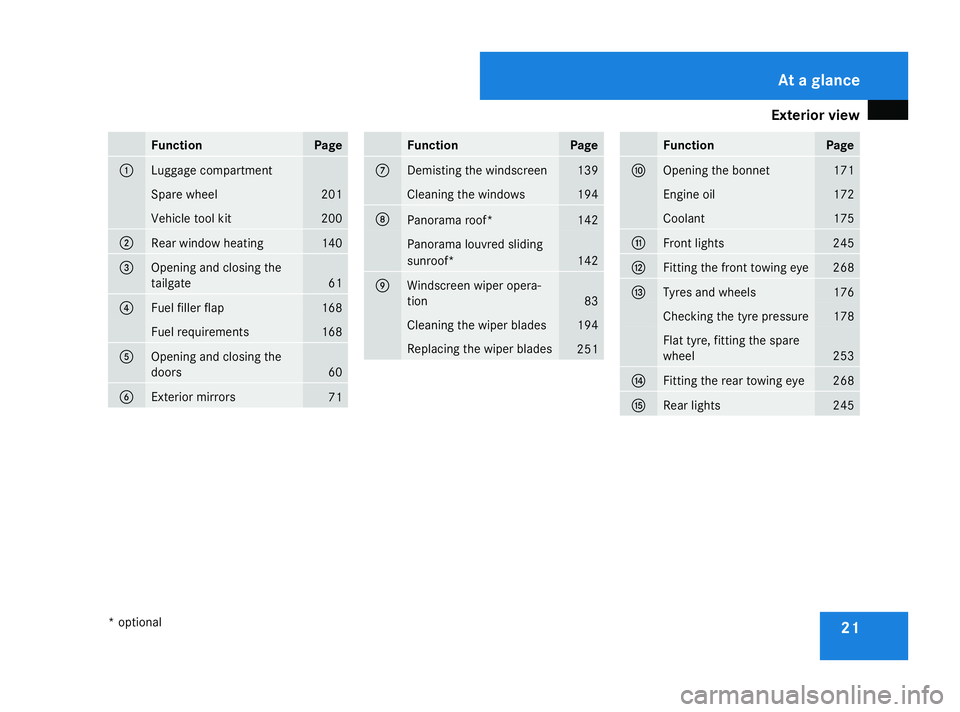
21Function Page
1
Luggage compartment
Spare wheel 201
Vehicle tool kit 200
2
Rear window heating 140
3
Opening and closing the
tailgate 61
4
Fuel filler flap 168
Fuel requirements 168
5
Opening and closing the
doors 60
6
Exterior mirrors
71 Function Page
7
Demisting the windscreen 139
Cleaning the windows 194
8
Panorama roof* 142
Panorama louvred sliding
sunroof*
142
9
Windscreen wiper opera-
tion
83
Cleaning the wiper blades 194
Replacing the wiper blades
251 Function Page
a
Opening the bonnet 171
Engine oil 172
Coolant 175
b
Front lights 245
c
Fitting the front towing eye 268
d
Tyres and wheels 176
Checking the tyre pressure 178
Flat tyre, fitting the spare
wheel
253
e
Fitting the rear towing eye 268
f
Rear lights 245At a glance
* optional
169_AKB; 2; 4, en-GB
wdomann,
Version: 2.10.6
2008-07-16T08:52:06+02:00 - Seite 21 Dateiname: 6515_0315_02_buchblock.pdf; preflight
Page 26 of 305
Cockpit
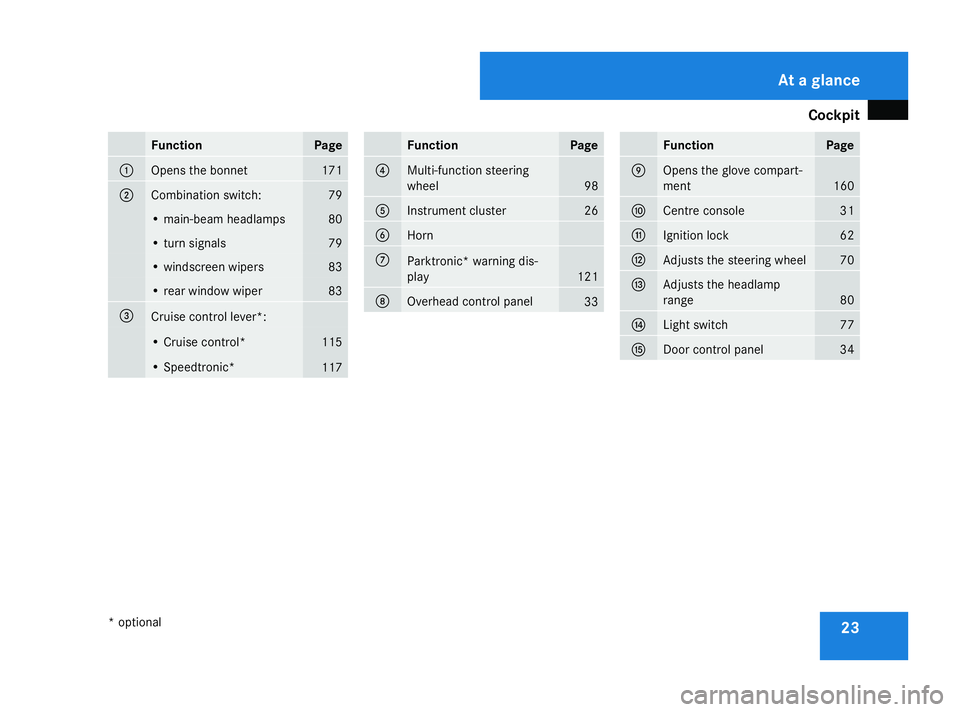
23Function Page
1
Opens the bonnet 171
2
Combination switch: 79
• main-beam headlamps 80
• turn signals 79
• windscreen wipers 83
• rear window wiper 83
3
Cruise control lever*:
• Cruise control* 115
• Speedtronic*
117 Function Page
4
Multi-function steering
wheel
98
5
Instrument cluster 26
6
Horn
7
Parktronic* warning dis-
play
121
8
Overhead control panel
33 Function Page
9
Opens the glove compart-
ment
160
a
Centre console 31
b
Ignition lock 62
c
Adjusts the steering wheel 70
d
Adjusts the headlamp
range
80
e
Light switch 77
f
Door control panel 34At a glance
* optional
169_AKB; 2; 4, en-GB
wdomann
,V ersion: 2.10.6
2008-07-16T08:52:06+02:00 - Seite 23 Dateiname: 6515_0315_02_buchblock.pdf; preflight
Page 28 of 305
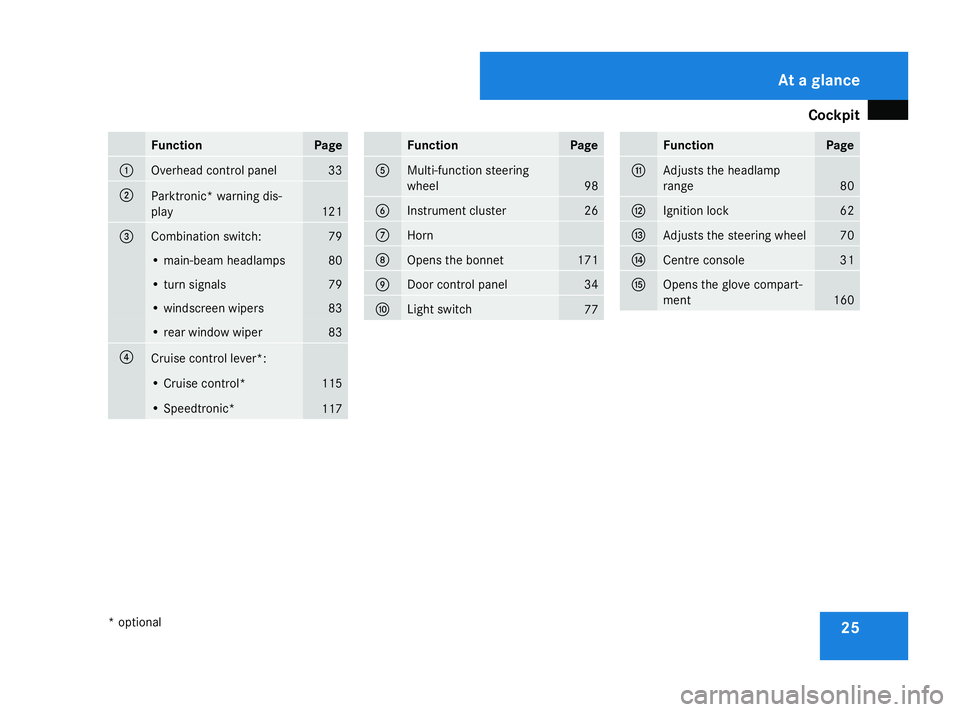
Cockpit
25Function Page
1
Overhead control panel 33
2
Parktronic* warning dis-
play
121
3
Combination switch: 79
• main-beam headlamps 80
• turn signals 79
• windscreen wipers 83
• rear window wiper 83
4
Cruise control lever*:
• Cruise control* 115
• Speedtronic*
117 Function Page
5
Multi-function steering
wheel
98
6
Instrument cluster 26
7
Horn
8
Opens the bonnet 171
9
Door control panel 34
a
Light switch
77 Function Page
b
Adjusts the headlamp
range
80
c
Ignition lock 62
d
Adjusts the steering wheel 70
e
Centre console 31
f
Opens the glove compart-
ment
160At a glance
* optional
169_AKB; 2; 4, en-GB
wdomann
,V ersion: 2.10.6
2008-07-16T08:52:06+02:00 - Seite 25 Dateiname: 6515_0315_02_buchblock.pdf; preflight
Page 37 of 305

Door cont
rol panel 34 Door control panel
Function Page
1
r
Adjusts the exterior
mirrors 71
2
Z
Folds the exterior mir-
rors in/out* 71
3
&
Selects the right exte-
rior mirror 71
4
=
Opens/closes the
front side windows 84
5
=
5-door vehicle:
opens/closes* the rear
side windows 84
6
5-door vehicle: activates/
deactivates the override
feature for the rear power
side windows*
54
7
k
Unlocks the vehicle 61
8
j
Locks the vehicle 61 Function Page
9
Opens the door 61
a
%
Selects the left exte-
rior mirror 71At a glance
169_AKB; 2; 4, en-GB
wdomann,
Version: 2.10.6
2008-07-16T08:52:06+02:00 - Seite 34 Dateiname: 6515_0315_02_buchblock.pdf; preflight
Page 43 of 305

Occupant safety
40 R
do not lean on the doors from inside the
vehicle.
R make sure that there are no people, ani-
mals or objects between the vehicle
occupants and the area of deployment of
the airbag.
R do not place any objects between the
seat backrest and the door.
R do not hang any hard objects, for exam-
ple coat hangers, on the grab handles or
coat hooks.
R do not attach accessories, e.g. cup hold-
ers, to the doors.
It is not possible to rule out a risk of injuries
caused by an airbag due to the high speed
at which the airbag is required to deploy. G
Risk of injury
The airbag's functionality can only be guar-
anteed if the following parts are not cov-
ered and no badges or stickers are
attached to them:
R padded steering wheel boss
R front-passenger front airbag cover
R outer side of front seats
R side panel next to the rear seat backrest G
Risk of injury
When an airbag deploys, a small amount of
powder is released. The powder may cause
short-term breathing difficulties to persons
suffering from asthma or other pulmonary
conditions.
In order to prevent potential breathing dif-
ficulties you should leave the vehicle as
soon as it is safe to do so. You can also open
the window to allow fresh air to enter the
interior. The powder does not constitute a
health hazard and does not indicate that
there is a fire in the vehicle. G
Risk of injury
The airbag parts are hot after the airbag has
been deployed. Do not touch them, other-
wise you may burn yourself.
Have the airbags checked at a qualified
specialist workshop. Otherwise, occupants
are not protected by the airbags in the
event of another accident.
Front airbags
The front airbags are designed to increase
protection for the driver's and front-
passenger head and chest. The driver's front airbag and front-passenger
front airbag are deployed:
R
at the start of an accident with a high rate
of vehicle acceleration or deceleration in a
longitudinal direction
R if the system determines that airbag
deployment can offer additional protection
to that provided by the seat belt
R if the seat belt is fastened
R independently of other airbags in the vehi-
cle
R if the vehicle overturns, but only if the sys-
tem detects high vehicle deceleration in a
longitudinal direction 1
Driver's front airbag
2 Front-passenger front airbag Safety
169_AKB; 2; 4, en-GB
wdomann,
Version: 2.10.6 2008-07-16T08:52:06+02:00 - Seite 40Dateiname: 6515_0315_02_buchblock.pdf; preflight
Page 45 of 305
Occupant safety
42
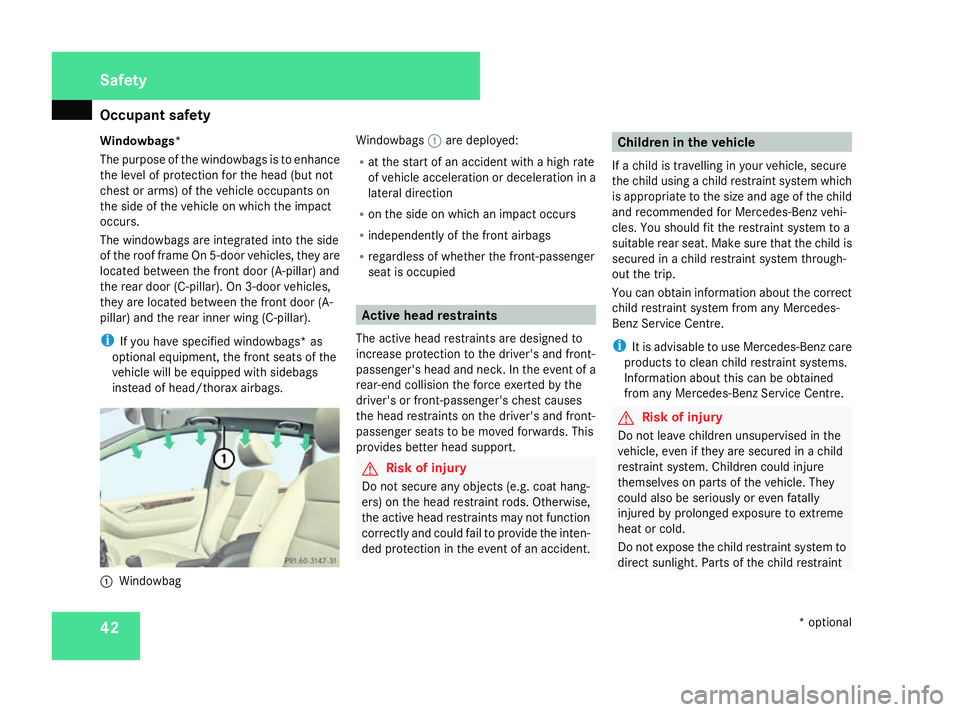
Windowbags*
The purpose of the windowbags is to enhance
the level of protection for the head (but not
chest or arms) of the vehicle occupants on
the side of the vehicle on which the impact
occurs.
The windowbags are integrated into the side
of the roof frame On 5-door vehicles, they are
located between the front door (A-pillar) and
the rear door (C-pillar). On 3-door vehicles,
they are located between the front door (A-
pillar) and the rear inner wing (C-pillar).
i If you have specified windowbags* as
optional equipment, the front seats of the
vehicle will be equipped with sidebags
instead of head/thorax airbags. 1
Windowbag Windowbags
1are deployed:
R at the start of an accident with a high rate
of vehicle acceleration or deceleration in a
lateral direction
R on the side on which an impact occurs
R independently of the front airbags
R regardless of whether the front-passenger
seat is occupied Active head restraints
The active head restraints are designed to
increase protection to the driver's and front-
passenger's head and neck. In the event of a
rear-end collision the force exerted by the
driver's or front-passenger's chest causes
the head restraints on the driver's and front-
passenger seats to be moved forwards. This
provides better head support. G
Risk of injury
Do not secure any objects (e.g. coat hang-
ers) on the head restraint rods. Otherwise,
the active head restraints may not function
correctly and could fail to provide the inten-
ded protection in the event of an accident. Children in the vehicle
If a child is travelling in your vehicle, secure
the child using a child restraint system which
is appropriate to the size and age of the child
and recommended for Mercedes-Benz vehi-
cles. You should fit the restraint system to a
suitable rear seat. Make sure that the child is
secured in a child restraint system through-
out the trip.
You can obtain information about the correct
child restraint system from any Mercedes-
Benz Service Centre.
i It is advisable to use Mercedes-Benz care
products to clean child restraint systems.
Information about this can be obtained
from any Mercedes-Benz Service Centre. G
Risk of injury
Do not leave children unsupervised in the
vehicle, even if they are secured in a child
restraint system. Children could injure
themselves on parts of the vehicle. They
could also be seriously or even fatally
injured by prolonged exposure to extreme
heat or cold.
Do not expose the child restraint system to
direct sunlight. Parts of the child restraint Safety
* optional
169_AKB; 2; 4, en-GB
wdomann,
Version: 2.10.6
2008-07-16T08:52:06+02:00 - Seite 42 Dateiname: 6515_0315_02_buchblock.pdf; preflight
Page 46 of 305
Occupant safety
43system could heat up and the child could
burn itself on them.
If a child opens a door, the child or other
persons could be injured as a result. The
child could get out and be injured in the
process or be injured by a passing vehicle.
G
Risk of injury
An unsecured or incorrectly positioned load
increases the risk of injury to the child in
the event of:
R an accident
R a braking manoeuvre
R a sudden change of direction
Do not carry heavy or hard objects inside
the vehicle unless they are secured. You
will find further information under "Loading
guidelines" in the index.
Child restraint systems Mercedes-Benz recommends that you only
use the child restraint systems listed on
(Y page 47). G
Risk of injury
To reduce the risk of serious or even fatal
injury to the child in the event of a sudden
change in direction, braking or an accident:
R children less than 1.50 m tall and under
twelve years of age must always be
secured in special child restraint systems
on a suitable vehicle seat. This is neces-
sary because the seat belts are not
designed for children of this size.
R Do not secure children less than 1.50 m
tall or under twelve years of age on the
front-passenger seat. Exception: the
child is secured in a vehicle with auto-
matic child seat recognition on the front-
passenger seat* and is secured in a child
restraint system with automatic child
seat recognition.
R If you secure a forward-facing child
restraint system to the front-passenger
seat, you must move the front-passenger
seat as far back as possible.
R children must never travel sitting on the
lap of another occupant. Due to the
forces occurring in the event of a sudden
change of direction, heavy braking or an
accident, it would not be possible to restrain the child. The child could be
thrown against parts of the vehicle inte-
rior and be seriously or even fatally
injured.
G
Risk of injury
The child restraint system cannot perform
its protective function if is not correctly fit-
ted to a suitable vehicle seat. The child can-
not be restrained in the event of a sudden
change of direction, heavy braking or an
accident. This may lead to serious or even
fatal injuries. For this reason, when fitting
a child restraint system, observe the man-
ufacturer's installation instructions and the
correct use of the child restraint system.
Child restraint systems should be fitted to
the rear seats. Children are generally better
protected there.
The entire base of the child restraint system
must always rest on the seat cushion.
Never place objects, e.g. a cushion, under
the child restraint system.
Only use child restraint systems with their
original covers. Only replace damaged cov-
ers with genuine Mercedes-Benz covers.
For safety reasons, you should only use
child restraint systems which have been Safety
* optional
169_AKB; 2; 4, en-GB
wdomann
,V ersion: 2.10.6
2008-07-16T08:52:06+02:00 - Seite 43 ZDateiname: 6515_0315_02_buchblock.pdf; preflight
Page 48 of 305
Occupant safety
45
Automatic child seat recognition on the
front-passenger seat*
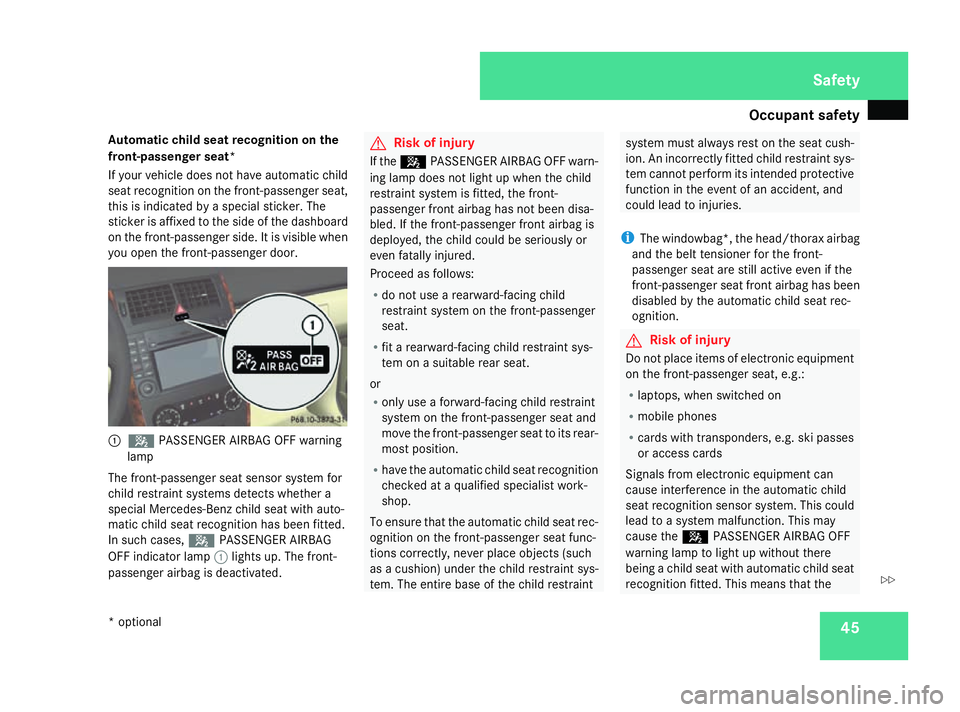
If your vehicle does not have automatic child
seat recognition on the front-passenger seat,
this is indicated by a special sticker. The
sticker is affixed to the side of the dashboard
on the front-passenger side. It is visible when
you open the front-passenger door. 1
5 PASSENGER AIRBAG OFF warning
lamp
The front-passenger seat sensor system for
child restraint systems detects whether a
special Mercedes-Benz child seat with auto-
matic child seat recognition has been fitted.
In such cases, 5PASSENGER AIRBAG
OFF indicator lamp 1lights up. The front-
passenger airbag is deactivated. G
Risk of injury
If the 5 PASSENGER AIRBAG OFF warn-
ing lamp does not light up when the child
restraint system is fitted, the front-
passenger front airbag has not been disa-
bled. If the front-passenger front airbag is
deployed, the child could be seriously or
even fatally injured.
Proceed as follows:
R do not use a rearward-facing child
restraint system on the front-passenger
seat.
R fit a rearward-facing child restraint sys-
tem on a suitable rear seat.
or
R only use a forward-facing child restraint
system on the front-passenger seat and
move the front-passenger seat to its rear-
most position.
R have the automatic child seat recognition
checked at a qualified specialist work-
shop.
To ensure that the automatic child seat rec-
ognition on the front-passenger seat func-
tions correctly, never place objects (such
as a cushion) under the child restraint sys-
tem. The entire base of the child restraint system must always rest on the seat cush-
ion. An incorrectly fitted child restraint sys-
tem cannot perform its intended protective
function in the event of an accident, and
could lead to injuries.
i The windowbag*, th e head/thorax airbag
and the belt tensioner for the front-
passenger seat are still active even if the
front-passenger seat front airbag has been
disabled by the automatic child seat rec-
ognition. G
Risk of injury
Do not place items of electronic equipment
on the front-passenger seat, e.g.:
R laptops, when switched on
R mobile phones
R cards with transponders, e.g. ski passes
or access cards
Signals from electronic equipment can
cause interference in the automatic child
seat recognition sensor system. This could
lead to a system malfunction. This may
cause the 5PASSENGER AIRBAG OFF
warning lamp to light up without there
being a child seat with automatic child seat
recognition fitted. This means that the Safety
* optional
169_AKB; 2; 4, en-GB
wdomann,
Version: 2.10.6 2008-07-16T08:52:06+02:00 - Seite 45 ZDateiname: 6515_0315_02_buchblock.pdf; preflight