service MERCEDES-BENZ A-CLASS HATCHBACK 2008 Owners Manual
[x] Cancel search | Manufacturer: MERCEDES-BENZ, Model Year: 2008, Model line: A-CLASS HATCHBACK, Model: MERCEDES-BENZ A-CLASS HATCHBACK 2008Pages: 305, PDF Size: 5.43 MB
Page 1 of 305
Disclaimer
Das folgen de PDF -Doku ment für die ses Fahrze ugmodell be zieht sich in allen
Sprachver sionen nur auf die Fahrz euge, d ie fü r den deutsche n Markt best immt
sind und die den deutschen Vorschriften entsprechen. Bitte wenden Sie sich an
Ihr en autorisierten Mer cedes-Benz Services tützpunkt, um ein gedruckt es Exem plar
für andere Fahrzeugmodelle und Fahrzeugmodelljahre zu erhalten.
Dieses PDF -Dokume nt stellt die aktuelle Version dar . Mögliche Abweic hungen zu
Ihrem konkreten Fahrzeug könnten nicht berücksichtigt sein, da Mercedes-Benz
seine Fahrzeuge st ändig dem neuest en Stand d er Technik anp asst, so wie
Änderungen in Form und Ausstattung vornimmt. Bitte beachten Sie daher, dass
dieses PDF-Dokument in keinem Fall das gedruckte Exemplar ersetzt, das mit
dem Fahrzeug ausgeliefert wurde.
Internal use only
Disclaimer
All language versions of the following PD\f document for this vehicle model
relate solel\b to vehicles intended for sale on the German market and which
correspond to German regulations.
Please contact \bour authorised Mercedes-Benz Service Centre to obtain
a printed version for other vehicle models and vehicle model \bears. This PD\f
document is the latest version. Possible variations to \bour vehicle ma\b not
be taken into account as Mercedes-Benz constantl\b updates their vehicles to
the state of the art and introduces changes in design and e\Dquipment. Please
therefore note that this PD\f document in no wa\b replaces the printed version
which was delivered with \bour vehicle.
Internal use only
Disclaimer
The following version of the Owner‘s Manual describes all models, series and
special equipment of your vehicle. Country-specific language variations are
possible. Please note that your vehicle might not be equipped with all the
described functions. This also affects safety-relevant systems and functions.
Please contact your authorised Mercedes-Benz dealership if you would like
to receive a printed Owner‘s Manual for other vehicle models and vehicle
model years.
The online Owner‘s Manual is the current and valid version. It is possible that
deviations affecting your specific vehicle could not be taken into account
as Mercedes-Benz constantly adapts its vehicles according to the latest
technology and makes changes to the form and the equipment.
Please also read the printed Owner‘s Manual, supplementary documents and
the digital Owner‘s Manual in the vehicle.
Copyright
All rights reserved. All texts, images and graphics are subject to copyright
and other laws for the protection of intellectual property. They may not be
copied or changed for any commercial use or for the purpose of being passed
on nor used on other webistes.
Page 4 of 305
Thank you for choosing Mercedes-Benz.
Before you drive off, familiarise yourself with
your vehicle and read the Owner's Manual.
This will help you to obtain the maximum
pleasure from your vehicle and to avoid
endangering yourself and others.
Items of optional equipment are marked with
an asterisk *.
The equipment in your vehicle may vary,
depending on the model, the ordered items,
the country specifications and availability.
The illustrations in this Owner's Manual show
a left-hand-drive vehicle. The arrangement of
the switches, levers, stowage compartments,
etc. will differ accordingly in a right-hand-
drive vehicle.
Mercedes-Benz is constantly updating its
vehicles to the state of the art and therefore
reserves the right to introduce changes in
design, equipment and technical features at
any time. You cannot, therefore, base any
claims on the data, illustrations or descrip-
tions in this Owner's Manual.
Please consult a Mercedes-Benz Service
Centre if you have any questions.
The Owner’s Manual, Brief Instructions,
service booklet and supplements related to
vehicle equipment belong with the vehicle.
You should always keep them in the vehicle and pass them on to the new owner if you sell
the vehicle.
The technical documentation team at
Daimler AG wishes you safe and pleasant
motoring.
i
You can get to know the important fea-
tures of your vehicle in German and in Eng-
lish in the interactive Owner's Manual on
the Internet at:
www.mercedes-benz.de/betriebsanlei-
tung
169_AKB; 2; 4, en-GB
wdomann,
Version: 2.10.6 2008-07-16T08:52:06+02:00 - Seite 1Dateiname: 6515_0315_02_buchblock.pdf; preflight
Page 6 of 305
3A
ABS (Anti-lock Braking System).......... 55
Display message ............204, 205, 206
Warning lamp.................................. 224
Acceleration
Technical data. ............................... 281
Accident
Notes. ............................................. 231
Active head restraint........................... 42
Active Park Assist Display messages ........................... 210
Active parking assist......................... 123
Trailer towing. ................................. 127
Active Service System PLUS
see Service indicator
Adaptive brake lamps.......................... 56
Airbag Activation.......................................... 37
Control unit....................................... 37
Driver's ............................................. 40
Front. ................................................ 40
Front passenger ................................ 40
PASSENGER AIRBAG OFF warning
lamp .............................................. 223
Sidebags. .......................................... 41
System.............................................. 39
Windowbags. .................................... 42
Airbags
Head/thorax airbags. .......................41Air conditioning
Activating/deactivating ..................135
Activating/deactivating air-recir-
culation mode. ................................ 141
Air-conditioning system ..................132
Controlling automatically. ...............136
Convenience opening/closing
(air-recirculation mode). .................141
Cooling with air dehumidification ...136
Demisting the windscreen ..............139
Heatmatic. ...................................... 131
Malfunction indicator lamp. ............222
Misted-up windows. ........................140
Rear window heating ......................140
Setting the air distribution. .............138
Setting the airflow .......................... 139
Setting the air vents .......................137
Setting the temperature .................136
Switching the residual heat func-
tion on/off ...................................... 142
Thermotronic .................................. 134
Air-conditioning system
see Air conditioning
Antifreeze concentration................... 299
Anti-lock braking system see ABS
Anti-theft alarm system
see ATA
Anti-theft systems................................ 57 Armrest
Front seat (adjusting)........................ 67
Rear seat (adjusting).. .......................68
Removing/fitting. ........................... 148
Ashtray................................................ 162
ASSYST PLUS see Service interval display
ASSYST PLUS service indicator........ 191
ATA (anti-theft alarm system)............. 57
Switching off the alarm. ....................57
Audible warning signal...................... 230
AUTO lights Display message ............................. 216
Automatic car wash........................... 193
Automatic engine start Using the ECO Start-Stop function ...91
With ECO start/stop function ...........89
Automatic transmission
Changing gear yoursel f..................... 95
Display message ............................. 209
Driving tips ....................................... 96
Emergency running mode ...............235
Malfunction..................................... 235
One-touch gearshifting. ....................95
Program selector button ...................96
Trailer towing. ................................... 96
Working on the vehicle .....................96
AUTOTRONIC
Releasing the parking lock man-
ually. ............................................... 243 Index
169_AKB; 2; 4, en-GB
wdomann,
Version: 2.10.6 2008-07-16T08:52:06+02:00 - Seite 3Dateiname: 6515_0315_02_buchblock.pdf; preflight
Page 8 of 305
5
Changing a wheel
see Flat tyre
Child-proof locks
Rear doors ........................................ 54
Children
Fastening seat belts.......................... 51
In the vehicle. ................................... 42
Restraint systems. ............................ 43
Child seat
Automatic recognition ......................45
Automatic recognition (malfunc-
tion). ............................................... 223
Integrated ......................................... 50
ISOFIX............................................... 48
Recommendations. ...........................47
Suitable positions. ............................ 46
Cigarette lighter................................. 163
Cockpit Overview. .......................................... 22
COMAND............................................. 101
On-board computer. .......................101
see separate operating instructions
Constant headlamp mode
Setting (on-board computer).......... .109
Consumption statistics (on-board
computer)........................................... 112
Convenience closing............................ 86
Convenience opening........................... 86
Coolant................................................ 175
Checking the level. .........................175Display message
............213, 214, 215
Mixture ratio ................................... 297
Temperature gauge ...........................97
Cornering light
Display message ............................. 216
Cruise control..................................... 115
Cup holder.......................................... 144 D
Dashboard see Instrument cluster
Date
Setting (on-board computer).......... .109
Daytime driving lights
see Constant headlamp mode
Delayed switch-off
Exterior lighting (on-board com-
puter). ............................................. 110
Interior lighting (on-board com-
puter). ............................................. 110
Diesel
Low outside temperatures. .............170
Diesel engine
Winter driving. ................................ 170
Digital speedometer.......................... 103
Dipped-beam headlamps Display message ............................. 216
Symmetrical. .................................. 185Display message
................................ 202
Service interval display. ..................191
Display messages
Symbol messages. ..........................212
Text messages. ............................... 203
Distance recorder
see Total distance recorder
see Trip meter
Distance Recorder
see Trip meter
Door
Automatic locking ............................. 61
Display message ............................. 212
Emergency locking .........................242
Emergency unlocking...................... 241
Opening (from the inside). ................61
Door control panel
Overview. .......................................... 34
Drinks holder
see Cup holder
Driver's airbag...................................... 40
Driver's seat position........................... 76
Driving abroad.................................... 185
Driving safety system.......................... 55
ABS. .................................................. 55
Adaptive brake lamps. ......................56
BAS. .................................................. 55
Steering assistant STEER CON-
TROL. ................................................ 56 Index
169_AKB; 2; 4, en-GB
wdomann,
Version: 2.10.6 2008-07-16T08:52:06+02:00 - Seite 5Dateiname: 6515_0315_02_buchblock.pdf; preflight
Page 14 of 305
11S
Seat Adjusting. ................................... 63, 65
Correct driver's seat position. ..........76
Folding the rear bench seat
forward. .......................................... 150
Removing/fitting the front-
passenger seat. .............................. 156
Removing/fitting the rear seat
backrest. ........................................ 152
Removing/fitting the rear seat
cushion. .......................................... 151
Seat belt
Adjusting the height.......................... 75
Display message .......................76, 212
Fastening. ......................................... 73
Warning lamp. .......................... 75, 228
Seat cushion
Removing (rear bench seat). ...........151
Seat heating......................................... .69
Seat ventilation Malfunction indicator lamp. ............222
Securing a load................................... 146
Selector lever Positions. .......................................... 94
Service indicator................................ 191
Service products................................ 292
Brake fluid. ..................................... 300Coolant.
.......................................... 297
Windscreen washer fluid. ................300
Settings
Factory (on-board computer). .........106
Setting the unit (on-board computer)
Speedometer. ................................. 108
Sidebags................................................ 41
Side window
Fault. .............................................. 238
Side windows
Cleaning. ........................................ 194
Opening/closing. .............................. 84
resetting ........................................... 85
Ski rack............................................... 144
Snow chains....................................... 182
Socket Cockpit. .......................................... 163
Luggage compartment. ...................164
Spare wheel
Fitting ............................................. 259
Storage location. ............................ 200
Technical data. ............................... 285
Speed
Technical data. ............................... 280
Speed limiter
Speedtronic. ................................... 117Speedometer
Digital speedometer (on-board
computer). ...................................... 103
Setting the unit (on-board com-
puter). ............................................. 108
Speedtronic ........................................ 117
Display message ............................. 220
Permanent. ..................................... 120
Variabl e.......................................... 118
SRS (Supplemental Restraint Sys-
tem)....................................................... 37
Display message ............................. 211
Warning lamp. .......................... 37, 226
Standard display (on-board com-
puter) ................................................... 103
Station see Radio
Status line (on-board computer)....... 100
Selecting the display....................... 108
Steering
Display message ............................. 215
Steering assistant STEER CONTROL ...56
Steering wheel Adjusting .......................................... 70
Buttons (on-board computer)............ 98
Stowage compartment...................... 159
Armrest (front) ................................ 160
Armrest (under) .............................. 161
Boxes under the driver's seat/
front-passenger seat....................... 161 Index
169_AKB; 2; 4, en-GB
wdomann,
Version: 2.10.6 2008-07-16T08:52:06+02:00 - Seite 11Dateiname: 6515_0315_02_buchblock.pdf; preflight
Page 18 of 305
Protection of the environment
15Protection of the environment
H
Environmental note
Daimler's declared policy is one of integra-
ted environmental protection.
The objectives are for the natural resources
which form the basis of our existence on
this planet to be used sparingly and in a
manner which takes the requirements of
both nature and humanity into account.
You too can help to protect the environ-
ment by operating your vehicle in an envi-
ronmentally-responsible manner.
Fuel consumption and the rate of engine,
transmission, brake and tyre wear depend
on the following factors:
R Operating conditions of your vehicle
R Your personal driving style
You can influence both factors.
You should bear the following in mind:
Operating conditions
R Avoid short trips as these increase fuel
consumption.
R Make sure that the tyre pressures are
always correct. R
Do not carry any unnecessary weight.
R Keep an eye on the vehicle's fuel con-
sumption.
R Remove roof racks once you no longer
need them.
R A regularly serviced vehicle will contrib-
ute to environmental protection. You
should therefore adhere to the service
intervals.
R Always have maintenance work carried
out at a qualified specialist workshop,
e.g. a Mercedes-Benz Service Centre.
Personal driving style
R Do not depress the accelerator pedal
when starting the engine.
R Do not warm up the engine with the vehi-
cle stationary.
R Drive carefully and maintain a safe dis-
tance from the vehicle in front.
R Avoid frequent, sudden acceleration.
R Change gear in good time and use each
gear only up to 2
/ 3of its maximum engine
speed.
R Switch off the engine in stationary traffic. Returning used vehicles
Mercedes-Benz will take back your
Mercedes-Benz to dispose of it in an environ-
mentally-responsible manner, in accordance
with the European Union (EU) End of Life
Vehicles Directive.
The End of Life Vehicles Directive applies to
vehicles of up to 3.5 t gross vehicle weight, in
accordance with national regulations. For
several years, Mercedes-Benz has been
meeting all the legal requirements for a
design which allows for recycling and re-use.
There is a network of return points and dis-
assembly plants which can recycle your vehi-
cle in an environmentally-responsible man-
ner. The options for recycling vehicles and
parts are constantly being developed and
improved. This means that your Mercedes-
Benz will also continue to meet even the
increased recycling quotas in the future in
good time. You can obtain further information
from your national Mercedes-Benz homepage
or your national hotline number. Introduction
169_AKB; 2; 4, en-GB
wdomann,
Version: 2.10.6 2008-07-16T08:52:06+02:00 - Seite 15 ZDateiname: 6515_0315_02_buchblock.pdf; preflight
Page 19 of 305
Operating safety
16 Operating safety
Safety notes
G
Risk of accident and injury
Always have work on the vehicle carried out
by a qualified specialist workshop. In par-
ticular, work relevant to safety or on safety-
related systems as well as maintenance
work must be carried out at a qualified spe-
cialist workshop. The workshop must have
the necessary specialist knowledge and
tools to carry out the work required.
Mercedes-Benz recommends that you use
a Mercedes-Benz Service Centre for this
purpose. G
Risk of accident and injury
Some safety systems only function while
the engine is running. Therefore, do not
switch the engine off when driving. Other-
wise, the safety systems in your vehicle
may no longer function correctly and
thereby not provide you or others with the
intended degree of protection. There is also
a risk that you could lose control of the
vehicle and cause an accident. G
Risk of accident and injury
Work carried out incorrectly or impermissi-
ble modifications to the vehicle, for exam-
ple cables laid under trim, can impair the
function of the safety systems. The safety
systems may no longer be able to protect
you or others as they are designed to do.
There is also a risk that you could lose con-
trol of the vehicle and cause an accident.
Have all work on and modifications to the
vehicle, such as installations or conver-
sions, carried out at a qualified workshop. G
Risk of accident
A heavy impact to the underbody, tyres or
wheels, for example when bottoming out on
rough terrain or driving over an obstacle at
high speed, could damage your vehicle. As
a result, you could cause an accident. This
also applies to vehicles which are equipped
with underbody protection.
For this reason, drive slowly over obstacles,
avoid bottoming out the vehicle in rough
terrain and, if necessary, have your vehicle
checked at a qualified specialist workshop. G
Risk of accident
If work on electronic equipment and its
software is carried out incorrectly, the equipment could stop functioning. The
electronic systems are networked via inter-
faces. Tampering with these electronic sys-
tems could cause malfunctions in systems
which have not been modified. Such mal-
functions can seriously compromise the
vehicle’s operating safety and your own
safety as well.
Have all work on and modifications to elec-
tronic components carried out at a qualified
workshop. Vehicle registration
Mercedes-Benz may ask its Service Centres
to carry out technical inspections on certain
vehicles to improve their quality or safety.
If you did not purchase your vehicle from an
authorised specialist dealer and your vehicle
has never been inspected at a Mercedes-
Benz Service Centre, it is possible that your
vehicle is not registered in your name with
Mercedes-Benz. Mercedes-Benz can only
inform you about vehicle checks if it has your
registration data.
It is advisable to register your vehicle with a
Mercedes-Benz Service Centre. Introduction
169_AKB; 2; 4, en-GB
wdomann
,V ersion: 2.10.6
2008-07-16T08:52:06+02:00 - Seite 16 Dateiname: 6515_0315_02_buchblock.pdf; preflight
Page 39 of 305
Occupant safety
36 Occupant safety
Notes on occupant safety
Seat belts, together with belt tensioners, belt
force limiters and airbags, are coordinated
restraint systems. They reduce the risk of
injury in defined accident situations and
thereby increase occupant safety. However,
seat belts and airbags generally do not pro-
tect against objects penetrating the vehicle
from the outside.
To ensure that the restraint systems can
deliver their full potential protection, you
should ensure that:
R the seat and head restraint are adjusted
properly (Y page 63)
R the seat belt has been fastened properly
(Y page 73)
R the airbags can inflate properly if they are
deployed (Y page 39)
R the steering wheel is adjusted properly
(Y page 70)
R the restraint systems have not been modi-
fied
i An airbag increases the protection of
vehicle occupants wearing a seat belt.
However, airbags are only an additional restraint system which complements, but
does not replace, the seat belt. All vehicle
occupants must wear their seat belt cor-
rectly at all times, even if the vehicle is
equipped with airbags. This is because - on
the one hand - airbags are not deployed in
all types of accident, as in some situations
airbag deployment would not increase the
protection afforded to vehicle occupants,
provided they are wearing their seat belt
correctly. On the other hand, airbag deploy-
ment only provides increased protection if
the seat belt is worn correctly because:
R
the seat belt helps to keep the vehicle
occupant in the best position in relation
to the airbag
R for example, in a head-on collision, the
seat belt can more adequately prevent
the occupant from being propelled
towards the force of the impact, and is
thus better suited to prevent injury
Therefore, in accident situations where an
airbag is deployed, it only provides protec-
tion in addition to the seat belt if the seat
belt is being worn correctly. G
Risk of accident and injury
Always have maintenance work carried out
at a qualified specialist workshop which has the necessary specialist knowledge
and tools to carry out the work required.
Mercedes-Benz recommends that you use
a Mercedes-Benz Service Centre for this
purpose.
In particular, work relevant to safety or on
safety-related systems must be carried out
at a qualified specialist workshop. If this
work is not carried out correctly, the oper-
ating safety of your vehicle may be affec-
ted. There is a risk of an accident and injury.
G
Risk of injury
The restraint system may not work as inten-
ded if the following components have been
modified or work on these components has
not been performed correctly:
R restraint system, consisting of the seat
belts and anchorages, belt tensioners,
belt force limiters, airbags
R wiring
R networked electronic systems
Airbags or belt tensioners could then fail,
e.g. in the event of an accident in which the
deceleration force would normally be high
enough to trigger the systems, or they
could be triggered unintentionally. Never Safety
169_AKB; 2; 4, en-GB
wdomann
,V ersion: 2.10.6
2008-07-16T08:52:06+02:00 - Seite 36 Dateiname: 6515_0315_02_buchblock.pdf; preflight
Page 42 of 305

Occupant safety
39Comply with safety regulations when dis-
posing of belt tensioners. Any Mercedes-
Benz Service Centre can provide details of
these regulations.
Airbags Airbag deployment slows down and restricts
the movement of the vehicle occupant.
If the airbags are deployed, you will hear a
bang and a small amount of powder may also
be released. Only in rare cases will the bang
affect your hearing. The powder that escapes
does not generally constitute a health hazard.
The
1 warning lamp lights up.
The SRS/AIRBAG identification indicates the
location of the airbags. G
Risk of injury
Airbags provide additional protection; they
are not, however, a substitute for seat
belts.
Observe the following notes to reduce the
risk of serious or even fatal injury if an air-
bag is deployed:
R all vehicle occupants — in particular preg-
nant women — must wear their seat belt
correctly at all times and lean back against the backrest, which should be
positioned as close to the vertical as pos-
sible. The head restraint must support
the back of the head at about eye level.
R always secure children less than 1.50 m
tall or under 12 years of age in suitable
child restraint systems.
R all vehicle occupants must select a seat
position that is as far away from the air-
bag as possible. The driver's seat posi-
tion must allow the vehicle to be driven
safely. The driver's chest should be as far
away from the middle of the driver's front
airbag cover as possible.
R move the front-passenger seat as far
back as possible, especially if a child is
secured in a child restraint system on the
seat.
R vehicle occupants – in particular, chil-
dren – must not lean their head on the
area of the window in which a sidebag or
head/thorax airbag* is deployed.
R Rearward-facing child restraint systems
must not be fitted to the front-passenger
seat unless the front-passenger front air-
bag has been disabled. The front-
passenger front airbag of a vehicle fitted with automatic child seat recognition* is
only disabled when a child restraint sys-
tem with automatic child seat recogni-
tion is fitted to the front-passenger seat.
The
5 PASSENGER AIRBAG OFF
warning lamp must be constantly lit.
If the front-passenger seat of your vehicle
does not have automatic child seat rec-
ognition*, or your rearward-facing child
restraint system does not have such a
feature, children must be secured in a
child restraint system on a suitable seat
in the rear. If you secure a forward-facing
child restraint system to the front-
passenger seat, you must move the front-
passenger seat as far back as possible.
R make sure there are no heavy or sharp-
edged objects in pockets of clothing.
R do not lean forwards, e.g. over the cover
of the driver's front airbag, particularly
when the vehicle is in motion.
R do not put your feet on the dashboard.
R only hold the steering wheel by the rim.
This allows the airbag to inflate fully. You
could be injured if the airbag is deployed
and you are holding the inside of the
steering wheel. Safety
* optional
169_AKB; 2; 4, en-GB
wdomann
,V ersion: 2.10.6
2008-07-16T08:52:06+02:00 - Seite 39 ZDateiname: 6515_0315_02_buchblock.pdf; preflight
Page 44 of 305
Occupant safety
41
Driver's front airbag
1deploys in front of the
steering wheel; front-passenger front airbag
2 deploys in front of and above the glove
compartment.
On vehicles with automatic child seat recog-
nition in the front-passenger seat*, front-
passenger front airbag 2is only deployed if
the 5 PASSENGER AIRBAG OFF warning
lamp in the centre console is not lit
(Y page 45). This means that there is not a
child restraint system with automatic child
seat recognition* fitted to the front-
passenger seat or that a child restraint sys-
tem with automatic child seat recognition*
has been fitted to the front-passenger seat
incorrectly.
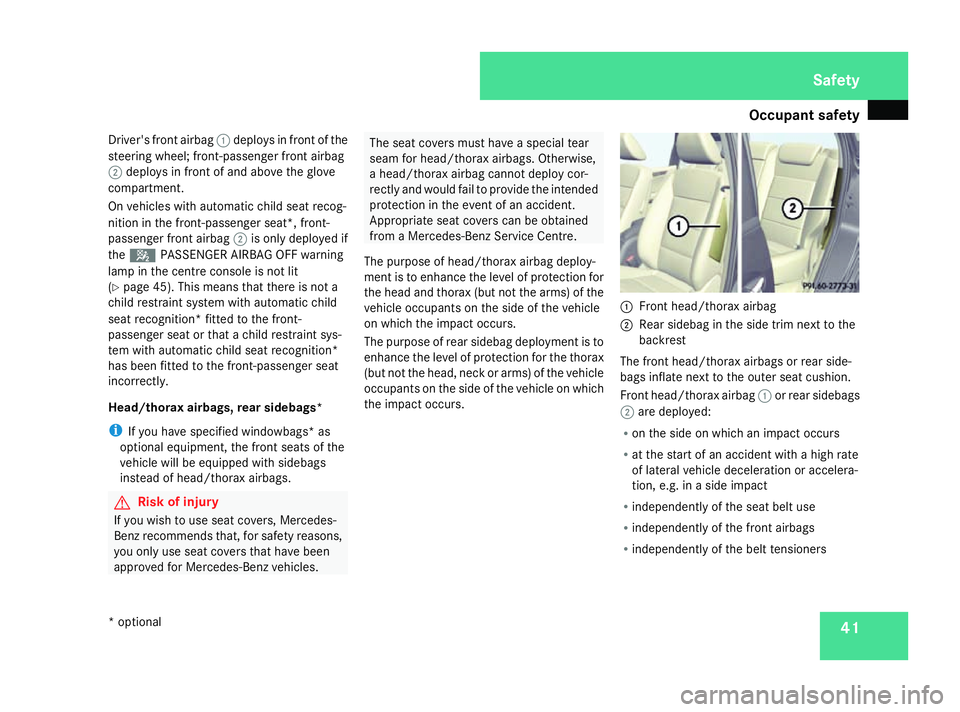
Head/thorax airbags, rear sidebags*
i If you have specified windowbags* as
optional equipment, the front seats of the
vehicle will be equipped with sidebags
instead of head/thorax airbags. G
Risk of injury
If you wish to use seat covers, Mercedes-
Benz recommends that, for safety reasons,
you only use seat covers that have been
approved for Mercedes-Benz vehicles. The seat covers must have a special tear
seam for head/thorax airbags. Otherwise,
a head/thorax airbag cannot deploy cor-
rectly and would fail to provide the intended
protection in the event of an accident.
Appropriate seat covers can be obtained
from a Mercedes-Benz Service Centre.
The purpose of head/thorax airbag deploy-
ment is to enhance the level of protection for
the head and thorax (but not the arms) of the
vehicle occupants on the side of the vehicle
on which the impact occurs.
The purpose of rear sidebag deployment is to
enhance the level of protection for the thorax
(but not the head, neck or arms) of the vehicle
occupants on the side of the vehicle on which
the impact occurs. 1
Front head/thorax airbag
2 Rear sidebag in the side trim next to the
backrest
The front head/thorax airbags or rear side-
bags inflate next to the outer seat cushion.
Front head/thorax airbag 1or rear sidebags
2 are deployed:
R on the side on which an impact occurs
R at the start of an accident with a high rate
of lateral vehicle deceleration or accelera-
tion, e.g. in a side impact
R independently of the seat belt use
R independently of the front airbags
R independently of the belt tensioners Safety
* optional
169_AKB; 2; 4, en-GB
wdomann,
Version: 2.10.6 2008-07-16T08:52:06+02:00 - Seite 41 ZDateiname: 6515_0315_02_buchblock.pdf; preflight