weight MERCEDES-BENZ A-CLASS HATCHBACK 2012 User Guide
[x] Cancel search | Manufacturer: MERCEDES-BENZ, Model Year: 2012, Model line: A-CLASS HATCHBACK, Model: MERCEDES-BENZ A-CLASS HATCHBACK 2012Pages: 357, PDF Size: 11.61 MB
Page 271 of 357
Useful information
i This Owner's Manual describes all mod-
els, series and optional equipment for your
vehicle that were available at the time of
going to press. National variations are pos- sible. Note that your vehicle may not be
equipped with all of the functions descri-
bed. This is also the case for systems and
functions relevant to safety.
i Read the information on qualified special-
ist workshops: (Y page 24). Loading guidelines
G
WARNING
If objects, luggage or loads are not secured or not secured sufficiently, they could slip, tip
over or be flung around and thereby hit vehicle
occupants. There is a risk of injury, especially when braking or abruptly changing directions.
Always store objects so that they cannot be
flung around. Secure objects, luggage or
loads against slipping or tipping before the
journey. G
WARNING
Combustion engines emit poisonous exhaust
gases such as carbon monoxide. If the tailgate is open when the engine is running, particu-
larly if the vehicle is moving, exhaust fumes
could enter the passenger compartment.
There is a risk of poisoning.
Turn off the engine before opening the tail-
gate. Never drive with the tailgate open.
The handling characteristics of a laden vehi-
cle are dependent on the distribution of the
load within the vehicle. For this reason, you
should observe the following notes when
transporting a load:
R when transporting a load, never exceed the
maximum permissible gross vehicle weight or the permissible axle loads for the vehicle
(including occupants).
R the luggage compartment is the preferred
place to carry objects.
R position heavy loads as far forwards as pos-
sible and as low down in the luggage com-
partment as possible.
R the load must not protrude above the upper
edge of the seat backrests.
R always place the load against the rear or
front seat backrests. Make sure that the
seat backrests are securely locked into
place.
R always place the load behind unoccupied
seats if possible.
R use the lashing eyelets and the luggage
nets to transport loads and luggage.
R only use lashing eyelets and fastening com-
ponents that are suitable for the weight and size of the load.
R the maximum load capacity of the stowage
well under the luggage compartment floor
is 25 kg.
R secure the load with sufficiently strong and
wear-resistant lashing material. Pad sharp
edges for protection.
i Lashing material is available at any quali-
fied specialist workshop.
! Do not position the load on one part of the
folding luggage compartment floor only.
The maximum load capacity of the folding
luggage compartment floor is 100 kg.
Spread the weight evenly to avoid damag-
ing the luggage compartment floor. Place a
solid board under the load if necessary.
Please note that the load on the luggage
compartment floor will be increased when
the load is lashed down. 268
Loading guidelinesStowing and features
Page 279 of 357
There is a risk of injury, especially when brak-
ing or abruptly changing directions.
R Always store objects so that they cannot be
flung around in these or in similar situa-
tions.
R Always make sure that objects do not pro-
trude from stowage compartments, lug-
gage nets or stowage nets.
R Close lockable stowage compartments
while driving.
R Stow and secure objects that are heavy,
hard, pointy, sharp-edged, fragile or too
large in the luggage compartment.
! Only use the cup holders for containers of
the right size and which have lids. The
drinks could otherwise spill.
The stowage compartments in the doors pro- vide space for bottles:
R front: capacity up to 1.0 l
R rear: capacity up to 0.5 l
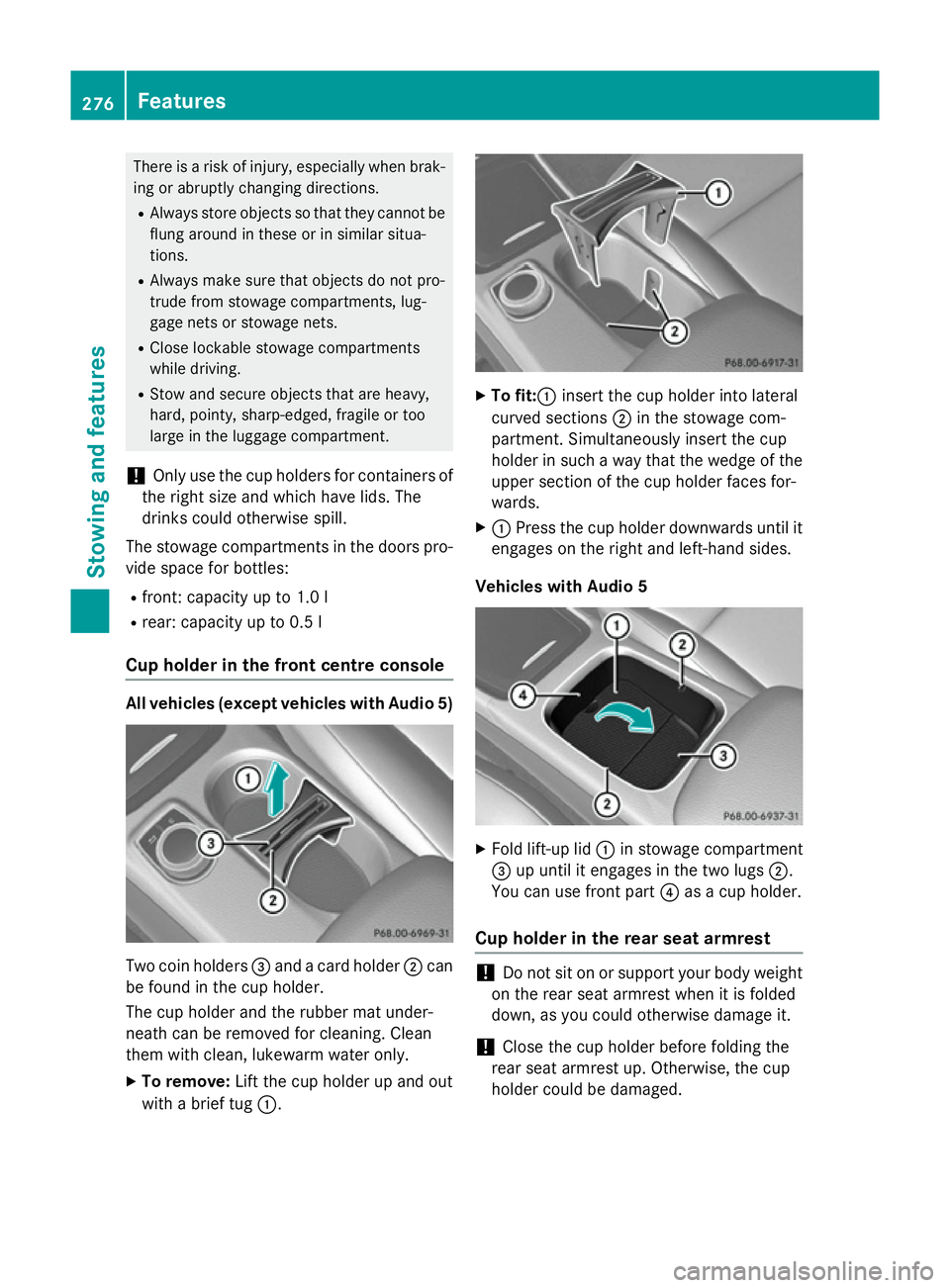
Cup holder in the front centre console All vehicles (except vehicles with Audio 5)
Two coin holders
=and a card holder ;can
be found in the cup holder.
The cup holder and the rubber mat under-
neath can be removed for cleaning. Clean
them with clean, lukewarm water only.
X To remove: Lift the cup holder up and out
with a brief tug :. X
To fit:: insert the cup holder into lateral
curved sections ;in the stowage com-
partment. Simultaneously insert the cup
holder in such a way that the wedge of the upper section of the cup holder faces for-
wards.
X : Press the cup holder downwards until it
engages on the right and left-hand sides.
Vehicles with Audio 5 X
Fold lift-up lid :in stowage compartment
= up until it engages in the two lugs ;.
You can use front part ?as a cup holder.
Cup holder in the rear seat armrest !
Do not sit on or support your body weight
on the rear seat armrest when it is folded
down, as you could otherwise damage it.
! Close the cup holder before folding the
rear seat armrest up. Otherwise, the cup
holder could be damaged. 276
FeaturesStowing and features
Page 313 of 357
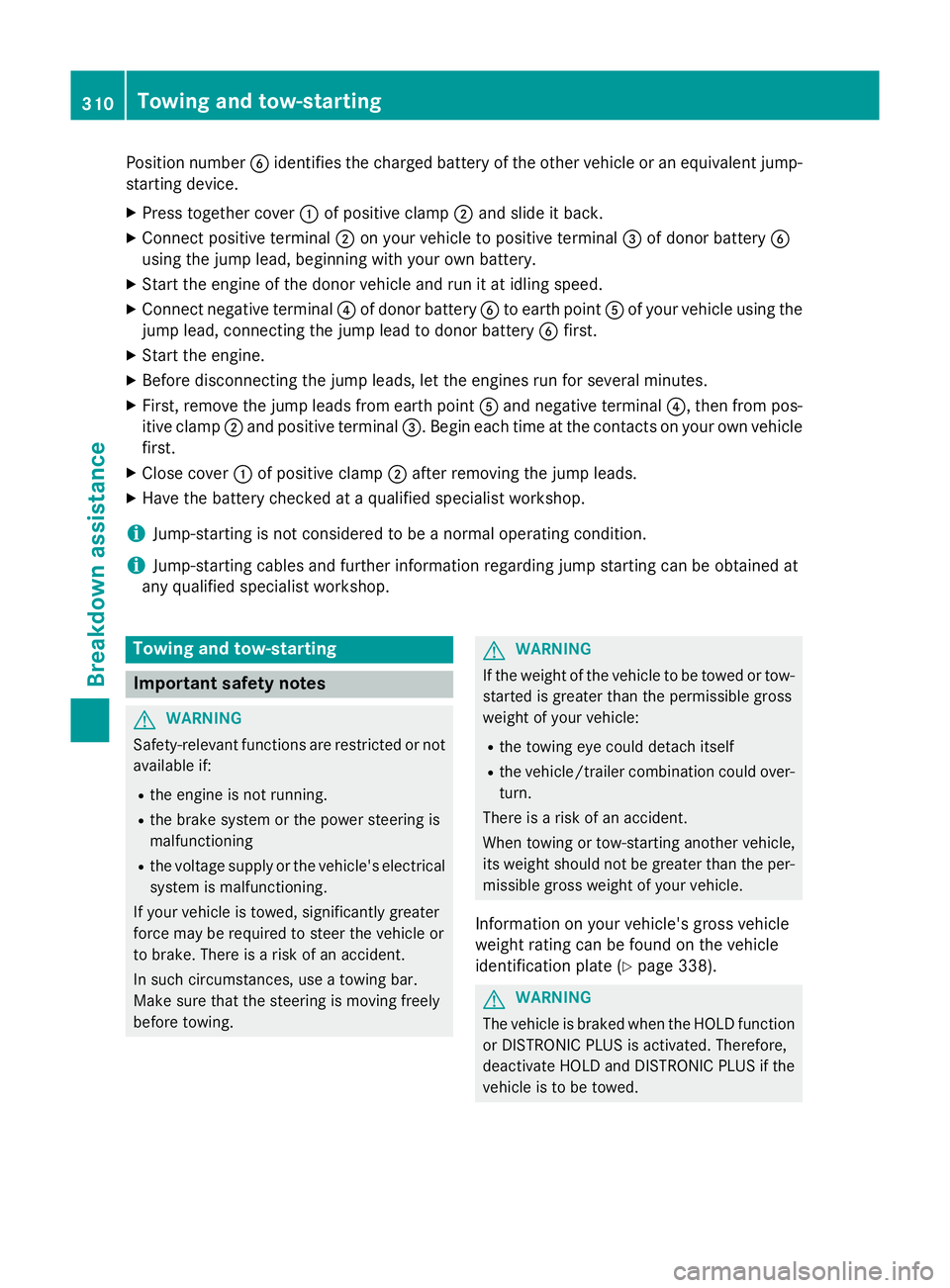
Position number
Bidentifies the charged battery of the other vehicle or an equivalent jump-
starting device.
X Press together cover :of positive clamp ;and slide it back.
X Connect positive terminal ;on your vehicle to positive terminal =of donor battery B
using the jump lead, beginning with your own battery.
X Start the engine of the donor vehicle and run it at idling speed.
X Connect negative terminal ?of donor battery Bto earth point Aof your vehicle using the
jump lead, connecting the jump lead to donor battery Bfirst.
X Start the engine.
X Before disconnecting the jump leads, let the engines run for several minutes.
X First, remove the jump leads from earth point Aand negative terminal ?, then from pos-
itive clamp ;and positive terminal =. Begin each time at the contacts on your own vehicle
first.
X Close cover :of positive clamp ;after removing the jump leads.
X Have the battery checked at a qualified specialist workshop.
i Jump-starting is not considered to be a normal operating condition.
i Jump-starting cables and further information regarding jump starting can be obtained at
any qualified specialist workshop. Towing and tow-starting
Important safety notes
G
WARNING
Safety-relevant functions are restricted or not
available if:
R the engine is not running.
R the brake system or the power steering is
malfunctioning
R the voltage supply or the vehicle's electrical
system is malfunctioning.
If your vehicle is towed, significantly greater
force may be required to steer the vehicle or
to brake. There is a risk of an accident.
In such circumstances, use a towing bar.
Make sure that the steering is moving freely
before towing. G
WARNING
If the weight of the vehicle to be towed or tow- started is greater than the permissible gross
weight of your vehicle:
R the towing eye could detach itself
R the vehicle/trailer combination could over-
turn.
There is a risk of an accident.
When towing or tow-starting another vehicle,
its weight should not be greater than the per-
missible gross weight of your vehicle.
Information on your vehicle's gross vehicle
weight rating can be found on the vehicle
identification plate (Y page 338). G
WARNING
The vehicle is braked when the HOLD function or DISTRONIC PLUS is activated. Therefore,
deactivate HOLD and DISTRONIC PLUS if the
vehicle is to be towed. 310
Towing and tow-startingBreakdown assistance
Page 341 of 357
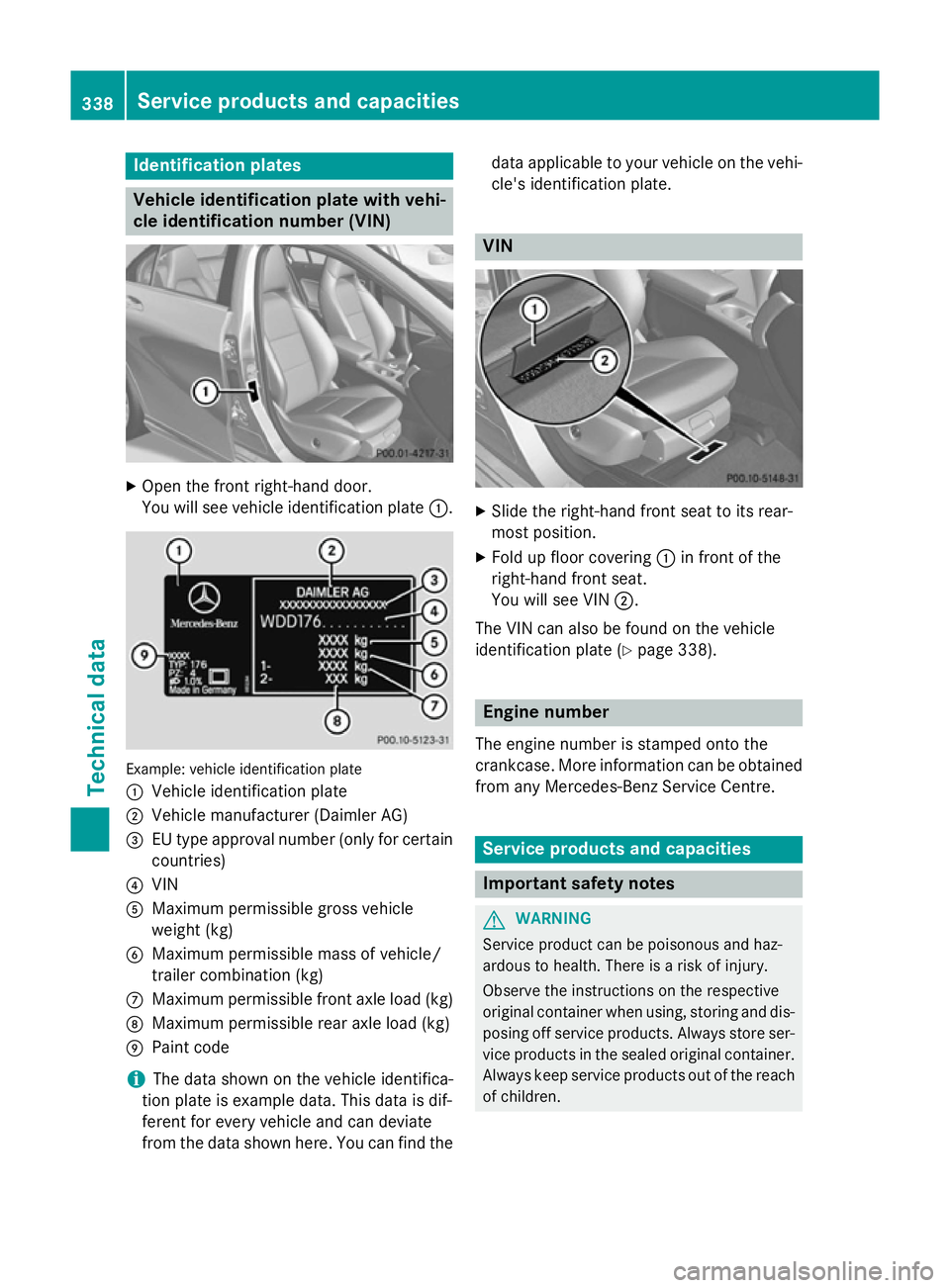
Identification plates
Vehicle identification plate with vehi-
cle identification number (VIN) X
Open the front right-hand door.
You will see vehicle identification plate :.Example: vehicle identification plate
:
Vehicle identification plate
; Vehicle manufacturer (Daimler AG)
= EU type approval number (only for certain
countries)
? VIN
A Maximum permissible gross vehicle
weight (kg)
B Maximum permissible mass of vehicle/
trailer combination (kg)
C Maximum permissible front axle load (kg)
D Maximum permissible rear axle load (kg)
E Paint code
i The data shown on the vehicle identifica-
tion plate is example data. This data is dif-
ferent for every vehicle and can deviate
from the data shown here. You can find the data applicable to your vehicle on the vehi-
cle's identification plate. VIN
X
Slide the right-hand front seat to its rear-
most position.
X Fold up floor covering :in front of the
right-hand front seat.
You will see VIN ;.
The VIN can also be found on the vehicle
identification plate (Y page 338). Engine number
The engine number is stamped onto the
crankcase. More information can be obtained
from any Mercedes-Benz Service Centre. Service products and capacities
Important safety notes
G
WARNING
Service product can be poisonous and haz-
ardous to health. There is a risk of injury.
Observe the instructions on the respective
original container when using, storing and dis- posing off service products. Always store ser-
vice products in the sealed original container. Always keep service products out of the reach
of children. 338
Service products and capacitiesTechnical data
Page 349 of 357
At temperatures above freezing:
X Fill the washer fluid reservoir with a mixture
of water and washer fluid, e.g. MB Sum-
merFit.
Mix 1 part MB SummerFit to 100 parts water.
At temperatures below freezing:
X Fill the washer fluid reservoir with a mixture
of water and washer fluid, e.g. MB Winter-
Fit.
Adapt the mixing ratio to the outside temper-
ature.
R Down to Ò10 †: mix 1 part MB WinterFit to
2 parts water.
R Down to Ò20 †: mix 1 part MB WinterFit to
1 part water.
R Down to Ò29 †: mix 2 parts MB WinterFit to
1 part water.
i Add washer fluid concentrate, e.g. MB
SummerFit or MB WinterFit, to the washer
fluid all year round. Vehicle data
General notes
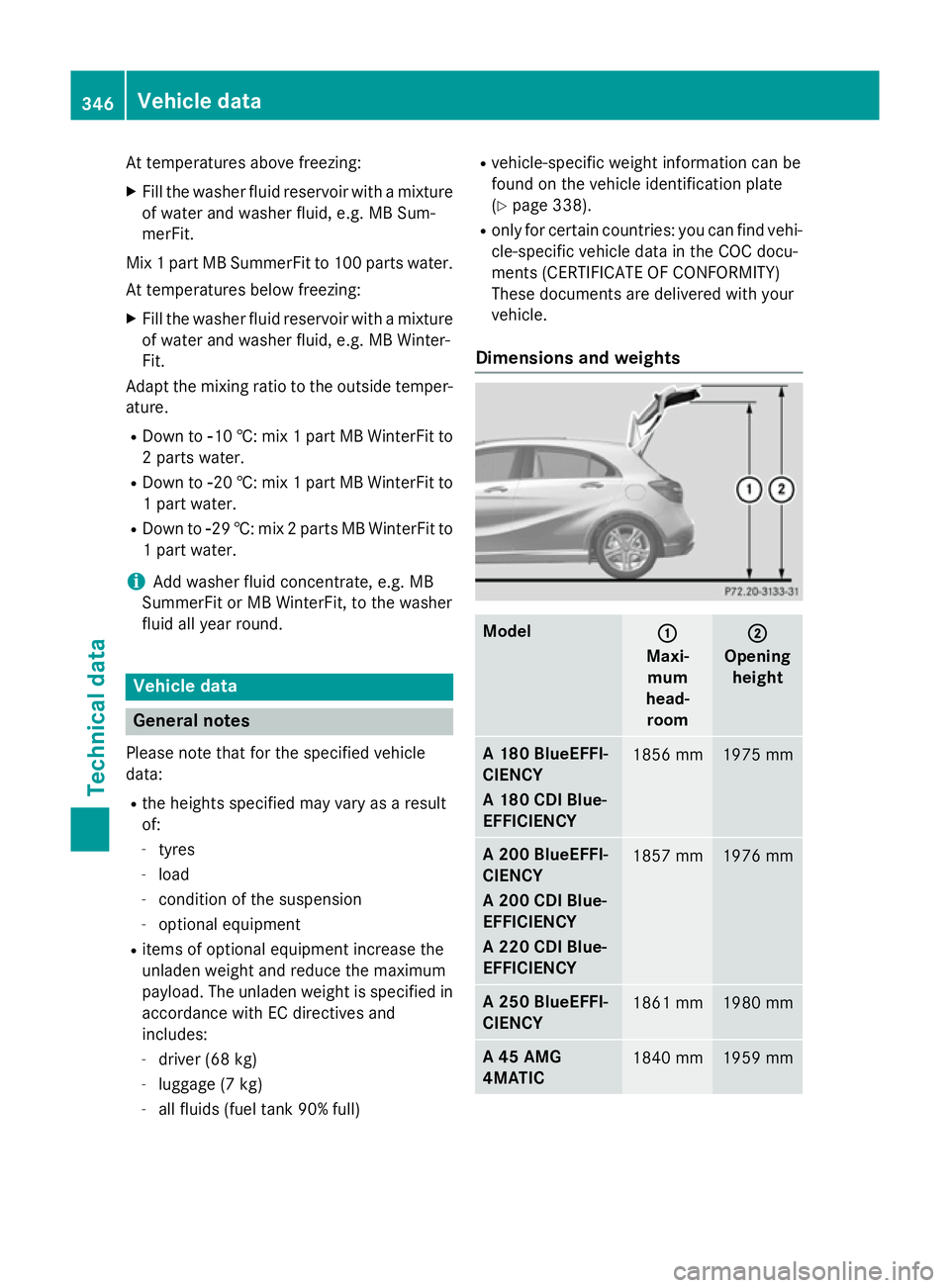
Please note that for the specified vehicle
data:
R the heights specified may vary as a result
of:
- tyres
- load
- condition of the suspension
- optional equipment
R items of optional equipment increase the
unladen weight and reduce the maximum
payload. The unladen weight is specified in
accordance with EC directives and
includes:
- driver (68 kg)
- luggage (7kg)
- all fluids (fuel tank 90% full) R
vehicle-specific weight information can be
found on the vehicle identification plate
(Y page 338).
R only for certain countries: you can find vehi-
cle-specific vehicle data in the COC docu-
ments (CERTIFICATE OF CONFORMITY)
These documents are delivered with your
vehicle.
Dimensions and weights Model
: :
Maxi- mum
head- room ;
;
Opening height A 180 BlueEFFI-
CIENCY
A 180 CDI Blue-
EFFICIENCY 1856 mm 1975 mm
A 200 BlueEFFI-
CIENCY
A 200 CDI Blue-
EFFICIENCY
A 220 CDI Blue-
EFFICIENCY 1857 mm 1976 mm
A 250 BlueEFFI-
CIENCY
1861 mm 1980 mm
A 45 AMG
4MATIC
1840 mm 1959 mm346
Vehicle dataTechnical data
Page 350 of 357

Missing values were not available at the time
of going to print. All models (except AMG vehicles)
Vehicle length
4292 mm
Vehicle width
including exterior
mirrors
2022 mm
Vehicle width
excluding exterior
mirrors
1780 mm
Wheelbase
2699 mm
Maximum roof load
100 kg
Maximum boot load
100 kg
A 180 BlueEFFICIENCY
Vehicle height
1433 mm
Unladen weight,
manual transmis-
sion
1370 kg
Unladen weight,
automatic transmis-
sion 1395 kg
A 200 BlueEFFICIENCY
Vehicle height
1434 mm
Unladen weight,
manual transmis-
sion
1370 kg
Unladen weight,
automatic transmis-
sion 1395 kg
A 250 BlueEFFICIENCY
Vehicle height
1438 mm
Unladen weight
1445 kg A 180 CDI BlueEFFICIENCY
Vehicle height
1433 mm
Unladen weight,
manual transmis-
sion
1395 kg
Unladen weight,
automatic transmis-
sion 1475 kg
A 200 CDI BlueEFFICIENCY
Vehicle height
1434 mm
Unladen weight,
manual transmis-
sion
1445 kg
Unladen weight,
automatic transmis-
sion 1475 kg
A 220 CDI BlueEFFICIENCY
Vehicle height
1434 mm
Unladen weight
AMG vehicles
Vehicle length
4395 mm
Vehicle width
including exterior
mirrors
2022 mm
Vehicle width
excluding exterior
mirrors
1780 mm
Vehicle height
1417 mm
Wheelbase
2699 mm
Roof load
100 kg
Maximum boot load
100 kgVehicle data
347Technical data Z
Page 352 of 357
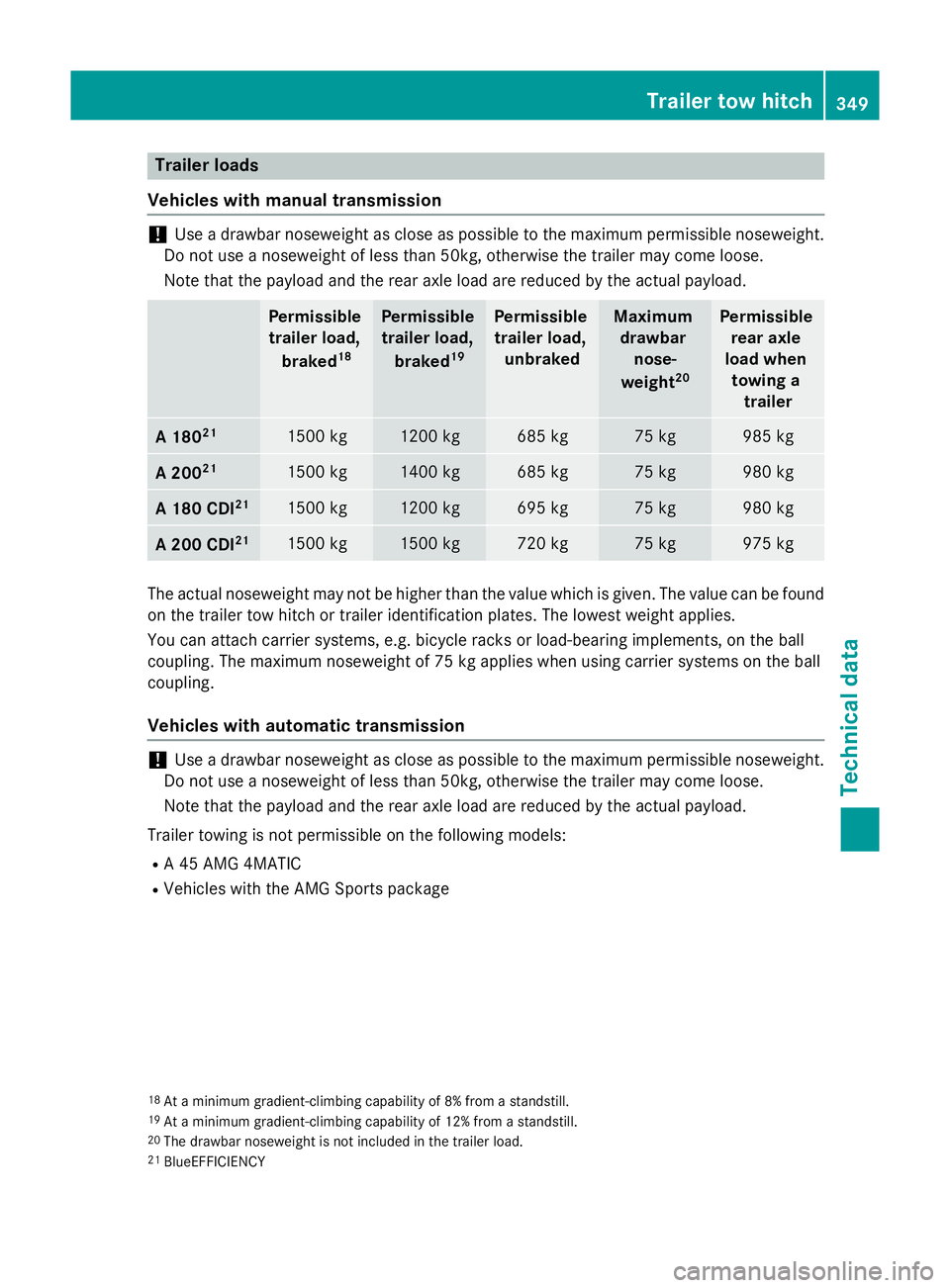
Trailer loads
Vehicles with manual transmission !
Use a drawbar noseweight as close as possible to the maximum permissible noseweight.
Do not use a noseweight of less than 50kg, otherwise the trailer may come loose.
Note that the payload and the rear axle load are reduced by the actual payload. Permissible
trailer load,
braked 18 Permissible
trailer load,
braked 19 Permissible
trailer load, unbraked Maximum
drawbar nose-
weight 20 Permissible
rear axle
load when towing a trailer A 180
21 1500 kg 1200 kg 685 kg 75 kg 985 kg
A 200
21 1500 kg 1400 kg 685 kg 75 kg 980 kg
A 180 CDI
21 1500 kg 1200 kg 695 kg 75 kg 980 kg
A 200 CDI
21 1500 kg 1500 kg 720 kg 75 kg 975 kg
The actual noseweight may not be higher than the value which is given. The value can be found
on the trailer tow hitch or trailer identification plates. The lowest weight applies.
You can attach carrier systems, e.g. bicycle racks or load-bearing implements, on the ball
coupling. The maximum noseweight of 75 kg applies when using carrier systems on the ball
coupling.
Vehicles with automatic transmission !
Use a drawbar noseweight as close as possible to the maximum permissible noseweight.
Do not use a noseweight of less than 50kg, otherwise the trailer may come loose.
Note that the payload and the rear axle load are reduced by the actual payload.
Trailer towing is not permissible on the following models:
R A 45 AMG 4MATIC
R Vehicles with the AMG Sports package
18 At a minimum gradient-climbing capability of 8% from a standstill.
19 At a minimum gradient-climbing capability of 12% from a standstill.
20 The drawbar noseweight is not included in the trailer load.
21 BlueEFFICIENCY Trailer tow hitch
349Technical data Z
Page 353 of 357
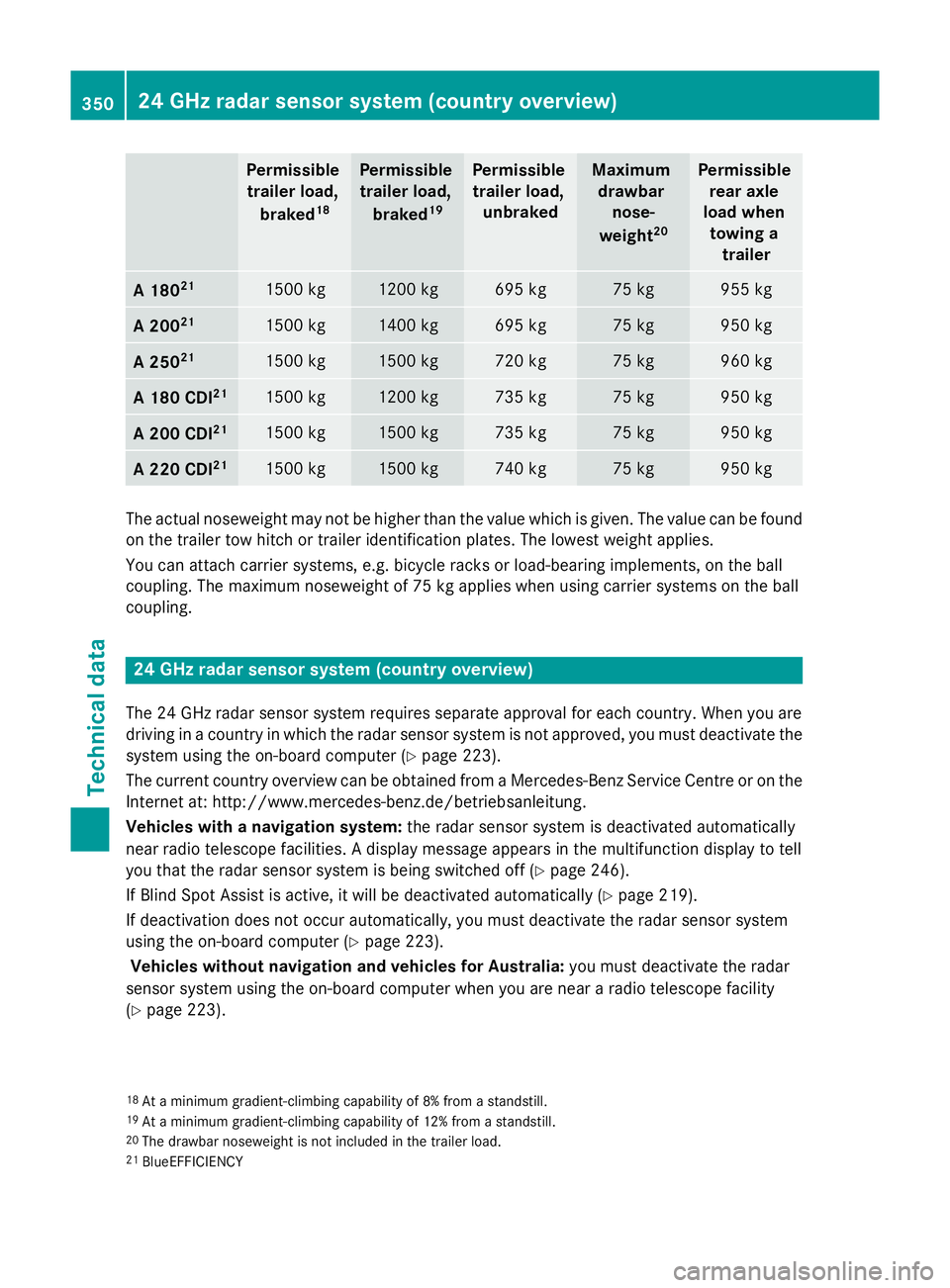
Permissible
trailer load,
braked 18 Permissible
trailer load,
braked 19 Permissible
trailer load, unbraked Maximum
drawbar nose-
weight 20 Permissible
rear axle
load when towing a trailer A 180
21 1500 kg 1200 kg 695 kg 75 kg 955 kg
A 200
21 1500 kg 1400 kg 695 kg 75 kg 950 kg
A 250
21 1500 kg 1500 kg 720 kg 75 kg 960 kg
A 180 CDI
21 1500 kg 1200 kg 735 kg 75 kg 950 kg
A 200 CDI
21 1500 kg 1500 kg 735 kg 75 kg 950 kg
A 220 CDI
21 1500 kg 1500 kg 740 kg 75 kg 950 kg
The actual noseweight may not be higher than the value which is given. The value can be found
on the trailer tow hitch or trailer identification plates. The lowest weight applies.
You can attach carrier systems, e.g. bicycle racks or load-bearing implements, on the ball
coupling. The maximum noseweight of 75 kg applies when using carrier systems on the ball
coupling. 24 GHz radar sensor system (country overview)
The 24 GHz radar sensor system requires separate approval for each country. When you are
driving in a country in which the radar sensor system is not approved, you must deactivate the
system using the on-board computer (Y page 223).
The current country overview can be obtained from a Mercedes-Benz Service Centre or on the
Internet at: http://www.mercedes-benz.de/betriebsanleitung.
Vehicles with a navigation system: the radar sensor system is deactivated automatically
near radio telescope facilities. A display message appears in the multifunction display to tell
you that the radar sensor system is being switched off (Y page 246).
If Blind Spot Assist is active, it will be deactivated automatically (Y page 219).
If deactivation does not occur automatically, you must deactivate the radar sensor system
using the on-board computer (Y page 223).
Vehicles without navigation and vehicles for Australia: you must deactivate the radar
sensor system using the on-board computer when you are near a radio telescope facility
(Y page 223).
18 At a minimum gradient-climbing capability of 8% from a standstill.
19 At a minimum gradient-climbing capability of 12% from a standstill.
20 The drawbar noseweight is not included in the trailer load.
21 BlueEFFICIENCY 350
24 GHz radar sensor system (country overview)Technical data