tailgate MERCEDES-BENZ A-CLASS HATCHBACK 2012 Owner's Manual
[x] Cancel search | Manufacturer: MERCEDES-BENZ, Model Year: 2012, Model line: A-CLASS HATCHBACK, Model: MERCEDES-BENZ A-CLASS HATCHBACK 2012Pages: 357, PDF Size: 11.61 MB
Page 278 of 357
X
Fold the luggage compartment floor down.
X Press the luggage compartment floor down
until it engages. Roof carrier
Important safety notes G
WARNING
An incorrectly secured roof carrier, ski rack or load could become detached from the vehi-
cle. These objects might then be thrown
around, and could injure you or others or
cause an accident. Follow the roof carrier/ski
rack manufacturer's installation instructions
and special instructions for use.
The roof load raises the vehicle's centre of
gravity, thereby affecting vehicle handling.
You must always observe the maximum roof
load of 75 kg. Always adapt your driving style to the prevailing road, traffic and weather
conditions and drive with particular care if the
roof is laden.
! Mercedes-Benz recommends that you
only use roof carriers that have been tested
and approved for Mercedes-Benz vehicles.
This helps to prevent damage to the vehi-
cle.
Position the load on the roof carrier in such
a way that the vehicle will not sustain dam-
age even when it is in motion.
Ensure that, depending on the vehicle's
equipment, you can raise the panorama
sliding sunroof fully and open the tailgate
fully when the roof carrier is fitted.
i Vehicles with panorama sliding sun-
roof: if a roof carrier is fitted, the panorama
sliding sunroof cannot be opened. In order to allow ventilation of the vehicle interior,
you can raise the panorama sliding sunroof.
If a roof carrier approved by Mercedes-
Benz makes contact with the panorama
sliding sunroof, the sunroof will lower
slightly but remain raised in the rear. Attaching the roof carrier
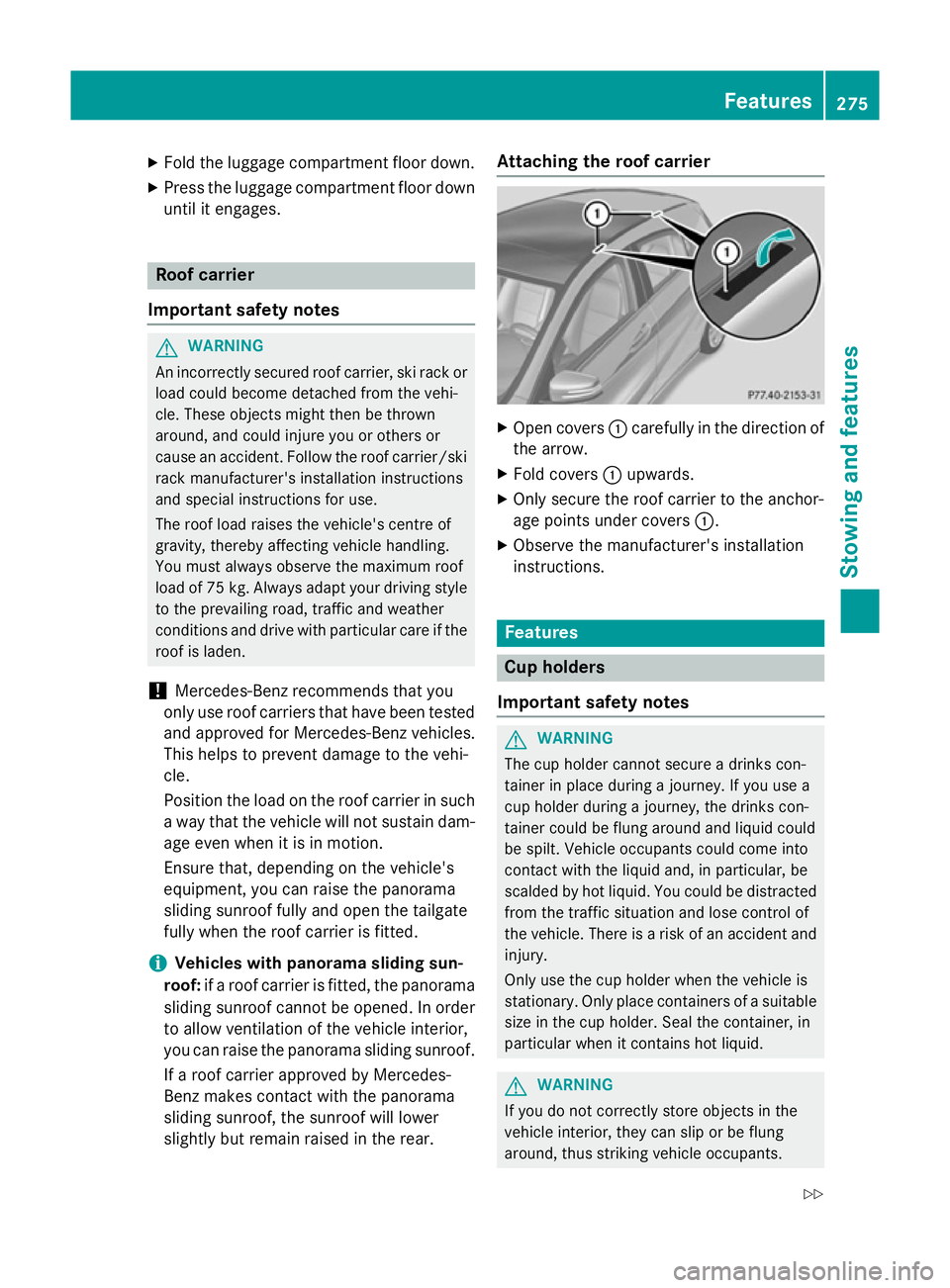
X
Open covers :carefully in the direction of
the arrow.
X Fold covers :upwards.
X Only secure the roof carrier to the anchor-
age points under covers :.
X Observe the manufacturer's installation
instructions. Features
Cup holders
Important safety notes G
WARNING
The cup holder cannot secure a drinks con-
tainer in place during a journey. If you use a
cup holder during a journey, the drinks con-
tainer could be flung around and liquid could
be spilt. Vehicle occupants could come into
contact with the liquid and, in particular, be
scalded by hot liquid. You could be distracted
from the traffic situation and lose control of
the vehicle. There is a risk of an accident and
injury.
Only use the cup holder when the vehicle is
stationary. Only place containers of a suitable size in the cup holder. Seal the container, in
particular when it contains hot liquid. G
WARNING
If you do not correctly store objects in the
vehicle interior, they can slip or be flung
around, thus striking vehicle occupants. Features
275Stowing and features
Z
Page 301 of 357
Useful information
i This Owner's Manual describes all mod-
els, series and optional equipment for your
vehicle that were available at the time of
going to press. National variations are pos- sible. Note that your vehicle may not be
equipped with all of the functions descri-
bed. This is also the case for systems and
functions relevant to safety.
i Read the information on qualified special-
ist workshops: (Y page 24). Where will I find...?
Warning triangle
Removing/replacing the warning trian-
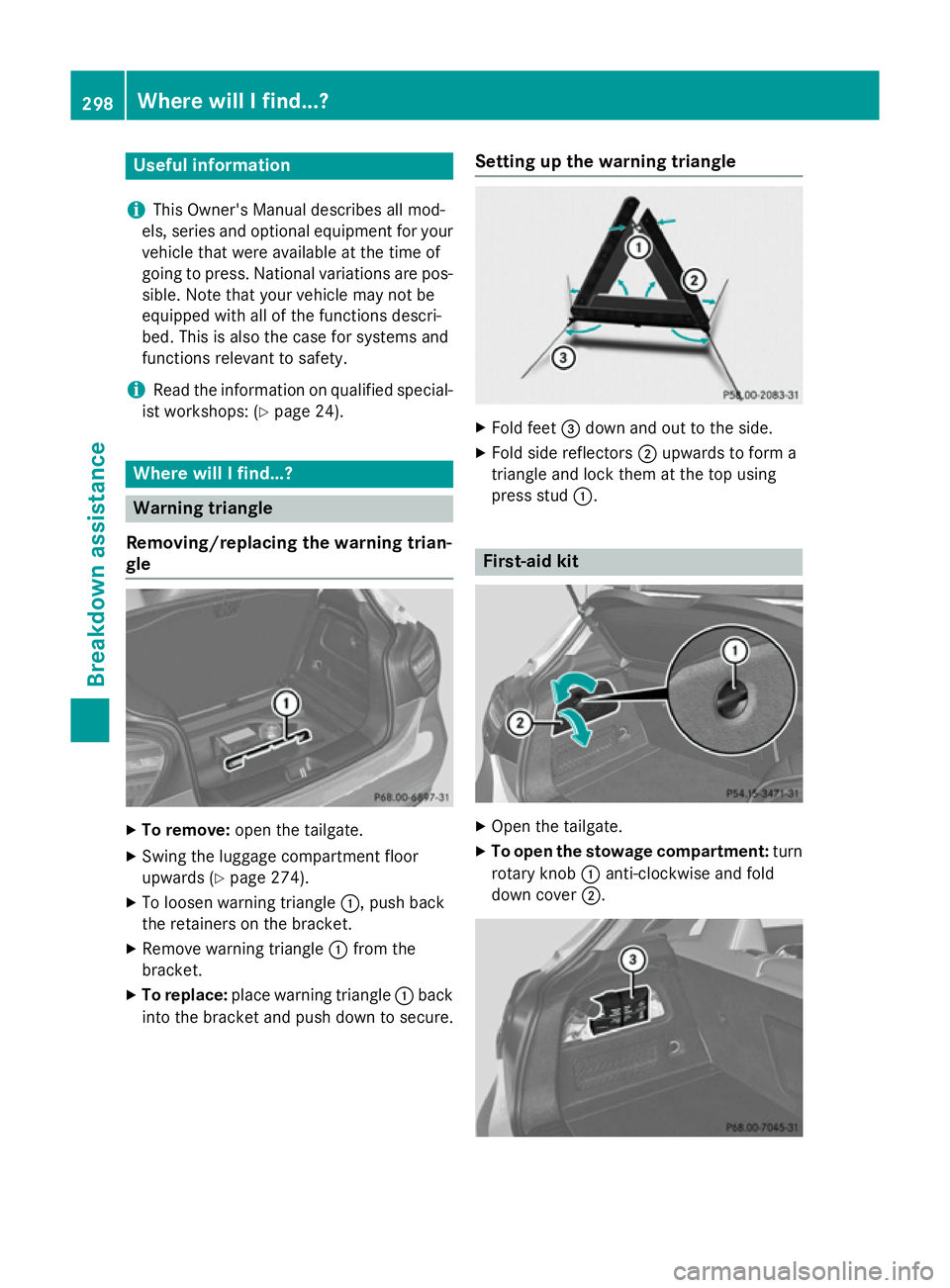
gle X
To remove: open the tailgate.
X Swing the luggage compartment floor
upwards (Y page 274).
X To loosen warning triangle :, push back
the retainers on the bracket.
X Remove warning triangle :from the
bracket.
X To replace: place warning triangle :back
into the bracket and push down to secure. Setting up the warning triangle X
Fold feet =down and out to the side.
X Fold side reflectors ;upwards to form a
triangle and lock them at the top using
press stud :. First-aid kit
X
Open the tailgate.
X To open the stowage compartment: turn
rotary knob :anti-clockwise and fold
down cover ;.298
Where will I find...?Breakdown assistance
Page 302 of 357

X
Remove first-aid kit =.
i Check the expiry date on first-aid kit
=at
least once a year. Replace the contents if
necessary, and replace any missing items. Fire extinguisher
The fire extinguisher is located underneath
the front of the driver's seat.
X Pull tab :upwards.
X Remove the fire extinguisher.
i Have the fire extinguisher refilled after
each use and checked every one or two
years. It may otherwise fail in an emer-
gency.
Observe the legal requirements for each
individual country. Vehicle tool kit
General notes Vehicles with a TIREFIT kit: the TIREFIT kit is
located in the stowage well under the boot
floor.
Vehicles with a tyre-change tool kit: the tyre-
change tool kit is in the stowage well under
the luggage compartment floor.
For vehicles with an emergency spare wheel, see "Removing the emergency spare wheel"
(Y page 332).
i Apart from some country-specific var-
iants, vehicles are not equipped with tyre- changing tools. Some tools for changing a
wheel are specific to the vehicle. For more
information on which tools are required and
approved to perform a wheel change on
your vehicle, consult a qualified specialist
workshop.
Necessary tyre-changing tools can include, for example:
R Jack
R Wheel chock
R Wheel wrench
Vehicles with a TIREFIT kit :
Tyre inflation compressor
; Towing eye
= Tyre sealant filler bottle
X Open the tailgate.
X Swing the luggage compartment floor
upwards (Y page 274).
i Towing eye
;is located under tyre infla-
tion compressor :.
Vehicles with a tyre-change tool kit X
Open the tailgate.
X Swing the luggage compartment floor
upwards (Y page 274).
X Remove the tyre-change tool kit.
The tyre-change tool kit contains:
R Jack
R Wheel wrench
R One pair of gloves
R Foldable wheel chock Where will I find.
..?
299Breakdo wn assis tance
Page 329 of 357
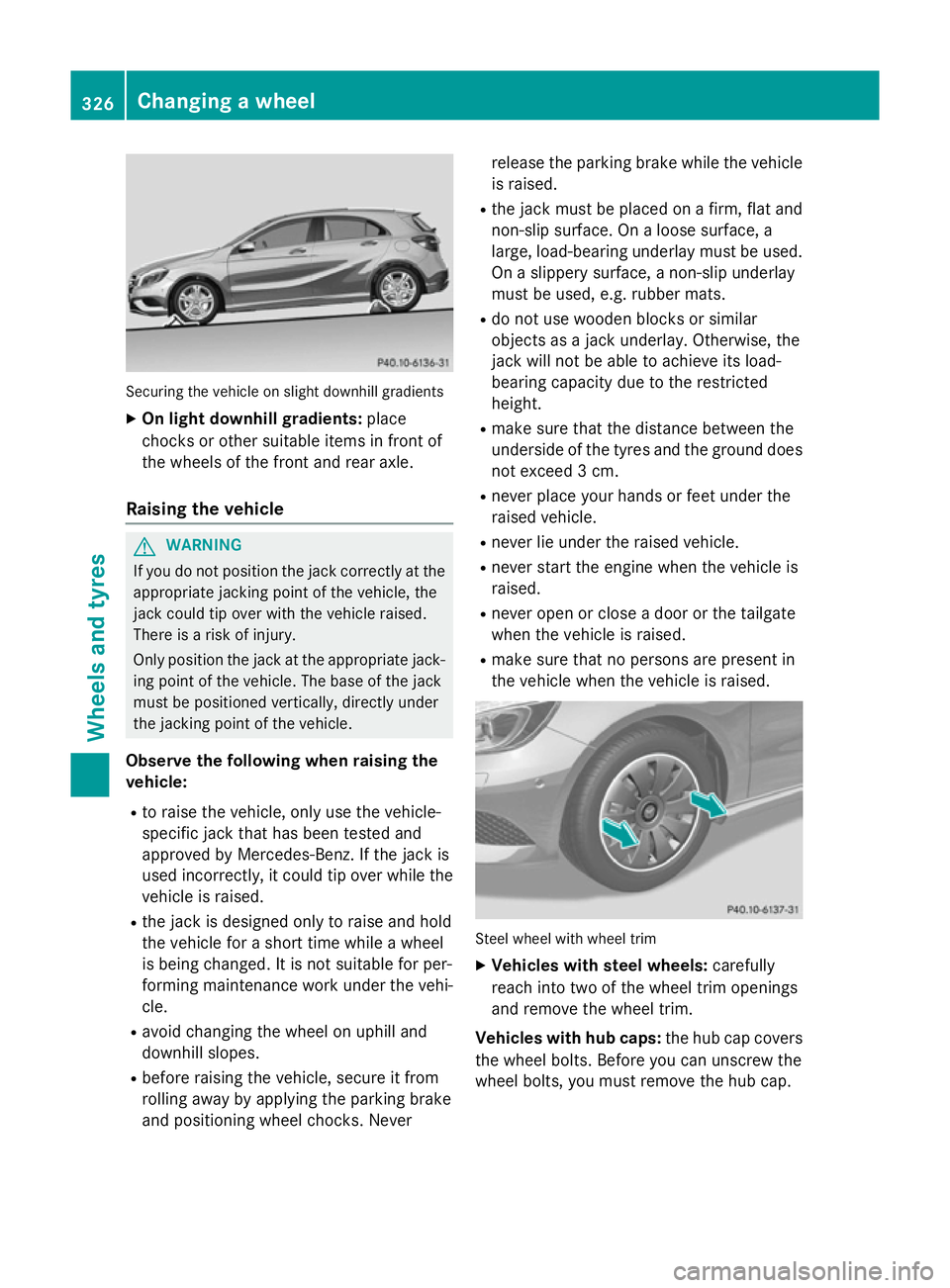
Securing the vehicle on slight downhill gradients
X On light downhill gradients: place
chocks or other suitable items in front of
the wheels of the front and rear axle.
Raising the vehicle G
WARNING
If you do not position the jack correctly at the appropriate jacking point of the vehicle, the
jack could tip over with the vehicle raised.
There is a risk of injury.
Only position the jack at the appropriate jack-
ing point of the vehicle. The base of the jack
must be positioned vertically, directly under
the jacking point of the vehicle.
Observe the following when raising the
vehicle:
R to raise the vehicle, only use the vehicle-
specific jack that has been tested and
approved by Mercedes-Benz. If the jack is
used incorrectly, it could tip over while the
vehicle is raised.
R the jack is designed only to raise and hold
the vehicle for a short time while a wheel
is being changed. It is not suitable for per-
forming maintenance work under the vehi- cle.
R avoid changing the wheel on uphill and
downhill slopes.
R before raising the vehicle, secure it from
rolling away by applying the parking brake
and positioning wheel chocks. Never release the parking brake while the vehicle
is raised.
R the jack must be placed on a firm, flat and
non-slip surface. On a loose surface, a
large, load-bearing underlay must be used.
On a slippery surface, a non-slip underlay
must be used, e.g. rubber mats.
R do not use wooden blocks or similar
objects as a jack underlay. Otherwise, the
jack will not be able to achieve its load-
bearing capacity due to the restricted
height.
R make sure that the distance between the
underside of the tyres and the ground does
not exceed 3 cm.
R never place your hands or feet under the
raised vehicle.
R never lie under the raised vehicle.
R never start the engine when the vehicle is
raised.
R never open or close a door or the tailgate
when the vehicle is raised.
R make sure that no persons are present in
the vehicle when the vehicle is raised. Steel wheel with wheel trim
X Vehicles with steel wheels: carefully
reach into two of the wheel trim openings
and remove the wheel trim.
Vehicles with hub caps: the hub cap covers
the wheel bolts. Before you can unscrew the
wheel bolts, you must remove the hub cap. 326
Changing a wheelWheels and tyres
Page 336 of 357
X
Open the tailgate.
X Loosen lashing straps ;on emergency
spare wheel bag :.
X Remove emergency spare wheel bag :
with the "Minispare" emergency spare
wheel.
For further information on changing and fit-
ting a wheel, see (Y page 325). Technical data
"Minispare" emer-
gency spare wheel
Tyres Steel wheel
T 125/80 R17 99 M
Tyre pressure: 420 kPa
(4.2 bar/61 psi) 3.5 B x 17 H2
ET 19.5 Emergency spare wheel
333Wheels and tyres Z