towing MERCEDES-BENZ A-CLASS HATCHBACK 2015 Workshop Manual
[x] Cancel search | Manufacturer: MERCEDES-BENZ, Model Year: 2015, Model line: A-CLASS HATCHBACK, Model: MERCEDES-BENZ A-CLASS HATCHBACK 2015Pages: 417, PDF Size: 11.91 MB
Page 357 of 417
transport vehicle is not permitted. The drive
train may otherwise be damaged.
All vehicles !
You may only secure the vehicle by the
wheels, not by parts of the vehicle such as axle or steering components. Otherwise,
the vehicle could be damaged.
X Vehicles with manual transmission:
depress the clutch pedal fully and engage
neutral.
X Turn the key to position 2in the ignition
lock (Y page 157).
X Vehicles with automatic transmission:
turn the key to position 2in the ignition lock
(Y page 157).
X Shift the transmission to position N.
As soon as the vehicle is loaded: X Prevent the vehicle from rolling away by
applying the electric parking brake.
X Vehicles with manual transmission:
depress the clutch pedal fully and engage
first or reverse gear.
X Vehicles with automatic transmission:
shift the transmission to position P.
X Turn the key to position 0in the ignition
lock and remove it.
X Secure the vehicle.
The towing eyes or trailer tow hitch can be
used to pull the vehicle onto a trailer or trans- porter if you wish to transport it. Notes for 4MATIC vehicles
! Vehicles with 4MATIC must not be towed
with the front or rear axle raised; otherwise, the transmission may be damaged.
Vehicles with 4MATIC may only be either
towed away with both axles on the ground or be loaded up and transported.
If the vehicle has transmission damage or
damage to the front or rear axle, have it trans-
ported on a transporter or trailer. In the event of damage to the electrical
system:
If the battery is defective, the automatic
transmission will be locked in position P. To
shift the automatic transmission to position
N, you must provide power to the vehicle's
electrical system in the same way as when
jump-starting (Y page 348).
Have the vehicle transported on a transporter
or trailer. Tow-starting (emergency engine
starting)
! Do not tow-start vehicles with automatic
transmission. You could otherwise damage the automatic transmission.
i You can find information on "Jump-start-
ing" under (Y page 348).
Before tow-starting, the following conditions
must be fulfilled: R the battery is connected
R the engine has cooled down
R the exhaust system has cooled down
When tow-starting, it is important that you
observe the safety notes (Y page 350)and the
legal requirements in each respective coun-
try.
X Switch on the hazard warning lamps
(Y page 123).
X Fit the towing eye (Y page 352).
X Secure the rigid towing bar or the towing
rope.
X When the vehicle is stationary, depress the
brake pedal and keep it depressed.
X Turn the key to position 2in the ignition
lock (Y page 157).
X Depress the clutch pedal fully, engage sec-
ond gear and continue to keep the clutch
pedal fully depressed.
X Release the brake pedal.
X Tow-start the vehicle. 354
Towing away and tow-startingBreakdo
wn assis tance
Page 358 of 417
X
Release the clutch pedal slowly; do not
depress the accelerator pedal while doing
so.
X When the engine has been started, imme-
diately depress the clutch pedal fully and
shift to neutral.
X Pull over at a suitable place and stop the
vehicle safely, paying attention to road and
traffic conditions.
X Use the electric parking brake to secure the
vehicle and prevent it from rolling away.
X Remove the rigid towing bar or towing rope.
X Remove the towing eye (Y page 352).
X Switch off the hazard warning lamps. Electrical fuses
Important safety notes
G
WARNING
If you manipulate, bridge or replace a faulty
fuse with a fuse of a higher amperage, the
electric cables could be overloaded. This may result in a fire. There is a risk of an accident
and injury.
Always replace faulty fuses with specified new fuses of the correct amperage.
Blown fuses must be replaced with fuses of
the same rating, which you can recognise by
the colour and fuse rating. The fuse ratings
are listed in the fuse allocation chart.
If the newly inserted fuse also blows, have the
cause traced and rectified at a qualified spe-
cialist workshop, e.g. a Mercedes-Benz Ser-
vice Centre.
! Only use fuses that have been approved
for Mercedes-Benz vehicles and which
have the correct fuse rating for the system concerned. Only use fuses marked with an
"S". Components or systems could other-
wise be damaged.
The fuses in your vehicle disconnect faulty
circuits. If a fuse blows, all the components on the circuit and their functions will fail. Before replacing a fuse
X Safeguard the vehicle against rolling away
(Y page 184).
X Switch off all electrical consumers.
X Vehicles without KEYLESS-GO: remove
the key from the ignition lock.
X Vehicles with KEYLESS-GO start-func-
tion or KEYLESS-GO: open the driver's
door.
The on-board electronics now have status
0. This is the same as the key having been
removed.
The fuses are located in various fuse boxes: R fuse box in the engine compartment on the
left-hand side of the vehicle, when viewed
in the direction of travel
R fuse box in the front-passenger footwell
The fuse allocation chart is on the fuse box in
the front-passenger footwell (Y page 356). Fuse box in the engine compartment
G
WARNING
When the bonnet is open, and the windscreen wipers are set in motion, you can be injured by
the wiper linkage. There is a risk of injury.
Always switch off the windscreen wipers and
the ignition before opening the bonnet.
! Make sure that no moisture can enter the
fuse box when the cover is open.
! When closing the cover, make sure that it
is lying correctly on the fuse box. Moisture
seeping in or dirt could otherwise impair
the operation of the fuses. Elect
rical fuses
355Breakdown assis tance Z
Page 366 of 417
does not permit any reliable conclusion about
the tyre pressure. On vehicles fitted with the
electronic tyre pressure monitor, the tyre
pressure can be checked using the on-board
computer.
If possible, only correct tyre pressures when
the tyres are cold.
The tyres are cold:
R if the vehicle has been parked with the tyres
out of direct sunlight for at least three
hours and
R if the vehicle has not been driven further
than 1.6 km
Depending on the ambient temperature, the
vehicle speed and the load on the tyres, the
tyre temperature and thus the tyre pressure
changes by approximately 10 kPa (0.1 bar/
1.5 psi) per 10 †. Take this into account
when checking the pressure of warm tyres.
Only correct the tyre pressure if it is too low
for the current operating conditions.
Driving with tyre pressure that is too high or
too low can:
R shorten the service life of the tyres
R cause increased tyre damage
R have a negative effect on handling charac-
teristics and thus driving safety (e.g. aqua- planing)
The tyre pressure values given for low loads
are minimum values which offer you good ride
comfort characteristics.
However, you can also use the values given
for higher loads. These are permissible and
will not adversely affect the running of the
vehicle. Tyre pressure loss warning system
General notes While the vehicle is in motion, the tyre pres-
sure loss warning system monitors the set
tyre pressure using the rotational speed of
the wheels. This enables the system to detect significant pressure loss in a tyre. If the speed of rotation of a wheel changes as a result of a
loss of pressure, a corresponding warning
message will appear in the multifunction dis-
play.
You can recognise the tyre pressure loss
warning by the Run Flat Indicator
Run Flat Indicator
active Restart with OK active Restart with OK message which
appears in the multifunction display in the
Serv.
Serv.menu. Information on the message dis-
play can be found in the "Restarting the tyre
pressure loss warning system" section
(Y page 364).
Important safety notes The tyre pressure warning system does not
warn you of an incorrectly set tyre pressure.
Observe the notes on the recommended tyre
pressure (Y page 362).
The tyre pressure loss warning does not
replace the need to regularly check the tyre
pressures. An even loss of pressure on sev-
eral tyres at the same time cannot be detec-
ted by the tyre pressure loss warning system.
The tyre pressure monitor is not able to warn
you of a sudden loss of pressure, e.g. if the
tyre is penetrated by a foreign object. In the
event of a sudden loss of pressure, bring the
vehicle to a halt by braking carefully. Avoid
abrupt steering manoeuvres.
The function of the tyre pressure loss warning system is limited or delayed if:
R snow chains are fitted to your vehicle's
tyres.
R road conditions are wintry.
R you are driving on sand or gravel.
R you adopt a very sporty driving style (cor-
nering at high speeds or driving with high
rates of acceleration).
R you are towing a very heavy or large trailer.
R you are driving with a heavy load (in the
vehicle or on the roof). Tyre pressure
363Wheels and tyres Z
Page 403 of 417
label on the petrol pump, ask the filling sta-
tion staff.
Information on refuelling (Y page 181).
Low outside temperatures
In winter months, diesel fuel with an improved cold flow quality is available. In Europe, the
EN 590 standard defines various climate-
dependent temperature categories. Malfunc- tions can be avoided by refuelling with diesel
fuel that corresponds to the climatic specifi-
cations outlined in EN 590. At unusually low
outside temperatures, it is possible that the
flow characteristics of the diesel fuel could be
insufficient. Accordingly, diesel fuel from
warmer areas may not be suitable for opera-
tion in colder climatic conditions.
i Further information on country-specific
fuel properties and fuel types with low-tem-
perature resistance can be obtained from
oil companies, e.g. at filling stations.
Fuel consumption information H
Environmental note
CO 2(carbon dioxide) is the gas which scien-
tists believe to be principally responsible for
global warming (the greenhouse effect). Your vehicle's CO 2emissions are directly related to
fuel consumption and therefore depend on:
R efficient use of the fuel by the engine
R driving style
R other non-technical factors, such as envi-
ronmental influences, road conditions or
traffic flow
You can minimise your vehicle's CO 2emis-
sions by driving carefully and having it serv-
iced regularly.
The vehicle will use more fuel than usual in the following situations:
R at very low outside temperatures
R in urban traffic
R on short journeys R
in mountainous terrain
R when towing a trailer
i Only for certain countries: you can find
the current consumption and emissions
values of your vehicle in the COC docu-
ments (EU Certificate of Conformity).
These documents are delivered with your
vehicle.
The consumption figures were, in each
case, based on the currently applicable ver- sion:
R for vehicles that comply with standards
up to and including the EURO 4 standard,
in accordance with EU Directive
80/1268/EEC
R for vehicles that comply with or exceed
the EURO 5 standard, in accordance with
Regulation (EC) No. 715/2007
Deviations from these values may occur
under normal operating conditions. Engine oil
General notes When handling engine oil, observe the impor-
tant safety notes on service products
(Y page 396).
The quality of the engine oil is decisive for the
function and service life of an engine. After
extensive tests, Mercedes-Benz approves
engine oils that correspond to the current
technical standard.
Therefore, only Mercedes-Benz approved
engine oils may be used in Mercedes-Benz
engines.
Further information on tested and approved
engine oils can be obtained from any
Mercedes-Benz Service Centre. Mercedes-
Benz recommends that you have the oil
change carried out at a qualified specialist
workshop. Mercedes-Benz approval is indica- ted on the oil container by the inscription
"MB-Freigabe" or "MB-Approval" and the cor-
responding designation, e.g. MB-Freigabe or
MB-Approval 229.51. 400
Service products and capacitiesTechnical data
Page 408 of 417
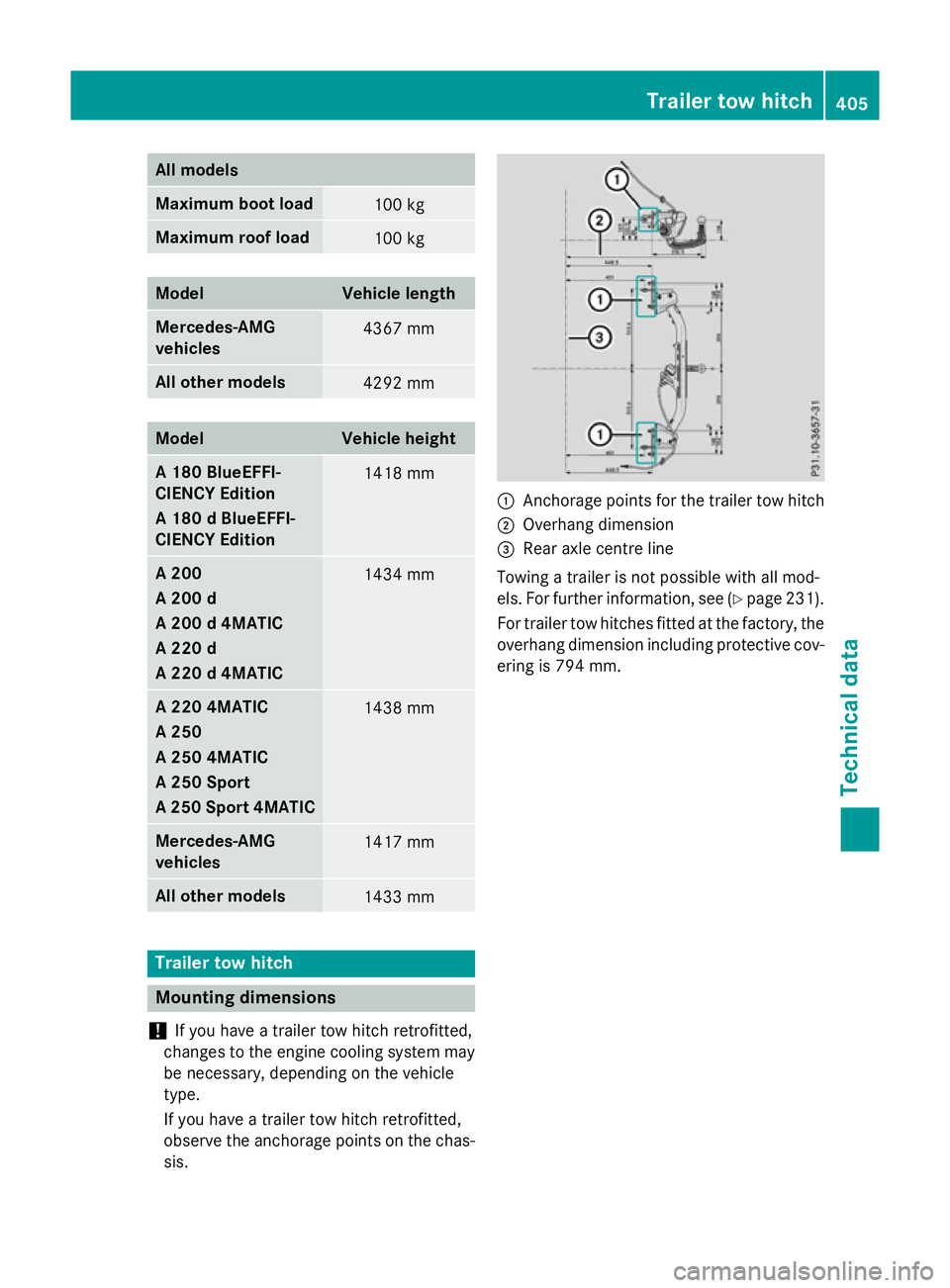
All models
Maximum boot load
100 kg
Maximum roof load
100 kg
Model Vehicle length
Mercedes-AMG
vehicles
4367 mm
All other models
4292 mm
Model Vehicle height
A 180 BlueEFFI-
CIENCY Edition
A 180 d BlueEFFI-
CIENCY Edition
1418 mm
A 200
A 200 d
A 200 d 4MATIC
A 220 d
A 220 d 4MATIC
1434 mm
A 220 4MATIC
A 250
A 250 4MATIC
A 250 Sport
A 250 Sport 4MATIC
1438 mm
Mercedes-AMG
vehicles
1417 mm
All other models
1433 mm
Trailer tow hitch
Mounting dimensions
! If you have a trailer tow hitch retrofitted,
changes to the engine cooling system may
be necessary, depending on the vehicle
type.
If you have a trailer tow hitch retrofitted,
observe the anchorage points on the chas- sis. :
Anchorage points for the trailer tow hitch
; Overhang dimension
= Rear axle centre line
Towing a trailer is not possible with all mod-
els. For further information, see (Y page 231).
For trailer tow hitches fitted at the factory, the
overhang dimension including protective cov- ering is 794 mm. Trailer tow hitch
405Technical data Z
Page 409 of 417
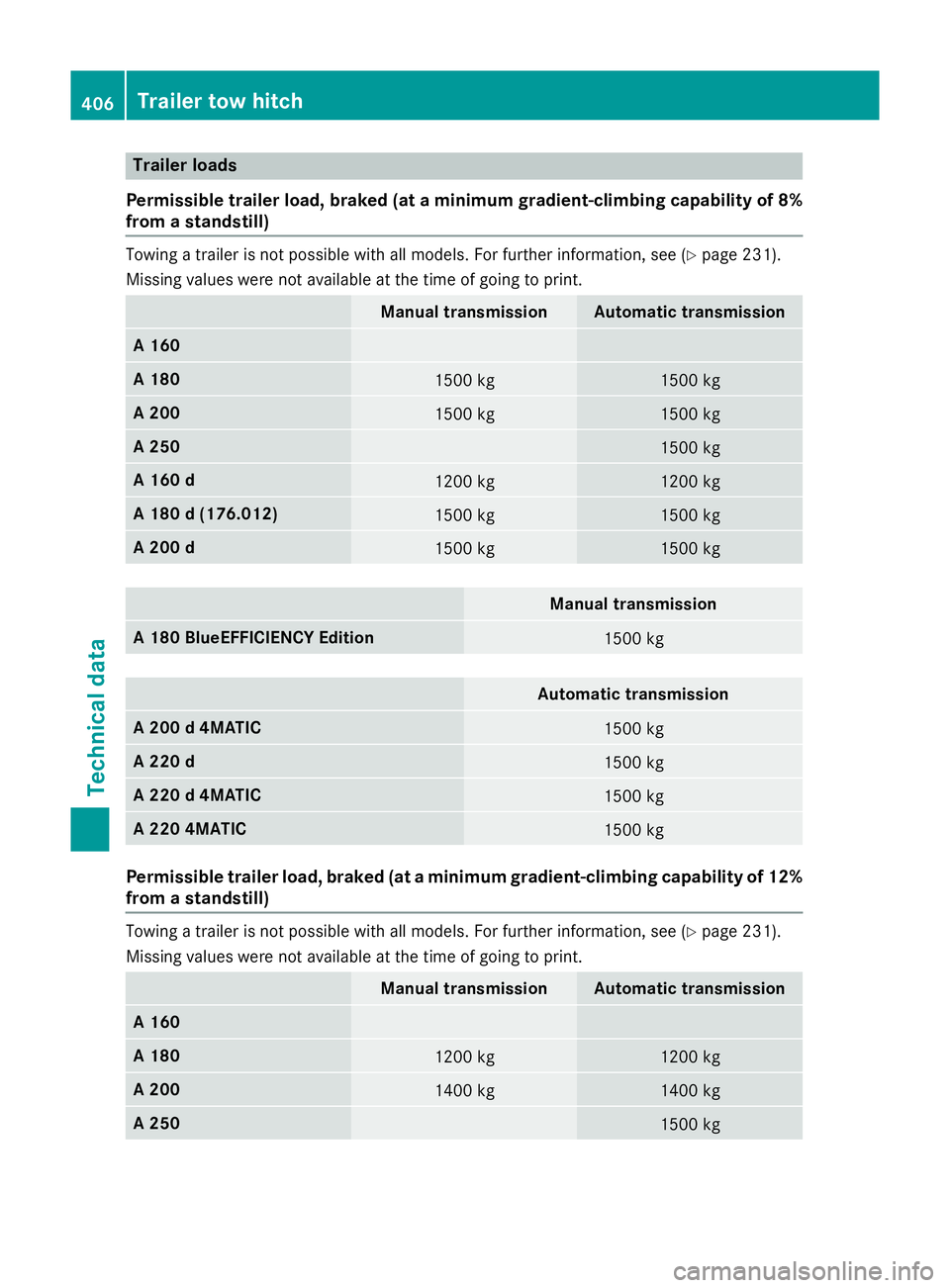
Trailer loads
Permissible trailer load, braked (at a minimum gradient-climbing capability of 8%
from a standstill) Towing a trailer is not possible with all models. For further information, see (Y
page 231).
Missing values were not available at the time of going to print. Manual transmission Automatic transmission
A 160
A 180
1500 kg 1500 kg
A 200
1500 kg 1500 kg
A 250
1500 kg
A 160 d
1200 kg 1200 kg
A 180 d (176.012)
1500 kg 1500 kg
A 200 d
1500 kg 1500 kg
Manual transmission
A 180 BlueEFFICIENCY Edition
1500 kg
Automatic transmission
A 200 d 4MATIC
1500 kg
A 220 d
1500 kg
A 220 d 4MATIC
1500 kg
A 220 4MATIC
1500 kg
Permissible trailer load, braked (at a minimum gradient-climbing capability of 12%
from a standstill) Towing a trailer is not possible with all models. For further information, see (Y
page 231).
Missing values were not available at the time of going to print. Manual transmission Automatic transmission
A 160
A 180
1200 kg 1200 kg
A 200
1400 kg 1400 kg
A 250
1500 kg406
Trailer tow hitchTechnical data
Page 410 of 417
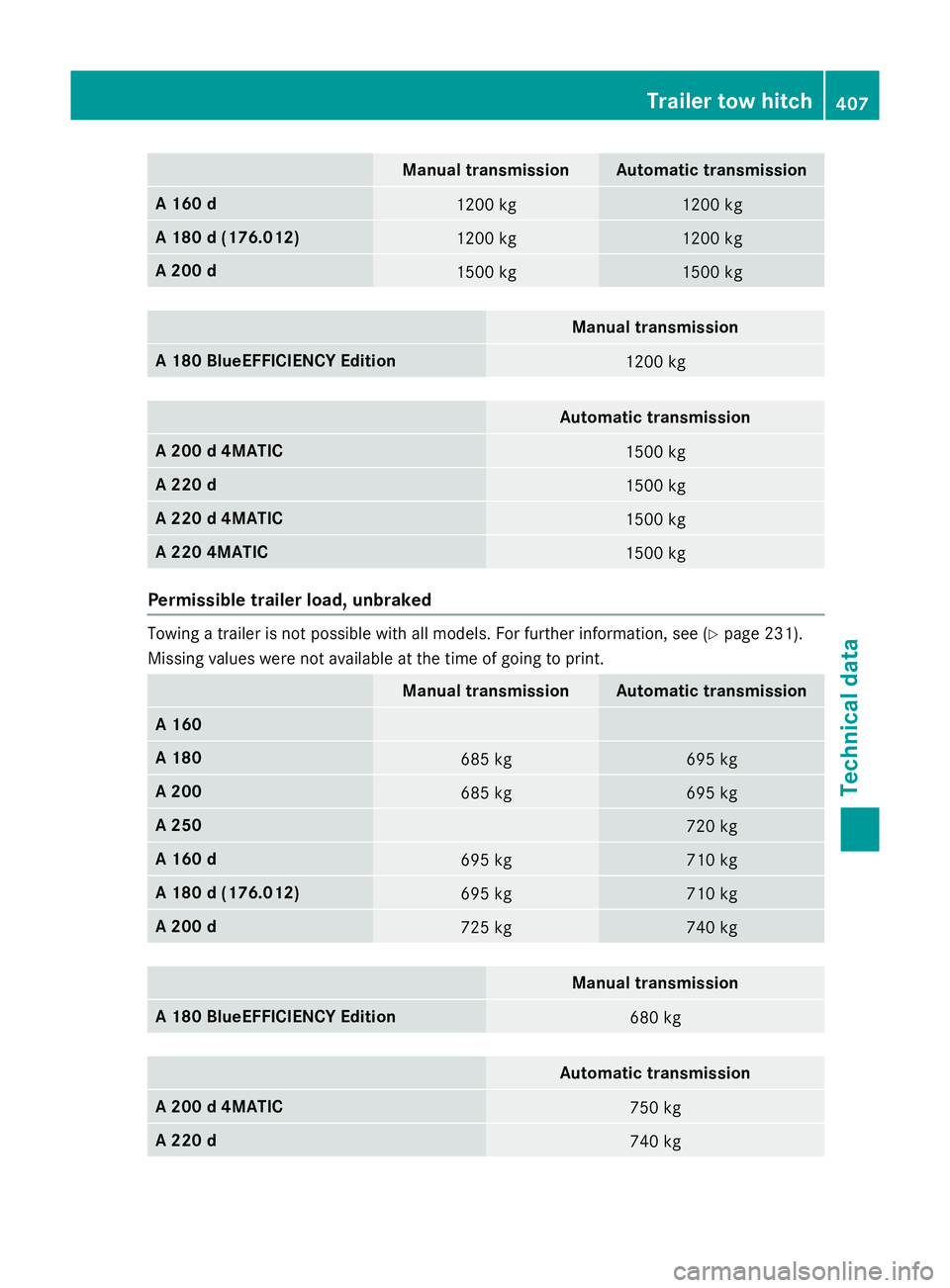
Manual transmission Automatic transmission
A 160 d
1200 kg 1200 kg
A 180 d (176.012)
1200 kg 1200 kg
A 200 d
1500 kg 1500 kg
Manual transmission
A 180 BlueEFFICIENCY Edition
1200 kg
Automatic transmission
A 200 d 4MATIC
1500 kg
A 220 d
1500 kg
A 220 d 4MATIC
1500 kg
A 220 4MATIC
1500 kg
Permissible trailer load, unbraked
Towing a trailer is not possible with all models. For further information, see (Y
page 231).
Missing values were not available at the time of going to print. Manual transmission Automatic transmission
A 160
A 180
685 kg 695 kg
A 200
685 kg 695 kg
A 250
720 kg
A 160 d
695 kg 710 kg
A 180 d (176.012)
695 kg 710 kg
A 200 d
725 kg 740 kg
Manual transmission
A 180 BlueEFFICIENCY Edition
680 kg
Automatic transmission
A 200 d 4MATIC
750 kg
A 220 d
740 kg Trailer tow hitch
407Technical data Z
Page 411 of 417
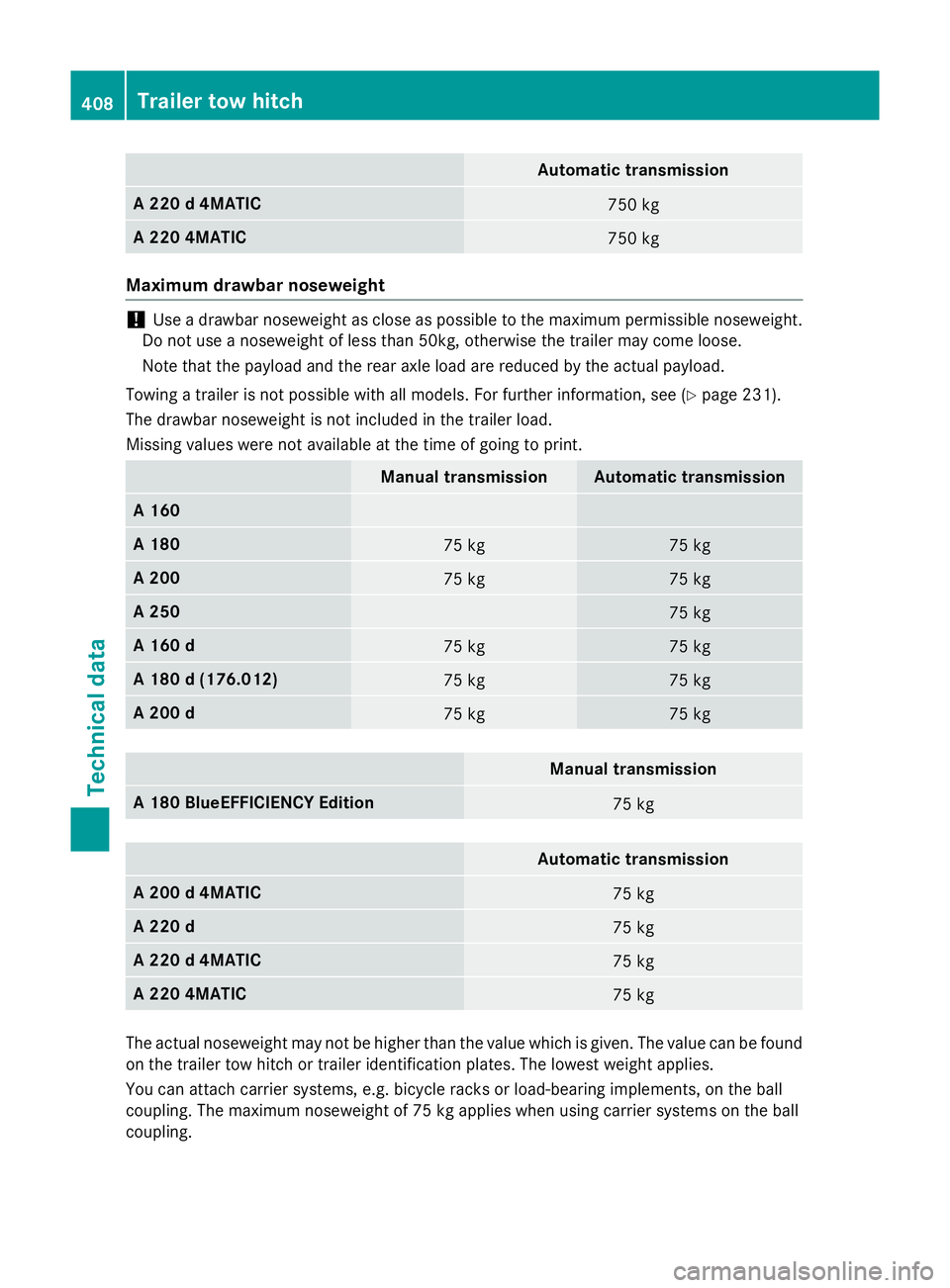
Automatic transmission
A 220 d 4MATIC
750 kg
A 220 4MATIC
750 kg
Maximum drawbar noseweight
!
Use a drawbar noseweight as close as possible to the maximum permissible noseweight.
Do not use a noseweight of less than 50kg, otherwise the trailer may come loose.
Note that the payload and the rear axle load are reduced by the actual payload.
Towing a trailer is not possible with all models. For further information, see (Y page 231).
The drawbar noseweight is not included in the trailer load.
Missing values were not available at the time of going to print. Manual transmission Automatic transmission
A 160
A 180
75 kg 75 kg
A 200
75 kg 75 kg
A 250
75 kg
A 160 d
75 kg 75 kg
A 180 d (176.012)
75 kg 75 kg
A 200 d
75 kg 75 kg
Manual transmission
A 180 BlueEFFICIENCY Edition
75 kg
Automatic transmission
A 200 d 4MATIC
75 kg
A 220 d
75 kg
A 220 d 4MATIC
75 kg
A 220 4MATIC
75 kg
The actual noseweight may not be higher than the value which is given. The value can be found
on the trailer tow hitch or trailer identification plates. The lowest weight applies.
You can attach carrier systems, e.g. bicycle racks or load-bearing implements, on the ball
coupling. The maximum noseweight of 75 kg applies when using carrier systems on the ball
coupling. 408
Trailer tow hitchTechnical data
Page 412 of 417
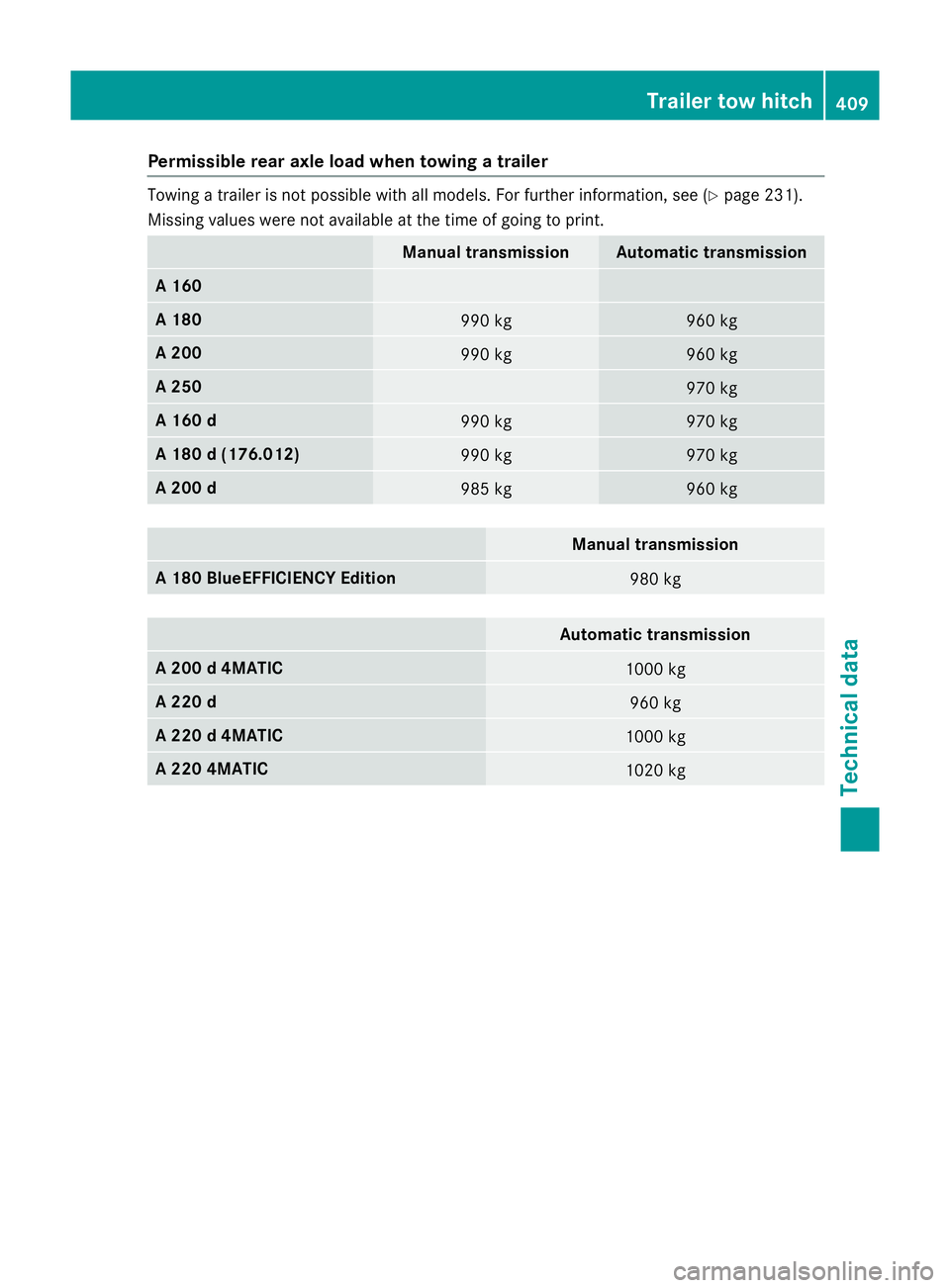
Permissible rear axle load when towing a trailer
Towing a trailer is not possible with all models. For further information, see (Y
page 231).
Missing values were not available at the time of going to print. Manual transmission Automatic transmission
A 160
A 180
990 kg 960 kg
A 200
990 kg 960 kg
A 250
970 kg
A 160 d
990 kg 970 kg
A 180 d (176.012)
990 kg 970 kg
A 200 d
985 kg 960 kg
Manual transmission
A 180 BlueEFFICIENCY Edition
980 kg
Automatic transmission
A 200 d 4MATIC
1000 kg
A 220 d
960 kg
A 220 d 4MATIC
1000 kg
A 220 4MATIC
1020 kg Trailer tow hitch
409Technical data Z