tyre pressure MERCEDES-BENZ A-CLASS HATCHBACK 2015 Owners Manual
[x] Cancel search | Manufacturer: MERCEDES-BENZ, Model Year: 2015, Model line: A-CLASS HATCHBACK, Model: MERCEDES-BENZ A-CLASS HATCHBACK 2015Pages: 417, PDF Size: 11.91 MB
Page 7 of 417
1, 2, 3 ...
4ETS (Electronic Traction System) see ETS/4ETS (Electronic Trac-
tion System)
4MATIC
Display message ............................ 288
4MATIC (permanent four-wheel
drive) .................................................. 208
12 V socket
see Sockets A
ABS (Anti-lock Braking System) Display message ............................ 258
Function/notes ................................ 69
Important safety notes .................... 69
Warning lamp .................................2 95
Accident
Automatic measures after an acci-
dent ................................................. 57
Activating/deactivating air-recir-
culation mode ................................... .146
Activating/deactivating cooling
with air dehumidification ................. 141
Active Parking Assist
Detecting parking spaces .............. 213
Display message ............................ 279
Exiting a parking space .................. 216
Function/notes ............................ .212
Important safety notes .................. 212
Parking .......................................... 214
Towing a trailer .............................. 212
ADAPTIVE BRAKE ................................. 77
Adaptive Brake Assist
Function/notes ................................ 72
Adaptive brake lights .......................... 73
Adaptive Damping System
Function/notes ............................ .207
Adaptive Highbeam Assist
Display message ............................ 274
Function/notes ............................ .123
Switching on/off ........................... 124
Additional speedometer ................... 250
Additives (engine oil) ........................ 401
Adjusting the headlamp range ......... 122Air conditioning
General notes ................................ 136
Air filter (white display message) .... 277
Air pressure
see Tyre pressure
Air vents
Important safety notes .................. 153
Rear ............................................... 154
Setting the centre air vents ........... 154
Setting the side air vents .............. .154
Air-conditioning system
see Climate control
Airbag
Automatic front-passenger front
airbag deactivatio n .......................... 49
Introduction ..................................... 46
PASSENGER AIR BAG indicator
lamps ............................................... 41
Airbags
Display message ............................ 270
Front airbag (driver, front
passenger) ....................................... 47
Important safety guidelines ............. 46
Kneebag .......................................... .48
Sidebag ............................................ 48
Triggering ......................................... 55
Windowbag ...................................... 49
Alarm
ATA (Anti-Theft Alarm system) ......... 78
Switching off (ATA) .......................... 78
Switching the function on/off
(ATA) ................................................ 78
Alarm system
see ATA (Anti-Theft Alarm system)
AMG
Performance Seat .......................... 111
RIDE CONTROL sports suspen-
sion ................................................ 207
AMG menu (on-board computer) ..... 254
AMG Performance exhaust sys-
tem ..................................................... 164
Anti-glare film .................................... 319
Anti-lock braking system
see ABS (Anti-lock Braking System)
Anti-Theft Alarm system
see ATA (Anti-Theft Alarm system)
Aquaplaning ....................................... 1904
Index
Page 9 of 417
Activating/deactivating (on the
centre console) .............................. 149
Remote contro l.............................. 149
Axle load, permissible (trailer tow-
ing) ...................................................... 406 B
Bag hook ............................................ 311
Ball coupling
Folding in ....................................... 233
Folding out ..................................... 232
BAS (Brake Assist System) ................. 70
Battery (key)
Checking .......................................... 86
Important safety notes .................... 85
Replacing ......................................... 86
Battery (vehicle)
Charging ........................................ 347
Display message ............................ 276
Important safety notes .................. 344
Jump starting ................................. 348
Belt
see Seat belts
Belt tensioner
Activation ......................................... 55
Blind Spot Assist
Activating/deactivating (on-
board computer) ............................ 249
Display message ............................ 279
Notes/function .............................. 226
Trailer towing ................................. 228
Bonnet
Active bonnet (pedestrian protec-tion) ............................................... 322
Closing ........................................... 324
Display message ............................ 288
Important safety notes .................. 322
Opening ......................................... 323
Boot lid
see Tailgate
Boot load (maximum) ........................ 404
Brake
EBD .................................................. 77
Brake Assist
see BAS (Brake Assist System)
Brake fluid
Display message ............................ 265 Notes ............................................. 402
Brake force distribution
see EBD (electronic brake force
distribution)
Brake lamps
Adaptive ........................................... 73
Changing bulb s.............................. 128
Display message ............................ 272
Brakes
ABS .................................................. 69
Adaptive Brake Assist ...................... 72
BAS .................................................. 70
Brake fluid (notes) ......................... 402
Display message ............................ 258
Driving tips .................................... 189
Hill start assist ............................... 161
HOLD function ............................... 204
Important safety notes .................. 189
Parking brake ................................ 185
Warning lamp ................................. 294
Breakdown
Where will I find...? ........................ 338
see Flat tyre
see Tow-starting
see Towing away
Brightness control (instrument
cluster lighting) ................................... 30
Buttons on the steering column ...... 239 C
Calling up a fault see Display messages
Car
see Vehicle
Car wash (care) ................................. 329
Care
Automatic car wash ....................... 329
Carpets .......................................... 335
Display ........................................... 334
Exhaust pipe .................................. 333
Exterior lighting ............................. 332
Gear or selector lever .................... 334
High-pressure cleaner .................... 330
Interior ........................................... 334
Matt paintwork .............................. 331
Note s............................................. 329
Paint .............................................. 330 6
Index
Page 22 of 417
Transmission oil (on-board com-
puter, Mercedes-AMG vehicles) ..... 254
TEMPOMAT
Function/notes ............................. 191
Through-loading ................................ 309
Timing (RACETIMER) .........................254
TIREFIT kit .......................................... 341
Tyre pressure not reached ............. 343
Tyre pressure reached ................... 343
Top Tether ............................................ 60
Total distance recorder .................... 242
Tow-away protection
Activating ......................................... 78
Deactivating ..................................... 79
Function .......................................... .78
Tow-starting
Emergency engine starting ............ 354
Fitting the towing eye .................... 352
Important safety notes .................. 350
Removing the towing eye ............... 352
Towing
Important safety notes .................. 350
Notes for 4MATIC vehicles ............ 354
Transporting the vehicle ................ 353
Towing a trailer
Active Parking Assist ..................... 212
Axle load, permissibl e.................... 406
ESP ®
(Electronic Stability Pro-
gram) ............................................... 76
Failure check for LEDs ................... 234
General notes ................................ 231
Pulling away with a traile r.............. 161
Trailer tow hitch display message .. 289
Towing away
Fitting the towing ey e.................... 352
Removing the towing eye ............... 352
With both axles on the ground ....... 353
With front axle raised ..................... 352
Towing eye ......................................... 339
Traffic Sign Assist
Activating ....................................... 224
Activating/deactivating the warn- ing function .................................... 248
Display message ............................ 280
Function/note s............................. 223
Important safety notes .................. 224
Instrument cluster display ............. 224 Trailer coupling
see Towing a trailer
Trailer towing
7-pin connecto r............................. 234
Blind Spot Assist ............................ 228
Cleaning the trailer tow hitch ......... 333
Coupling up a traile r...................... 233
Decoupling a trailer ....................... 233
Driving tips .................................... 231
Folding in the ball coupling ............ 233
Folding out the ball coupling .......... 232
Important safety notes .................. 229
Lights display message .................. 271
Mounting dimensions .................... 405
Power supply ................................. 234
Trailer load s................................... 406
Transmission
see Automatic transmission
see Manual transmission
Transmission position display
(DIRECT SELECT lever) ...................... 170
Transporting the vehicle .................. 353
Trim pieces (cleaning instruc-
tions) .................................................. 335
Trip computer (on-board com-
puter) .................................................. 242
Trip meter
Calling up ....................................... 242
Resetting (on-board computer) ...... 243
Turn signals
Changing bulbs (front) ................... 128
Changing bulbs (rear) .................... 128
Switching on/of f........................... 122
TV
Operating (on-board computer) ..... 246
see Separate operating instructions
Two-way radio
Frequencies ................................... 394
Installation ..................................... 394
Transmission output (maximum) .... 394
Type identification plate
see Vehicle identification plate
Tyre pressure
Calling up (on-board computer) ..... 364
Display message ............................ 283
Not reached (TIREFIT) .................... 343
Reached (TIREFIT) .......................... 343
Recommended ............................... 362 Index
19
Page 23 of 417
Tyre pressure loss warning
General notes ................................ 363
Important safety notes .................. 363
Restarting ...................................... 364
Tyre pressure monitor
Checking the tyre pressure elec-
tronically ........................................ 365
Function/note s............................. 364
General notes ................................ 364
Important safety notes .................. 364
Radio type approval for the tyre
pressure monitor ........................... 367
Restarting ...................................... 366
Warning lamp ................................. 304
Warning message .......................... 366
Tyres
Changing a whee l.......................... 367
Checking ........................................ 359
Direction of rotation ...................... 368
Display message ............................ 283
General notes ................................ 372
Important safety notes .................. 358
Information on driving .................... 358
M+S tyres ...................................... 360
MOExtended tyre s......................... 360
Replacing ....................................... 367
Service life ..................................... 359
Storing ........................................... 368
Summer tyres ................................ 360
Tyre size (data ).............................. 372
Tyre tread ...................................... 359
Wheel and tyre combinations ........ 374
see Flat tyre U
Unlocking Emergency unlocking ....................... 91
From inside the vehicle (central
unlocking button) ............................. 90
Upshift indicator (on-board com-
puter, Mercedes-AMG vehicles) ....... 254V
Vanity mirror (in sun visor) .............. 315
Variable SPEEDTRONIC
see SPEEDTRONIC Vehicle
Correct use ...................................... 24
Data acquisition ............................... 25
Display message ............................ 285
Electronics ..................................... 394
Equipment ....................................... 23
Implied warranty .............................. 25
Individual settings .......................... 250
Leaving parked up ......................... 187
Locking (in an emergency) ............... 92
Locking (key) ................................... 83
Lowering ........................................ 372
Pulling away ................................... 160
Raising ........................................... 369
Registration ..................................... 24
Securing from rolling away ............ 369
Transporting .................................. 353
Unlocking (in an emergency) ........... 91
Unlocking (key) ................................ 83
Vehicle data ................................... 404
Vehicle data ....................................... 404
Boot load (maximum) ..................... 404
Roof load (maximum) ..................... 404
Vehicle dimensions ........................... 404
Vehicle emergency locking ................ 92
Vehicle identification number
see VIN
Vehicle identification plate .............. 396
Vehicle tool kit .................................. 339
Ventilation
Setting the vents ........................... 153
Video
Operating the DVD ......................... 245
VIN
Seat ............................................... 396
Type plate ...................................... 396 W
Warning and indicator lamps ABS ................................................ 295
Brakes ........................................... 294
Distance warning signal ................. 303
ESP ®
.............................................. 297
ESP ®
OFF ....................................... 298
Fuel tank ........................................ 301
LIM (cruise control )........................ 192
LIM (DISTRONIC PLUS) .................. 198 20
Index
Page 24 of 417
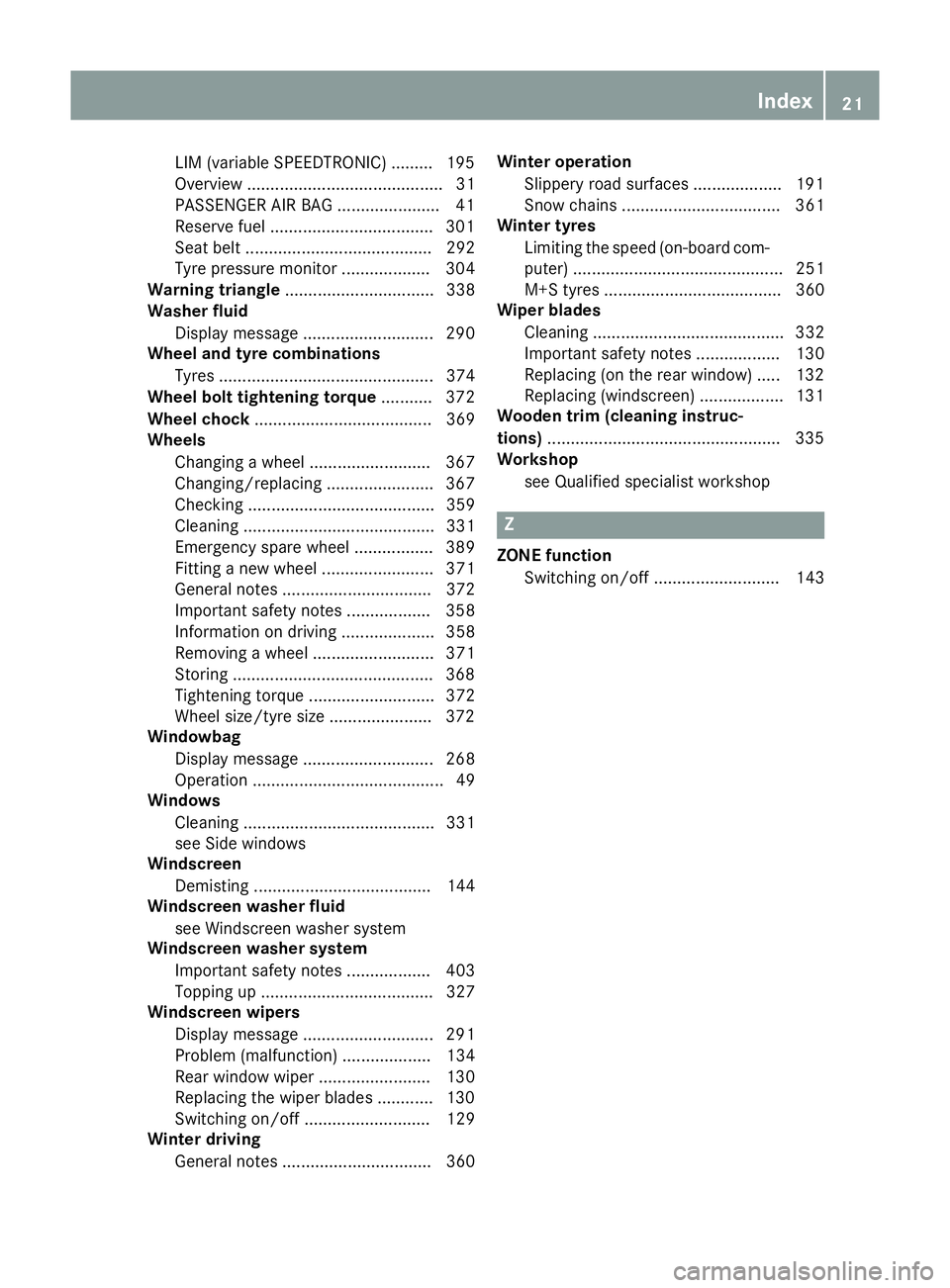
LIM (variable SPEEDTRONIC) .........1
95
Overview .......................................... 31
PASSENGER AIR BAG ..................... .41
Reserve fuel .................................. .301
Seat belt ........................................ 292
Tyre pressure monitor ................... 304
Warning triangle ................................ 338
Washer fluid
Display message ............................ 290
Wheel and tyre combinations
Tyres .............................................. 374
Wheel bolt tightening torque ........... 372
Wheel chock ...................................... 369
Wheels
Changing a wheel .......................... 367
Changing/replacing ....................... 367
Checking ........................................ 359
Cleaning ......................................... 331
Emergency spare wheel ................. 389
Fitting a new wheel ........................ 371
General notes ................................ 372
Important safety notes .................. 358
Information on driving .................... 358
Removing a wheel .......................... 371
Storing .......................................... .368
Tightening torque ........................... 372
Wheel size/tyre size ..................... .372
Windowbag
Display message ............................ 268
Operation ......................................... 49
Windows
Cleaning ......................................... 331
see Side windows
Windscreen
Demisting ...................................... 144
Windscreen washer fluid
see Windscreen washer system
Windscreen washer system
Important safety notes .................. 403
Topping up ..................................... 327
Windscreen wipers
Display message ............................ 291
Problem (malfunction) ................... 134
Rear window wiper ........................ 130
Replacing the wiper blades ............ 130
Switching on/off ........................... 129
Winter driving
General notes ................................ 360 Winter operation
Slippery road surfaces ................... 191
Snow chains .................................. 361
Winter tyres
Limiting the speed (on-board com-
puter) ............................................. 251
M+S tyres ...................................... 360
Wiper blades
Cleaning ......................................... 332
Important safety notes .................. 130
Replacing (on the rear window) ..... 132
Replacing (windscreen) .................. 131
Wooden trim (cleaning instruc-
tions) ................................................. .335
Workshop
see Qualified specialist workshop Z
ZONE function Switching on/off ........................... 143 Index
21
Page 25 of 417
Protection of the environment
General notes
H
Environmental note
Daimler's declared policy is one of compre-
hensive environmental protection.
Our objectives are to use the natural resour-
ces which form the basis of our existence on
this planet sparingly and in a manner which
takes the requirements of both nature and
humanity into consideration.
You too can help to protect the environment
by operating your vehicle in an environmen-
tally-responsible manner.
Fuel consumption and the rate of engine,
transmission, brake and tyre wear depend on
the following factors:
R operating conditions of your vehicle
R your personal driving style
You can influence both factors. Therefore,
please bear the following in mind:
Operating conditions:
R avoid short trips, as these increase fuel
consumption.
R observe the correct tyre pressure.
R do not carry any unnecessary weight in the
vehicle.
R remove the roof rack once you no longer
need it.
R a regularly serviced vehicle will contribute
to environmental protection. You should
therefore adhere to the service intervals.
R all maintenance work should be carried out
at a qualified specialist workshop.
Personal driving style:
R do not depress the accelerator pedal when
starting the engine.
R do not warm up the engine when the vehicle
is stationary.
R drive carefully and maintain a safe distance
from the vehicle in front.
R avoid frequent, sudden acceleration and
braking. R
change gear in good time and use each gear
only up to Ôof its maximum engine speed.
R switch off the engine in stationary traffic.
R monitor the vehicle's fuel consumption. Returning an end-of-life vehicle
EU countries only:
Mercedes-Benz will take back your old vehicle to dispose of it in an environmentally-respon-sible manner in accordance with the Euro-
pean Union (EU) End of Life Vehicles Direc-
tive.
There is a network of return points and dis-
assembly plants available. You can return
your vehicle to these plants free of charge.
This makes a valuable contribution to the
recycling process and the conservation of
resources.
For further information on recycling old vehi- cles, recovery and the terms of the policy,
visit the Mercedes-Benz homepage. Genuine Mercedes-Benz parts
H
Environmental note
Daimler AG also supplies reconditioned
assemblies and parts which are of the same
quality as new parts. For these, the same war-
ranty applies as for new parts.
! Airbags and seat belt tensioners, as well
as control units and sensors for these
restraint systems, may be installed in the
following areas of your vehicle:
R doors
R door pillars
R door sills
R seats
R dashboard
R instrument cluster
R centre console 22
Introduction
Page 34 of 417
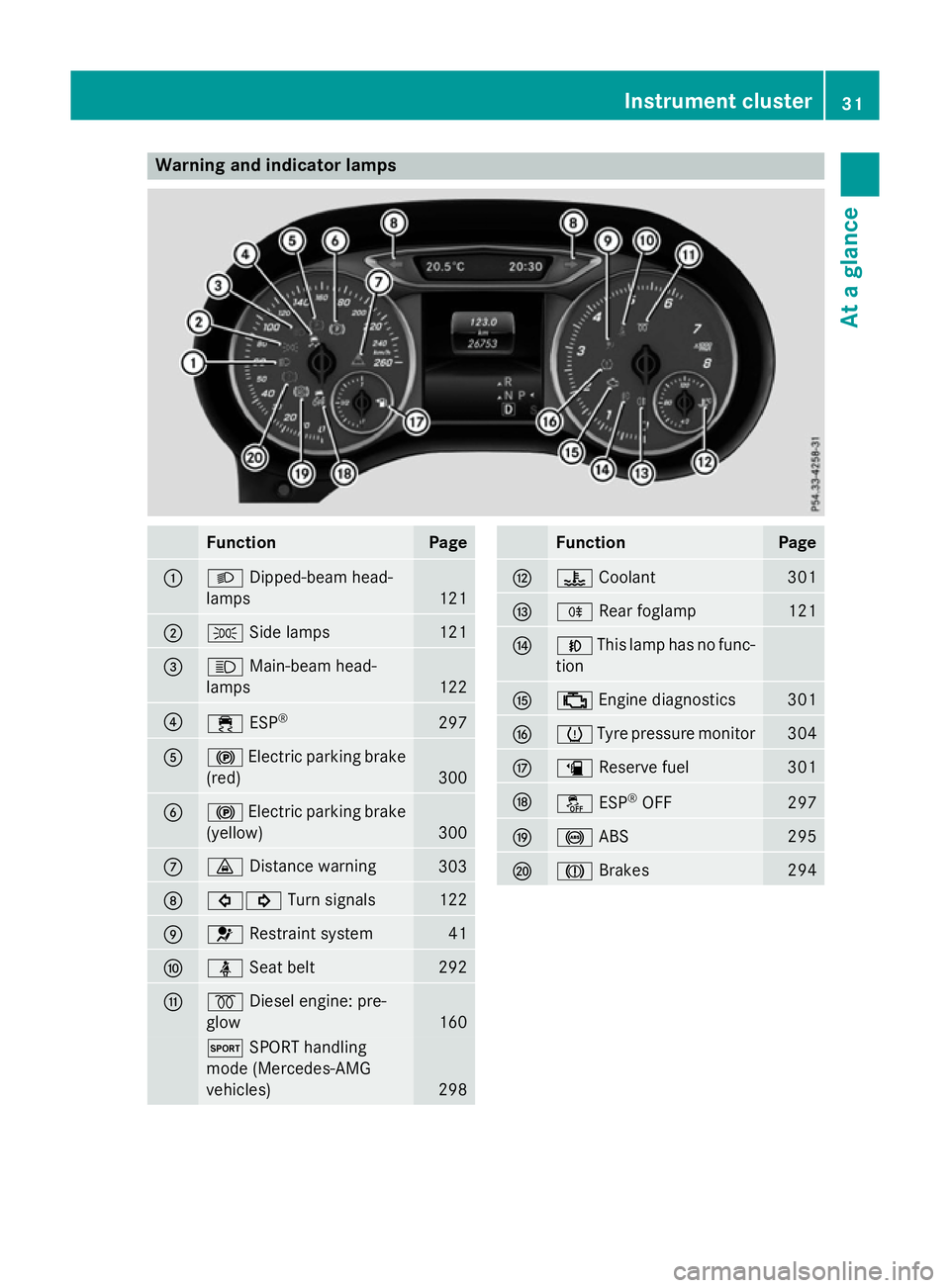
Warning and indicator lamps
Function Page
:
L
Dipped-beam head-
lamps 121
;
T
Side lamps 121
=
K
Main-beam head-
lamps 122
?
÷
ESP® 297
A
!
Electric parking brake
(red) 300
B
!
Electric parking brake
(yellow) 300
C
·
Distance warning 303
D
#!
Turn signals 122
E
6
Restraint system 41
F
ü
Seat belt 292
G
%
Diesel engine: pre-
glow 160
M
SPORT handling
mode (Mercedes-AMG
vehicles) 298 Function Page
H
?
Coolant 301
I
R
Rear foglamp 121
J
N
This lamp has no func-
tion K
;
Engine diagnostics 301
L
h
Tyre pressure monitor 304
M
æ
Reserve fuel 301
N
å
ESP®
OFF 297
O
!
ABS 295
P
J
Brakes 294Instrument cluster
31At a glance
Page 72 of 417
Pets in the vehicle
G
WARNING
If you leave animals unsupervised or unse-
cured in the vehicle, they may push a button
or a switch, for example.
They could:
R activate vehicle equipment and become
trapped, for example
R switch vehicle systems on or off, thus
endangering other road users
In the event of an accident, sudden braking or
abrupt changes of direction, unsecured ani-
mals could be flung around the vehicle, injur-
ing the vehicle occupants. There is a risk of an accident and injury.
Never leave animals unattended in the vehi-
cle. Always secure animals correctly during a
journey, e.g. in an animal transport box. Driving safety systems
Driving safety systems overview
In this section, you will find information about the following driving safety systems:
R ABS ( Anti-lock BrakingSystem)
(Y page 69)
R BAS ( Brake Assist System) (Y page 70)
R COLLISION PREVENTION ASSIST PLUS
(Y page 70)
R Adaptive brake lights (Y page 73)
R ESP ®
(Electronic StabilityProgram)
(Y page 73)
R EBD ( electronic brake force distribution)
(Y page 77)
R ADAPTIVE BRAKE (Y page 77)
R STEER CONTROL (Y page 77) Important safety notes
If you fail to adapt your driving style or if you
are inattentive, the driving safety systems can neither reduce the risk of an accident nor
override the laws of physics. Driving safety
systems are merely aids designed to assist
driving. You are responsible for maintaining
the distance to the vehicle in front, for vehicle speed, for braking in good time, and for stay-ing in lane. Always adapt your driving style to
suit the prevailing road and weather condi-
tions and maintain a safe distance from the
vehicle in front. Drive carefully.
The driving safety systems described only
work as effectively as possible when there is
adequate contact between the tyres and the
road surface. Please pay special attention to
the notes on tyres, recommended minimum
tyre tread depths etc. (Y page 358).
In wintry driving conditions, always use winter
tyres (M+S tyres) and, if necessary, snow
chains. Only in this way will the driving safety systems described in this section work as
effectively as possible. ABS (Anti-lock Braking System)
General notes ABS regulates brake pressure in such a way
that the wheels do not lock when you brake.
This allows you to continue steering the vehi-
cle when braking.
The ! ABS warning lamp in the instrument
cluster lights up when the ignition is switched on. It goes out when the engine is running.
ABS works from a speed of about 8 km/h,
regardless of road-surface conditions. ABS
works on slippery surfaces, even when you
only brake gently.
Important safety notes i
Observe the "Important safety notes" sec-
tion (Y page 69). G
WARNING
If ABS is faulty, the wheels could lock when
braking. The steerability and braking charac-
teristics may be severely impaired. Addition- Driving safety systems
69Safety
Z
Page 184 of 417
fuel. Otherwise, the fuel will enter the fuel
system. Even small amounts of the wrong
fuel can result in damage to the fuel system
and the engine. Notify a qualified specialist workshop and have the fuel tank and fuel
lines drained completely.
! Do not use petrol to refuel vehicles with a
diesel engine. Do not switch on the ignition if you accidentally refuel with the wrong
fuel. Otherwise, fuel can enter the fuel sys-tem. Even small amounts of the wrong fuel
could result in damage to the fuel system
and the engine. The repair costs are high.
Notify a qualified specialist workshop and
have the fuel tank and fuel lines drained
completely.
! Overfilling the fuel tank could damage the
fuel system.
! Take care not to spill any fuel on painted
surfaces. You could otherwise damage the
paintwork.
! Use a filter when adding fuel from a fuel
can. The fuel lines and/or the fuel injection system could otherwise be blocked by par-
ticles from the fuel can.
Do not get into the vehicle again during the
refuelling process. Otherwise, electrostatic
charge could build up again.
If you overfill the fuel tank, some fuel may
spray out when you remove the fuel pump
nozzle.
Further information on fuel and fuel quality
(Y page 396). Refuelling
General notes The fuel filler flap is unlocked/locked auto-
matically when you unlock/lock the vehicle
with the key.
The position of the fuel filler cap is displayed
æ in the instrument cluster. The arrow
next to the filling pump indicates the side of
the vehicle. Opening the fuel filler flap
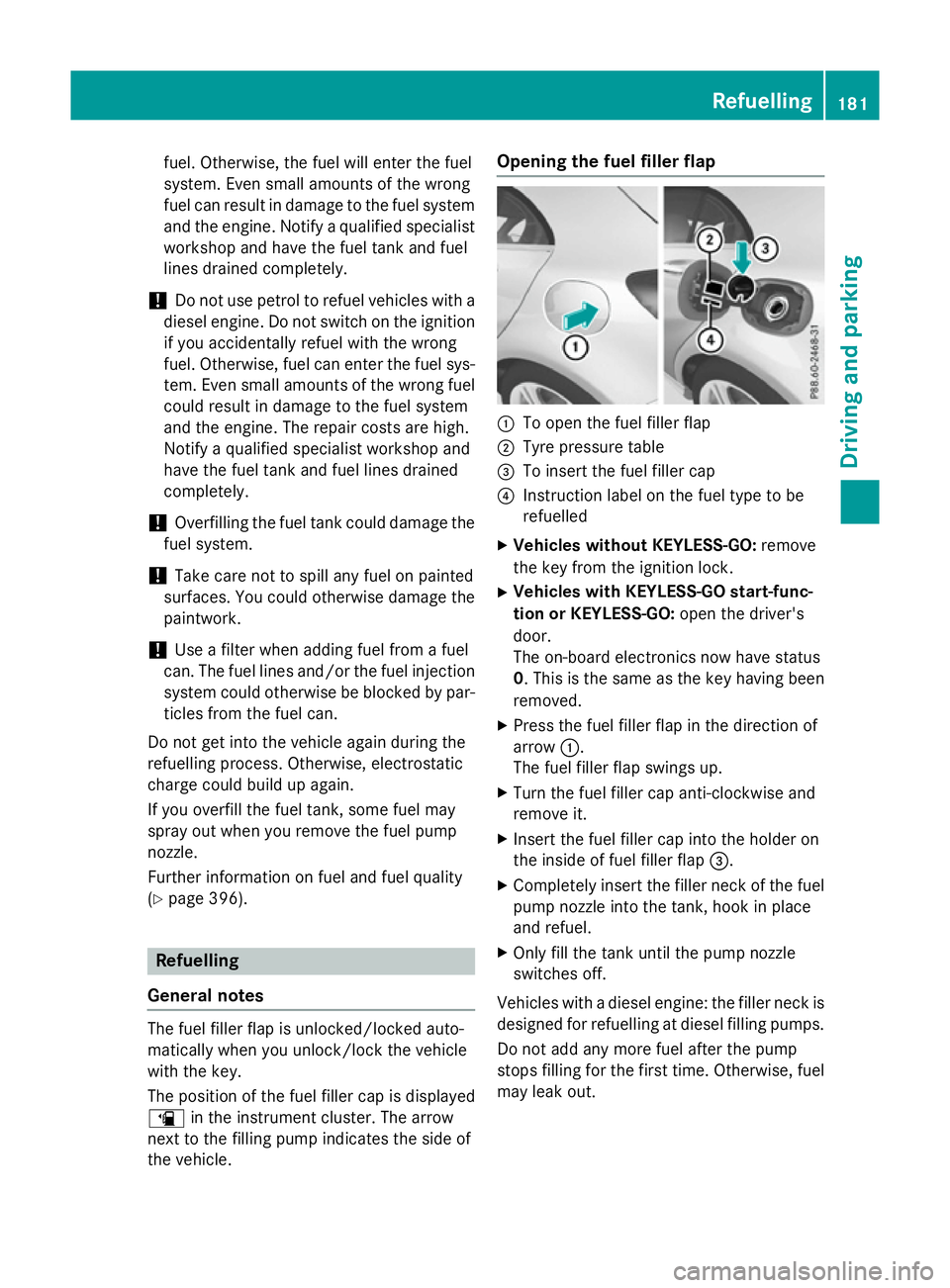
:
To open the fuel filler flap
; Tyre pressure table
= To insert the fuel filler cap
? Instruction label on the fuel type to be
refuelled
X Vehicles without KEYLESS-GO: remove
the key from the ignition lock.
X Vehicles with KEYLESS-GO start-func-
tion or KEYLESS-GO: open the driver's
door.
The on-board electronics now have status
0. This is the same as the key having been removed.
X Press the fuel filler flap in the direction of
arrow :.
The fuel filler flap swings up.
X Turn the fuel filler cap anti-clockwise and
remove it.
X Insert the fuel filler cap into the holder on
the inside of fuel filler flap =.
X Completely insert the filler neck of the fuel
pump nozzle into the tank, hook in place
and refuel.
X Only fill the tank until the pump nozzle
switches off.
Vehicles with a diesel engine: the filler neck is
designed for refuelling at diesel filling pumps.
Do not add any more fuel after the pump
stops filling for the first time. Otherwise, fuel
may leak out. Refuelling
181Driving and parking Z
Page 191 of 417
Drive sensibly – save fuel
Observe the following tips to save fuel:
R The tyres should always be inflated to the
recommended tyre pressure.
R Remove unnecessary loads.
R Remove roof racks when they are not nee-
ded.
R Warm up the engine at low engine speeds.
R Avoid frequent acceleration or braking.
R Have all maintenance work carried out as
indicated by the service intervals in the
Service Booklet or by the service interval
display.
Fuel consumption also increases when driv-
ing in cold weather, in stop-start traffic, on
short journeys and in hilly terrain. ECO display
The ECO display shows you how economical
your driving style is. The ECO display assists
you in achieving the most economical driving
style for the selected settings and prevailing
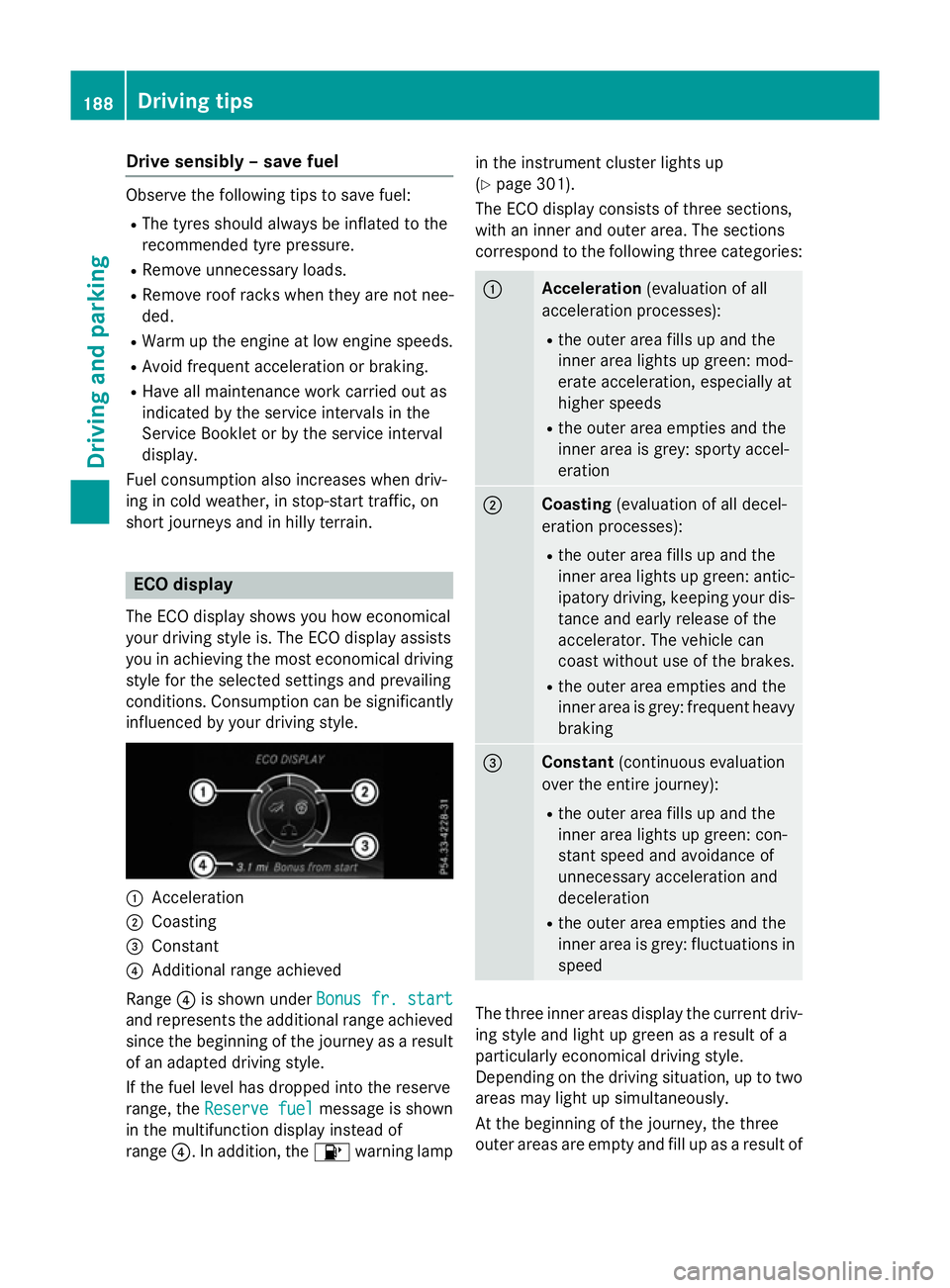
conditions. Consumption can be significantly influenced by your driving style. :
Acceleration
; Coasting
= Constant
? Additional range achieved
Range ?is shown under Bonus fr. start Bonus fr. start
and represents the additional range achieved
since the beginning of the journey as a result of an adapted driving style.
If the fuel level has dropped into the reserve
range, the Reserve fuel Reserve fuel message is shown
in the multifunction display instead of
range ?. In addition, the 8warning lamp in the instrument cluster lights up
(Y
page 301).
The ECO display consists of three sections,
with an inner and outer area. The sections
correspond to the following three categories: :
Acceleration
(evaluation of all
acceleration processes):
R the outer area fills up and the
inner area lights up green: mod-
erate acceleration, especially at
higher speeds
R the outer area empties and the
inner area is grey: sporty accel-
eration ;
Coasting
(evaluation of all decel-
eration processes):
R the outer area fills up and the
inner area lights up green: antic-
ipatory driving, keeping your dis- tance and early release of the
accelerator. The vehicle can
coast without use of the brakes.
R the outer area empties and the
inner area is grey: frequent heavy
braking =
Constant
(continuous evaluation
over the entire journey):
R the outer area fills up and the
inner area lights up green: con-
stant speed and avoidance of
unnecessary acceleration and
deceleration
R the outer area empties and the
inner area is grey: fluctuations in
speed The three inner areas display the current driv-
ing style and light up green as a result of a
particularly economical driving style.
Depending on the driving situation, up to two
areas may light up simultaneously.
At the beginning of the journey, the three
outer areas are empty and fill up as a result of 188
Driving tipsDriving and pa
rking