run flat MERCEDES-BENZ B-CLASS 2012 Owners Manual
[x] Cancel search | Manufacturer: MERCEDES-BENZ, Model Year: 2012, Model line: B-CLASS, Model: MERCEDES-BENZ B-CLASS 2012Pages: 340, PDF Size: 3.09 MB
Page 7 of 340
Automatic transmission
Automatic drive program ............... 144
Changing gear ............................... 143
DIRECT SELECT lever .....................140
Display message
............................ 220
Drive program display ....................141
Driving tips .................................... 143
Emergency running mode ..............147
Engaging drive position .................. 142
Engaging neutral ............................ 141
Engaging reverse gear ................... 141
Engaging the park position ............ 141
Holding the vehicle stationary on
uphill gradients .............................. 143
Kickdown ....................................... 143
Manual drive program ....................144
Overview ........................................ 140
Problem (malfunction) ...................147
Program selector button ................143
Pulling away ................................... 136
Starting the engine ........................ 135
Steering wheel paddle shifters ...... 144
Transmission position display ........ 141
Transmission positions .................. 142
Automatic transmission
emergency mode ............................... 147B
Backup lamp Changing bulbs .............................. 109
Display message ............................ 211
Bag hook
............................................ 243
BAS (Brake Assist System) ................. 59
Battery (SmartKey) Checking .......................................... 70
Important safety notes .................... 70
Replacing ......................................... 70
Battery (vehicle)
Charging ........................................ 288
Display message ............................ 213
Important safety notes .................. 285
Jump starting ................................. 289
Belt force limiter
Activation ......................................... 49
Function ........................................... 49
Blinds
see Roller sunblind Blind Spot Assist
Activating/deactivating .................195
Display message
............................ 216
Notes/function .............................. 181
Brake Assist
see BAS (Brake Assist System)
Brake fluid
Display message ............................ 207
Notes ............................................. 332
Brake lamps
Adaptive ........................................... 62
Changing bulbs .............................. 109
Display message ............................ 209
Brakes
ABS .................................................. 59
Adaptive Brake Assist ......................61
BAS .................................................. 59
Brake fluid (notes) .........................332
Display message ............................ 201
Driving tips .................................... 154
Important safety notes .................. 154
Maintenance .................................. 155
Parking brake ................................ 150
Warning lamp ................................. 225
Breakdown
see Flat tire
see Towing away/tow-starting
Bulbs
see Changing bulbs C
Calling up a malfunction see Display messages
Car
see Vehicle
Care
Carpets .......................................... 277
Car wash ........................................ 271
Display ........................................... 275
Exhaust pipe .................................. 275
Exterior lights ................................ 274
Gear or selector lever ....................276
Interior ........................................... 275
Matte finish ................................... 273
Notes ............................................. 271
Paint .............................................. 273
Plastic trim .................................... 276 Index
5
ProCarManuals.com
Page 11 of 340
E
EASY-VARIO-PLUS system Cargo compartment enlargement ..240
EBD (electronic brake force
distribution)
Display message ............................ 203
Function/notes ................................
64
ECO display
Function/notes ............................. 153
On-board computer ....................... 190
ECO start/stop function
Automatic engine start .................. 137
Automatic engine switch-off .......... 137
Deactivating/activating ................. 138
General information ....................... 136
Important safety notes .................. 136
Electronic Stability Program
see ESP ®
(Electronic Stability Program)
Emergency release
Driver's door .................................... 75
Vehicle ............................................. 75
Emergency spare wheel
General notes ................................ 325
Important safety notes .................. 325
Removing ....................................... 326
Technical data ............................... 326
Emergency Tensioning Devices
Activation ......................................... 39
Function ........................................... 49
Safety guidelines ............................. 40
Emergency unlocking
Tailgate ............................................ 76
Emissions control
Service and warranty information .... 21
Engine
Check Engine warning lamp ........... 231
Display message ............................ 212
ECO start/stop function ................ 136
Engine number ............................... 329
Irregular running ............................ 139
Jump-starting ................................. 289
Starting problems .......................... 139
Starting the engine with the
SmartKey ....................................... 135
Switching off .................................. 150
Tow-starting (vehicle) ..................... 294 Engine electronics
Problem (malfunction) ...................139
Engine oil
Adding ........................................... 268
Additives ........................................ 332
Checking the oil level ..................... 267
Checking the oil level using the
dipstick
.......................................... 268
Display message ............................ 214
Filling capacity ............................... 332
Notes about oil grades ................... 332
Notes on oil level/consumption .... 267
Viscosity ........................................ 332
ESP ®
(Electronic Stability
Program) Deactivating/activating ................. 194
Deactivating/activating (notes) ....... 63
Display message ............................ 201
ETS .................................................. 62
Function/notes ......................... 62, 63
Important safety information ........... 62
Warning lamp ................................. 227
ETS (Electronic Traction System) ....... 62
Exhaust check ................................... 152
Exhaust pipe (cleaning instructions) 275
Exterior lighting Setting options ................................ 98
see Lights
Exterior mirrors
Adjusting ......................................... 92
Dipping (automatic) .........................93
Folding in/out (automatically) ......... 93
Folding in/out (electrically) ............. 93
Folding in when locking (on-board
computer) ...................................... 199
Out of position (troubleshooting) .....93
Setting ............................................. 93
Storing settings (memory function) .. 95
Storing the parking position ............. 94
Eyeglasses compartment ................. 237 F
Filler cap see Fuel filler flap
First-aid kit ......................................... 280
Flat tire MOExtended tires .......................... 281 Index
9
ProCarManuals.com
Page 20 of 340
Wear indicator (definition)
.............318
Wheel rim (definition) ....................316
see Flat tire
Top Tether ............................................ 55
Towing Important safety guidelines ...........291
Installing the towing eye ................ 292
Removing the towing eye ...............292
Towing away
With both axles on the ground ....... 293
With front axle raised ..................... 293
Tow-starting
Emergency engine starting ............ 294
Important safety notes .................. 291
Installing the towing eye ................ 292
Removing the towing eye ...............292
Traction control ................................... 62
Transmission see Automatic transmission
Transmission position display .........141
Transporting the vehicle .................. 293
Trim pieces (cleaning instructions) . 276
Trip computer (on-board computer) 189
Trip odometer Calling up ....................................... 189
Resetting (on-board computer) ...... 190
Trunk
see Tailgate
Turn signals
Changing bulbs (front) ................... 108
Changing bulbs (rear) .................... 109
Display message ............................ 209
Switching on/off ........................... 100
Type identification plate
see Vehicle identification plate U
Unlocking Emergency unlocking .......................75
From inside the vehicle (central
unlocking button) ............................. 74 V
Vanity mirror (in the sun visor) ........ 249
Vehicle Correct use ...................................... 24
Data acquisition ............................... 25
Equipment
....................................... 21
Individual settings ..........................196
Limited Warranty ............................. 25
Loading .......................................... 306
Locking (in an emergency) ............... 75
Locking (SmartKey) .......................... 68
Lowering ........................................ 322
Maintenance .................................... 22
Parking for a long period ................ 152
Pulling away ................................... 136
Raising ........................................... 320
Reporting problems .........................24
Securing from rolling away ............320
Towing away .................................. 291
Tow-starting ................................... 291
Transporting .................................. 293
Unlocking (in an emergency) ........... 75
Unlocking (SmartKey) ......................68
Vehicle data ................................... 335
Vehicle data ....................................... 335
Vehicle dimensions ...........................335
Vehicle emergency locking ................75
Vehicle identification number see VIN
Vehicle identification plate ..............328
Vehicle tool kit .................................. 280
Video (DVD) ........................................ 193
VIN ...................................................... 328 W
Warning and indicator lamps ABS ................................................ 225
Brakes
........................................... 225
Check Engine ................................. 231
Coolant .......................................... 231
Distance warning ........................... 233
DISTRONIC PLUS ........................... 233
ESP ®
.............................................. 227
ESP ®
OFF ....................................... 228
Fuel tank ........................................ 231
Overview .......................................... 3018
Index
ProCarManuals.com
Page 53 of 340
passenger front air bag is deactivated.
Should the 4 5 indicator lamp not
illuminate or go out while the restraint is
installed, please check installation.
Periodically check
the 4
5 indicator
lamp while driving to make sure the 4
5 indicator lamp is illuminated. If the
4 5 indicator lamp goes out or
remains out, do not transport a child on the
front passenger seat until the system has
been repaired.
A child in a rear-facing child restraint on the
front passenger seat will be seriously
injured or even killed if the front passenger
front air bag inflates.
R If you have to place a child in a forward-
facing child restraint on the front passenger
seat, move the seat as far back as possible,
use the proper child restraint
recommended for the age, size and weight
of the child, and secure child restraint with
the vehicle's seat belt according to the
child seat manufacturer's instructions. G
WARNING
Infants and small children should never share
a seat belt
with another occupant. In the event
of an accident, they could be crushed
between the occupant and seat belt.
A child's risk of serious or fatal injuries is
significantly increased if the child restraints
are not properly secured in the vehicle and/
or the child is not properly secured in the child
restraint.
Children that are too large for a child restraint
must travel in seats using normal seat belts.
Position the shoulder belt across the chest
and shoulder, not the face or neck. A booster
seat may be necessary to achieve proper seat
belt positioning for children over 41 lbs
(18 kg) until they reach a height where a lap/
shoulder belt fits properly without a booster
seat.
When the child restraint is not in use, remove
it from the vehicle or secure it with the seat
belt to prevent the child restraint from becoming a projectile in the event of an
accident.
G
WARNING
When leaving the vehicle, always remove the
SmartKey from the ignition lock. Always take
the SmartKey with you and lock the vehicle.
Do not leave children unattended in the
vehicle, even if they are secured in a child
restraint system, or with access to an
unlocked vehicle. A child's unsupervised
access to a
vehicle could result in an accident
and/or serious personal injury. The children
could:
R injure themselves on parts of the vehicle
R be seriously or fatally injured through
excessive exposure to extreme heat or cold
R injure themselves or cause an accident with
vehicle equipment that can be operated
even if the SmartKey is removed from the
ignition lock or removed from the vehicle,
such as seat adjustment, steering wheel
adjustment, or the memory function
If children open a door, they could injure other
persons or get out of the vehicle and injure
themselves or be injured by following traffic.
Do not expose the child restraint system to
direct sunlight. The child restraint system's
metal parts, for example, could become very
hot, and the child could be burned on these
parts. G
WARNING
Do not carry heavy or hard objects in the
passenger compartment or
trunk unless they
are firmly secured in place.
Unsecured or improperly positioned cargo
increases a child's risk of injury in the event
of
R strong braking maneuvers
R sudden changes of direction
R an accident Children in the vehicle
51
Safety Z
ProCarManuals.com
Page 221 of 340
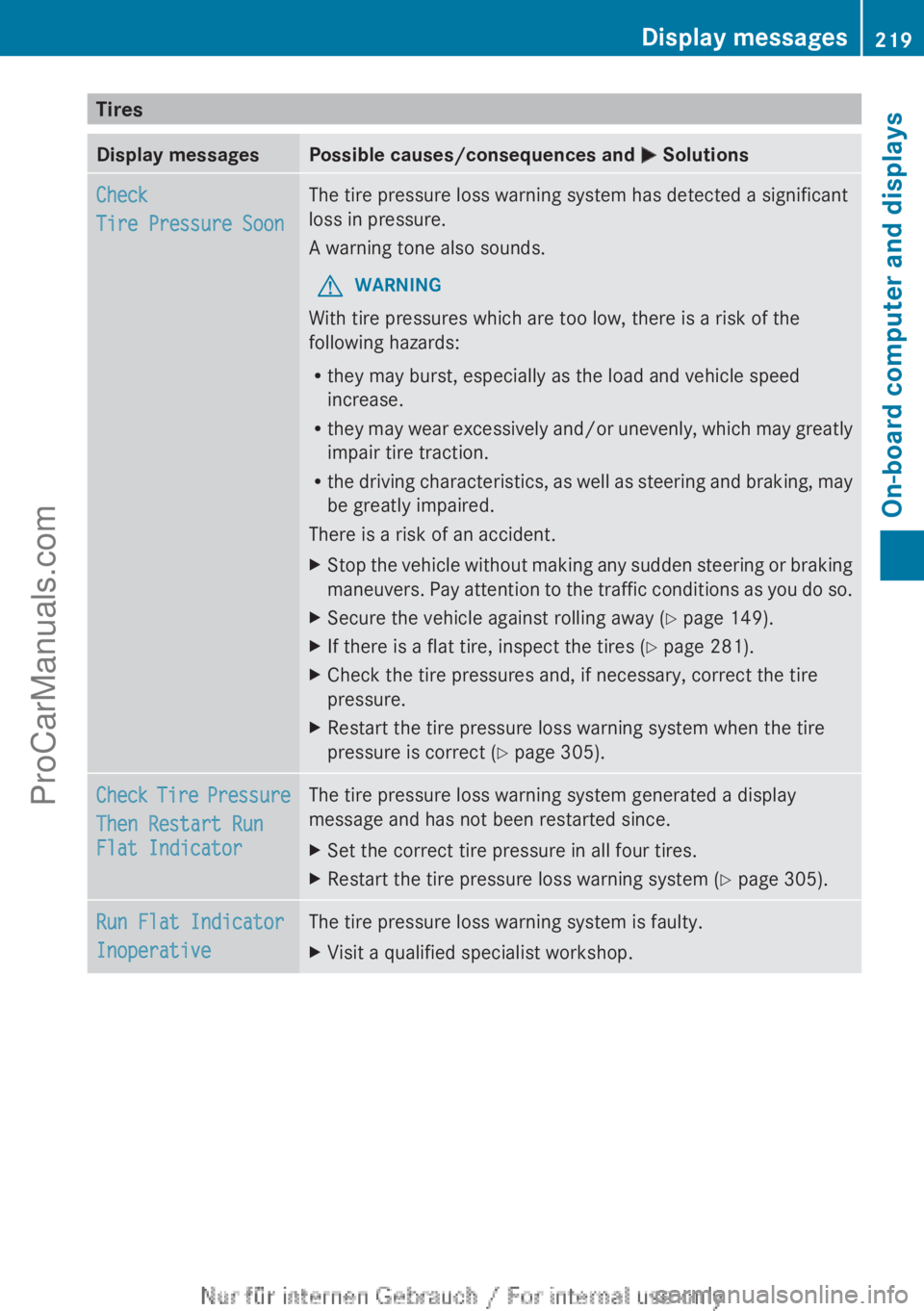
Tires
Display messages Possible causes/consequences and
M SolutionsCheck
Tire Pressure Soon The tire pressure loss warning system has detected a significant
loss in pressure.
A warning tone also sounds.
G WARNING
With tire pressures which are too low, there is a risk of the
following hazards:
R they may burst, especially as the load and vehicle speed
increase.
R they may wear
excessively and/or unevenly, which may greatly
impair tire traction.
R the driving characteristics, as well as steering and braking, may
be greatly impaired.
There is a risk of an accident.
X Stop the vehicle without making any sudden steering or braking
maneuvers. Pay attention
to the traffic conditions as you do so.
X Secure the vehicle against rolling away ( Y page 149).
X If there is a flat tire, inspect the tires ( Y page 281).
X Check the tire pressures and, if necessary, correct the tire
pressure.
X Restart the tire pressure loss warning system when the tire
pressure is correct (Y page 305). Check Tire Pressure
Then Restart Run
Flat Indicator The tire pressure loss warning system generated a display
message and has not been restarted since.
X
Set the correct tire pressure in all four tires.
X Restart the tire pressure loss warning system ( Y page 305).Run Flat Indicator
Inoperative The tire pressure loss warning system is faulty.
X
Visit a qualified specialist workshop. Display messages
219
On-board computer and displays Z
ProCarManuals.com
Page 248 of 340
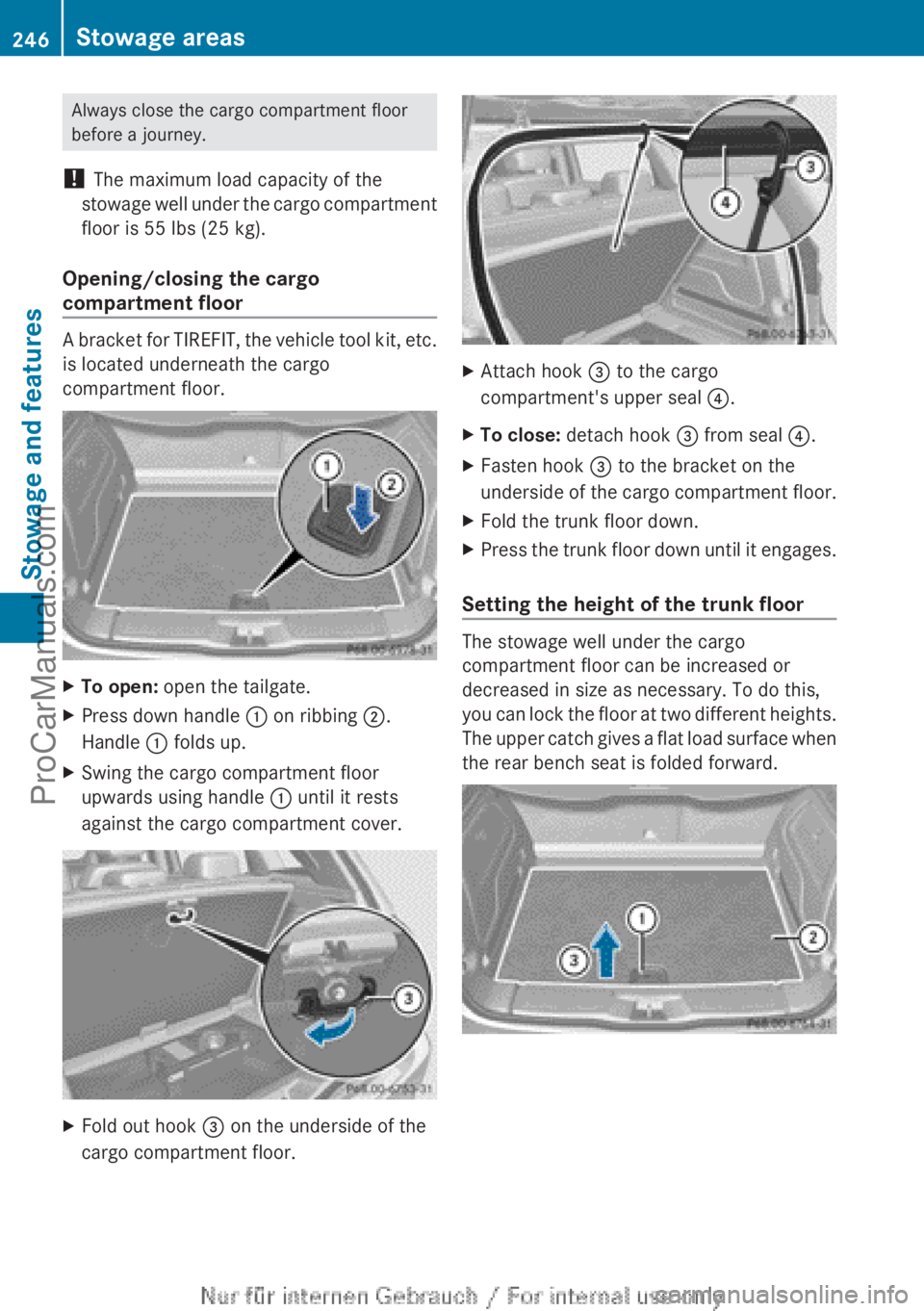
Always close the cargo compartment floor
before a journey.
! The maximum load capacity of the
stowage well under
the cargo compartment
floor is 55 lbs (25 kg).
Opening/closing the cargo
compartment floor A bracket for TIREFIT, the vehicle tool kit, etc.
is located underneath the cargo
compartment floor.
X
To open: open the tailgate.
X Press down handle : on ribbing ;.
Handle : folds up.
X Swing the cargo compartment floor
upwards using handle : until it rests
against the cargo compartment cover. X
Fold out hook = on the underside of the
cargo compartment floor. X
Attach hook = to the cargo
compartment's upper seal ?.
X To close: detach hook = from seal ?.
X Fasten hook = to the bracket on the
underside of the
cargo compartment floor.
X Fold the trunk floor down.
X Press the trunk floor down until it engages.
Setting the height of the trunk floor The stowage well under the cargo
compartment floor can be increased or
decreased in size as necessary. To do this,
you can
lock
the floor at two different heights.
The upper catch gives a flat load surface when
the rear bench seat is folded forward. 246
Stowage areas
Stowage and features
ProCarManuals.com
Page 283 of 340
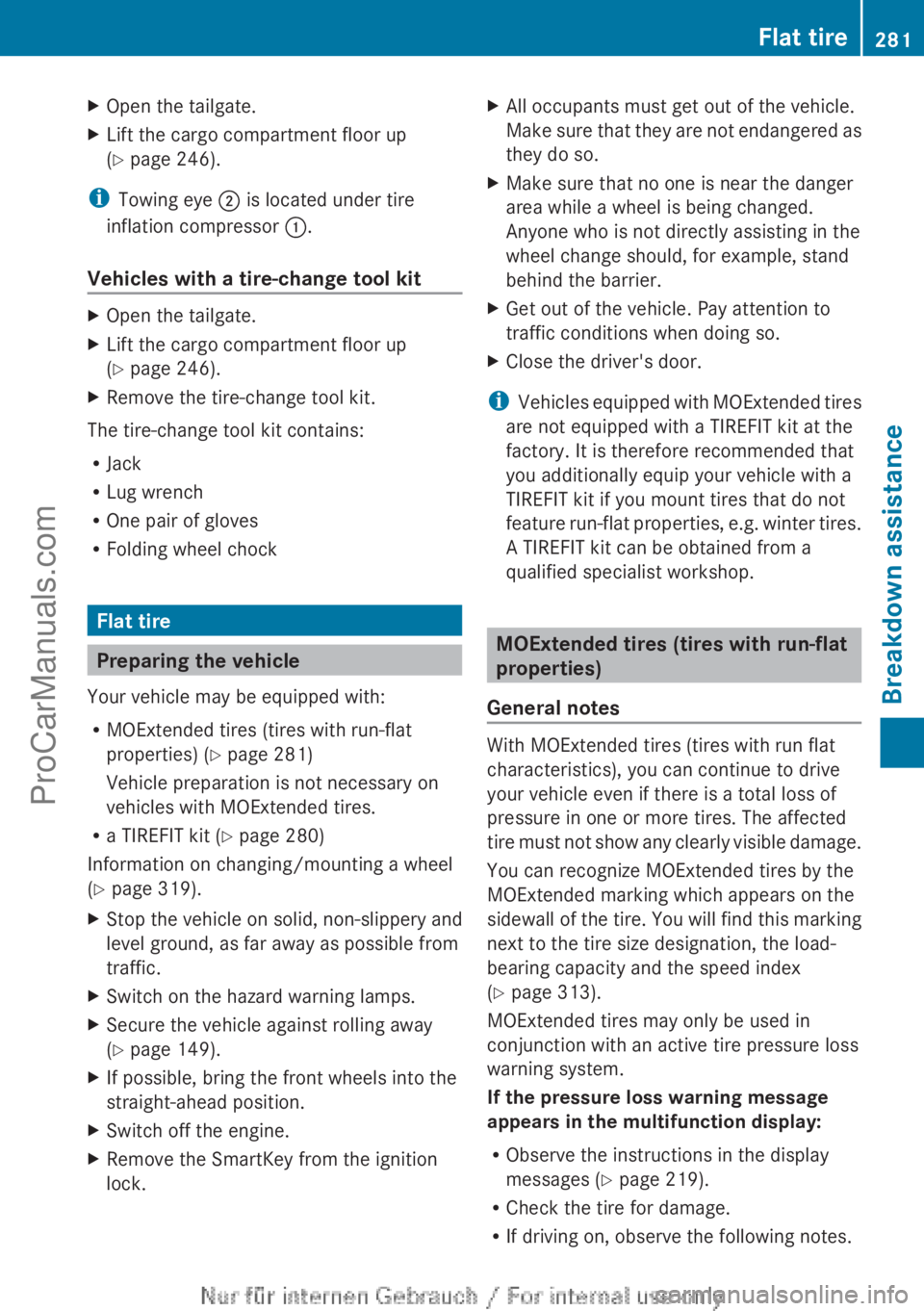
X
Open the tailgate.
X Lift the cargo compartment floor up
(Y page 246).
i Towing eye ; is located under tire
inflation compressor :.
Vehicles with a tire-change tool kit X
Open the tailgate.
X Lift the cargo compartment floor up
(Y page 246).
X Remove the tire-change tool kit.
The tire-change tool kit contains:
R Jack
R Lug wrench
R One pair of gloves
R Folding wheel chock Flat tire
Preparing the vehicle
Your vehicle may be equipped with:
R MOExtended tires (tires with run-flat
properties) ( Y page 281)
Vehicle preparation is not necessary on
vehicles with MOExtended tires.
R a TIREFIT kit (Y page 280)
Information on changing/mounting a wheel
(Y page 319).
X Stop the vehicle on solid, non-slippery and
level ground, as far away as possible from
traffic.
X Switch on the hazard warning lamps.
X Secure the vehicle against rolling away
(Y page 149).
X If possible, bring the front wheels into the
straight-ahead position.
X Switch off the engine.
X Remove the SmartKey from the ignition
lock. X
All occupants must get out of the vehicle.
Make sure that
they are not endangered as
they do so.
X Make sure that no one is near the danger
area while a wheel is being changed.
Anyone who is not directly assisting in the
wheel change should, for example, stand
behind the barrier.
X Get out of the vehicle. Pay attention to
traffic conditions when doing so.
X Close the driver's door.
i Vehicles equipped with
MOExtended tires
are not equipped with a TIREFIT kit at the
factory. It is therefore recommended that
you additionally equip your vehicle with a
TIREFIT kit if you mount tires that do not
feature run-flat properties, e.g. winter tires.
A TIREFIT kit can be obtained from a
qualified specialist workshop. MOExtended tires (tires with run-flat
properties)
General notes With MOExtended tires (tires with run flat
characteristics), you can continue to drive
your vehicle even if there is a total loss of
pressure in one or more tires. The affected
tire must
not
show any clearly visible damage.
You can recognize MOExtended tires by the
MOExtended marking which appears on the
sidewall of the tire. You will find this marking
next to the tire size designation, the load-
bearing capacity and the speed index
(Y page 313).
MOExtended tires may only be used in
conjunction with an active tire pressure loss
warning system.
If the pressure loss warning message
appears in the multifunction display:
R Observe the instructions in the display
messages ( Y page 219).
R Check the tire for damage.
R If driving on, observe the following notes. Flat tire
281
Breakdown assistance
ProCarManuals.com
Page 284 of 340
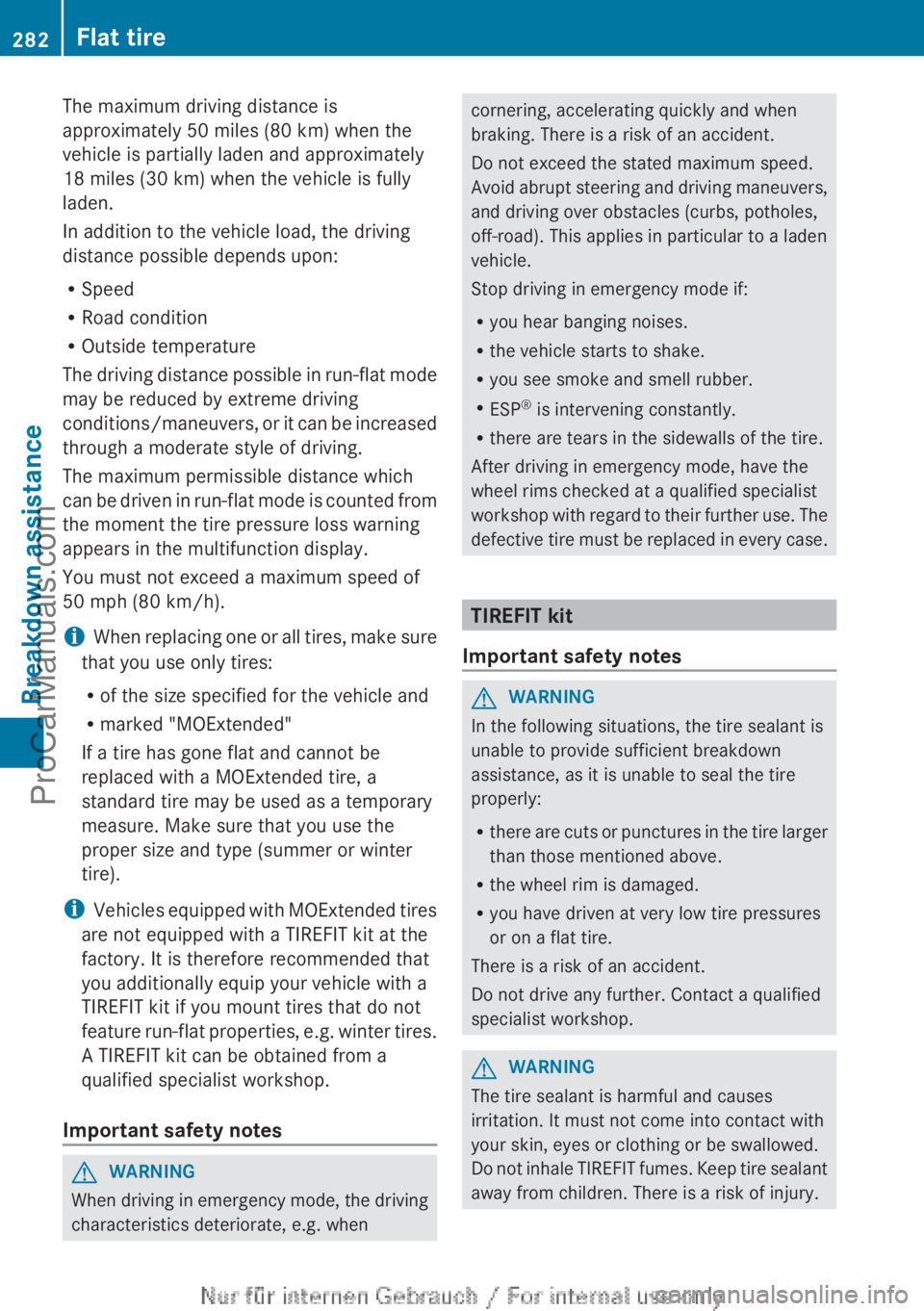
The maximum driving distance is
approximately 50 miles (80 km) when the
vehicle is partially laden and approximately
18 miles (30 km) when the vehicle is fully
laden.
In addition to the vehicle load, the driving
distance possible depends upon:
R Speed
R Road condition
R Outside temperature
The driving
distance possible in run-flat mode
may be reduced by extreme driving
conditions/maneuvers, or it can be increased
through a moderate style of driving.
The maximum permissible distance which
can be driven in run-flat mode is counted from
the moment the tire pressure loss warning
appears in the multifunction display.
You must not exceed a maximum speed of
50 mph (80 km/h).
i When replacing one or all tires, make sure
that you use only tires:
R of the size specified for the vehicle and
R marked "MOExtended"
If a tire has gone flat and cannot be
replaced with a MOExtended tire, a
standard tire may be used as a temporary
measure. Make sure that you use the
proper size and type (summer or winter
tire).
i Vehicles equipped with MOExtended tires
are not equipped with a TIREFIT kit at the
factory. It is therefore recommended that
you additionally equip your vehicle with a
TIREFIT kit if you mount tires that do not
feature run-flat properties, e.g. winter tires.
A TIREFIT kit can be obtained from a
qualified specialist workshop.
Important safety notes G
WARNING
When driving in emergency mode, the driving
characteristics deteriorate, e.g. when cornering, accelerating quickly and when
braking. There is a risk of an accident.
Do not exceed the stated maximum speed.
Avoid abrupt
steering
and driving maneuvers,
and driving over obstacles (curbs, potholes,
off-road). This applies in particular to a laden
vehicle.
Stop driving in emergency mode if:
R you hear banging noises.
R the vehicle starts to shake.
R you see smoke and smell rubber.
R ESP ®
is intervening constantly.
R there are tears in the sidewalls of the tire.
After driving in emergency mode, have the
wheel rims checked at a qualified specialist
workshop with regard to their further use. The
defective tire must be replaced in every case. TIREFIT kit
Important safety notes G
WARNING
In the following situations, the tire sealant is
unable to provide sufficient breakdown
assistance, as it is unable to seal the tire
properly:
R there are cuts
or punctures in the tire larger
than those mentioned above.
R the wheel rim is damaged.
R you have driven at very low tire pressures
or on a flat tire.
There is a risk of an accident.
Do not drive any further. Contact a qualified
specialist workshop. G
WARNING
The tire sealant is harmful and causes
irritation. It must not come into contact with
your skin, eyes or clothing or be swallowed.
Do not inhale
TIREFIT fumes. Keep tire sealant
away from children. There is a risk of injury. 282
Flat tire
Breakdown assistance
ProCarManuals.com
Page 286 of 340
X
Press on/off switch ? on the tire inflation
compressor to ON.
The tire inflation compressor is switched
on. The tire is inflated.
i First, tire sealant is pumped into the tire.
The pressure can briefly rise to
approximately 500 kPa (5 bar/73 psi).
Do not switch off the tire inflation
compressor during this phase.
X Let the tire inflation compressor run for a
maximum of ten minutes. The tire should
then have attained a pressure of at least
200 kPa (2.0 bar/29 psi).
! Do not operate the tire inflation
compressor for longer than ten minutes at
a time without a break. It may otherwise
overheat.
The tire inflation compressor can be
operated again once it has cooled down.
If a pressure
of 200 kPa (2.0 bar/29 psi) has
been attained after a maximum of after ten
minutes, see ( Y page 284).
If a pressure of 200 kPa (2.0 bar/29 psi) has
not been attained after a maximum of ten
minutes, see ( Y page 284).
i If tire sealant leaks out, allow it to dry. It
can then be removed like a layer of film.
If your clothes are soiled with tire sealant,
have them cleaned with perchloroethylene
at a dry cleaner as soon as possible.
Tire pressure not reached If a pressure of 200 kPa (
2.0 bar
/29 psi) has
not been achieved after ten minutes:
X Switch off the tire inflation compressor.
X Unscrew the filler hose from the valve of
the faulty tire.
X Very slowly drive forwards or reverse
approximately 30 ft (10 m).
X Pump up the tire again.
After a maximum of ten minutes, the tire
pressure
must be
at least 200 kPa (2.0 bar/
29 psi). G
WARNING
If the required tire pressure is not reached
after the specified time, the tire is too badly
damaged. The tire sealant cannot repair the
tire in this
instance. Damaged tires and a tire
pressure that is too low can significantly
impair the vehicle's braking and driving
characteristics. There is a risk of accident.
Do not continue driving. Contact a qualified
specialist workshop.
Tire pressure reached G
WARNING
A tire temporarily sealed with tire sealant
impairs the driving characteristics and is not
suitable for higher speeds. There is a risk of
accident.
You should therefore adapt your driving style
accordingly and drive
carefully. Do not exceed
the specified maximum speed with a tire that
has been repaired using tire sealant.
! After use, excess tire sealant may run out
of the filler hose. This could cause stains.
Therefore, place the filler hose in the plastic
bag that contained the TIREFIT kit. H
Environmental note
Have the used tire sealant bottle disposed of
professionally, e.g. at a qualified specialist
workshop.
If a tire
pressure of 200 kPa (2.0 bar/29 psi)
has been achieved after ten minutes:
X Switch off the tire inflation compressor.
X Unscrew the filler hose from the valve of
the faulty tire.
X Stow the tire sealant bottle and the tire
inflation compressor.
X Pull away immediately.
The maximum speed for a tire sealed with tire
sealant is 50 mph (
80 km/h). The upper part
of the TIREFIT sticker must be affixed to the
instrument cluster in the driver's field of
vision. 284
Flat tire
Breakdown assistance
ProCarManuals.com
Page 300 of 340
Useful information
i This Operator's Manual describes all
models and all standard and optional
equipment of your vehicle available at the
time of publication of the Operator's
Manual. Country-specific differences are
possible. Please note
that your vehicle may
not be equipped with all features
described. This also applies to safety-
related systems and functions.
i Read the information on qualified
specialist workshops: ( Y page 24).Important safety notes
G
WARNING
If wheels and tires of the wrong size are used,
the wheel brakes or suspension components
may be damaged. There is a risk of an
accident.
Always replace wheels and tires with those
that fulfill the specifications of the original
part.
When replacing wheels,
make sure to use the
correct:
R designation
R model
When replacing tires, make sure to use the
correct:
R designation
R manufacturer
R model G
WARNING
A flat tire severely impairs the driving,
steering and braking characteristics of the
vehicle. There is a risk of accident.
Tires without run-flat characteristics:
R do not drive with a flat tire.
R immediately replace the flat tire with your
emergency spare wheel or spare wheel, or
consult a qualified specialist workshop. Tires with run-flat characteristics:
R
pay attention to the information and
warning notices on
MOExtended tires (tires
with run-flat characteristics).
Accessories that are not approved for your
vehicle by Mercedes-Benz or are not being
used correctly can impair the operating
safety.
Before purchasing and using non-approved
accessories, visit a qualified specialist
workshop and inquire about:
R suitability
R legal stipulations
R factory recommendations
Information on dimensions and types of
wheels and tires for your vehicle can be found
(Y page 323).
Information on air pressure for the tires on
your vehicle can be found:
R on the vehicle's Tire and Loading
Information placard on the B-pillar
R on the tire pressure label on the fuel filler
flap
R under "Tire pressure"
i Further information on wheels and tires
can be obtained at any qualified specialist
workshop. Operation
Information on driving
R If the vehicle is heavily loaded, check the
tire pressures and correct them if
necessary.
R While driving, pay attention to vibrations,
noises and unusual handling
characteristics, e.g. pulling to one side.
This may indicate that the wheels or tires
are damaged. If you suspect that a tire is
defective, reduce your speed immediately.
Stop the vehicle as soon as possible to
check the wheels and tires for damage.
Hidden tire damage could also be causing298
Operation
Wheels and tires
ProCarManuals.com