seats MERCEDES-BENZ B-CLASS 2012 Owners Manual
[x] Cancel search | Manufacturer: MERCEDES-BENZ, Model Year: 2012, Model line: B-CLASS, Model: MERCEDES-BENZ B-CLASS 2012Pages: 340, PDF Size: 3.09 MB
Page 5 of 340
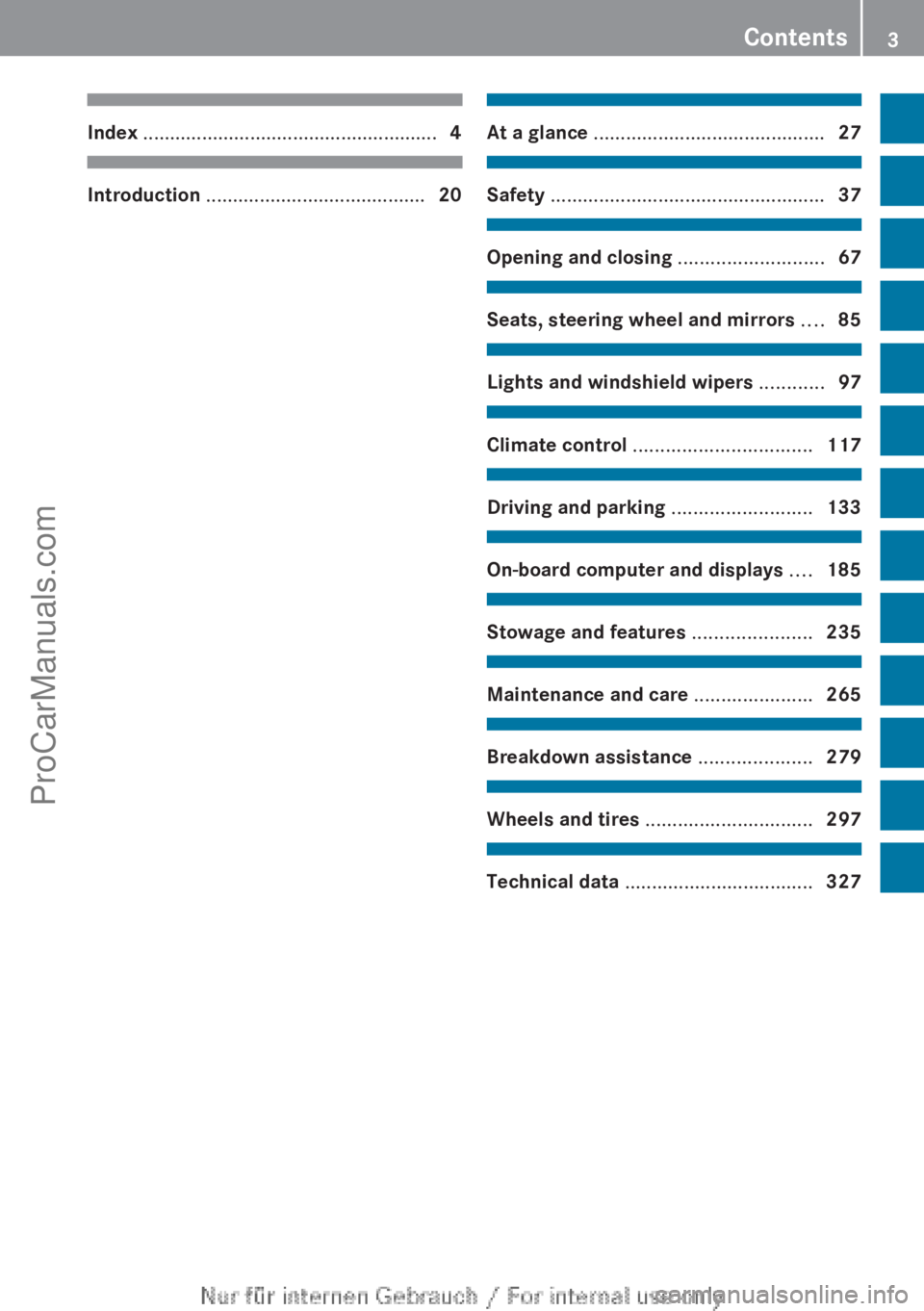
Index
....................................................... 4Introduction .........................................
20 At a glance
........................................... 27 Safety ...................................................
37 Opening and closing
...........................67 Seats, steering wheel and mirrors ....
85 Lights and windshield wipers
............97 Climate control
................................. 117 Driving and parking ..........................
133 On-board computer and displays
....185 Stowage and features ......................
235 Maintenance and care
......................265 Breakdown assistance
.....................279 Wheels and tires ...............................
297 Technical data ...................................
327 Contents
3ProCarManuals.com
Page 17 of 340

(vehicles without the EASY-
VARIO-PLUS system)
.....................240
Folding the backrest (rear
compartment) forwards/back
(vehicles with the EASY-VARIO-
PLUS system) ................................ 241
Seat belts
Adjusting the height ......................... 48
Belt force limiters ............................ 49
center rear-compartment seat
.........48
Cleaning ......................................... 277
Correct usage .................................. 46
Emergency Tensioning Devices ........ 49
Fastening ......................................... 47
Important safety guidelines .............45
Releasing ......................................... 48
Safety guidelines ............................. 40
Warning lamp ................................. 224
Warning lamp (function) ................... 49
Seats
Adjusting (electrically) .....................88
Adjusting (manually) ........................ 88
Adjusting the 4-way lumbar
support ............................................ 90
Adjusting the head restraint ............ 89
Cleaning the cover ......................... 276
Correct driver's seat position ........... 86
Important safety notes .................... 87
Seat heating problem ...................... 91
Storing settings (memory function) .. 95
Switching seat heating on/off ......... 91
Sensors (cleaning instructions) .......275
Service menu (on-board computer) . 196
Service products Brake fluid ..................................... 332
Coolant (engine) ............................ 333
Engine oil ....................................... 332
Fuel ................................................ 330
Important safety notes .................. 329
Refrigerant (air-conditioning
system) .......................................... 334
Washer fluid ................................... 334
Service work
see ASSYST PLUS
Settings
Factory (on-board computer) ......... 199
On-board computer ....................... 196
Setting the air distribution ...............126Setting the airflow
............................ 126
Side impact air bag ............................. 44
Side marker lamp (display
message) ............................................ 211
Side windows Cleaning ......................................... 274
Convenience closing feature ............ 78
Convenience opening feature
..........78
Important safety information ........... 77
Opening/closing .............................. 77
Problem (malfunction) .....................79
Resetting ......................................... 79
Sliding sunroof
see Panorama roof with power
tilt/sliding panel
SmartKey
Changing the battery ....................... 70
Changing the programming ............. 69
Checking the battery ....................... 70
Convenience closing feature ............ 78
Convenience opening feature .......... 78
Display message ............................ 223
Door central locking/unlocking ....... 68
Important safety notes .................... 68
Loss ................................................. 72
Mechanical key ................................ 69
Positions (ignition lock) ................. 135
Problem (malfunction) .....................72
Starting the engine ........................ 135
SmartKey positions (ignition lock) ..135
Snow chains ...................................... 301
Sockets Center console .............................. 251
Luggage compartment ................... 251
Points to observe before use ......... 250
Rear compartment ......................... 251
Specialist workshop ............................ 24
Speed, controlling see Cruise control
Speedometer
Activating/deactivating the
additional speedometer .................196
Digital ............................................ 190
In the Instrument cluster ................. 29
Segments ...................................... 187
Selecting the unit of measurement 196
see Instrument cluster Index
15
ProCarManuals.com
Page 22 of 340

Protection of the environment
General notes
H
Environmental note
Daimler's declared policy is one of
comprehensive environmental protection.
The objectives are for the natural resources
that form the basis of our existence on this
planet to be used sparingly and in a manner
that takes the requirements of both nature
and humanity into account.
You too can help to protect the environment
by operating your vehicle in an
environmentally responsible manner.
Fuel consumption and the rate of engine,
transmission, brake and
tire wear are affected
by these factors:
R operating conditions of your vehicle
R your personal driving style
You can influence both factors. You should
bear the following in mind:
Operating conditions:
R avoid short trips as these increase fuel
consumption.
R always make sure that the tire pressures
are correct.
R do not carry any unnecessary weight.
R remove roof racks once you no longer need
them.
R a regularly serviced vehicle will contribute
to environmental protection. You should
therefore adhere to the service intervals.
R always have service work carried out at a
qualified specialist workshop.
Personal driving style:
R do not depress the accelerator pedal when
starting the engine.
R do not warm up the engine when the vehicle
is stationary.
R drive carefully and maintain a safe distance
from the vehicle in front.
R avoid frequent, sudden acceleration and
braking. R
change gear in
good time and use each gear
only up to Ô of its maximum engine speed.
R switch off the engine in stationary traffic.
R keep an eye on the vehicle's fuel
consumption. Environmental concerns and
recommendations
Wherever the operating instructions require
you to dispose of materials, first try to
regenerate or re-use them. Observe the
relevant environmental rules and regulations
when disposing of materials. In this way you
will help to protect the environment. Genuine Mercedes-Benz parts
H
Environmental note
Daimler AG also supplies reconditioned major
assemblies and parts which are of the same
quality as new
parts. They are covered by the
same Limited Warranty entitlements as new
parts.
! Air bags and Emergency Tensioning
Devices, as well as control units and
sensors for these restraint systems, may be
installed in the following areas of your
vehicle:
R doors
R door pillars
R door sills
R seats
R cockpit
R instrument cluster
R center console
Do not install accessories such as audio
systems in these areas. Do not carry out
repairs or welding. You could impair the
operating efficiency of the restraint
systems. 20
Introduction
ProCarManuals.com
Page 37 of 340

Door control panel
Function Page
:
Opens the door 73
;
%& Unlocks/locks
the vehicle
74
=
r45= Saves
the seat
and exterior mirror
settings 95
?
Adjusts the seats
electrically
88
A
7Zö\
Adjusts and folds the
exterior mirrors in/out
electrically
92 Function Page
B
W Opens/closes the
side windows
77
C
n Activates/
deactivates the override
feature for the side
windows in the rear
compartment
58Door control panel
35
At a glance
ProCarManuals.com
Page 42 of 340
R
the deformation characteristics of the
vehicle
R the characteristics of
the object with which
the vehicle has collided
Factors that can only be seen and measured
after a collision has occurred do not play a
decisive role in the deployment of an air bag,
nor do they provide an indication of air bag
deployment.
The vehicle may be deformed significantly,
e.g. the hood or the fender, without an air bag
being deployed. This is the case if only parts
which are relatively easily deformed are
affected and the rate of deceleration is not
high. Conversely, air bags may be deployed
even though the vehicle suffers only minor
deformation. This is the case if, for example,
very rigid vehicle parts such as longitudinal
body members are hit, and sufficient
deceleration occurs as a result.
i The front Emergency Tensioning Devices
can only be triggered if the seat belt
tongues on the front seats are correctly
engaged in the seat belt buckles.
i Not all air bags are deployed in an
accident. The different air bag systems
work independently of each other.
How the air bag system works is
determined by predicting the severity of
the accident, especially vehicle
deceleration or acceleration, and the type
of accident:
R head-on collision
R side impact
R rollover
Safety guidelines for seat belts,
Emergency Tensioning Devices (ETDs)
and air bags G
WARNING
R Damaged seat belts
or seat belts that have
been subjected to stress in an accident
must be replaced. Their anchoring points
must also be checked. Only use seat belts installed or supplied by an authorized
Mercedes-Benz Center.
R Air bags and pyrotechnic Emergency
Tensioning Devices (ETDs) contain
perchlorate material, which may require
special handling and regard for the
environment. Check your
national disposal
guidelines. In California, see
www.dtsc.ca.gov/HazardousWaste/
Perchlorate/index.cfm.
R Air bags and ETDs are designed to function
on a one-time-only basis. An air bag or ETD
that has deployed must be replaced.
R Do not pass seat belts over sharp edges.
They could tear.
R Do not make any modification that could
change the effectiveness of the seat belts.
R Do not bleach or dye seat belts, as this may
severely weaken them. In a crash, they may
not be able to provide adequate protection.
R Do not make any modifications to the SRS
wiring or components.
R Do not modify or remove any components
or parts of the SRS.
R Do not install additional trim material, seat
covers, badges, etc. to the:
-padded steering wheel boss
- knee bag covers
- front-passenger air bag cover
- outer side of front seat bolsters
- outer seat bolsters of the rear bench seat
backrest
- roof frame trim
R Do not install additional electrical/
electronic equipment on or near SRS
components and wiring.
R Keep the area between the air bags and
occupants free of objects (e.g. packages,
handbags, umbrellas etc.).
R Do not hang any objects such as coat
hangers on the coat hooks or the grab
handle above the door. These items may be
thrown around in the vehicle and cause40
Occupant safety
Safety
ProCarManuals.com
Page 46 of 340

Driver's knee bag
Driver's knee bag : deploys under the
steering column. The driver's knee bag is
always deployed
along
with the driver's front
air bag. The driver's knee bag is designed to
operate together with the front air bags in
frontal impacts if certain thresholds are
exceeded. The driver's knee bag operates
best in conjunction with correctly positioned
and fastened seat belts.
Driver's knee bag : increases the driver's
protection against:
R knee injuries
R thigh injuries
R lower leg injuries
Side impact air bags G
WARNING
Only use seat covers which have been tested
and approved by Mercedes-Benz for your
vehicle model. Using other seat covers may
interfere with or prevent the deployment of
the side impact air bags. Contact an
authorized Mercedes-Benz Center for
availability. G
WARNING
The pressure sensors for side impact air bag
control are located in the doors. Do not
modify any components of the doors or door
trim panels including, for example, the
addition of door speakers.
Improper repair work on the doors or the
modification or addition
of components to the doors create a risk of rendering the side
impact air bags inoperative or causing
unintended air bag deployment. Work on the
doors must therefore only be performed by
qualified technicians. Contact an authorized
Mercedes-Benz Center.
Front side impact air bags
: and rear side
impact air bags ; deploy next to the outer
seat cushions.
When deployed,
the
side impact air bags offer
additional protection of the thorax for
occupants on the front seats as well as also
of the pelvis for the vehicle occupants on the
side of the vehicle on which the impact
occurs. However, they do not protect the:
R head
R neck
R arms
The side impact air bags are deployed:
R on the side on which an impact occurs
R at the start of an accident with a high rate
of lateral vehicle deceleration or
acceleration, e.g. in a side impact
R independently of the use of the seat belt
R independently of the front air bags
R independently of the ETDs
If the vehicle rolls over, the side impact air
bags are generally not deployed. Side impact
air bags are deployed if the system detects
high vehicle deceleration or acceleration in a
lateral direction and determines that side
impact air bag deployment can offer 44
Occupant safety
Safety
ProCarManuals.com
Page 49 of 340
touch the neck. Never pass the shoulder
portion of
the
seat belt under your arm. For
this purpose, you can adjust the height of
the seat belt outlet.
R Position the lap belt as low as possible on
your hips and not across the abdomen. If
the lap belt is positioned across your
abdomen, it could cause serious injuries in
a crash.
R Never wear seat belts over rigid or
breakable objects in or on your clothing,
such as eyeglasses, pens, keys etc., as
these might cause injuries.
R Make sure the seat belt is always fitted
snugly. Take special care of this when
wearing loose clothing.
R Never use a seat belt for more than one
person at a time. Do not fasten a seat belt
around a person and another person or
other objects at the same time.
R Seat belts should not be worn twisted. In a
crash, you would not have the full width of
the seat belt to distribute impact forces.
The twisted seat belt against your body
could cause injuries.
R Pregnant women should also always use a
lap-shoulder belt. The lap belt portion
should be positioned as low as possible on
the hips to avoid any possible pressure on
the abdomen.
R Place the seat backrest in a position that is
as upright as possible.
R Check your seat belt during travel to make
sure it is properly positioned.
R Never place your feet on the instrument
panel, dashboard, or on the seat. Always
keep both feet on the floor in front of the
seat.
R When using a seat belt to secure infant
restraints, toddler restraints, or children in
booster seats, always follow the child seat
manufacturer's instructions. G
WARNING
Do not pass seat belts over sharp edges. They
could tear.
Do not allow
the seat belt to get caught in the
door or in the seat adjustment mechanism.
This could damage the seat belt.
Never attempt to make modifications to seat
belts. This could impair the effectiveness of
the seat belts.
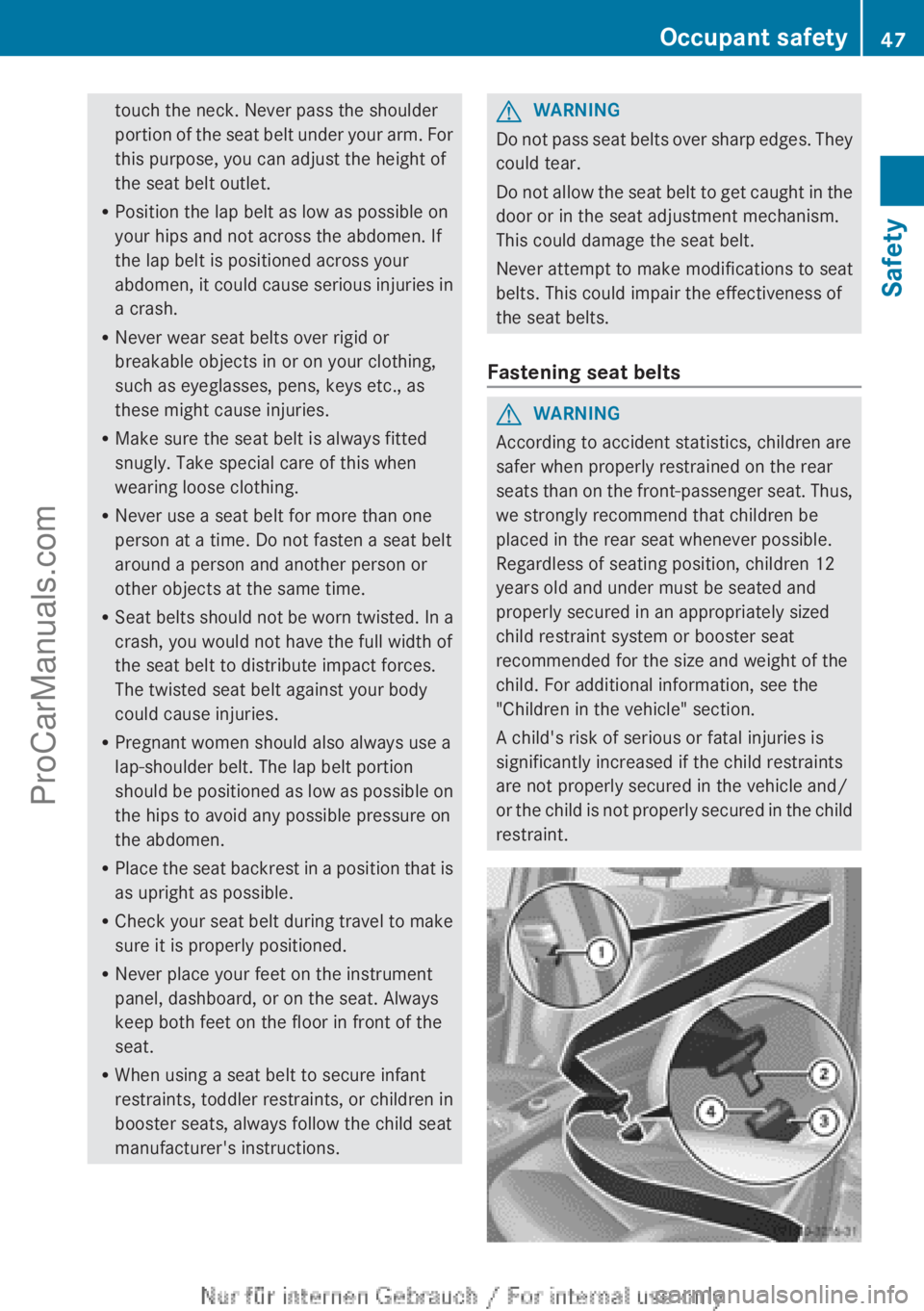
Fastening seat belts G
WARNING
According to accident statistics, children are
safer when properly restrained on the rear
seats than on
the front-passenger seat. Thus,
we strongly recommend that children be
placed in the rear seat whenever possible.
Regardless of seating position, children 12
years old and under must be seated and
properly secured in an appropriately sized
child restraint system or booster seat
recommended for the size and weight of the
child. For additional information, see the
"Children in the vehicle" section.
A child's risk of serious or fatal injuries is
significantly increased if the child restraints
are not properly secured in the vehicle and/
or the child is not properly secured in the child
restraint. Occupant safety
47
Safety Z
ProCarManuals.com
Page 50 of 340
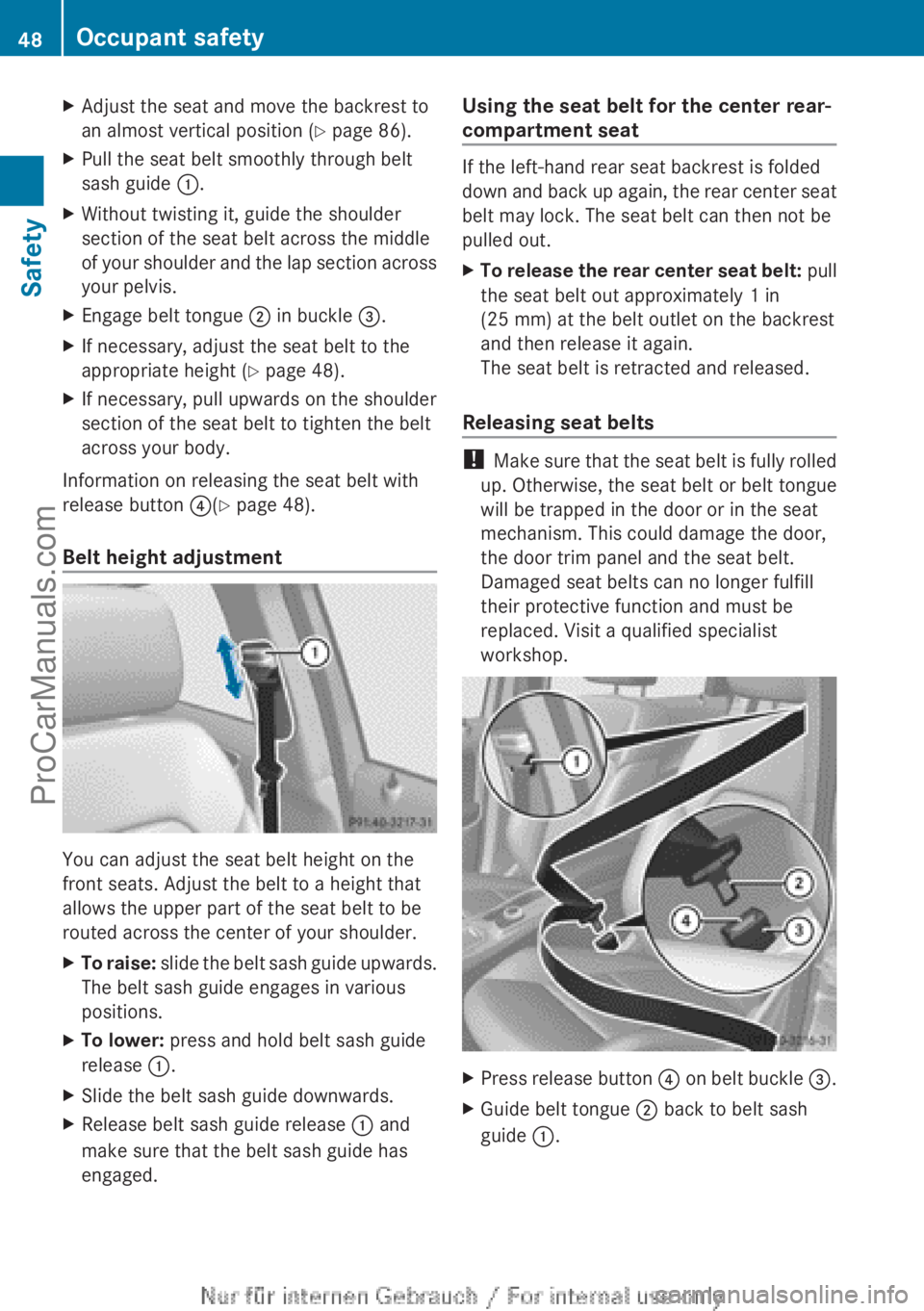
X
Adjust the seat and move the backrest to
an almost vertical position ( Y page 86).
X Pull the seat belt smoothly through belt
sash guide :.
X Without twisting it, guide the shoulder
section of the seat belt across the middle
of your shoulder
and the lap section across
your pelvis.
X Engage belt tongue ; in buckle =.
X If necessary, adjust the seat belt to the
appropriate height ( Y page 48).
X If necessary, pull upwards on the shoulder
section of the seat belt to tighten the belt
across your body.
Information on releasing the seat belt with
release button
?(Y page 48).
Belt height adjustment You can adjust the seat belt height on the
front seats. Adjust the belt to a height that
allows the upper part of the seat belt to be
routed across the center of your shoulder.
X
To raise: slide the belt sash guide upwards.
The belt sash guide engages in various
positions.
X To lower: press and hold belt sash guide
release :
.
X Slide the belt sash guide downwards.
X Release belt sash guide release : and
make sure that the belt sash guide has
engaged. Using the seat belt for the center rear-
compartment seat If the left-hand rear seat backrest is folded
down and
back
up again, the rear center seat
belt may lock. The seat belt can then not be
pulled out.
X To release the rear center seat belt: pull
the seat belt out approximately 1 in
(25 mm) at the belt outlet on the backrest
and then release it again.
The seat belt is retracted and released.
Releasing seat belts !
Make sure
that
the seat belt is fully rolled
up. Otherwise, the seat belt or belt tongue
will be trapped in the door or in the seat
mechanism. This could damage the door,
the door trim panel and the seat belt.
Damaged seat belts can no longer fulfill
their protective function and must be
replaced. Visit a qualified specialist
workshop. X
Press release button ?
on belt
buckle =.
X Guide belt tongue ; back to belt sash
guide :.48
Occupant safety
Safety
ProCarManuals.com
Page 51 of 340
Belt warning for the driver and front
passenger
Regardless of whether the driver's and front-
passenger seat belts have already been
fastened, the 7 seat belt warning lamp
lights up
for
six seconds each time the engine
is started. It then goes out if the driver and
the front passenger have already fastened
their seat belts.
If the driver's seat belt is not fastened when
the engine is started, an additional warning
tone will sound. This warning tone stops after
a maximum of six seconds or once the
driver's seat belt is fastened.
If after six seconds the driver or front
passenger have not fastened their seat belts
and the doors are closed, the 7 seat belt
warning lamp lights up:
R until the driver's or front passenger's seat
belt is fastened
R if a vehicle speed of 15 mph (25 km/h) is
exceeded, a warning tone also sounds with
increasing intensity for a maximum of
60 seconds or until the driver or front-
passenger seat belt has been fastened.
If the driver/front passenger unfasten their
seat belt while the vehicle is in motion, the
7 seat belt warning lamp lights up and a
warning tone sounds again.
The warning tone ceases even if the driver or
front-passenger seat belt has still not been
fastened after 60 seconds. The 7 seat belt
warning lamp stops flashing but remains
illuminated.
After the vehicle comes to a standstill, the
warning tone is reactivated and the 7 seat
belt warning lamp flashes again if the vehicle
speed again exceeds 15 mph (25 km/h).
The 7 seat belt warning lamp only goes
out if:
R both the driver and the front passenger
have fastened their seat belts.
or
R the vehicle is stationary and a door is open. i
For more information on the 7 seat
belt warning lamp, see "Warning and
indicator lamps in the instrument cluster,
seat belts" ( Y page 224).
Emergency Tensioning Devices, seat
belt force limiters G
WARNING
Pyrotechnic ETDs that were activated must be
replaced.
For your safety, when disposing of the
pyrotechnic ETDs always follow our safety
instructions. These are available at any
authorized Mercedes-Benz Center.
! If the front-passenger seat is not
occupied, do not engage the seat belt
tongue in the buckle on the front-
passenger seat. Otherwise,
the Emergency
Tensioning Device could be triggered in the
event of an accident.
The front seat belts and the outer seat belts
in the rear are equipped with Emergency
Tensioning Devices and seat belt force
limiters.
The ETDs tighten the seat belts in an accident,
pulling them close against the body.
The ETDs do not correct incorrect seat
positions or incorrectly fastened seat belts.
The ETDs do not pull vehicle occupants back
towards the backrest.
The ETDs can only be activated when:
R the ignition is switched on.
R the restraint systems are operational; see
"SRS warning lamp" 6(Y page 39).
R the belt tongue is engaged in the buckle on
each of the front seat belts.
The ETDs on the outside seats in the rear
compartment are triggered independently of
the lock status of the seat belts.
The ETDs are triggered depending on the type
and severity of an accident:
R if, in the event of a head-on or rear-end
collision, the vehicle decelerates or Occupant safety
49
Safety Z
ProCarManuals.com
Page 52 of 340
accelerates rapidly in a longitudinal
direction during the initial stages of the
impact
R if, in the
event of a side impact, on the side
opposite the impact the vehicle
decelerates or accelerates rapidly in a
lateral direction
R if, in certain situations where the vehicle
rolls over, the system determines that it
can provide additional protection
If the ETDs are deployed, you will hear a bang,
and a small amount of powder may also be
released. Only in rare cases will the bang
affect your hearing. The powder that is
released generally does not constitute a
health hazard. The 6 SRS warning lamp
lights up.
If the seat belt is also equipped with a seat
belt force limiter and this is triggered, the
force exerted by the seat belt on the vehicle
occupant is reduced.
The seat belt force limiters for the front seats
are synchronized with the front air bags,
which take on a part of the deceleration force.
This results in the force exerted on the
occupant being distributed over a greater
area. Children in the vehicle
Child restraint systems
Important safety notes G
WARNING
According to accident statistics, children are
safer when properly restrained in the rear
seating positions than in the front seating
position. Thus, we strongly recommend that
children be placed
in the rear seats whenever
possible. Regardless of seating position,
children 12 years old and under must be
seated and properly secured in an appropriate
infant restraint, toddler restraint, or booster
seat recommended for the size and weight of
the child. The infant or child restraint must be properly
secured with the vehicle's seat belt, the seat
belt and
top
tether strap, or lower anchors and
top tether strap, fully in accordance with the
child seat manufacturer's instructions.
Occupants, especially children, should always
sit as upright as possible, wear the seat belt
properly and use an appropriately sized infant
restraint, toddler restraint, or booster seat
recommended for the size and weight of the
child.
Children can be killed or seriously injured by
an inflating air bag. Note the following
important information when circumstances
require you to place a child in the front
passenger seat:
R Your vehicle is equipped with air bag
technology designed to deactivate the front
passenger front air bag in your vehicle
when the system senses the weight of a
typical 12-month-old child or less along
with the weight of a standard appropriate
child restraint on the front passenger seat.
R For children larger than the typical
12-month-old child, the front passenger
front air bag may or may not be activated.
Always make sure the 4 5 indicator
lamp is illuminated, indicating that the front
passenger front air bag is deactivated.
R A child in a rear-facing child restraint on the
front passenger seat will be seriously
injured or even killed if the front passenger
front air bag inflates in a collision which
could occur under some circumstances,
even with the air bag technology installed
in your vehicle. The only means to
completely eliminate this risk is to never
place a child in a rear-facing child restraint
in the front seat. We therefore strongly
recommend that you always place a child
in a rear-facing child restraint in a backseat.
R If you must install a rear-facing child
restraint on the front passenger seat
because circumstances require you to do
so, make sure the 4 5 indicator
lamp is illuminated, indicating that the front 50
Children in the vehicle
Safety
ProCarManuals.com