key battery MERCEDES-BENZ B-CLASS HATCHBACK 2008 User Guide
[x] Cancel search | Manufacturer: MERCEDES-BENZ, Model Year: 2008, Model line: B-CLASS HATCHBACK, Model: MERCEDES-BENZ B-CLASS HATCHBACK 2008Pages: 305, PDF Size: 5.1 MB
Page 193 of 305
Trailer towing*
190note that the power output of the engine,
and consequently the vehicle's gradient-
climbing capability, decrease with increas-
ing altitude.
If the trailer swings from side to side:
X Do not accelerate.
X Do not counter-steer.
X Brake if necessary. G
Risk of accident
On no account should you attempt to draw
the vehicle/trailer combination out by
increasing speed. Removing the ball coupling
X Pull the protective cap off the lock in the
handwheel.
X Insert the key into the lock in the hand-
wheel.
X Turn the key clockwise.
The lock is unlocked.
X Hold the ball coupling. Pull the handwheel
away from the ball coupling and turn it
clockwise until it engages.
The green area on the ball coupling is
aligned with the red mark on the hand-
wheel. X
Pull out the ball coupling downwards.
X Clean the ball coupling if it is dirty.
X Vehicles without ECO start/stop func-
tion*: open the stowage compartment on
the right of the luggage compartment.
X Fold the trim downwards.
X Vehicles with start/stop function*:
open the luggage compartment floor.
X Remove the protective cap from the ball
coupling recess.
X Press the protective cap into the ball cou-
pling recess until it engages.
Storing the ball coupling X
Store the ball coupling with the key inser-
ted in the ball coupling recess.
X Vehicle without ECO start/stop func-
tion: Secure the ball coupling in place using
the retainer strap. G
Risk of accident
Do not carry the ball coupling in the vehicle
interior if it is not secured.
Otherwise, you and others could be injured
by the ball coupling being thrown around if
you: R
brake sharply
R change direction suddenly
R are involved in an accident Trailer power supply
When it leaves the factory, your vehicle's
trailer socket outlet is equipped with a per-
manent power supply and a power supply that
is switched on via the ignition lock.
The permanent power supply is supplied via
trailer socket pin 9.
The power supply that is switched on via the
ignition lock is supplied via trailer socket pin
10.
! You can connect consumers with a power
rating of up to 240 W to the permanent
power supply and up to 180 W to the power
supply that is switched on via the ignition
lock.
You must not charge a trailer battery using
the power supply.
The trailer's turn signal lamps are only guar-
anteed to function when bulbs are used.
You can obtain further information about
installing the trailer electrics from a qualified Operation
* optional
245_AKB; 2; 7, en-GB
wdomann,
Version: 2.11.4 2008-10-17T11:22:31+02:00 - Seite 190Dateiname: 6515_1640_02_buchblock.pdf; preflight
Page 197 of 305
Care
194nozzle of the high-pressure cleaner and the
vehicle (at least 30 cm).
Move the high-pressure cleaner nozzle
around when cleaning your vehicle.
Do not aim directly at any of the following:
R tyres
R door joint
R electrical components
R battery
R connectors
R lights
R seals
R trim elements
Damaged seals or electrical components
can lead to failures or leaks.
Cleaning the wiper blades and the out-
side of the windscreen G
Risk of injury
Before cleaning the windscreen or wiper
blades, turn the key in the ignition to 0.
Otherwise, the windscreen wipers may
move and injure you. X
Turn the key to position 1(Y page 62) in
the ignition lock.
X Set the windscreen wipers to position
I(Y page 82) on the combination switch.
X Turn the key to position 0(Y page 62) or
remove it when the wiper arms are vertical.
! Only fold the windscreen wipers away
from the windscreen when vertical. Other-
wise, you will damage the bonnet.
X Fold the wiper arms away from the wind-
screen.
X Wipe the windscreen and wiper blades with
a damp, lint-free cloth (e.g. a microfibre
cloth) and cleaning agent.
X Fold the wiper arms back on to the wind-
screen before the ignition is switched on.
! Do not clean the wiper blades too often
as this will result in damage to the surface
coating, leading to wiper noise.
Cleaning the windows !
Do not use dry cloths, abrasive products,
solvents or cleaning agents containing sol-
vents to clean the inside of the windows.
Clean the insides of the windows with a
damp cloth or commercially-available glass cleaner. Avoid touching the inside of the
rear windscreen and the side windows with
hard objects, e.g. ice scrapers or rings. You
could otherwise cause damage to the win-
dows, rear window heating or aerial on the
rear window.
i Anti-glare film retrofitted to the insides of
the windows could interfere with radio or
mobile phone reception, especially if it is
conductive or metal-coated film. Informa-
tion about anti-glare film can be obtained
from any Mercedes-Benz Service Centre.
Cleaning the headlamps X
Clean the plastic lenses of the headlamps
with a damp sponge.
! Only use washer fluid which is suitable
for plastic lenses. Unsuitable washer fluid
could damage the plastic lenses of the
headlamps.
Do not use the following:
R dry cloths
R abrasive cleaning agents
R solvents
R cleaning agents containing solvent Operation
245_AKB; 2; 7, en-GB
wdomann
,V ersion: 2.11.4
2008-10-17T11:22:31+02:00 - Seite 194 Dateiname: 6515_1640_02_buchblock.pdf; preflight
Page 226 of 305
Troubleshooting
223Problem Possible cause/consequence Suggested solutions
The indicator lamp in the
F/
1 rear-window heating button
is flashing. The rear-window heat-
ing has switched itself off prema-
turely or cannot be switched on. The on-board voltage is too low,
because too many consumers are
switched on. X
Switch off consumers that are not required, e. g. reading lamp or
interior lighting.
Once the battery is sufficiently charged, the rear window heating
will switch back on automatically. Vehicles with automatic child
seat recognition on the front-
passenger seat:
The
5 PASSENGER AIRBAG
OFF warning lamp on the centre
console is lit. A special Mercedes-Benz child
seat with automatic child seat
recognition has been fitted to the
front-passenger seat. The front-
passenger airbag has therefore
been disabled as desired.
G
Risk of injury
There is no child seat fitted to the
front-passenger seat. The auto-
matic child seat recognition is
malfunctioning. X
Remove electronic equipment from the front-passenger seat, for
example
R
notebook
R mobile phone
R cards with transponders, e.g. ski passes or access passes
If the 5 PASSENGER AIRBAG OFF warning lamp is still lit:
X Visit a qualified specialist workshop. You have started the engine with
the key. The indicator lamp in the
ECO start/stop function* button
does not light up or goes out
again after a short time. You have deactivated the ECO
start/stop function*. X
Activate the ECO start/stop function* again. The ECO start/stop function*is
not available due to a fault. X
Visit a qualified specialist workshop. Practical advice
* optional
245_AKB; 2; 7, en-GB
wdomann,
Version: 2.11.4
2008-10-17T11:22:31+02:00 - Seite 223 ZDateiname: 6515_1640_02_buchblock.pdf; preflight
Page 236 of 305
Troubleshooting
233Engine
Problem Possible cause/consequence Suggested solutions
The engine will not start. You can
hear the starter motor operating. R
The engine electronics system
is malfunctioning.
R There is a malfunction in the
fuel supply.
R The on-board voltage is too low
because the starter battery is
too weak or discharged. X
Turn the key back to position 0(Y page 62) in the ignition lock
before the next starting attempt.
X Try to start the engine again (Y page 86). When doing so, remember
that excessively long and frequent attempts to start the engine will
drain the battery.
If the engine does not start after several attempts:
X Consult a qualified specialist workshop. The engine will not start. You can
hear the starter motor operating.
The reserve fuel warning lamp is
on and the fuel gauge shows
0. The fuel tank has been run dry. X
Refuel the vehicle.
X Bleed the fuel system (Y page 232).The engine will not start. You can-
not hear the starter motor oper-
ating. The on-board voltage is too low
because the starter battery is too
weak or discharged. X
Jump-start the vehicle (Y page 266).
If the engine does not start despite attempting to jump-start it:
X Consult a qualified specialist workshop. The starter motor was exposed to
a thermal load that was too high. X
Allow the starter motor to cool down for approximately two
minutes.
X Try to start the engine again.
If the engine still does not start:
X Consult a qualified specialist workshop. Practical advice
245_AKB; 2; 7, en-GB
wdomann,
Version: 2.11.4
2008-10-17T11:22:31+02:00 - Seite 233 ZDateiname: 6515_1640_02_buchblock.pdf; preflight
Page 242 of 305
Troubleshooting
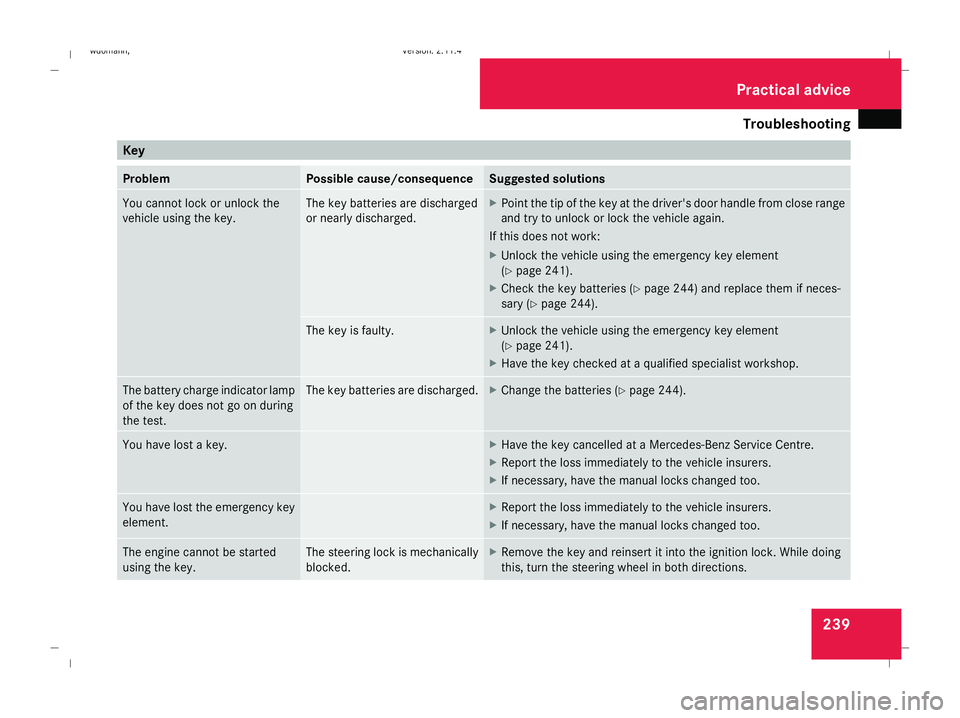
239Key
Problem Possible cause/consequence Suggested solutions
You cannot lock or unlock the
vehicle using the key. The key batteries are discharged
or nearly discharged. X
Point the tip of the key at the driver's door handle from close range
and try to unlock or lock the vehicle again.
If this does not work:
X Unlock the vehicle using the emergency key element
(Y page 241).
X Check the key batteries (Y page 244) and replace them if neces-
sary (Y page 244). The key is faulty. X
Unlock the vehicle using the emergency key element
(Y page 241).
X Have the key checked at a qualified specialist workshop. The battery charge indicator lamp
of the key does not go on during
the test. The key batteries are discharged. X
Change the batteries (Y page 244).You have lost a key. X
Have the key cancelled at a Mercedes-Benz Service Centre.
X Report the loss immediately to the vehicle insurers.
X If necessary, have the manual locks changed too. You have lost the emergency key
element. X
Report the loss immediately to the vehicle insurers.
X If necessary, have the manual locks changed too. The engine cannot be started
using the key. The steering lock is mechanically
blocked. X
Remove the key and reinsert it into the ignition lock. While doing
this, turn the steering wheel in both directions. Practical advice
245_AKB; 2; 7, en-GB
wdomann,
Version: 2.11.4
2008-10-17T11:22:31+02:00 - Seite 239 ZDateiname: 6515_1640_02_buchblock.pdf; preflight
Page 243 of 305
Troubleshooting
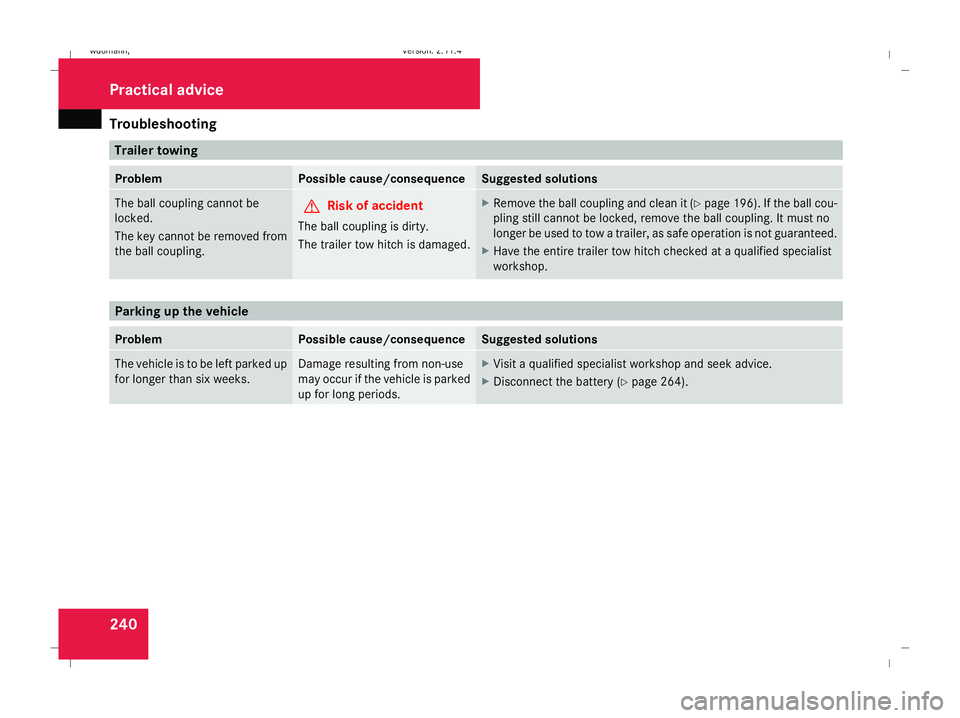
240 Trailer towing
Problem Possible cause/consequence Suggested solutions
The ball coupling cannot be
locked.
The key cannot be removed from
the ball coupling.
G
Risk of accident
The ball coupling is dirty.
The trailer tow hitch is damaged. X
Remove the ball coupling and clean it (Y page 196). If the ball cou-
pling still cannot be locked, remove the ball coupling. It must no
longer be used to tow a trailer, as safe operation is not guaranteed.
X Have the entire trailer tow hitch checked at a qualified specialist
workshop. Parking up the vehicle
Problem Possible cause/consequence Suggested solutions
The vehicle is to be left parked up
for longer than six weeks. Damage resulting from non-use
may occur if the vehicle is parked
up for long periods. X
Visit a qualified specialist workshop and seek advice.
X Disconnect the battery ( Ypage 264). Practical advice
245_AKB; 2; 7, en-GB
wdomann,
Version: 2.11.4 2008-10-17T11:22:31+02:00 - Seite 240Dateiname: 6515_1640_02_buchblock.pdf; preflight
Page 247 of 305
Changing bulbs
244 Key
Checking the batteries X
Press the jork button.
The batteries are in order if the battery
charge indicator lamp lights up briefly.
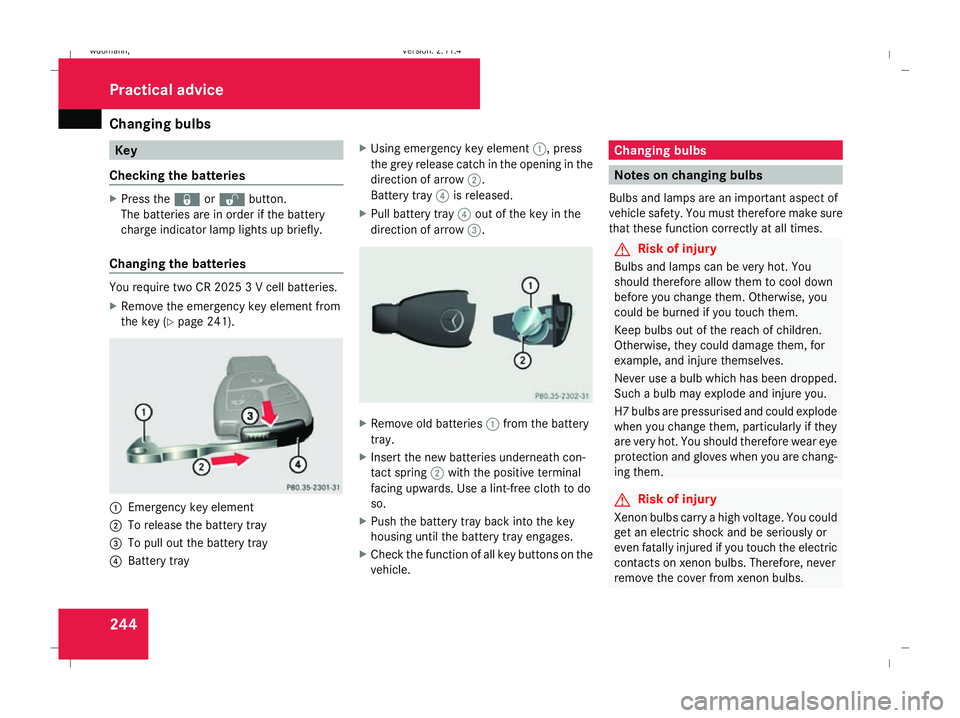
Changing the batteries You require two CR 2025 3 V cell batteries.
X Remove the emergency key element from
the key (Y page 241). 1
Emergency key element
2 To release the battery tray
3 To pull out the battery tray
4 Battery tray X
Using emergency key element 1, press
the grey release catch in the opening in the
direction of arrow 2.
Battery tray 4is released.
X Pull battery tray 4out of the key in the
direction of arrow 3. X
Remove old batteries 1from the battery
tray.
X Insert the new batteries underneath con-
tact spring 2with the positive terminal
facing upwards. Use a lint-free cloth to do
so.
X Push the battery tray back into the key
housing until the battery tray engages.
X Check the function of all key buttons on the
vehicle. Changing bulbs
Notes on changing bulbs
Bulbs and lamps are an important aspect of
vehicle safety. You must therefore make sure
that these function correctly at all times. G
Risk of injury
Bulbs and lamps can be very hot. You
should therefore allow them to cool down
before you change them. Otherwise, you
could be burned if you touch them.
Keep bulbs out of the reach of children.
Otherwise, they could damage them, for
example, and injure themselves.
Never use a bulb which has been dropped.
Such a bulb may explode and injure you.
H7 bulbs are pressurised and could explode
when you change them, particularly if they
are very hot. You should therefore wear eye
protection and gloves when you are chang-
ing them. G
Risk of injury
Xenon bulbs carry a high voltage. You could
get an electric shock and be seriously or
even fatally injured if you touch the electric
contacts on xenon bulbs. Therefore, never
remove the cover from xenon bulbs. Practical advice
245_AKB; 2; 7, en-GB
wdomann
,V ersion: 2.11.4
2008-10-17T11:22:31+02:00 - Seite 244 Dateiname: 6515_1640_02_buchblock.pdf; preflight
Page 267 of 305
Battery
264 step out of the vehicle first and touch the
bodywork.
R Do not wipe the battery using a cloth. The
battery could be destroyed as a result of
electrostatic charge or due to flying
sparks.
! Switch off the engine and remove the key
before disconnecting the terminal clamps
from the battery. Otherwise, you may
destroy electronic components, such as
the alternator.
i Mercedes-Benz recommends that you
have all work involving the battery, e.g.
removing, charging and replacing, carried
out at a qualified specialist workshop, e.g.
a Mercedes-Benz Service Centre.
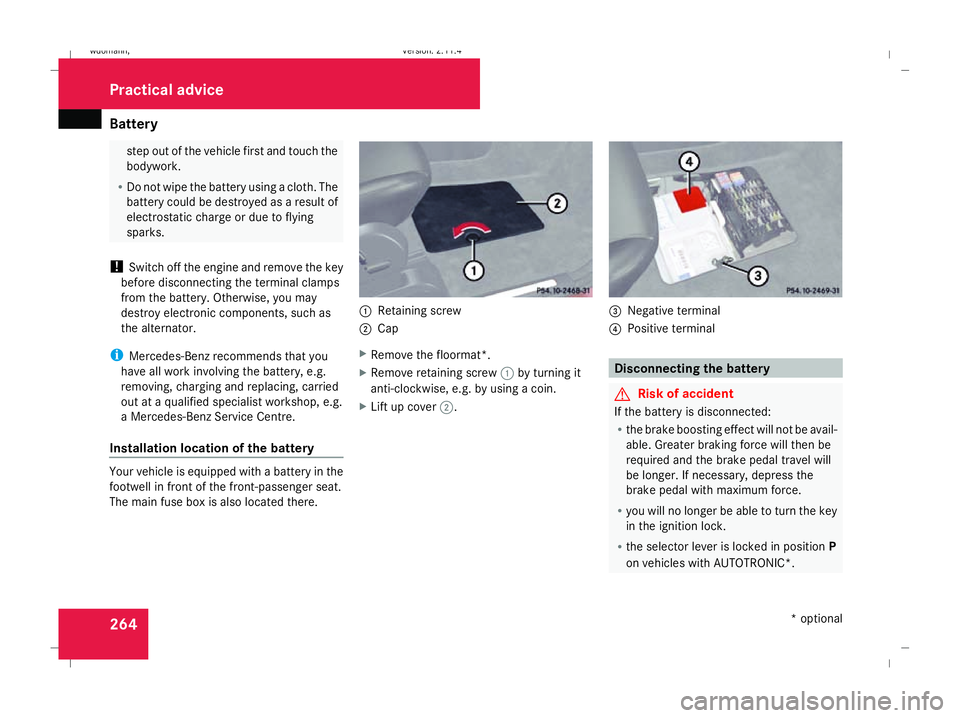
Installation location of the battery Your vehicle is equipped with a battery in the
footwell in front of the front-passenger seat.
The main fuse box is also located there. 1
Retaining screw
2 Cap
X Remove the floormat*.
X Remove retaining screw 1by turning it
anti-clockwise, e.g. by using a coin.
X Lift up cover 2. 3
Negative terminal
4 Positive terminal Disconnecting the battery
G
Risk of accident
If the battery is disconnected:
R the brake boosting effect will not be avail-
able. Greater braking force will then be
required and the brake pedal travel will
be longer. If necessary, depress the
brake pedal with maximum force.
R you will no longer be able to turn the key
in the ignition lock.
R the selector lever is locked in position P
on vehicles with AUTOTRONIC*. Practical advice
* optional
245_AKB; 2; 7, en-GB
wdomann,
Version: 2.11.4 2008-10-17T11:22:31+02:00 - Seite 264Dateiname: 6515_1640_02_buchblock.pdf; preflight
Page 268 of 305
Battery
265
!
Always disconnect the battery in
the order described below. Never swap the
terminal clamps. Otherwise, you may dam-
age the vehicle electronics.
X Apply the handbrake and shift the selector
lever to position Pon vehicles with AUTO-
TRONIC*.
X Switch off all electrical consumers.
X Turn the key to position 0(Y page 62) in
the ignition lock and remove it.
X Remove the negative terminal clamp from
the battery.
X Remove the cover from the positive termi-
nal clamp.
X Remove the positive terminal clamp from
the battery.
X Disconnect the breather hose. Removing the battery
X Disconnect the battery ( Ypage 264).
X Loosen the bolt which holds the battery in
place.
X Remove the battery. Charging and fitting the battery
G
Risk of injury
Only charge the battery in a well-ventilated
area. As the battery is being charged, gases
can escape and generate minor explosions.
This may injure you and other persons or
cause damage to the paintwork or acid cor-
rosion on the vehicle.
You can obtain information about battery
chargers which allow the battery to be
charged when still installed from a qualified
specialist workshop, e.g. a Mercedes-Benz
Service Centre. G
Risk of injury
There is a risk of acid burns during the
charging process due to the gases which
escape from the battery. Do not lean over
the battery during the charging process. G
Risk of injury
Battery acid is caustic. Avoid contact with
the skin, eyes or clothing.
! Only charge the installed battery with a
battery charger which has been tested and
approved by Mercedes-Benz. These battery
chargers allow the battery to be charged
while it is still installed. However, the bat-
tery must always be disconnected first.
! Only use battery chargers with a maxi-
mum charging voltage of 14.8 V.
X Charge the battery. Observe the notes in
the operating instructions for your battery
charger.
X Refit the charged battery.
To do this, follow the steps described in
"Removing the battery" (Y page 265) in
reverse order. Practical advice
* optional
245_AKB; 2; 7, en-GB
wdomann,
Version: 2.11.4
2008-10-17T11:22:31+02:00 - Seite 265 ZDateiname: 6515_1640_02_buchblock.pdf; preflight
Page 270 of 305
Towing and tow-starting
2671
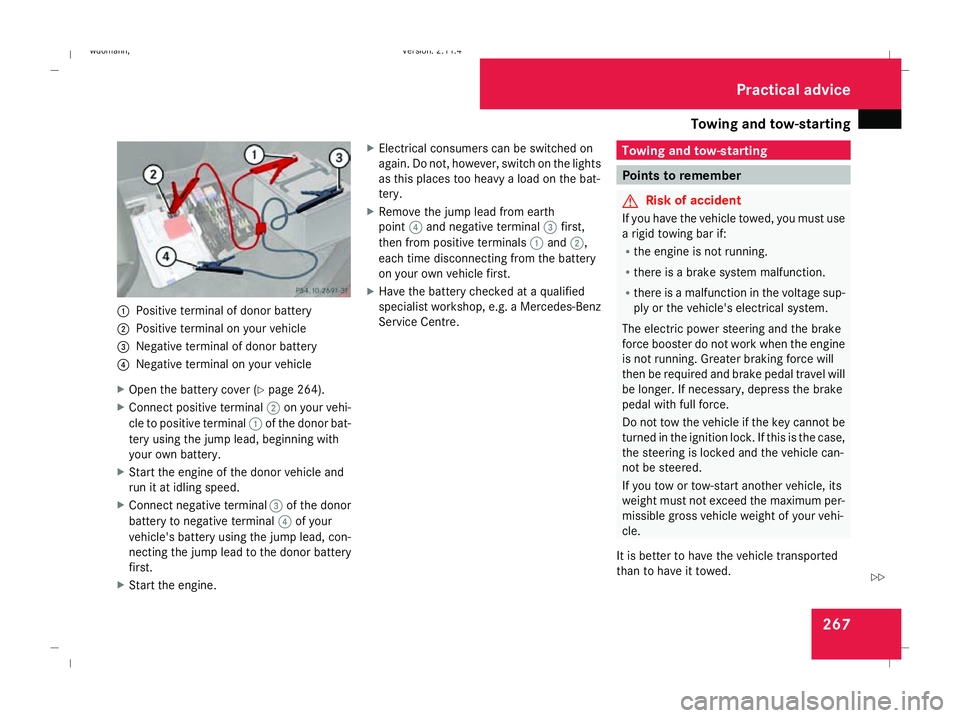
Positive terminal of donor battery
2 Positive terminal on your vehicle
3 Negative terminal of donor battery
4 Negative terminal on your vehicle
X Open the battery cover ( Ypage 264).
X Connect positive terminal 2on your vehi-
cle to positive terminal 1of the donor bat-
tery using the jump lead, beginning with
your own battery.
X Start the engine of the donor vehicle and
run it at idling speed.
X Connect negative terminal 3of the donor
battery to negative terminal 4of your
vehicle's battery using the jump lead, con-
necting the jump lead to the donor battery
first.
X Start the engine. X
Electrical consumers can be switched on
again. Do not, however, switch on the lights
as this places too heavy a load on the bat-
tery.
X Remove the jump lead from earth
point 4and negative terminal 3first,
then from positive terminals 1and 2,
each time disconnecting from the battery
on your own vehicle first.
X Have the battery checked at a qualified
specialist workshop, e.g. a Mercedes-Benz
Service Centre. Towing and tow-starting
Points to remember
G
Risk of accident
If you have the vehicle towed, you must use
a rigid towing bar if:
R the engine is not running.
R there is a brake system malfunction.
R there is a malfunction in the voltage sup-
ply or the vehicle's electrical system.
The electric power steering and the brake
force booster do not work when the engine
is not running. Greater braking force will
then be required and brake pedal travel will
be longer. If necessary, depress the brake
pedal with full force.
Do not tow the vehicle if the key cannot be
turned in the ignition lock. If this is the case,
the steering is locked and the vehicle can-
not be steered.
If you tow or tow-start another vehicle, its
weight must not exceed the maximum per-
missible gross vehicle weight of your vehi-
cle.
It is better to have the vehicle transported
than to have it towed. Practical advice
245_AKB; 2; 7, en-GB
wdomann,
Version: 2.11.4 2008-10-17T11:22:31+02:00 - Seite 267 ZDateiname: 6515_1640_02_buchblock.pdf; preflight