roof MERCEDES-BENZ B-CLASS HATCHBACK 2008 User Guide
[x] Cancel search | Manufacturer: MERCEDES-BENZ, Model Year: 2008, Model line: B-CLASS HATCHBACK, Model: MERCEDES-BENZ B-CLASS HATCHBACK 2008Pages: 305, PDF Size: 5.1 MB
Page 86 of 305
Side windows
83Side windows
Opening/closing the side windows
G
Risk of injury
Make sure that nobody can become trap-
ped between the side window and the door
frame when a side window is opened. Do
not touch or lean against the side window
during the opening procedure. You could
become trapped between the side window
and the door frame as the side window
moves down. If there is a risk of becoming
trapped, release the switch or pull the
switch upwards to close the side window
again. G
Risk of injury
Make sure that nobody can become trap-
ped when closing the side windows. If there
is a risk of becoming trapped, release the
switch or push the switch again to reopen
the side window. G
Risk of injury
Children may injure themselves if they
operate the side windows.
Never leave children unsupervised in the
vehicle. Always take the key with you when leaving the vehicle, even if you are only
leaving it for a short time.
G
Risk of injury
Do not leave children unsupervised in the
vehicle, even if they are secured in a child
restraint system. The children could:
R be seriously or even fatally injured on
parts of the vehicle
R be seriously or even fatally injured by
prolonged exposure to extremely high or
extremely low temperatures
If children open a door, they could:
R seriously or even fatally injure other peo-
ple
R get out of the vehicle, thereby injuring
themselves or be seriously or even fatally
injured by a passing vehicle
Activate the child-proof locks if children are
travelling in the vehicle. They could other-
wise open doors or windows while the vehi-
cle is in motion and thereby injure them-
selves or others. i
Related topics:
R convenience opening (Y page 84)
R convenience closing (Y page 85)
R override controls in the rear compart-
ment (Y page 53)
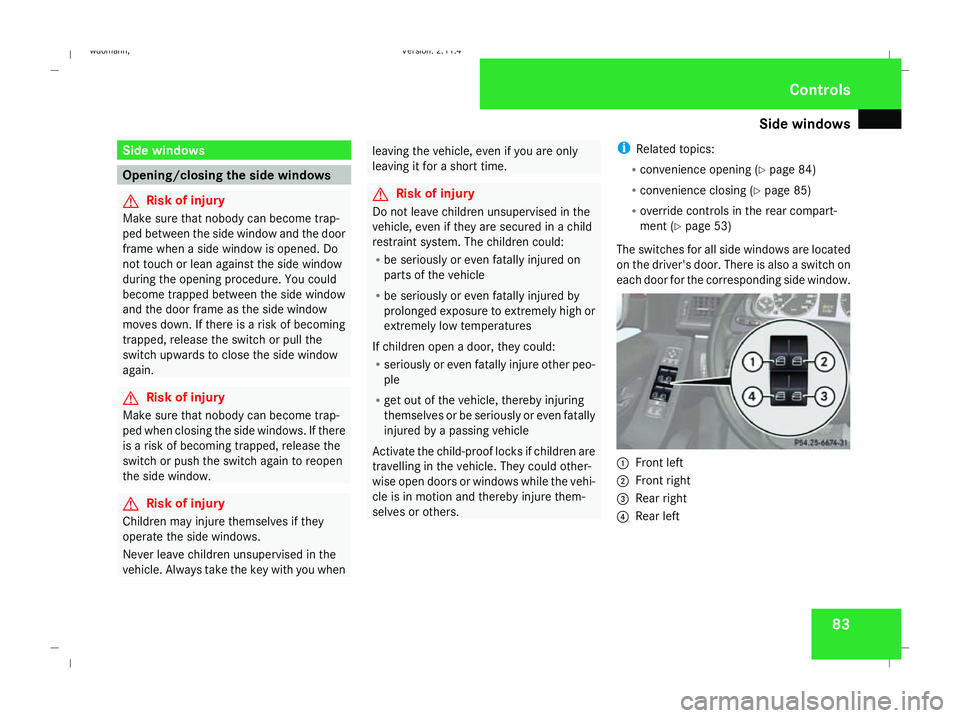
The switches for all side windows are located
on the driver's door. There is also a switch on
each door for the corresponding side window. 1
Front left
2 Front right
3 Rear right
4 Rear left Controls
245_AKB; 2; 7, en-GB
wdomann,
Version: 2.11.4
2008-10-17T11:22:31+02:00 - Seite 83 ZDateiname: 6515_1640_02_buchblock.pdf; preflight
Page 87 of 305
Side windows
84
X
Turn the key to position 2in the ignition
lock.
i You can still operate the side windows
when the key is in the 0position or when
the key has been removed. However, this
is only possible for a maximum of five
minutes afterwards, or until the driver's or
front-passenger door is opened.
X To open: press the corresponding switch.
X To close: pull the corresponding switch.
i If you operate the switch beyond its pres-
sure point, it will trigger automatic opera-
tion in the corresponding direction. You can
stop automatic operation by pressing
again.
Closing with increased force and with-
out the anti-entrapment feature G
Risk of injury
Closing the side windows with increased
force or without the anti-entrapment fea-
ture could lead to serious or even fatal
injury. Make sure that nobody can become
trapped when closing the side windows. If a side window blocks during closing and
reopens slightly:
X
Immediately after the window blocks, pull
on the corresponding switch again until the
side window has closed.
The side window is closed with increased
force.
If a side window blocks again during closing
and reopens slightly:
X Immediately after the window blocks, pull
on the corresponding switch again until the
side window has closed.
The side window is closed without the anti-
entrapment feature. Resetting the side windows
You must reset each side window if:
R the battery has been disconnected or has
become discharged.
R the side window no longer opens or closes
fully.
R the side windows open again slightly after
being closed fully. X
Turn the key to position 2in the ignition
lock.
X Pull the corresponding switch until the side
window is closed.
X Hold the switch for an additional second.
If the side window opens again slightly:
X Pull the corresponding switch again imme-
diately and hold it for approx. one second. Convenience opening*
You can ventilate the vehicle before a journey.
To do this, you can use the key to simultane-
ously:
R open the side windows
R open the panorama louvred sliding sun-
roof* or move it to the ventilation position
i The "Convenience opening" feature can
only be operated using the key. Controls
* optional
245_AKB; 2; 7, en-GB
wdomann,
Version: 2.11.4 2008-10-17T11:22:31+02:00 - Seite 84Dateiname: 6515_1640_02_buchblock.pdf; preflight
Page 88 of 305
Side windows
85X
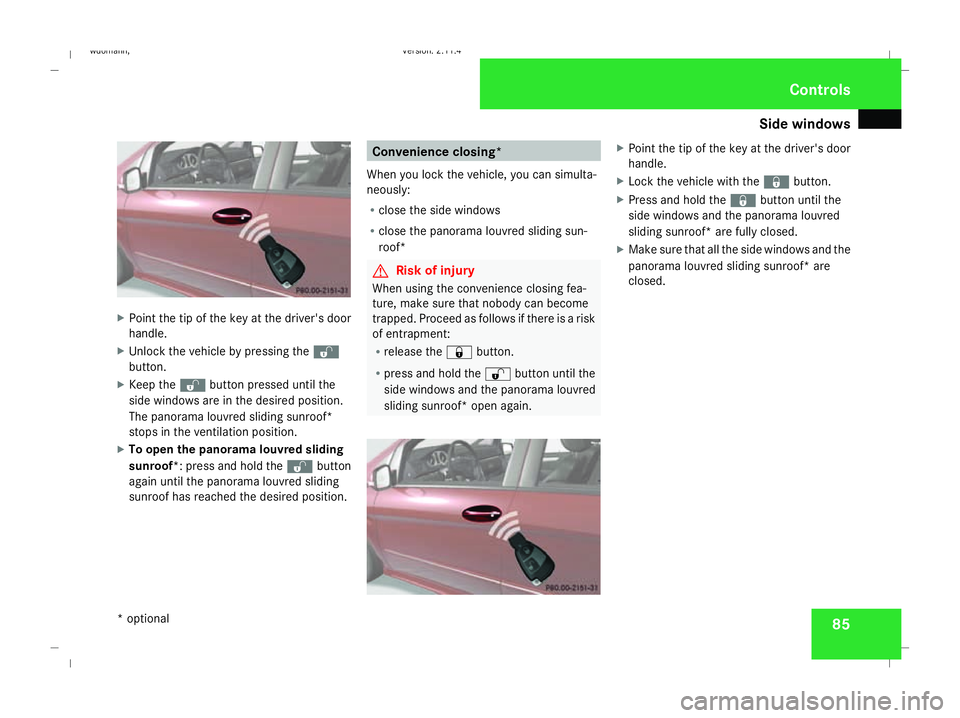
Point the tip of the key at the driver's door
handle.
X Unlock the vehicle by pressing the k
button.
X Keep the kbutton pressed until the
side windows are in the desired position.
The panorama louvred sliding sunroof*
stops in the ventilation position.
X To open the panorama louvred sliding
sunroof*: press and hold the kbutton
again until the panorama louvred sliding
sunroof has reached the desired position. Convenience closing*
When you lock the vehicle, you can simulta-
neously:
R close the side windows
R close the panorama louvred sliding sun-
roof* G
Risk of injury
When using the convenience closing fea-
ture, make sure that nobody can become
trapped. Proceed as follows if there is a risk
of entrapment:
R release the &button.
R press and hold the %button until the
side windows and the panorama louvred
sliding sunroof* open again. X
Point the tip of the key at the driver's door
handle.
X Lock the vehicle with the jbutton.
X Press and hold the jbutton until the
side windows and the panorama louvred
sliding sunroof* are fully closed.
X Make sure that all the side windows and the
panorama louvred sliding sunroof* are
closed. Controls
* optional
245_AKB; 2; 7, en-GB
wdomann,
Version: 2.11.4 2008-10-17T11:22:31+02:00 - Seite 85 ZDateiname: 6515_1640_02_buchblock.pdf; preflight
Page 123 of 305
Driving sys
tems 1201
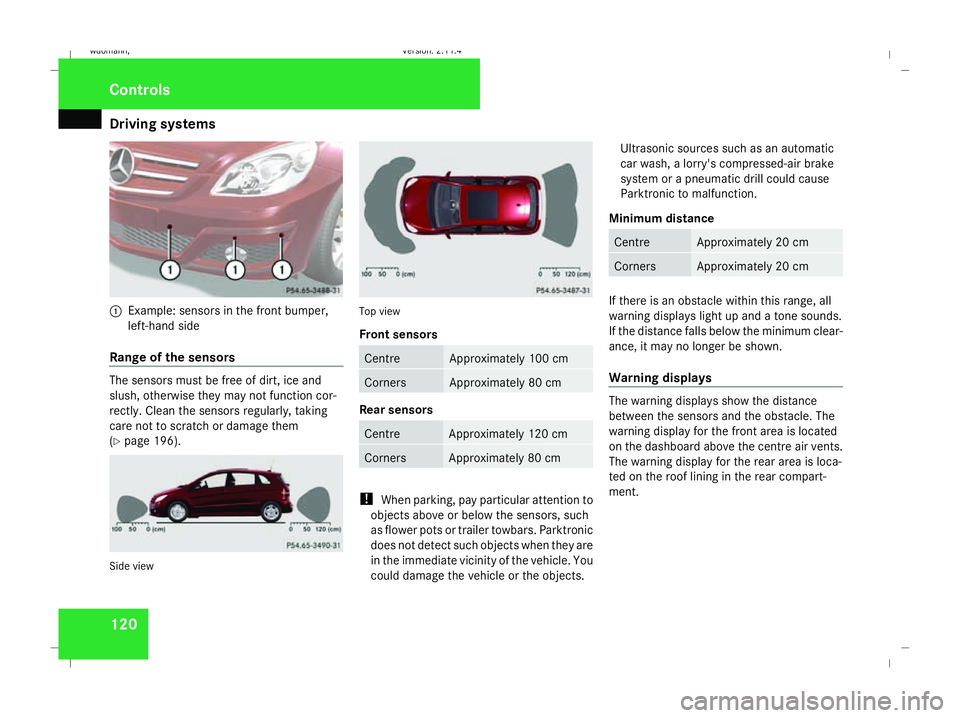
Example: sensors in the front bumper,
left-hand side
Range of the sensors The sensors must be free of dirt, ice and
slush, otherwise they may not function cor-
rectly. Clean the sensors regularly, taking
care not to scratch or damage them
(Y page 196). Side view Top view
Front sensors
Centre Approximately 100 cm
Corners Approximately 80 cm
Rear sensors
Centre Approximately 120 cm
Corners Approximately 80 cm
!
When parking, pay particular attention to
objects above or below the sensors, such
as flower pots or trailer towbars. Parktronic
does not detect such objects when they are
in the immediate vicinity of the vehicle. You
could damage the vehicle or the objects. Ultrasonic sources such as an automatic
car wash, a lorry's compressed-air brake
system or a pneumatic drill could cause
Parktronic to malfunction.
Minimum distance Centre Approximately 20 cm
Corners Approximately 20 cm
If there is an obstacle within this range, all
warning displays light up and a tone sounds.
If the distance falls below the minimum clear-
ance, it may no longer be shown.
Warning displays
The warning displays show the distance
between the sensors and the obstacle. The
warning display for the front area is located
on the dashboard above the centre air vents.
The warning display for the rear area is loca-
ted on the roof lining in the rear compart-
ment.Controls
245_AKB; 2; 7, en-GB
wdomann,
Version: 2.11.4 2008-10-17T11:22:31+02:00 - Seite 120Dateiname: 6515_1640_02_buchblock.pdf; preflight
Page 132 of 305
Air conditioning
129General notes
The air-conditioning system*/
Thermotronic* controls the temperature and
the humidity of the vehicle interior and filters
out undesirable substances from the air.
Heatmatic/the air-conditioning system*/
Thermotronic* is only operational when the
engine is running. Optimum operation is ach-
ieved only when you drive with the side win-
dows and panorama louvred sliding sun-
roof* closed. i
Ventilate the vehicle for a brief period
during warm weather, e.g. using the con-
venience opening feature (Y page 84). This
will speed up the cooling process and the
desired vehicle interior temperature will be
reached more quickly.
i The integrated filter filters out most par-
ticles of dust and completely filters out pol-
len. A clogged filter reduces the amount of
air supplied to the vehicle interior. For this
reason, you should always observe the interval for replacing the filter, which is
specified in the Service Booklet. As it
depends on environmental conditions, e.g.
heavy air pollution, the interval may be
shorter than stated in the Service Booklet. G
Risk of accident
Observe the settings recommended on the
following pages. Otherwise, the windows
could mist up. This may obstruct your view
of the traffic situation and, as a result, you
may cause an accident. Cont
rols
* optional
245_AKB; 2; 7, en-GB
wdomann, Version: 2.11.4
2008-10-17T11:22:31+02:00 - Seite 129 ZDateiname: 6515_1640_02_buchblock.pdf; preflight
Page 143 of 305
Air conditioning
140 Activating/deactivating air-recircula-
tion mode
You can deactivate the flow of fresh air if
unpleasant odours are entering the vehicle
from outside. The air already inside the vehi-
cle will then be recirculated. G
Risk of accident
Only switch over to air-recirculation mode
briefly at low outside temperatures. Other-
wise, the windows could mist up, thus
impairing visibility and endangering your-
self and others. This may prevent you from
observing the traffic conditions, thereby
causing an accident.
X Turn the key to position 2in the ignition
lock.
X To activate: press theÄbutton.
The indicator lamp in the Äbutton lights
up.
i Air-recirculation mode is activated auto-
matically at high outside temperatures.
When air-recirculation mode is activated
automatically, the indicator lamp in the
Ä button is not lit. Outside air is added after about 30
minutes.
X To deactivate: press theÄbutton.
The indicator lamp in the Äbutton goes
out.
i Air-recirculation mode switches off auto-
matically:
R after approximately five minutes at out-
side temperatures below approximately
7 †
R after approximately 5 minutes if cooling
with air dehumidification 23
is switched
off
R after approximately 30 minutes at out-
side temperatures above approximately
7 †
Convenience opening/closing feature G
Risk of injury
Make sure that nobody can become trap-
ped between the side window and the door
frame as the side windows are opened and
closed. Do not place objects or lean against
the side windows when they are being opened or closed. You or the objects could
be drawn in or become trapped between
the side window and the door frame as the
window moves. If there is a risk of entrap-
ment, press the
Äbutton again. Press
the button for stopping, opening or closing
the side windows in the opposite direction
as appropriate.
Make sure that nobody can become trap-
ped as the panorama louvred sliding sun-
roof *is opened and closed. If there is a risk
of entrapment, press the Äbutton
again. Press the button for stopping, open-
ing or closing the panorama louvred sun-
roof* in the opposite direction as appropri-
ate.
X Convenience closing: press and hold
the Ä button until the side windows and
the panorama louvred sliding sunroof*
have closed.
The indicator lamp in the Äbutton lights
up. Air-recirculation mode is activated.
23 Vehicles with air conditioning*/Thermotronic*. Controls
* optional
245_AKB; 2; 7, en-GB
wdomann,
Version: 2.11.4 2008-10-17T11:22:31+02:00 - Seite 140Dateiname: 6515_1640_02_buchblock.pdf; preflight
Page 144 of 305
Roof
141
X
Convenience opening: press and hold the
Ä button until the side windows have
returned to the original position.
The indicator lamp in the Äbutton goes
out. Air-recirculation mode is deactivated.
The panorama louvred sliding sunroof*
moves to the ventilation position.
i If you open the side windows or the pan-
orama louvred sliding sunroof* manually
after closing with the convenience closing
feature, they will remain in this position
when opened using the convenience open-
ing feature. Switching the residual heat on/off
The "residual heat" function is only available
with Thermotronic*.
It is possible to make use of the residual heat
of the engine to continue heating the station-
ary vehicle for up to 30 minutes after the
engine has been switched off. The heating
time depends on the set interior temperature.
i The blower will run at a low speed regard-
less of the airflow setting.
i If you activate the "residual heat" function
at high temperatures, only the ventilation will be activated. The blower runs at
medium speed.
X Turn the key to position 0in the ignition
lock or remove it.
X To activate: press theTbutton.
The indicator lamp in the Tbutton lights
up.
X To deactivate: press theTbutton.
The indicator lamp in the Tbutton goes
out.
i The residual heat automatically switches
off after around 30 minutes or if:
R the ignition is switched on
R the battery voltage drops Roof
Panorama roof*
G
Risk of injury
The glass in the panorama sunroof* could
break in an accident.
If you are not wearing a seat belt, there is
a risk that you could be thrown through the
opening in the event of the vehicle over-
turning. Therefore, always wear a seat belt
to reduce the risk of injuries. Panorama louvred sliding sunroof*
G
Risk of injury
Make sure that nobody can become trap-
ped when closing the panorama louvred
sliding sunroof. If danger threatens, release
the switch and press the switch again to
reopen the panorama louvred sliding sun-
roof. G
Risk of injury
Never leave children unsupervised in the
vehicle. Always remove the key from the
ignition lock, even if you are leaving the
vehicle only briefly. Controls
* optional
245_AKB; 2; 7, en-GB
wdomann,
Version: 2.11.4
2008-10-17T11:22:31+02:00 - Seite 141 ZDateiname: 6515_1640_02_buchblock.pdf; preflight
Page 145 of 305
Roof
142
!
Only open the panorama louvred sliding
sunroof if it is free of snow and ice. Other-
wise, malfunctions may occur.
Do not allow anything to protrude from the
panorama louvred sliding sunroof. The
seals could otherwise be damaged.
i You can also set the panorama louvred
sliding sunroof to the ventilation position
from the outside by using the "Convenience
opening" feature (Y page 84).
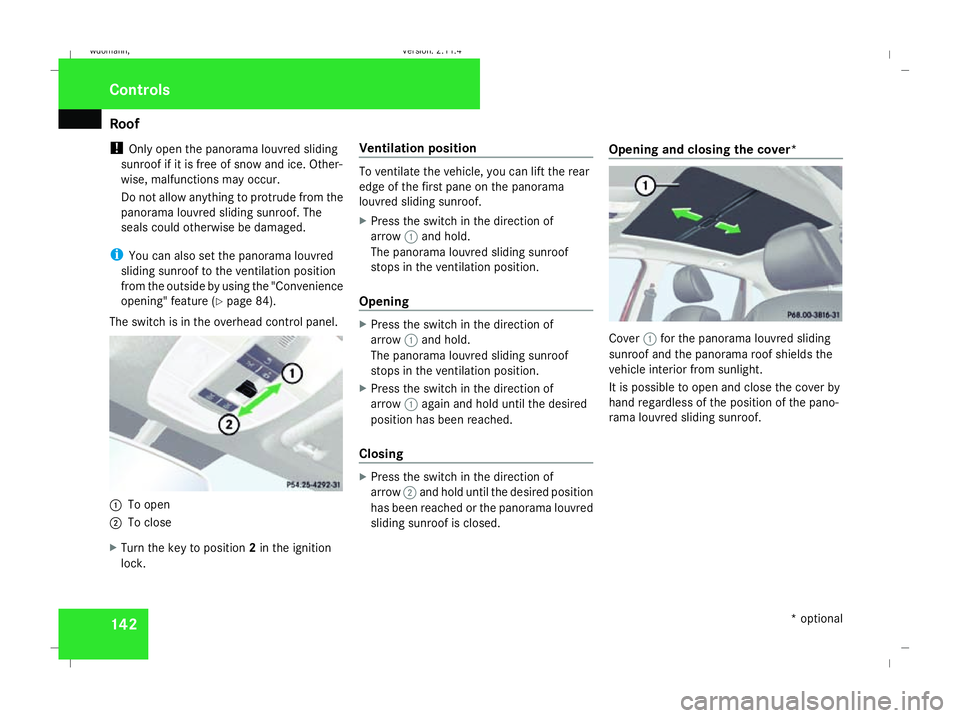
The switch is in the overhead control panel. 1
To open
2 To close
X Turn the key to position 2in the ignition
lock. Ventilation position To ventilate the vehicle, you can lift the rear
edge of the first pane on the panorama
louvred sliding sunroof.
X
Press the switch in the direction of
arrow 1and hold.
The panorama louvred sliding sunroof
stops in the ventilation position.
Opening X
Press the switch in the direction of
arrow 1and hold.
The panorama louvred sliding sunroof
stops in the ventilation position.
X Press the switch in the direction of
arrow 1again and hold until the desired
position has been reached.
Closing X
Press the switch in the direction of
arrow 2and hold until the desired position
has been reached or the panorama louvred
sliding sunroof is closed. Opening and closing the cover* Cover
1for the panorama louvred sliding
sunroof and the panorama roof shields the
vehicle interior from sunlight.
It is possible to open and close the cover by
hand regardless of the position of the pano-
rama louvred sliding sunroof. Controls
* optional
245_AKB; 2; 7, en-GB
wdomann,
Version: 2.11.4
2008-10-17T11:22:31+02:00 - Seite 142 Dateiname: 6515_1640_02_buchblock.pdf; preflight
Page 146 of 305
Loading and stowing
143Loading and stowing
Cup holder
The stowage compartments in the doors con-
tain mouldings designed to hold bottles. G
Risk of injury
Keep the cup holder closed while the vehi-
cle is in motion. Otherwise, vehicle occu-
pants could be injured by objects being
thrown around if you:
R brake sharply
R change direction suddenly
R are involved in an accident
Only use the cup holders for containers of
a suitable size and which have lids. Other-
wise, the drinks could spill.
Cup holders should not be used for hot
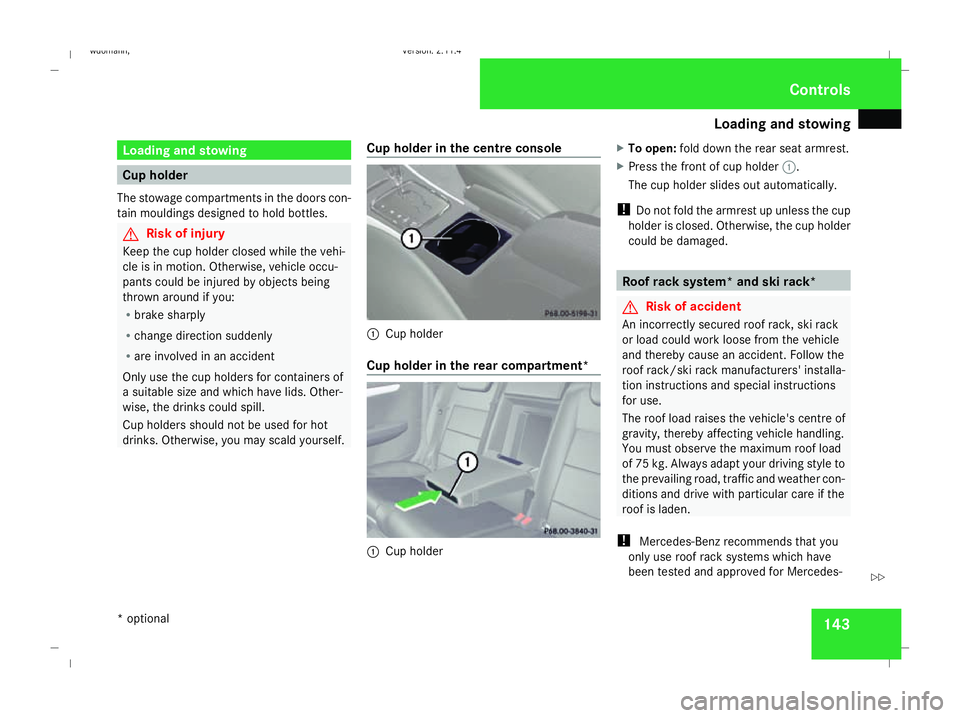
drinks. Otherwise, you may scald yourself. Cup holder in the centre console 1
Cup holder
Cup holder in the rear compartment* 1
Cup holder X
To open: fold down the rear seat armrest.
X Press the front of cup holder 1.
The cup holder slides out automatically.
! Do not fold the armrest up unless the cup
holder is closed. Otherwise, the cup holder
could be damaged. Roof rack system* and ski rack*
G
Risk of accident
An incorrectly secured roof rack, ski rack
or load could work loose from the vehicle
and thereby cause an accident. Follow the
roof rack/ski rack manufacturers' installa-
tion instructions and special instructions
for use.
The roof load raises the vehicle's centre of
gravity, thereby affecting vehicle handling.
You must observe the maximum roof load
of 75 kg. Always adapt your driving style to
the prevailing road, traffic and weather con-
ditions and drive with particular care if the
roof is laden.
! Mercedes-Benz recommends that you
only use roof rack systems which have
been tested and approved for Mercedes- Controls
* optional
245_AKB; 2; 7, en-GB
wdomann
,V ersion: 2.11.4
2008-10-17T11:22:31+02:00 - Seite 143 ZDateiname: 6515_1640_02_buchblock.pdf; preflight
Page 147 of 305
Loading and stowing
144Benz vehicles. This helps to prevent dam-
age to the vehicle.
Position the load on the roof rack in such a
way that the vehicle will not sustain dam-
age even when it is in motion.
Depending on the vehicle's equipment,
make sure that you can:
R open the panorama louvred sliding sun-
roof* fully
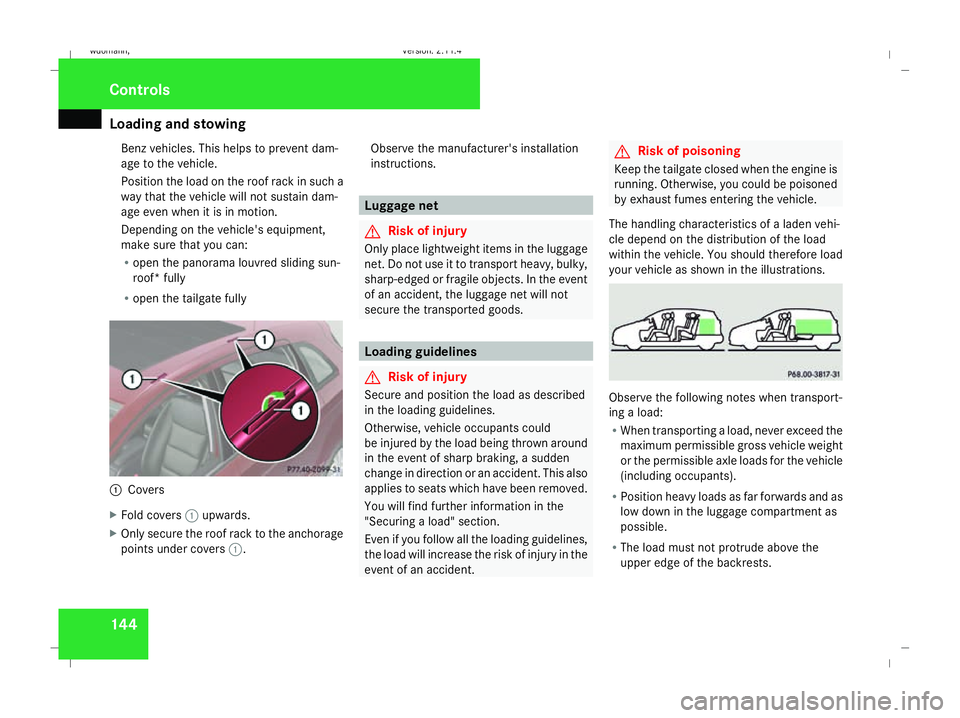
R open the tailgate fully 1
Covers
X Fold covers 1upwards.
X Only secure the roof rack to the anchorage
points under covers 1. Observe the manufacturer's installation
instructions. Luggage net
G
Risk of injury
Only place lightweight items in the luggage
net. Do not use it to transport heavy, bulky,
sharp-edged or fragile objects. In the event
of an accident, the luggage net will not
secure the transported goods. Loading guidelines
G
Risk of injury
Secure and position the load as described
in the loading guidelines.
Otherwise, vehicle occupants could
be injured by the load being thrown around
in the event of sharp braking, a sudden
change in direction or an accident. This also
applies to seats which have been removed.
You will find further information in the
"Securing a load" section.
Even if you follow all the loading guidelines,
the load will increase the risk of injury in the
event of an accident. G
Risk of poisoning
Keep the tailgate closed when the engine is
running. Otherwise, you could be poisoned
by exhaust fumes entering the vehicle.
The handling characteristics of a laden vehi-
cle depend on the distribution of the load
within the vehicle. You should therefore load
your vehicle as shown in the illustrations. Observe the following notes when transport-
ing a load:
R
When transporting a load, never exceed the
maximum permissible gross vehicle weight
or the permissible axle loads for the vehicle
(including occupants).
R Position heavy loads as far forwards and as
low down in the luggage compartment as
possible.
R The load must not protrude above the
upper edge of the backrests. Controls
245_AKB; 2; 7, en-GB
wdomann,
Version: 2.11.4
2008-10-17T11:22:31+02:00 - Seite 144 Dateiname: 6515_1640_02_buchblock.pdf; preflight