ECU MERCEDES-BENZ B-CLASS HATCHBACK 2008 Owner's Manual
[x] Cancel search | Manufacturer: MERCEDES-BENZ, Model Year: 2008, Model line: B-CLASS HATCHBACK, Model: MERCEDES-BENZ B-CLASS HATCHBACK 2008Pages: 305, PDF Size: 5.1 MB
Page 146 of 305
Loading and stowing
143Loading and stowing
Cup holder
The stowage compartments in the doors con-
tain mouldings designed to hold bottles. G
Risk of injury
Keep the cup holder closed while the vehi-
cle is in motion. Otherwise, vehicle occu-
pants could be injured by objects being
thrown around if you:
R brake sharply
R change direction suddenly
R are involved in an accident
Only use the cup holders for containers of
a suitable size and which have lids. Other-
wise, the drinks could spill.
Cup holders should not be used for hot
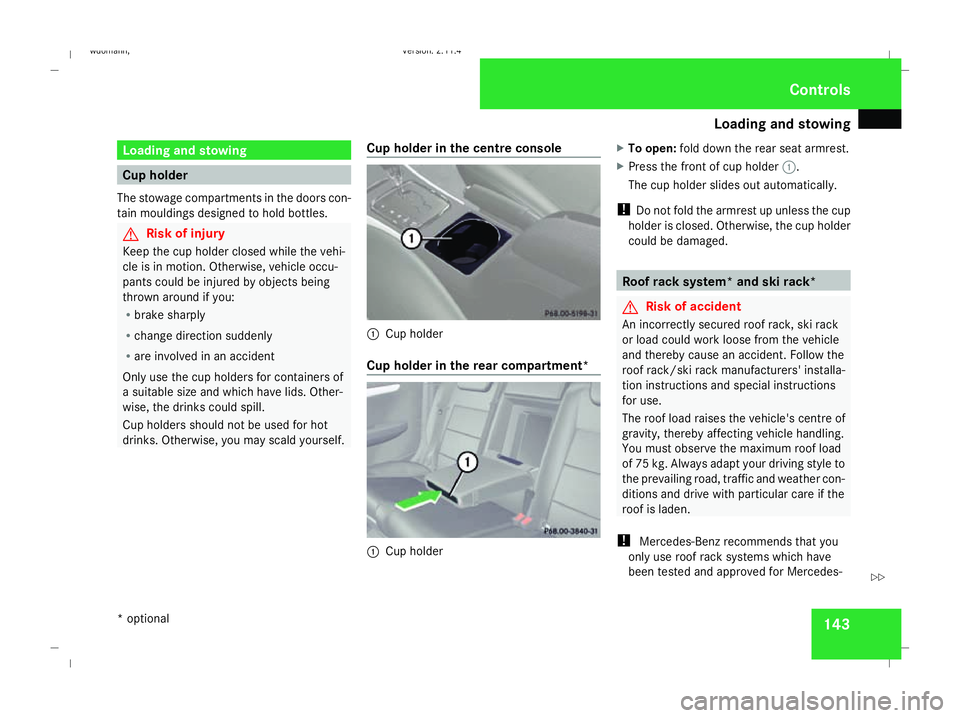
drinks. Otherwise, you may scald yourself. Cup holder in the centre console 1
Cup holder
Cup holder in the rear compartment* 1
Cup holder X
To open: fold down the rear seat armrest.
X Press the front of cup holder 1.
The cup holder slides out automatically.
! Do not fold the armrest up unless the cup
holder is closed. Otherwise, the cup holder
could be damaged. Roof rack system* and ski rack*
G
Risk of accident
An incorrectly secured roof rack, ski rack
or load could work loose from the vehicle
and thereby cause an accident. Follow the
roof rack/ski rack manufacturers' installa-
tion instructions and special instructions
for use.
The roof load raises the vehicle's centre of
gravity, thereby affecting vehicle handling.
You must observe the maximum roof load
of 75 kg. Always adapt your driving style to
the prevailing road, traffic and weather con-
ditions and drive with particular care if the
roof is laden.
! Mercedes-Benz recommends that you
only use roof rack systems which have
been tested and approved for Mercedes- Controls
* optional
245_AKB; 2; 7, en-GB
wdomann
,V ersion: 2.11.4
2008-10-17T11:22:31+02:00 - Seite 143 ZDateiname: 6515_1640_02_buchblock.pdf; preflight
Page 147 of 305
Loading and stowing
144Benz vehicles. This helps to prevent dam-
age to the vehicle.
Position the load on the roof rack in such a
way that the vehicle will not sustain dam-
age even when it is in motion.
Depending on the vehicle's equipment,
make sure that you can:
R open the panorama louvred sliding sun-
roof* fully
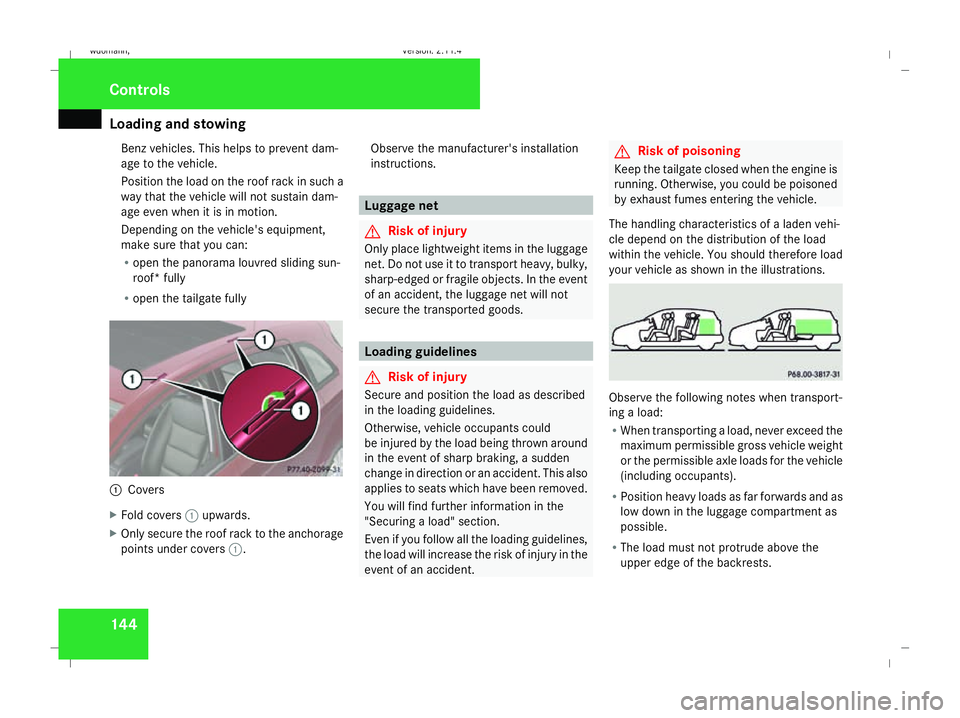
R open the tailgate fully 1
Covers
X Fold covers 1upwards.
X Only secure the roof rack to the anchorage
points under covers 1. Observe the manufacturer's installation
instructions. Luggage net
G
Risk of injury
Only place lightweight items in the luggage
net. Do not use it to transport heavy, bulky,
sharp-edged or fragile objects. In the event
of an accident, the luggage net will not
secure the transported goods. Loading guidelines
G
Risk of injury
Secure and position the load as described
in the loading guidelines.
Otherwise, vehicle occupants could
be injured by the load being thrown around
in the event of sharp braking, a sudden
change in direction or an accident. This also
applies to seats which have been removed.
You will find further information in the
"Securing a load" section.
Even if you follow all the loading guidelines,
the load will increase the risk of injury in the
event of an accident. G
Risk of poisoning
Keep the tailgate closed when the engine is
running. Otherwise, you could be poisoned
by exhaust fumes entering the vehicle.
The handling characteristics of a laden vehi-
cle depend on the distribution of the load
within the vehicle. You should therefore load
your vehicle as shown in the illustrations. Observe the following notes when transport-
ing a load:
R
When transporting a load, never exceed the
maximum permissible gross vehicle weight
or the permissible axle loads for the vehicle
(including occupants).
R Position heavy loads as far forwards and as
low down in the luggage compartment as
possible.
R The load must not protrude above the
upper edge of the backrests. Controls
245_AKB; 2; 7, en-GB
wdomann,
Version: 2.11.4
2008-10-17T11:22:31+02:00 - Seite 144 Dateiname: 6515_1640_02_buchblock.pdf; preflight
Page 148 of 305
Loading and stowing
145
R
Always place the load against the rear seat
backrests or the seat cushions if these
have been folded forwards.
R The maximum load capacity of the stowage
well under the luggage compartment floor
is 25 kg.
R Always place the load behind unoccupied
seats if possible.
R Secure the load with sufficiently strong and
wear-resistant load restraints. Pad sharp
edges for protection.
i Load restraints are available at any quali-
fied specialist workshop, e.g. a Mercedes-
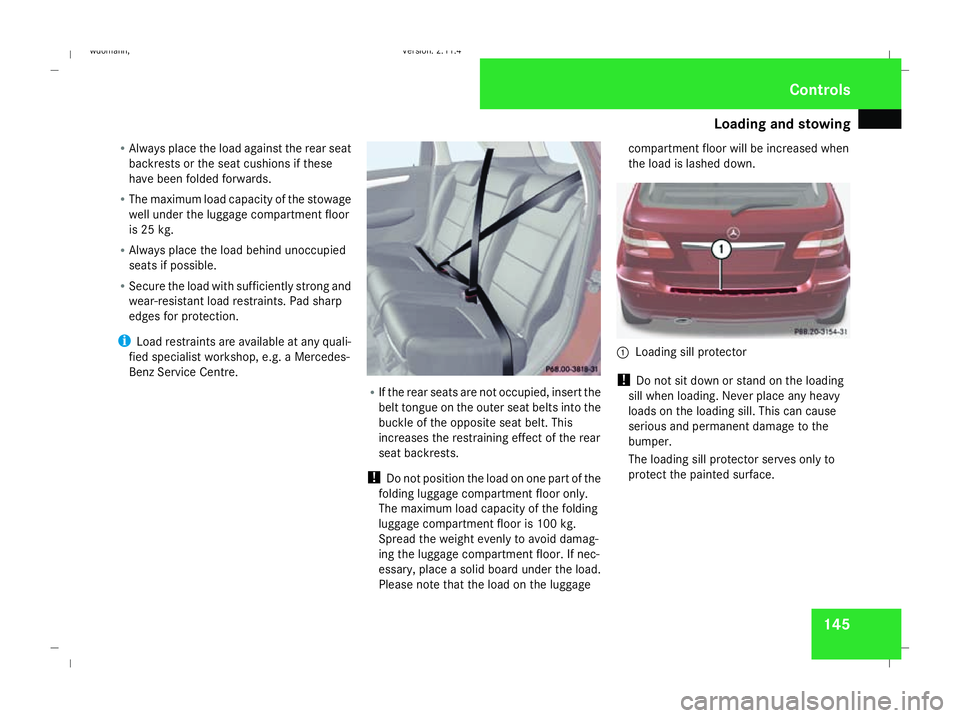
Benz Service Centre. R
If the rear seats are not occupied, insert the
belt tongue on the outer seat belts into the
buckle of the opposite seat belt. This
increases the restraining effect of the rear
seat backrests.
! Do not position the load on one part of the
folding luggage compartment floor only.
The maximum load capacity of the folding
luggage compartment floor is 100 kg.
Spread the weight evenly to avoid damag-
ing the luggage compartment floor. If nec-
essary, place a solid board under the load.
Please note that the load on the luggage compartment floor will be increased when
the load is lashed down.
1
Loading sill protector
! Do not sit down or stand on the loading
sill when loading. Never place any heavy
loads on the loading sill. This can cause
serious and permanent damage to the
bumper.
The loading sill protector serves only to
protect the painted surface. Controls
245_AKB; 2; 7, en-GB
wdomann
,V ersion: 2.11.4
2008-10-17T11:22:31+02:00 - Seite 145 ZDateiname: 6515_1640_02_buchblock.pdf; preflight
Page 149 of 305
Loading and stowing
146 Securing a load
Lashing eyelets G
Risk of injury
Distribute the load on the lashing eyelets
evenly.
Otherwise, vehicle occupants could be
injured by objects being thrown around if
you:
R brake sharply
R change direction suddenly
R are involved in an accident
Please observe the loading guidelines.
Observe the following points or guidelines
when securing loads:
R Secure the load using the lashing eyelets.
R Do not use elastic straps or nets to secure
a load, as these are only intended as an
anti-slip protection for light loads.
R Do not route lashing materials across sharp
edges or corners.
R Pad sharp edges for protection. Securing loads in the luggage compart-
ment
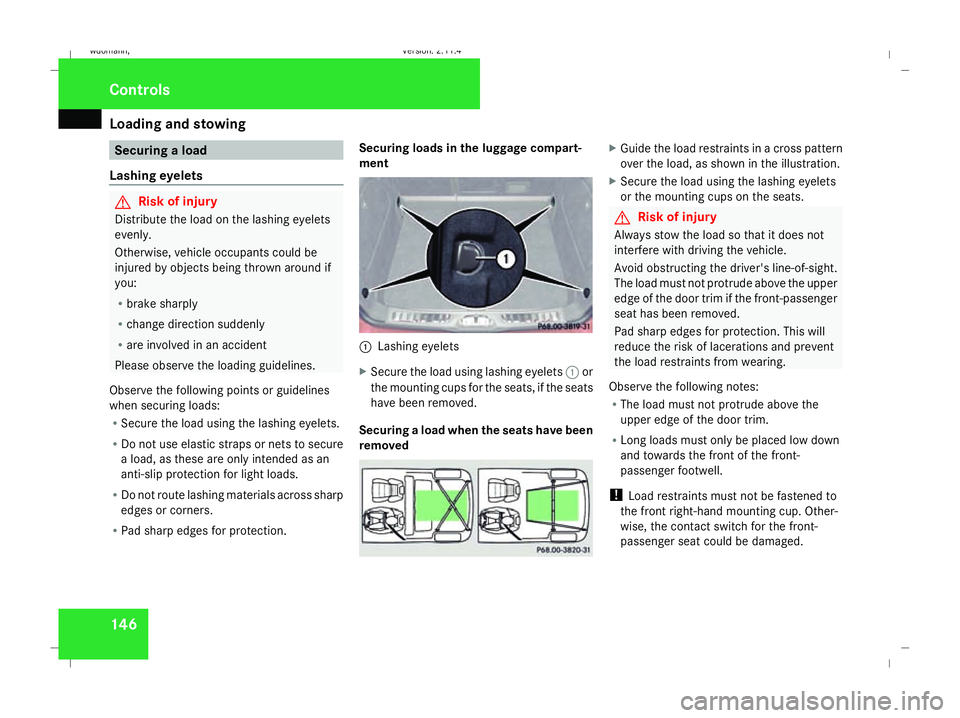
1
Lashing eyelets
X Secure the load using lashing eyelets 1or
the mounting cups for the seats, if the seats
have been removed.
Securing a load when the seats have been
removed X
Guide the load restraints in a cross pattern
over the load, as shown in the illustration.
X Secure the load using the lashing eyelets
or the mounting cups on the seats. G
Risk of injury
Always stow the load so that it does not
interfere with driving the vehicle.
Avoid obstructing the driver's line-of-sight.
The load must not protrude above the upper
edge of the door trim if the front-passenger
seat has been removed.
Pad sharp edges for protection. This will
reduce the risk of lacerations and prevent
the load restraints from wearing.
Observe the following notes:
R The load must not protrude above the
upper edge of the door trim.
R Long loads must only be placed low down
and towards the front of the front-
passenger footwell.
! Load restraints must not be fastened to
the front right-hand mounting cup. Other-
wise, the contact switch for the front-
passenger seat could be damaged. Controls
245_AKB; 2; 7, en-GB
wdomann
,V ersion: 2.11.4
2008-10-17T11:22:31+02:00 - Seite 146 Dateiname: 6515_1640_02_buchblock.pdf; preflight
Page 150 of 305
Loading and stowing
147
Securing a light load using a retaining
net*
X Place the retaining net over the load.
X Engage the retaining net hooks in the lash-
ing eyelets. Through-loading feature*
G
Risk of injury
Do not transport unsecured objects in the
through-loading facility.
Otherwise, you and other vehicle occu-
pants could be injured by objects being
thrown around the vehicle in the event of
sharp braking, a sudden change in direction
or an accident.
To enable you to use the maximum through-
loading opening and to prevent the armrest
from becoming dirty or being damaged, the
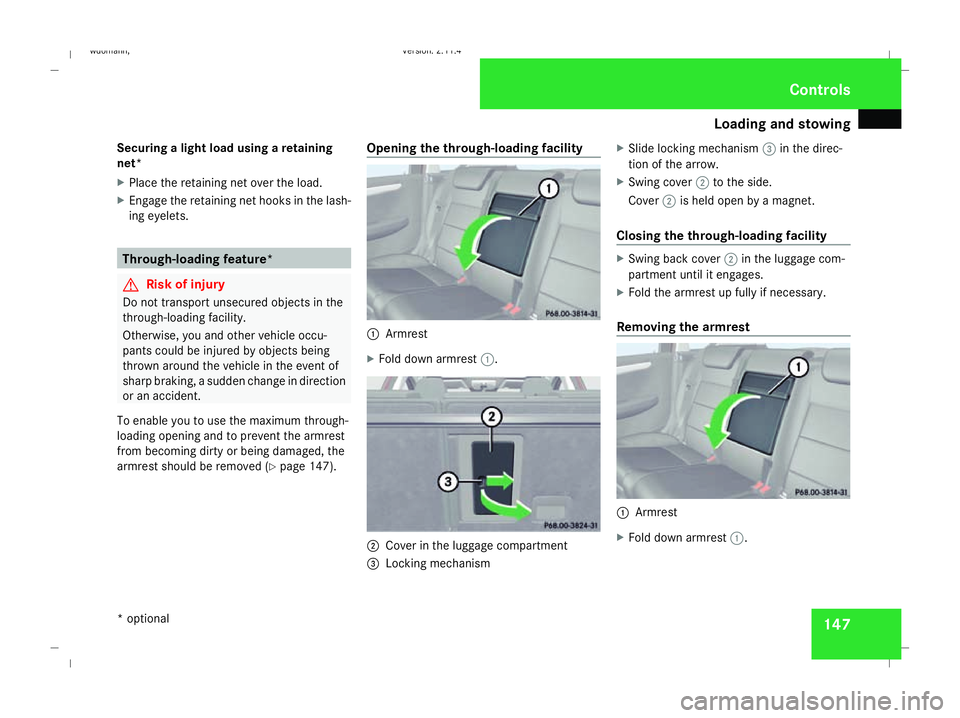
armrest should be removed (Y page 147).Opening the through-loading facility 1
Armrest
X Fold down armrest 1. 2
Cover in the luggage compartment
3 Locking mechanism X
Slide locking mechanism 3in the direc-
tion of the arrow.
X Swing cover 2to the side.
Cover 2is held open by a magnet.
Closing the through-loading facility X
Swing back cover 2in the luggage com-
partment until it engages.
X Fold the armrest up fully if necessary.
Removing the armrest 1
Armrest
X Fold down armrest 1. Controls
* optional
245_AKB; 2; 7, en-GB
wdomann
,V ersion: 2.11.4
2008-10-17T11:22:31+02:00 - Seite 147 ZDateiname: 6515_1640_02_buchblock.pdf; preflight
Page 151 of 305
Loading and stowing
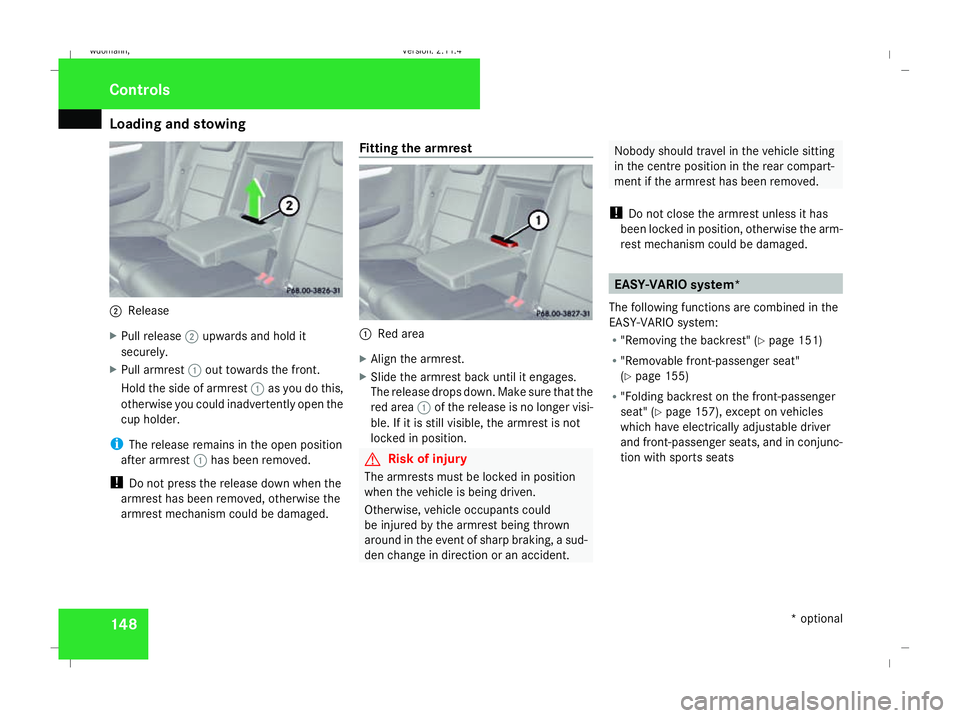
1482
Release
X Pull release 2upwards and hold it
securely.
X Pull armrest 1out towards the front.
Hold the side of armrest 1as you do this,
otherwise you could inadvertently open the
cup holder.
i The release remains in the open position
after armrest 1has been removed.
! Do not press the release down when the
armrest has been removed, otherwise the
armrest mechanism could be damaged. Fitting the armrest 1
Red area
X Align the armrest.
X Slide the armrest back until it engages.
The release drops down. Make sure that the
red area 1of the release is no longer visi-
ble. If it is still visible, the armrest is not
locked in position. G
Risk of injury
The armrests must be locked in position
when the vehicle is being driven.
Otherwise, vehicle occupants could
be injured by the armrest being thrown
around in the event of sharp braking, a sud-
den change in direction or an accident. Nobody should travel in the vehicle sitting
in the centre position in the rear compart-
ment if the armrest has been removed.
! Do not close the armrest unless it has
been locked in position, otherwise the arm-
rest mechanism could be damaged. EASY-VARIO system*
The following functions are combined in the
EASY-VARIO system:
R "Removing the backrest" (Y page 151)
R "Removable front-passenger seat"
(Y page 155)
R "Folding backrest on the front-passenger
seat" (Y page 157), except on vehicles
which have electrically adjustable driver
and front-passenger seats, and in conjunc-
tion with sports seats Controls
* optional
245_AKB; 2; 7, en-GB
wdomann,
Version: 2.11.4 2008-10-17T11:22:31+02:00 - Seite 148Dateiname: 6515_1640_02_buchblock.pdf; preflight
Page 155 of 305
Loading and stowing
152
i
When the ignition is switched on, a mes-
sage is displayed for the corresponding
rear seats in the upper multi-function dis-
play. If, for example, both connectors are
removed, the message:
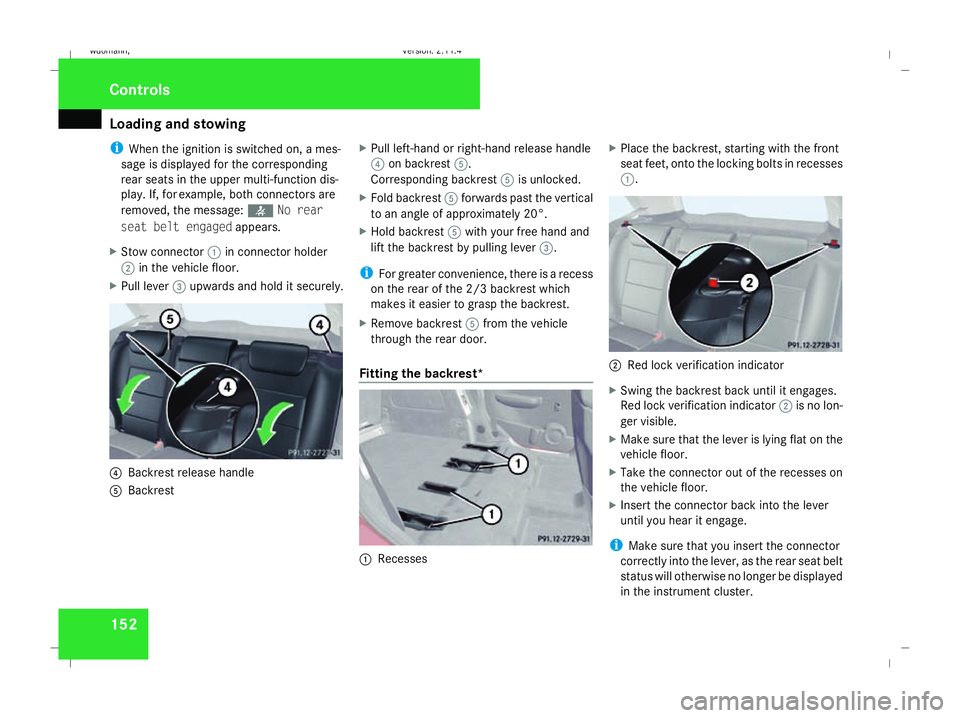
X Stow connector 1in connector holder
2 in the vehicle floor.
X Pull lever 3upwards and hold it securely. 4
Backrest release handle
5 Backrest X
Pull left-hand or right-hand release handle
4 on backrest 5.
Corresponding backrest 5is unlocked.
X Fold backrest 5forwards past the vertical
to an angle of approximately 20°.
X Hold backrest 5with your free hand and
lift the backrest by pulling lever 3.
i For greater convenience, there is a recess
on the rear of the 2/3 backrest which
makes it easier to grasp the backrest.
X Remove backrest 5from the vehicle
through the rear door.
Fitting the backrest* 1
Recesses X
Place the backrest, starting with the front
seat feet, onto the locking bolts in recesses
1. 2
Red lock verification indicator
X Swing the backrest back until it engages.
Red lock verification indicator 2is no lon-
ger visible.
X Make sure that the lever is lying flat on the
vehicle floor.
X Take the connector out of the recesses on
the vehicle floor.
X Insert the connector back into the lever
until you hear it engage.
i Make sure that you insert the connector
correctly into the lever, as the rear seat belt
status will otherwise no longer be displayed
in the instrument cluster. Controls
245_AKB; 2; 7, en-GB
wdomann,
Version: 2.11.4
2008-10-17T11:22:31+02:00 - Seite 152 Dateiname: 6515_1640_02_buchblock.pdf; preflight
Page 159 of 305
Loading and stowing
156
X
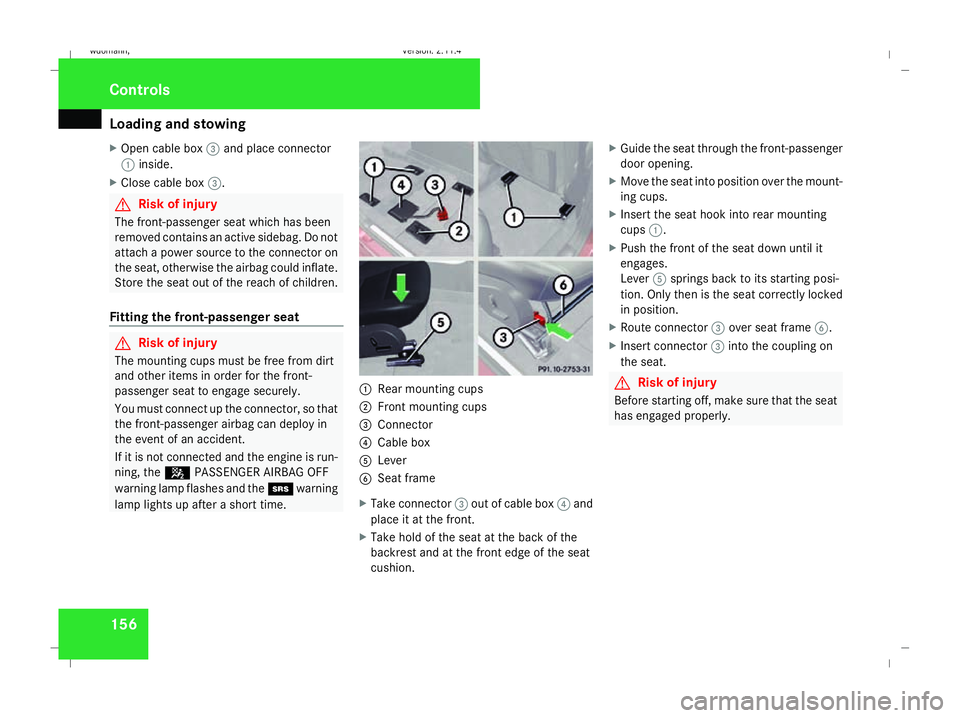
Open cable box 3and place connector
1 inside.
X Close cable box 3. G
Risk of injury
The front-passenger seat which has been
removed contains an active sidebag. Do not
attach a power source to the connector on
the seat, otherwise the airbag could inflate.
Store the seat out of the reach of children.
Fitting the front-passenger seat G
Risk of injury
The mounting cups must be free from dirt
and other items in order for the front-
passenger seat to engage securely.
You must connect up the connector, so that
the front-passenger airbag can deploy in
the event of an accident.
If it is not connected and the engine is run-
ning, the 5PASSENGER AIRBAG OFF
warning lamp flashes and the 1warning
lamp lights up after a short time. 1
Rear mounting cups
2 Front mounting cups
3 Connector
4 Cable box
5 Lever
6 Seat frame
X Take connector 3out of cable box 4and
place it at the front.
X Take hold of the seat at the back of the
backrest and at the front edge of the seat
cushion. X
Guide the seat through the front-passenger
door opening.
X Move the seat into position over the mount-
ing cups.
X Insert the seat hook into rear mounting
cups 1.
X Push the front of the seat down until it
engages.
Lever 5springs back to its starting posi-
tion. Only then is the seat correctly locked
in position.
X Route connector 3over seat frame 6.
X Insert connector 3into the coupling on
the seat. G
Risk of injury
Before starting off, make sure that the seat
has engaged properly. Controls
245_AKB; 2; 7, en-GB
wdomann
,V ersion: 2.11.4
2008-10-17T11:22:31+02:00 - Seite 156 Dateiname: 6515_1640_02_buchblock.pdf; preflight
Page 160 of 305
Loading and stowing
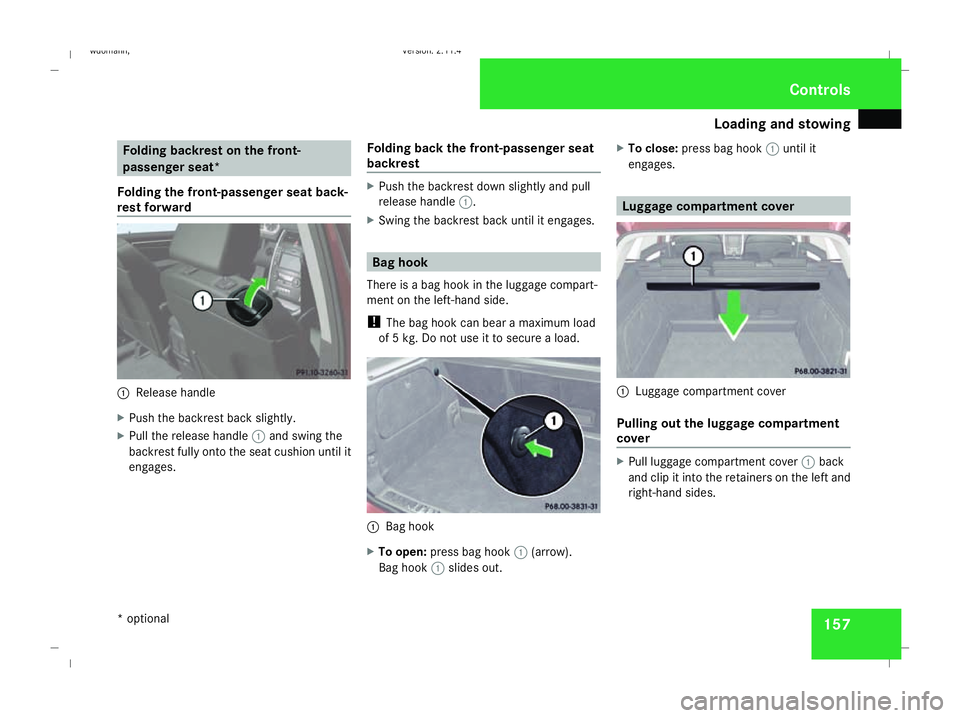
157Folding backrest on the front-
passenger seat*
Folding the front-passenger seat back-
rest forward 1
Release handle
X Push the backrest back slightly.
X Pull the release handle 1and swing the
backrest fully onto the seat cushion until it
engages. Folding back the front-passenger seat
backrest X
Push the backrest down slightly and pull
release handle 1.
X Swing the backrest back until it engages. Bag hook
There is a bag hook in the luggage compart-
ment on the left-hand side.
! The bag hook can bear a maximum load
of 5 kg. Do not use it to secure a load. 1
Bag hook
X To open: press bag hook 1(arrow).
Bag hook 1slides out. X
To close: press bag hook 1until it
engages. Luggage compartment cover
1
Luggage compartment cover
Pulling out the luggage compartment
cover X
Pull luggage compartment cover 1back
and clip it into the retainers on the left and
right-hand sides. Controls
* optional
245_AKB; 2; 7, en-GB
wdomann
,V ersion: 2.11.4
2008-10-17T11:22:31+02:00 - Seite 157 ZDateiname: 6515_1640_02_buchblock.pdf; preflight
Page 161 of 305
Loading and stowing
158
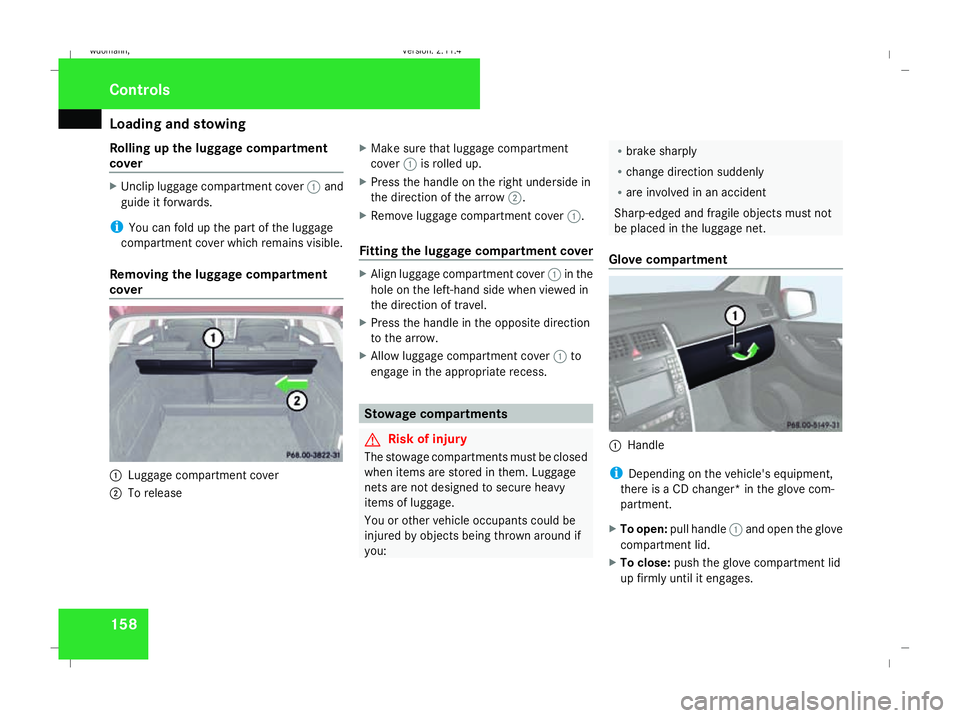
Rolling up the luggage compartment
cover X
Unclip luggage compartment cover 1and
guide it forwards.
i You can fold up the part of the luggage
compartment cover which remains visible.
Removing the luggage compartment
cover 1
Luggage compartment cover
2 To release X
Make sure that luggage compartment
cover 1is rolled up.
X Press the handle on the right underside in
the direction of the arrow 2.
X Remove luggage compartment cover 1.
Fitting the luggage compartment cover X
Align luggage compartment cover 1in the
hole on the left-hand side when viewed in
the direction of travel.
X Press the handle in the opposite direction
to the arrow.
X Allow luggage compartment cover 1to
engage in the appropriate recess. Stowage compartments
G
Risk of injury
The stowage compartments must be closed
when items are stored in them. Luggage
nets are not designed to secure heavy
items of luggage.
You or other vehicle occupants could be
injured by objects being thrown around if
you: R
brake sharply
R change direction suddenly
R are involved in an accident
Sharp-edged and fragile objects must not
be placed in the luggage net.
Glove compartment 1
Handle
i Depending on the vehicle's equipment,
there is a CD changer* in the glove com-
partment.
X To open: pull handle 1and open the glove
compartment lid.
X To close: push the glove compartment lid
up firmly until it engages. Controls
245_AKB; 2; 7, en-GB
wdomann
,V ersion: 2.11.4
2008-10-17T11:22:31+02:00 - Seite 158 Dateiname: 6515_1640_02_buchblock.pdf; preflight