belt MERCEDES-BENZ B-CLASS HATCHBACK 2008 Owner's Guide
[x] Cancel search | Manufacturer: MERCEDES-BENZ, Model Year: 2008, Model line: B-CLASS HATCHBACK, Model: MERCEDES-BENZ B-CLASS HATCHBACK 2008Pages: 305, PDF Size: 5.1 MB
Page 148 of 305
Loading and stowing
145
R
Always place the load against the rear seat
backrests or the seat cushions if these
have been folded forwards.
R The maximum load capacity of the stowage
well under the luggage compartment floor
is 25 kg.
R Always place the load behind unoccupied
seats if possible.
R Secure the load with sufficiently strong and
wear-resistant load restraints. Pad sharp
edges for protection.
i Load restraints are available at any quali-
fied specialist workshop, e.g. a Mercedes-
Benz Service Centre. R
If the rear seats are not occupied, insert the
belt tongue on the outer seat belts into the
buckle of the opposite seat belt. This
increases the restraining effect of the rear
seat backrests.
! Do not position the load on one part of the
folding luggage compartment floor only.
The maximum load capacity of the folding
luggage compartment floor is 100 kg.
Spread the weight evenly to avoid damag-
ing the luggage compartment floor. If nec-
essary, place a solid board under the load.
Please note that the load on the luggage compartment floor will be increased when
the load is lashed down.
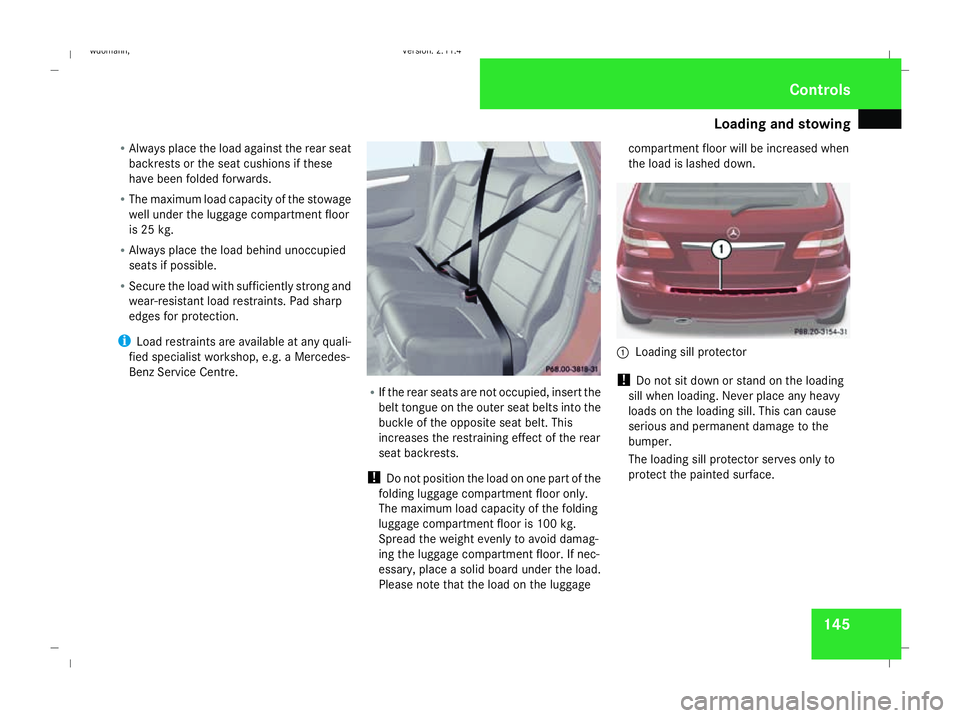
1
Loading sill protector
! Do not sit down or stand on the loading
sill when loading. Never place any heavy
loads on the loading sill. This can cause
serious and permanent damage to the
bumper.
The loading sill protector serves only to
protect the painted surface. Controls
245_AKB; 2; 7, en-GB
wdomann
,V ersion: 2.11.4
2008-10-17T11:22:31+02:00 - Seite 145 ZDateiname: 6515_1640_02_buchblock.pdf; preflight
Page 152 of 305
Loading and stowing
149Enlarging the luggage compartment
The left-hand and right-hand rear seats can
be folded down to increase the luggage com-
partment capacity. G
Risk of injury
Make sure that nobody can become trap-
ped as you fold the backrests forward.
! To prevent damage, before the backrests
are folded forward:
R the head restraints must be pushed in
fully
R the front seats must be as far forwards
as possible
R the seat cushions must be folded forward
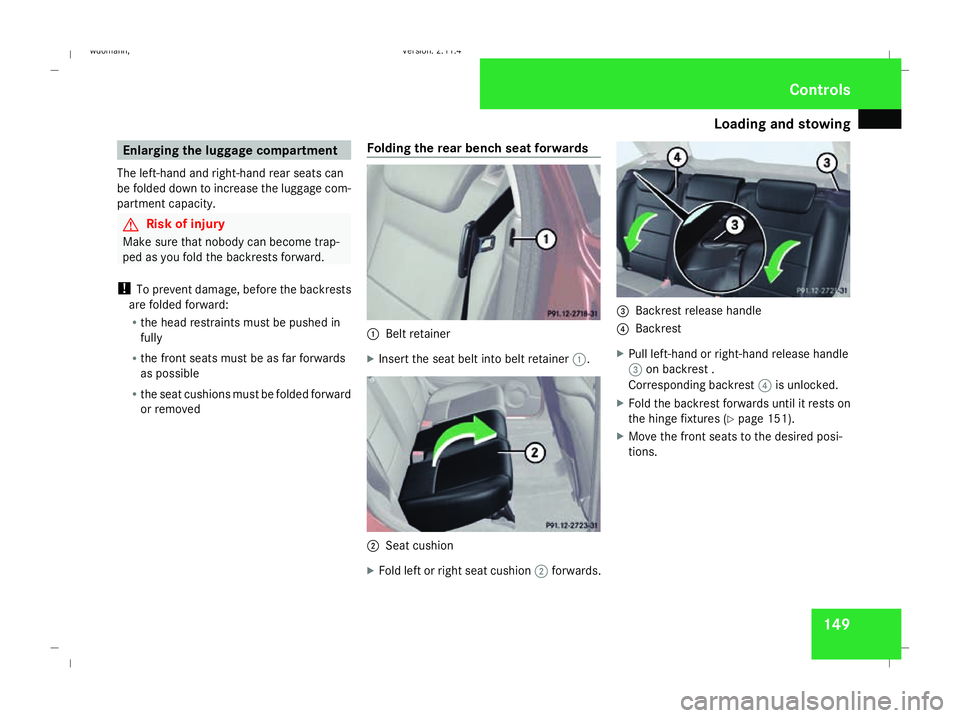
or removed Folding the rear bench seat forwards 1
Belt retainer
X Insert the seat belt into belt retainer 1. 2
Seat cushion
X Fold left or right seat cushion 2forwards. 3
Backrest release handle
4 Backrest
X Pull left-hand or right-hand release handle
3 on backrest .
Corresponding backrest 4is unlocked.
X Fold the backrest forwards until it rests on
the hinge fixtures (Y page 151).
X Move the front seats to the desired posi-
tions. Controls
245_AKB; 2; 7, en-GB
wdomann
,V ersion: 2.11.4
2008-10-17T11:22:31+02:00 - Seite 149 ZDateiname: 6515_1640_02_buchblock.pdf; preflight
Page 153 of 305
Loading and stowing
150
Swinging back the rear bench seat
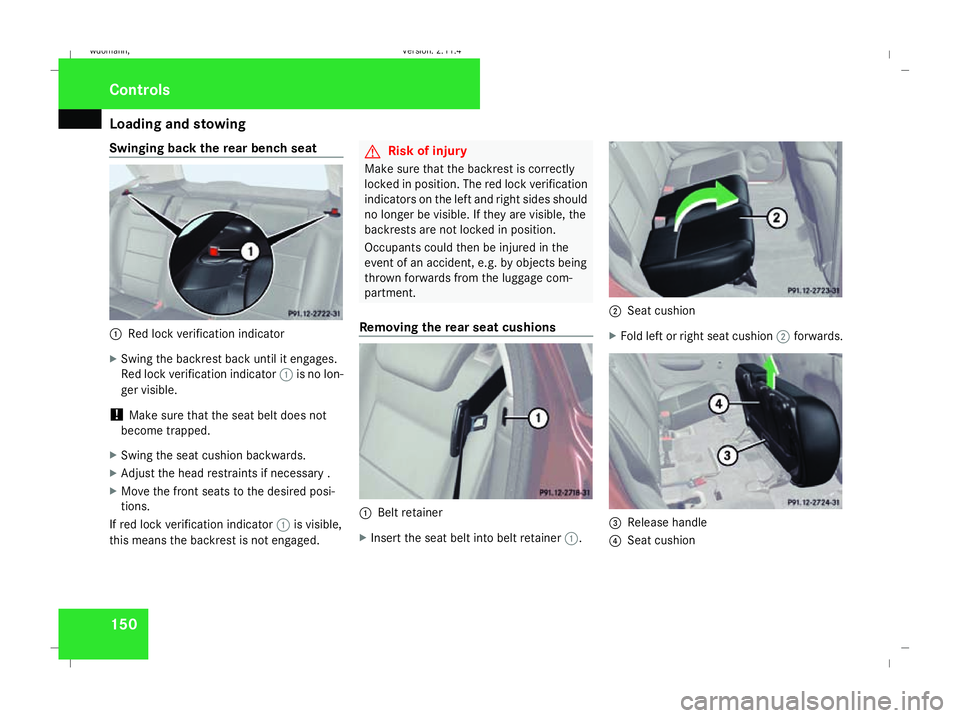
1
Red lock verification indicator
X Swing the backrest back until it engages.
Red lock verification indicator 1is no lon-
ger visible.
! Make sure that the seat belt does not
become trapped.
X Swing the seat cushion backwards.
X Adjust the head restraints if necessary .
X Move the front seats to the desired posi-
tions.
If red lock verification indicator 1is visible,
this means the backrest is not engaged. G
Risk of injury
Make sure that the backrest is correctly
locked in position. The red lock verification
indicators on the left and right sides should
no longer be visible. If they are visible, the
backrests are not locked in position.
Occupants could then be injured in the
event of an accident, e.g. by objects being
thrown forwards from the luggage com-
partment.
Removing the rear seat cushions 1
Belt retainer
X Insert the seat belt into belt retainer 1. 2
Seat cushion
X Fold left or right seat cushion 2forwards. 3
Release handle
4 Seat cushion Controls
245_AKB; 2; 7, en-GB
wdomann
,V ersion: 2.11.4
2008-10-17T11:22:31+02:00 - Seite 150 Dateiname: 6515_1640_02_buchblock.pdf; preflight
Page 154 of 305
Loading and stowing
151
X
Grasp release handle 3and pull seat cush-
ion 4upwards.
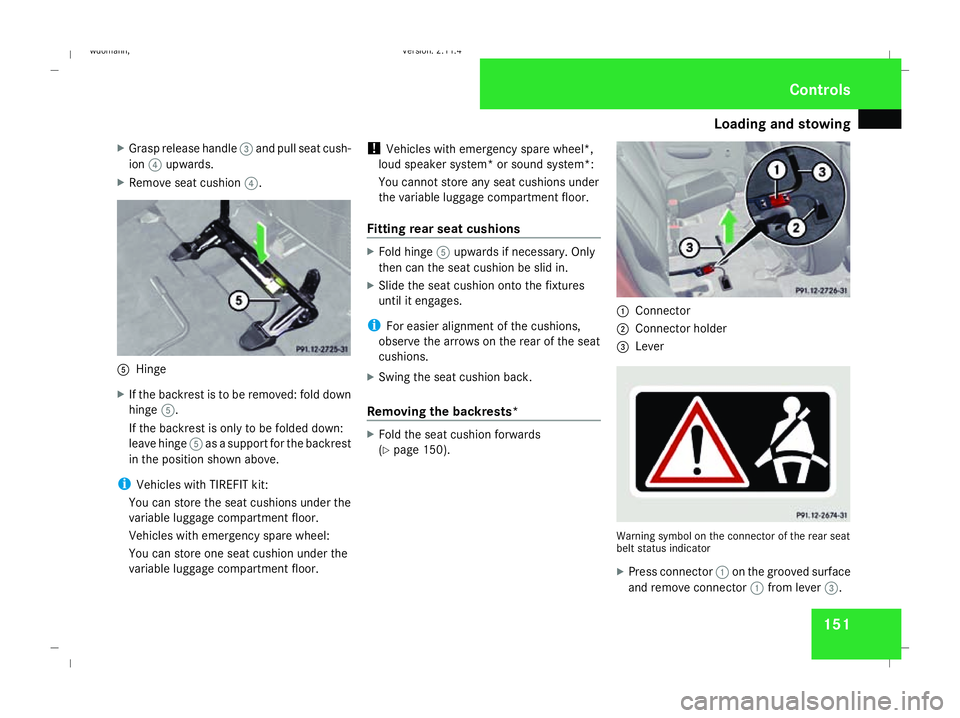
X Remove seat cushion 4. 5
Hinge
X If the backrest is to be removed: fold down
hinge 5.
If the backrest is only to be folded down:
leave hinge 5as a support for the backrest
in the position shown above.
i Vehicles with TIREFIT kit:
You can store the seat cushions under the
variable luggage compartment floor.
Vehicles with emergency spare wheel:
You can store one seat cushion under the
variable luggage compartment floor. !
Vehicles with emergency spare wheel*,
loud speaker system* or sound system*:
You cannot store any seat cushions under
the variable luggage compartment floor.
Fitting rear seat cushions X
Fold hinge 5upwards if necessary. Only
then can the seat cushion be slid in.
X Slide the seat cushion onto the fixtures
until it engages.
i For easier alignment of the cushions,
observe the arrows on the rear of the seat
cushions.
X Swing the seat cushion back.
Removing the backrests* X
Fold the seat cushion forwards
(Y page 150). 1
Connector
2 Connector holder
3 Lever Warning symbol on the connector of the rear seat
belt status indicator
X
Press connector 1on the grooved surface
and remove connector 1from lever 3. Controls
245_AKB; 2; 7, en-GB
wdomann,
Version: 2.11.4 2008-10-17T11:22:31+02:00 - Seite 151 ZDateiname: 6515_1640_02_buchblock.pdf; preflight
Page 155 of 305
Loading and stowing
152
i
When the ignition is switched on, a mes-
sage is displayed for the corresponding
rear seats in the upper multi-function dis-
play. If, for example, both connectors are
removed, the message:
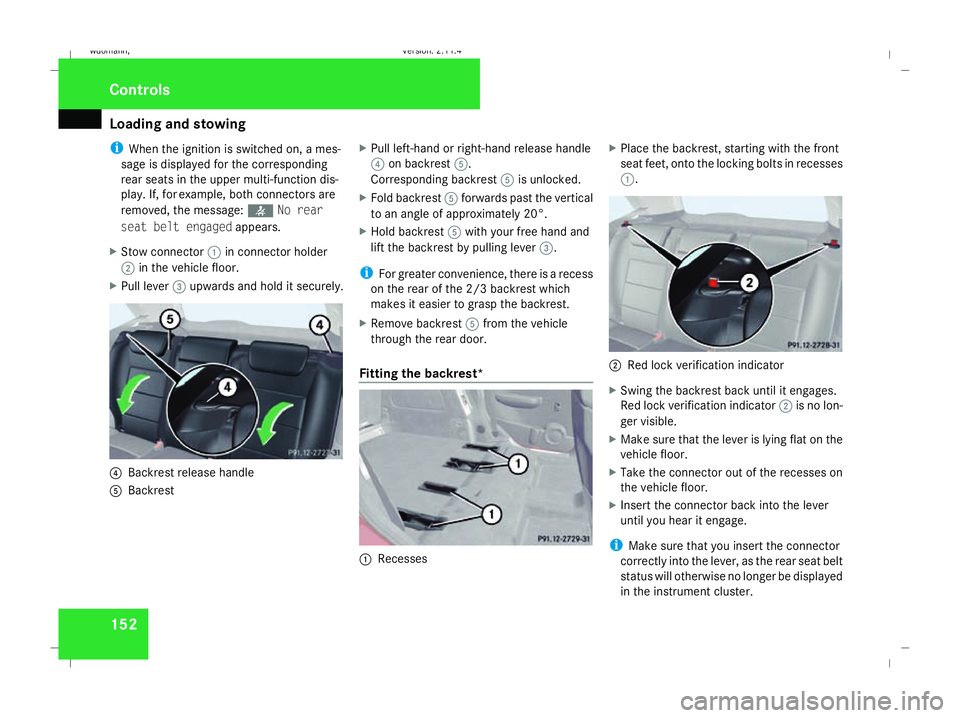
X Stow connector 1in connector holder
2 in the vehicle floor.
X Pull lever 3upwards and hold it securely. 4
Backrest release handle
5 Backrest X
Pull left-hand or right-hand release handle
4 on backrest 5.
Corresponding backrest 5is unlocked.
X Fold backrest 5forwards past the vertical
to an angle of approximately 20°.
X Hold backrest 5with your free hand and
lift the backrest by pulling lever 3.
i For greater convenience, there is a recess
on the rear of the 2/3 backrest which
makes it easier to grasp the backrest.
X Remove backrest 5from the vehicle
through the rear door.
Fitting the backrest* 1
Recesses X
Place the backrest, starting with the front
seat feet, onto the locking bolts in recesses
1. 2
Red lock verification indicator
X Swing the backrest back until it engages.
Red lock verification indicator 2is no lon-
ger visible.
X Make sure that the lever is lying flat on the
vehicle floor.
X Take the connector out of the recesses on
the vehicle floor.
X Insert the connector back into the lever
until you hear it engage.
i Make sure that you insert the connector
correctly into the lever, as the rear seat belt
status will otherwise no longer be displayed
in the instrument cluster. Controls
245_AKB; 2; 7, en-GB
wdomann,
Version: 2.11.4
2008-10-17T11:22:31+02:00 - Seite 152 Dateiname: 6515_1640_02_buchblock.pdf; preflight
Page 213 of 305
Display
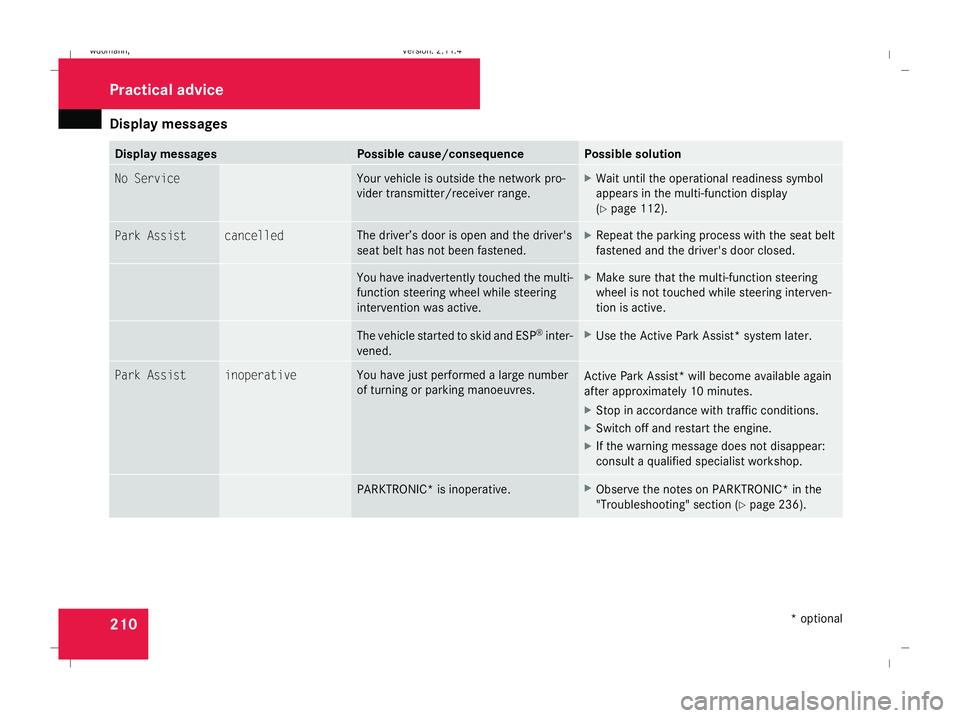
messages 210 Display messages Possible cause/consequence Possible solution
No Service Your vehicle is outside the network pro-
vider transmitter/receiver range. X
Wait until the operational readiness symbol
appears in the multi-function display
(Y page 112). Park Assist cancelled The driver’s door is open and the driver's
seat belt has not been fastened. X
Repeat the parking process with the seat belt
fastened and the driver's door closed. You have inadvertently touched the multi-
function steering wheel while steering
intervention was active. X
Make sure that the multi-function steering
wheel is not touched while steering interven-
tion is active. The vehicle started to skid and ESP
®
inter-
vened. X
Use the Active Park Assist* system later. Park Assist inoperative You have just performed a large number
of turning or parking manoeuvres.
Active Park Assist* will become available again
after approximately 10 minutes.
X
Stop in accordance with traffic conditions.
X Switch off and restart the engine.
X If the warning message does not disappear:
consult a qualified specialist workshop. PARKTRONIC* is inoperative. X
Observe the notes on PARKTRONIC* in the
"Troubleshooting" section (Y page 236).Practical advi
ce
* optional
245_AKB; 2; 7, en-GB
wdomann,
Version: 2.11.4 2008-10-17T11:22:31+02:00 - Seite 210Dateiname: 6515_1640_02_buchblock.pdf; preflight
Page 215 of 305
Display
messages 212 Symbol messages
G
Risk of accident and injury
The operating safety of your vehicle could be compromised if service work is carried out improperly. You could lose control of the vehicle,
thereby causing an accident. Safety systems may also not be able to protect you or others as intended.
Always have maintenance work carried out at a qualified specialist workshop which has the necessary specialist knowledge and tools to
carry out the work required.
Mercedes-Benz recommends that you use a Mercedes-Benz Service Centre for this purpose.
In particular, work relevant to safety or on safety-related systems must be carried out at a qualified specialist workshop. Display messages Possible cause/consequence Possible solution
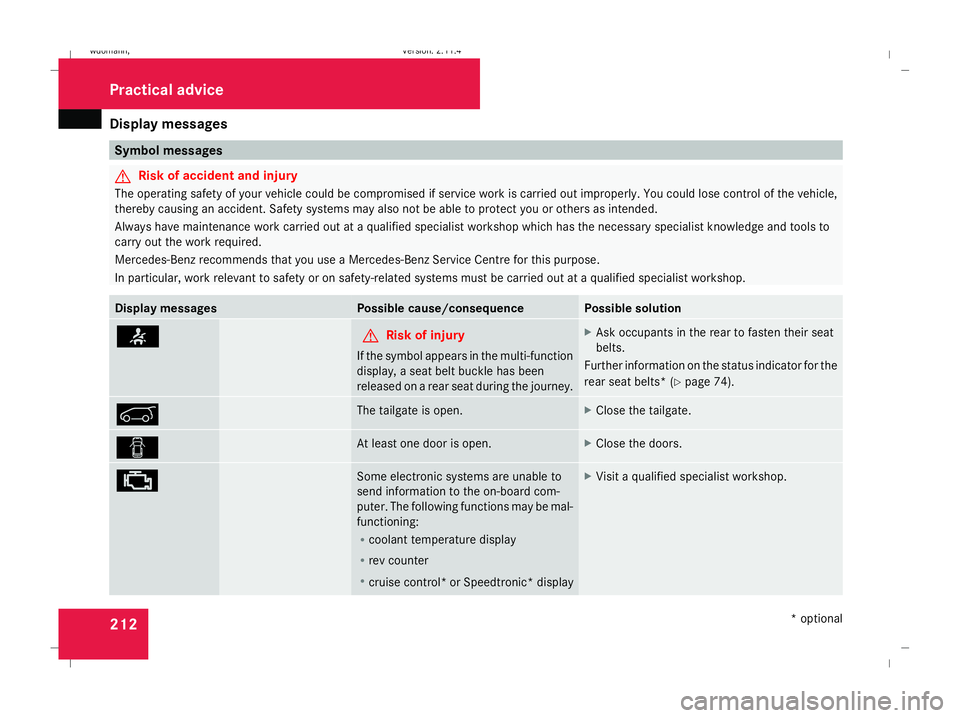
< G
Risk of injury
If the symbol appears in the multi-function
display, a seat belt buckle has been
released on a rear seat during the journey. X
Ask occupants in the rear to fasten their seat
belts.
Further information on the status indicator for the
rear seat belts* (Y page 74). 1 The tailgate is open. X
Close the tailgate. 2 At least one door is open. X
Close the doors. ± Some electronic systems are unable to
send information to the on-board com-
puter. The following functions may be mal-
functioning:
R coolant temperature display
R rev counter
R cruise control *or Speedtronic* display X
Visit a qualified specialist workshop. Practical advice
* optional
245_AKB; 2; 7, en-GB
wdomann,
Version: 2.11.4 2008-10-17T11:22:31+02:00 - Seite 212Dateiname: 6515_1640_02_buchblock.pdf; preflight
Page 216 of 305
Display
messages 213Display messages Possible cause/consequence Possible solution
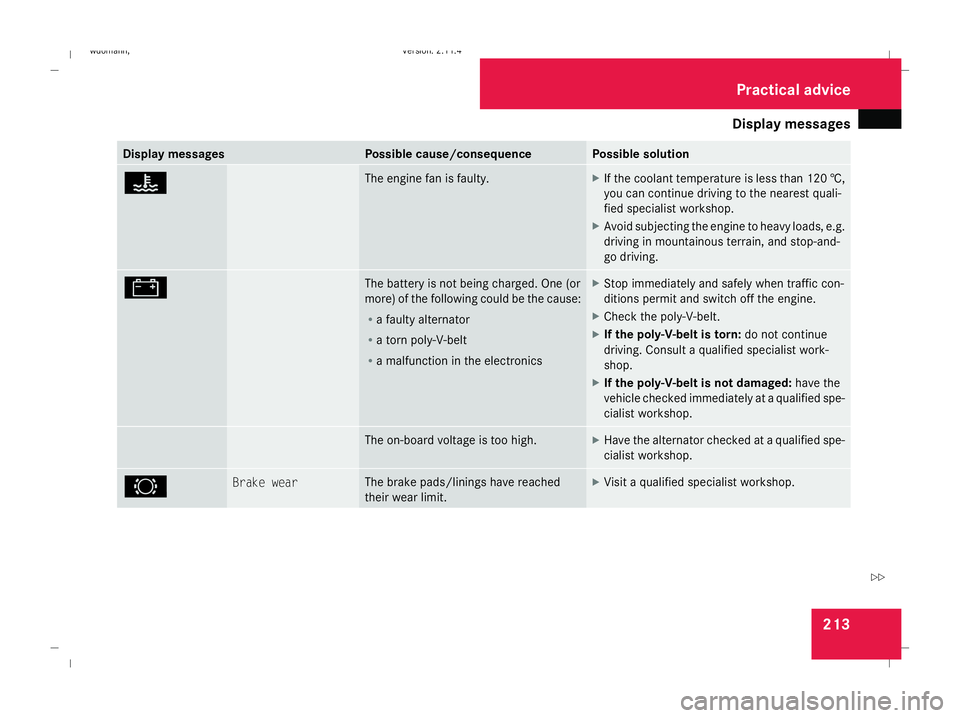
D The engine fan is faulty. X
If the coolant temperature is less than 120 †,
you can continue driving to the nearest quali-
fied specialist workshop.
X Avoid subjecting the engine to heavy loads, e.g.
driving in mountainous terrain, and stop-and-
go driving. # The battery is not being charged. One (or
more) of the following could be the cause:
R
a faulty alternator
R a torn poly-V-belt
R a malfunction in the electronics X
Stop immediately and safely when traffic con-
ditions permit and switch off the engine.
X Check the poly-V-belt.
X If the poly-V-belt is torn: do not continue
driving. Consult a qualified specialist work-
shop.
X If the poly-V-belt is not damaged: have the
vehicle checked immediately at a qualified spe-
cialist workshop. The on-board voltage is too high. X
Have the alternator checked at a qualified spe-
cialist workshop. 2 Brake wear The brake pads/linings have reached
their wear limit. X
Visit a qualified specialist workshop. Practical advi
ce
245_AKB; 2; 7, en-GB
wdomann,
Version: 2.11.4 2008-10-17T11:22:31+02:00 - Seite 213 ZDateiname: 6515_1640_02_buchblock.pdf; preflight
Page 218 of 305
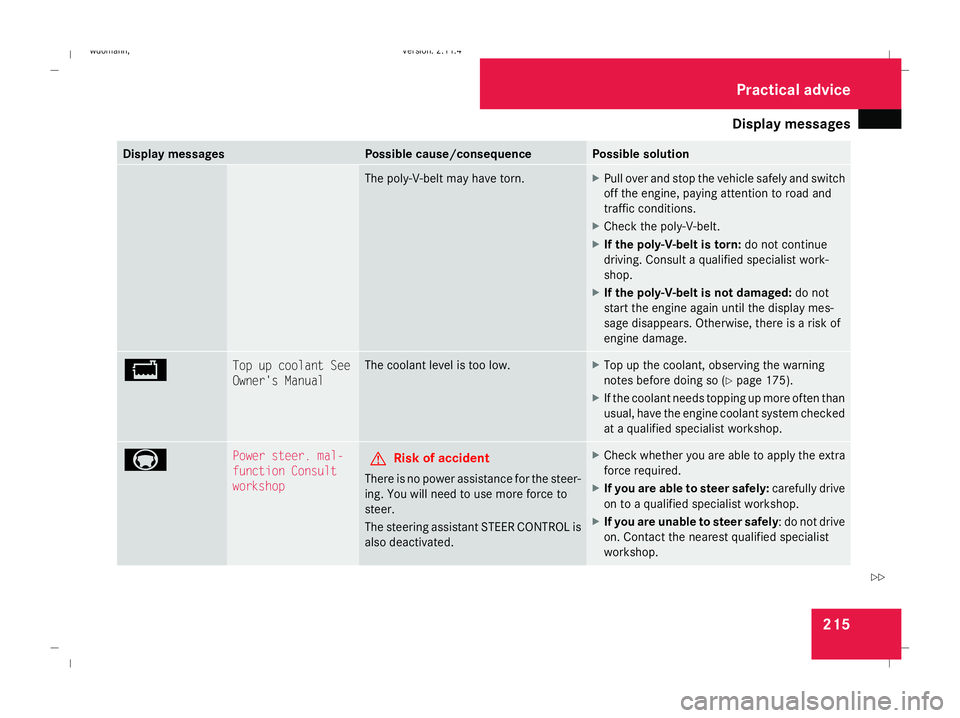
Display
messages 215Display messages Possible cause/consequence Possible solution
The poly-V-belt may have torn. X
Pull over and stop the vehicle safely and switch
off the engine, paying attention to road and
traffic conditions.
X Check the poly-V-belt.
X If the poly-V-belt is torn: do not continue
driving. Consult a qualified specialist work-
shop.
X If the poly-V-belt is not damaged: do not
start the engine again until the display mes-
sage disappears. Otherwise, there is a risk of
engine damage. B Top up coolant See
Owner's Manual The coolant level is too low. X
Top up the coolant, observing the warning
notes before doing so (Y page 175).
X If the coolant needs topping up more often than
usual, have the engine coolant system checked
at a qualified specialist workshop. 3 Power steer. mal-
function Consult
workshop G
Risk of accident
There is no power assistance for the steer-
ing. You will need to use more force to
steer.
The steering assistant STEER CONTROL is
also deactivated. X
Check whether you are able to apply the extra
force required.
X If you are able to steer safely: carefully drive
on to a qualified specialist workshop.
X If you are unable to steer safely : do not drive
on. Contact the nearest qualified specialist
workshop. Practical advi
ce
245_AKB; 2; 7, en-GB
wdomann,
Version: 2.11.4 2008-10-17T11:22:31+02:00 - Seite 215 ZDateiname: 6515_1640_02_buchblock.pdf; preflight
Page 229 of 305
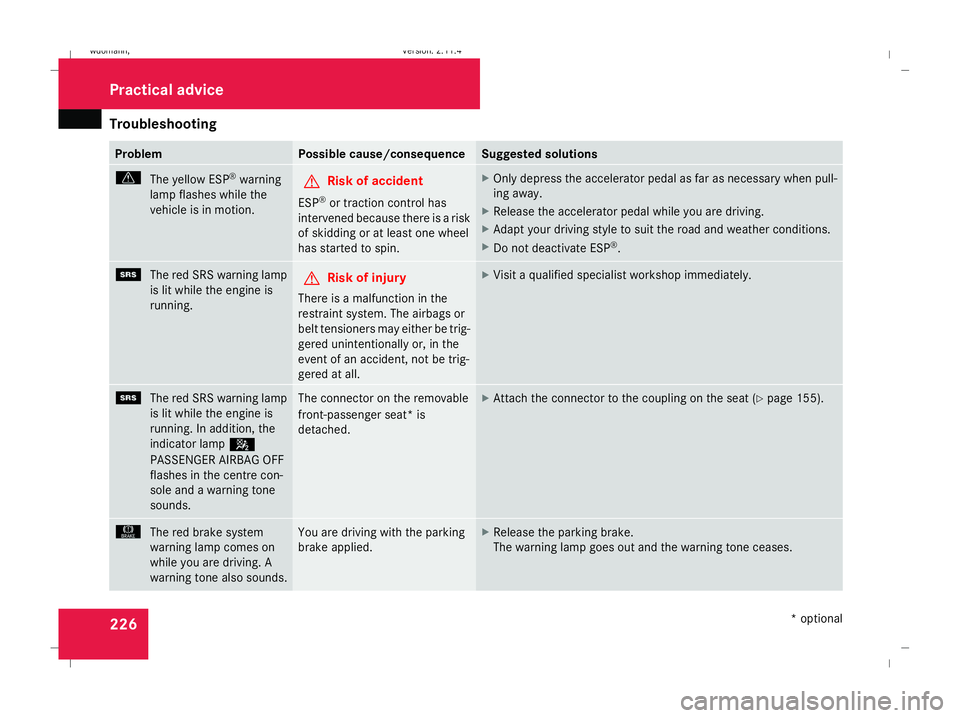
Troubleshooting
226 Problem Possible cause/consequence Suggested solutions
v
The yellow ESP ®
warning
lamp flashes while the
vehicle is in motion. G
Risk of accident
ESP ®
or traction control has
intervened because there is a risk
of skidding or at least one wheel
has started to spin. X
Only depress the accelerator pedal as far as necessary when pull-
ing away.
X Release the accelerator pedal while you are driving.
X Adapt your driving style to suit the road and weather conditions.
X Do not deactivate ESP ®
. 1
The red SRS warning lamp
is lit while the engine is
running. G
Risk of injury
There is a malfunction in the
restraint system. The airbags or
belt tensioners may either be trig-
gered unintentionally or, in the
event of an accident, not be trig-
gered at all. X
Visit a qualified specialist workshop immediately. 1
The red SRS warning lamp
is lit while the engine is
running. In addition, the
indicator lamp 5
PASSENGER AIRBAG OFF
flashes in the centre con-
sole and a warning tone
sounds. The connector on the removable
front-passenger seat* is
detached. X
Attach the connector to the coupling on the seat ( Ypage 155). H
The red brake system
warning lamp comes on
while you are driving. A
warning tone also sounds. You are driving with the parking
brake applied. X
Release the parking brake.
The warning lamp goes out and the warning tone ceases. Practical advice
* optional
245_AKB; 2; 7, en-GB
wdomann,
Version: 2.11.4 2008-10-17T11:22:31+02:00 - Seite 226Dateiname: 6515_1640_02_buchblock.pdf; preflight