ECU MERCEDES-BENZ B-CLASS HATCHBACK 2011 User Guide
[x] Cancel search | Manufacturer: MERCEDES-BENZ, Model Year: 2011, Model line: B-CLASS HATCHBACK, Model: MERCEDES-BENZ B-CLASS HATCHBACK 2011Pages: 329, PDF Size: 7.91 MB
Page 54 of 329
i
If the front-passenger front airbag is dis-
abled by the automatic child seat recogni-
tion, the following remaine nabled on the
front-passenger side:
R the sidebag
R the windowbag
R the belt tensioner
ISOFIX chil dseat securing system for
the rear seats G
WARNING
Ac hild restraint system secured by the ISOFIX
child seat securing system does not provide
sufficient protection for children weighing
more than 22 kg. For this reason, do not
secure children weighing more than 22 kg in
a child restraint system secured by the ISOFIX
child seat securing system. If the child weighs
more than 22 kg, secure the child restraint
system using a three-point seat belt. G
WARNING
The child restraint system cannot perform its
protective function if it is not correctly fitted
to a suitable vehicle seat. The child cannot be
restrained in the event of an accident, heavy
braking or sudden changes of direction. The
child could be seriously or even fatally injured.
For this reason, when fitting a child restraint
system, observe the manufacturer's installa-
tion instructions and the correct use of the
child restraint system.
For reasons of safety, only use child restraint
systems with the ISOFIX child seat securing
system on the rear seats.
We recommend that you use the ISOFIX child
restraint systems that have been recommen-
ded for Mercedes-Benz.
An incorrectly fitted child restraint system
could come loose and seriously or even fatally
injure the child or other vehicle occupants.
When fitting the child restraint system, always
make sure that it is engaged correctly in the
securing rings on both sides. G
WARNING
Please note that if child restraint systems, or
their retaining systems, are damaged or sub-
jected to a load in an accident, they may not
be able to provide their protective function.
This could result in serious or even fatal inju-
ries to the secured child in the event of an
accident, heavy braking or a sudden change
in direction.
For this reason, have child restraint systems
and their anchorages which have been dam-
aged or subjected to a load in an accident
checked immediately at a qualified specialist
workshop.
! When fitting the child restraint system,
make sure that the seat belt for the centre
seat does not get trapped. Otherwise, the
seat belt could be damaged.
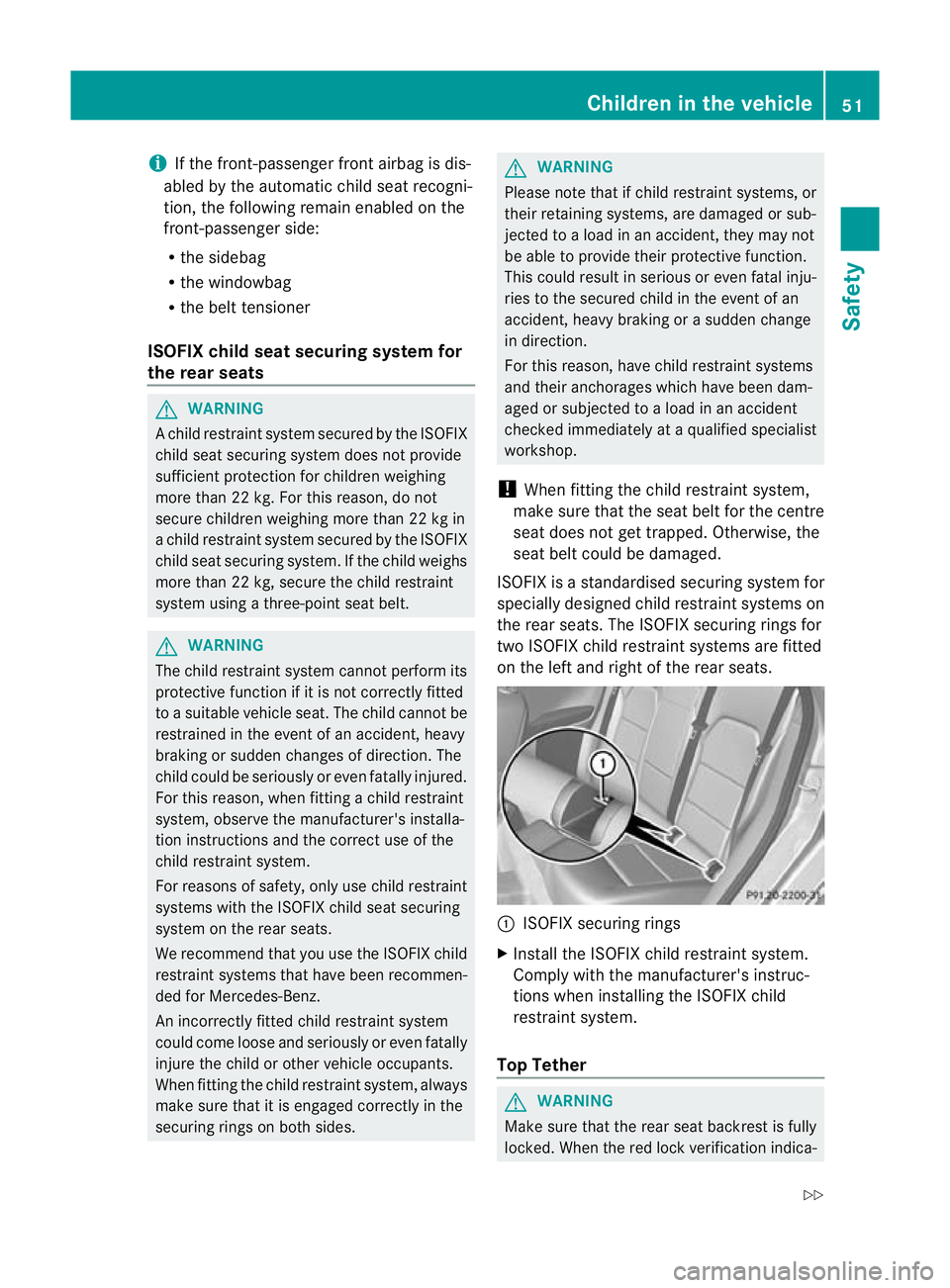
ISOFIX is a standardised securing system for
specially designed child restraint systems on
the rear seats. The ISOFIX securing rings for
two ISOFIX child restraint systems are fitted
on the left and right of the rear seats. :
ISOFIX securing rings
X Install the ISOFIX child restraint system.
Comply with the manufacturer's instruc-
tions when installing the ISOFIX child
restraint system.
Top Tether G
WARNING
Make sure that the rear seat backrest is fully
locked. When the red lock verification indica- Children in the vehicle
51Safety
Z
Page 55 of 329
tors on the left and right are no longe
rvisible,
the rear seat backrests are locked. If the rear
seat backrests are not locked, occupants
could be injured in the event of an accident,
e.g. by objects that are thrown forward from
the luggage compartment.
Top Tether provides an additional connection
betwee nthe child restraint system secured
with ISOFIX and the rear seat. It helps reduce
the risk of injury even further.
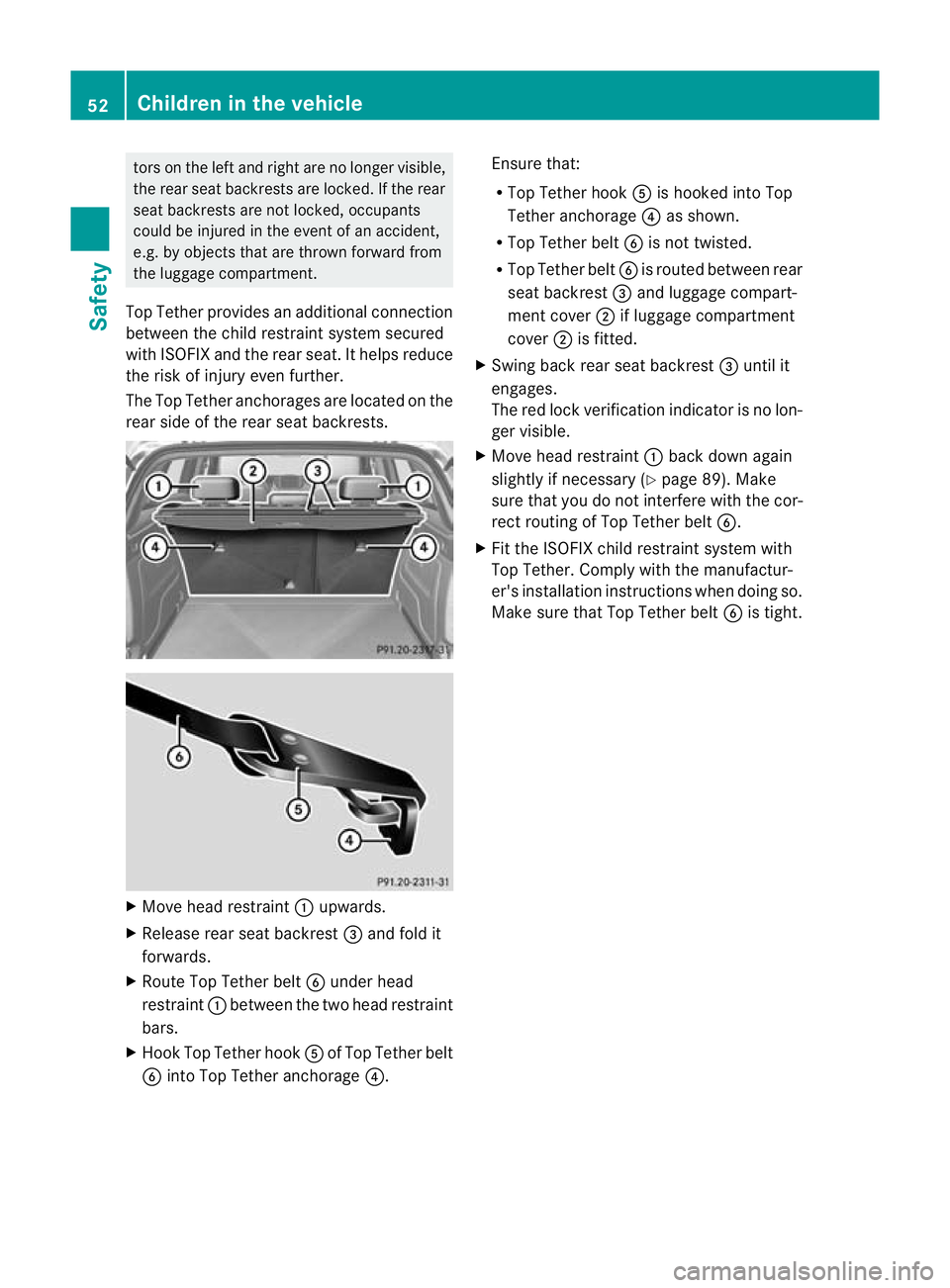
The Top Tether anchorages are located on the
rear side of the rear seat backrests. X
Move head restraint :upwards.
X Release rear seat backrest =and fold it
forwards.
X Route Top Tether belt Bunder head
restraint :between the two head restraint
bars.
X Hook Top Tether hook Aof Top Tether belt
B into Top Tether anchorage ?.Ensure that:
R
Top Tether hook Ais hooked into Top
Tether anchorage ?as shown.
R Top Tether belt Bis not twisted.
R Top Tether belt Bis routed between rear
seat backrest =and luggage compart-
ment cover ;if luggage compartment
cover ;is fitted.
X Swing back rear seat backrest =until it
engages.
The red lock verification indicator is no lon-
ger visible.
X Move head restraint :back down again
slightly if necessary (Y page 89). Make
sure that you do not interfere with the cor-
rect routing of Top Tether belt B.
X Fit the ISOFIX child restraint system with
Top Tether. Comply with the manufactur-
er's installation instructions when doing so.
Make sure that Top Tether belt Bis tight. 52
Children in the vehicleSafety
Page 57 of 329
conjunction with the components listed in the
following table, they comply with the legal
requirements of ECE R 44.04.
Weight
catego-
ries Integra-
ted
child
seat ICS pad-
ded play
table Side
head
restrain
ts Group I:
12.5 to
18 kg Folded
out Manda-
tory Manda-
tory Group II:
15 to
25 kg Folded
out Not per-
missible Manda-
tory Group
III: 22 to
36 kg Folded
out Not per-
missible Recom-
mended Mercedes-Benz recommends using the inte-
grated child sea
tfor children who weigh
between 12.5and 36 kg.
For children weighing between approximately
12.5 kg and 18 kg: an ICS padded play table
and a side head restraint which have been
specially approved for the integrated child
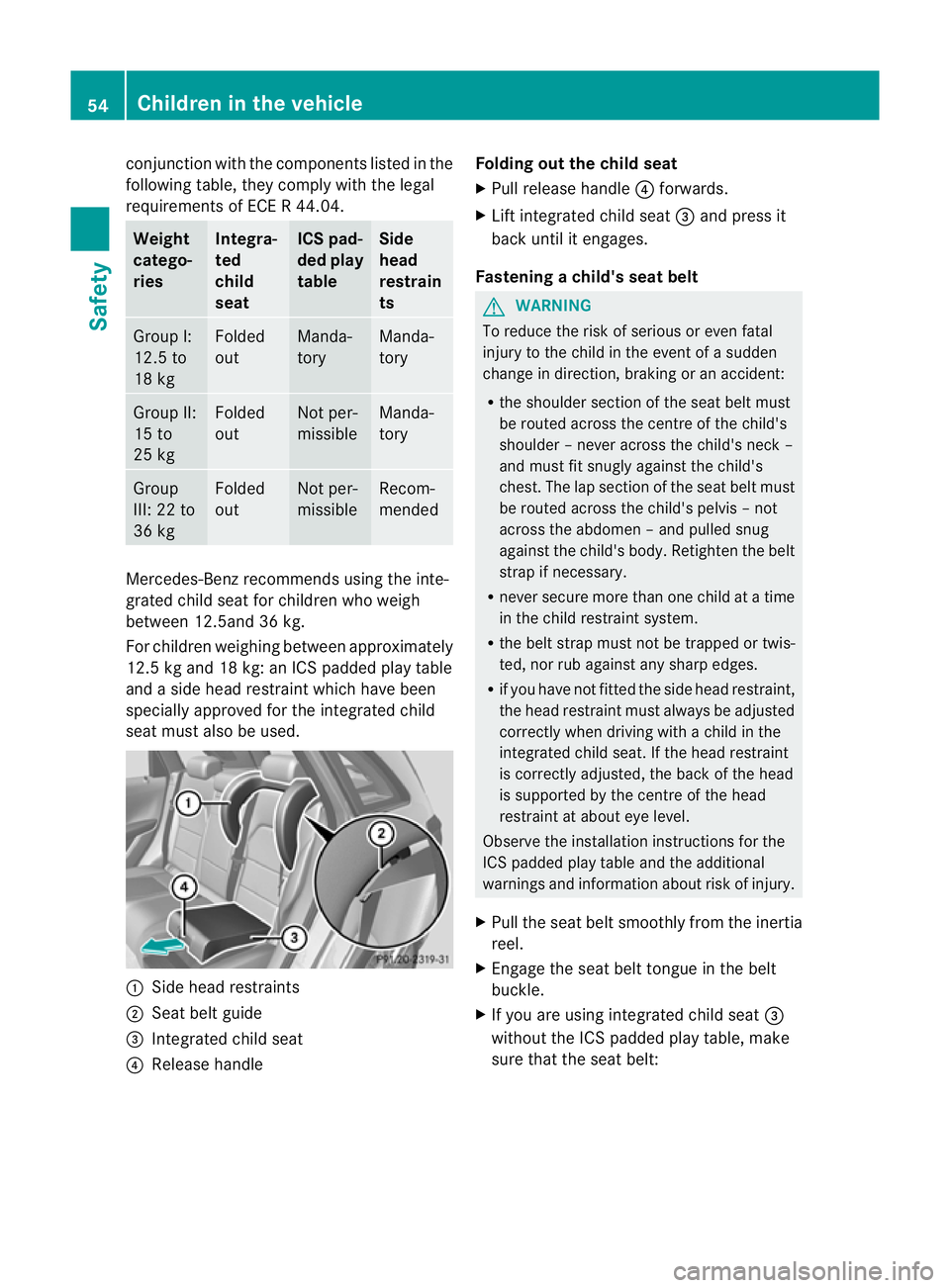
seat must also be used. :
Side head restraints
; Seat belt guide
= Integrated child seat
? Release handle Folding out the child seat
X Pull release handle ?forwards.
X Lift integrated child seat =and press it
back until it engages.
Fastening achild's seat belt G
WARNING
To reduce the risk of serious or even fatal
injury to the child in the event of a sudden
change in direction, braking or an accident:
R the shoulde rsection of the seat belt must
be routed across the centre of the child's
shoulder –never across the child's neck –
and must fit snugly against the child's
chest .The lap section of the seat belt must
be routed across the child's pelvis –not
across the abdomen –and pulled snug
against the child's body .Retighten the belt
strap if necessary.
R never secure more than one child at a time
in the child restraint system.
R the belt strap must not be trapped or twis-
ted, nor rub against any sharp edges.
R if you have not fitted the side head restraint,
the head restraint must always be adjusted
correctly when driving with a child in the
integrated child seat. If the head restraint
is correctly adjusted, the back of the head
is supported by the centre of the head
restraint at about eye level.
Observe the installation instructions for the
ICS padded play table and the additional
warnings and information about risk of injury.
X Pull the seat belt smoothly from the inertia
reel.
X Engage the seat belt tongue in the belt
buckle.
X If you are using integrated child seat =
without the ICS padded play table, make
sure that the seat belt: 54
Children in the vehicleSafety
Page 58 of 329
R
is routed as low as possible across the pel-
vic area, in front of the hips
R is tightened across the lap by pulling
upwards on the shoulder section of the seat
belt
R is tigh tand is routed across the centre of
the child's shoulder
R is not twisted and does not pass across the
child's neck or under the child's arm
X Adjust the head restraint if necessary; see
(Y page 89).
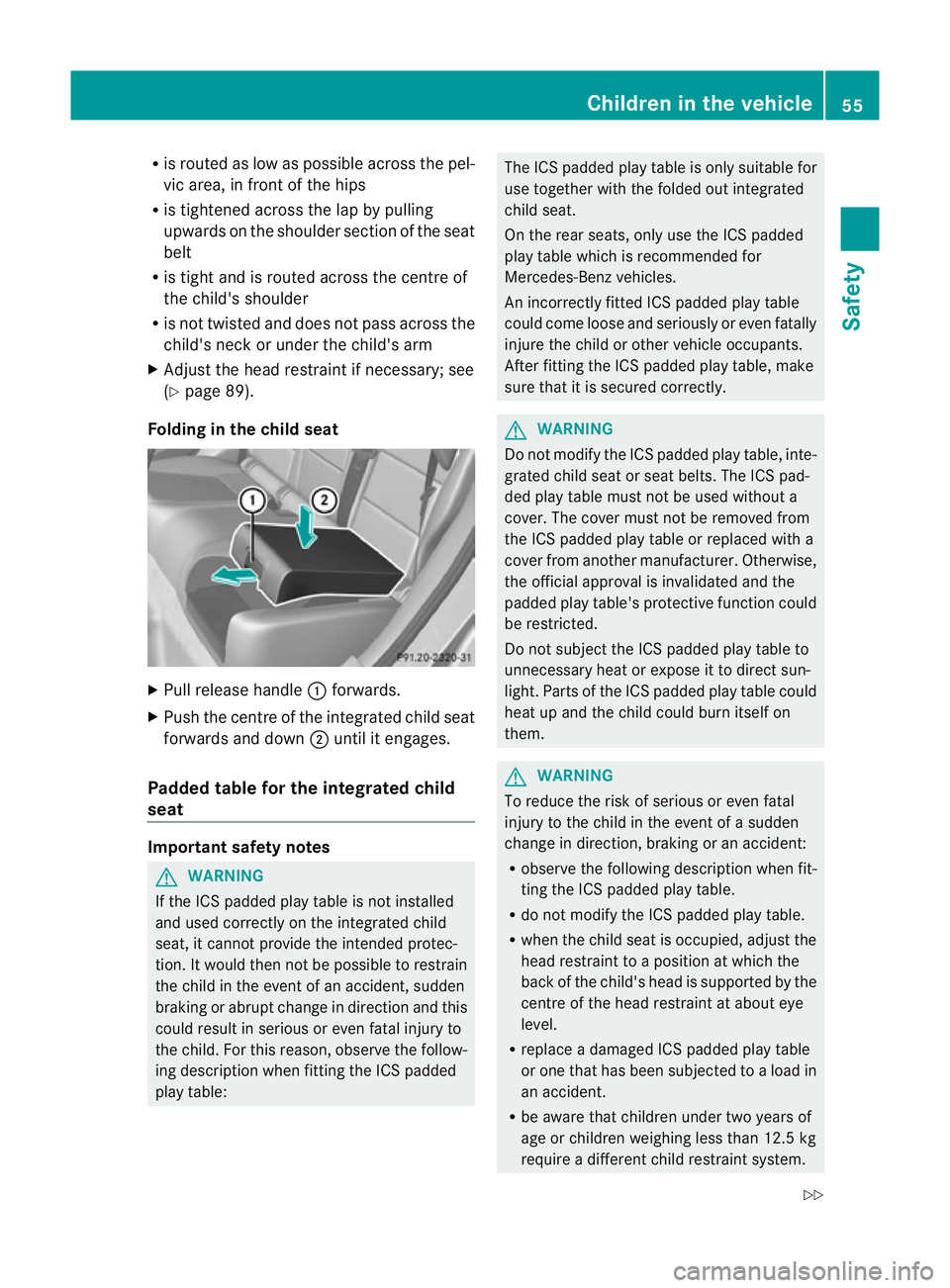
Folding in the chil dseat X
Pull release handle :forwards.
X Push the centre of the integrated child seat
forwards and down ;until it engages.
Padded table for the integrated child
seat Important safety notes
G
WARNING
If the ICS padded play table is not installed
and used correctly on the integrated child
seat, it cannot provide the intended protec-
tion. It would then not be possible to restrain
the child in the even tofanaccident, sudden
braking or abrup tchange in direction and this
could result in serious or even fatal injury to
the child. For this reason, observe the follow-
ing description when fitting the ICS padded
play table: The ICS padded play table is only suitable for
use together with the folded out integrated
child seat.
On the rear seats, only use the ICS padded
play table which is recommended for
Mercedes-Ben
zvehicles.
An incorrectly fitted ICS padded play table
could come loose and seriously or even fatally
injure the child or other vehicle occupants.
After fitting the ICS padded play table, make
sure that it is secured correctly. G
WARNING
Do not modify the ICS padded play table, inte-
grated child seat or seat belts. The ICS pad-
ded play table must not be used without a
cover. The cover must not be removed from
the ICS padded play table or replaced with a
cover from another manufacturer. Otherwise,
the official approval is invalidated and the
padded play table's protective function could
be restricted.
Do not subject the ICS padded play table to
unnecessary heat or expose it to direct sun-
light. Parts of the ICS padded play table could
heat up and the child could burn itself on
them. G
WARNING
To reduce the risk of serious or even fatal
injury to the child in the event of a sudden
change in direction, braking or an accident:
R observe the following description when fit-
ting the ICS padded play table.
R do not modify the ICS padded play table.
R when the child seat is occupied, adjust the
head restraint to a position at which the
back of the child's head is supported by the
centre of the head restraint at about eye
level.
R replace a damaged ICS padded play table
or one that has been subjected to a load in
an accident.
R be aware that children under two years of
age or children weighing less than 12.5kg
require a different child restraint system. Children in the vehicle
55Safety
Z
Page 60 of 329

i
Should a side head restraint be required
for the second integrated child seat, this
can be ordered at any Mercedes-Benz
Service Centre. G
WARNING
If you do not secure the side head restraint at
the anchor points intended, it canno tprovide
the intended level of protection. It would then
not be possible to protect the child in the
event of an accident, sudden braking or
abrupt change in directio nand this could
result in serious or even fatal injury to the
child.
Only attach the side head restraint to the
intended anchor points on the rea rhead
restraint.
For safety reasons, Mercedes-Benz recom-
mends that you only use side head restraints
which have been approved by Mercedes-Benz
for your vehicle.
Fitting side head restraints
X Slide head restraint ;upwards and posi-
tion it upright.
X Slide side head restraints Bfrom the front
to the centre of both head restraint bars
until they engage.
Right lock verification indicator :and left
lock verification indicator =must be fol-
ded in. The red surfaces are no longer visi-
ble.
X Make sure that side head restraint Bis
engaged in both head restraint bars. X
Slide head restraint ;downwards
(Y page 89) until it rests on the upper
edge of side head restraints B.
X Guide the seat belt through seat belt guide
A on the door side on side head restraint
B.
X Secure the child (Y page 54).
i When using the integrated child seat with
the ICS padded play table, the seat belt is
not guided through the seat belt guide on
the side head restraint.
Removing the side head restraints
X Take the seat belt out of seat belt guide
A.
X Move head restraint ;upwards.
X Press left or right release button ?and pull
side head restraint Bforward to remove
it.
Right lock verification indicator :and left
lock verification indicator =fold out
briefly.
X Adjust head restraint ;(Ypage 89).
Storing the padded table and the side
head restraints G
WARNING
Secure the ICS padded play table and the side
head restraints in the vehicle as specified;
otherwise, they may come loose. In the event
of an accident, sudden braking or abrupt
change in direction, they could injure vehicle
occupants or cause damage to the vehicle.
When you are not using the ICS padded play
table and the side head restraints, store these
in a suitable place, such as the boot.
On vehicles with a TIREFIT kit, for example,
you can store the side head restraints in the
stowage compartment under the luggage
compartment floor (Y page 253). Children in the vehicle
57Safety Z
Page 62 of 329
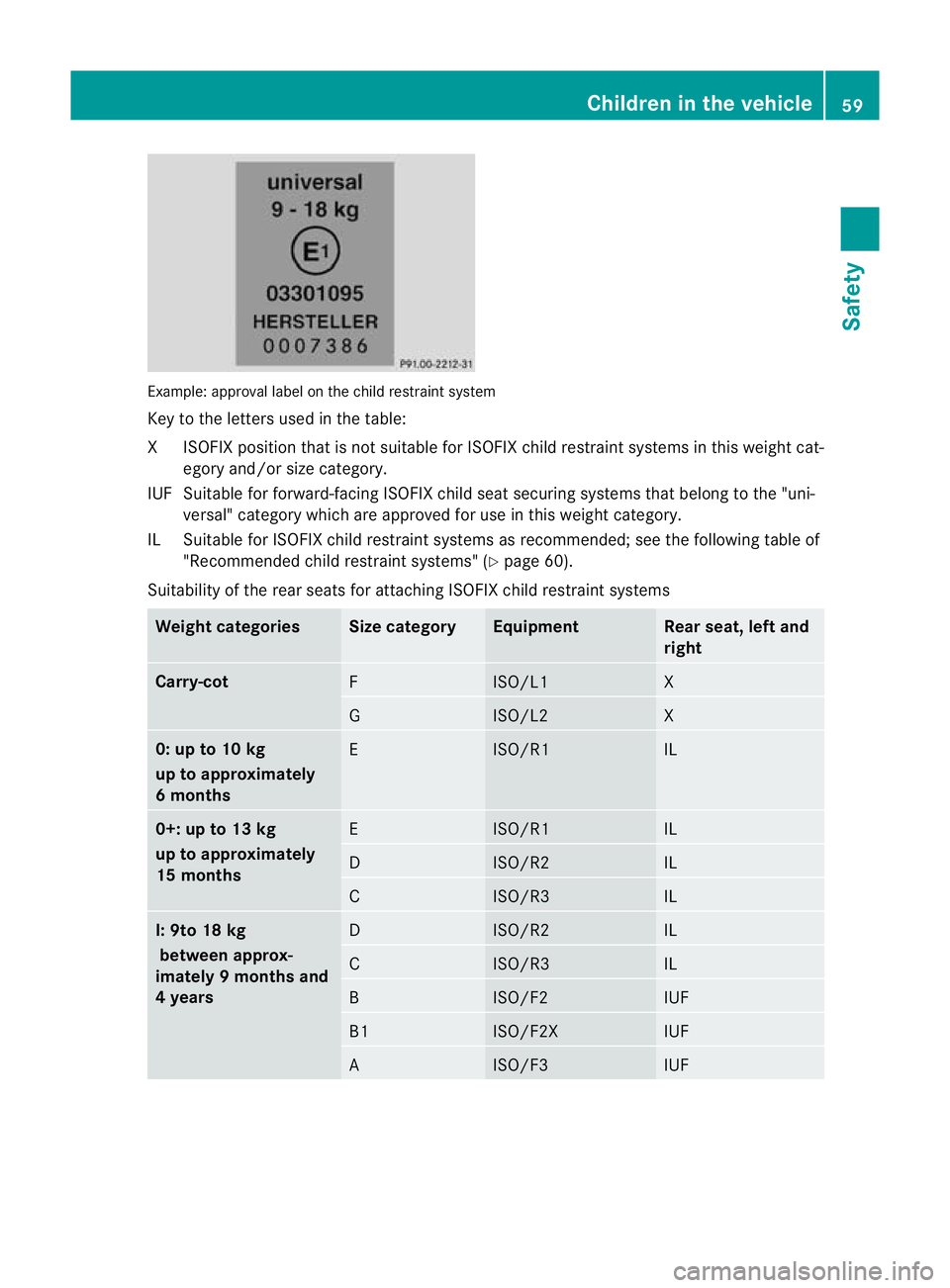
Example: approval label on the child restraint system
Key to the letters used in the table:
XI SOFIX position tha tis not suitable for ISOFIX child restraint systems in this weight cat-
egory and/or size category.
IUF Suitable for forward-facing ISOFIX child seat securing systems that belong to the "uni- versal" category which are approved for use in this weight category.
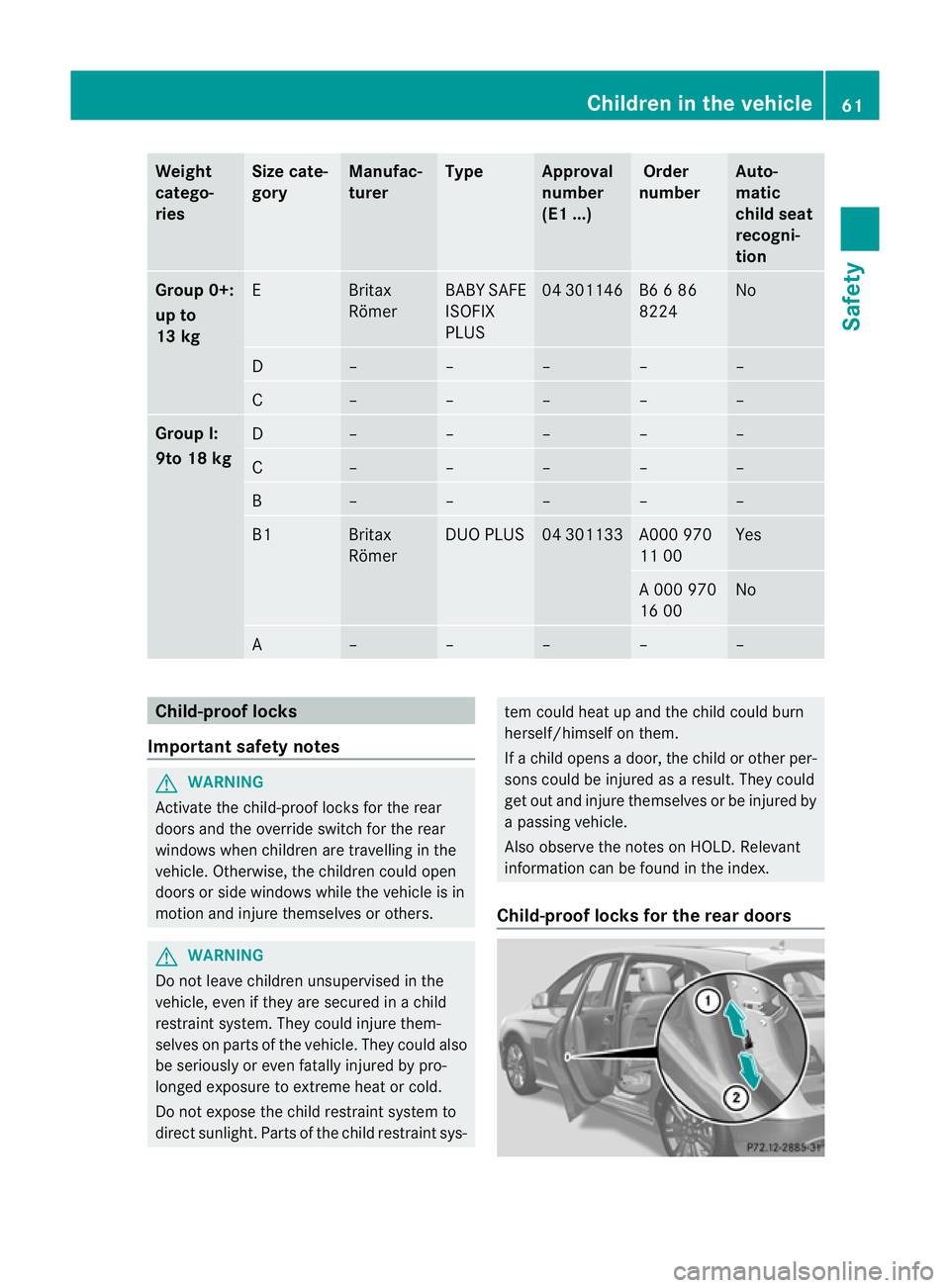
IL Suitable for ISOFIX child restraint systems as recommended; see the following table of "Recommended child restraint systems" (Y page 60).
Suitability of the rear seats for attaching ISOFIX child restraint systems Weight categories Size category Equipment Rear seat, left and
right
Carry-cot
F ISO/L1 X
G ISO/L2 X
0: up to 10 kg
up to approximately
6 months
E ISO/R1 IL
0+: up to 13 kg
up to approximately
15 months
E ISO/R1 IL
D ISO/R2 IL
C ISO/R3 IL
I: 9to 18 kg
between approx-
imately 9 months and
4 years D ISO/R2 IL
C ISO/R3 IL
B ISO/F2 IUF
B1 ISO/F2X IUF
A ISO/F3 IUFChildren in the vehicle
59Safety Z
Page 64 of 329
Weight
catego-
ries Size cate-
gory Manufac-
turer Type Approval
number
(E1 ...) Order
number Auto-
matic
chil
dseat
recogni-
tion Group 0+:
up to
13 kg
E Britax
Römer BABY SAFE
ISOFIX
PLUS 04 301146 B6 6 86
8224 No
D – – – – –
C – – – – –
Group I:
9to 18 kg
D – – – – –
C – – – – –
B – – – – –
B1 Britax
Römer DUO PLUS 04 301133 A000 970
11 00 Yes
A 000 970
16 00 No
A – – – – –
Child-proof locks
Important safety notes G
WARNING
Activate the child-proof locks for the rear
doors and the override switch for the rear
windows when children are travelling in the
vehicle. Otherwise, the children could open
doors or side windows while th evehicle is in
motion and injure themselves or others. G
WARNING
Do not leave children unsupervised in the
vehicle, even if they are secured in a child
restraint system. They could injure them-
selves on parts of the vehicle. They could also
be seriously or even fatally injured by pro-
longed exposure to extreme heat or cold.
Do not expose the child restraint system to
direct sunlight. Parts of the child restraint sys- tem could heat up and the child could burn
herself/himself on them.
If a child opens a door, the child or other per-
sons could be injured as a result. They could
get out and injure themselves or be injured by
a passing vehicle.
Also observe the notes on HOLD
.Relevant
information can be found in the index.
Child-proof locks for the rear doors Children in the vehicle
61Safety Z
Page 65 of 329
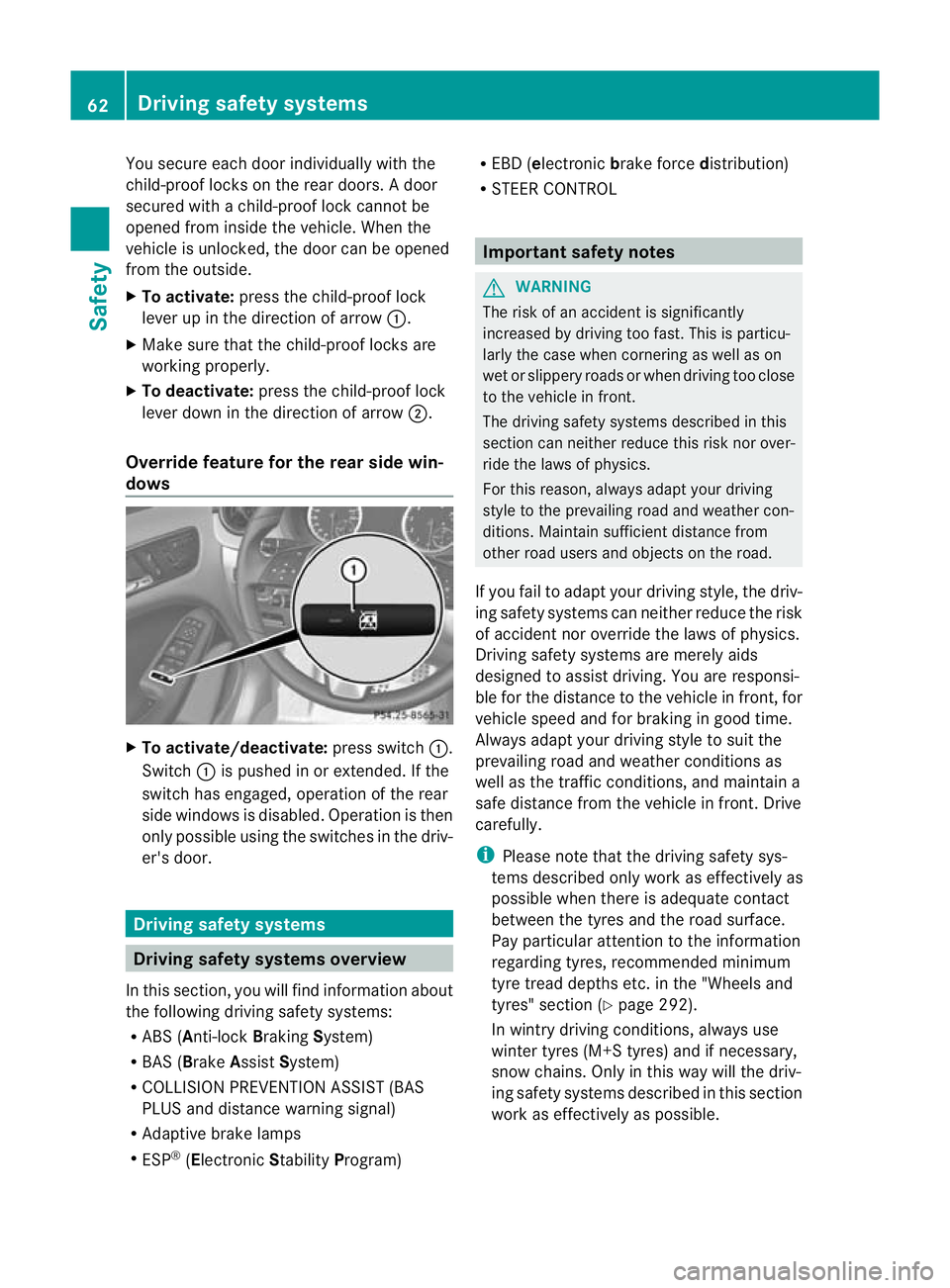
You secure each door individually with the
child-proof locks on the rear doors
.Adoor
secured with a child-proof lock cannot be
opened from inside the vehicle. When the
vehicle is unlocked, the door can be opened
from the outside.
X To activate: press the child-proof lock
lever up in the direction of arrow :.
X Make sure that the child-proof locks are
working properly.
X To deactivate: press the child-proof lock
lever down in the direction of arrow ;.
Override feature for the rear side win-
dows X
To activate/deactivate: press switch:.
Switch :is pushed in or extended. If the
switch has engaged, operation of the rear
side windows is disabled. Operation is then
only possible using the switches in the driv-
er's door. Driving safety systems
Driving safety systems overview
In this section, you will find information about
the following driving safety systems:
R ABS (Anti-lock BrakingSystem)
R BAS (Brake AssistSystem)
R COLLISION PREVENTION ASSIST (BAS
PLUS and distance warning signal)
R Adaptive brake lamps
R ESP ®
(Electronic StabilityProgram) R
EBD ( electronic brake force distribution)
R STEER CONTROL Important safety notes
G
WARNING
The risk of an accident is significantly
increased by driving too fast. This is particu-
larly the case when cornering as well as on
wet or slippery roads or when driving too close
to the vehicle in front.
The driving safety systems described in this
section can neither reduce this risk nor over-
ride the laws of physics.
For this reason, always adapt your driving
style to the prevailing road and weather con-
ditions. Maintain sufficient distance from
other road users and objects on the road.
If you fail to adapt your driving style, the driv-
ing safety systems can neither reduce the risk
of accident nor override the laws of physics.
Driving safety systems are merely aids
designed to assist driving. You are responsi-
ble for the distance to the vehicle in front, for
vehicle speed and for braking in good time.
Always adapt your driving style to suit the
prevailing road and weather conditions as
well as the traffic conditions, and maintain a
safe distance from the vehicle in front. Drive
carefully.
i Please note that the driving safety sys-
tems described only work as effectively as
possible when there is adequate contact
between the tyres and the road surface.
Pay particular attention to the information
regarding tyres, recommended minimum
tyre tread depths etc. in the "Wheels and
tyres" section (Y page 292).
In wintry driving conditions, always use
winter tyres (M+S tyres) and if necessary,
snow chains. Only in this way will the driv-
ing safety systems described in this section
work as effectively as possible. 62
Driving safety systemsSafety
Page 79 of 329
Doors
Important safety notes
G
WARNING
Only for the United Kingdom: if the vehicle
has bee nlocked with the key, the double lock
function is activated as standard. It is then not
possible to open the doors from inside the
vehicle.
Therefore, do not leave any people behind in
the vehicle, particularly children, elderly peo-
ple or people in need of special assistance if
the vehicle has been locked with the key. As
a result, they may not be able to free them-
selves in the event of an emergency. As a
result, they could be seriously or even fatally
injured by prolonged exposure to extremely
high or low temperatures, for example. In this
case, rescuing people from outside the vehi-
cle is difficult.
Deactivate the interior motion sensor before
you lock the vehicle with the key. The doors
can then be opened from the inside after the
vehicle has been locked from the outside with
the key. G
WARNING
If children are left unsupervised in the vehicle,
they could:
R open a door from inside the vehicle at any
time, even if it has been locked
R start the vehicle using akey which has been
left in the vehicle
R release the parking brake
They could thereby endanger themselves and
others. Never leave children unsupervised in
the vehicle. Always take the key with you
when leaving the vehicle, even if you are only
leaving it for a short time. Unlocking and opening the doors
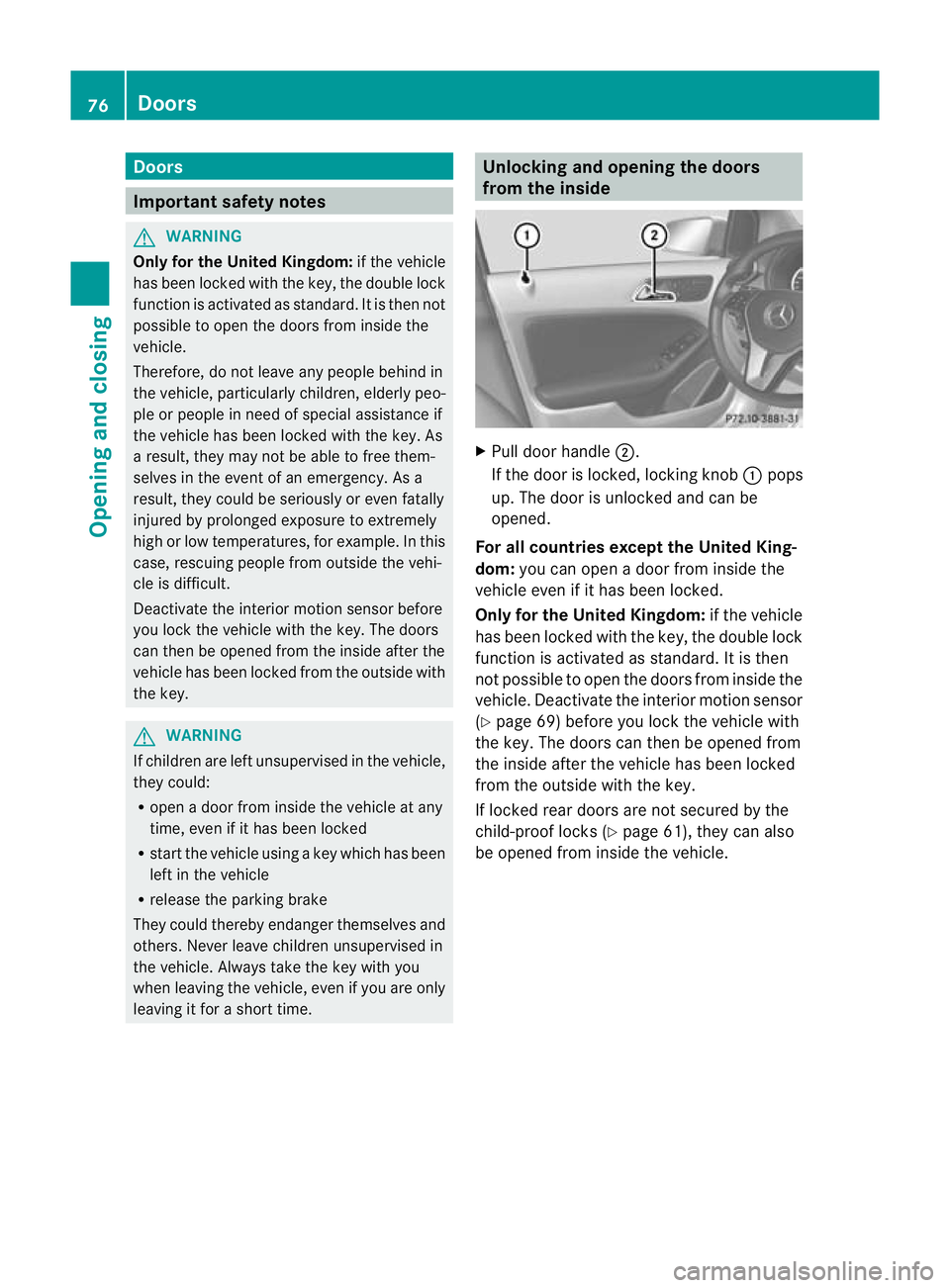
from the inside
X
Pull door handle ;.
If the door is locked, locking knob :pops
up. The door is unlocked and can be
opened.
For all countries except the United King-
dom: you can open a door from inside the
vehicle even if it has been locked.
Only for the United Kingdom: if the vehicle
has been locked with the key, the double lock
function is activated as standard. It is then
not possible to open the doors from inside the
vehicle. Deactivate the interior motion sensor
(Y page 69) before you lock the vehicle with
the key. The doors can then be opened from
the inside after the vehicle has been locked
from the outside with the key.
If locked rear doors are not secured by the
child-proof locks (Y page 61), they can also
be opened from inside the vehicle. 76
DoorsOpening and closing
Page 83 of 329
the switch or pull the switch upwards to close
the side window again.
G
WARNING
Make sure tha tnobody can become trapped
as you close a side window. If there is a risk
of becoming trapped, release the switch or
press it again to open the side window again. G
WARNING
Children may injure themselves if they open
or close the side windows.
Never leave children unsupervised in the vehi-
cle. Always take the key with you when leaving
the vehicle, even if you are only leaving it for
a short time. G
WARNING
Do not leave children unsupervised in the
vehicle, even if they are secured in a child
restraint system. The children could:
R be seriously or even fatally injured on parts
of the vehicle
R be seriously or even fatally injured by pro-
longed exposure to extremely high or
extremely low temperatures
If children open a door, they could:
R seriously or even fatally injure other people
R get out of the vehicle and injure them-
selves, or be seriously or even fatally
injured by a passing vehicle
Activate the child-proof locks/override fea-
ture if children are travelling in the vehicle.
They could otherwise open doors or side win-
dows while the vehicle is in motion and
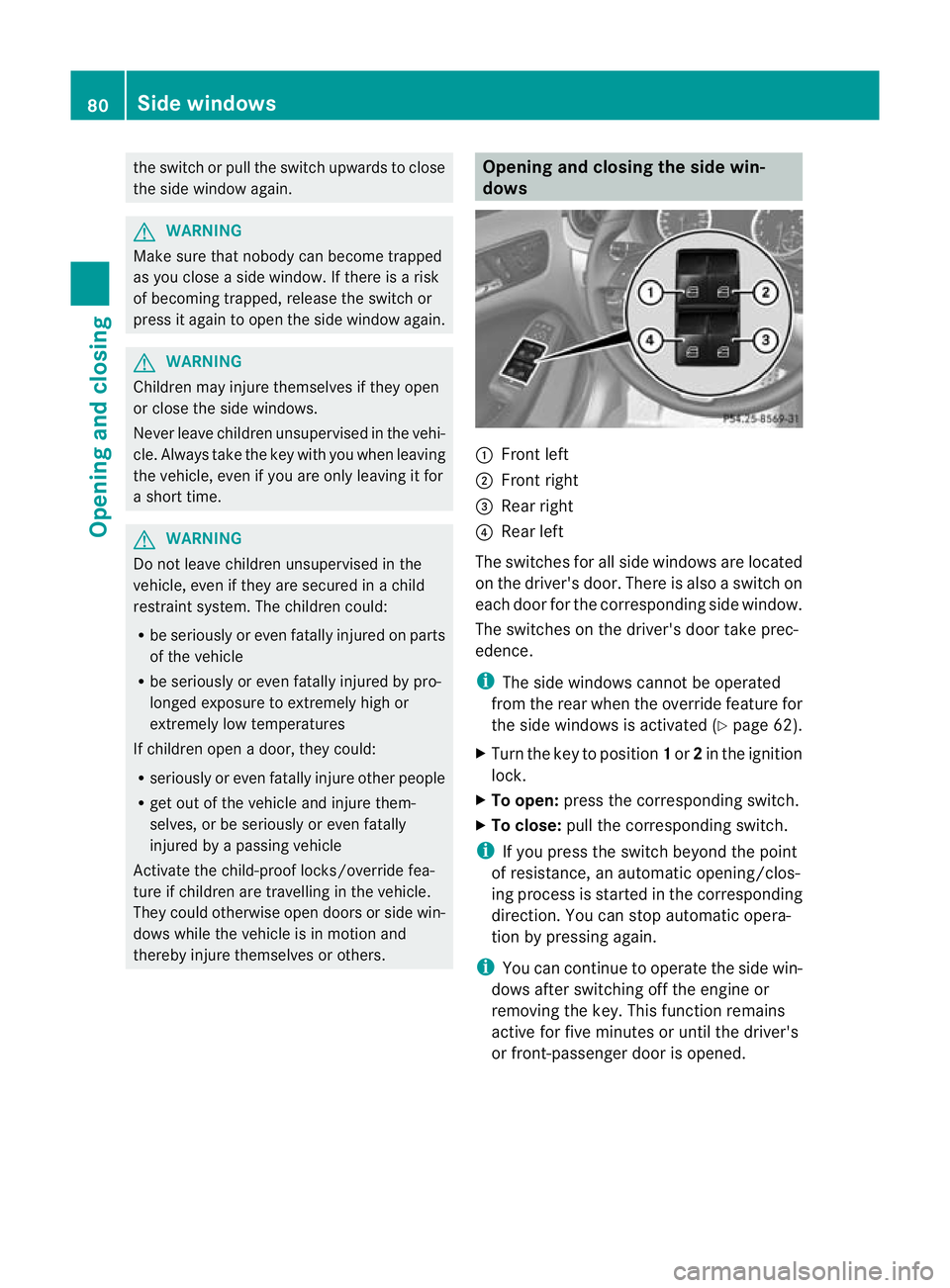
thereby injure themselves or others. Opening and closing the side win-
dows
:
Front left
; Front right
= Rear right
? Rear left
The switches for all side windows are located
on the driver's door. There is also a switch on
each door for the corresponding side window.
The switches on the driver's door take prec-
edence.
i The side windows cannot be operated
from the rear when the override feature for
the side windows is activated (Y page 62).
X Turn the key to position 1or 2in the ignition
lock.
X To open: press the corresponding switch.
X To close: pull the corresponding switch.
i If you press the switch beyond the point
of resistance, an automatic opening/clos-
ing process is started in the corresponding
direction .You can stop automatic opera-
tion by pressing again.
i You can continue to operate the side win-
dows after switching off the engine or
removing the key. This function remains
active for five minutes or until the driver's
or front-passenger door is opened. 80
Side windowsOpening and closing