tailgate MERCEDES-BENZ B-CLASS HATCHBACK 2011 User Guide
[x] Cancel search | Manufacturer: MERCEDES-BENZ, Model Year: 2011, Model line: B-CLASS HATCHBACK, Model: MERCEDES-BENZ B-CLASS HATCHBACK 2011Pages: 329, PDF Size: 7.91 MB
Page 173 of 329
If you have attached a traile
rto your vehicle,
you should not use Active Parking Assist.
Once the electrical connection is established
between your vehicle and the trailer, Active
Parking Assist is no longer available. Reversing camera
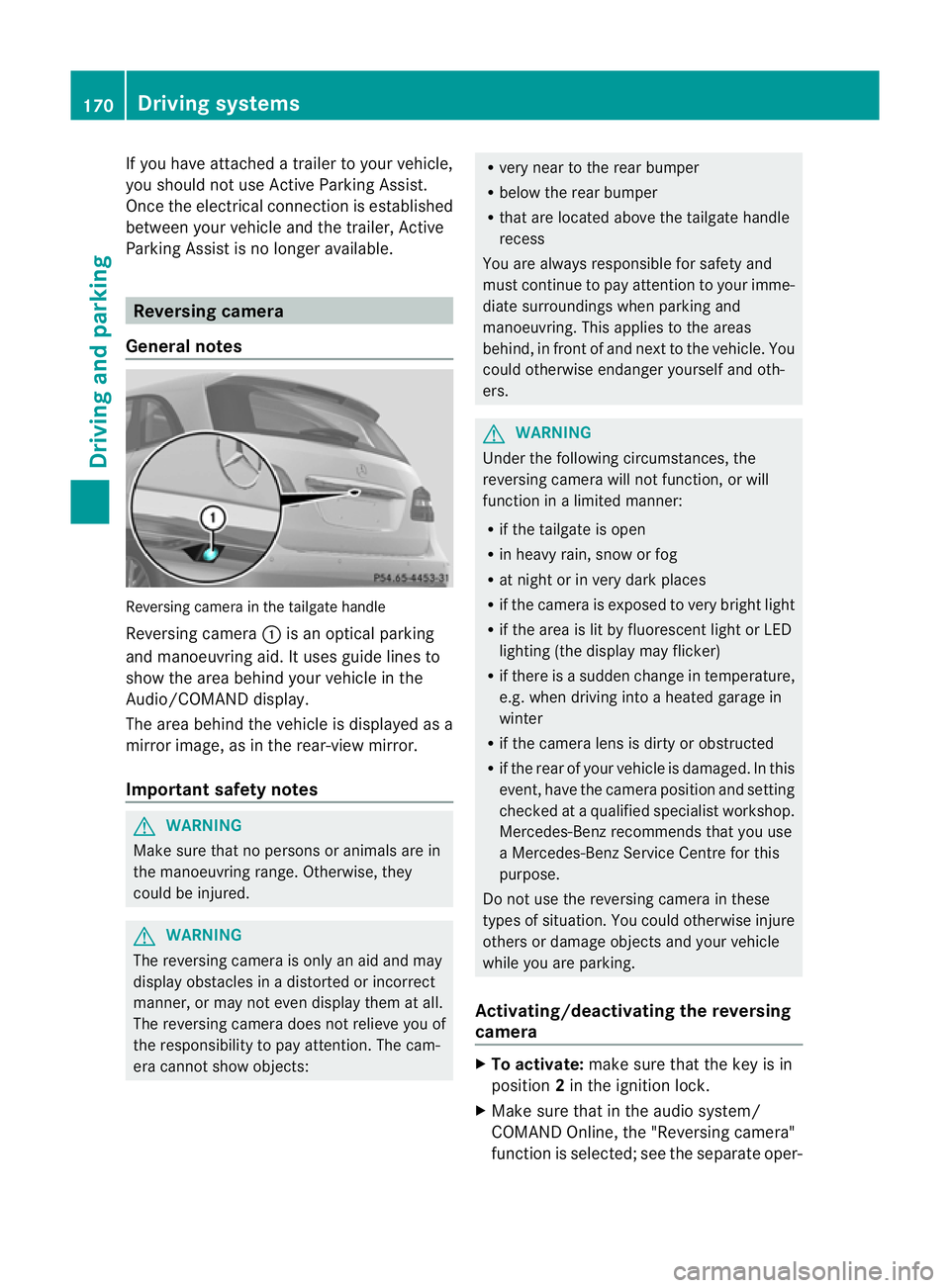
General notes Reversing camera in the tailgate handle
Reversing camera :is an optical parking
and manoeuvring aid. It uses guide lines to
show the area behind your vehicle in the
Audio/COMAND display.
The area behind the vehicle is displayed as a
mirror image, as in the rear-view mirror.
Important safety notes G
WARNING
Make sure that no persons or animals are in
the manoeuvring range. Otherwise, they
could be injured. G
WARNING
The reversing camera is only an aid and may
display obstacles in a distorted or incorrect
manner, or may not even display them at all.
The reversing camera does not relieve you of
the responsibility to pay attention. The cam-
era cannot show objects: R
very near to the rear bumper
R below the rear bumper
R that are located above the tailgate handle
recess
You are always responsible for safety and
must continue to pay attention to your imme-
diate surroundings when parking and
manoeuvring. This applies to the areas
behind, in front of and next to the vehicle. You
could otherwise endanger yourself and oth-
ers. G
WARNING
Under the following circumstances, the
reversing camera will not function, or will
function in a limited manner:
R if the tailgate is open
R in heavy rain, snow or fog
R at night or in very dark places
R if the camera is exposed to very bright light
R if the area is lit by fluorescent light or LED
lighting (the display may flicker)
R if there is a sudden change in temperature,
e.g. when driving into a heated garage in
winter
R if the camera lens is dirty or obstructed
R if the rear of your vehicle is damaged. In this
event, have the camera position and setting
checked at a qualified specialist workshop.
Mercedes-Benz recommends that you use
a Mercedes-Benz Service Centre for this
purpose.
Do not use the reversing camera in these
types of situation. You could otherwise injure
others or damage objects and your vehicle
while you are parking.
Activating/deactivating the reversing
camera X
To activate: make sure that the key is in
position 2in the ignition lock.
X Make sure that in the audio system/
COMAND Online, the "Reversing camera"
function is selected; see the separate oper- 170
Driving systemsDriving and parking
Page 205 of 329
X
Press :or9 to select the Dipped headl. Setting for: function.
You will see the selected setting: Right-side traffic or
Left-side traffic .
X Press the abutton to save the setting.
When you change the setting, conversion
does not take place until the next time the
vehicle is stationary.
This function is only available on vehicles with
the Intelligent Light System.
You can use this function to switch between
symmetrical and asymmetrical dipped beam
(Y page 96).
If you set the dipped-beam headlamps for
driving on the right/left, then motorway
mode and the extended range foglamps are
not available.
You can also have the dipped-beam head-
lamps set for driving on the right/left at a
qualified specialist workshop, e.g. a
Mercedes-Benz Service Centre.
Switching Adaptive Highbeam Assist on/
off
X Press the =or; button on the steer-
ing wheel to select the Settings menu.
X Press the :or9 button to select the
Light submenu.
X Press the abutton to confirm.
X Press the :or9 button to select the
Adaptive Main-beam Assist: function.
You will see the selected setting: Activa‐ted or
Deactivated .
X Press the abutton to save the setting.
Activating/deactivating the surround
lighting and exterior lighting delayed
switch-off
If you have activated the Surround light‐ing: function and the light switch is set to
Ã, the following functions are activated
when it is dark:
R Surround lighting: the exterior lighting
remains lit for 40 seconds after unlocking
with the key. If you start the engine, the surround lighting is switched off and auto-
matic headlamp mode is activated
(Y
page 97).
R Exterior lighting delayed switch-off: the
exterior lighting remains lit for 60seconds
after the engine is switched off. If you close
all the doors and the tailgate, the exterior
lighting goes off after 15 seconds.
X Press the =or; button on the steer-
ing wheel to select the Settings menu.
X Press the :or9 button to select the
Light submenu.
X Press the abutton to confirm.
X Press the :or9 button to select the
Surround lighting: function.
You will see the selected setting: on or
off .
X Press the abutton to save the setting.
Deactivating delayed switch-off of the exte-
rior lighting temporarily:
X Before leaving the vehicle, turn the key to
position 0in the ignition lock.
X Turn the key to position 2in the ignition
lock.
The exterior lighting delayed switch-off is
deactivated.
Delayed switch-off of the exterior lighting is
reactivated the next time you start the
engine.
i Depending on your vehicle's equipment,
when the surround lighting and delayed
switch-off exterior lighting are on, the fol-
lowing light up:
R side lamps
R foglamps
R dipped-beam headlamps
R daytime driving lights
R surround lighting in the exterior mirrors
Activating/deactivating the interior light-
ing delayed switch-off
If you activate the Interior lighting delay sw. off: function, the interior light-202
Menus and submenusOn-board computer and displays
Page 233 of 329
Display messages Possible causes/consequences and
M Solutions
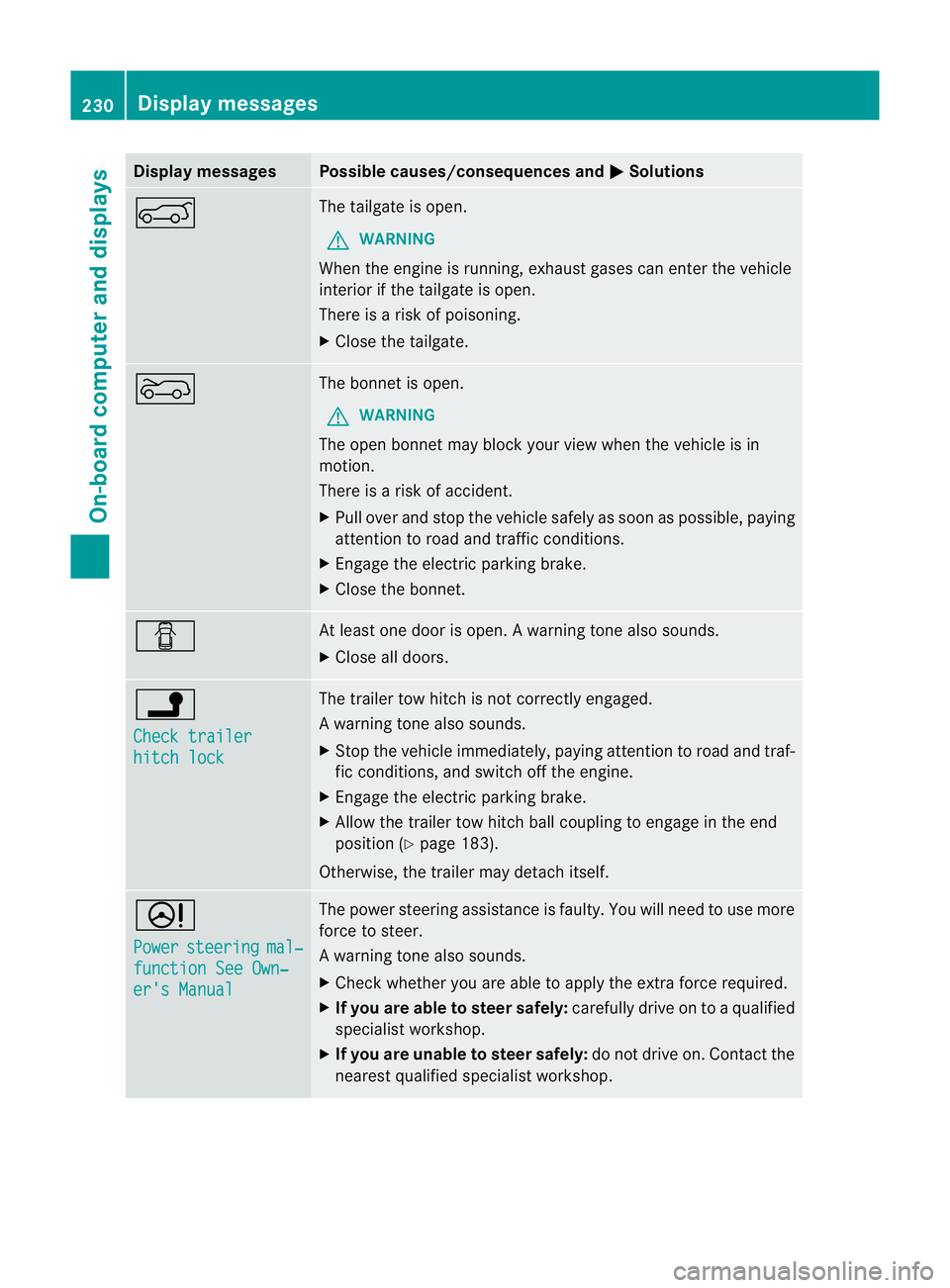
A The tailgate is open.
G WARNING
Whe nthe engine is running, exhaust gases can enter the vehicle
interior if the tailgate is open.
There is a risk of poisoning.
X Close the tailgate. ? The bonnet is open.
G WARNING
The open bonnet may block your view when the vehicle is in
motion.
There is a risk of accident.
X Pull over and stop the vehicle safely as soon as possible, paying
attention to road and traffic conditions.
X Engage the electric parking brake.
X Close the bonnet. C At least one door is open.
Awarning tone also sounds.
X Close all doors. j
Check trailer
hitch lock The trailer tow hitch is no
tcorrectly engaged.
Aw arning tone also sounds.
X Stop the vehicle immediately, paying attentio ntoroad and traf-
fic conditions, and switch off the engine.
X Engage the electric parking brake.
X Allow the trailer tow hitch ball coupling to engage in the end
position (Y page 183).
Otherwise, the trailer may detach itself. D
Power
steering mal‐
function See Own‐
er's Manual The power steering assistance is faulty. You will need to use more
force to steer.
Aw
arning tone also sounds.
X Chec kwhether you are able to apply the extra force required.
X If you are able to steer safely: carefully drive on to a qualified
specialist workshop.
X If you are unable to steer safely: do not drive on. Contact the
nearest qualified specialist workshop. 230
Display messagesOn-board computer and displays
Page 247 of 329
Useful information
i This Owner's Manual describes all models
and all standard and optional equipment
available to your vehicle at the time of pub-
lication of the Owner's Manual. Country-
specific deviations are possible. Please
note that your vehicle may not be equipped
with all features described. This also
applies to safety-relevan tsystems and
functions.
i Please read the information on qualified
specialist workshops (Y page 22).Loading guidelines
G
WARNING
Secure and position the load as described in
the loading guidelines.
Otherwise, vehicle occupants could
be injured by the load being throw naround in
the event of sharp braking, a sudden change
in direction or an accident.
You will find further informatio ninthe "Secur-
ing a load" section.
Even if you follow all the loading guidelines,
the load will increase the risk of injury in the
event of an accident. G
WARNING
Keep the tailgate closed when the engine is
running. Otherwise, you could be poisoned by
exhaust fumes entering the vehicle.
The handling characteristics of a laden vehi-
cle are dependent on the distribution of the
load within the vehicle. For this reason, you
should observe the following notes when
transporting a load:
R when transporting a load, never exceed the
maximum permissible gross vehicle weight or the permissible axle loads for the vehicle
(including occupants).
R position heavy loads as far forwards as pos-
sible and as low down in the load compart-
ment as possible.
R the load must not protrude above the upper
edge of the seat backrests.
R always place the load against the rear or
front seat backrests. Make sure that the
seat backrests are securely locked into
place.
R hook in the safety net when loading.
R the maximum load capacity of the stowage
well under the luggage compartmentf loor
is 25 kg.
R always place the load behind unoccupied
seats if possible.
R secure the load with sufficiently strong and
wear-resistan tlashing material. Pad sharp
edges for protection.
i Lashing material is available at any quali-
fied specialist workshop.
! Do no tposition the load on one part of the
folding luggage compartment floor only.
The maximum load capacity of the folding
luggage compartment floor is 100 kg.
Spread the weight evenly to avoid damag-
ing the luggage compartment floor. Place a
solid board under the load if necessary.
Please note that the load on the luggage
compartment floor will be increased when
the load is lashed down. Stowage areas
Stowage compartments
Important safety notes G
WARNING
The stowage compartments must be closed
when items are stored in them. Luggage nets
are not designed to secure heavy items of
luggage. 244
Stowage areasStowing and features
Page 251 of 329
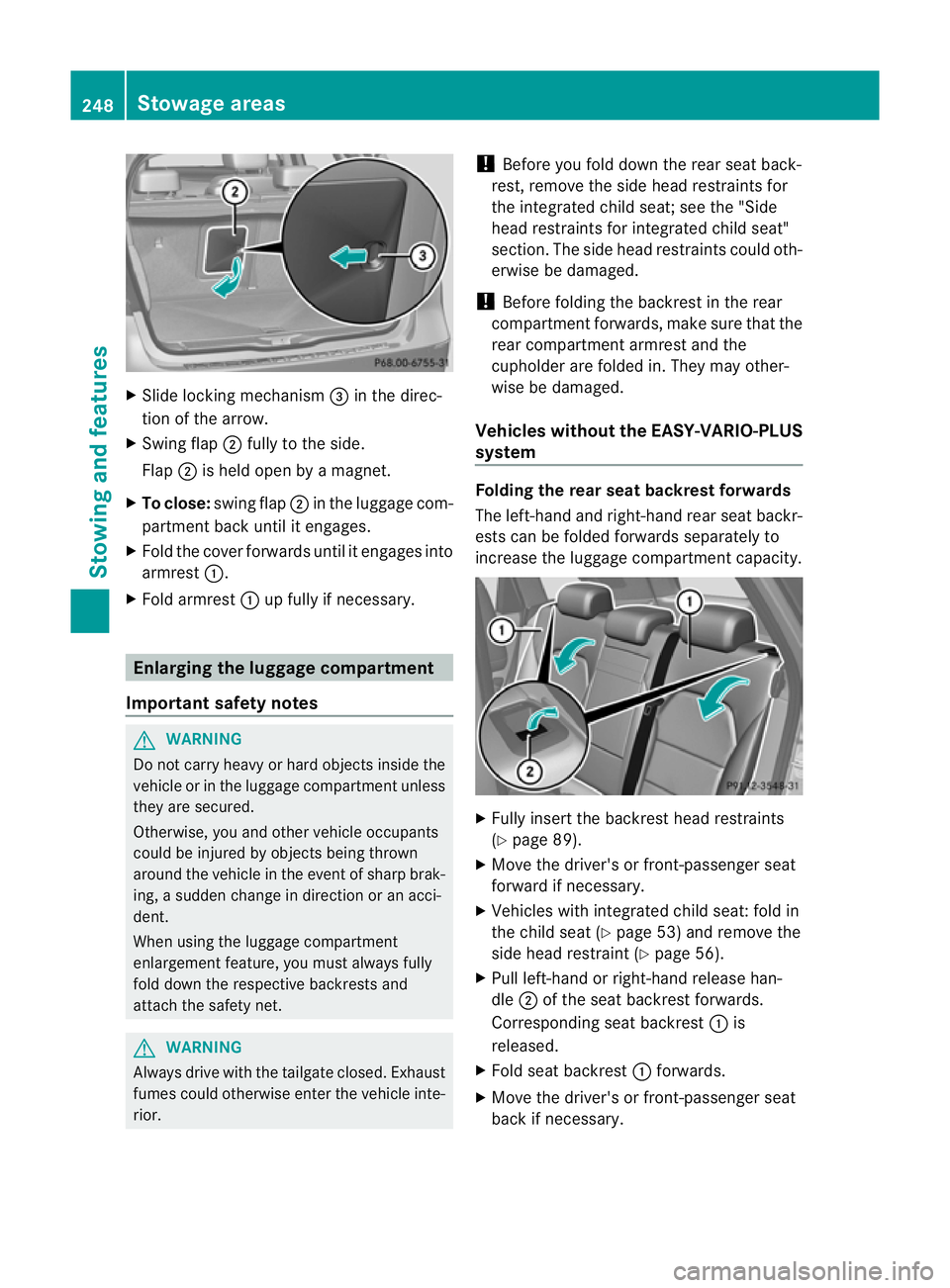
X
Slide locking mechanism =in the direc-
tion of the arrow.
X Swing flap ;fully to the side.
Flap ;is held ope nby a magnet.
X To close: swing flap ;in the luggage com-
partmen tback until it engages.
X Fold the cover forwards until it engages into
armrest :.
X Fold armrest :up fully if necessary. Enlarging the luggage compartment
Important safety notes G
WARNING
Do no tcarry heavy or hard objects inside the
vehicle or in the luggage compartmen tunless
they are secured.
Otherwise, you and othe rvehicle occupants
could be injured by objects being thrown
around the vehicle in the event of sharp brak-
ing, a sudden change in direction or an acci-
dent.
When using the luggage compartment
enlargemen tfeature, you must always fully
fold down the respective backrests and
attach the safety net. G
WARNING
Always drive with the tailgate closed. Exhaust
fumes could otherwise enter the vehicle inte-
rior. !
Before you fold down the rear seat back-
rest, remove the side head restraints for
the integrated child seat; see the "Side
head restraints for integrated child seat"
section. The side head restraints could oth-
erwise be damaged.
! Before folding the backrest in the rear
compartment forwards, make sure that the
rear compartment armrest and the
cupholder are folded in. They may other-
wise be damaged.
Vehicles without the EASY-VARIO-PLUS
system Folding the rear seat backrest forwards
The left-hand and right-hand rear seat backr-
ests can be folded forwards separately to
increase the luggage compartment capacity. X
Fully insert the backrest head restraints
(Y page 89).
X Move the driver's or front-passenger seat
forward if necessary.
X Vehicles with integrated child seat: fold in
the child seat (Y page 53) and remove the
side head restraint (Y page 56).
X Pull left-hand or right-hand release han-
dle ;of the seat backrest forwards.
Corresponding seat backrest :is
released.
X Fold seat backrest :forwards.
X Move the driver's or front-passenger seat
back if necessary. 248
Stowage areasStowing and features
Page 256 of 329
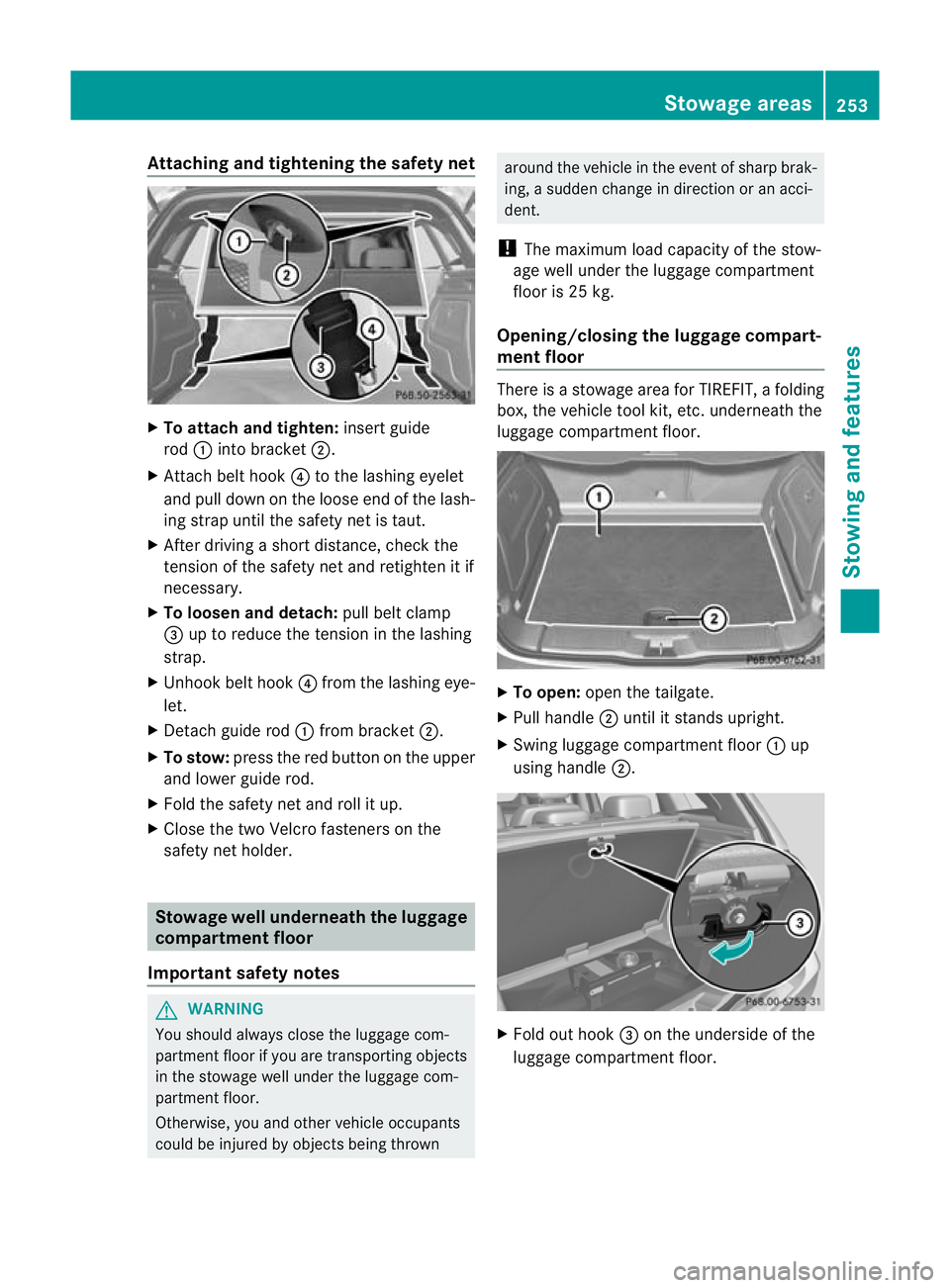
Attaching and tightening the safety net
X
To attach and tighten: insert guide
rod :into bracket ;.
X Attach belt hook ?to the lashing eyelet
and pull down on the loos eend of the lash-
ing strap until the safety net is taut.
X After driving a short distance, check the
tension of the safety net and retighten it if
necessary.
X To loosen and detach: pull belt clamp
= up to reduce the tension in the lashing
strap.
X Unhook belt hook ?from the lashing eye-
let.
X Detach guide rod :from bracket ;.
X To stow: press the red button on the upper
and lowe rguide rod.
X Fold the safety ne tand roll it up.
X Close the two Velcro fasteners on the
safety net holder. Stowage well underneath the luggage
compartment floor
Important safety notes G
WARNING
You should always close the luggage com-
partment floor if you are transporting objects
in the stowage well under the luggage com-
partment floor.
Otherwise, you and othe rvehicle occupants
could be injured by objects being thrown around the vehicle in the event of sharp brak-
ing, a sudden change in direction or an acci-
dent.
! The maximum load capacity of the stow-
age well under the luggage compartment
floor is 25 kg.
Opening/closing the luggage compart-
ment floor There is a stowage area for TIREFIT, a folding
box, the vehicle tool kit, etc.u
nderneath the
luggage compartment floor. X
To open: open the tailgate.
X Pull handle ;until it stands upright.
X Swing luggage compartment floor :up
using handle ;. X
Fold ou thook =on the underside of the
luggage compartment floor. Stowage areas
253Stowing and features Z
Page 257 of 329
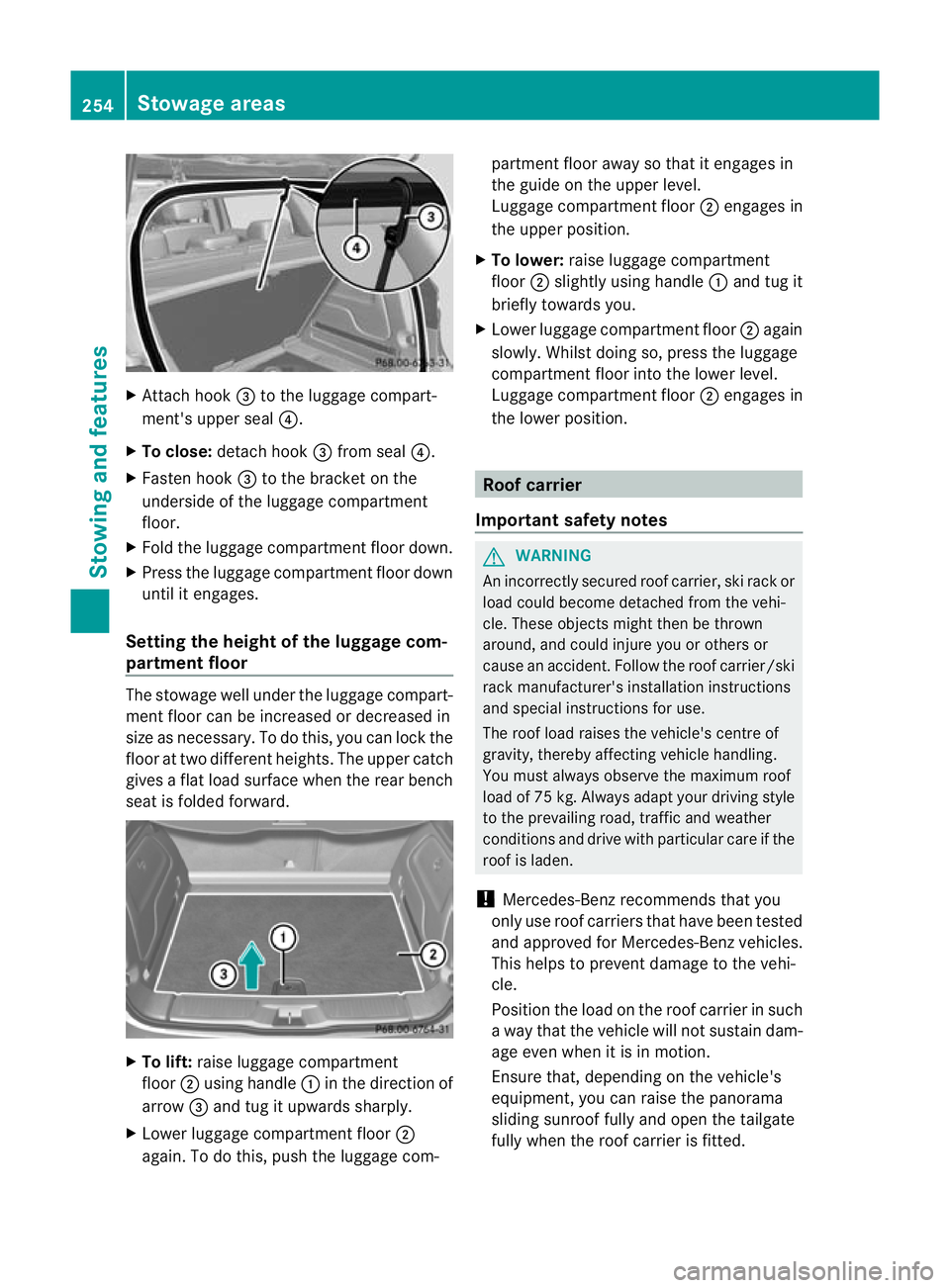
X
Attach hook =to the luggage compart-
ment's uppe rseal ?.
X To close: detach hook =from seal ?.
X Fasten hook =to the bracket on the
underside of the luggage compartment
floor.
X Fold the luggage compartment floor down.
X Press the luggage compartment floor down
until it engages.
Setting the height of the luggage com-
partment floor The stowage well under the luggage compart-
ment floor can be increased or decreased in
size as necessary. To do this, you can lock the
floor at two differen
theights. The upper catch
gives a flat load surface when the rear bench
seat is folded forward. X
To lift: raise luggage compartment
floor ;using handle :in the direction of
arrow =and tug it upwards sharply.
X Lower luggage compartment floor ;
again. To do this, push the luggage com- partmen
tfloor away so that it engages in
the guide on the upper level.
Luggage compartmen tfloor ;engages in
the upper position.
X To lower: raise luggage compartment
floor ;slightly using handle :and tug it
briefly towards you.
X Lower luggage compartmen tfloor ;again
slowly. Whilst doing so, press the luggage
compartmen tfloor into the lower level.
Luggage compartmen tfloor ;engages in
the lower position. Roof carrier
Important safety notes G
WARNING
An incorrectly secured roof carrier, ski rack or
load could become detached fro mthe vehi-
cle. These objects might then be thrown
around, and could injure you or others or
cause an accident. Follow the roof carrier/ski
rack manufacturer's installation instructions
and special instructions for use.
The roof load raises the vehicle's centre of
gravity, thereby affecting vehicle handling.
You must always observe the maximum roof
load of 75 kg .Always adapt your driving style
to the prevailing road, traffic and weather
conditions and drive with particular care if the
roof is laden.
! Mercedes-Ben zrecommends that you
only use roof carriers that have been tested
and approved for Mercedes-Benzv ehicles.
This helps to preven tdamage to the vehi-
cle.
Positio nthe load on the roof carrier in such
a way that the vehicle will not sustain dam-
age even when it is in motion.
Ensure that, depending on the vehicle's
equipment, you can raise the panorama
sliding sunroof fully and open the tailgate
fully when the roof carrier is fitted. 254
Stowage areasStowing and features
Page 277 of 329
Useful information
i This Owner's Manual describes all models
and all standard and optional equipment
available to your vehicle at the time of pub-
lication of the Owner's Manual. Country-
specific deviations are possible. Please
note that your vehicle may not be equipped
with all features described. This also
applies to safety-relevan tsystems and
functions.
i Please read the information on qualified
specialist workshops (Y page 22).Where will I find...?
Warning triangle
Removing/replacing the warning trian-
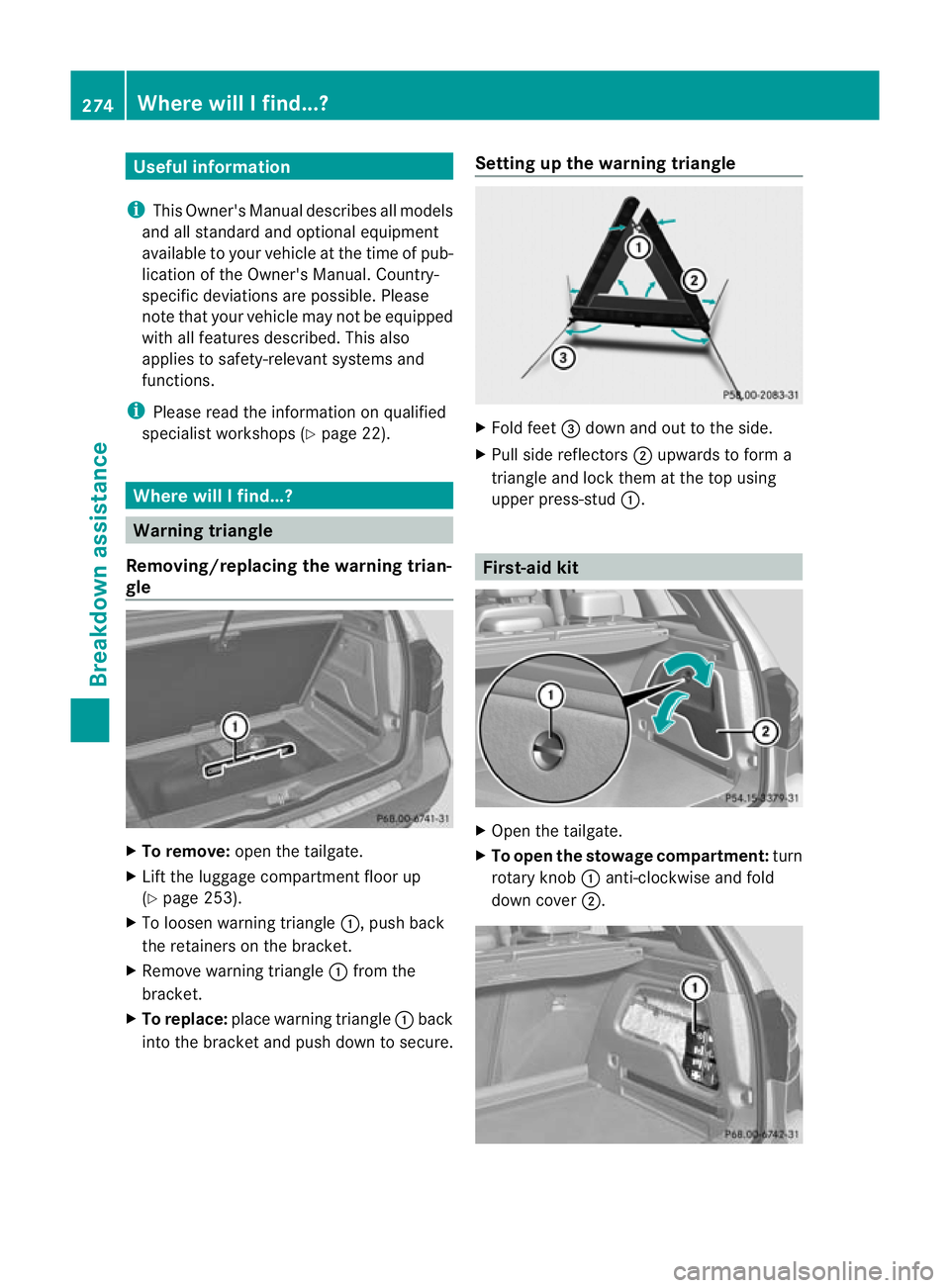
gle X
To remove: openthe tailgate.
X Lift the luggage compartmentf loor up
(Y page 253).
X To loosen warning triangle :, push back
the retainers on the bracket.
X Remove warning triangle :from the
bracket.
X To replace: place warning triangle :back
into the bracket and push down to secure. Setting up the warning triangle
X
Fold feet =down and out to the side.
X Pull side reflectors ;upwards to form a
triangle and lock the matthe top using
upper press-stud :. First-aid kit
X
Open the tailgate.
X To open the stowage compartment: turn
rotary knob :anti-clockwise and fold
down cover ;.274
Where will I find...?Breakdown assistance
Page 278 of 329
X
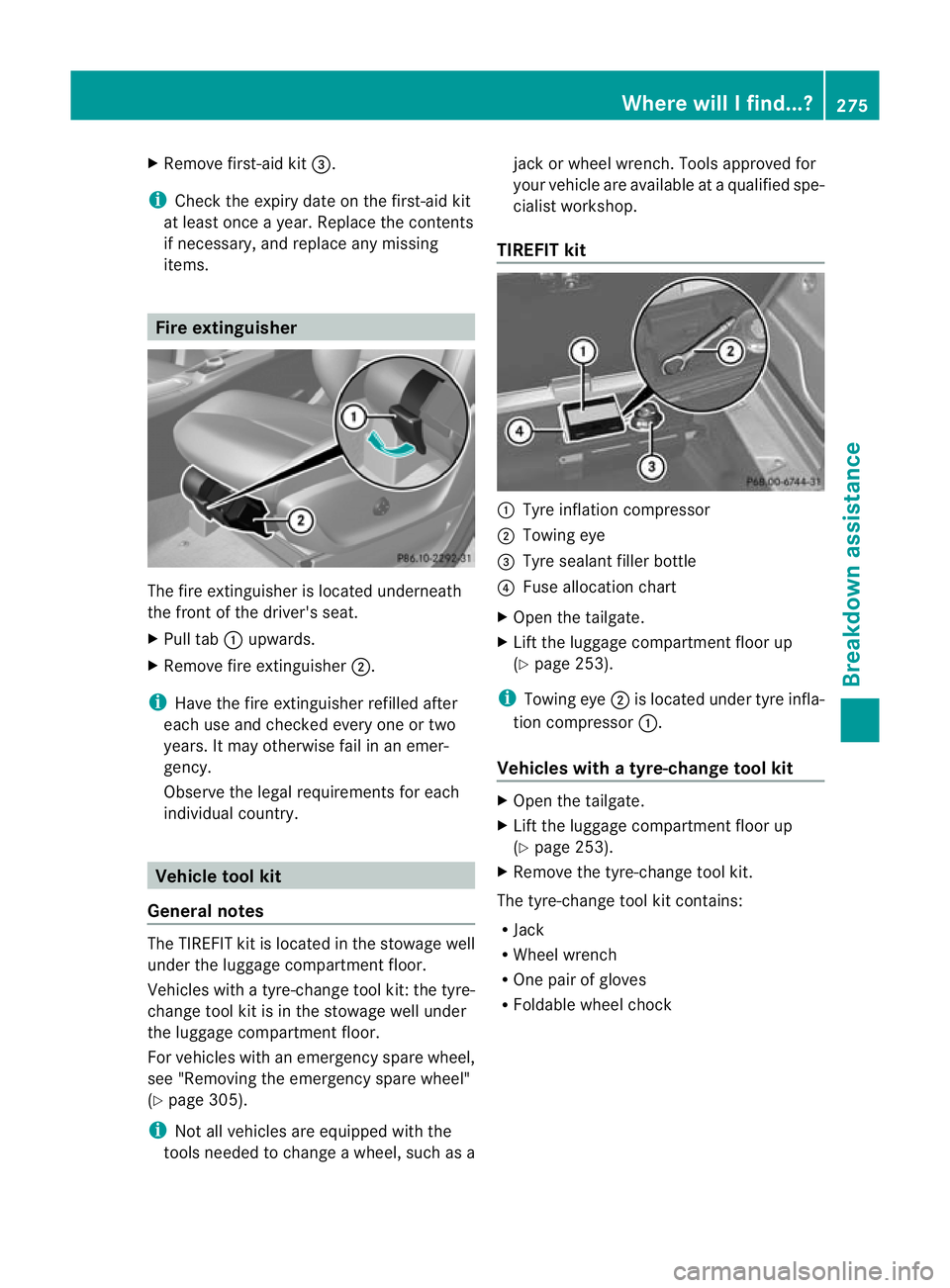
Remove first-aid kit =.
i Chec kthe expiry date on the first-aid kit
at least once a year. Replace the contents
if necessary, and replace any missing
items. Fire extinguisher
The fire extinguisher is located underneath
the front of the driver's seat.
X
Pull tab :upwards.
X Remove fire extinguisher ;.
i Have the fire extinguisher refilled after
each use and checked every one or two
years. It may otherwise fail in an emer-
gency.
Observe the legal requirements for each
individual country. Vehicle tool kit
General notes The TIREFIT kit is located in the stowage well
under the luggage compartmentf loor.
Vehicles with a tyre-change tool kit :the tyre-
change tool kit is in the stowage well under
the luggage compartmentf loor.
For vehicles with an emergency spare wheel,
see "Removing the emergency spare wheel"
(Y page 305).
i Not all vehicles are equipped with the
tools needed to change a wheel, such as a jac
korw heel wrench. Tools approved for
your vehicle are available at a qualified spe-
cialist workshop.
TIREFIT kit :
Tyre inflation compressor
; Towing eye
= Tyre sealant filler bottle
? Fuse allocation chart
X Open the tailgate.
X Lift the luggage compartmentf loor up
(Y page 253).
i Towing eye ;is located under tyre infla-
tion compressor :.
Vehicles with a tyre-change tool kit X
Open the tailgate.
X Lift the luggage compartmen tfloor up
(Y page 253).
X Remove the tyre-change tool kit.
The tyre-change tool kit contains:
R Jack
R Wheel wrench
R One pair of gloves
R Foldable wheel chock Where will I find...?
275Breakdown assistance
Page 303 of 329
The following must be observed when raising
the vehicle:
R
to raise the vehicle, only use the vehicle-
specific jack that has been tested and
approved by Mercedes-Benz.Ifu sed incor-
rectly, the jack could tip over with the vehi-
cle raised.
R the jack is designed only to raise and hold
the vehicle for a short time while a wheel
is being changed. It is not suited for per-
forming maintenance work under the vehi-
cle.
R avoid changing the wheel on uphill and
downhill slopes.
R before raising the vehicle, secure it from
rolling away by applying the parking brake
and inserting wheel chocks. Never disen-
gage the parking brake while the vehicle is
raised.
R the jack must be placed on a firm, flat and
non-slip surface. On a loose surface, a
large, load-bearing underlay must be used.
On a slippery surface, a non-slip underlay
must be used, e.g. rubber mats.
R do not use wooden blocks or similar
objects as a jack underlay.O therwise, the
jack will not be able to achieve its load-
bearing capacity due to the restricted
height.
R make sure tha tthe distance between the
underside of the tyres and the ground does
not exceed 3 cm.
R never place your hands and feet under the
raised vehicle.
R never lie under the raised vehicle.
R never start the engine when the vehicle is
raised.
R never open or close a door or the tailgate
when the vehicle is raised.
R make sure that no persons are present in
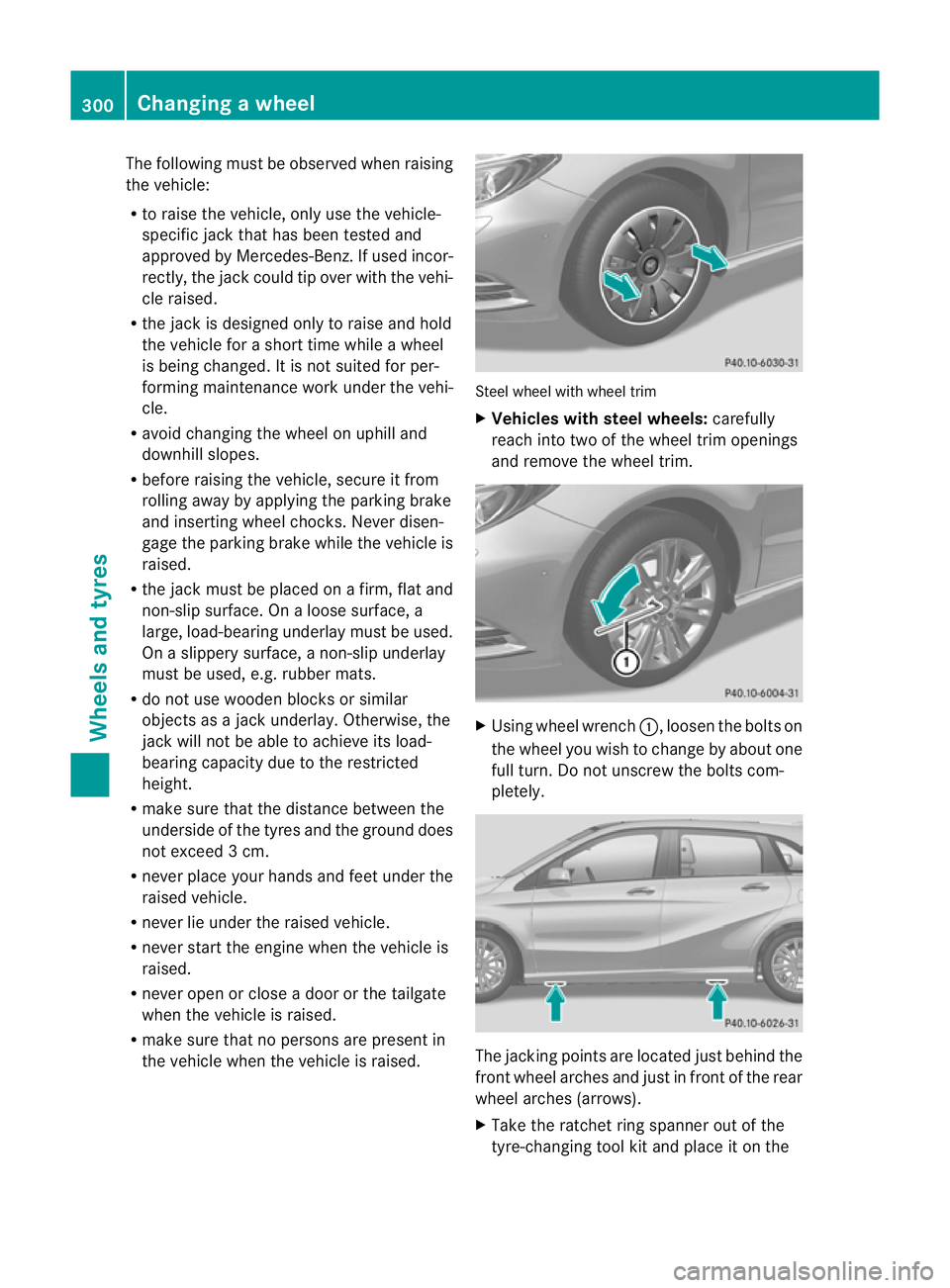
the vehicle when the vehicle is raised. Steel wheel with wheel trim
X Vehicles with steel wheels: carefully
reach into two of the wheel trim openings
and remove the wheel trim. X
Using wheel wrench :, loosen the bolts on
the wheel you wish to change by about one
full turn. Do not unscrew the bolts com-
pletely. The jacking points are located just behind the
front wheel arches and just in front of the rear
wheel arches (arrows).
X Take the ratchet ring spanner out of the
tyre-changing tool kit and place it on the 300
Changing
awheelWheels and tyres