weight MERCEDES-BENZ B-CLASS HATCHBACK 2014 Owner's Manual
[x] Cancel search | Manufacturer: MERCEDES-BENZ, Model Year: 2014, Model line: B-CLASS HATCHBACK, Model: MERCEDES-BENZ B-CLASS HATCHBACK 2014Pages: 405, PDF Size: 12.24 MB
Page 348 of 405
Details on the permissible gross vehicle
weight of your vehicle can be found on the
vehicle identification plate (Y page 386).
! When COLLISION PREVENTION ASSIST
PLUS, DISTRONIC PLUS or the HOLD func- tion is activated, the vehicle brakes auto-
matically in certain situations. To avoid
damage to the vehicle, deactivate these
systems in the following or similar situa-
tions:
R when towing away
R in a car wash
! Make sure that the electric parking brake
is released. If the electric parking brake is
faulty, visit a qualified specialist workshop.
! Only secure the tow cable or tow bar to
the towing eyes or, if available, to the trailer
tow hitch. You could otherwise damage the
vehicle.
! Observe the following points when towing
with a tow rope:
R Secure the tow rope on the same side on
both vehicles.
R Make sure that the tow rope is not longer
than legally permitted. Mark the tow rope
in the middle, e.g. with a white cloth
(30 x 30 cm). This will make other road
users aware that a vehicle is being
towed.
R Only secure the tow cable to the towing
eyes or, if available, to the trailer tow
hitch.
R Observe the brake lamps of the towing
vehicle while driving. Always maintain a
distance a distance so that the tow rope does not sag.
R Do not use steel cables or chains to tow
your vehicle. You could otherwise dam-
age the vehicle.
! Do not use the towing eyes for recovery
purposes as this could damage the vehicle.
If in doubt, recover the vehicle with a crane. !
Pull away smoothly when towing away or
tow-starting a vehicle. If the tractive power
is too high, the vehicles could be damaged.
! You may tow the vehicle for a maximum of
50km. A towing speed of 50 km/h must not be exceeded.
For towing distances over 50 km, the frontaxle or the entire vehicle must be raised
and transported.
! To tow vehicles with KEYLESS-GO, use
the key instead of the Start/Stop button.
The automatic transmission may otherwise switch to position Pwhen you open the
driver's or front-passenger door which
could damage the transmission.
! Vehicles with automatic transmission
must not be tow-started. The transmission
may otherwise be damaged.
Observe the legal requirements for the rele-
vant countries when towing and tow-starting.
It is better to have the vehicle transported
than to have it towed.
If the vehicle can no longer be driven because
of an accident or breakdown, you have the
following options:
R Transporting the vehicle.
As a rule, you should have the vehicle trans-
ported.
R Towing the vehicle with a tow rope or tow
bar.
Only tow the vehicle in exceptional cases.
Vehicles with automatic transmission:
when towing a vehicle, the transmission must be in position N.
The battery must be connected and charged.
Otherwise, you:
R cannot turn the key to position 2in the
ignition lock
R cannot release the electric parking brake
R cannot shift the transmission to position N
on vehicles with automatic transmis-
sion Towing away and tow-starting
345Breakdown assistance Z
Page 389 of 405
Identification plates
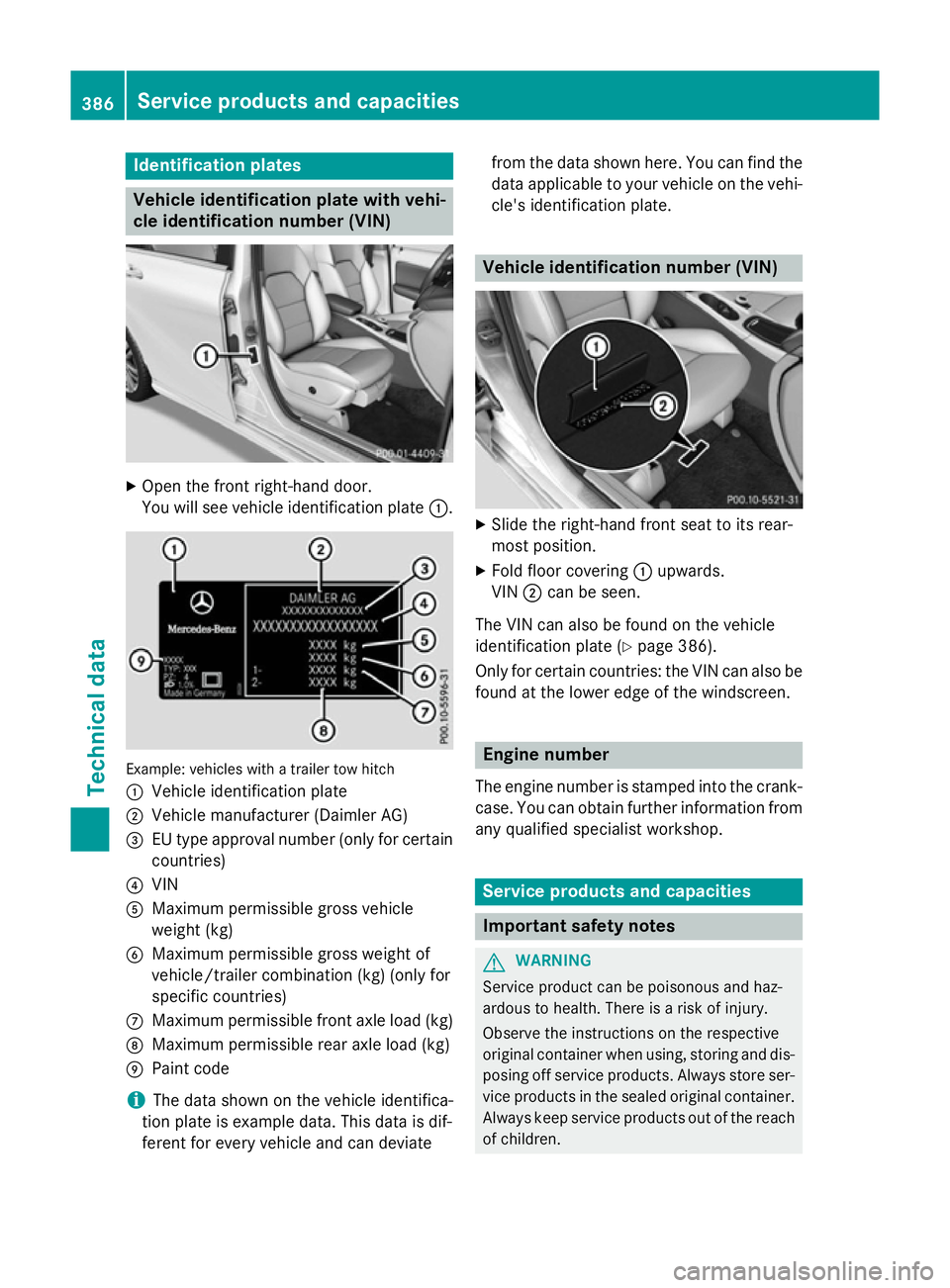
Vehicle identification plate with vehi-
cle identification number (VIN) X
Open the front right-hand door.
You will see vehicle identification plate :.Example: vehicles with a trailer tow hitch
: Vehicle identification plate
; Vehicle manufacturer (Daimler AG)
= EU type approval number (only for certain
countries)
? VIN
A Maximum permissible gross vehicle
weight (kg)
B Maximum permissible gross weight of
vehicle/trailer combination (kg) (only for
specific countries)
C Maximum permissible front axle load (kg)
D Maximum permissible rear axle load (kg)
E Paint code
i The data shown on the vehicle identifica-
tion plate is example data. This data is dif-
ferent for every vehicle and can deviate from the data shown here. You can find the
data applicable to your vehicle on the vehi- cle's identification plate. Vehicle identification number (VIN)
X
Slide the right-hand front seat to its rear-
most position.
X Fold floor covering :upwards.
VIN ;can be seen.
The VIN can also be found on the vehicle
identification plate (Y page 386).
Only for certain countries: the VIN can also be
found at the lower edge of the windscreen. Engine number
The engine number is stamped into the crank-
case. You can obtain further information from any qualified specialist workshop. Service products and capacities
Important safety notes
G
WARNING
Service product can be poisonous and haz-
ardous to health. There is a risk of injury.
Observe the instructions on the respective
original container when using, storing and dis- posing off service products. Always store ser-
vice products in the sealed original container. Always keep service products out of the reach
of children. 386
Service products and capacitiesTechnical data
Page 396 of 405
The antifreeze/corrosion inhibitor concentra-
tion in the engine cooling system should:
R be at least 50%. This will protect the engine
cooling system against freezing down to
approximately -37 †.
R not exceed 55% (antifreeze protection
down to -45 †). Heat will otherwise not be
dissipated as effectively.
Mercedes-Benz recommends coolant or anti- freeze/corrosion inhibitor concentrate in
accordance with
MB Specifications for Service Products 310.1
.
i When the vehicle is first delivered, it is fil-
led with a coolant mixture that ensures
adequate antifreeze and corrosion protec-
tion.
i The coolant is checked at every mainte-
nance interval at a qualified specialist
workshop. Windscreen washer system and head-
lamp cleaning system
Important safety notes G
WARNING
If windscreen washer concentrate comes into contact with hot components of the engine or
the exhaust system, it can ignite. There is a
risk of fire and injury.
Make sure the windscreen washer concen-
trate does not come into contact with the filler neck.
! Do not use distilled or de-ionised water in
the washer fluid reservoir. Otherwise, the
level sensor may be damaged.
! Only the washer fluids SummerFit and
WinterFit can be mixed. Otherwise, the
spraying nozzles could become blocked.
When handling washer fluid, observe the
important safety notes on service products
(Y page 386). At temperatures above freezing:
X Fill the washer fluid reservoir with a mixture
of water and washer fluid, e.g. MB Sum-
merFit.
Mix 1 part MB SummerFit to 100 parts water.
At temperatures below freezing:
X Fill the washer fluid reservoir with a mixture
of water and washer fluid, e.g. MB Winter-
Fit.
For the correct mixing ratio refer to the
information on the antifreeze reservoir.
i Add washer fluid concentrate, e.g. MB
SummerFit or MB WinterFit, to the washer
fluid all year round. Vehicle data
General notes
Please note that for the specified vehicle
data: R the heights specified may vary as a result
of:
- tyres
- load
- condition of the suspension
- optional equipment
R optional equipment reduces the maximum
payload.
R vehicle-specific weight information can be
found on the vehicle identification plate
(Y page 386).
R only for certain countries: you can find vehi-
cle-specific vehicle data in the COC docu-
ments (CERTIFICATE OF CONFORMITY).
These documents are delivered with your
vehicle. Vehicle data
393Technical data Z
Page 397 of 405
Dimensions and weights
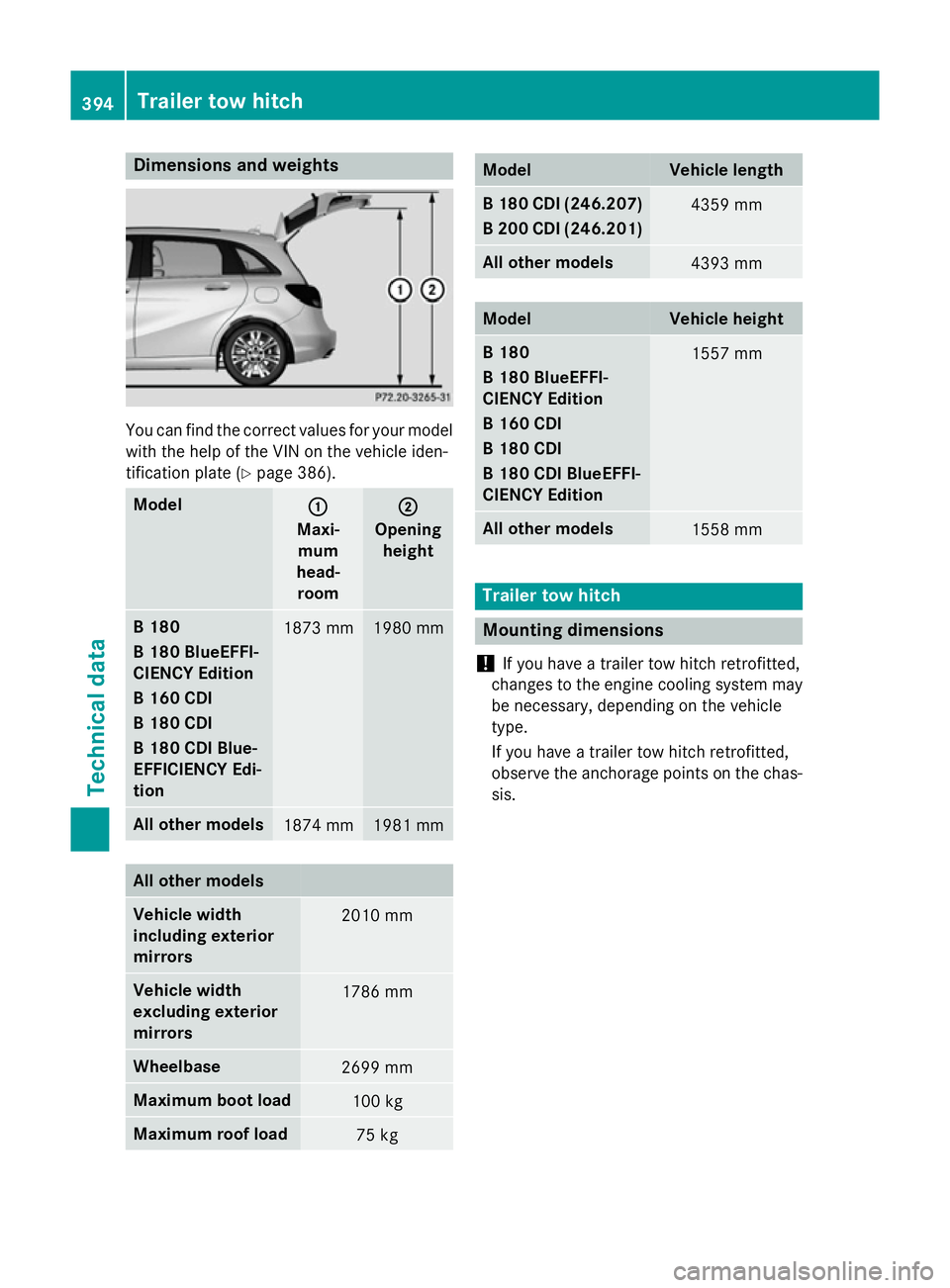
You can find the correct values for your model
with the help of the VIN on the vehicle iden-
tification plate (Y page 386). Model
: :
Maxi- mum
head- room ;
;
Opening height B 180
B 180 BlueEFFI-
CIENCY Edition
B 160 CDI
B 180 CDI
B 180 CDI Blue-
EFFICIENCY Edi-
tion
1873 mm 1980 mm
All other models
1874 mm 1981 mm
All other models
Vehicle width
including exterior
mirrors
2010 mm
Vehicle width
excluding exterior
mirrors
1786 mm
Wheelbase
2699 mm
Maximum boot load
100 kg
Maximum roof load
75 kg Model Vehicle length
B 180 CDI (246.207)
B 200 CDI (246.201) 4359 mm
All other models
4393 mm
Model Vehicle height
B 180
B 180 BlueEFFI-
CIENCY Edition
B 160 CDI
B 180 CDI
B 180 CDI BlueEFFI-
CIENCY Edition
1557 mm
All other models
1558 mm
Trailer tow hitch
Mounting dimensions
! If you have a trailer tow hitch retrofitted,
changes to the engine cooling system may
be necessary, depending on the vehicle
type.
If you have a trailer tow hitch retrofitted,
observe the anchorage points on the chas- sis. 394
Trailer tow hitchTe
chnical da ta
Page 400 of 405
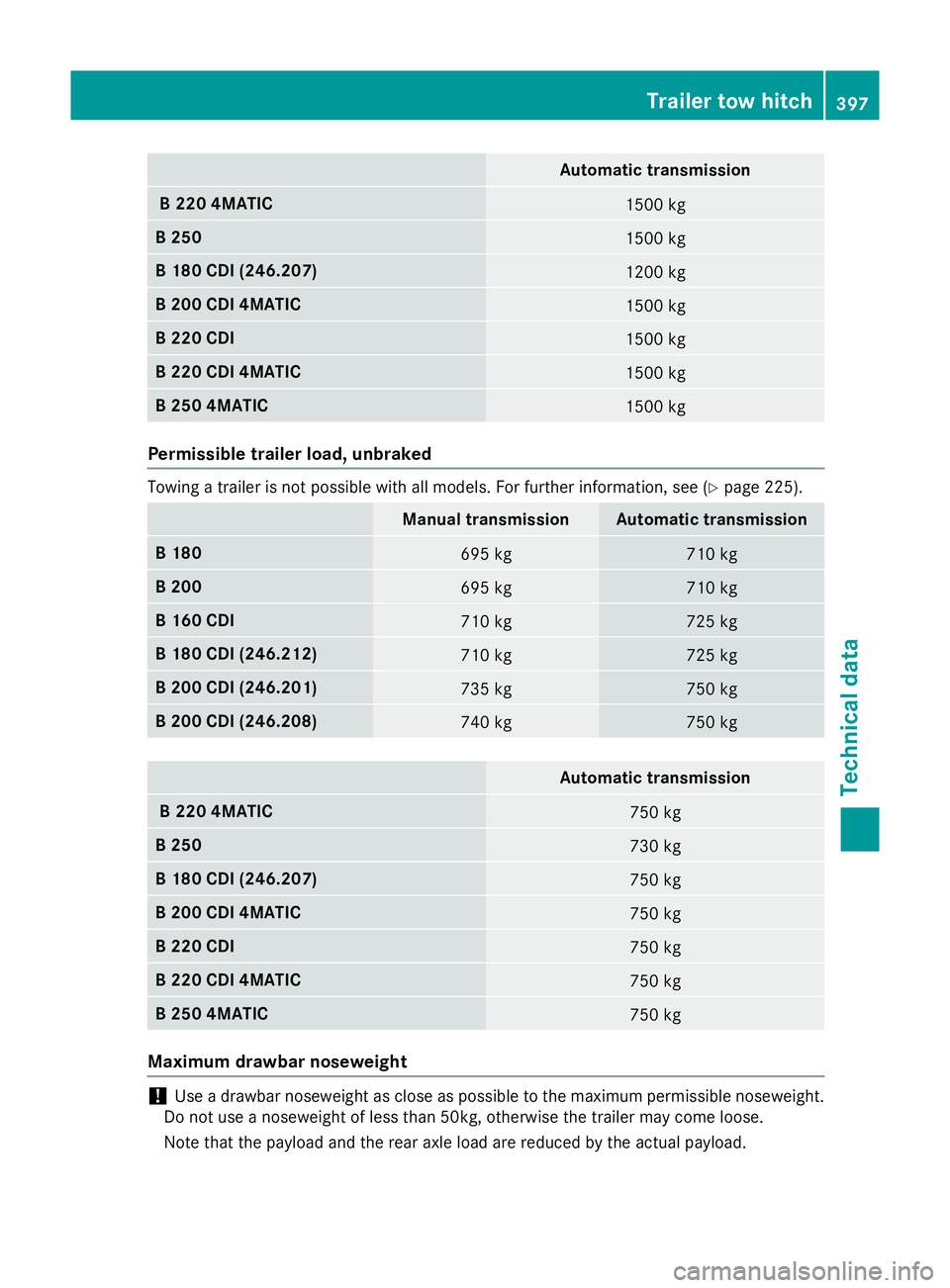
Automatic transmission
B 220 4MATIC
1500 kg
B 250
1500 kg
B 180 CDI (246.207)
1200 kg
B 200 CDI 4MATIC
1500 kg
B 220 CDI
1500 kg
B 220 CDI 4MATIC
1500 kg
B 250 4MATIC
1500 kg
Permissible trailer load, unbraked
Towing a trailer is not possible with all models. For further information, see (Y
page 225).Manual transmission Automatic transmission
B 180
695 kg 710 kg
B 200
695 kg 710 kg
B 160 CDI
710 kg 725 kg
B 180 CDI (246.212)
710 kg 725 kg
B 200 CDI (246.201)
735 kg 750 kg
B 200 CDI (246.208)
740 kg 750 kg
Automatic transmission
B 220 4MATIC
750 kg
B 250
730 kg
B 180 CDI (246.207)
750 kg
B 200 CDI 4MATIC
750 kg
B 220 CDI
750 kg
B 220 CDI 4MATIC
750 kg
B 250 4MATIC
750 kg
Maximum drawbar noseweight
!
Use a drawbar noseweight as close as possible to the maximum permissible noseweight.
Do not use a noseweight of less than 50kg, otherwise the trailer may come loose.
Note that the payload and the rear axle load are reduced by the actual payload. Trailer tow hitch
397Technical data Z
Page 401 of 405
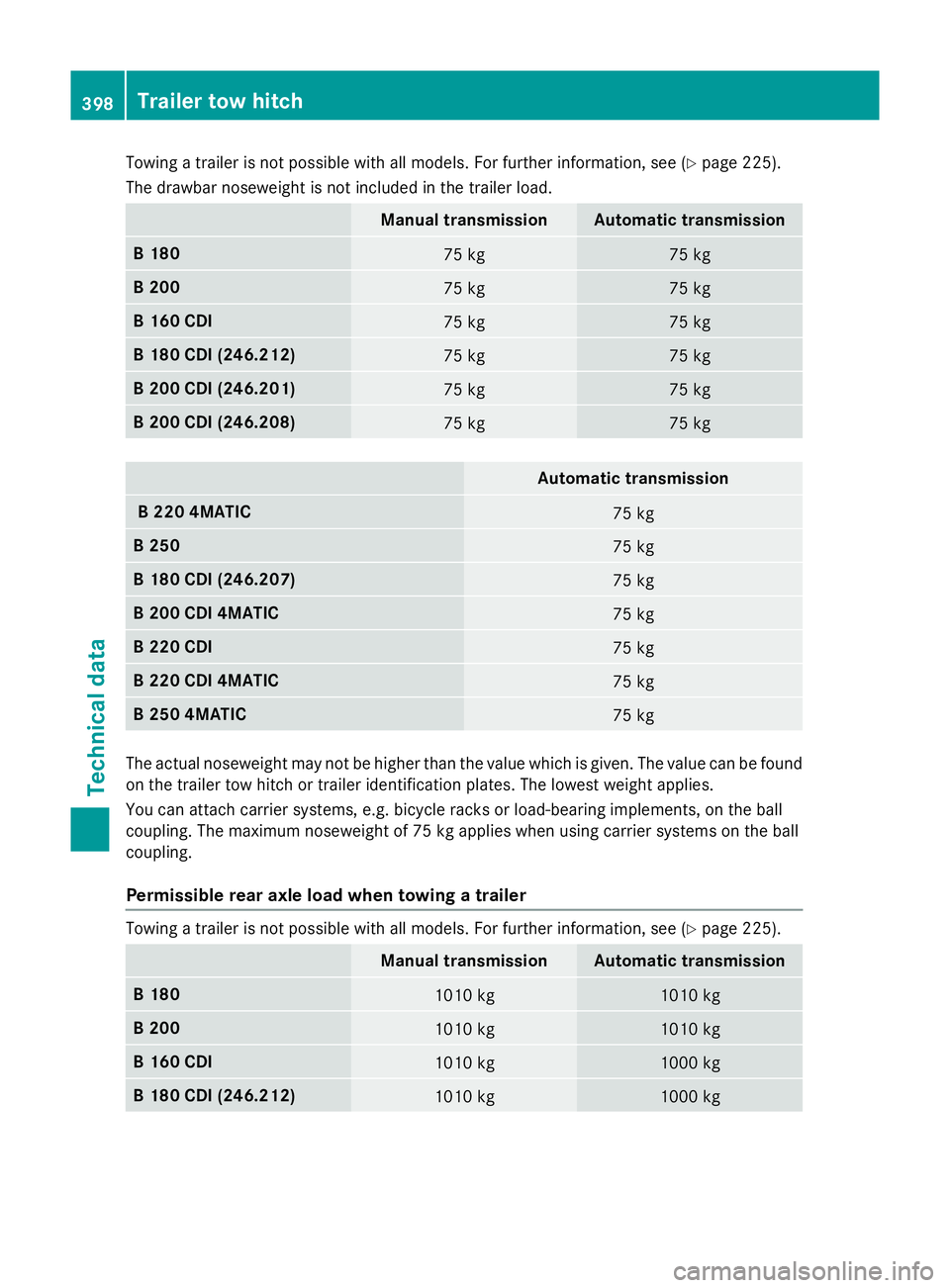
Towing a trailer is not possible with all models. For further information, see (Y
page 225).
The drawbar noseweight is not included in the trailer load. Manual transmission Automatic transmission
B 180
75 kg 75 kg
B 200
75 kg 75 kg
B 160 CDI
75 kg 75 kg
B 180 CDI (246.212)
75 kg 75 kg
B 200 CDI (246.201)
75 kg 75 kg
B 200 CDI (246.208)
75 kg 75 kg
Automatic transmission
B 220 4MATIC
75 kg
B 250
75 kg
B 180 CDI (246.207)
75 kg
B 200 CDI 4MATIC
75 kg
B 220 CDI
75 kg
B 220 CDI 4MATIC
75 kg
B 250 4MATIC
75 kg
The actual noseweight may not be higher than the value which is given. The value can be found
on the trailer tow hitch or trailer identification plates. The lowest weight applies.
You can attach carrier systems, e.g. bicycle racks or load-bearing implements, on the ball
coupling. The maximum noseweight of 75 kg applies when using carrier systems on the ball
coupling.
Permissible rear axle load when towing a trailer Towing a trailer is not possible with all models. For further information, see (Y
page 225).Manual transmission Automatic transmission
B 180
1010 kg 1010 kg
B 200
1010 kg 1010 kg
B 160 CDI
1010 kg 1000 kg
B 180 CDI (246.212)
1010 kg 1000 kg398
Trailer tow hitchTechnical data