engine MERCEDES-BENZ B-CLASS SPORTS 2014 User Guide
[x] Cancel search | Manufacturer: MERCEDES-BENZ, Model Year: 2014, Model line: B-CLASS SPORTS, Model: MERCEDES-BENZ B-CLASS SPORTS 2014Pages: 360, PDF Size: 39.45 MB
Page 21 of 360
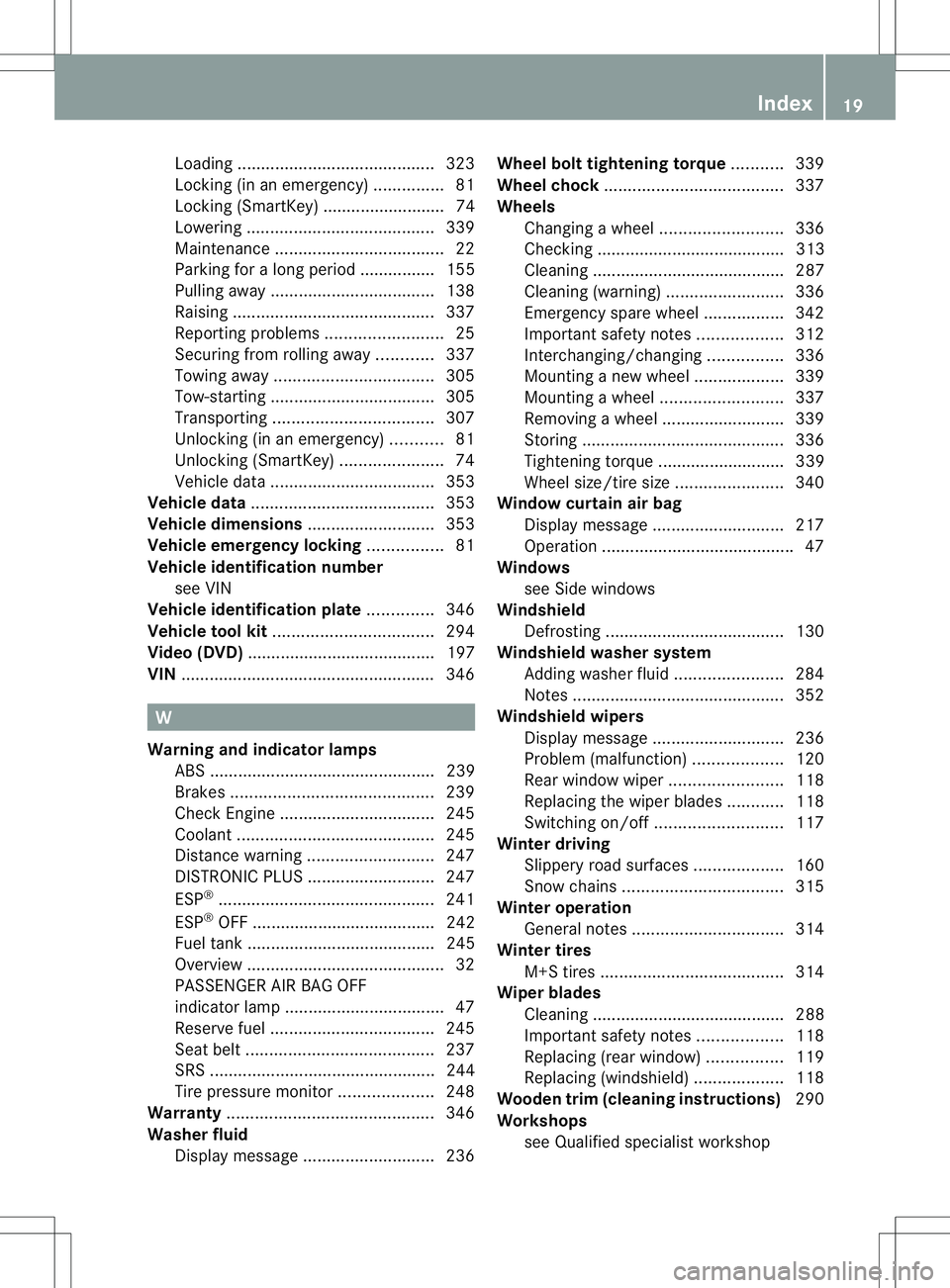
Loading
.......................................... 323
Locking (in an emergency) ...............81
Locking (SmartKey) .......................... 74
Lowering ........................................ 339
Maintenance .................................... 22
Parking for along period ................ 155
Pulling away ................................... 138
Raising ........................................... 337
Reporting problems .........................25
Securing from rolling away ............337
Towing away .................................. 305
Tow-starting ................................... 305
Transporting .................................. 307
Unlocking (in an emergency) ...........81
Unlocking (SmartKey) ......................74
Vehicle data ................................... 353
Vehicle data ....................................... 353
Vehicle dimensions ...........................353
Vehicle emergency locking ................81
Vehicle identification number see VIN
Vehicle identification plate ..............346
Vehicle tool kit .................................. 294
Video (DVD) ........................................ 197
VIN ...................................................... 346W
Warning and indicator lamps ABS ................................................ 239
Brakes ........................................... 239
Check Engine ................................. 245
Coolant .......................................... 245
Distance warning ........................... 247
DISTRONI CPLUS ........................... 247
ESP ®
.............................................. 241
ESP ®
OFF ....................................... 242
Fuel tank ........................................ 245
Overview .......................................... 32
PASSENGER AIR BAG OFF
indicator lamp .................................. 47
Reserve fuel ................................... 245
Seat bel t........................................ 237
SRS ................................................ 244
Tire pressure monitor ....................248
Warranty ............................................ 346
Washer fluid Display message ............................ 236Whee
lboltt ightening torque ...........339
Whee lchock ...................................... 337
Wheels Changing awheel .......................... 336
Checking ........................................ 313
Cleaning ......................................... 287
Cleaning (warning) .........................336
Emergency spare wheel .................342
Important safety notes ..................312
Interchanging/changing ................336
Mounting anew wheel ................... 339
Mounting awheel .......................... 337
Removing awheel .......................... 339
Storing ........................................... 336
Tightening torqu e........................... 339
Whee lsize/tir esize ....................... 340
Windo wcurtain air bag
Display message ............................ 217
Operation ........................................ .47
Windows
see Side windows
Windshield
Defrosting ...................................... 130
Windshiel dwasher system
Adding washer fluid .......................284
Notes ............................................. 352
Windshiel dwipers
Display message ............................ 236
Problem (malfunction) ...................120
Rea rwindow wiper ........................ 118
Replacing the wiper blades ............118
Switching on/off ........................... 117
Winte rdriving
Slippery roa dsurface s................... 160
Snow chains .................................. 315
Winte roperation
General notes ................................ 314
Winte rtires
M+S tires ....................................... 314
Wiper blades
Cleaning ......................................... 288
Important safety notes ..................118
Replacing (rea rwindow) ................ 119
Replacing (windshield )................... 118
Wooden trim (cleaning instructions) 290
Workshops see Qualified specialist workshop Index
19
Page 23 of 360
Protection of the environment
General notes
H
Environmental note
Daimler's declared policy is one of
comprehensive environmental protection.
The objectives are for the natural resources
that form the basis of our existence on this
planet to be used sparingly and in amanner
that takes the requirements of both nature
and humanity into account.
You too can help to protect the environment
by operating your vehicle in an
environmentally responsible manner.
Fuel consumption and the rate of engine,
transmission, brake and tire wear are affected
by these factors:
R operating condition sofyour vehicle
R your personal driving style
You can influence both factors. You should
bear the following in mind:
Operating conditions:
R avoid short trips as these increase fuel
consumption.
R always make sure that the tire pressures
are correct.
R do not carry any unnecessary weight.
R remove roof racks once you no longer need
them.
R ar egularly serviced vehicle will contribute
to environmental protection. You should
therefore adhere to the service intervals.
R always have service work carried out at a
qualified specialist workshop.
Personal driving style:
R do not depress the accelerator pedal when
startingt he engine.
R do not warm up the engine when the vehicle
is stationary.
R drive carefully and maintain asafe distance
from the vehicle in front.
R avoid frequent, sudden acceleration and
braking. R
change gear in good time and use each gear
only up to 001Bof its maximum engine speed.
R switch off the engine in stationary traffic.
R keep an eye on the vehicle's fuel
consumption. Environmental concerns and
recommendations
Wherever the operating instructions require
you to dispose of materials, first try to
regenerate or re-use them. Observe the
relevant environmental rules and regulations
when disposing of materials. In this way you
will help to protect the environment. Genuine Mercedes-Benz parts
H
Environmental note
Daimler AG also suppliesr econditioned major
assemblies and parts which are of the same
quality as new parts. They are covered by the
same Limited Warranty entitlements as new
parts.
! Air bags and Emergency Tensioning
Devices, as well as control units and
sensors for these restraint systems, may be
installed in the following areas of your
vehicle:
R doors
R door pillars
R door sills
R seats
R cockpit
R instrumen tcluster
R center console
Do not install accessories such as audio
systems in these areas. Do not carry out
repairs or welding. You could impair the
operating efficienc yofthe restraint
systems. Introduction
21 Z
Page 25 of 360
Roadside Assistance
The Mercedes-Benz Roadsid eAssistance
Progra moffers technical help in the event of
ab reakdown. Calls to the toll-fre eRoadside
Assistance Hotline are answered by our
agents 24 hours aday,3 65 day sayear.
1-800-FOR-MERCedes(1-800-367-6372)
(USA)
1-800-387-0100 (Canada)
For additiona linformation, refer to the
Mercedes-Benz Roadside Assistance
Progra mbrochure (USA) or the "Roadside
Assistance" section in the Service and
Warranty bookle t(Canada). You will fin dboth
in your vehicle literature portfolio. Change of address or change of
ownership
In th eevent of achang eofa ddress ,please
sen dust he"Notification of Address Change"
in th eServic eand Guarante ebooklet or
simply call th eMercedes-Ben zCustomer
Assistanc eCente r(USA) at th ehotline
number
1-800-FOR-MERCedes(1-800-367-6372 )or
Customer Servic eCenter (Canada) at
1-800-387-0100 .This will assist us in
contacting you in atimely manner should the
need arise.
If you sell your Mercedes, please leave the
entirel iterature in the vehicle so that it is
available to the next owner.
If you have purchased aused car, please send
us the "Notification of Used Car Purchase" in
the Servic eand Guarantee booklet or simply
call the Mercedes-Benz Customer Assistance
Center (USA) at the hotline number
1-800-FOR-MERCedes(1-800-367-6372)or
Customer Servic e(Canada) at
1-800-387-0100. Vehicle operation outside Canada
If you plan to operate your vehicle in foreign
countries, please be aware that:
R service facilities or replacement parts may
not be readily available.
R unleaded fuel for vehicles with acatalytic
converter may not be available. Leaded fuel
may cause damage to the catalytic
converter.
R the fuel may have aconsiderably lower
octaner ating. Unsuitable fuel can cause
engine damage.
Some Mercedes-Benz models are available
for delivery in Europe through our European
Delivery Program. For details, consult an
authorized Mercedes-Benz Center or write to
one of the following addresses.
In the USA
Mercedes-Benz USA,L LC
European Delivery Department
One Mercedes Drive
Montvale, NJ 07645-0350
In Canada
Mercedes-Benz Canada, Inc.
European Delivery Department
98 Vanderhoof Avenue
Toronto, Ontario M4G 4C9 Operating safety
Important safety notes
G
WARNING
If you do not have the prescribed service/
maintenance work or any required repairs
carried out, this can result in malfunctions or
system failures. There is arisk of an accident.
Always have the prescribed service/
maintenance work as well as any required
repairs carried out at aqualified specialist
workshop. Introduction
23 Z
Page 34 of 360
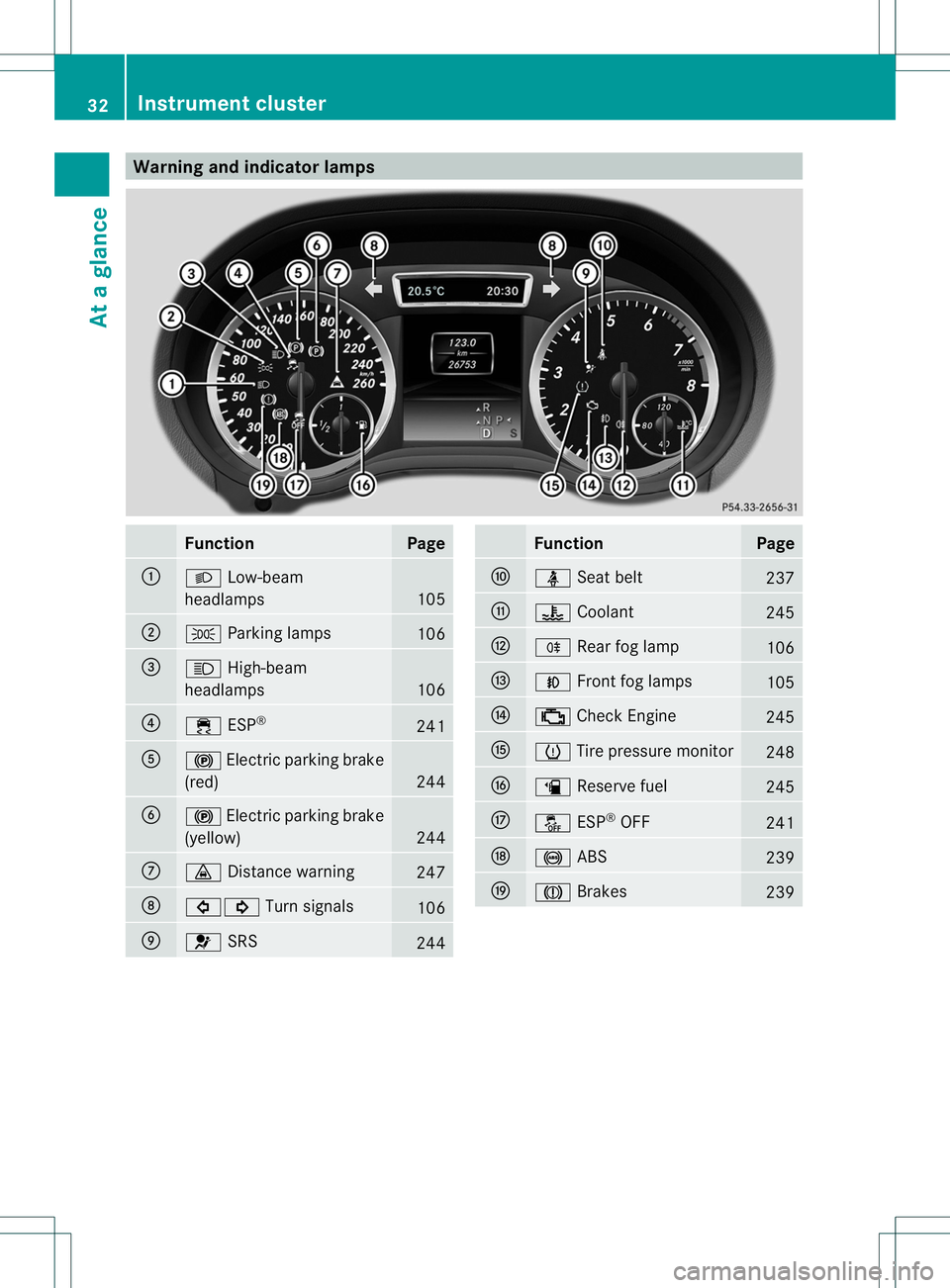
Warning and indicator lamps
Function Page
001A
0005
Low-beam
headlamps 105
0010
000F
Parking lamps 106
0023
0011
High-beam
headlamps 106
0021
000A
ESP® 241
001E
000A
Electric parking brake
(red) 244
0024
000A
Electric parking brake
(yellow) 244
0007
0008
Distance warning 247
0008
00020001
Turn signals 106
0009
0021
SRS 244 Function Page
0016
0016
Seat belt 237
001D
0010
Coolant 245
0004
0006
Rearfog lamp 106
000B
0019
Frontf og lamps 105
001C
000A
Check Engine 245
000E
0005
Tire pressure monitor 248
0013
0007
Reserve fuel 245
0017
0004
ESP®
OFF 241
0022
001C
ABS 239
0020
0001
Brakes 23932
Instrument clusterAt
ag lance
Page 49 of 360
additional protection to that provide
dbythe
seat belt.
Sid eimpac tair bags will not deploy in side
impacts which do not exceed the system's
prese tdeployment thresholds for lateral
acceleration/deceleration .You will then be
protected by the fastened seat belt.
The side impact air bag on the front-
passenger side is not deployed in the
following situations:
R OCS has detected that the front-passenger
seat is unoccupied.
R the front-passenger seat belt is not
fastened.
The side impact air bag on the front-
passenger side will deploy if the front-
passenger seat belt is fastened, regardless of
whether the front-passenger seat is occupied
or not.
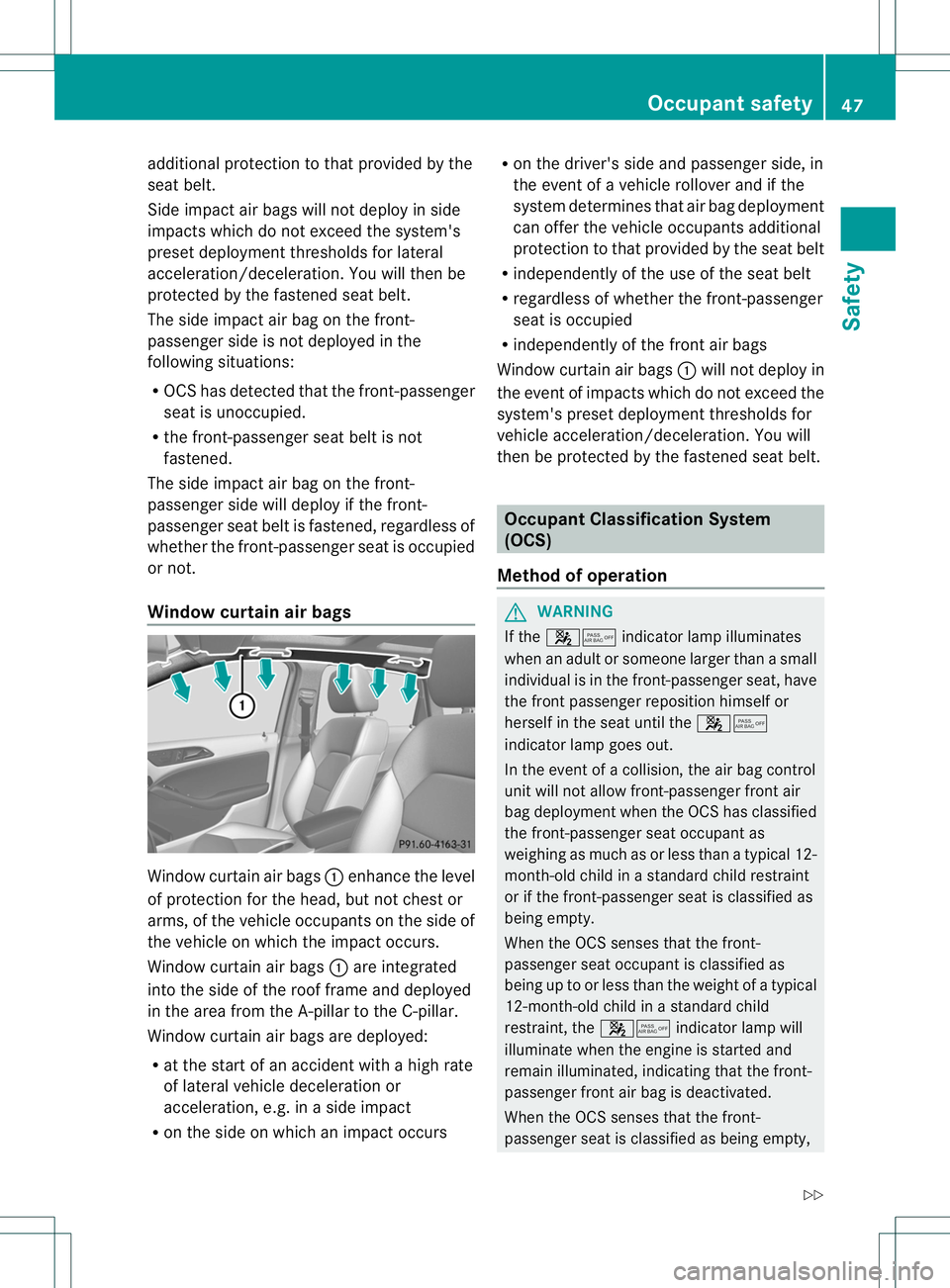
Window curtain air bags Window curtain air bags
001Aenhanc ethe level
of protection for the head, but not chest or
arms, of the vehicle occupant sonthe side of
the vehicle on which the impact occurs.
Window curtain air bags 001Aare integrated
into the side of the roof frame and deployed
in the area from the A-pillar to the C-pillar.
Window curtain air bags are deployed:
R at the start of an accident with ahigh rate
of lateral vehicle deceleration or
acceleration, e.g. in aside impact
R on the side on which an impact occurs R
on th edriver' ssidea nd passenger side, in
the event of avehicl erollover and if the
system determine sthat ai rbag deployment
can offer th evehicle occupants additional
protection to that provide dbytheseat belt
R independently of th euse of th eseat belt
R regardless of whether th efront-pa ssenger
seat is occupied
R independently of th efront air bags
Windo wcurtain air bags 001Awill not deploy in
the even tofimpacts which do not exceed the
system's prese tdeployment thresholds for
vehicle acceleration/deceleration .You will
then be protected by the fastened seat belt. Occupant Classification System
(OCS)
Method of operation G
WARNING
If the 000E0013 indicator lamp illuminates
when an adult or someone larger than asmall
individual is in the front-passenger seat, have
the front passenger reposition himself or
herself in the seat until the 000E0013
indicator lamp goes out.
In the event of acollision, the air bag control
unit will not allow front-passenger front air
bag deployment when the OCS has classified
the front-passenger seat occupant as
weighing as much as or less than atypical 12-
month-old child in astandard child restraint
or if the front-passenger seat is classified as
being empty.
When the OCS senses that the front-
passenger seat occupant is classified as
being up to or less than the weight of atypical
12-month-old child in astandard child
restraint ,the 000E0013 indicator lamp will
illuminate when the engine is started and
remain illuminated, indicating that the front-
passenger front air bag is deactivated.
When the OCS senses that the front-
passenger seat is classified as being empty, Occupant safety
47Safety
Z
Page 50 of 360
the
000E0013 indicator lamp will illuminate
when the engine is started and remain
illuminated, indicating tha tthe front-
passenger front air bag is deactivated.
When the OCS senses that the front-
passenger seat occupant is classified as
being heavier than the weight of atypical 12-
month-old child seated in astandar dchild
restraint or as being asmall individual (such
as ayoung teenager or asmall adult), the
000E0013 indicator lamp willi lluminate for
approximatel y6seconds when the engine is
started and then ,depending on occupant
weight sensor readings from the front-
passenger seat, remain illuminated or go out.
With the 000E0013 indicator lamp
illuminated, the front-passenger fron tair bag
is deactivated. With the 000E0013indicator
lamp out, the front-passenge rfront air bag is
activated.
When the OCS senses that the front-
passenger seat occupant is classifie dasan
adult or someone larger than asmall
individual, the 000E0013indicator lamp will
illuminate for approximatel y6seconds when
the engine is started and then go out,
indicating that the front-passenger fron tair
bag is activated.
If the 000E0013 indicator lamp is illuminated,
the front-passenger fron tair bag is
deactivated and will not be deployed.
If the 000E0013 indicator lamp is not
illuminated, the front-passenger fron tair bag
is activate dand will be deployed:
R in the even tofcertain frontal impacts
R if impact exceeds apreset deployment
threshold
R independently of the side impact air bags
If the front-passenge rfront air bag is
deployed, the rate of inflation will be
influenced by:
R the rate of relevant vehicle deceleratio nas
assessed by th eair bag control unit
R thef ront pa ssenger's weigh tcategor yas
identified by OCS G
WARNING
Accordin gtoacciden tstatistics, childre nare
safe rwhen properly restrained on the rear
seats than on the front-passenger seat. Thus,
we strongly recommendt hat children be
placed in the rear seats whenever possible.
Regardless of seating position, children 12
years old and under must be seated and
properly secured in an appropriate infant
restraint,t oddler restraint,orb ooster seat
recommended for the size and weight of the
child.
The infant or child restraint must be properly
secured with the vehicle's seat belt, the seat
belt and Top Tether strap, or lower anchors
and Top Tether strap, fully in accordance with
the child seat manufacturer's instructions.
Occupants, especially children, should always
sit as upright as possible, wear the seat belt
properly and use an appropriately sized infant
restraint,t oddler restraint,orb ooster seat
recommended for the size and weight of the
child.
Children can be killed or seriously injured by
an inflating air bag. Note the following
important information when circumstances
require you to place achild in the front-
passenger seat:
R Your vehicle is equipped with air bag
technology designed to deactivate the
front-passenger front air bag in your vehicle
when the system senses the weight of a
typical 12-month-old child or less along
with the weight of astandard appropriate
child restraint on the front-passenger seat.
R Ac hild in arear-facing child restraint on the
front-passenger seat will be seriously
injured or even killed if the front-passenger
front air bag inflates in acollision which
could occur under some circumstances,
even with the air bag technology installed
in your vehicle. The only means to eliminate
this risk completely is never to place achild
in ar ear-facing child restraint in the front-
passenger seat. We therefore strongly
recommendt hat you always place achild 48
Occupant safetySafety
Page 57 of 360
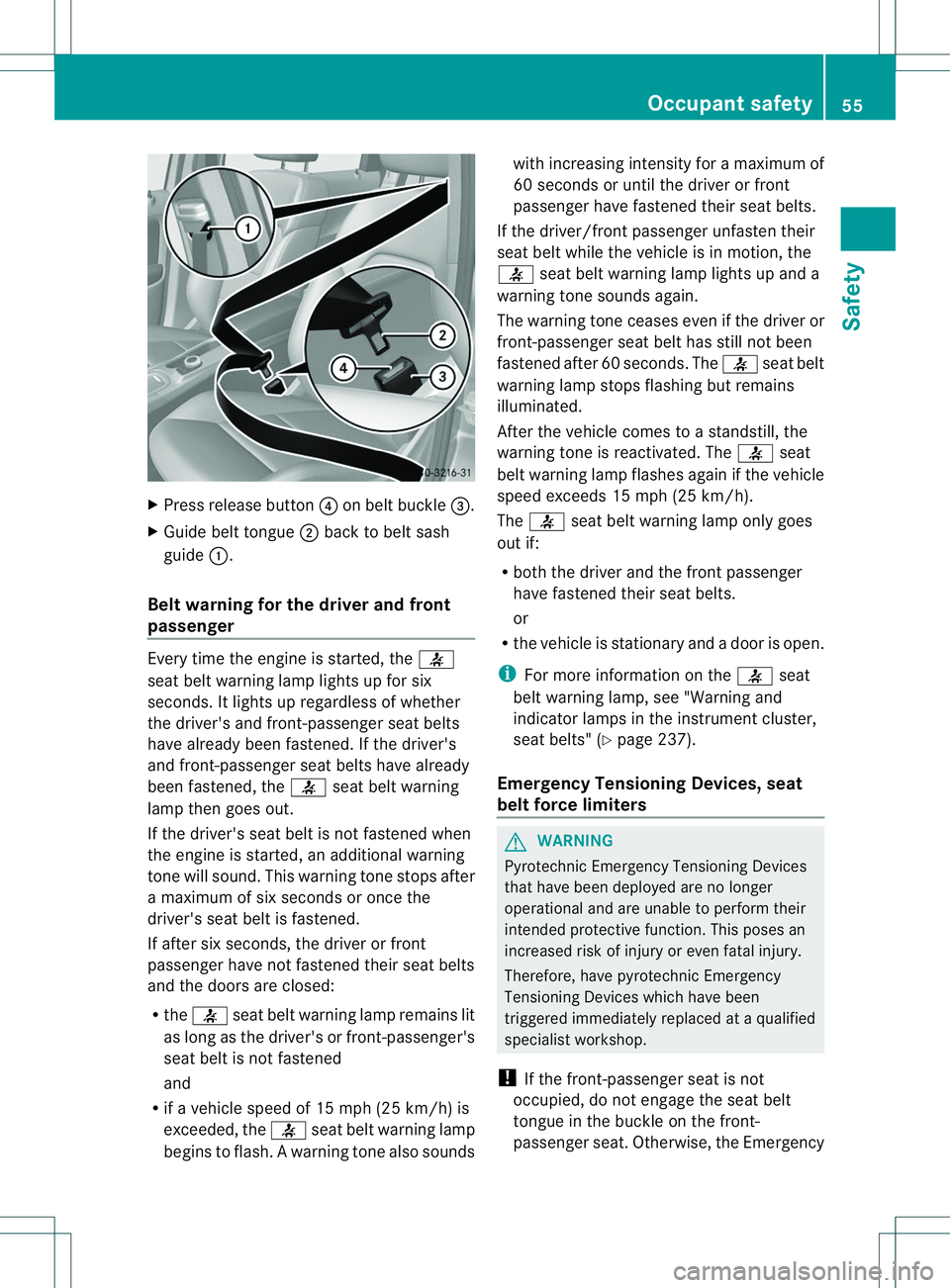
X
Press release button 0021on belt buckle 0023.
X Guide belt tongue 0010back to belt sash
guide 001A.
Belt warning for the driver and front
passenger Everyt
ime the engine is started, the 0020
seat belt warning lamp lights up for six
seconds. It lights up regardless of whether
the driver's and front-passenger seat belts
have already been fastened. If the driver's
and front-passenger seat belts have already
been fastened, the 0020seat belt warning
lamp then goes out.
If the driver's seat belt is not fastened when
the engine is started, an additional warning
tonew ill sound. This warning tones tops after
am aximum of six seconds or once the
driver's seat belt is fastened.
If after six seconds, the driver or front
passenger have not fastened their seat belts
and the doors are closed:
R the 0020 seat belt warning lamp remains lit
as long as the driver's or front-passenger's
seat belt is not fastened
and
R ifav ehicle speed of 15 mph (25 km/h) is
exceeded, the 0020seat belt warning lamp
begins to flash. Awarning tone also sounds wit
hincreasing intensit yfor am aximum of
60 seconds or until th edriver or front
passenger have fastened their seat belts.
If th edriver/fron tpassenger unfasten their
seat belt while th evehicle is in motion ,the
0020 seat belt warning lamp light supand a
warning tone sounds again.
The warning tone ceases eve nifthe driver or
front-passenger seat belt has still not been
fastened after 60 seconds. The 0020seat belt
warning lamp stops flashing but remains
illuminated.
After the vehicle comes to astandstill, the
warning tone is reactivated. The 0020seat
belt warning lamp flashes again if the vehicle
speed exceeds 15 mph (25 km/h).
The 0020 seat belt warning lamp only goes
out if:
R both the driver and the front passenger
have fastened their seat belts.
or
R the vehicle is stationary and adoor is open.
i For more information on the 0020seat
belt warning lamp, see "Warning and
indicator lamps in the instrumentc luster,
seat belts" (Y page 237).
Emergency Tensioning Devices, seat
belt force limiters G
WARNING
Pyrotechnic Emergency Tensioning Devices
that have been deployed are no longer
operational and are unable to perform their
intended protective function. This poses an
increased risk of injury or even fatal injury.
Therefore, have pyrotechnic Emergency
Tensioning Devices which have been
triggered immediately replaced at aqualified
specialist workshop.
! If the front-passenger seat is not
occupied, do not engage the seat belt
tongue in the buckle on the front-
passenger seat. Otherwise, the Emergency Occupant safety
55Safety Z
Page 60 of 360
G
WARNING
Child restraint systems or their securing
systems which have been damaged or
subjected to aloa dinana ccident can no
longer protect as intended. The child cannot
then be restrained in the event of an accident,
heavy braking or sudden changes of direction.
There is an increased risk of injury ,possibly
even fatal.
Replace child restraint systems which have
been damaged or subjected to aloa dinan
accident as soon as possible.H ave the
securin gsystems on th echild restraint
system checked at aqualified specialist
workshop ,before you install achild restraint
system again. G
WARNING
Infants and small childre nshould never share
as eat belt with another occupant. In the event
of an accident, they could be crushed
between the occupant and seat belt.
Ac hild's risk of serious or fatal injuries is
significantly increased if the child restraints
are not properly secured in the vehicle and/
or the child is not properly secured in the child
restraint.
Children that are too large for achild restraint
must travel in seats using normal seat belts.
Position the shoulder belt across the chest
and shoulder, not the face or neck.Ab ooster
seat may be necessary to achieve proper seat
belt positioning for children over 41 lbs
(18 kg )until they reach aheight where alap/
shoulder belt fit sproperly without abooster
seat.
When th echild restraint is no tinuse, remove
it from the vehicle or secure it with the seat
belt to prevent the child restraint from
becoming aprojectile in the event of an
accident. G
WARNING
If children are left unsupervised in the vehicle,
they could:
R open the doors, thus endangering other
people or road users.
R get out and disrupt traffic.
R operate the vehicle's equipment.
Additionally, children could set the vehicle in
motion if, for example, they:
R release the parking brake.
R shifting the automatic transmission out of
park position P
R Start the engine.
There is arisk of an accident and injury.
When leaving the vehicle, always take the
SmartKey with you and lock the vehicle. Never
leave children or animals unattended in the
vehicle. Always keep the SmartKey out of
reach of children. G
WARNING
If persons, particularly children are subjected
to prolonged exposure to extreme heat or
cold, there is arisk of injury, possibly even
fatal. Never leave children unattended in the
vehicle. G
WARNING
If the child restraint system is subjected to
direct sunlight, parts may get very hot.
Children may burn themselves on these parts,
particularly on the metal parts of the child
restraint system. There is arisk of injury.
If you leave the vehicle, taking the child with
you, always ensure that the child restraint
system is not exposed to direct sunlight.
Protect it with ablanket, for example. If the
child restraint system has been exposed to
direct sunlight, let it cool down before
securing the child in it. Never leave children
unattended in the vehicle. 58
Children in the vehicleSafety
Page 64 of 360
Additionally, children could set the vehicl
ein
motion if, for example, they:
R release the parking brake.
R shifting the automatic transmission ou tof
park position P
R Start the engine.
There is arisk of an acciden tand injury.
When leaving the vehicle, always take the
SmartKey with you and lock the vehicle. Never
leave children or animals unattended in the
vehicle. Always keep the SmartKey out of
reach of children. G
WARNING
If persons, particularly children are subjected
to prolonged exposure to extreme heat or
cold, ther eisarisk of injury, possibly even
fatal. Never leave children unattended in the
vehicle. G
WARNING
If children are traveling in the vehicle, they
could:
R open doors, thus endangering other people
or road users
R exit the vehicle and be caught by oncoming
traffic
R operate vehicle equipment and become
trapped
There is arisk of an acciden tand injury.
Always activate the child-proof lock sand
override feature if children are traveling in the
vehicle. When leaving the vehicle, always take
the key with you and lock the vehicle. Never
leave children unattended in the vehicle.
You can activate the following child-proof
locks:
R rear doors (Y page 62)
R rear side windows (Y page 62) Child-proof locks for the rear doors G
WARNING
Children could open arear door from inside
the vehicle. This could result in serious
injuries or an accident. Therefore, when
children ride in the rear always secure the rear
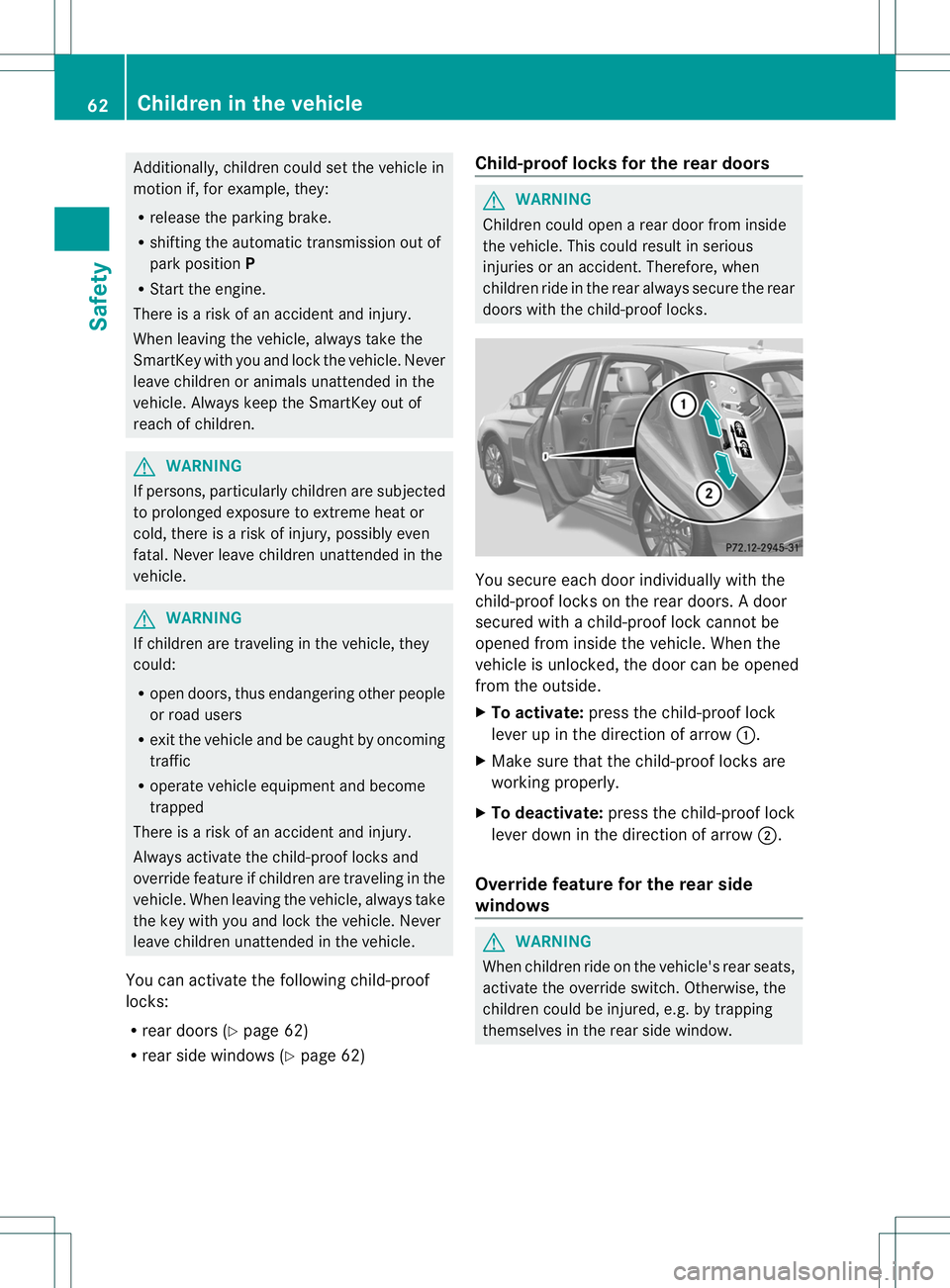
doors with the child-proof locks. You secure each door individually with the
child-proof lock
sonthe rear doors. Adoor
secured with achild-proof lock cannot be
opened from inside the vehicle. When the
vehicle is unlocked, the door can be opened
from the outside.
X To activate: press the child-proof lock
lever up in the direction of arrow 001A.
X Make sure that the child-proof locks are
working properly.
X To deactivate: press the child-proof lock
lever down in the direction of arrow 0010.
Overrid efeature for the rear side
windows G
WARNING
When children ride on the vehicle's rear seats,
activate the override switch. Otherwise, the
children could be injured, e.g. by trapping
themselves in the rear side window. 62
Children in the vehicleSafety
Page 65 of 360
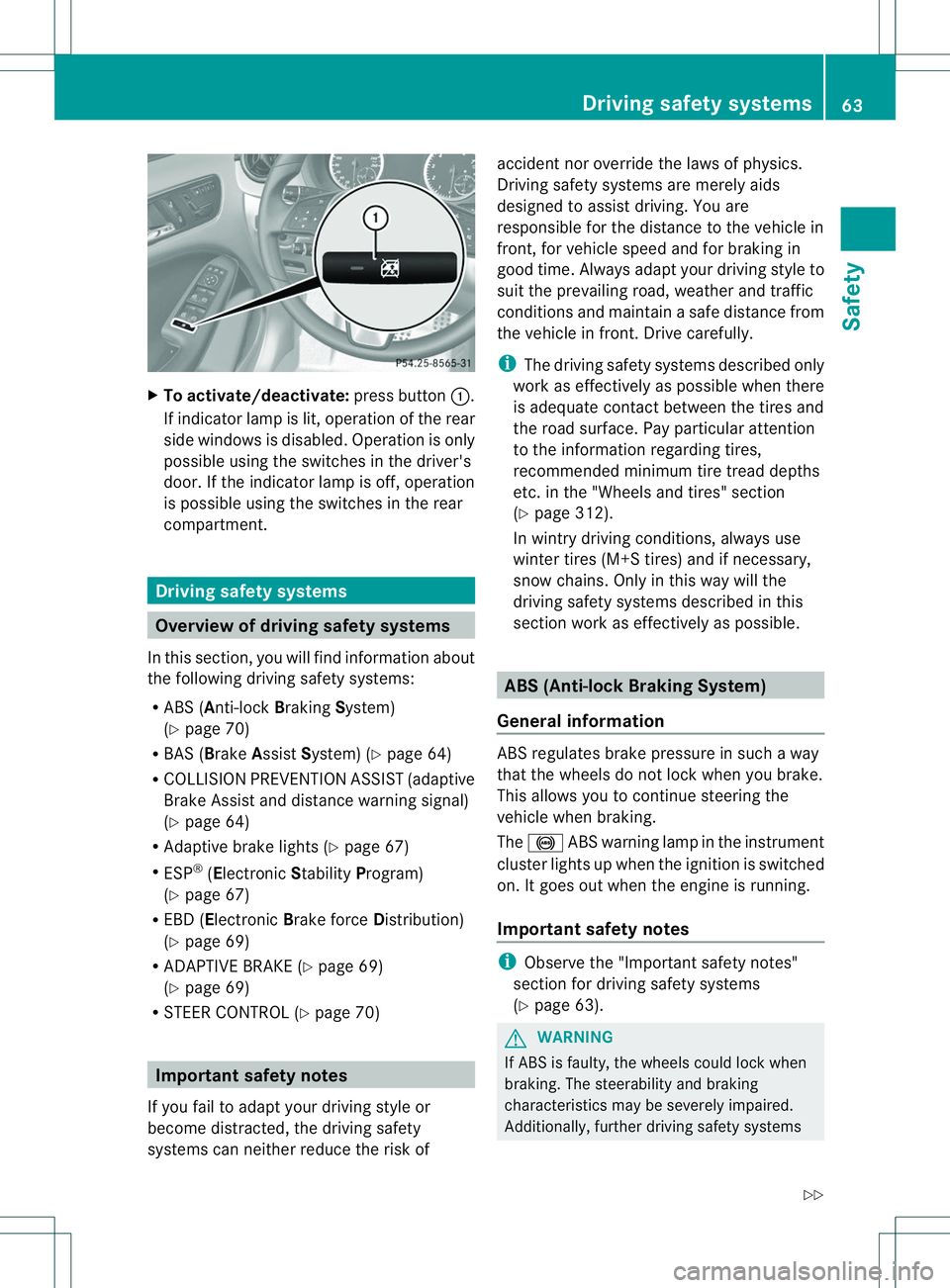
X
To activate/deactivate: press button001A.
If indicator lamp is lit, operatio nofthe rear
side windows is disabled. Operation is only
possible using the switches in the driver's
door. If the indicator lamp is off, operation
is possible using the switches in the rear
compartment. Driving safety systems
Overview of driving safety systems
In this section, you will find information about
the following driving safety systems:
R ABS ( Anti-lock BrakingSystem)
(Y page 70)
R BAS ( Brake Assist System) (Y page 64)
R COLLISION PREVENTION ASSIST (adaptive
Brake Assist and distance warning signal)
(Y page 64)
R Adaptive brake lights (Y page 67)
R ESP ®
(Electronic StabilityProgram)
(Y page 67)
R EBD ( Electronic Brake force Distribution)
(Y page 69)
R ADAPTIVE BRAKE (Y page 69)
(Y page 69)
R STEERC ONTROL (Y page 70) Important safety notes
If you fail to adapt your driving style or
become distracted, the driving safety
systems can neither reduce the risk of accident nor override the laws of physics.
Driving safety systems are merely aids
designed to assist driving. You are
responsible for the distance to the vehicle in
front,f
or vehicle speed and for braking in
good time. Always adapt your driving style to
suit the prevailing road, weather and traffic
conditionsa nd maintain asafe distanc efrom
th ev ehicle in front. Drive carefully.
i The driving safety systems describe donly
work as effectivel yaspossible when there
is adequat econtac tbetween th etires and
th er oad surface. Pay particular attention
to th einformatio nregarding tires,
recommended minimum tire tread depths
etc.int he "Wheels and tires" section
(Y page 312).
In wintry driving conditions, always use
winter tires (M+S tires) and if necessary,
snow chains. Only in this way will the
driving safety systems described in this
section work as effectively as possible. ABS (Anti-lockB
raking System)
General information ABS regulate
sbrake pressure in such away
tha tthe wheels do not lock when you brake.
This allowsy ou to continue steering the
vehicle when braking.
The 001C ABS warning lamp in the instrument
cluster lights up when the ignition is switched
on. It goes out when the engine is running.
Important safety notes i
Observe the "Important safety notes"
section for driving safety systems
(Y page 63). G
WARNING
If ABS is faulty, the wheels could lock when
braking. The steerability and braking
characteristics may be severely impaired.
Additionally, further driving safety systems Driving safety systems
63Safety
Z