light MERCEDES-BENZ C-280 1999 Owner's Manual
[x] Cancel search | Manufacturer: MERCEDES-BENZ, Model Year: 1999, Model line: C-280, Model: MERCEDES-BENZ C-280 1999Pages: 122, PDF Size: 1.69 MB
Page 71 of 122

Exterior Lamp Failure Indicator Lamp
With the electronic key in steering lock position 2, an indicator lamp comes on. It should go out when the engine is
running. If the warning lamp does not go out after starting the engine, or if it comes on while driving, this lamp
indicates a failure in the parking lamp, taillamp, stop lamp, or low beam headlamp. If an exterior lamp fails, the
indicator lamp will come on only when that lamp is switched on. If a brake lamp fails, the lamp failure indicator will
come on when applying the brake and st ay on until the engine is turned off.
Note:
If additional lighting equipment is installed (e.g. auxiliary headl amps etc.) be certain to connect into the fuse before
the failure indicator monitoring unit in order to avoid damaging the system.
Brake Pad Wear Indicator Lamp
With the electronic key in steering lock position 2, the brake pad wear indicator lamp comes on for approximately 30
seconds. It goes out when the engine is running.
If the indicator lamp lights up during braking, this indica tes that the brake pads are worn down. Have the brake
system checked at your authorized Mercedes- Benz dealer as soon as possible.
Brake Warning Lamp
With the electronic key in steering lock position 2, the brake warning lamp will come on. It should go out when the
engine is running. The brake warning lamp will come on:
• when there is insufficient brake fluid in the rese rvoir (engine running and parking brake released), or
• when the parking brake is set (engine running).
Warning !
Driving with the brake warning lamp on can result in an accident. Have your brake system checked
immediately if the brake warning lamp stays on. Don't add brake fluid before checking the brake system.
Overfilling the brake fluid reservoir can result in spilling brake fluid on hot engine parts and the brake fluid
catching fire. You can be seriously burned.
If you find that the minimum mark on the brake fluid reserv oir is reached, have the brake system checked for brake
pad thickness and leaks. To test the brake warning lamp, turn electronic key in steering lock to position 2. The brake
warning lamp comes on, and should go out when the engine is running.
ProCarManuals.com
Page 73 of 122

Antilock Brake System (ABS)
Important !
The ABS improves steering control of the vehicle during braking maneuvers. Do not pump the brake pedal, rather use
firm, steady brake pedal pressure. Pu mping the brake pedal defeats the pur pose for ABS and significantly reduces
braking effectiveness.
The ABS prevents the wheels from locking up above a vehicl e speed of approximately 5 mph (8 km/h) independent of
road surface conditions.
At the instant one of the wheels is about to lock up, a slight pulsation can be felt in the brake pedal, indicating that the
ABS is in the regulating mode. Keep firm and steady pressure on the brake pedal while experiencing the pulsation.
On slippery road surfaces, the ABS will re spond even with light brake pedal pressure because of the increased
likelihood of locking wheels. The pulsating brake pedal can be an indication of hazardous road conditions and
functions as a reminder to take extra care while driving.
ABS Control
The ABS malfunction indicator lamp in the instrument cl uster comes on with the electronic key in steering lock
position 2 and should go out when the engine is running.
If the charging voltage falls below 10 volts, the malfunction indicator lamp comes on and the ABS is switched off.
When the voltage is above this value again, the malfunction indicator lamp should go out and the ABS is operational.
With the ABS malfunctioning, the ASR or ESP, if vehicl e so equipped, are also switched off. Both malfunction
indicator lamps come on with the engine running. If the ABS malfunction indicator lamp does not go out or comes on
while driving, it indicates that the ABS has detected a malfunction and has switched off. In this case, the brake
system functions in the usual manner, but without antilock assistance.
Have the system checked at your authorized Mercedes-Benz dealer as soon as possible.
Warning !
ABS cannot prevent the natural laws of physics from acting on the vehicle, nor can it increase the traction
made available by the road conditions. The ABS ca nnot prevent accidents, including those resulting from
excessive speed in turns, following another vehicle too cl osely, or aquaplaning. Only a safe, attentive, and
skillful driver can prevent accidents. The capabilities of an ABS equipped car must never be exploited in a
reckless or dangerous manner which could jeopardize the user's safety or the safety of others.
Note:
To alert following vehicles to slippery road conditions you discover, operate your hazard warning flashers as
appropriate.
ProCarManuals.com
Page 79 of 122

Hood
To open:
To unlock the hood, pull release lever (1) under the driver's
side of the instrument panel. At the same time handle
(2) will extend out of the radiator grill (it may be necessary to lift the hood up slightly).
Caution !
To avoid damage to the windshield wiper or hood, open the hood only with wiper in the parked position. Pull handle
(2) completely out of radiator grill and open hood (do not pull up on handle).
To close:
Lower hood and let it drop into lock from a height of approx. 1 ft. (30 cm), assisting with hands pl aced flat on edges
of hood (3). To avoid hood damage, if hood is not fully cl osed, repeat closing procedure. Do not push down on hood
to attempt to fully close it.
Warning!
To help prevent personal injury, stay clear of moving parts when the hood is open and the engine is running.
Be sure the hood is properly closed before driving. When closing hood, use extreme caution not to catch
hands or fingers. The engine is equipped with a transi storized ignition system. Because of the high voltage it
is dangerous to touch any components (ignition coils , spark plug sockets, diagnostic socket) of the ignition
system
• with the engine running,
• while starting the engine,
• if ignition is "on" and the engine is turned manually.
If you see flames, steam or smoke coming from the engi ne compartment, or if the coolant temperature
gauge indicates that the engine is overheated, do not open the hood. Move away from vehicle and do not
open the hood until the engine has cooled. If necessary, call a fire department.
ProCarManuals.com
Page 88 of 122
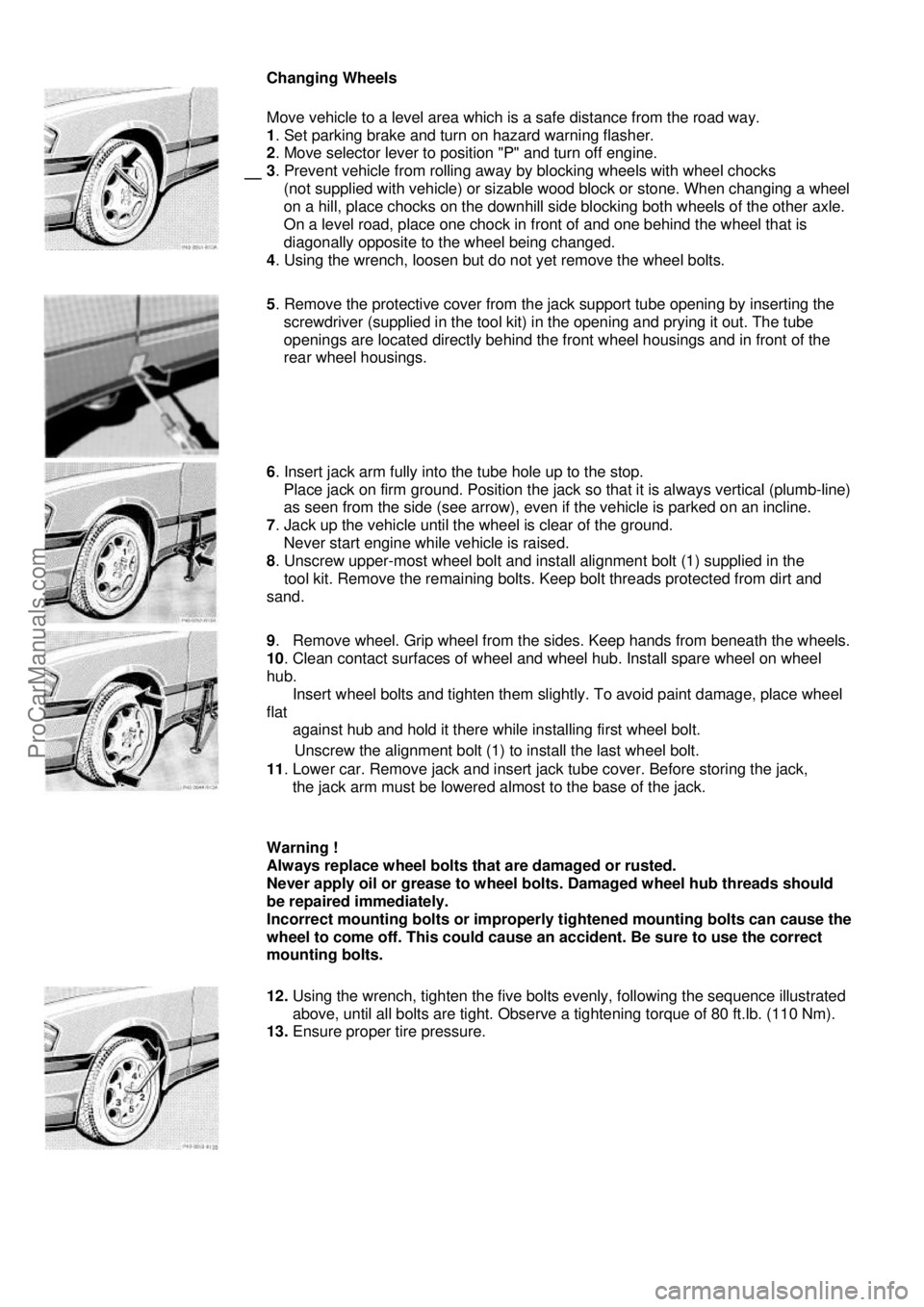
Changing Wheels
Move vehicle to a level area which is a safe distance from the road way.
1 . Set parking brake and turn on hazard warning flasher.
2 . Move selector lever to position "P" and turn off engine.
3 . Prevent vehicle from rolling away by blocking wheels with wheel chocks
(not supplied with vehicle) or sizable wood block or stone. When changing a wheel
on a hill, place chocks on the downhill side blocking both wheels of the other axle.
On a level road, place one chock in front of and one behind the wheel that is
diagonally opposite to the wheel being changed.
4 . Using the wrench, loosen but do not yet remove the wheel bolts.
5
. Remove the protective cover from the jack support tube opening by inserting the
screwdriver (supplied in the tool kit) in the opening and prying it out. The tube
openings are located directly behind the front wheel housings and in front of the
rear wheel housings.
6
. Insert jack arm fully into the tube hole up to the stop.
Place jack on firm ground. Position the jack so that it is always vertical (plumb-line)
as seen from the side (see arrow), even if the vehicle is parked on an incline.
7. Jack up the vehicle until the wheel is clear of the ground.
Never start engine while vehicle is raised.
8 . Unscrew upper-most wheel bolt and install alignment bolt (1) supplied in the
tool kit. Remove the remaining bolts. Keep bolt threads protected from dirt and
sand.
9. Remove wheel. Grip wheel from the sides. Keep hands from beneath the wheels.
10. Clean contact surfaces of wheel and wheel hub. Install spare wheel on wheel
hub.
Insert wheel bolts and tighten them slightly. To avoid paint damage, place wheel
flat
against hub and hold it there while installing first wheel bolt.
Unscrew the alignment bolt (1) to install the last wheel bolt.
11. Lower car. Remove jack and insert jack tube cover. Before storing the jack,
the jack arm must be lowered almost to the base of the jack.
Warning !
Always replace wheel bolts that are damaged or rusted.
Never apply oil or grease to wheel bolts. Damaged wheel hub threads should
be repaired immediately.
Incorrect mounting bolts or improperly tightened mounting bolts can cause the
wheel to come off. This could cause an accident. Be sure to use the correct
mounting bolts.
12.
Using the wrench, tighten the five bolts evenly, following the sequence illustrated
above, until all bolts are tight. Obse rve a tightening torque of 80 ft.lb. (110 Nm).
13. Ensure proper tire pressure.
ProCarManuals.com
Page 89 of 122

Tire Inflation Pressure
A table (see fuel filler flap) lists the tire inflation pressures specified for Mercedes-Benz recommended tires as well as
for the varying operating conditions.
Important !
Tire pressure changes by approx. 1.5 psi (0.1 bar) per 18°F (10°C) of air temperature change. Keep this in mind
when checking tire pressure inside a garage - especially in the winter.
Example:
If garage temperature = approx. +68°F (+20°C) and ambient te mperature = approx. +32°F (0°C) then the adjusted air
pressure = specified air pressure +3 psi (+0.2 bar).
Tire pressures listed for light loads are minimum values o ffering high driving comfort. Increased inflation pressures for
heavy loads produce favorable handling characteristics with lighter loads arid are perfectly permissible. The ride of
the vehicle, however, will become somewhat harder.
Tire temperature and pressure increase with the vehicle speed. Tire pressure should therefore only be corrected on
cold tires. Correct tire pressure in warm tires only if pressure has dropped below the pressure listed in the table and
the respective operating conditions are taken into consideration.
An underinflated tire due to a slow leak (e.g. due to a
nail in the tire) may cause damage such as tread separation, bulging etc.. Regular tire pressure checks (including the
spare tire) at intervals of no more than 14 days are therefore essential. If a tire constantly loses air, it should be
inspected for damage.
Warning !
Do not overinflate tires. Overinfiating tires can result in sudden deflation (blowout) because they are more
likely to become punctured or damaged by road debris, potholes etc.. Follow recommended inflation
pressures.
Do not overload the tires by exceeding the specified vehicle capacity weight (as indicated by the label on the
driver's door latch post). Overloading the tires can overheat them, possibly causing a blowout.
ProCarManuals.com
Page 97 of 122

Jump Starting
Warning !
Failure to follow these directions will cause damage to the electronic components, and can lead to a battery
explosion and severe injury or death. Never lean over batteries while connecting or jump starting, you might
get injured. Battery fluid contains sulfuric acid. Do not allow this fluid to come in contact with eyes, skin or
clothing. In case it does, immediately flush affected ar ea with water, and seek medical help if necessary.
A battery will also produce hydrogen gas, which is flammable and very explosive. Keep flames or sparks
away from battery, avoid improper connection of jumper cables, smoking etc.. Read all instructions before
proceeding.
If the battery is discharged, the engine should be started with jumper cables and the (12 V) battery of another vehicle.
The battery is located in the trunk under the trunk floor.
Proceed as follows:
1 . Position the vehicle with the charged battery so that the jumper cables will reach, but never
let the vehicles touch. Make sure the jump er cables do not have loose or missing insulation.
2. On both vehicles:
• Turn off engine and all lights and acce ssories, except hazard warning flashers or
work lights.
• Apply parking brake and shift selector lever to position "P".
Important !
3. Clamp one end of the first jumper cable to the positive (+) terminal of the discharged
battery and the other end to the positive (+ ) terminal of the charged battery. Make sure
the cable clamps do not touch any other metal parts.
4. Clamp one end of the second jumper cable to the grounded negative (-) terminal of the
charged battery and the final connection to the negative (-) terminal of the discharged battery.
Important !
5. Start engine of the vehicle with the charged battery and run at high idle. Make sure the
cables are not on or near pulleys, fans, or other parts that will move when the engine is
started. Allow the discharged battery to charge for a few minutes. Start engine of the
disabled vehicle in the usual manner.
6. After the engine has started, remove jumper cables exactly reversing the above
installation sequence, starting with the last connection made first. When removing each
clamp, make sure that it does not touch any other metal while the other end is still attached.
Important !
A discharged battery can freeze at approx. +14°F (-10°C ). In that case, it must be thawed out before
jumper cables are used. A frozen battery can explode and cause personal injury.
Jumper cable specifications:
• Minimum cable cross-section of 25 mm
2 or approx. 2 AWG
• Maximum length of 11.5 ft. (3.5 m).
ProCarManuals.com
Page 99 of 122

Cleaning and Care of the Vehicle
Warning !
Many cleaning products can be hazardous. Some are poisonous, others are flammable.
Always follow the instructions on the particular container. Always open your car's doors or
windows when cleaning the inside. Never use fluids or solvents that are not designed for
cleaning your car.
In operation, your vehicle is subjected to varying external influences which, if gone unchecked, can
attack the paintwork as well as the underbody and cause lasting damage.
Such damage is caused not only by extreme and varying climatic conditions, but also by air
pollution, road salt, tar, gravel and stone chipping. Grease and oil, fuel, coolant, brake fluid, bird
droppings, insects, tree resins etc. should be removed immediately to avoid paint damage. Frequent
washing reduces and/or eliminates the aggr essiveness and potency of the above adverse
influences.
More frequent washings are necessary to deal with unfavorable conditions; for example, near the
ocean, in industrial areas (smoke, exhaust emissions), or during winter operation.
You should check your vehicle from time to time for stone chipping or other damage. Any damage
should be repaired as soon as possible to prevent the start of corrosion. In doing so, do not neglect
the underside of the car. A prerequisite for a t horough check is a washing of the underbody followed
by a thorough inspection. Damage d areas need to be reundercoated.
Your vehicle has been treated at the factory with a wax-base rustproofing in the body cavities which
will last for the lifetime of t he vehicle. Post-production treatment is neither necessary nor
recommended by Mercedes-Be nz because of the possibility of incompatibility between materials
used in the production proc ess and others applied later.
We have selected car care products and compiled recommendations which are specially matched to
our vehicles and which always reflect the late st technology. You can obtain Mercedes- Benz
approved car care products at your authorized Mercedes-Benz dealer.
Scratches, corrosive deposits, corrosion or damage due to negligent or incorrect care cannot always
be removed or repaired with the car care products recommended here. In such cases it is best to
seek aid at your authorized Mercedes-Benz dealer. The following topics deal with the cleaning and
care of your vehicle and give important "how-to" in formation as well as references to Mercedes-Benz
approved car care products. Additional information can be found in the booklet titled "Car Care".
Engine Cleaning
Prior to cleaning the engine compartment make sure to protect electrical components and
connectors from the intrusion of water and cleaning agents.
Corrosion protection, such as MB Anticorrosion Wax should be applied to the engine compartment
after every engine cleaning. Before applying, all control linkage bushings and joints should be
lubricated. The poly-V-belt and all pulleys should be protected from any wax.
Car Washing
Do not use hot water or wash your car in direct sunlight. Use only a mild car wash detergent, such
as Mercedes-Benz approved Car Shampoo.
Thoroughly spray the car with a diffused jet of wa ter. Direct only a very weak spray towards the
ventilation intake. Use plenty of water an d rinse the sponge and chamois frequently.
Rinse with clear water and thoroughly wipe dry with a chamois. Do not allow cleaning agents to dry
on the finish. If the vehicle has been run through an automatic car wash - in particular one of the
older installations - rewipe the recessed sections in the taillamps (designed to prevent soiling) if
necessary. No solvents (fuels, thi nners etc.) must be used. In the winter, thoroughly remove all
traces of road salt as soon as possible.
When washing the underbody, do not forget to clean the inner sides of the wheels.
Tar Stains
Quickly remove tar stains before they dry and beco me more difficult to remove. A tar remover is
recommended.
Window Cleaning
Use a window cleaning solution on all glass surfac es. An automotive glass cleaner is recommended.
ProCarManuals.com
Page 100 of 122

Wiper Blade
Clean the wiper blade rubber with a clean cloth and detergent solution. Replace blade twice a year;
once before and once after winter.
Headlamp Cleaning System
The condition of the wiper blades is important for satisfactory cleaning of the headlamp lenses. We
therefore recommend that the blades be insp ected regularly. Replace damaged wiper blades.
Paintwork. Painted Body Components
Mercedes-Benz approved Paint Care should be a pplied when water drops on the paint surface do
not "bead up"; normally in 3 to 5 months, depending on climate and washing detergent used.
Mercedes-Benz approved Paint Cleaner should be ap plied if paint surface shows signs of dirt
embedding (i.e. loss of gloss). Do not apply any of t hese products or wax if your car is parked in the
sun or if the hood is still hot. Use the appropriate MB-Touch-Up Stick for quick and provisional
repairs of minor paint damage (i.e. chips from stones, car doors etc.).
Seat Belts
The webbing must not be treated with chemical cleaning agents. Use only clear, lukewarm water
and soap. Do not dry the webbing at temperatures above 176°F (80°C) or in direct sunlight.
Warning !
Do not bleach or dye seat belts as this may severely weaken them. In a crash they may not be
able to provide adequate protection.
Hard Plastic Trim Items
Pour Mercedes-Benz approved Interior Care onto so ft lint-free cloth and apply with light pressure.
Headliner and Shelf below Rear Window
Clean with soft bristle brush, or use a dry- shampoo cleaner in case of excessive dirt.
Plastic and Rubber Parts
Do not use oil or wax on these parts.
Steering Wheel and Gear Selector Lever
Wipe with a damp cloth and dry thoroughly or clean with Mercedes-Benz approved Leather Care.
Light Alloy Wheels
Mercedes-Benz approved Wheel Care should be used for regular cleaning of the light alloy wheels.
If possible, clean wheels once a week with Merc edes-Benz approved Wheel Care, using a soft
bristle brush and a strong spray of water. Follow instructions on container.
Note:
Use only acid-free cleaning materials. The acid could lead to corrosion.
Ornamental Moldings
For regular cleaning and care of very dirty chrome-plated parts, use a chrome cleaner.
Upholstery
Using aftermarket seat covers or wearing clothing that have the tendency to give off coloring (e.g.
when wet etc.) may cause the upholstery to become permanently discolored. By lining the seats with
a proper intermediate cover, contac t-discoloration will be prevented.
Leather Upholstery Wipe leather upholstery with a damp cloth and dry thoroughly or clean with
Mercedes-Benz approved Leather Care. Exercise particular care when cleaning perforated leather
as its underside should not become wet.
MB Tex Upholstery Pour Mercedes-Benz approved In terior Care onto soft lint-free cloth and apply
wi
th light pressure.
ProCarManuals.com
Page 102 of 122
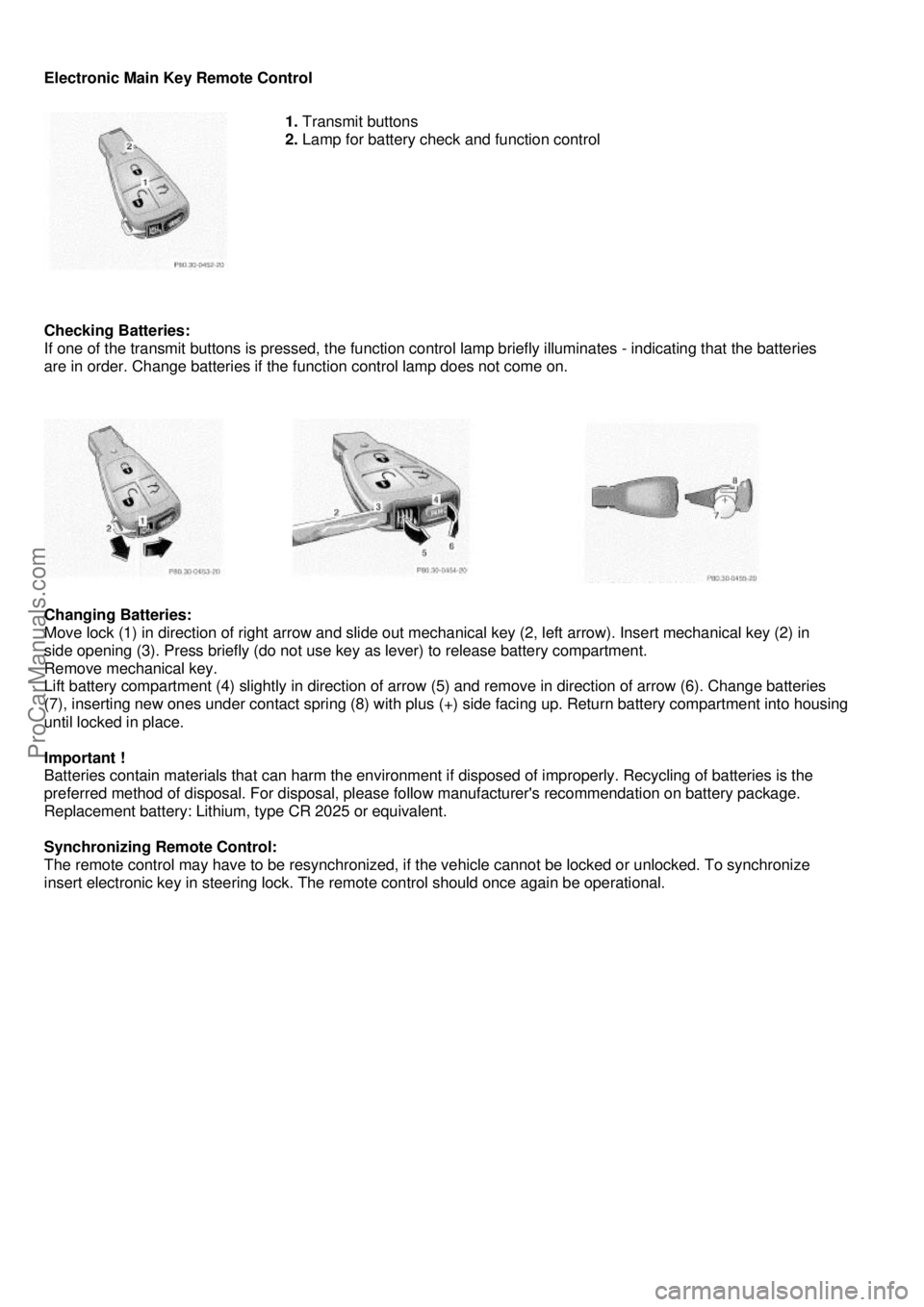
Electronic Main Key Remote Control
1. Transmit buttons
2. Lamp for battery check and function control
Checking Batteries:
If one of the transmit buttons is pressed, the function contro l lamp briefly illuminates - indicating that the batteries
are in order. Change batteries if the function control lamp does not come on.
Changing Batteries:
Move lock (1) in direction of right arrow and slide out mechanical key (2, left arrow). Insert mechanical key (2) in
side opening (3). Press briefly (do not use ke y as lever) to release battery compartment.
Remove mechanical key.
Lift battery compartment (4) slightly in direction of arrow (5) and remove in direction of arrow (6). Change batteries
(7), inserting new ones under contact spring (8) with plus (+) side facing up. Return battery compartment into housing
until locked in place.
Important !
Batteries contain materials that can harm the environment if disposed of improperly. Recycling of batteries is the
preferred method of disposal. For disposal, please fo llow manufacturer's recommendation on battery package.
Replacement battery: Lithium, type CR 2025 or equivalent.
Synchronizing Remote Control:
The remote control may have to be resynchronized, if t he vehicle cannot be locked or unlocked. To synchronize
insert electronic key in steering lock. The remote control should once again be operational.
ProCarManuals.com
Page 110 of 122
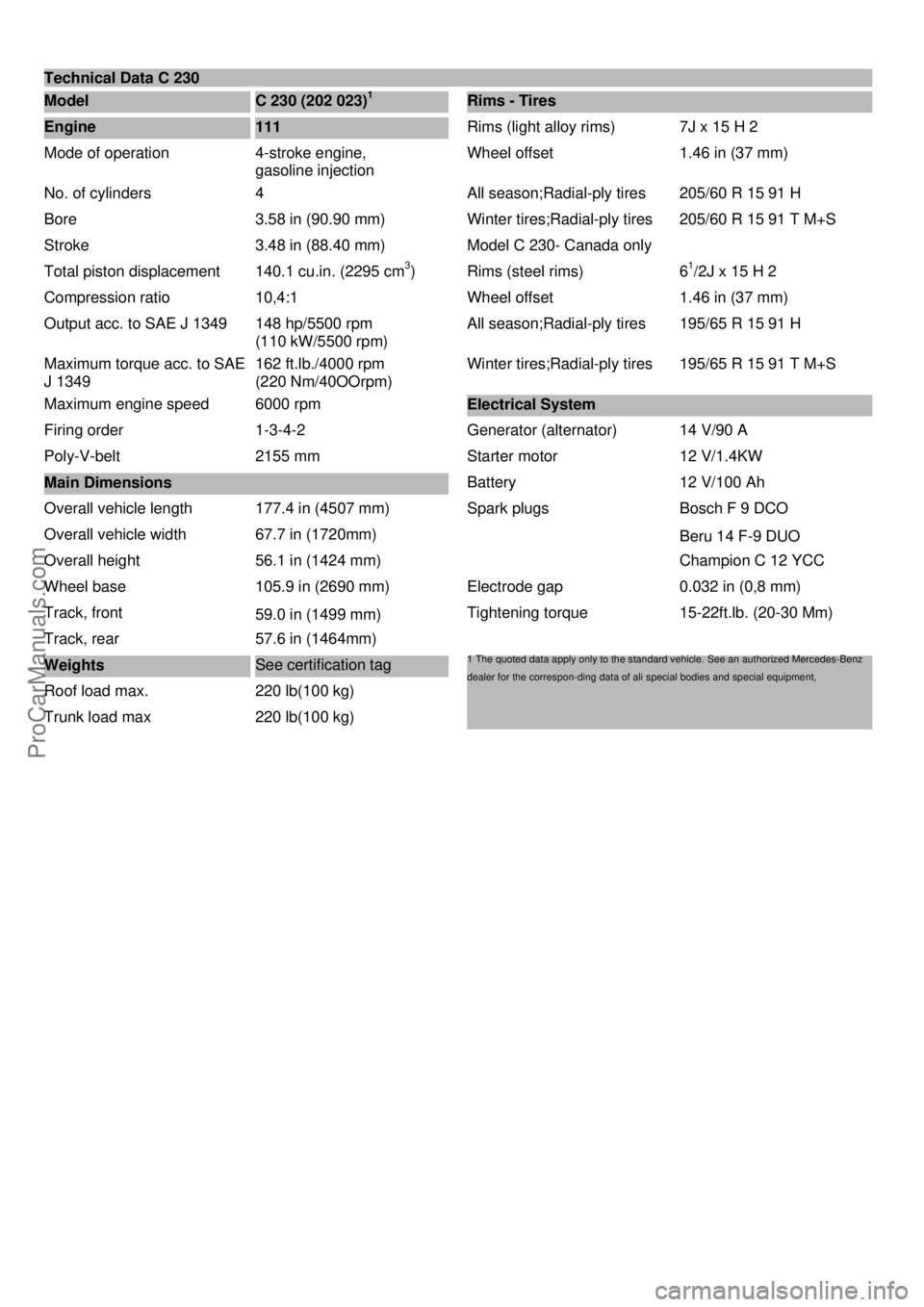
Technical Data C 230
Model C 230 (202 023)1 Rims - Tires
Engine 111 Rims (light alloy rims) 7J x 15 H 2
Mode of operation 4-stroke engine,
gasoline injection
Wheel offset 1.46 in (37 mm)
No. of cylinders
4 All season;Radial-ply tires 205/60 R 15 91 H
Bore 3.58 in (90.90 mm) Winter tires;Radial-ply tires 205/60 R 15 91 T M+S
Stroke 3.48 in (88.40 mm) Model C 230- Canada only
Total piston displacement 140.1 cu.in. (2295 cm3) Rims (steel rims) 61/2J x 15 H 2
Compression ratio 10,4:1 Wheel offset 1.46 in (37 mm)
Output acc. to SAE J 1349 148 hp/5500 rpm
(110 kW/5500 rpm)
All season;Radial-ply tires 195/65 R 15 91 H
Maximum torque acc. to SAE
J 1349
162 ft.lb./4000 rpm
(220 Nm/40OOrpm)
Winter tires;Radial-ply tires
195/65 R 15 91 T M+S
Maximum engine speed 6000 rpm Electrical System
Firing order 1-3-4-2 Generator (alternator) 14 V/90 A
Poly-V-belt 2155 mm Starter motor 12 V/1.4KW
Main Dimensions Battery 12 V/100 Ah
Overall vehicle length 177.4 in (4507 mm) Spark plugs Bosch F 9 DCO
Overall vehicle width 67.7 in (1720mm) Beru 14 F-9 DUO
Overall height 56.1 in (1424 mm)
Champion C 12 YCC
Wheel base 105.9 in (2690 mm) Electrode gap 0.032 in (0,8 mm)
Track, front 59.0 in (1499 mm) Tightening torque 15-22ft.lb. (20-30 Mm)
Track, rear 57.6 in (1464mm)
Weights See certification tag
Roof load max. 220 lb(100 kg)
Trunk load max 220 lb(100 kg)
1 The quoted data apply only to the standard vehicle. See an authorized Mercedes-Benz
dealer for the correspon-ding data of ali special bodies and special equipment,
ProCarManuals.com