ECU MERCEDES-BENZ C-CLASS 1999 User Guide
[x] Cancel search | Manufacturer: MERCEDES-BENZ, Model Year: 1999, Model line: C-CLASS, Model: MERCEDES-BENZ C-CLASS 1999Pages: 122, PDF Size: 1.66 MB
Page 48 of 122

Night Security Illumination
(Vehicles with Antitheft AlarmSystem)
When exiting the vehicle after driving with the exterior lamps on, they switch on again for added illumination for
approximately 30 seconds after closing the last door. The lamp-on time period can be changed at your
Mercedes-Benz dealer.
Inside Rear View Mirror
Manually adjust the mirror.
Use your inside mirror to determine the size and distan ce of objects seen in the passenger side convex mirror.
Antiglare Night Position
With the electronic key in steering lock position 2, the mirror reflection brightness responds to changes in light
sensitivity. With gear selector lever in position "R", or wi th the interior lamp switched on, the mirror brightness does
not respond to changes in light sensitivity.
Note:
The automatic antiglare function is restricted, if incoming light is not aimed directly at sensors in the mirror.
ProCarManuals.com
Page 59 of 122
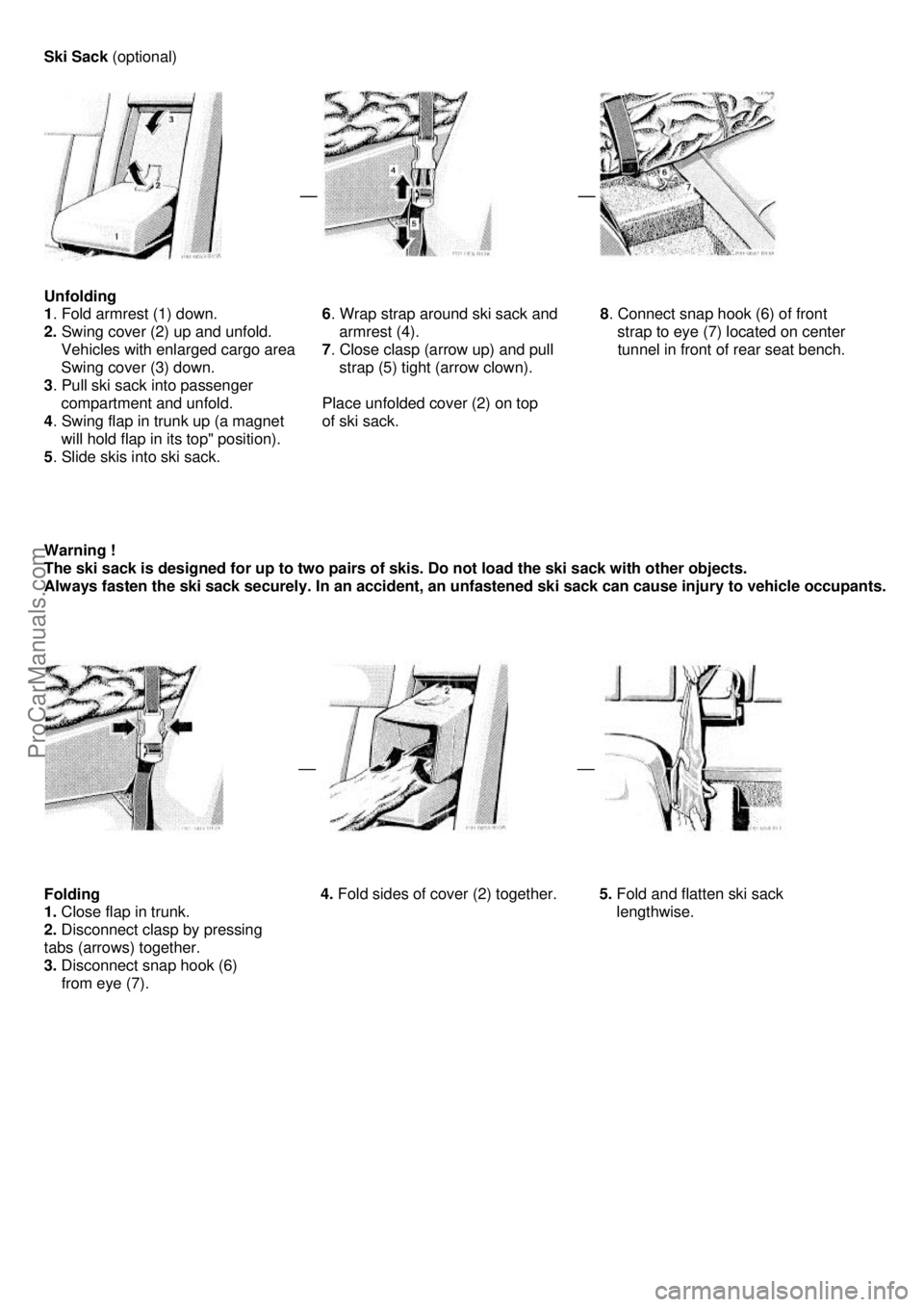
Ski Sack (optional)
Unfolding
1 . Fold armrest (1) down.
2. Swing cover (2) up and unfold.
Vehicles with enlarged cargo area
Swing cover (3) down.
3 . Pull ski sack into passenger
compartment and unfold.
4 . Swing flap in trunk up (a magnet
will hold flap in its top" position).
5 . Slide skis into ski sack.
6
. Wrap strap around ski sack and
armrest (4).
7 . Close clasp (arrow up) and pull
strap (5) tight (arrow clown).
Place unfolded cover (2) on top
of ski sack.
8
. Connect snap hook (6) of front
strap to eye (7) located on center
tunnel in front of rear seat bench.
Warning !
The ski sack is designed for up to two pairs of skis. Do not load the ski sack with other objects.
Always fasten the ski sack securely. In an accident, an unfastened ski sack can cause injury to vehicle occupants.
Folding
1. Close flap in trunk.
2. Disconnect clasp by pressing
tabs (arrows) together.
3. Disconnect snap hook (6)
from eye (7).
4.
Fold sides of cover (2) together.
5.
Fold and flatten ski sack
lengthwise.
ProCarManuals.com
Page 63 of 122
Automatic Transmission
The automatic transmission selects individual gears automatically, dependent upon
• Selector lever position
• Program mode selector
• Accelerator position
• Vehicle speed
Important !
When parking the car or before working on the vehicle with the engine running, firmly depress the parking brake
pedal and shift the selector lever into "P".
Driving
The selector lever is automatically locked while in position "P". To move the selector lever out of position "P", the
service brake pedal must be firmly depressed before the shift lock will release. Shift selector lever to the desired
position only when the engine is idling normally and the service brake is applied. Do not release the brake until
ready to drive. The vehicle may otherwise start creeping when the selector lever is in drive or reverse position.
Warning !
It is dangerous to shift the selector lever out of "P" or "N" if the engine speed is higher than idle speed. If
your foot is not firmly on the brake pedal, the car could accelerate quickly forward or in reverse. You
could lose control of the car and hit someone or something. Only shift into gear when the engine is idling
normally and when your right foot is firmly on the brake pedal.
Important !
After selecting any driving position from "N" or "P", wait a moment to allow the gear to fully engage before
accelerating, especially when the engine is cold.
Accelerator Position
Partial throttle = early upshifting = normal acceleration
Full throttle = later upshifting = rapid acceleration
Kickdown (depressing the accelerator beyond full throttle) = downshifting to a lower gear = maximum acceleration.
Once the desired speed is attained, ease up on t he accelerator - the transmission shifts up again.
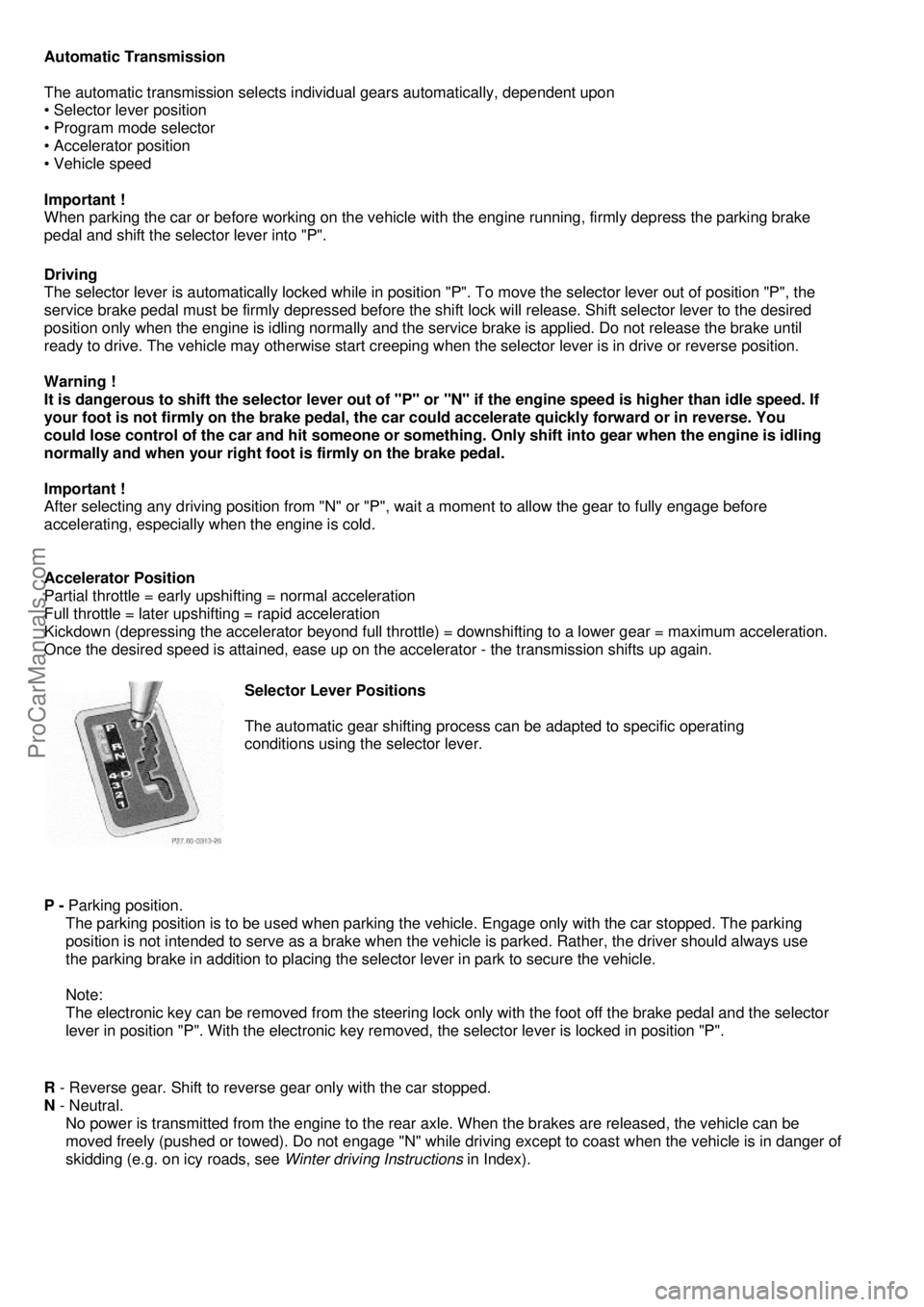
Selector Lever Positions
The automatic gear shifting process can be adapted to specific operating
conditions using the selector lever.
P - Parking position.
The parking position is to be used when parking t he vehicle. Engage only with the car stopped. The parking
position is not intended to serve as a brake when the vehicle is parked. Rather, the driver should always use
the parking brake in addition to placing the selector lever in park to secure the vehicle.
Note:
The electronic key can be removed from the steering lo ck only with the foot off the brake pedal and the selector
lever in position "P". With the electronic key removed, the selector lever is locked in position "P".
R - Reverse gear. Shift to reverse gear only with the car stopped.
N - Neutral.
No power is transmitted from the engine to the rear axle. When the brakes are released, the vehicle can be
moved freely (pushed or towed). Do not engage "N" while driving except to coast when the vehicle is in danger of
skidding (e.g. on icy roads, see Winter driving Instructions in Index).
ProCarManuals.com
Page 84 of 122
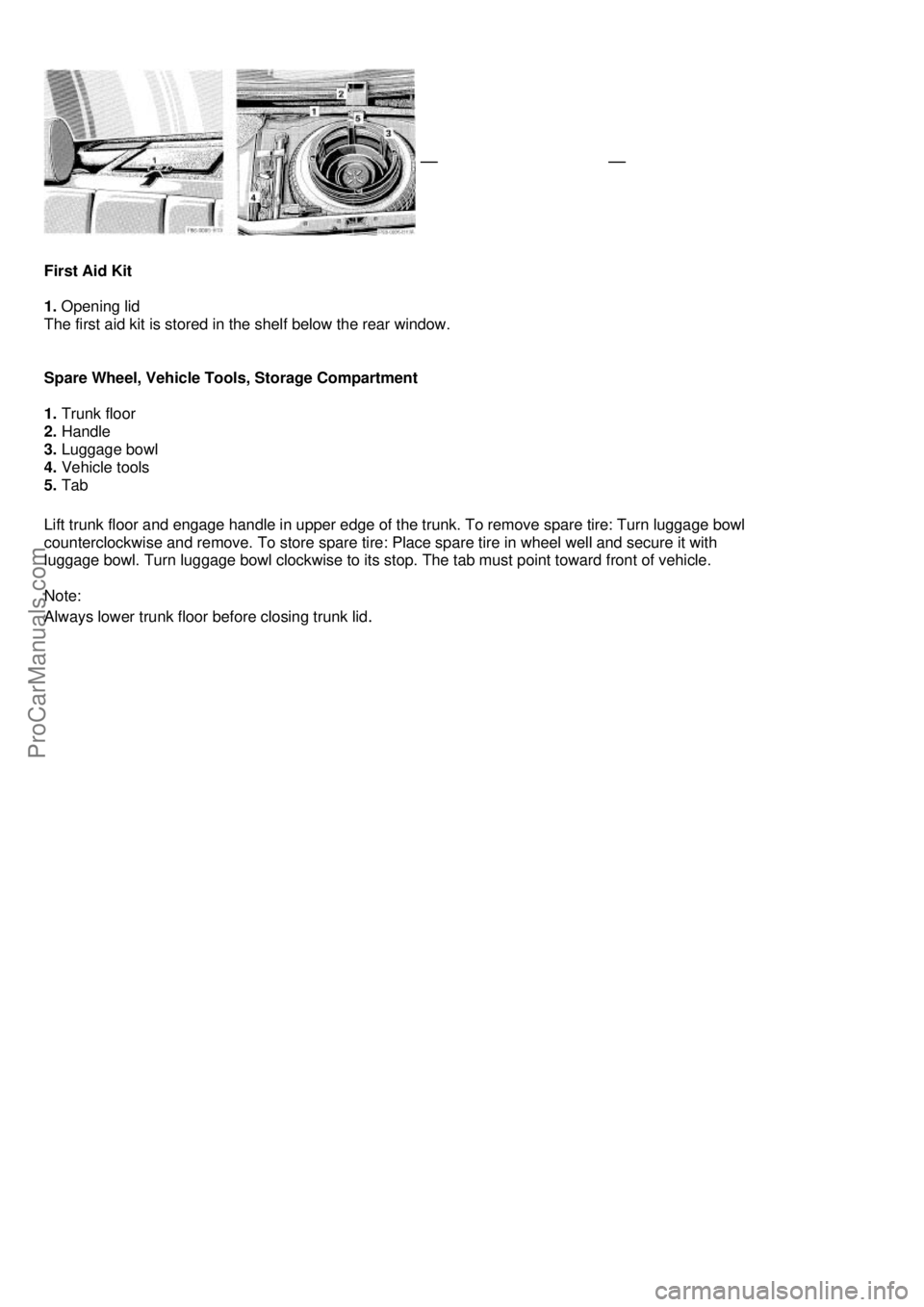
First Aid Kit
1. Opening lid
The first aid kit is stored in the shelf below the rear window.
Spare Wheel, Vehicle Tools, Storage Compartment
1. Trunk floor
2. Handle
3. Luggage bowl
4. Vehicle tools
5. Tab
Lift trunk floor and engage handle in upper edge of the trunk. To remove spare tire: Turn luggage bowl
counterclockwise and remove. To store spare tire: Place spare tire in wheel well and secure it with
luggage bowl. Turn luggage bowl clockwise to its stop . The tab must point toward front of vehicle.
Note:
Always lower trunk floor before closing trunk lid
.
ProCarManuals.com
Page 90 of 122

Exterior Lamps
Headlamp Adjustment
Correct headlamp adjustment is extremely important. Check and readjust headlamps at regular intervals and
when a bulb has been replaced.
Headlamp Assembly
1. Cover for low beam headlamp bulb, fog lamp, and level for vertical adjustment
2. Latch for cover (1)
3. Cover for high beam headlamp bulb
4. Clamp for cover (3)
5. Headlamp vertical adjustment screw
6. Headlamp horizontal adjustment screw
7. Scale for horizontal adjustment
8. Electrical connector for low beam headlamp bulb Xenon lamp (optional) ignition module for low beam
9. Electrical connector for fog lamp bulb
10. Electrical connector for high beam headlamp bulb
Replacing Bulb:
To prevent a possible electrical short circuit, switch off lamp prior to replacing a bulb. When replacing bulbs,
install only 12 volt bulbs with the specified watt rati ng. When replacing halogen bulbs do not touch glass
portion of bulb with bare hands. Us e plain paper or a clean cloth.
Warning !
Halogen lamps contain pressurized gas. A bulb can explode if you:
• touch or move it when hot,
• drop the bulb,
• scratch the bulb.
Wear eye and hand protection.
Bulb for Low Beam H7 (55 W)
Bulb for Fog Lamp H1 (55 W)
Open hood.
Depress latch (2) and remove cover (1). Pull of electrical connector (8) or (9). Unhook clamping ring and
removes bulb. Insert new bulb (seating properly in cutouts of bulb socket), and mount clamping ring.
Reinstall and push electrical connector on securely. Re install bottom end of cover (1) and push against top
end of cover until properly seated. Check lamp for proper operation.
Xenon (optional)
Bulb for Low Beam
Warning !
Because of high voltage in Xenon lamps, it is dangerous to replace the bulb or repair the lamp and its
components. We recommend that you have such work done by a qualified technician.
ProCarManuals.com
Page 91 of 122

Bulb for High Beam H1 (55 W)
Open hood.
Move retaining clamps (4) aside and remove cover (3). Pull off electrical connector (10). Unhook clamping ring
and pull out bulb together with clamping ring. Remove bulb. Insert new bulb (seating properly in cutouts of bulb
socket), mount clamping ring. Reinstall and push electr ical connector on securely. Reinstall cover and fasten
with retaining clamp (4).
Turn Signal, Parking, Side Marker and Standing Lamp
(2357 NA [28.5/8.3 W/30/2.2 cp bulb])
Open hood.
Squeeze latch (1) together and lift complete lamp assemb ly out to front of vehicle. Twist bulb socket (2)
counterclockwise and pull out. Push bulb into socket, turn counterclockwise and remove. Insert new bulb in socket
push in and twist clockwise. Reinstall bulb socket. Reinsta ll lamp assembly by sliding tabs (3) into guides (4) until
properly seated.
1. Latch for turn signal, parking, side marker, and standing lamp assembly
2. Bulb socket for turn signal, parking, side marker, and standing lamp
3. Tab
4. Guide
ProCarManuals.com
Page 95 of 122

Battery
Warning !
Failure to follow these instructions can result in severe injury or death. Never lean over batteries while
connecting, you might get injured. Battery fluid contains sulfuric acid. Do not allow this fluid to come in
contact with eyes, skin or clothing. In case it does, immediately flush affected area with water and seek
medical help if necessary. A battery will also produ ce hydrogen gas, which is flammable and explosive.
Keep flames or sparks away from battery, avoid im proper connection of jumper cables, smoking etc..
Important !
Battery maintenance information:
The battery is located in the trunk under the trunk floor. The fluid level must be checked at every A and B service.
Always insure that the fluid level is at the specified maximum level and that only distilled water is used. Failure to
maintain proper fluid level may result in cell deterioration and possible battery rupture. The service life of the battery is
dependent on its condition of charge. The battery should alwa ys be kept sufficiently charged, in order to last an
optimum length of time.
Therefore, we strongly recommend that you have the battery charge checked frequently, and corrected if
necessary, especially if you use the vehicle less than approximately 200 miles (300 km) per month, mostly for
short distance trips, or if it is not used for long periods of time.
Only charge a battery with a battery charger after the battery has been disconnected from the vehicle electrical circuit.
Always disconnect the battery negative lead first and connect last. When removing and connecting the battery,
always make sure that all electrical consumers are off and the electronic key is in steering lock position 0. The battery
and its vent tube must always be securely installed when the car is in operation. While the engine is running the
battery terminal clamps must not be loosened or detached, otherwise the generator and other electronic components
would be damaged.
Note:
After reconnecting the battery al so resynchronize the Express feature of the power windows
(see Power Windows in Index).
Battery Recycling
Batteries contain materials that can harm the environment with improper disposal. Large 12 Volt storage batteries
contain lead. Recycling of batteries is the preferred method of disposal. Many states require sellers of batteries to
accept old batteries for recycling.
ProCarManuals.com
Page 96 of 122

Fuses
1. Main fuse box in engine compartment
2. Auxiliary fuse box in trunk
3. Auxiliary fuse in trunk
4. Auxiliary fuse in engine compartment
Before replacing a blown fuse, determine the cause of the short circuit. Spare fuses are supplied inside the
main fuse box. Observe amperage and color of fuse. To gai n access to the main fuse box, release clamp (1),
lift the fuse box cover up and remove it. A special fuse puller comes with the vehicle tools. Always use a
new fuse for replacement. Never attempt to repair or bridge a blown fuse. After replacing a blown fuse, close
fuse box cover. To close the main fuse box, engag e cover at the rear and secure with clamp.
ProCarManuals.com
Page 98 of 122
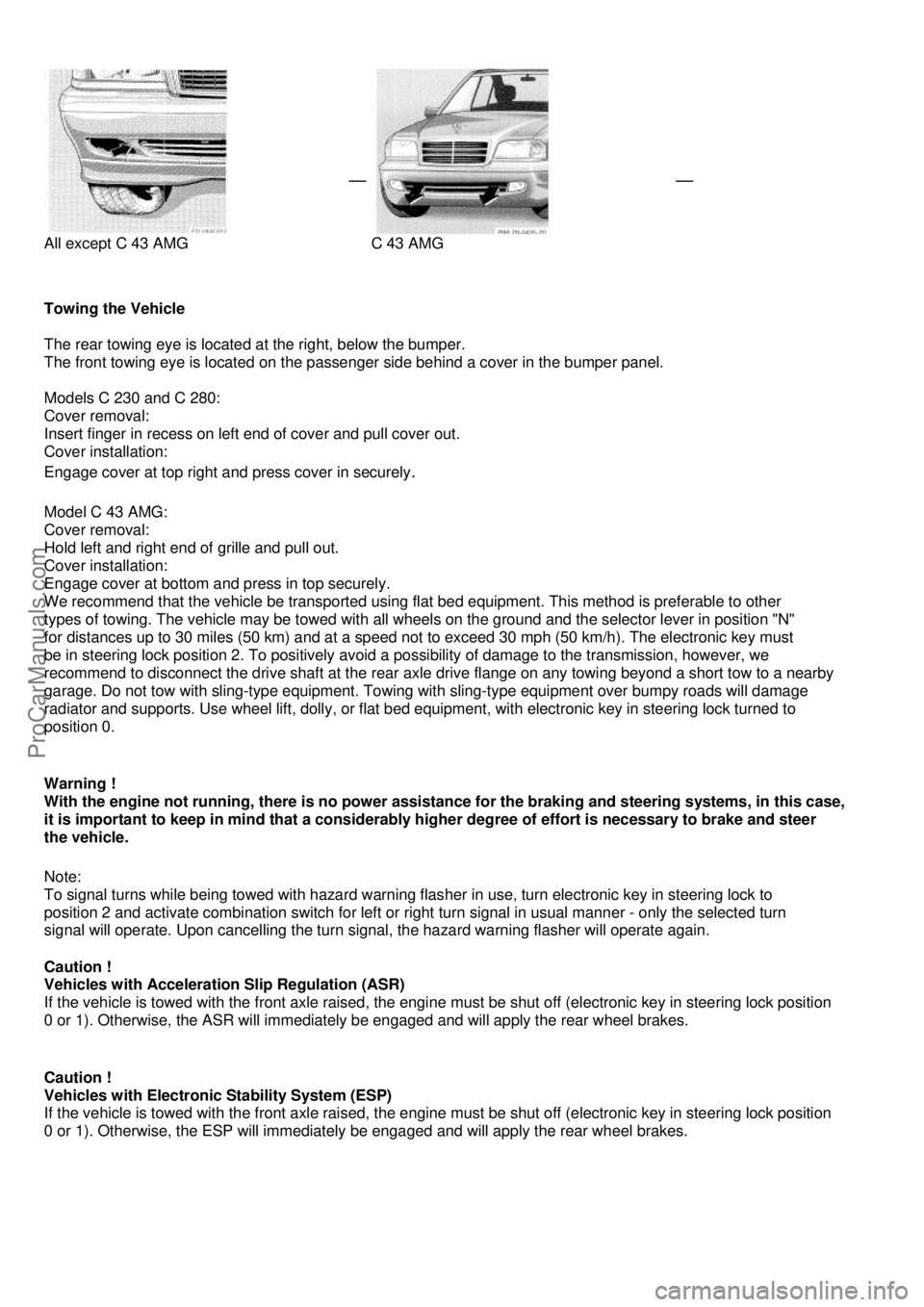
All except C 43 AMG
C 43 AMG
Towing the Vehicle
The rear towing eye is located at the right, below the bumper.
The front towing eye is located on the passenger side behind a cover in the bumper panel.
Models C 230 and C 280:
Cover removal:
Insert finger in recess on left end of cover and pull cover out.
Cover installation:
Engage cover at top right and press cover in securely
.
Model C 43 AMG:
Cover removal:
Hold left and right end of grille and pull out.
Cover installation:
Engage cover at bottom and press in top securely.
We recommend that the vehicle be transported using flat bed equipment. This method is preferable to other
types of towing. The vehicle may be towed with all wheel s on the ground and the selector lever in position "N"
for distances up to 30 miles (50 km) and at a speed not to exceed 30 mph (50 km/h). The electronic key must
be in steering lock position 2. To positively avoid a possibility of damage to the transmission, however, we
recommend to disconnect the drive shaft at the rear axle drive flange on any towing beyond a short tow to a nearby
garage. Do not tow with sling-type equipment. Towing with sling-type equipment over bumpy roads will damage
radiator and supports. Use wheel lift, dolly, or flat bed equipment, with electronic key in steering lock turned to
position 0.
Warning !
With the engine not running, there is no power assistance for the braking and steering systems, in this case,
it is important to keep in mind that a considerably higher degree of effort is necessary to brake and steer
the vehicle.
Note:
To signal turns while being towed with hazard warning flas her in use, turn electronic key in steering lock to
position 2 and activate combination switch for left or right turn signal in usual manner - only the selected turn
signal will operate. Upon cancelling the turn signal, the hazard warning flasher will operate again.
Caution !
Vehicles with Acceleration Slip Regulation (ASR)
If the vehicle is towed with the front axle raised, the engi ne must be shut off (electronic key in steering lock position
0 or 1). Otherwise, the ASR will immediately be engaged and will apply the rear wheel brakes.
Caution !
Vehicles with Electronic Stability System (ESP)
If the vehicle is towed with the front axle raised, the engine must be shut off (electronic key in steering lock position
0 or 1). Otherwise, the ESP will immediately be engaged and will apply the rear wheel brakes.
ProCarManuals.com
Page 104 of 122

Rear Seat Cushion
Removal:
Push in locking tabs (on left and right side of seat) and pull up seat at the front. Installation: Slide rear edge of
cushion under the backrest. Push front of cushion down until it locks in place.
Caution!
Watch out for sharp edges when removing or installing the rear seat cushion, and make sure that it is securely
locked in place again, to prevent personal injury.
Emergency Operation of Sliding/Pop-Up Roof
The sliding/pop-up roof can be opened or closed manually should an electrical malfunction occur.
The sliding/pop-up roof drive is located behind the le ns of the left interior lamp between the sun visors.
1. Pry off lens (1) by using a screw driver.
2. Obtain crank (2) (supplied with vehicle) and insert it through hole.
To slide the roof closed or to raise the roof at the rear: turn crank clockwise.
To slide the roof open or to lower the roof at the rear: turn crank counterclockwise.
ProCarManuals.com