battery MERCEDES-BENZ C-CLASS 1999 User Guide
[x] Cancel search | Manufacturer: MERCEDES-BENZ, Model Year: 1999, Model line: C-CLASS, Model: MERCEDES-BENZ C-CLASS 1999Pages: 122, PDF Size: 1.66 MB
Page 58 of 122

Garage Door Opener
1. Remote control transmitter located on driver side sun visor
2. Portable remote control transmitter
Warning !
When programming a garage door opener, the door moves up or down. When programming or operating
the remote control make sure there is no possib ility of anyone being harmed by the moving door.
The visor remote control is capable of operati ng up to three separately controlled objects.
Notes:
Certain types of garage door openers are incompatible wi th the integrated opener. If you should experience
difficulties
with programming the transmitter, contact your authoriz ed Mercedes-Benz dealer or call Mercedes-Benz Customer
Assistance Center (in the U.S.A. only) at 1-800-FOR- MERCedes. For operation in the USA only: This devise
complies
with Part 15 of the FCC Rules. Operation is subject to the following two conditions:
(1) This device may not cause harmful interference, and (2) this device must accept any interference received,
including interference that may cause undesired operation. Any unauthorized modification to this device could void
the user's
authority to operate the equipment.
Programming or reprogramming the remote control:
1. Turn electronic key in steering lock to position 1 or 2.
2. Press and hold one button of the remote control located on the sun visor until its control light begins to flash at a
rate of about once a second. Continue holding down the button.
Note:
The light blinks immediately if the remote control is being programmed for the first time, or if its memory was
previously erased. If you are re programming a previously used button, the light will flash afte r about 20 seconds.
3. Hold end opposite to battery of portable remote contro l against the sun visor transmitter to be programmed. While
still holding down the button on the transmitter on the sun visor, press down the button on your portable remote
control, until the sun visor remote control light starts to flash rapidly. This means that the integrated remote control
has accepted the frequency and code of the portable transmitter.
4. If you wish, repeat the procedure for each remaining button.
Operation of remote control:
1. Turn electronic key in steering lock to position 1 or 2.
2. Select and press the appropriate button (1, 2 or 3) to ac tivate the remote controlled device. The remote control
transmitter continues to send the signal as long as the button is pressed - up to 20 seconds.
Erasing the remote control memory:
1. Turn electronic key in steering lock to position 1 or 2.
2. Simultaneously holding down buttons 1 and 3 for approximatel y 20 seconds, or until the control light blinks rapidly,
will erase the code s of all three channels.
ProCarManuals.com
Page 72 of 122
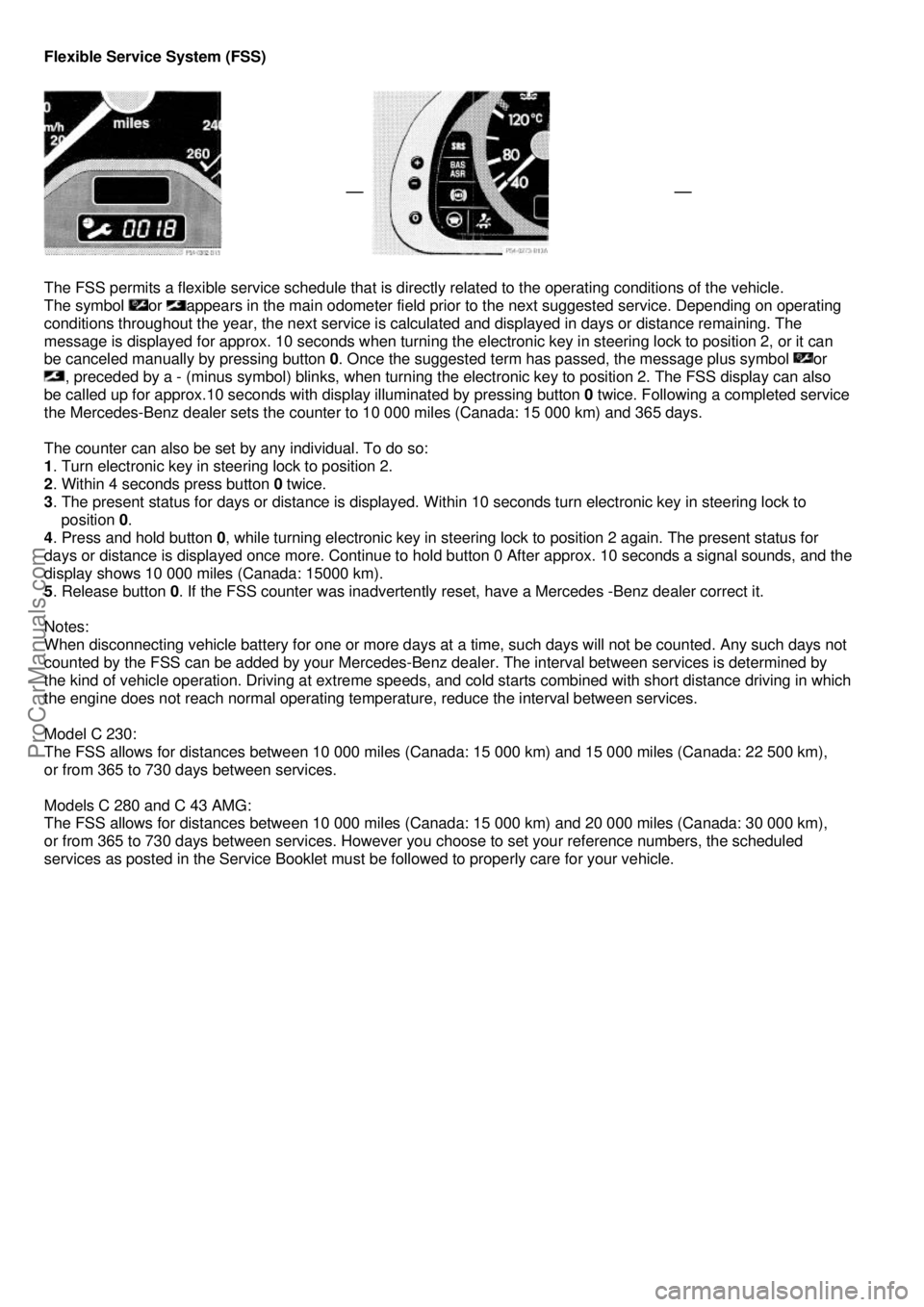
Flexible Service System (FSS)
The FSS permits a flexible service schedule that is dire
ctly related to the operating conditions of the vehicle.
The symbol
or appears in the main odometer field prior to the next suggested service. Depending on operating
conditions throughout the year, the nex t service is calculated and displayed in days or distance remaining. The
message is displayed for approx. 10 seconds when turning the electronic key in steering lock to position 2, or it can
be canceled manually by pressing button 0. Once the suggested term has passed, the message plus symbol
or
, preceded by a - (minus symbol) blinks, when turning t he electronic key to position 2. The FSS display can also
be called up for approx.10 seconds with display illuminated by pressing button 0 twice. Following a completed service
the Mercedes-Benz dealer sets the counter to 10 000 miles (Canada: 15 000 km) and 365 days.
The counter can also be set by any individual. To do so:
1 . Turn electronic key in steering lock to position 2.
2 . Within 4 seconds press button 0 twice.
3 . The present status for days or distance is displayed. Within 10 seconds turn electronic key in steering lock to
position 0.
4 . Press and hold button 0, while turning electronic key in steering lock to position 2 again. The present status for
days or distance is displayed once more. Continue to hold button 0 After approx. 10 seconds a signal sounds, and the
display shows 10 000 miles (Canada: 15000 km).
5 . Release button 0. If the FSS counter was inadvertently reset, have a Mercedes -Benz dealer correct it.
Notes:
When disconnecting vehicle battery for one or more days at a time, such days will not be counted. Any such days not
counted by the FSS can be added by your Mercedes-Benz de aler. The interval between services is determined by
the kind of vehicle operation. Driving at extreme speeds, and cold starts combined with short distance driving in which
the engine does not reach normal operating temperat ure, reduce the interval between services.
Model C 230:
The FSS allows for distances between 10 000 miles (Canada: 15 000 km) and 15 000 miles (Canada: 22 500 km),
or from 365 to 730 days between services.
Models C 280 and C 43 AMG:
The FSS allows for distances between 10 000 miles (Canada: 15 000 km) and 20 000 miles (Canada: 30 000 km),
or from 365 to 730 days between services. However you choose to set your reference numbers, the scheduled
services as posted in the Service Booklet must be followed to properly care for your vehicle.
ProCarManuals.com
Page 78 of 122

Winter Driving
Have your car winterized at your authorized Mercedes-Benz dealer before the onset of winter.
• Change the engine oil if the engine contains an oil which is not approved for winter operation.
For viscosity (SAE/CCMC class) and filling quantity, see Capacities: Fuels, Coolants,
Lubricants etc. in Index.
• Check engine coolant anticorr osion/antifreeze concentration.
• Additive for the windshield washer and headlamp cleani ng system: Add MB Concentrate "S" to a premixed
windshield washer solvent/antifreeze which is form ulated for below freezing temperatures (see Index).
• Test battery: Battery capacity drops with dec reasing ambient temperature. A well charged
battery helps to ensure that the engine can be started, even at low ambient temperatures.
• Tires: We recommend M+S rated radial-ply tires on all four wheels for the winter season. Observe
permissible maximum speed for M+S rated radial-ply tires and the legal speed limit.
Note:
In winter operation, the maximum effect iveness of the acceleration slip regulation or of the electronic traction system
can only be achieved with M+S rated radial-ply tires and/or snow chains recommended by Mercedes-Benz. Snow
chains maximize performance.
Snow Chains
Use only snow chains that are tested and recommended by Mercedes-Benz. Your authorized Mercedes-Benz dealer
will be glad to advise you on this subject. Chains should only be used on the rear wheels. Follow the manufacturer's
mounting instructions. Snow chains should only be driven on snow covered roads at speeds not to exceed 30 mph
(50 km/h). Remove chains as soon as possible when driving on roads without snow. For tips on driving on slippery
winter roads, refer to Index. Vehicles with Acceleration Slip Regulation (ASR) or Electronic Stability Program (ESP):
When driving with snow chai ns, press the ASR or ESP control switch, refer to Index.
Model C 43 AMG
Important!
Use of snow chains is permissible only on winter tire size 215/45 R 17 H M+S. Refer to "Rims - Tires" in section
"Technical Data" (see Index).
Travelling Abroad
Abroad, there is a widely-spread Mercedes-Benz service network at your disposal. If you plan to travel into areas
which are not listed in the index of your dealer directory, you should request pertinent information from your
authorized Mercedes-Benz dealer.
ProCarManuals.com
Page 83 of 122

Trunk Lamp
If the trunk is to remain open for a long period of time, the
trunk lamp can be switched off by pulling out the plunger
in the switch (arrow). This prevents t he vehicle battery from being discharged. When the trunk lid is closed, the switch
will reset and turn on the lamp next time the lid is opened.
Stowing Things in the Vehicle
Warning !
To help avoid personal injury during a collision or sudden maneuver, exercise care when stowing things.
Put luggage or cargo in the trunk if possible. Do not pile luggage or cargo higher than the seat backs.
Do not place anything on the shelf below the rear window.
ProCarManuals.com
Page 95 of 122

Battery
Warning !
Failure to follow these instructions can result in severe injury or death. Never lean over batteries while
connecting, you might get injured. Battery fluid contains sulfuric acid. Do not allow this fluid to come in
contact with eyes, skin or clothing. In case it does, immediately flush affected area with water and seek
medical help if necessary. A battery will also produ ce hydrogen gas, which is flammable and explosive.
Keep flames or sparks away from battery, avoid im proper connection of jumper cables, smoking etc..
Important !
Battery maintenance information:
The battery is located in the trunk under the trunk floor. The fluid level must be checked at every A and B service.
Always insure that the fluid level is at the specified maximum level and that only distilled water is used. Failure to
maintain proper fluid level may result in cell deterioration and possible battery rupture. The service life of the battery is
dependent on its condition of charge. The battery should alwa ys be kept sufficiently charged, in order to last an
optimum length of time.
Therefore, we strongly recommend that you have the battery charge checked frequently, and corrected if
necessary, especially if you use the vehicle less than approximately 200 miles (300 km) per month, mostly for
short distance trips, or if it is not used for long periods of time.
Only charge a battery with a battery charger after the battery has been disconnected from the vehicle electrical circuit.
Always disconnect the battery negative lead first and connect last. When removing and connecting the battery,
always make sure that all electrical consumers are off and the electronic key is in steering lock position 0. The battery
and its vent tube must always be securely installed when the car is in operation. While the engine is running the
battery terminal clamps must not be loosened or detached, otherwise the generator and other electronic components
would be damaged.
Note:
After reconnecting the battery al so resynchronize the Express feature of the power windows
(see Power Windows in Index).
Battery Recycling
Batteries contain materials that can harm the environment with improper disposal. Large 12 Volt storage batteries
contain lead. Recycling of batteries is the preferred method of disposal. Many states require sellers of batteries to
accept old batteries for recycling.
ProCarManuals.com
Page 97 of 122

Jump Starting
Warning !
Failure to follow these directions will cause damage to the electronic components, and can lead to a battery
explosion and severe injury or death. Never lean over batteries while connecting or jump starting, you might
get injured. Battery fluid contains sulfuric acid. Do not allow this fluid to come in contact with eyes, skin or
clothing. In case it does, immediately flush affected ar ea with water, and seek medical help if necessary.
A battery will also produce hydrogen gas, which is flammable and very explosive. Keep flames or sparks
away from battery, avoid improper connection of jumper cables, smoking etc.. Read all instructions before
proceeding.
If the battery is discharged, the engine should be started with jumper cables and the (12 V) battery of another vehicle.
The battery is located in the trunk under the trunk floor.
Proceed as follows:
1 . Position the vehicle with the charged battery so that the jumper cables will reach, but never
let the vehicles touch. Make sure the jump er cables do not have loose or missing insulation.
2. On both vehicles:
• Turn off engine and all lights and acce ssories, except hazard warning flashers or
work lights.
• Apply parking brake and shift selector lever to position "P".
Important !
3. Clamp one end of the first jumper cable to the positive (+) terminal of the discharged
battery and the other end to the positive (+ ) terminal of the charged battery. Make sure
the cable clamps do not touch any other metal parts.
4. Clamp one end of the second jumper cable to the grounded negative (-) terminal of the
charged battery and the final connection to the negative (-) terminal of the discharged battery.
Important !
5. Start engine of the vehicle with the charged battery and run at high idle. Make sure the
cables are not on or near pulleys, fans, or other parts that will move when the engine is
started. Allow the discharged battery to charge for a few minutes. Start engine of the
disabled vehicle in the usual manner.
6. After the engine has started, remove jumper cables exactly reversing the above
installation sequence, starting with the last connection made first. When removing each
clamp, make sure that it does not touch any other metal while the other end is still attached.
Important !
A discharged battery can freeze at approx. +14°F (-10°C ). In that case, it must be thawed out before
jumper cables are used. A frozen battery can explode and cause personal injury.
Jumper cable specifications:
• Minimum cable cross-section of 25 mm
2 or approx. 2 AWG
• Maximum length of 11.5 ft. (3.5 m).
ProCarManuals.com
Page 102 of 122
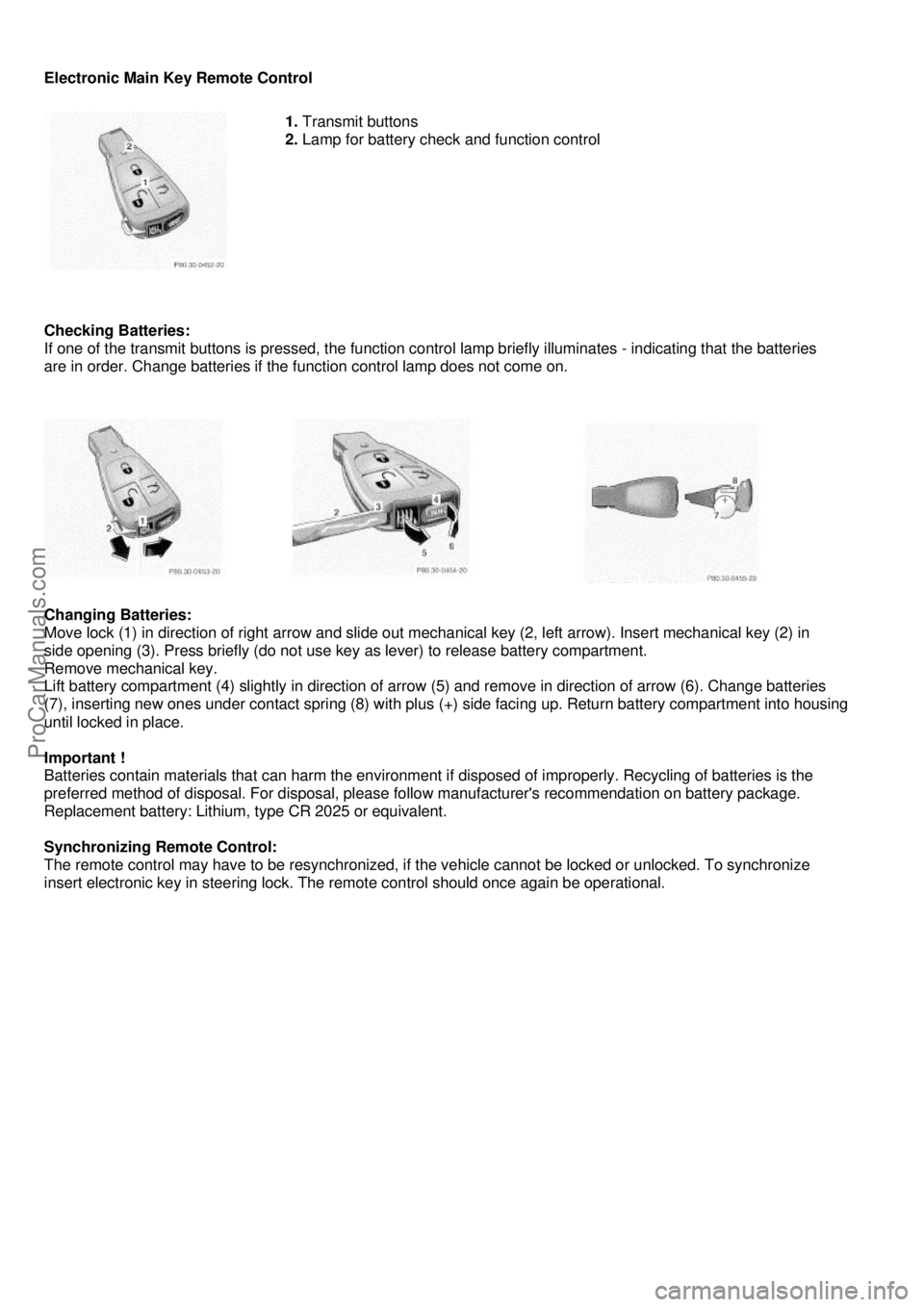
Electronic Main Key Remote Control
1. Transmit buttons
2. Lamp for battery check and function control
Checking Batteries:
If one of the transmit buttons is pressed, the function contro l lamp briefly illuminates - indicating that the batteries
are in order. Change batteries if the function control lamp does not come on.
Changing Batteries:
Move lock (1) in direction of right arrow and slide out mechanical key (2, left arrow). Insert mechanical key (2) in
side opening (3). Press briefly (do not use ke y as lever) to release battery compartment.
Remove mechanical key.
Lift battery compartment (4) slightly in direction of arrow (5) and remove in direction of arrow (6). Change batteries
(7), inserting new ones under contact spring (8) with plus (+) side facing up. Return battery compartment into housing
until locked in place.
Important !
Batteries contain materials that can harm the environment if disposed of improperly. Recycling of batteries is the
preferred method of disposal. For disposal, please fo llow manufacturer's recommendation on battery package.
Replacement battery: Lithium, type CR 2025 or equivalent.
Synchronizing Remote Control:
The remote control may have to be resynchronized, if t he vehicle cannot be locked or unlocked. To synchronize
insert electronic key in steering lock. The remote control should once again be operational.
ProCarManuals.com
Page 110 of 122

Technical Data C 230
Model C 230 (202 023)1 Rims - Tires
Engine 111 Rims (light alloy rims) 7J x 15 H 2
Mode of operation 4-stroke engine,
gasoline injection
Wheel offset 1.46 in (37 mm)
No. of cylinders
4 All season;Radial-ply tires 205/60 R 15 91 H
Bore 3.58 in (90.90 mm) Winter tires;Radial-ply tires 205/60 R 15 91 T M+S
Stroke 3.48 in (88.40 mm) Model C 230- Canada only
Total piston displacement 140.1 cu.in. (2295 cm3) Rims (steel rims) 61/2J x 15 H 2
Compression ratio 10,4:1 Wheel offset 1.46 in (37 mm)
Output acc. to SAE J 1349 148 hp/5500 rpm
(110 kW/5500 rpm)
All season;Radial-ply tires 195/65 R 15 91 H
Maximum torque acc. to SAE
J 1349
162 ft.lb./4000 rpm
(220 Nm/40OOrpm)
Winter tires;Radial-ply tires
195/65 R 15 91 T M+S
Maximum engine speed 6000 rpm Electrical System
Firing order 1-3-4-2 Generator (alternator) 14 V/90 A
Poly-V-belt 2155 mm Starter motor 12 V/1.4KW
Main Dimensions Battery 12 V/100 Ah
Overall vehicle length 177.4 in (4507 mm) Spark plugs Bosch F 9 DCO
Overall vehicle width 67.7 in (1720mm) Beru 14 F-9 DUO
Overall height 56.1 in (1424 mm)
Champion C 12 YCC
Wheel base 105.9 in (2690 mm) Electrode gap 0.032 in (0,8 mm)
Track, front 59.0 in (1499 mm) Tightening torque 15-22ft.lb. (20-30 Mm)
Track, rear 57.6 in (1464mm)
Weights See certification tag
Roof load max. 220 lb(100 kg)
Trunk load max 220 lb(100 kg)
1 The quoted data apply only to the standard vehicle. See an authorized Mercedes-Benz
dealer for the correspon-ding data of ali special bodies and special equipment,
ProCarManuals.com
Page 111 of 122

Technical Data C 280
Model C 280 (202 029)1 Rims - Tires
Engine 112 Rims (light
alloy rims)
7J x 15 H 2
Mode of operation 4-stroke engine,
gasoline injection
Wheel
offset
1.46 in (37 mm)
No. of cylinders 6
Summer
tires;
Radial-ply
tires
205/60R 15 91 H
Bore 3.54 in (89.90 mm)
Winter
tires;
Radial-ply
tires
205/60 R 15 91 T M+S
Stroke 2.89 in (73.50 mm)
Rims and All season Tires ( Sport Package)
Rims (light alloy rims) 7J x 16 H 2
Wheel offset 1.46 in (37 mm)
Summer tires;
Radial-ply tires
205/55 R 16 91 H
Electrical System
Total piston displacement 170.8 cu.in. (2799 cm3) Generator
(alternator) 14 V/90 A
Compression ratio 10:1
Starter
motor
12 V/1.7KW
Output acc. to SAE J
1349
195 hp/5800 rpm
(145 kW/5800 rpm)
Battery 12 V/100 Ah
Maximum torque acc.
to SAE J 1349
195 ft.lb./3000 rpm
(265 Nm/3000rpm)
Spark
plugs
Electrode
gap
Tightening
torque
Bosch F 9 DPER
0.032 in (0,8 mm)
15-22ft.lb. (20-30 Mm)
Maximum engine speed 6000 rpm Main Dimensions
Firing order 1-4-3-6-2-5 Overall
vehicle
length
177.4 in (4507 mm)
Poly-V-belt 2390 mm
Overall
vehicle
width
67.7 in (1720mm)
Weights: See certification tag
Overall
height
56.1 in (1424 mm)
Roof load max. 220 lb(100 kg) Wheel
base
105.9 in (2690 mm)
Trunk load max. 220 lb(100 kg) Track,
front
59.0 in (1499 mm)
Track, rear57.6 in (1464mm)
1 The quoted data apply only to the standard vehicle. See an authorized Mercedes-Benz dealer
for the correspon-ding data of ali special bodies and special equipment,
ProCarManuals.com
Page 112 of 122

Technical Data C 43 AMG
Model C 43 AMG (202 033)1 Rims and All season Tires
Engine 113 Rims2
Front axle
AMG light
alloy rims
Wheel
offset
71/2J x 17 H 2
1.38 in (35 mm)
Mode of operation 4-stroke engine,
gasoline injection
Rear axle
AMG light
alloy rims
Wheel
offset
8
1/2J x 17 H 2
1.18 in (30 mm)
No. of cylinders 8
Radial-ply
tires
Front axle
Rear axe
225/45 ZR 173
245/40 ZR 173
Bore 3.54 in 89.90 mm)
Rims and
Winter
Tires
Stroke
3.31 in (84.00 mm)
Rims2
AMG light alloy rims 71/2J x 17 H 2
Wheel offset 1.38 in (35 mm)
Radial-ply tires
or
215/45 R 17 H M + S
225/45 R 17 H M + S 3
Spare Wheel
Rims2
AMG light alloy rims 71/2J x 17 H 2
Wheel offset 1.38 in (35 mm)
All season tire:
Radial-ply tire
225/45 ZR 173
Electrical System
Total piston displacement 260.0 cu.in. (4265 cm3) Generator
(alternator)14 V/150 A
Compression ratio 10:1
Starter
motor
12 V/1.7KW
Output acc. to SAE J
1349
302 hp/5850 rpm
(225 kW/5850 rpm)
Battery 12 V/100 Ah
Maximum torque acc.
to SAE J 1349
302ft.lb./3250 rpm
(410 Nm/3250rpm)
Spark
plugs
Electrode
gap
Tightening
torque
Bosch F 8 DEPER
0.032 in (0,8 mm)
15-22ft.lb. (20-30 Mm)
Maximum engine speed 6300 rpm
Main Dimensions
Firing order 1-5-4-2-6-3-7-8
Overall
vehicle
length
177.4 in (4507 mm)
Poly-V-belt 2390 mm
Overall
vehicle
width 67.7 in (1720mm)
Overall
height
56.1 in (1424 mm)
Wheel
base 105.9 in (2690 mm)
Track,
front
59.2 in (1503 mm)
Weights See certification tag Tra ck, rear 58.2 in (1478mm)
ProCarManuals.com