warning MERCEDES-BENZ C-CLASS 1999 Workshop Manual
[x] Cancel search | Manufacturer: MERCEDES-BENZ, Model Year: 1999, Model line: C-CLASS, Model: MERCEDES-BENZ C-CLASS 1999Pages: 122, PDF Size: 1.66 MB
Page 85 of 122

Vehicle Jack
1. Jack arm
2. Jack base
See illustration for proper storage of jack. Before storing the jack on the felt in the spare wheel well, the jack arm
must be lowered almost to the base of the jack.
Warning !
The jack is designed exclusively for jacking up the vehicle at the jack tubes built into either side of the
vehicle. To help avoid personal injury, use the jack only to lift the vehicle during a wheel change. Never
get beneath the vehicle while it is supported by the jack. Keep hands and feet away from the area under the
lifted vehicle. Always firmly set parking brake and blo ck wheels before raising vehicle with jack. Do not
disengage parking brake while the vehicle is raised. Be certain that the jack is always vertical when in use,
especially on hills. Always try to use the jack on level surface. Be sure that the jack arm is fully inserted in
the jack tube. Always lower the vehicle onto sufficient capacity jackstands before working under the vehicle.
ProCarManuals.com
Page 86 of 122

Wheels
Replace rims or tires with the same designation, manufacturer and type as shown on the original part. See your
authorized Mercedes-Benz dealer for further information. See your authorized Mercedes- Benz dealer for information
on tested and recommended rims and tires for summer and wi nter operation. They can also offer advice concerning
tire service and purchase.
Tire Replacement
Front tires should be replaced in sets. Furthermore - in the event of tire replacement - the spare wheel (except model
C 43 AMG), if possible, should be used on the rear axle. Ri ms and tires must be of the correct size and type. For
dimensions, see "Technical Data". We recommend that y ou break in new tires for approx. 60 miles (100 km) at
moderate speed. It is imperative that the wheel mounting bolts be fastened to a tightening torque of 80 ft.lb. (110 Nm)
whenever wheels are mounted. For rim and tire specifications, refer to "Technical Data".
Warning !
Worn, old tires can cause accidents. If the tire tread is badly worn, or if the tires have sustained damage,
replace them. When replacing rims, use only genuine Mercedes-Benz wheel bolts specified for the particular
rim type. Failure to do so can result in the bolts loosening and possibly an accident.
Rotating Wheels
Rotation of wheels with summer tires does not apply to m odel C 43 AMG. The wheels can be rotated according to the
degree of tire wear while retaining the same direction of travel. Rotating, however, should be carried out at the
scheduled service intervals, before the characteristic tire wear pattern (shoulder wear on front wheels and tread
center wear on rear wheels) becomes visible, as otherwise the driving properties
Important !
Unidirectional tires must always be mounted with arrow on tire sidewall pointing in direction of vehicle forward
movement. Notes: Thoroughly clean the inner side of the w heels any time you rotate the wheels or wash the vehicle
underside. The use of retread tires is not recommended. Retread tires may adversely affect the handling
characteristics and safety of the vehicle. Dented or bent rims can cause tire pressure loss and damage to the tire
beads. For this reason, check rims for damage at regular in tervals. The rim flanges must be checked for wear before
a tire is mounted. Remove burrs, if any. Check and correct ti re inflation pressure after rotating the wheels. For Tire
Inflation Pressure refer to Index.
ProCarManuals.com
Page 87 of 122

Spare Wheel for Model C 43 AMG
The spare wheel rim size is 71/2Jx17H2 In the case of a flat tire or break- down, you may temporarily use a 71/2Jx17
H 2 instead of the 81/2J x 17 H 2 wheel rim on the rear axle, when observing the following restrictions:
• Do not exceed vehicle speed of 50 mph (80 km/h).
• Drive to the nearest repair facility to have the fl at tire repaired or replaced as appropriate.
For additional information, refer to "Technical Data".
1. Wheel bolt for model C 43 AMG
2. Wheel bolt for model 230 und C 28
Replace rims or tires with the same designation, manufa cturer and type as shown on the original part. See your
authorized Mercedes-Benz dealer for further information.
Warning !
The jack is designed exclusively for jacking up the vehicle at the jack tubes built into either side of the
vehicle. To help avoid personal injury, use the jack only to lift the vehicle during a wheel change. Never get
beneath the vehicle while it is supported by the jack. Keep hands and feet away from the area under the lifted
vehicle. Always firmly set parking brake and block whee ls before raising vehicle with jack. Do not disengage
parking brake while the vehicle is raised. Be certain that the jack is always vertical when in use, especially on
hills. Always try to use the jack on level surface. Be sure that the jack arm is fully inserted in the jack tube.
Always lower the vehicle onto sufficient capacity jackstands before working under the vehicle.
ProCarManuals.com
Page 88 of 122
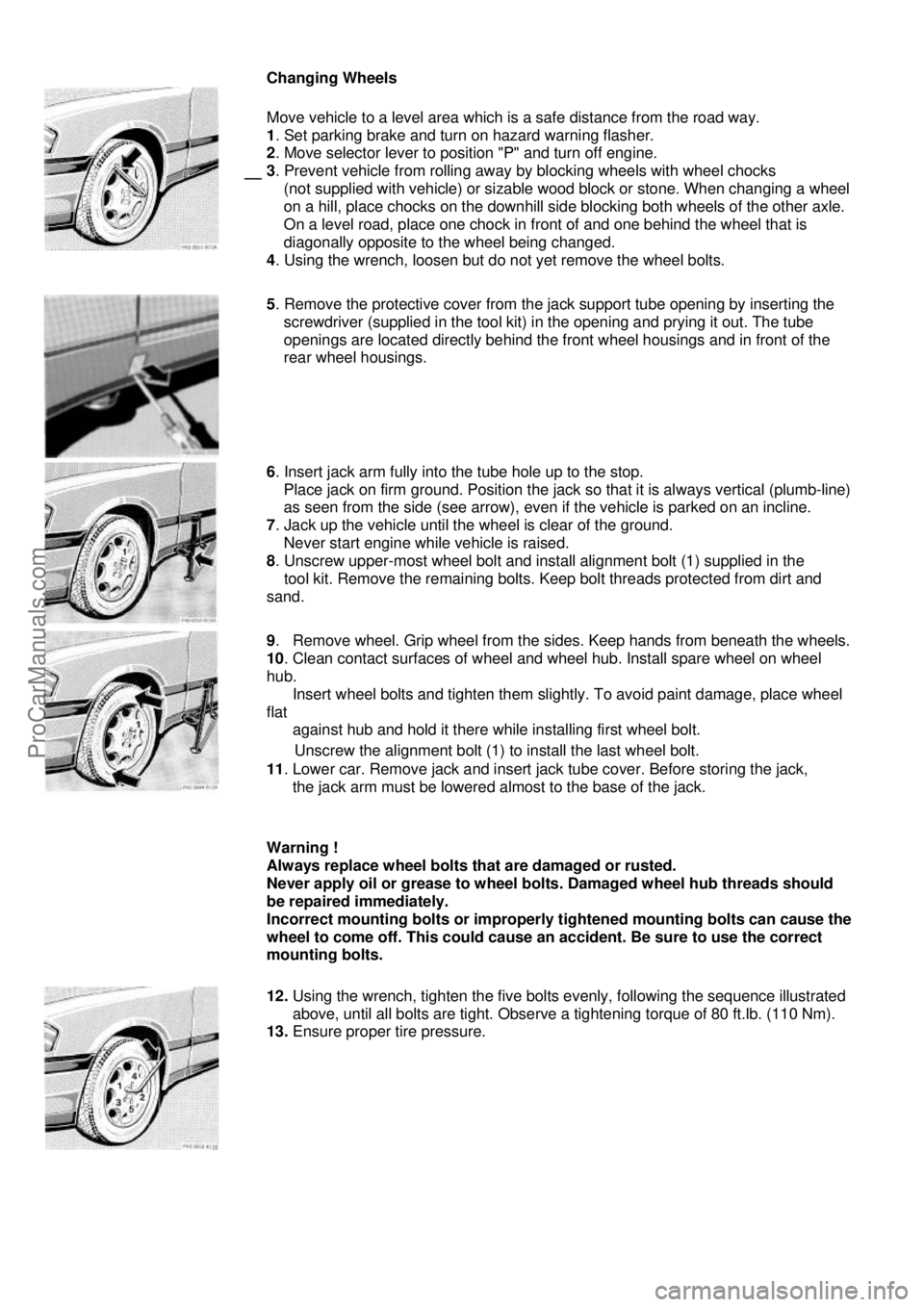
Changing Wheels
Move vehicle to a level area which is a safe distance from the road way.
1 . Set parking brake and turn on hazard warning flasher.
2 . Move selector lever to position "P" and turn off engine.
3 . Prevent vehicle from rolling away by blocking wheels with wheel chocks
(not supplied with vehicle) or sizable wood block or stone. When changing a wheel
on a hill, place chocks on the downhill side blocking both wheels of the other axle.
On a level road, place one chock in front of and one behind the wheel that is
diagonally opposite to the wheel being changed.
4 . Using the wrench, loosen but do not yet remove the wheel bolts.
5
. Remove the protective cover from the jack support tube opening by inserting the
screwdriver (supplied in the tool kit) in the opening and prying it out. The tube
openings are located directly behind the front wheel housings and in front of the
rear wheel housings.
6
. Insert jack arm fully into the tube hole up to the stop.
Place jack on firm ground. Position the jack so that it is always vertical (plumb-line)
as seen from the side (see arrow), even if the vehicle is parked on an incline.
7. Jack up the vehicle until the wheel is clear of the ground.
Never start engine while vehicle is raised.
8 . Unscrew upper-most wheel bolt and install alignment bolt (1) supplied in the
tool kit. Remove the remaining bolts. Keep bolt threads protected from dirt and
sand.
9. Remove wheel. Grip wheel from the sides. Keep hands from beneath the wheels.
10. Clean contact surfaces of wheel and wheel hub. Install spare wheel on wheel
hub.
Insert wheel bolts and tighten them slightly. To avoid paint damage, place wheel
flat
against hub and hold it there while installing first wheel bolt.
Unscrew the alignment bolt (1) to install the last wheel bolt.
11. Lower car. Remove jack and insert jack tube cover. Before storing the jack,
the jack arm must be lowered almost to the base of the jack.
Warning !
Always replace wheel bolts that are damaged or rusted.
Never apply oil or grease to wheel bolts. Damaged wheel hub threads should
be repaired immediately.
Incorrect mounting bolts or improperly tightened mounting bolts can cause the
wheel to come off. This could cause an accident. Be sure to use the correct
mounting bolts.
12.
Using the wrench, tighten the five bolts evenly, following the sequence illustrated
above, until all bolts are tight. Obse rve a tightening torque of 80 ft.lb. (110 Nm).
13. Ensure proper tire pressure.
ProCarManuals.com
Page 89 of 122

Tire Inflation Pressure
A table (see fuel filler flap) lists the tire inflation pressures specified for Mercedes-Benz recommended tires as well as
for the varying operating conditions.
Important !
Tire pressure changes by approx. 1.5 psi (0.1 bar) per 18°F (10°C) of air temperature change. Keep this in mind
when checking tire pressure inside a garage - especially in the winter.
Example:
If garage temperature = approx. +68°F (+20°C) and ambient te mperature = approx. +32°F (0°C) then the adjusted air
pressure = specified air pressure +3 psi (+0.2 bar).
Tire pressures listed for light loads are minimum values o ffering high driving comfort. Increased inflation pressures for
heavy loads produce favorable handling characteristics with lighter loads arid are perfectly permissible. The ride of
the vehicle, however, will become somewhat harder.
Tire temperature and pressure increase with the vehicle speed. Tire pressure should therefore only be corrected on
cold tires. Correct tire pressure in warm tires only if pressure has dropped below the pressure listed in the table and
the respective operating conditions are taken into consideration.
An underinflated tire due to a slow leak (e.g. due to a
nail in the tire) may cause damage such as tread separation, bulging etc.. Regular tire pressure checks (including the
spare tire) at intervals of no more than 14 days are therefore essential. If a tire constantly loses air, it should be
inspected for damage.
Warning !
Do not overinflate tires. Overinfiating tires can result in sudden deflation (blowout) because they are more
likely to become punctured or damaged by road debris, potholes etc.. Follow recommended inflation
pressures.
Do not overload the tires by exceeding the specified vehicle capacity weight (as indicated by the label on the
driver's door latch post). Overloading the tires can overheat them, possibly causing a blowout.
ProCarManuals.com
Page 90 of 122

Exterior Lamps
Headlamp Adjustment
Correct headlamp adjustment is extremely important. Check and readjust headlamps at regular intervals and
when a bulb has been replaced.
Headlamp Assembly
1. Cover for low beam headlamp bulb, fog lamp, and level for vertical adjustment
2. Latch for cover (1)
3. Cover for high beam headlamp bulb
4. Clamp for cover (3)
5. Headlamp vertical adjustment screw
6. Headlamp horizontal adjustment screw
7. Scale for horizontal adjustment
8. Electrical connector for low beam headlamp bulb Xenon lamp (optional) ignition module for low beam
9. Electrical connector for fog lamp bulb
10. Electrical connector for high beam headlamp bulb
Replacing Bulb:
To prevent a possible electrical short circuit, switch off lamp prior to replacing a bulb. When replacing bulbs,
install only 12 volt bulbs with the specified watt rati ng. When replacing halogen bulbs do not touch glass
portion of bulb with bare hands. Us e plain paper or a clean cloth.
Warning !
Halogen lamps contain pressurized gas. A bulb can explode if you:
• touch or move it when hot,
• drop the bulb,
• scratch the bulb.
Wear eye and hand protection.
Bulb for Low Beam H7 (55 W)
Bulb for Fog Lamp H1 (55 W)
Open hood.
Depress latch (2) and remove cover (1). Pull of electrical connector (8) or (9). Unhook clamping ring and
removes bulb. Insert new bulb (seating properly in cutouts of bulb socket), and mount clamping ring.
Reinstall and push electrical connector on securely. Re install bottom end of cover (1) and push against top
end of cover until properly seated. Check lamp for proper operation.
Xenon (optional)
Bulb for Low Beam
Warning !
Because of high voltage in Xenon lamps, it is dangerous to replace the bulb or repair the lamp and its
components. We recommend that you have such work done by a qualified technician.
ProCarManuals.com
Page 95 of 122

Battery
Warning !
Failure to follow these instructions can result in severe injury or death. Never lean over batteries while
connecting, you might get injured. Battery fluid contains sulfuric acid. Do not allow this fluid to come in
contact with eyes, skin or clothing. In case it does, immediately flush affected area with water and seek
medical help if necessary. A battery will also produ ce hydrogen gas, which is flammable and explosive.
Keep flames or sparks away from battery, avoid im proper connection of jumper cables, smoking etc..
Important !
Battery maintenance information:
The battery is located in the trunk under the trunk floor. The fluid level must be checked at every A and B service.
Always insure that the fluid level is at the specified maximum level and that only distilled water is used. Failure to
maintain proper fluid level may result in cell deterioration and possible battery rupture. The service life of the battery is
dependent on its condition of charge. The battery should alwa ys be kept sufficiently charged, in order to last an
optimum length of time.
Therefore, we strongly recommend that you have the battery charge checked frequently, and corrected if
necessary, especially if you use the vehicle less than approximately 200 miles (300 km) per month, mostly for
short distance trips, or if it is not used for long periods of time.
Only charge a battery with a battery charger after the battery has been disconnected from the vehicle electrical circuit.
Always disconnect the battery negative lead first and connect last. When removing and connecting the battery,
always make sure that all electrical consumers are off and the electronic key is in steering lock position 0. The battery
and its vent tube must always be securely installed when the car is in operation. While the engine is running the
battery terminal clamps must not be loosened or detached, otherwise the generator and other electronic components
would be damaged.
Note:
After reconnecting the battery al so resynchronize the Express feature of the power windows
(see Power Windows in Index).
Battery Recycling
Batteries contain materials that can harm the environment with improper disposal. Large 12 Volt storage batteries
contain lead. Recycling of batteries is the preferred method of disposal. Many states require sellers of batteries to
accept old batteries for recycling.
ProCarManuals.com
Page 97 of 122

Jump Starting
Warning !
Failure to follow these directions will cause damage to the electronic components, and can lead to a battery
explosion and severe injury or death. Never lean over batteries while connecting or jump starting, you might
get injured. Battery fluid contains sulfuric acid. Do not allow this fluid to come in contact with eyes, skin or
clothing. In case it does, immediately flush affected ar ea with water, and seek medical help if necessary.
A battery will also produce hydrogen gas, which is flammable and very explosive. Keep flames or sparks
away from battery, avoid improper connection of jumper cables, smoking etc.. Read all instructions before
proceeding.
If the battery is discharged, the engine should be started with jumper cables and the (12 V) battery of another vehicle.
The battery is located in the trunk under the trunk floor.
Proceed as follows:
1 . Position the vehicle with the charged battery so that the jumper cables will reach, but never
let the vehicles touch. Make sure the jump er cables do not have loose or missing insulation.
2. On both vehicles:
• Turn off engine and all lights and acce ssories, except hazard warning flashers or
work lights.
• Apply parking brake and shift selector lever to position "P".
Important !
3. Clamp one end of the first jumper cable to the positive (+) terminal of the discharged
battery and the other end to the positive (+ ) terminal of the charged battery. Make sure
the cable clamps do not touch any other metal parts.
4. Clamp one end of the second jumper cable to the grounded negative (-) terminal of the
charged battery and the final connection to the negative (-) terminal of the discharged battery.
Important !
5. Start engine of the vehicle with the charged battery and run at high idle. Make sure the
cables are not on or near pulleys, fans, or other parts that will move when the engine is
started. Allow the discharged battery to charge for a few minutes. Start engine of the
disabled vehicle in the usual manner.
6. After the engine has started, remove jumper cables exactly reversing the above
installation sequence, starting with the last connection made first. When removing each
clamp, make sure that it does not touch any other metal while the other end is still attached.
Important !
A discharged battery can freeze at approx. +14°F (-10°C ). In that case, it must be thawed out before
jumper cables are used. A frozen battery can explode and cause personal injury.
Jumper cable specifications:
• Minimum cable cross-section of 25 mm
2 or approx. 2 AWG
• Maximum length of 11.5 ft. (3.5 m).
ProCarManuals.com
Page 98 of 122
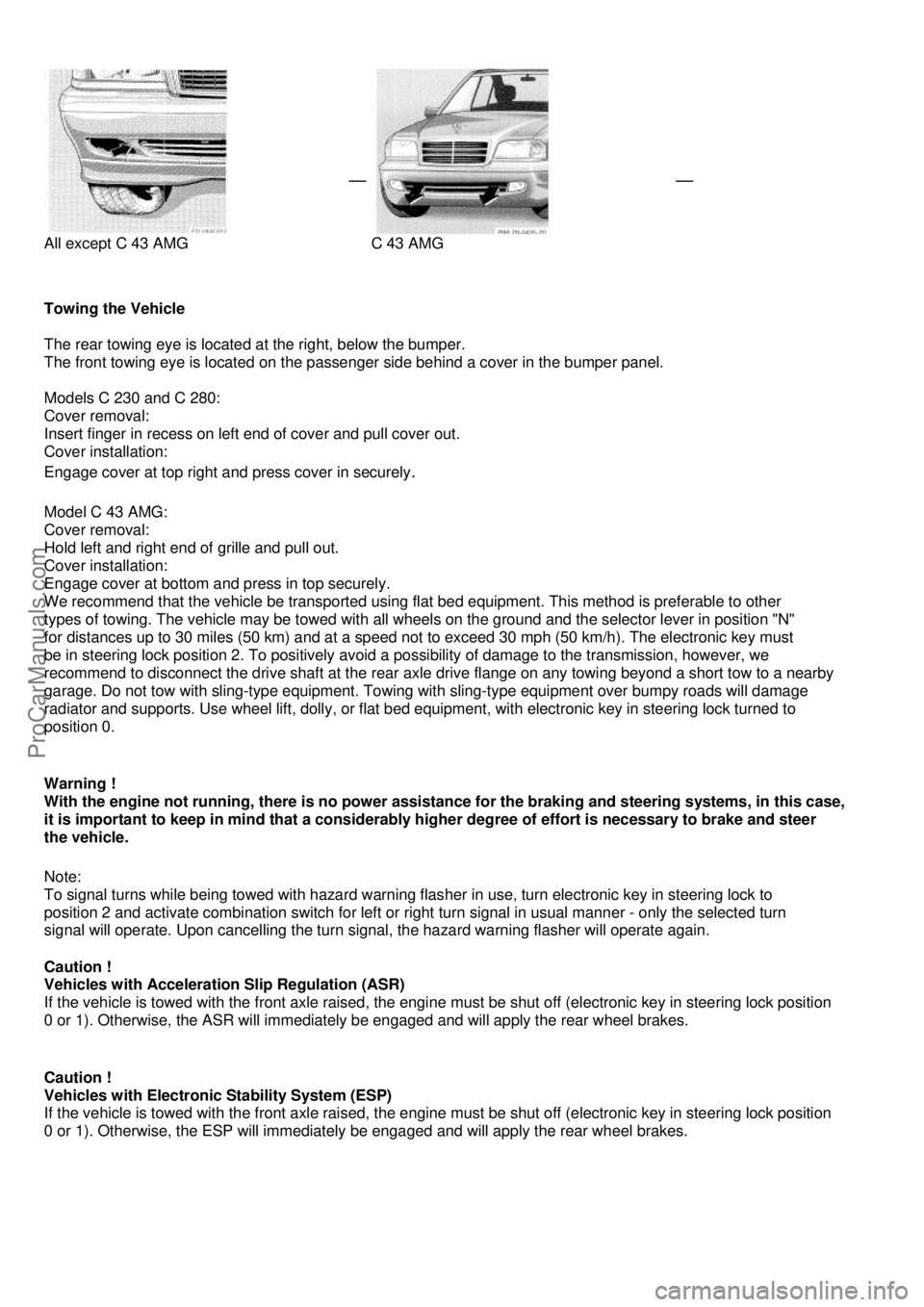
All except C 43 AMG
C 43 AMG
Towing the Vehicle
The rear towing eye is located at the right, below the bumper.
The front towing eye is located on the passenger side behind a cover in the bumper panel.
Models C 230 and C 280:
Cover removal:
Insert finger in recess on left end of cover and pull cover out.
Cover installation:
Engage cover at top right and press cover in securely
.
Model C 43 AMG:
Cover removal:
Hold left and right end of grille and pull out.
Cover installation:
Engage cover at bottom and press in top securely.
We recommend that the vehicle be transported using flat bed equipment. This method is preferable to other
types of towing. The vehicle may be towed with all wheel s on the ground and the selector lever in position "N"
for distances up to 30 miles (50 km) and at a speed not to exceed 30 mph (50 km/h). The electronic key must
be in steering lock position 2. To positively avoid a possibility of damage to the transmission, however, we
recommend to disconnect the drive shaft at the rear axle drive flange on any towing beyond a short tow to a nearby
garage. Do not tow with sling-type equipment. Towing with sling-type equipment over bumpy roads will damage
radiator and supports. Use wheel lift, dolly, or flat bed equipment, with electronic key in steering lock turned to
position 0.
Warning !
With the engine not running, there is no power assistance for the braking and steering systems, in this case,
it is important to keep in mind that a considerably higher degree of effort is necessary to brake and steer
the vehicle.
Note:
To signal turns while being towed with hazard warning flas her in use, turn electronic key in steering lock to
position 2 and activate combination switch for left or right turn signal in usual manner - only the selected turn
signal will operate. Upon cancelling the turn signal, the hazard warning flasher will operate again.
Caution !
Vehicles with Acceleration Slip Regulation (ASR)
If the vehicle is towed with the front axle raised, the engi ne must be shut off (electronic key in steering lock position
0 or 1). Otherwise, the ASR will immediately be engaged and will apply the rear wheel brakes.
Caution !
Vehicles with Electronic Stability System (ESP)
If the vehicle is towed with the front axle raised, the engine must be shut off (electronic key in steering lock position
0 or 1). Otherwise, the ESP will immediately be engaged and will apply the rear wheel brakes.
ProCarManuals.com
Page 99 of 122

Cleaning and Care of the Vehicle
Warning !
Many cleaning products can be hazardous. Some are poisonous, others are flammable.
Always follow the instructions on the particular container. Always open your car's doors or
windows when cleaning the inside. Never use fluids or solvents that are not designed for
cleaning your car.
In operation, your vehicle is subjected to varying external influences which, if gone unchecked, can
attack the paintwork as well as the underbody and cause lasting damage.
Such damage is caused not only by extreme and varying climatic conditions, but also by air
pollution, road salt, tar, gravel and stone chipping. Grease and oil, fuel, coolant, brake fluid, bird
droppings, insects, tree resins etc. should be removed immediately to avoid paint damage. Frequent
washing reduces and/or eliminates the aggr essiveness and potency of the above adverse
influences.
More frequent washings are necessary to deal with unfavorable conditions; for example, near the
ocean, in industrial areas (smoke, exhaust emissions), or during winter operation.
You should check your vehicle from time to time for stone chipping or other damage. Any damage
should be repaired as soon as possible to prevent the start of corrosion. In doing so, do not neglect
the underside of the car. A prerequisite for a t horough check is a washing of the underbody followed
by a thorough inspection. Damage d areas need to be reundercoated.
Your vehicle has been treated at the factory with a wax-base rustproofing in the body cavities which
will last for the lifetime of t he vehicle. Post-production treatment is neither necessary nor
recommended by Mercedes-Be nz because of the possibility of incompatibility between materials
used in the production proc ess and others applied later.
We have selected car care products and compiled recommendations which are specially matched to
our vehicles and which always reflect the late st technology. You can obtain Mercedes- Benz
approved car care products at your authorized Mercedes-Benz dealer.
Scratches, corrosive deposits, corrosion or damage due to negligent or incorrect care cannot always
be removed or repaired with the car care products recommended here. In such cases it is best to
seek aid at your authorized Mercedes-Benz dealer. The following topics deal with the cleaning and
care of your vehicle and give important "how-to" in formation as well as references to Mercedes-Benz
approved car care products. Additional information can be found in the booklet titled "Car Care".
Engine Cleaning
Prior to cleaning the engine compartment make sure to protect electrical components and
connectors from the intrusion of water and cleaning agents.
Corrosion protection, such as MB Anticorrosion Wax should be applied to the engine compartment
after every engine cleaning. Before applying, all control linkage bushings and joints should be
lubricated. The poly-V-belt and all pulleys should be protected from any wax.
Car Washing
Do not use hot water or wash your car in direct sunlight. Use only a mild car wash detergent, such
as Mercedes-Benz approved Car Shampoo.
Thoroughly spray the car with a diffused jet of wa ter. Direct only a very weak spray towards the
ventilation intake. Use plenty of water an d rinse the sponge and chamois frequently.
Rinse with clear water and thoroughly wipe dry with a chamois. Do not allow cleaning agents to dry
on the finish. If the vehicle has been run through an automatic car wash - in particular one of the
older installations - rewipe the recessed sections in the taillamps (designed to prevent soiling) if
necessary. No solvents (fuels, thi nners etc.) must be used. In the winter, thoroughly remove all
traces of road salt as soon as possible.
When washing the underbody, do not forget to clean the inner sides of the wheels.
Tar Stains
Quickly remove tar stains before they dry and beco me more difficult to remove. A tar remover is
recommended.
Window Cleaning
Use a window cleaning solution on all glass surfac es. An automotive glass cleaner is recommended.
ProCarManuals.com