Fuel MERCEDES-BENZ C-Class 2000 W202 User Guide
[x] Cancel search | Manufacturer: MERCEDES-BENZ, Model Year: 2000, Model line: C-Class, Model: MERCEDES-BENZ C-Class 2000 W202Pages: 130, PDF Size: 2.43 MB
Page 25 of 130
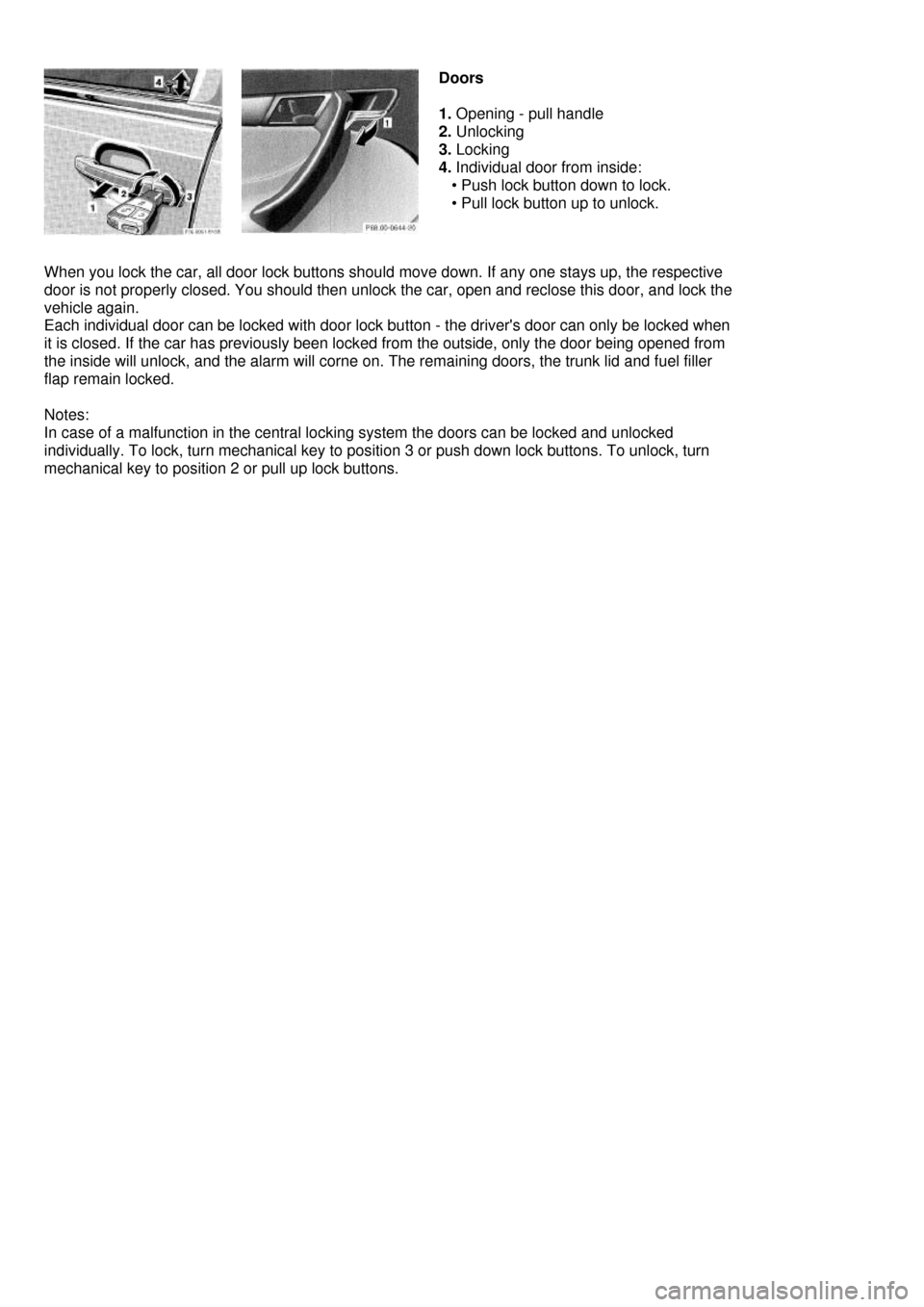
Doors
1. Opening - pull handle
2. Unlocking
3. Locking
4. Individual door from inside:
• Push lock button down to lock.
• Pull lock button up to unlock.
When you lock the car, all door lock buttons should move down. If any one stays up, the respective
door is not properly closed. You should then unlock the car, open and reclose this door, and lock the
vehicle again.
Each individual door can be locked with door lock button - the driver's door can only be locked when
it is closed. If the car has previously been locked from the outside, only the door being opened from
the inside will unlock, and the alarm will corne on. The remaining doors, the trunk lid and fuel filler
flap remain locked.
Notes:
In case of a malfunction in the central locking system the doors can be locked and unlocked
individually. To lock, turn mechanical key to position 3 or push down lock buttons. To unlock, turn
mechanical key to position 2 or pull up lock buttons.
Page 26 of 130
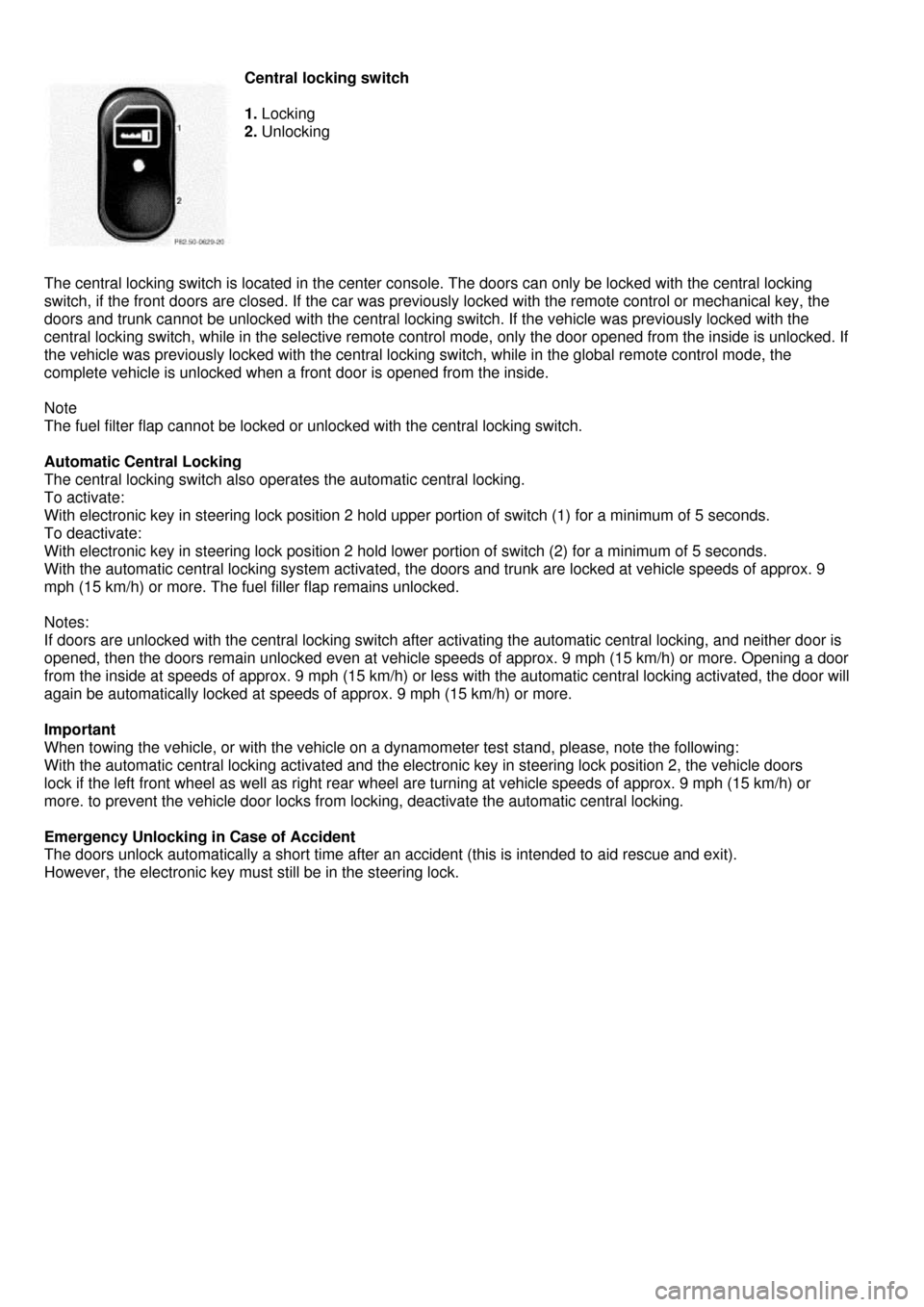
Central locking switch
1. Locking
2. Unlocking
The central locking switch is located in the center console. The doors can only be locked with the central locking
switch, if the front doors are closed. If the car was previously locked with the remote control or mechanical key, the
doors and trunk cannot be unlocked with the central locking switch. If the vehicle was previously locked with the
central locking switch, while in the selective remote control mode, only the door opened from the inside is unlocked. If
the vehicle was previously locked with the central locking switch, while in the global remote control mode, the
complete vehicle is unlocked when a front door is opened from the inside.
Note
The fuel filter flap cannot be locked or unlocked with the central locking switch.
Automatic Central Locking
The central locking switch also operates the automatic central locking.
To activate:
With electronic key in steering lock position 2 hold upper portion of switch (1) for a minimum of 5 seconds.
To deactivate:
With electronic key in steering lock position 2 hold lower portion of switch (2) for a minimum of 5 seconds.
With the automatic central locking system activated, the doors and trunk are locked at vehicle speeds of approx. 9
mph (15 km/h) or more. The fuel filler flap remains unlocked.
Notes:
If doors are unlocked with the central locking switch after activating the automatic central locking, and neither door is
opened, then the doors remain unlocked even at vehicle speeds of approx. 9 mph (15 km/h) or more. Opening a door
from the inside at speeds of approx. 9 mph (15 km/h) or less with the automatic central locking activated, the door will
again be automatically locked at speeds of approx. 9 mph (15 km/h) or more.
Important
When towing the vehicle, or with the vehicle on a dynamometer test stand, please, note the following:
With the automatic central locking activated and the electronic key in steering lock position 2, the vehicle doors
lock if the left front wheel as well as right rear wheel are turning at vehicle speeds of approx. 9 mph (15 km/h) or
more. to prevent the vehicle door locks from locking, deactivate the automatic central locking.
Emergency Unlocking in Case of Accident
The doors unlock automatically a short time after an accident (this is intended to aid rescue and exit).
However, the electronic key must still be in the steering lock.
Page 27 of 130
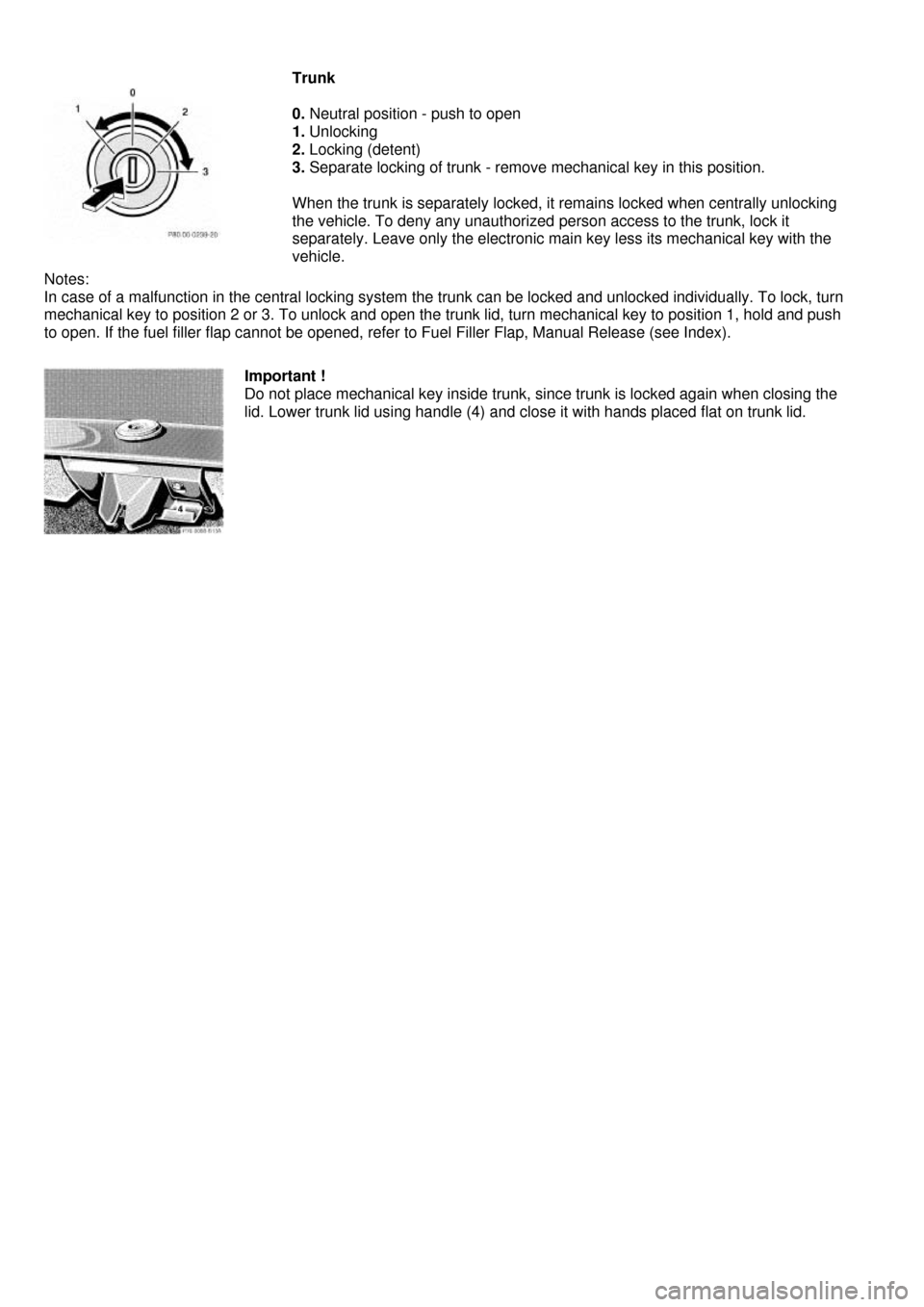
Trunk
0. Neutral position - push to open
1. Unlocking
2. Locking (detent)
3. Separate locking of trunk - remove mechanical key in this position.
When the trunk is separately locked, it remains locked when centrally unlocking
the vehicle. To deny any unauthorized person access to the trunk, lock it
separately. Leave only the electronic main key less its mechanical key with the
vehicle.
Notes:
In case of a malfunction in the central locking system the trunk can be locked and unlocked individually. To lock, turn
mechanical key to position 2 or 3. To unlock and open the trunk lid, turn mechanical key to position 1, hold and push
to open. If the fuel filler flap cannot be opened, refer to Fuel Filler Flap, Manual Release (see Index).
Important !
Do not place mechanical key inside trunk, since trunk is locked again when closing the
lid. Lower trunk lid using handle (4) and close it with hands placed flat on trunk lid.
Page 72 of 130

Charge Indicator Lamp
Should the charge indicator lamp fail to come on prior to starting when the electronic key is in steering lock position 2
or should it fail to go out after starting or during operati on, this indicates a fault which must be repaired at an
authorized Mercedes-Benz dealer immediately.
If the charge indicator lamp comes on while the engine is ru nning, this may indicate that the poly-V-belt has broken.
Should this condition occur, the poly-V-bel t must be replaced before continuing to operate the vehicle. Otherwise, the
engine will overheat due to an inoperative water pump which may result in damage to the engine.
Do not continue to drive the vehicle with the charge indicator lamp illuminated. Doing so could result in serious engine
damage that is not covered by the Mercedes-Benz Limited Warranty.
Low Engine Oil Level Warning Lamp
With the electronic key in steering lock position 2, the o il level warning lamp comes on. It should go out immediately
when the engine is running.
If the warning lamp does not go out after starting the engi ne, or comes on with the engine running and at operating
temperature, the engine oil level has dropped to approximately the minimum mark on the dipstick.
When this occurs, the warning lamp will first come on intermittently and then stay on if the oil level drops further.
If no oil leaks are noted, continue to drive to the nearest service station where the engine oil should be topped to the
"full" mark on the dipstick with an approved oil.
The low engine oil level warning light should not be ignored. Extended driving with the light illuminated could result in
serious engine damage that is not covered by the Mercedes -Benz Limited Warranty. In addition to the warning lamp,
the engine oil level should be periodically checked with t he dipstick (or via the odometer display - Model C280 and
C43 AMG only), for example during a fuel stop, or before a long trip (see Engine Oil Level, Checking in Index)
Page 73 of 130

Engine Oil Consumption
Engine oil consumption checks should only be made after the break-in period. During the breaking period, higher oil
consumption may be noticed and is normal. Frequent driving at high engine speeds results in increased consumption.
Fuel Reserve and Fuel Cap Placement Warning Lamp
With the electronic key in steering lock position 2, the fuel reserve warning lamp comes on. It should go out
immediately when the engine is running.
If the warning lamp does not go out after starting the engine, or if it comes on while driving, it indicates that the fuel
level is down to the reserve quantity of approximately 2.1 gal (8 liters).
The warning lamp blinks when the fuel c ap is not closed, or a fuel system leak has been detected. Retighten cap and
see if lamp goes out.
If the warning lamp continues to blink after closing the fuel cap correctly, hav e the fuel system checked at your
authorized Mercedes-Benz dealer as soon as possible.
Leaving the engine running and the fuel cap open can cause the "Check Engine" lamp to illuminate).
Tachometer
Red marking on tachometer: Excessive engine speed. Avoid th is engine speed, as it may result in serious engine
damage that is not covered by the Mercedes-Benz Limited Warranty. For engine protection, the fuel supply is
interrupted if the engine is operated within the red marking.
Seat Belt Warning Lamp
With the electronic key in steering lock position 2, the warning lamp comes on, and a warning sounds for a short time
if the drivers seat belt is not fastened. After starting the engine, the warning lamp blinks for a brief period to remind
the driver and passengers to fasten seat belts.
Page 83 of 130

Emission Control
Certain systems of the engine serve to keep the toxic components of the exhaust gases within permissible limits
required by law. These systems, of course, will function properly only when maintained strictly according to factory
specifications. Any adjustments on the engine should, ther efore, be carried out only by qualified Mercedes-Benz
authorized dealer technicians. Engine adjustments should not be altered in any way. Moreover, the specified service
jobs must be carried out regularly according to Mercedes -Benz servicing requirements. For details refer to the
Service Booklet.
Warning !
Inhalation of exhaust gas is hazardous to your health. All exhaust gas contains carbon monoxide, and
inhaling it can cause unconsciousness and lead to death.
Do not run the engine in confined areas (such as a garage) which are not properly ventilated.
If you think that exhaust gas fumes are entering the vehicle while driving, have the cause determined and
corrected immediately. If you must drive under these conditions, drive only with at least one window fully
open.
On-Board Diagnostic System
The Sequential Multiport Fuel Injection (SFI) control module monitors emission control components that either provide
input signals to or receive output sign als from the control module. Malfunctions resulting from interruptions or failure
of any of these components are indica ted by the "CHECK ENGINE" malfunction indicator lamp in the instrument
cluster and are simultaneously stored in the SFI control module. If the "CHECK ENGINE" malfunction indicator lamp
comes on, have the system checked at your authorized Mercedes-Benz dealer as soon as possible. With some
exceptions the control module switches off the "CHECK ENGINE" indicator lamp if the condition, causing the lamp to
come on, no longer exists during three consecutive cycles. An on-board diagnostic connector is located in the
passenger compartment near to the parking brake pedal, allowi ng the accurate identification of system malfunctions
through the readout of diagnostic trouble codes.
Page 84 of 130

Winter Driving
Have your car winterized at your authorized Mercedes-Benz dealer before the onset of winter.
• Change the engine oil if the engine contains an oil which is not approved for winter operation.
For viscosity (SAE/CCMC class) and filling quantity, see Capacities: Fuels, Coolants,
Lubricants etc. in Index.
• Check engine coolant anticorr osion/antifreeze concentration.
• Additive for the windshield washer and headl amp cleaning system: Add MB Concentrate "S"
to a premixed windshield washer solvent/ant ifreeze which is formulated for below freezing
temperatures (see Index).
• Test battery: Battery capacity drops with dec reasing ambient temperature. A well charged
battery helps to ensure that the engine can be started, even at low ambient temperatures.
• Tires: We recommend M+S rated radial-ply tires on all four wheels for the winter season.
Observe permissible maximum speed for M+S rated radial-ply tires and the legal speed limit.
Note:
In winter operation, the maximum effectiveness of the Antilock Brake System (ABS), Acceleration Slip Regulation
(ASR) or the Electronic Stab ility Program (ESP) can only be achieved with M+S rated radial-ply tires and/or snow
chains recommended by Mercedes-Benz. Snow chains maximize performance.
Snow Chains
Use only snow chains that are tested and recommended by Mercedes-Benz. Your authorized Mercedes-Benz
dealer will be glad to advise you on this subject. Ch ains should only be used on the rear wheels.
Follow the manufacturer's mounting instructions. Snow ch ains should only be driven on snow covered roads at
speeds not to exceed 30 mph (50 km/h). Remove chains as soon as possible when driving on roads without snow.
For tips on driving on slippery winter roads, refer to In dex. Vehicles with Acceleration Slip Regulation (ASR) or
Electronic Stability Program (ESP): When driving with snow chains, press the ASR or ESP control switch, refer to
Index.
Model C 43 AMG
Important !
Use of snow chains is permissible only on winter tire size 215/45 R 17 H M+S. Refer to "Rims - Tires" in section
"Technical Data" (see Index).
Travelling Abroad
Abroad, there is a widely-spread Mercedes-Benz service network at your disposal. If you plan to travel into areas
which are not listed in the index of your dealer directory, you should request pertinent information from your
authorized Mercedes-Benz dealer.
Page 95 of 130

Tire Inflation Pressure
A table (see fuel filler flap) lists the tire inflation pressures specified for Mercedes-Benz recommended tires as well as
for the varying operating conditions.
Important !
Tire pressure changes by approx. 1.5 psi (0.1 bar) per 18°F (10°C) of air temperature change. Keep this in mind
when checking tire pressure inside a garage - especially in the winter.
Example:
If garage temperature = approx. +68°F (+20°C) and ambient te mperature = approx. +32°F (0°C) then the adjusted air
pressure = specified air pressure +3 psi (+0.2 bar).
Tire pressures listed for light loads are minimum values o ffering high driving comfort. Increased inflation pressures for
heavy loads produce favorable handling characteristics with lighter loads arid are perfectly permissible. The ride of
the vehicle, however, will become somewhat harder.
Tire temperature and pressure increase with the vehicle speed. Tire pressure should therefore only be corrected on
cold tires. Correct tire pressure in warm tires only if pressure has dropped below the pressure listed in the table and
the respective operating conditions are taken into consideration.
An underinflated tire due to a slow leak (e.g. due to a
nail in the tire) may cause damage such as tread separation, bulging etc.. Regular tire pressure checks (including the
spare tire) at intervals of no more than 14 days are therefore essential. If a tire constantly loses air, it should be
inspected for damage.
Warning !
Do not overinflate tires. Overinfiating tires can result in sudden deflation (blowout) because they are more
likely to become punctured or damaged by road debris, potholes etc.. Follow recommended inflation
pressures.
Do not overload the tires by exceeding the specified vehicle capacity weight (as indicated by the label on the
driver's door latch post). Overloading the tires can overheat them, possibly causing a blowout.
Page 103 of 130

Jump Starting
Warning !
Failure to follow these directions will cause damage to the electronic components, and can
lead to a battery explosion and severe injury or death. Never lean over batteries while
connecting or jump starting, you might get injure d. Battery fluid contains sulfuric acid. Do
not allow this fluid to come in contact with ey es, skin or clothing. In case it does, immediately
flush affected area with water, and seek medical help if necessary. A battery will also produce
hydrogen gas, which is flammable and very explosive. Keep flames or sparks away from
battery, avoid improper connection of jumper cables, smoking etc.. Read all instructions
before proceeding.
If the battery is discharged, the engine should be start ed with jumper cables and the (12 V) battery of
another vehicle.
The battery is located in the trunk under the trunk floor.
Proceed as follows:
1 . Position the vehicle with the charged battery so that the jumper cables will reach, but never
let the vehicles touch. Make sure the jump er cables do not have loose or missing insulation.
2. On both vehicles:
• Turn off engine and all lights and accessories, except hazard warning flashers or work lights.
• Apply parking brake and shift selector lever to position "P".
Important !
3. Clamp one end of the first jumper cable to the positive (+) terminal of the discharged
battery and the other end to the positive (+ ) terminal of the charged battery. Make sure
the cable clamps do not touch any other metal parts.
4. Clamp one end of the second jumper cable to the grounded negative (-) terminal of the
charged battery and the final connection to the negative (-) terminal of the discharged battery.
Important !
5. Start engine of the vehicle with the charged battery and run at high idle. Make sure the
cables are not on or near pulleys, fans, or other parts that will move when the engine is
started. Allow the discharged battery to charge for a few minutes. Start engine of the
disabled vehicle in the usual manner.
6. After the engine has started, remove jumper cables exactly reversing the above
installation sequence, starting with the last connection made first. When removing each
clamp, make sure that it does not touch any other metal while the other end is still attached.
Important !
A discharged battery can freeze at approx. +14°F (-10°C ). In that case, it must be thawed out before
jumper cables are used. A frozen battery can explode and cause personal injury.
Jumper cable specifications:
• Minimum cable cross-section of 25 mm
2 or approx. 2 AWG
• Maximum length of 11.5 ft. (3.5 m).
Note:
If engine does not run after several unsuccessful starting attempts, have it checked at the nearest
authorized Mercedes-Benz dealer. Excessive unbur ned fuel may damage the catalytic converter.
Page 106 of 130

Cleaning and Care of the Vehicle
Warning !
Many cleaning products can be hazardous. Some are poisonous, others are flammable.
Always follow the instructions on the particular container. Always open your car's doors or
windows when cleaning the inside. Never use fluids or solvents that are not designed for
cleaning your car.
In operation, your vehicle is subjected to varying external influences which, if gone unchecked, can
attack the paintwork as well as the underbody and cause lasting damage.
Such damage is caused not only by extreme and varying climatic conditions, but also by air
pollution, road salt, tar, gravel and stone chipping. Grease and oil, fuel, coolant, brake fluid, bird
droppings, insects, tree resins etc. should be removed immediately to avoid paint damage. Frequent
washing reduces and/or eliminates the aggr essiveness and potency of the above adverse
influences.
More frequent washings are necessary to deal with unfavorable conditions; for example, near the
ocean, in industrial areas (smoke, exhaust emissions), or during winter operation.
You should check your vehicle from time to time for stone chipping or other damage. Any damage
should be repaired as soon as possible to prevent the start of corrosion. In doing so, do not neglect
the underside of the car. A prerequisite for a t horough check is a washing of the underbody followed
by a thorough inspection. Damage d areas need to be reundercoated.
Your vehicle has been treated at the factory with a wax-base rustproofing in the body cavities which
will last for the lifetime of t he vehicle. Post-production treatment is neither necessary nor
recommended by Mercedes-Be nz because of the possibility of incompatibility between materials
used in the production proc ess and others applied later.
We have selected car care products and compiled recommendations which are specially matched to
our vehicles and which always reflect the late st technology. You can obtain Mercedes- Benz
approved car care products at your authorized Mercedes-Benz dealer.
Scratches, corrosive deposits, corrosion or damage due to negligent or incorrect care cannot always
be removed or repaired with the car care products recommended here. In such cases it is best to
seek aid at your authorized Mercedes-Benz dealer. The following topics deal with the cleaning and
care of your vehicle and give important "how-to" in formation as well as references to Mercedes-Benz
approved car care products. Additional information can be found in the booklet titled "Car Care".
Engine Cleaning
Prior to cleaning the engine compartment make sure to protect electrical components and
connectors from the intrusion of water and cleaning agents.
Corrosion protection, such as MB Anticorrosion Wax should be applied to the engine compartment
after every engine cleaning. Before applying, all control linkage bushings and joints should be
lubricated. The poly-V-belt and all pulleys should be protected from any wax.
Car Washing
Do not use hot water or wash your car in direct sunlight. Use only a mild car wash detergent, such
as Mercedes-Benz approved Car Shampoo.
Thoroughly spray the car with a diffused jet of wa ter. Direct only a very weak spray towards the
ventilation intake. Use plenty of water an d rinse the sponge and chamois frequently.
Rinse with clear water and thoroughly wipe dry with a chamois. Do not allow cleaning agents to dry
on the finish. If the vehicle has been run through an automatic car wash - in particular one of the
older installations - rewipe the recessed sections in the taillamps (designed to prevent soiling) if
necessary. No solvents (fuels, thi nners etc.) must be used. In the winter, thoroughly remove all
traces of road salt as soon as possible.
When washing the underbody, do not forget to clean the inner sides of the wheels.
Tar Stains
Quickly remove tar stains before they dry and beco me more difficult to remove. A tar remover is
recommended.
Window Cleaning
Use a window cleaning solution on all glass surfac es. An automotive glass cleaner is recommended.