power MERCEDES-BENZ C-Class 2000 W202 User Guide
[x] Cancel search | Manufacturer: MERCEDES-BENZ, Model Year: 2000, Model line: C-Class, Model: MERCEDES-BENZ C-Class 2000 W202Pages: 130, PDF Size: 2.43 MB
Page 68 of 130
Automatic Transmission
The automatic transmission selects individual gears automatically, dependent upon
• Selector lever position
• Program mode selector
• Accelerator position
• Vehicle speed
The gear shifting is process is continuously adapted, dependent on the driving style, the driving situation and the road
characteristics.
Important !
When parking the car or before working on the vehicle with the engine running, firmly depress the parking brake
pedal and shift the selector lever into "P".
Driving
The selector lever is automatically locked while in position "P". To move the selector lever out of position "P", the
service brake pedal must be firmly depressed before the shift lock will release. Shift selector leverto the desired
position only when the engine is idling normally and the service brake is applied. Do not release the brake until
ready to drive. The vehicle may otherwise start creeping when the selector lever is in drive or reverse position.
Warning !
It is dangerous to shift the selector lever out of "P" or "N" if the engine speed is higher than idle speed. If
your foot is not firmly on the brake pedal, the car could accelerate quickly forward or in reverse. You
could lose control of the car and hit someone or something. Only shift into gear when the engine is idling
normally and when your right foot is firmly on the brake pedal.
Important !
After selecting any driving position from "N" or "P", wait a moment to allow the gear to fully engage before
accelerating, especially when the engine is cold.
Accelerator Position
Partial throttle = early upshifting = normal acceleration
Full throttle = later upshifting = rapid acceleration
Kickdown (depressing the accelerator beyond full throttle) = downshifting to a lower gear maximum acceleration.
Once the desired speed is attained, ease up on the accelerator - the transmission shifts up again.
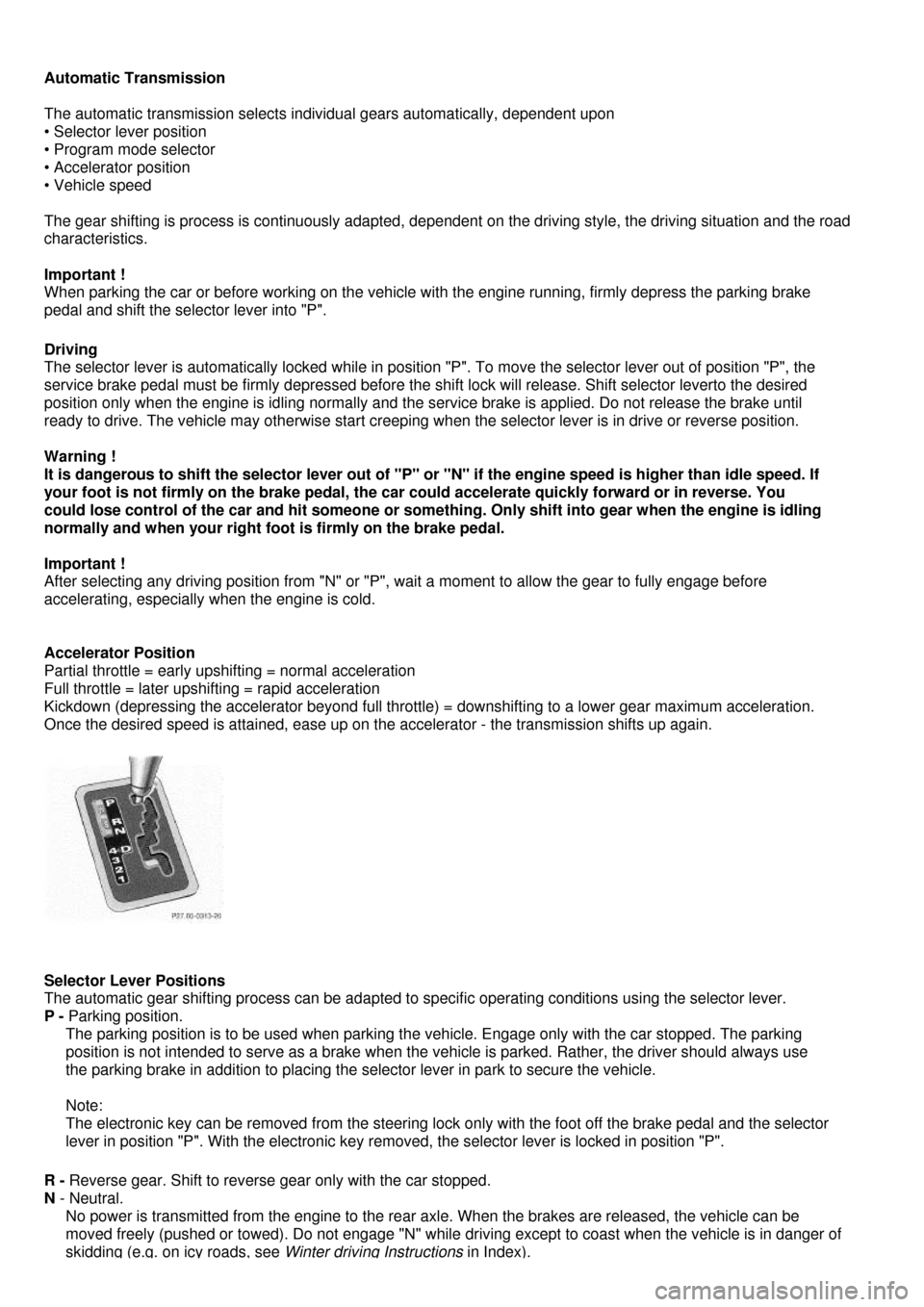
Selector Lever Positions
The automatic gear shifting process can be adapted to specific operating conditions using the selector lever.
P - Parking position.
The parking position is to be used when parking the vehicle. Engage only with the car stopped. The parking
position is not intended to serve as a brake when the vehicle is parked. Rather, the driver should always use
the parking brake in addition to placing the selector lever in park to secure the vehicle.
Note:
The electronic key can be removed from the steering lock only with the foot off the brake pedal and the selector
lever in position "P". With the electronic key removed, the selector lever is locked in position "P".
R - Reverse gear. Shift to reverse gear only with the car stopped.
N - Neutral.
No power is transmitted from the engine to the rear axle. When the brakes are released, the vehicle can be
moved freely (pushed or towed). Do not engage "N" while driving except to coast when the vehicle is in danger of
skidding (e.g. on icy roads, see Winter driving Instructions in Index).
Page 69 of 130

Important !
Coasting the vehicle, or driving for any other reason with selector lever in "N" can result in transmission damage
that is not covered by the Mercedes-Benz Limited Warranty.
D - The transmission automatically upshifts through 5th gear. Position "D" provides optimum driving characteristics
under all normal operating conditions.
4 - Upshift through 4th gear only.
Suitable for performance driving. To shift from position "D" to "4", push selector lever to the left.
3 - Upshift through 3rd gear only.
Suitable for moderately steep hill s. Since the transmission does not shift hi gher than 3rd gear, this gear selection
will allow use of the engine's braking power downhill.
2 - Upshift through 2nd gear only.
For driving in mountainous regions or under extreme operating conditions. This gear selection will allow use of the
engine's braking power when descending steep grades.
1 - In this position, the engine's braking effect is utilized by shifting into 1st gear.
Use this position while descending very steep or l engthy downgrades and only at speeds below 40 mph (60
km/h).
Important !
With selector lever in position "D", "4" or "3", upshifting from 1st to 2nd to 3rd gear is delayed depending on vehicle
speed and engine temperature. This allows the catalytic converter to heat up more quickly to operating temperatures.
During the brief warm-up period this delayed upshift and increased engine noise might be perceived as a malfunction.
However, neither the engine nor transmission are negatively affected by this mode of operation.
The delayed upshift is effective with vehicle speeds below 31 mph (50 km/h) at partial throttle and engine
temperatures below 95°F (35°C). To avoid overrevving the engi ne when the selector lever is moved to a lower driving
range, the transmission will not shift to a lower gear, if the engine's speed limit would be exceeded. In this case there
will be no downshift, even when the vehicle speed reaches t he engine's speed limit of that gear, e.g. by applying the
service brakes. Continue driving in the usual manner. The transmission will then shift down automatically.
To prevent the engine from laboring at low RPM when driv ing uphill gradients or with your vehicle heavily loaded, the
automatic transmission will downshift when necessary to maintain engine RPM within the best torque range.
Warning!
On slippery road surfaces, never downshift in order to obtain braking action. This could result in drive wheel
slip and reduced vehicle control. Your vehicle's AB S will not prevent this type of loss of control.
Warning !
On slippery road surfaces, never downshift in order to obtain braking action. This could result in rear
wheel slip and reduced vehicle control. Your vehicle' s ABS will not prevent this type of loss of control.
Maneuvering
To maneuver in tight areas, e.g. when pulling into a parki ng space, control the vehicle speed by gradually releasing
the
brakes. Accelerate gently and never abruptly step on the ac celerator. To rock a vehicle out of soft ground (mud or
snow),
alternately shift from forward to revers e, while applying slight partial throttle. Rocking a vehicle free in this manner
may
cause the ABS malfunction indicator lamp to come on. Turn off and restart the engine to clear the malfunction
indication.
Stopping
For brief stops, e.g. at traffic lights, leave the transmission in gear and hold vehicle with the service brake. For longer
stops with the engine idling, shift into "N" or "P" and hold the vehicle with the service brake. When stopping the
vehicle
on an uphill gradient, do not hold it with the accelerator, use the brake. This avoids unnecessary transmission heat
build up.
Warning !
Getting out of your vehicle with the selector lever not fully engaged in position "P" is dangerous. Also,
when parked on an incline, position "P" alone may not prevent your vehicle from moving, possibly hitting
people or objects. Always set the parking brake in a ddition to shifting to position "P". When parked on
an incline, also turn front wheel against curb.
Page 70 of 130

Program Mode Selector Switch
The transmission is provided with a selector switch for Standard "S" and Winter/Wet (snow and ice) "W" program
modes.
Important !
Always be certain of the program mode selected since the vehicle driving characteristics change with the selection of
the program mode.
S - Standard mode Press switch on symbol "S". Use this mode for all regular driving. The vehicle starts out in 1st
gear.
Accelerator Operation:
Fast on = depressing the accelerator pedal quickly (not into kickdown position) while driving continuously, rather
than depressing the accelerator pedal in the usual manner, will cause the automatic transmission to shift down
into a lower gear.
This gear shifting process is dependent on the current vehicle speed.
Fast off = there will be no upshift when releasing the accelerator pedal quickly, e.g. using the engine's braking
power during performance driving
W - Winter/Wet (snow and ice) mode Press switch on symbol "W".
The vehicle starts out in 2nd gear, except with selector lever in 1st gear, or with accelerator pedal in kick-down
position. The "W" mode helps to improve traction and driving stability of the vehicle.
The gear shifting process occurs at lower vehicle and engine speeds than in the "S,' program mode.
Important
Dependent on the program mode selector switch position "S" or "W" and the gear selector lever in position "13", the
ratio of power transmission changes.
Emergency Operation (Limp Home Mode)
If vehicle acceleration worsens, or the transmission no longer shifts, the transmission is most likely operating in Limp
Home Mode which engages when there is a malfunction at the transmission. This condition may be accompanied by
the "CHECK ENGINE" malfunction indicator lamp in the instrument cluster coming on.
In this mode only the 2nd gear or reverse gear can be activated.
To engage 2nd gear or reverse:
1. Stop the vehicle.
2. Move selector lever to position "P".
3. Turn off the engine.
4. Wait 10 seconds.
5. Restart the engine.
6. Move selector lever to position "D" (for 2nd gear), or move selector lever
to position "R" (for reverse gear).
Have the transmission checked at your authorized Mercedes-Benz dealer as soon as possible.
Page 71 of 130

Cruise Control
Cruise Control
Any given speed above approximately 25 mph (40 km/h) can be maintained with the cruise control by operating the
lever.
1. Accelerate and set:
Lift lever briefly to set speed. Hold lever up to accelerate.
2. Decelerate and set:
Depress lever briefly to set speed. Hold lever down to decelerate.
Normally the vehicle is accelerated to the desired speed with the accelerator. Speed is set by briefly pushing
the lever to position 1 or 2. The accelerator can be released. The speed can be increased (e.g. for passing)
by using the accelerator. After the accelerator is released, the previously set speed will be resumed
automatically. If a set speed is to be increased or decreased slightly, e.g. to adapt to the traffic flow, hold lever in
position 1 or 2 until the desired speed is reached, or briefly tip the lever in the appropriate direction for
increases or decreases in 0.6 mph (1 km/h) increments. When the lever is released, the newly set speed remains.
3. Cancelling
To cancel the cruise control, briefly push lever to position 3.
When you step on the brake pedal or the vehicle speed drops below approx. 25 mph (40 km/h), for example when
driving upgrade, the cruise control will be cancelled. If the cruise control cancels by itself and remains inoperative
until the engine is restarted, have the system checked at your authorized Mercedes-Benz dealer as soon as
possible.
4. Resume
If the lever is briefly pushed to position 4 when driving at a speed exceeding approx. 25 mph (40 km/h), the vehicle
resumes the speed which was set prior to the cancellation of the cruise control. The last memorized speed is
cancelled when the electronic key in the steering lock is turned to position 1 or 0.
Note:
If the engine does not brake the vehicle sufficiently while driving on a downgrade, the speed you set on the cruise
control may be exceeded. In this case the automatic transmission shifts down (max. to 3rd gear) to maintain the set
cruise control speed by using the engine's braking power. As soon as the grade eases, the automatic transmission
shifts up again dependent on the selector lever position. Nevertheless, in some cases you may have to step on the
brake pedal to slow down. In this case the cruise control is switched off. Use the lever to resume the previously set
speed.
Caution !
Moving gear selector lever to position "N" switches the cruise control off.
Warning !
Only use the cruise control if the traffic and weather conditions make it advisable to travel at a steady speed.
• The use of cruise control can be dangerous on winding roads or in heavy traffic because conditions do not
allow safe driving at a steady speed.
• The use of cruise control can be dangerous on slippery roads. Rapid changes in tire adhesion can result
in wheel spin and loss of control.
The "Resume" function should only be operated if the driver is fully aware of the previously set speed and
wishes to resume this particular preset speed.
Page 79 of 130

Brake Assist System (BAS)
Warning !
BAS cannot prevent the natural laws of physics from acting on the vehicle, nor can it increase braking
efficiency beyond that afforded by the condition of the vehicle brakes and tires or the traction afforded.
The BAS cannot prevent accidents, including those resulting from excessive speed in turns, following
another vehicle too closely, or aquaplaning. Only a safe, attentive, and skillful driver can prevent accidents.
The capabilities of a BAS equipped car must never be exploited in a reckless or dangerous manner which
could jeopardize the user's safety or the safety of others.
The Brake Assist System is designed to maximize the vehicle's braking capability during emergency braking
maneuvers by having maximum power boost applied to the br akes more quickly in emergency braking conditions
than might otherwise be afforded solely by the driver's braking style. This can help reduce braking distances over
what ordinary driving and braking style might do. The BAS complements the Antilock Brake System (ABS).
To receive the benefit of the system you must apply continuous full braking power during the stopping sequence.
Do not reduce brake pedal pressure.
Once the brake pedal is released, the BAS is deactivat ed The malfunction indicator lamps for the ASR and ESP are
combined with the BAS malfunction indicator lamp.
The BAS/ASR or BAS/ESP malfunction indicator lamp in the instrument cluster come on with the electronic key in
steering lock position 2 and should go out with the engine running.
If the BAS/ASR or BAS/ESP malfunction indicator lamp comes on permanently while the engine is running,
a malfunction has been detected in either system. As a resul t, it is possible that now only partial engine output will be
available, and pressing the accelerator pedal will require more effort. If the BAS malfunctions. The brake system
functions in the usual manner, but wi thout BAS. If the charging voltage falls be low 10 volts, the malfunction indicator
lamp comes on and the BAS is switched off. When the volt age is above this value again, the malfunction indicator
lamp should go out and the BAS is operational. With t he ABS malfunctioning, the BAS, ASR or ESP are also
switched off.
Both malfunction indicator lamps come on with the engine running. Have the BAS, ASR or ESP checked at your
authorized Mercedes-Benz dealer as soon as possible .
Page 81 of 130
Electronic Stability Program (ESP) (optional)
The ESP enhances directional control and reduces driving wheel spin of the vehicle under any driving condition.
Over/understeering of the vehicle is counteracted by applying brakes to the appropriate wheel to create a
counterpointing vehicle movement. The ESP warning lamp, located in the speedometer dial, starts to flash.
Important !
If the ESP warning lamp flashes, adapt your speed and driving to the prevailing road conditions.
Caution !
If the vehicle is towed with the front axle raised (see Towing the vehicle in Index), the engine must be shut off
(electronic key in steering lock position 0 or 1). Otherwise, the ESP will immediately be engaged and will apply
the rear wheel brakes.
Notes:
The indicator lamp for the ESP is combined with that of the BAS. The yellow BAS/ESP malfunction indicator lamp
in the instrument cluster and the yellow ESP warning lamp in the speedometer dial come on with the electronic key
in steering lock position 2. They should go out with the engine running. If the BAS/ESP multifunction indicator lamp
comes on permanently with the engine running, a malfunction has been detected in either system.
Pressing the accelerator pedal will require greater effort. Only partial engine output will be available. If the BAS
malfunctions, the brake system functions in the usual manner, but without BAS. Have the BAS or ESP checked at
your authorized Mercedes-Benz dealer as soon as possible. With the ABS malfunctioning, the ESP is also switched
off. Driving the vehicle with varied size tires will cause the wheels to rotate at different speeds, therefore the electronic
stability program may activate (yellow ESP warning lamp in speedometer dialcomes on).
For this reason, all wheels, including the spare wheel, must have the same tire size. When testing the parking brake
on a brake test dynamometer, the engine must be shut off. Otherwise, the electronic stability program will
immediately
be engaged and will apply the rear wheel brakes. In winter operation, the maximum effectiveness of the ESP is only
achieved with Mercedes-Benz recommended M+S rated radial-ply tires and/or snow chains.
Synchronizing ESP
If the power supply was interrupted(battery disconnected or empty), the BAS/ESP multifunction indicator lamp
may be illuminated with the engine running. Turn steering wheel completely to the left and then to the right. The
BAS/ESP malfunction indicator lamp should go out.
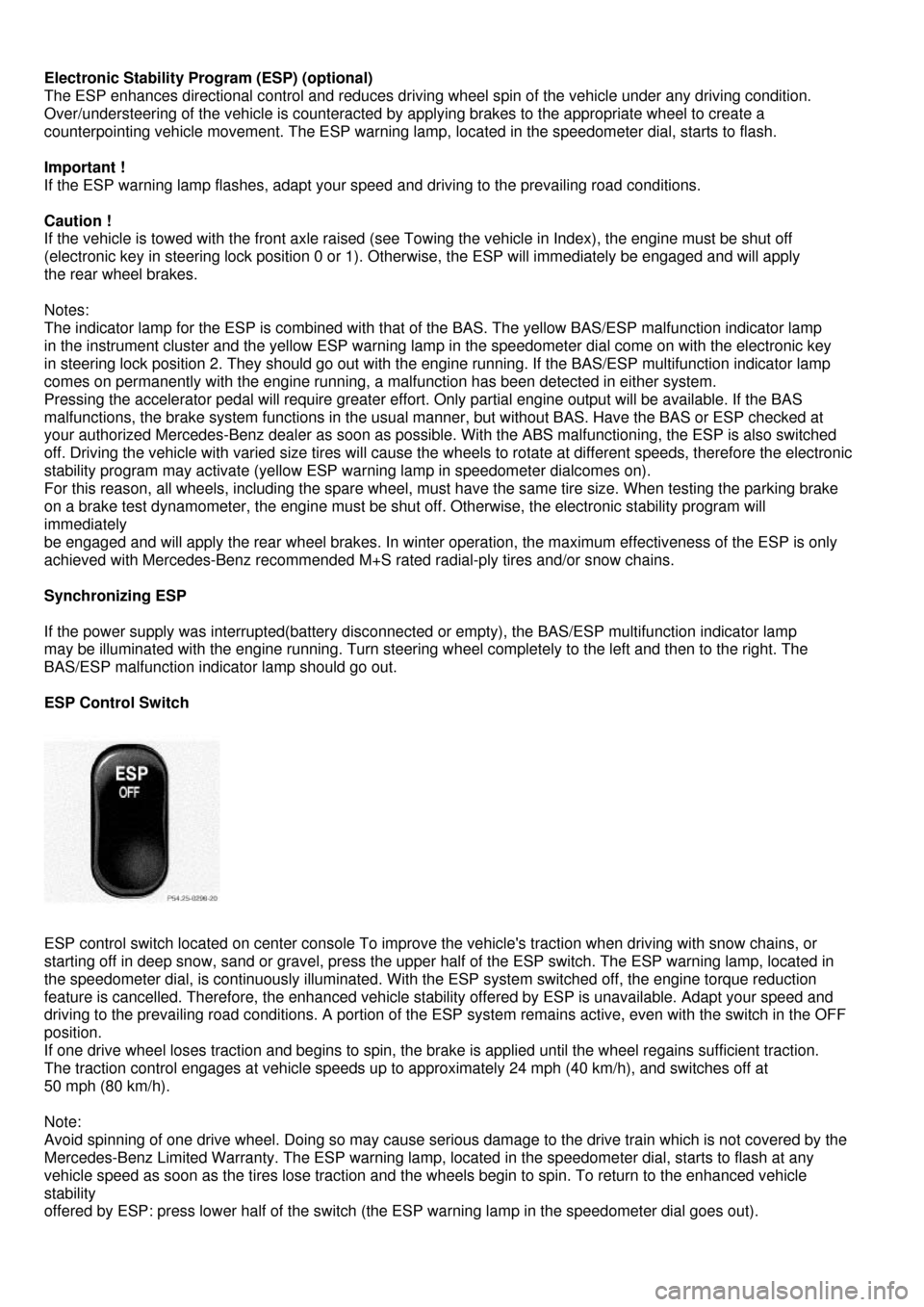
ESP Control Switch
ESP control switch located on center console To improve the vehicle's traction when driving with snow chains, or
starting off in deep snow, sand or gravel, press the upper half of the ESP switch. The ESP warning lamp, located in
the speedometer dial, is continuously illuminated. With the ESP system switched off, the engine torque reduction
feature is cancelled. Therefore, the enhanced vehicle stability offered by ESP is unavailable. Adapt your speed and
driving to the prevailing road conditions. A portion of the ESP system remains active, even with the switch in the OFF
position.
If one drive wheel loses traction and begins to spin, the brake is applied until the wheel regains sufficient traction.
The traction control engages at vehicle speeds up to approximately 24 mph (40 km/h), and switches off at
50 mph (80 km/h).
Note:
Avoid spinning of one drive wheel. Doing so may cause serious damage to the drive train which is not covered by the
Mercedes-Benz Limited Warranty. The ESP warning lamp, located in the speedometer dial, starts to flash at any
vehicle speed as soon as the tires lose traction and the wheels begin to spin. To return to the enhanced vehicle
stability
offered by ESP: press lower half of the switch (the ESP warning lamp in the speedometer dial goes out).
Page 101 of 130

Battery
Warning !
Failure to follow these instructions can result in severe injury or death. Never lean over batteries while
connecting, you might get injured. Battery fluid contains sulfuric acid. Do not allow this fluid to come in
contact with eyes, skin or clothing. In case it does, immediately flush affected area with water and seek
medical help if necessary. A battery will also produ ce hydrogen gas, which is flammable and explosive.
Keep flames or sparks away from battery, avoid im proper connection of jumper cables, smoking etc..
Important !
Battery maintenance information:
The battery is located in the trunk under the trunk floor. The fluid level must be checked at every A and B service.
Always insure that the fluid level is at the specified maximum level and that only distilled water is used. Failure to
maintain proper fluid level may result in cell deterioration and possible battery rupture. The service life of the battery is
dependent on its condition of charge. The battery should alwa ys be kept sufficiently charged, in order to last an
optimum length of time.
Therefore, we strongly recommend that you have the battery charge checked frequently, and corrected if
necessary, especially if you use the vehicle less than approximately 200 miles (300 km) per month, mostly for
short distance trips, or if it is not used for long periods of time.
Only charge a battery with a battery charger after the battery has been disconnected from the vehicle electrical circuit.
Always disconnect the battery negative lead first and connect last. When removing and connecting the battery,
always make sure that all electrical consumers are off and the electronic key is in steering lock position 0. The battery
and its vent tube must always be securely installed when the car is in operation. While the engine is running the
battery terminal clamps must not be loosened or detached, otherwise the generator and other electronic components
would be damaged.
Note:
After reconnecting the battery also resynchronize the Express feature of the power windows, the
sliding/pop-up roof, and the Electronic Stability Program (ESP) (see Power seats, front, Head
restraints, Power windows, Sliding/pop-up roof, and Electronic stability program in Index).
Battery Recycling
Batteries contain materials that can harm the environment with improper disposal. Large 12 Volt storage batteries
contain lead. Recycling of batteries is the preferred method of disposal. Many states require sellers of batteries to
accept old batteries for recycling.
Page 104 of 130
Towing the Vehicle
Warning!
Prior to towing the vehicle with all wheels on the ground, make
certain that the electronic key is in steering lock position 2.
If the electronic key is left in the steering lock position 0 for
an extended period of time, it can no longer be turned in the
lock. In this case, the steering is locked. To unlock, remove
electronic key from steering lock and reinsert.
Important !
When towing the vehicle, please, note the following:
With the automatic central locking activated and the electronic key inn steering lock position 2, the vehicle
doors lock if the left front wheel as well as the right rear wheel are turning at vehicle speeds of approx. 9 mph (15
km/h) or more. To prevent the vehicle door locks from locking, deactivate the automatic central locking.
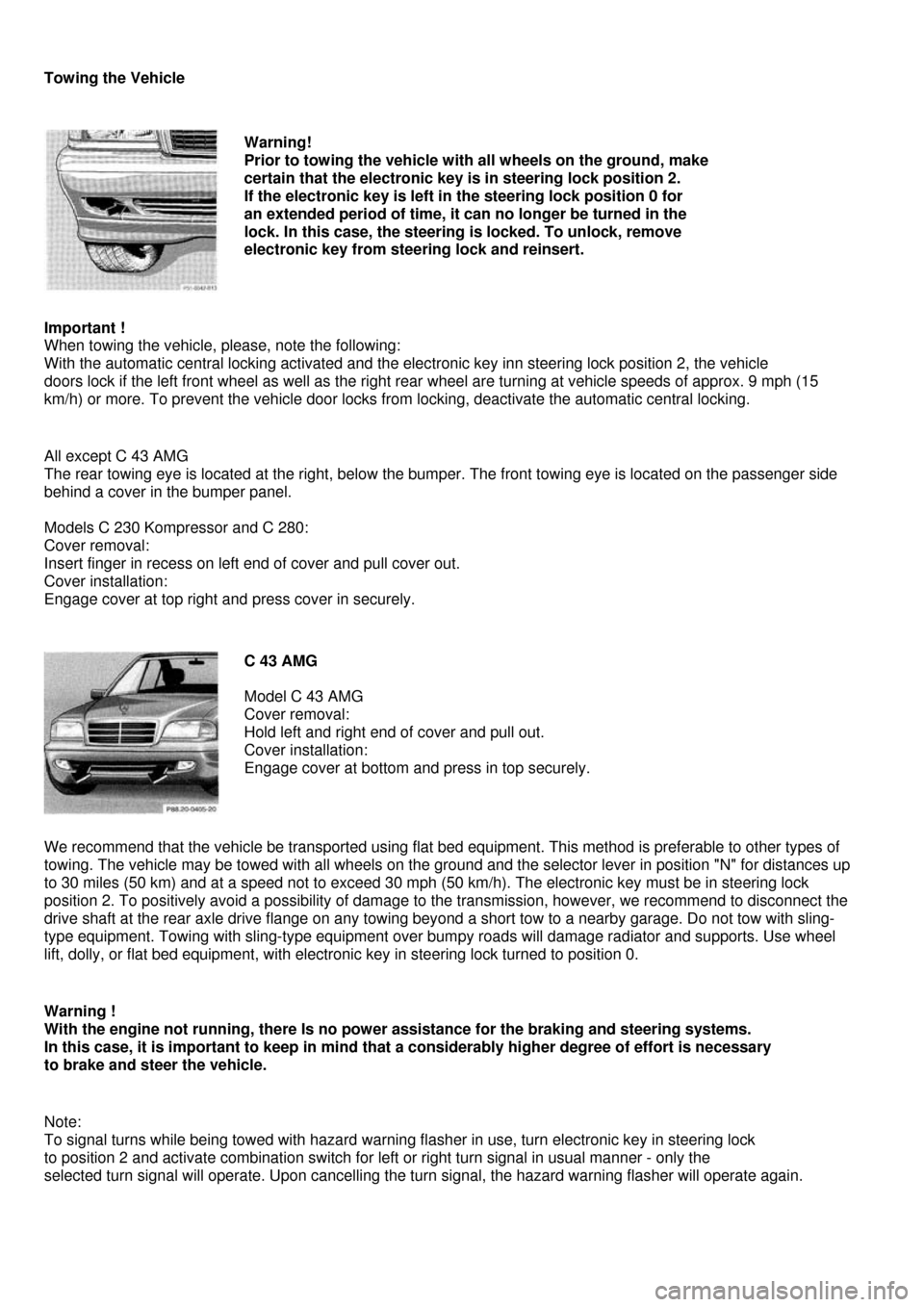
All except C 43 AMG
The rear towing eye is located at the right, below the bumper. The front towing eye is located on the passenger side
behind a cover in the bumper panel.
Models C 230 Kompressor and C 280:
Cover removal:
Insert finger in recess on left end of cover and pull cover out.
Cover installation:
Engage cover at top right and press cover in securely.
C 43 AMG
Model C 43 AMG
Cover removal:
Hold left and right end of cover and pull out.
Cover installation:
Engage cover at bottom and press in top securely.
We recommend that the vehicle be transported using flat bed equipment. This method is preferable to other types of
towing. The vehicle may be towed with all wheels on the ground and the selector lever in position "N" for distances up
to 30 miles (50 km) and at a speed not to exceed 30 mph (50 km/h). The electronic key must be in steering lock
position 2. To positively avoid a possibility of damage to the transmission, however, we recommend to disconnect the
drive shaft at the rear axle drive flange on any towing beyond a short tow to a nearby garage. Do not tow with sling-
type equipment. Towing with sling-type equipment over bumpy roads will damage radiator and supports. Use wheel
lift, dolly, or flat bed equipment, with electronic key in steering lock turned to position 0.
Warning !
With the engine not running, there Is no power assistance for the braking and steering systems.
In this case, it is important to keep in mind that a considerably higher degree of effort is necessary
to brake and steer the vehicle.
Note:
To signal turns while being towed with hazard warning flasher in use, turn electronic key in steering lock
to position 2 and activate combination switch for left or right turn signal in usual manner - only the
selected turn signal will operate. Upon cancelling the turn signal, the hazard warning flasher will operate again.
Page 110 of 130

Front Head Restraints
Warning !
For your protection, drive only with properly positioned head restraints. Adjust head restraint to support the
back of the head approximately at ear level. Do not drive the vehicle without the seat head restraints.
Head restraints are intended to help reduce injuries during an accident.
For positioning of head restraints refer to sections Manual Seats, Power Seats, and Head Restraints, Rear in Index.
Power seats
Removal:
Push button (1) up to bring the head restraint to its highest position. Pull out head restraint completely with both
hands. Installation: Push button (1) up for approximately 5 seconds. Insert head restraint and push it down to the
stop. Adjust
head restraint, see Index.
Manual seat
Removal:
Pull head restraint up to the stop. Push button (1) and pull head restraint out. Installation: Insert the head restraint and
push it down to the stop. Adjust head restraint, see Index.
Page 114 of 130

Layout of Poly-V-belt Drive
The engine is equipped with two poly-V-belts.
For dimensions of the poly-V-belts, see Technical Data in Index.
C 230 Kompressor
Routing, Belt I
1. Crankshaft
2. Air conditioner compressor
3. Power steering pump
4. Coolant pump
5. Idler pulley
C 230 Kompressor
Routing, Belt II
6. Generator (alternator)
7. Idler pulley
8. Idler pulley
9. Supercharger
C 230 Kompressor
Routings combined, Belts I and II